


Once, someone said about my Guru Yoga Swami: “You have to become a fool to appear before this man. He will speak to you like a divine madman. However, if you come to him in your ordinary state of consciousness, he will say: ‘I am just like you; go away. I have nothing to say. Nothing comes from within. Go away.’”
The Nature of the Satguru’s Darshan
To be in the presence of a Satguru, you need to be an intellectual fool. If you hear ordinary things from a Satguru, look more closely at yourself. He is like a mirror in which you see your own reflection. Until ordinary people come to him to make use of his knowledge, he merely wastes his time on you. Most Gurus delight in the richness of their inner life, which is so full and fascinating that this alone occupies them.
In Sri Lanka and India, the darshan of a Satguru is judged by the inner sensations that remain after leaving the Guru, rather than by the feelings experienced in his presence. This is because, in the presence of an intelligent visitor, the Guru may remain in a state of emotional disappointment. Thus, only after a person leaves and experiences what it was like to be in the Guru’s presence is the depth of the darshan assessed. The Guru’s darshan draws a state of bliss from your own depths, just as liquid comes out of a siphon.
The Mechanism of Darshan Transmission
The Guru works with darshan in two ways. The first is when darshan flows naturally from the Guru. This is the outflow of darshan. The other is directing the flow inward through external effort—the inflow of darshan. The Guru’s darshan raises energy from the inner depths of his disciples. At the same time, his natural darshan is also present. Each Satguru has his own darshan, corresponding to his spiritual development and training. The Guru’s darshan changes depending on what he is working on at a given time. Basically, the power of darshan comes directly from the soul. But as it passes through various unrevealed channels, like light through a prism, it can lead to the manifestation of many powers.
What does the penetration of darshan depend on? It depends on how capable the disciple is of receiving it while in the proper state of mind. Sometimes, if the right attitude is absent at the subtle levels of consciousness, it is difficult to perceive darshan. It is as if certain settings have not been configured: you try to establish a connection, but the connection cannot be made; the settings need to be changed. These settings are connected with the disciple’s subtle ego. Perhaps doubts have not been eliminated at the level of the disciple’s subtle ego. Perhaps, at the level of the disciple’s will or mental faculties, the seed of pure vision, devotion, and trust has not been planted. All these settings have a common name—samaya. When this attunement has been created, darshan flows entirely naturally.
The darshan of some Gurus is gentle and loving; that of others is fiery and powerful. Some Gurus possess such depth of darshan that it is very difficult to perceive, so unattached is their consciousness to the external world. The Satguru controls the energetic vibration of the disciple’s soul and can provide the necessary help and support at that moment.
But only if the disciple is sufficiently receptive, if they are in a state of openness and cooperation. If the disciple takes a mental position, an egoistic position, clings to their formed experience, or simply has not developed the capacity for clarity, such subtle contact does not occur.
The Concealment of Darshan and the Disciple’s Readiness
Sometimes the teacher does not give darshan, concealing it because they consider the disciple not yet ready, believing that intellectual understanding and verbal advice are sufficient for now, knowing that authentic darshan can completely disorient them, throw them into confusion and delusion, make them feel lost, frightened, bewildered, and paralyzed to the very core by the reality the Guru embodies. The Guru then does not hurry to reveal the power of his darshan; he simply waits patiently until the necessary qualities have developed.
There is no point in the unprepared asking about authentic darshan, because this darshan may leave “not one stone standing” of the disciple’s ego and all their notions. If the practice of self-surrender and awareness has not been developed, if clinging and attachments have not been cut off, such darshan will not fall on fertile ground and will not bring benefit. Therefore, one sometimes has to mature for years before being ready for authentic darshan.
Sometimes the teacher is unsure of the disciple’s strength of endurance and also conceals the power of his darshan, simply wishing to give the disciple some time to develop certain qualities or merely to test himself. A powerful darshan or powerful shaktipat can awaken hidden subtle karmas in the stream of the disciple’s mind, and these hidden subtle karmas may confuse him or even lead him away from the spiritual path. We have no idea how much exists within our subtle body, and what is revealed may seem completely unexpected. Great faith, inner strength, and purity are needed in order to perceive this naturally.

The Story of Narada’s Pride
Even Narada once fell into pride. Narada was meditating while performing tapas. Indra, fearing the power of his tapas, sent Kamadeva, Cupid, to strike him with flower arrows and awaken desires and sensual pleasures in his heart. Kamadeva began shooting arrows into his heart, and beautiful dancing girls appeared. When Narada came to his senses, he became angry with Kamadeva and sternly rebuked him, telling him to stop doing this and saying that Indra need not worry about his throne, as he was not claiming Indra’s throne. Frightened, Kamadeva apologized and disappeared. Indra then also apologized for interfering with Narada’s performance of tapas.
A thought flashed through Narada’s mind: “I managed to defeat Kamadeva; even Shiva was unable to defeat him.” Pleased and radiant, he set off for Kailasa and said, rather provocatively: “Lord Shiva, what I am about to tell you may not please you. I defeated Kamadeva.” Shiva replied: “That is all right. But what I am about to tell you may not please you either, so do not take offense. If you tell Vishnu this, he may not like it either, so it would be better not to tell him.” Narada did not understand what the matter was, and when he went to Vishnu in Vaikuntha-loka, he told him about this conversation and, as if in passing, let slip in front of Lakshmi and Vishnu: “Cupid Kamadeva came recently, and I defeated him. Even Shiva could not do it. I think that I am now completely free from all desires, highly detached and unattached.” Vishnu smiled skeptically: “Yes, Narada, you are very great.”
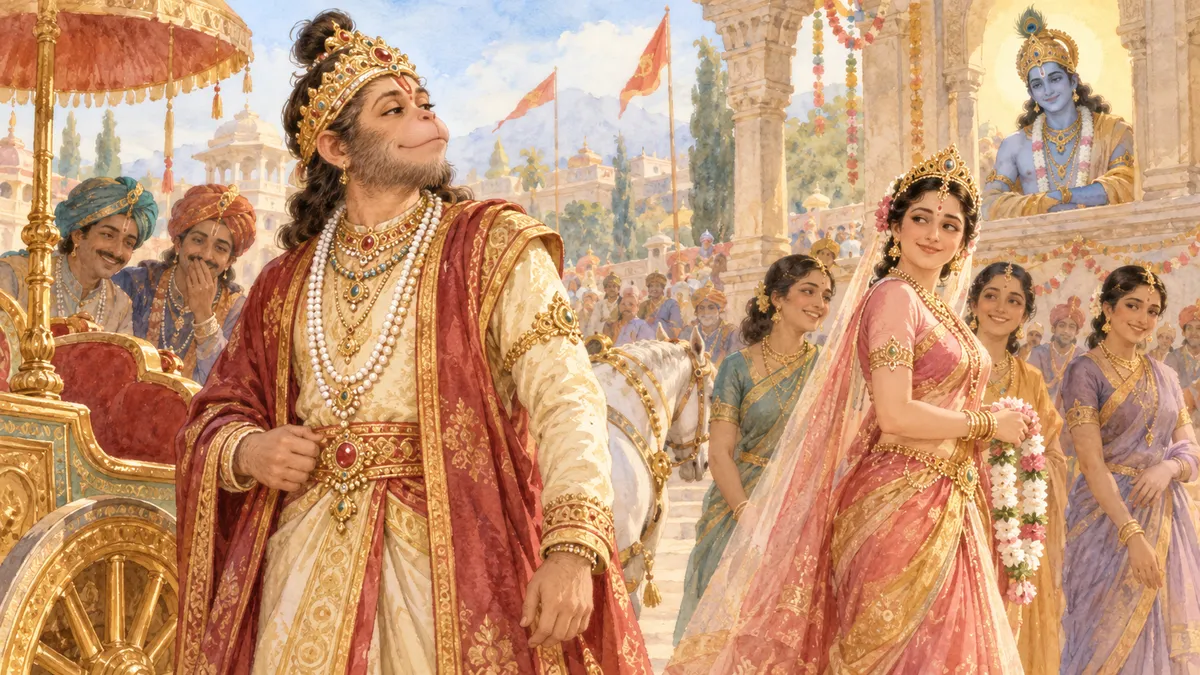
Then he arranged for Narada to arrive in one of the cities where a ceremony was being held in which the king’s daughter, Vishvamohini, would choose a bridegroom (swayamvara). Vishvamohini means “all-pervading enchantment.” As soon as Narada saw Vishvamohini, he immediately developed a desire to marry her. Without thinking, he began making plans for how to accomplish this, so powerfully had she influenced his mind. He went to Vishnu and said that his clothes were very plain and asked how he could appear at the swayamvara dressed as an ascetic in such attire. Could Lord Vishnu give him more attractive clothes? Smiling mysteriously, Vishnu said: “Yes, you will receive fine clothes from me.” In an instant, royal garments appeared on him, and he set off in royal attire on a chariot to the swayamvara.
But at the same time, the face of Hanuman appeared before him, and everyone began looking at one another, saying: “Even the monkey king has come to visit us,” while Narada did not suspect anything. And when Vishvamohini was choosing a bridegroom, she kept giggling and walking past him, while Narada changed his position using siddha-yoga and appeared in different places. He wondered why everyone was laughing at him until Vishnu himself appeared and Vishvamohini entered his body. Vishnu had simply taught Narada a lesson and laughed at him. All of this was his illusion, which revealed his tendency to become deluded and the foolish pride he had been boasting about.
When Lakshmi watched from the heavenly realm as Narada, in the form of Hanuman and with Hanuman’s face, stood at the swayamvara in royal garments without realizing it, she burst out laughing at him.
The Merging of Guru-darshan and Atma-darshan
Above all, the Guru seeks for the disciple to experience the bliss of his own soul. The Guru’s darshan will facilitate precisely this process if the disciple’s intellect and emotions do not obstruct this type of practice. If you have seen the inner light during meditation and lead a disciplined life, you will attain sufficient sensitivity in your spiritual development to experience and distinguish the darshan of your Satguru. Soon your awareness will shift to the bliss of your own superconscious darshan. These two darshans—yours and that of your Satguru—merge together, which can direct the awareness of someone who is only beginning the practice of meditation.
Guru-darshan and inner Atma-darshan merge through correct practice. If the practice is incorrect, then usually either one darshan dominates, or neither does at all. Suppose one Guru-darshan dominates. The disciple has an experience in the Guru’s presence, but their own inner experiences do not remain within, quickly dissipate, are not nurtured or allowed to grow, and Atma-darshan remains closed for now. Or the disciple receives a certain inner experience as Atma-darshan, a form of inner light, but due to some inconsistencies in the mind does not receive Guru-darshan. This may be due to an impure perception on a subtle, unconscious level, or perhaps due to insufficient faith, openness, samaya, or fear of openness. But usually these two darshans balance each other.
It is believed that the Guru is a projection of the Ishta-devata: if your Ishta-devata is Shiva, then the Guru is a projection of Shiva, and if, as in our case, the Ishta-devata is Dattatreya, then of Dattatreya. Relations with the Guru and relations with Dattatreya are approximately one and the same. Therefore, in order to receive Guru-darshan, one must establish such a relationship with the Ishta-devata and with the Guru as the illusory body of the Ishta-devata.
Recognizing True Realization
A person may say, “I have attained realization of the Atman.” How can one know whether this is true or not? Philosophy cannot provide the answer. Philosophy has correct answers to all questions; however, this is not living knowledge, it is merely recorded knowledge. Look at the aura. It will tell you a great deal. Once you have received such knowledge, strive toward it again and again—the channel is open.
A wise Guru will simply observe and feel the darshan of their disciple. If the disciple has realized the Atman, this is wonderful. Their darshan will become stronger with every month and year. However, if the feeling emanating from their inner depths takes on a negative quality just a few weeks after Enlightenment, it becomes obvious that the disciple has undoubtedly gained a wonderful inner experience, but has not yet traveled the entire path to its source.

The darshan of an adept in the state of Sat-Chit-Ananda differs from their ordinary darshan. It is extraordinarily intense, and this gives everyone present a sensation of a ringing sound in the mind. During this sacred time, no one even wants to move, so full are they. During such darshan, the physical body does not move and breathing is barely noticeable. This is how you feel in the presence of a sage when they immerse themselves in Sat-Chit-Ananda, in Parashiva, and when they emerge from the inner depths.
The Properties of Darshan and the Conditions for Perceiving It
These are different types of darshan, each of which has a beneficial effect on you. The vibration of darshan knows neither time nor place. You experience darshan when the Satguru is near you. You can also experience their darshan when they are far away from you. Sometimes the power of darshan increases. Regard darshan as a connection, like a telephone line that always allows you to pick up the receiver and talk to someone at the other end of the line.
Subconscious problems rise to the surface of consciousness only when the disciple does not feel the Guru’s darshan.
You must understand this. Subconscious problems arise when the disciple does not feel the Guru’s darshan. If the disciple feels the Guru’s darshan sufficiently, subconscious problems self-liberate at the very moment they arise. Subconscious problems, karmas, and kleshas arise, but the Guru’s darshan is present. It is like throwing a piece of paper into a mountain stream: the paper will simply be swept away by the mountain stream, while the mountain stream continues along its course.
In order to be capable of receiving Guru-darshan, several things must be overcome: the tendency toward distraction, subconscious egotism, the sense of separateness, and the fear of merging with the Supreme Source that flows from the ego. When these three tendencies have been overcome, you remain in a state of darshan all the time.

Obstacles to Perceiving Darshan
A certain person whom I stayed with several years ago considered himself a practitioner of the Teachings and my disciple, but in fact he was neither. His task was to tell me how great, experienced, wise, and knowledgeable he was. Whenever I tried to say something, he would find a thousand ways to demonstrate his knowledge; he believed that by doing so he was realizing the truth. So I stepped aside and stopped making any attempts to talk to him. But he still wanted something from me. I said: “No, I would rather remain silent. I can see that you do not have quite the kind of interest that, in my view, a disciple should have. Therefore, there is no point, and for now I do not intend to talk to you.”
Then he pleaded: “Well, at least give me something in silence.” I said: “I have already lost hope of getting through to you mentally, of reaching your soul and conveying something to you. You have many guards there, many self-appointed kings; there is no point—your soul is not opening to me.” A teacher can enter a disciple’s soul and hand him a precious casket only if all these guards have opened the door. He said: “Well, perhaps it will work in silence?” I began to meditate, and he sat down beside me. After about twenty minutes I came out, while he sat there all night, and in the morning he said: “Everything I said yesterday was an illusion. I realized how mistaken I was; everything is not as I thought. Everything you said is correct.”
Sometimes the superficial conceptual mind of an immature disciple desperately clings to itself. I am not speaking this way about mature disciples. He believes that this mind is who he is, and that if he steps aside, he will lose control, lose himself, and lose his personality. But in reality, this clinging is well known; it is precisely what obstructs, and the clinging of this mind must be overcome. Then true darshan reveals itself.
Sometimes the ordinariness of perception obstructs a disciple. The disciple prepares himself in advance, setting himself up. He thinks: “I will receive darshan if I see descending angels and divine light. If the sounds of music spread all around and sublime bhavas flow, then that will be true darshan, and everything around will begin to shine.” But in reality, this too is a form of illusory mental projections. True darshan may flow unnoticed, but if it enters, it changes the disciple’s soul forever.
One teacher transmitted the darshan of the natural state to a disciple in this way. They were lying there at night, and dogs were barking. The teacher asked: “Do you hear the dogs barking in the monastery?” “Yes.” “Do you see the sky before you?” “Yes.” “Good, everything is fine.” But at that moment his mind opened completely, just as he had sought and awaited this for twenty years.

Devotion to Your Satguru
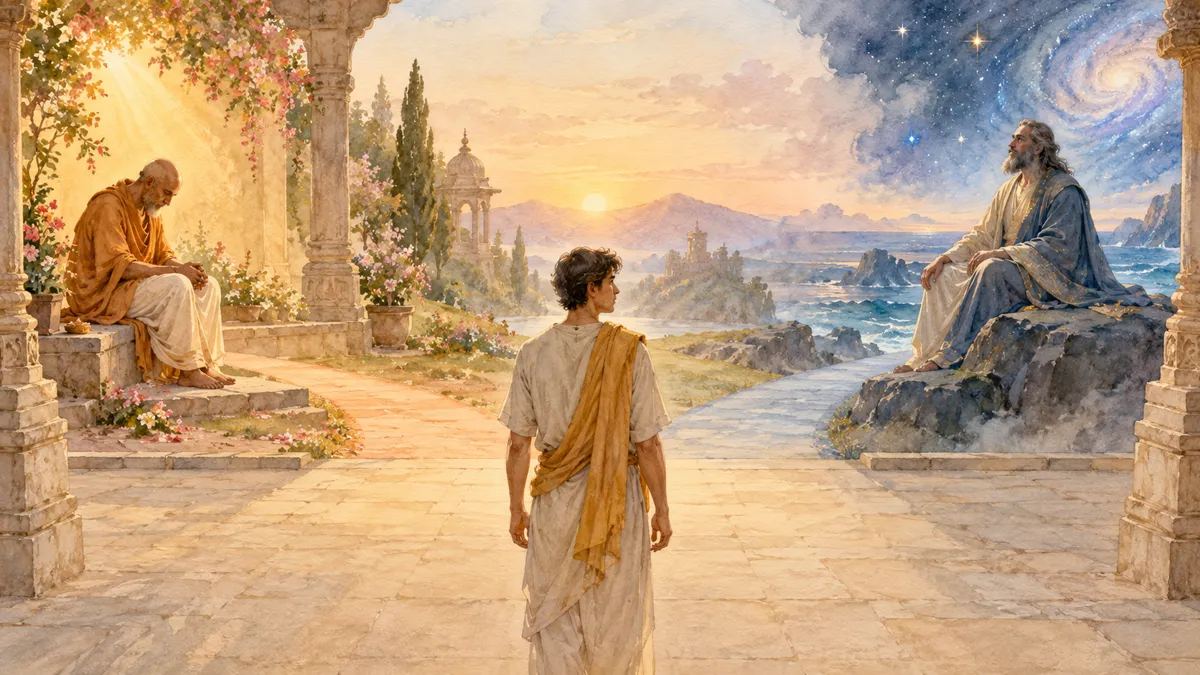
If you have a Satguru, you should not seek the darshan of another Guru until you have received permission to do so from your Satguru. Why? Because you should not enter into a psychic connection with another Guru. Darshan contributes to the development of inner psychic bonds. Nor does another Guru seek to influence your spiritual unfolding.
There is an etiquette among spiritual teachers. If someone is a spiritual teacher, but a disciple of another spiritual teacher comes to him, then this spiritual teacher will first inquire whether he has permission from his spiritual teacher and why, having his own spiritual teacher, he has come to him. This is because the Guru’s darshan and the disciple’s growth are connected with the transmission of a certain bhava, a certain vision, which must mature over the years.
For example, if one spiritual teacher teaches the path of devotion and says: “You are insignificant; God is everything; surrender to God. Understand that the ego is insignificant, that your mind is foolish, and love Him in a state of exaltation.” But another Guru transmits the bhava of divine pride and says: “All the stars and oceans are within you. Cultivate the notion that you are a king.” How should a disciple act if he goes to one Guru and then to another? These are incompatible rasas. Rasas, like flavors in food, must be compatible; only then can they be nurtured.
If one Guru teaches integration and opening, while the second teaches withdrawal and detachment, these too are incompatible rasas. In this case, the disciple makes a mistake himself and disrupts the process of darshan’s maturation if it has already been received. The problem is that many do not believe in the darshan they initially received or fail to retain it. I am not referring to those who are close to me. This is usually characteristic of those who are far away. They lack the inner shakti to stabilize this experience and work with it.
Special Cases of Receiving Darshan
However, if a disciple has received permission to receive darshan from another Guru, this means that there is a special inner agreement between the two Gurus, implying that no new psychic connection will arise and that, as a result of such darshan, the disciple will not deviate from their sadhana.
On their spiritual path, a person should not wander among teachers and lecturers, gathering a great deal of information about the path and the occultism associated with it.
This is beneficial and necessary at the “bee” stage. But once this stage has been passed, it is inappropriate, since it is like a bee buzzing around a jar of honey instead of drinking that very honey. It only gets in the way. Until the “bee” stage is complete, a disciple really should taste many kinds of honey from different jars, but once they have chosen their honey and decided to nourish themselves seriously, they must settle on that honey and drink it.
As a result, one can develop a psychic attachment to the disciples of various teachers. Sometimes, even to the teachers themselves. Teachers do not like such wandering, nor do they like the search for a new Guru, since this weakens their disciples and hinders natural spiritual unfoldment. Moreover, it is a waste of the Gurus’ and Swamis’ own energy and time.
Teachers’ Attitude Toward Disciples Who Change Teachers
If someone comes to a spiritual teacher, and the teacher knows that this person was another teacher’s disciple and left them, such a Guru will look at them with some suspicion, because if a disciple left one Guru and came to another, that already says something. Perhaps they lack sufficient faith and strength to follow, and perhaps it will not be possible for them to follow this Guru either. In this case, the teacher either keeps the disciple at a distance or tests them until becoming convinced of the depth of the disciple’s intention. In other words, a spiritual connection with a spiritual teacher is not something lightweight; it is not something that can simply be taken and changed easily. It does not limit you, but it presupposes a certain style of relationship and conduct.
A person should approach spiritual unfoldment in the same way as they approach the study of the arts. If you were studying the veena under the guidance of a good teacher, they would not like you to secretly go to three or four other teachers. They would require you to attend their classes regularly and work diligently between lessons. As a result of such training, you would be so satisfied with the results of unfolding your talents that you would not want to attend other teachers’ lessons or check what they teach. You would not be interested in other disciples. Disciples move from teacher to teacher only when they do not obey their teacher.

Remember, disciples move from one teacher to another in only one case—when they do not obey their own teacher. This is the only reason. There are no other reasons, because any teacher, if followed and if their instructions are heeded, inevitably leads the disciple to a state of realization. This happens only when the disciple lacks faith, patience, perseverance, and devotion; when the projections of their ego do not correspond to the Guru’s image and style of presenting the teaching; when their karmas are heavy, create difficulties, and they lack the determination to continue dealing with them for years.
The Procedure for Bringing Back Disciples Who Have Left
Wise Gurus or Swamis who take their mission seriously and understand the essence of human nature make the process of returning a disciple who has left the brotherhood very difficult. First of all, they require a detailed written explanation of the reasons for leaving, as well as a full written repentance and an account of what happened during that time. Then everything set down on paper is verified using additional information and during personal conversations. Then, in order to test his sincerity, before accepting him back into their ranks, they impose a punishment (penance) on him. Upon hearing of such a procedure, most will leave without saying a word and will look for less demanding Gurus, thereby revealing their insincerity. Such methods, having proven their effectiveness, protect against the infiltration of slanderers and against the further destruction of the group from within. From within, such people can act more effectively than from outside. If, after undergoing the trial of prayashchitta, such a person is again allowed to enter the group, he must begin by studying at the initial level, and he is granted no special privileges or respect for his previous merits.
In other words, the principle is: there are no past merits.
The protection of the brotherhood is very important and is aimed at the good of every disciple, as well as at the continuation of the spiritual unfolding of the Gurus and Swamis themselves. We should not be so naive and simple-minded as to think that former members of the brotherhood will not seek new ways to enter the brotherhood again and destroy it. Such people may be entrusted with a special mission aimed at destroying the group from within. In our century, this has often happened with various Swamis and Gurus. What is being said here is that in the twentieth century, in the Kali Yuga, numerous violations of samaya took place because people’s minds, their will, and their spirit are weak, and because major difficulties arise when the teaching is transmitted to the West, outside the context of spiritual culture. These difficulties are specifically connected with the principle of samaya.

Difficulties in Transmitting the Teaching in the Kali Yuga
Such difficulties arose repeatedly when certain Gurus preached in the West, in the United States of America. When the teaching is transmitted to the West, it is as if a plant were transplanted from one place to another. If a person is brought up in traditional Indian society, where spiritual culture, reverence for the deities, sadhus, saints, and the Guru are instilled in him from an early age; where the family Guru guides a particular family, gotra, or clan; where the way of life prescribed by varnashrama-dharma encourages one to progress through the various stages toward sannyasa over the course of one’s life; where humility and respect for the sacred texts are cultivated—then outside the context of Vedic ethics and culture, when dharma is transmitted in its pure vision, it is not easy for beginners to preserve samaya, pure vision, and humility.
This raises the question of taking the ethics of practitioners very seriously. The ethics of practitioners are not merely a set of rules that make communication easier; they are the context in which dharma must be transmitted and practiced. Until we have become deeply established in a unified state of awareness and realized very profound Guru Yoga and pure vision, ethics must accompany us from morning until evening. We must always consider how to build our relationships with the spiritual teacher, how to relate to the teaching, and how to interact with senior monks; how we should act, speak, and think in any given situation. We must not act, speak, or think according to our own whims. Even in our thoughts. We must always act, speak, and think precisely in accordance with ethics. For if we forget the ethical aspect of dharma, we hand our body, speech, and mind over to our karma: prarabdha karma, sanchita karma, and the rest.
The Danger of Pseudo-Spontaneity
Many, especially those on the path of Anuttara Tantra, think as follows: “Ethics is a convention, it is duality. Naked awareness is beyond boundaries and has no limitations, so I will be spontaneous.” But the spontaneity of awareness presupposes a very deep spiritual purity, whereas pseudo-spontaneity merely exposes the kleshas and does nothing to oppose them; it only intensifies pride and selfishness. Such a person thinks that they are growing, but in fact anarthas, the seeds of undesirable karma, are being deeply planted in their heart. However, due to a lack of viveka, a person does not fully see the processes taking place in their subtle body. They think they are spontaneously meditating, while a large demon stands to their right and another large demon stands to their left. These demons wait until the trial of Yama, when they will come forward and assert their claims over them. Anger on the right, pride or envy on the left—nurtured through such spontaneous treatment of the kleshas—and sooner or later they present the bill as karmic creditors.
But if ethics is observed and very deep control is exercised over both thoughts and actions, then one deity is on the right, another deity is on the left, and a third deity is above; these deities bless the yogin. Then they have no obstacles, and their natural state increases.
Four Types of Guru on the Spiritual Path
Traditionally, it is believed that there are three types of Guru who guide the soul. First and foremost, these are the parents. The next is the family Guru, or the Guru chosen by the children. The third Guru is often the most courteous and attractive, but in fact the most demanding. This is Vishvaguruji Mahamaharaj. He always acts in various ways in accordance with his name, since Vishva means everything and encompasses everything in the world.
Vishvaguruji Mahamaharaj is, in fact, this entire world. According to another classification, it is generally considered that every living soul, regardless of whether it engages in spiritual training or not, has several Gurus. The first is called bandha-guru, or klesha. This means the limitations and suffering that exist in samsara. This is the Guru called samsara, who teaches through his methods—for example, gives wealth and takes it away, generates attachment and then destroys it, or gives old age, illness, death, suffering, and so on. All of this is the Guru samsara. There is another Guru, Vishvaguru—this entire diverse world that we encounter. This includes, for example, a schoolteacher, a coach in a sports club, a music teacher at a music school, a traffic inspector who stops a driver and issues a fine, a superior at work, a mother, a grandmother, an older brother, and various beings whom we have encountered and who give us a particular darshan or lesson.

The first two Gurus are considered Gurus from the samsaric dimension; they reside in the mandala of the impure dimension. Their lessons are sometimes very harsh or even cruel, since they act without rules, entirely without rules. Sometimes such a Guru may be an army commander or a senior sergeant. This too is a form. But this is a Guru acting from the impure dimension. They act as conduits for deities who may not be interested in your spiritual growth. What are they interested in? They are interested only in giving you a mirror of your karma and confronting you, under various circumstances, with prarabdha and with accumulated karma.
It is believed that the lessons of these first two Gurus should be completed as quickly as possible. The next is the Satguru, the spiritual teacher who leads to Enlightenment, whom you accept in a physical body, and who teaches dharma, the path of Liberation and Enlightenment.
Finally, the fourth type of Guru is the Atmaguru. The Atmaguru is your inner “Self,” your inner light, which teaches you the complete realization of nonduality within your consciousness. These are the four teachers that every living soul has.
The Lessons of Vishvaguru Maharaj
As a rule, lower beings, such as animals, have only the first Guru, Bandhikaguru. That is, he comes to them in the form of the desire for food, the desire for sex, fear for their lives, and suffering. The Guru comes to human beings in two forms: as Bandhikaguru and as the worldly Guru, Vishvaguruji Mahamahāraj. He gives them entertainment, sexual partners, fame, family, a position at work, trials, military service, school, all worldly pleasures and joys. Through these lessons, a person must somehow attain darshan. Since they are not interested in spiritual enlightenment and are simply interested in flawlessly expressing karma in accordance with circumstances, a living soul does not necessarily awaken in this lifetime; it moves on to the next round. That is, Vishvaguru Maharaj can give an enlightening darshan only if this soul is very experienced, if it has learned to recognize his darshans and not become enchanted by them.
Vishvaguruji, as I call him, teaches patiently and at the same time accepts no excuses, forgives nothing, and always remains demanding. Everyone living on the planet has a Guru, whether they know it or not. When the world becomes the teacher, the lessons may be harsh or seductive, repellent or inspiring love, unpleasant or filled with the temptation of temporary happiness. The world is merciless in its trials and in the rewards it offers. It maims and heals. The merciless Vishvaguruji works secretly through the people you meet as the karmas of your past life unfold in this one. He never gives direct advice or instruction, but acts so that the lessons of each experience are revealed—or never revealed. Learning from one’s mistakes is his sutra.
Vishvaguru Maharaj does not give lectures, and if he does, they are not about Liberation. His principle is to learn from one’s mistakes. He believes that only after receiving a serious imprint as a result of a mistake is a living soul capable of reconsidering its actions and deeds.
His teaching style is through unexpected incidents and events that occur at the wrong time, although from Vishvaguruji’s perspective they happen at the right time. Unnecessary karmas are created while old ones, which should depart, patiently await your next birth. Pleasure and pain are his effective methods. Vishvaguruji is the teacher of all those who have turned their backs on their parents, elders, teachers, Gurus and Swamis, and traditions. Therefore, it is not surprising that some people, having once left their loving Guru or Swami, want to return and undergo the vratyastoma rite, despite all the difficulties of such a return.
The point is that it is impossible to hide anywhere from Vishvaguru, impossible to escape his darshans anywhere. Wherever a person goes, their karma will go with them. A person may climb to the summit of the Himalayas or to the most remote island, and karma will say: “Oh, I’ve been waiting for you here for a long time. Let’s begin.” A person may even fly to Mars or descend into the Mariana Trench, but there too their ego and karmas will meet them and say: “What took you so long? We’ve been waiting.” People do not understand that they are conditioned; there is nowhere for them to escape the material world—even by flying into space, they will still be in this material world and will still receive lessons. The learning process cannot be rejected; it is not within our power. This learning process can be made wise, gentle, and harmonious, for example, as in monastic life. It can be made harsh, immature, and suffering-producing, as in worldly life. Or it can be made pleasant and pleasure-giving, but in return demanding your life force, taking away your intellect and prana, exhausting or conditioning you. In samsara there is a great deal of choice. But the one thing about which there is no choice is that you cannot refuse the lessons; you cannot refuse the learning process in samsara.
Anava-marga and jnana-marga
Those who follow anava-marga, the path of the external ego, often claim that they are their own Guru. Some nontraditional teachers even approve of this. However, this is incorrect. According to tradition, a person may be their own Guru if they have received the appropriate initiation and their Guru has left the physical body. Nevertheless, even in this case, they remain connected to the lineage of succession in the corresponding direction of Sanatana Dharma to which they have devoted their life, and will always maintain a connection with their Gurudji in the realm of the inner world. Therefore, they will still never be their own Guru. Being one’s own Guru is an integral part of anava-marga, a very important part of it. It is immature, eccentric egotism. At school, a teenager cannot be their own teacher. A doctor does not become their own professor and obtain a medical license signed by themselves. The same applies to a lawyer, an engineer, and even a flight attendant. Thus, logic tells us that it is impossible to attain perfection, or acquire the necessary skill and knowledge, by following this path. Well, we find it interesting to follow this path, don’t we? However, these are all quite serious matters. Think about it.

Speaking about learning and responsibility, we say that there are two main margas, or stages: anava-marga and jnana-marga. Those who follow the path of jnana-marga know that they need someone who has already achieved what they wish to achieve, who can look ahead and guide them. This is the traditional path of Hindu dharma leading to self-realization. Those who follow the path of the external ego have met many teachers and discovered that none of them meet their standards. They are devoted to Sri Sri Sri Vishwaguruji Mahamaharaдж, and they are members of the bhoga-bhumi-ashram (the ashram of pleasures).
The bhoga-bhumi-ashram is an ashram of pleasures existing on Earth—the entire samsara—where one can satisfy worldly desires.
The Structure of the Bhoga-Bhumi-Ashram
Their regular, daily sadhana stimulates desires for sex and money, food and clothing. Unlike other ashrams, there are no explicit boundaries or clearly defined guidelines here. Followers are free to do whatever they wish. All classes are open to everyone, from the most elevated to the most limited, low, and vulgar.
Students in the senior classes of the lower level know well how to deceive and destroy their enemies while remaining unnoticed, how to access pornography on the internet—one of the ashram’s main tools—and then participate in the pleasures it recommends. There are courses on effectively beating children and cruelly mistreating one’s wife or husband in order to maximize chaos in the home. The learning process includes lessons on advancing up the career ladder. Here you will be taught how to save face when you are justly accused and how to deal with your abuser by accusing them of providing incorrect information and making them out to be a liar. An entire department is devoted to the art of indulging one’s desires and weaknesses. Technological perfection ensures an endless supply of novelty. There is a class on learning about crime, punishment, and terrorism. Students are taught the roles of the terrorized, revenge, retribution, and the search for forgiveness. Vishwaguruji has many professional assistant teachers around the world, in every city and community, in every country. In fact, every corner of our beloved planet is constantly participating in his training program.
Subjects of Study in the Ashram of Pleasures
Intermediate-level subjects include politics and learning how to lose and, nevertheless, gain something at the same time. Love and relationships are very popular subjects, covering marriage, infidelity, and divorce. How to find one’s little “self” and make it bigger, how to achieve a name and fame—these are among the top ten most popular subjects. There are numerous ways to gain and lose property. Suicide and the threat of suicide as a means of achieving one’s goals are among the favorite subjects. Some subjects are mandatory: health and longevity, denial of death and the process of dying. The part of the building where emotions are studied is always full, especially the classes on joy and sorrow. The classes on anger and envy are also overcrowded. It is an endless list.
Students in both primary and higher grades learn how to master the art of devotion while at the same time having nothing to do with devotion. Numerous highly qualified lawyers are engaged in keeping their children away from religion. The faculty of making a living is one of the main ones. Recently, a new department opened there, devoted to how to work in three places at once while preserving one’s health and sanity. How to understand your disobedient teenager and fulfill complex parental responsibilities is not a very popular faculty. How to have a family while neglecting it at the same time is the latest fashion at this institute. Most ashram members are buried under so many subjects that they work twenty-four hours a day and cannot cope with all of it. This is a very strict and difficult school. And the strangest thing is that you are automatically placed on the list of students at this school; even without applying to study the course, you find yourself involved in the educational process.
You did not take refuge, did not ask for blessings, and did not take the sixteen-question examination. This school admits people without any conditions, without entrance assignments, without an explanation of ethics and samaya, hoping that somehow everything will become clear in the process.
The Price of Every Freedom
This happens naturally when you reject the guidance of the Guru. There are many entrance doors in this ashram, but there is only one exit. Gradually, naturally, after many lifetimes, everyone begins to see that all the learning in this ashram leads them to understand the fact that every freedom has its price and every action has a consequence.
It is important to understand that every freedom has its price. For example, if a person wants to live a family life, they must pay by working to provide for their wife and children, going to work every morning, paying rent, participating in social life, and supporting all the games. Maintaining all these games will inevitably consume half of their life. This is the price paid for enjoying family life.
If a person wants to be rich, they will become rich, but they will have to pay the price. First, they will have to work like a madman for sixteen hours a day. Second, they will sometimes have to compromise their conscience if they earn money dishonestly. Third, they will not be able to enjoy all the pleasures they desire, because the human body is limited. Even with billions, it is impossible to eat more at one time than your stomach can hold, even in the finest restaurant. Even in the finest restaurant, a person cannot order a ton of lobsters and a ton of black caviar and enjoy them; it is impossible. Just like the poorest person, they will be limited to two or three plates.

The Unity of All Gurus in the Evolution of the Soul
So you can say to your friends: “I have a Guru, and you have one too. Everyone has a Guru, whether they know it or not.” All three Gurus—the parents, the family Guru, and Vishvaguru—unanimously say: “It is dirty work, but someone has to do it!”
Those people who are outside the ashram are pure devotees of Vishvaguru Mahamaharaj, who follow his instructions from morning to evening and receive his lessons.
The difficult school of Vishvaguru naturally guides all wandering students back to the Satguru, shaman, rabbi, pastor, or priest. To avoid going through the same kind of training several times, you learn either in the strict school of Vishvaguru or under the guidance of one of the traditional Gurus. All Gurus contribute to the evolution of the soul, and Shri Shri Shri Vishvaguru Mahamaharaj is no exception.
