

Hymn to the Higher “Self” from the Mahanirvana Tantra
Om! I bow before You, Immortal Protector of all.
I bow before You, Pure Mind, manifested in the Universe.
I bow before You, one in Your essence, who bestows liberation.
I bow before You, Great One, Omnipresent, devoid of qualities.
You are the only refuge and the only object of worship.
The entire Universe is Your manifestation; You are its first cause.
You are the only Creator, Preserver, and Destroyer of the world.
You alone are the unchanging Sustainer of all, devoid of qualities;
You are the most formidable, the most terrible,
The refuge of all beings, the best Purifier.
You alone rule over the most powerful.
The highest of the high, the Protector of protectors.
The Most High, containing everything within Yourself and secretly present in all.
Inaccessible to the sense organs and at the same time absolutely true.
Incomprehensible, Immortal, the hidden Essence of all.
Lord and Light of the Universe! Protect us.
Him alone do we contemplate; on Him alone is our mind concentrated.
Him alone, the witness of everything that happens in the Universe, do we worship.
We seek protection from the One who is our only Eternal Patron,
The Self-existent Lord, the Vessel of safety in the ocean of existence.
This hymn to the higher “Self,” composed of five sections, is recorded in the “Mahanirvana Tantra.”
Whoever repeats it with a pure mind and body unites with Brahman.
During the contemplation of the bhajan, you assume the posture for contemplation, look forward into space, and generate divine pride.
Avadhuta Dattatreya – the embodiment of spiritual freedom
This is a bhajan invoking Avadhuta Dattatreya. For us, Avadhuta Dattatreya is the embodiment of spiritual freedom. He is a great saint-siddha, embodying the powers of creation, destruction, and maintenance of the universe, who taught his disciples through the methods of crazy wisdom.
Saint Dattatreya is considered one of the founders of our lineage. He gave a promise to help all those who turn to him.
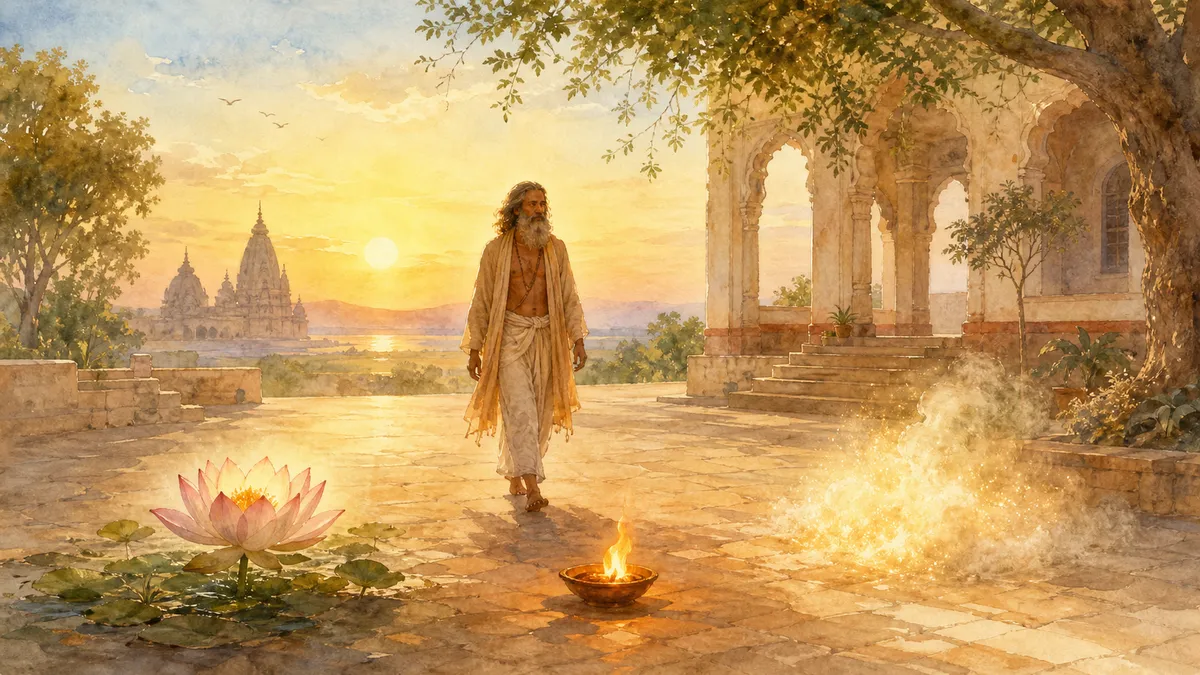
When we contemplate, we imagine ourselves in the form of Dattatreya and generate a feeling of divine pride: “I am Dattatreya,” since Dattatreya is not something external to us. The teacher of teachers, Guru Dattatreya, is our unborn Mind, our subtlest intuitive awarenesses, which we invoke to manifest through this bhajan.
Usually the word “avadhuta” is added to Dattatreya’s name. Avadhuta means “one who is beyond all definitions and prescriptions.” Dattatreya is traditionally considered the patron of all siddhas and the founder of many tantric traditions. He is often described as a great master of freeing the minds of disciples from duality by using various situations for this purpose. He is a master of various stratagems and tricks, capable of liberating the bound minds of his disciples by destroying their fixed ideas.
He is capable of appearing in a form that does not correspond to expectations, but even in this form one must recognize his darshan. For example, just now I assumed that we had put on a completely different bhajan, but all my hopes were destroyed in one stroke. However, I perceived this as a good sign, as the darshan of Dattatreya, who loves to appear in exactly this way.
Dattatreya is usually invoked in order to remove the limitations of consciousness and bondage to dualistic notions.
Stories about Dattatreya and the testing of devotion
There are many amusing stories about how he liberated the minds of his disciples and tested their devotion.
One brahmin passionately wished to receive the darshan of Dattatreya. When he was performing a ritual and reciting a mantra, a certain spirit came to him and said:
“You can receive the darshan of Dattatreya, but only if you recognize him. If you do not recognize him, the meeting will be closed to you. Come tomorrow to such-and-such a place, and you will see Dattatreya there.”
When the brahmin came to the indicated place, he saw that some beggar was walking around a butcher’s shop, asking passersby for pieces of meat. The brahmin asked the spirit:
“And where is Dattatreya?”
The spirit answered:
“Why, there he is! Don’t you see? Quickly fall at his feet and ask for whatever you want.”
But the brahmin was indignant:
“What are you talking about!? Don’t you see that this is some beggar asking for meat? He looks completely insane.”
The spirit said:
“Well, today you have lost your chance. But you still have another attempt.”
The brahmin could not imagine that this might be Dattatreya. His fixed notions did not allow him to see him.
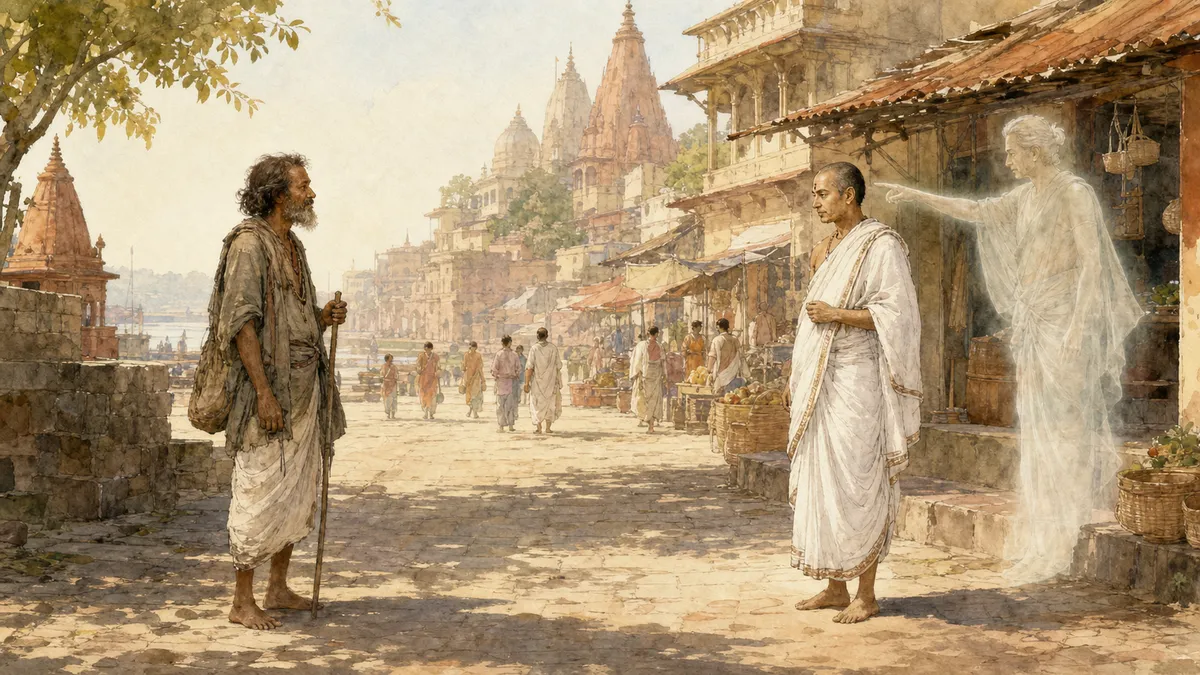
Another time, King Indra, who was suffering defeats in battle against the asuras, decided to find Dattatreya and turn to him for help. By his mystical power, he planned to pass into another space and, somewhere in the dimensions of the great universe, meet Dattatreya.
When he found Dattatreya, he saw him half-drunk, staggering, surrounded by many naked women with whom he was embracing. Indra was told:
“King, Dattatreya is not like all other saints. He is not entirely sane. If you do not recognize him, if you cannot develop devotion to him, then it is better not even to approach him. He has a habit of testing the faith of his disciples by putting them in an awkward position, confronting them with their own notions and illusions.”
But Indra was very determined, because the gods were in a critical situation: for the first time in many years, they were suffering defeat in battle against the asuras. Therefore, he decided to obtain Dattatreya’s support at any cost. And when he came, he addressed Dattatreya with a request, expressing his respect.
Dattatreya said to him:
“You know, I have already lost all my powers. Once I practiced yoga a little, but you yourself can see that now I am mired in sin. How can someone who needs help himself help you in any way? So it is better not to waste your time.”
The king thought, “Perhaps Dattatreya is testing me in this way,” and so he continued to turn to him for help anyway. And this went on for a week. Sometimes Dattatreya drove Indra away, sometimes he beat him with a slipper, sometimes he spat on his chest and constantly said:
“You are wasting your time! I am just a mad beggar; you have nothing to do with me.”
But the king, unwaveringly established in pure vision, continued to pray to Dattatreya. Finally, after seven days, Dattatreya suddenly assumed his usual form, appeared before Indra in a radiance of light, and asked:
“Speak, what do you want?”
The Principle of Dattatreya
Dattatreya is the one who destroys our illusions, freeing the pure clarity of our mind beyond all duality. He is the one who cannot be anticipated or predicted, who cannot be squeezed into any framework. He is incomprehensible and transcendent. One could say that he is an incomprehensibly holy soul who cannot be understood by the human dualistic mind, limited by frameworks. He is considered the teacher of teachers and the founder of various tantric traditions. He is revered in various tantric traditions.

What does Dattatreya embody? Dattatreya is the principle of our pure awareness beyond concepts. When we cannot understand this principle, it is obscured by dualistic notions. Dattatreya is a master at creating playful situations in order to free the disciple from these dualistic notions and reveal his original state. Therefore, when in life you encounter something that arouses rejection in you, or your hopes collapse, or your fixed ideas collide with something, think this way: “Could this be Dattatreya’s darshan? Was I able to recognize him?” If you were able to recognize him, the situation will instantly change, and you will enter the dimension of pure vision.
Pure Vision as a Path to the Divine Dimension
The dimension of pure vision is something in which one should constantly become established and grow stronger. Pure vision opens for us the path to another dimension of being. It is especially important when you receive the transmission of the teaching. The connection with the teaching, with the teacher, and with the saints is possible precisely through pure vision. One could say that samaya and pure vision are one and the same.
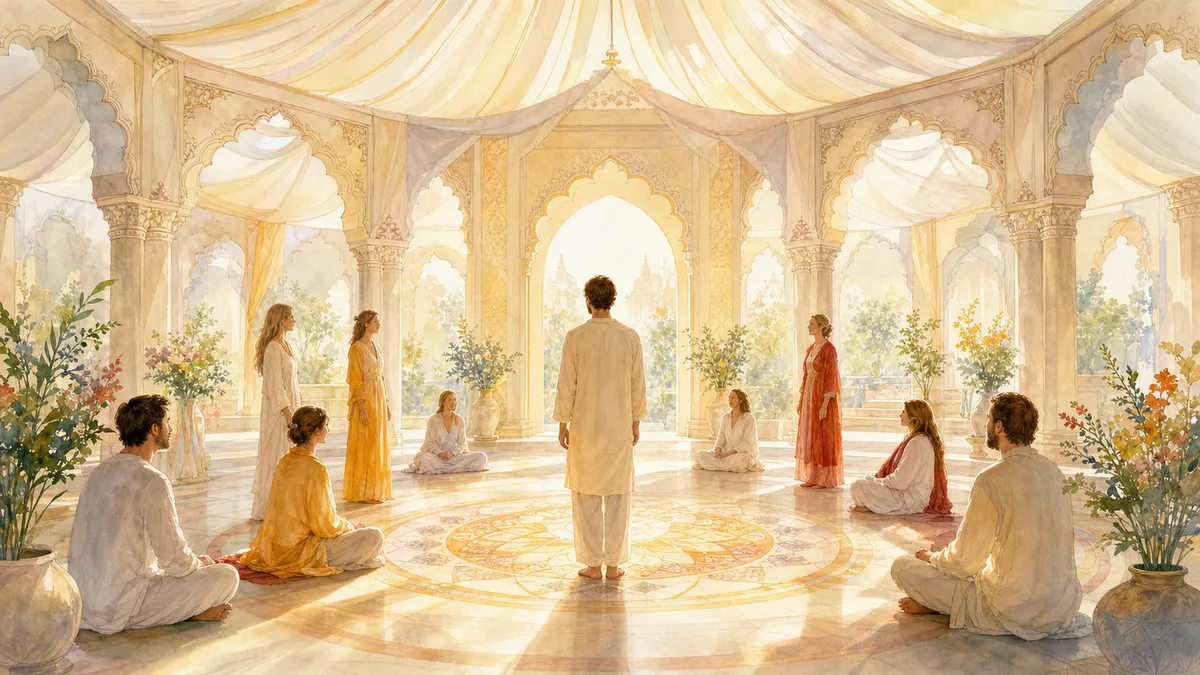
Right now, while receiving the teaching, imagine that the guru who is transmitting the teaching to you is a deity or its embodiment. Try simply to adopt such a point of view, to do this logically. Then, looking around, try to adopt the point of view that this hall is the palace of the deity within a sacred space (mandala) located in the dimension of the gods. Then try to see that the companions who are beside you are deities or their embodiments, who have taken this form in order to enter this mandala. Look at yourself and think: “I am a deity who has entered the play mandala called Dharma in order to deepen my vision.” Then attune yourself to all the sounds you perceive and think in this way: “These are sacred sounds, regardless of whether they seem pleasant or unpleasant to me.” That is, attune yourself to feeling like a deity in a mandala among deities.
The task is gradually to fully grow this deity within yourself, to become the central deity and to generate your inner universe of pure vision. That is, the teacher’s task is not to consider himself a deity seated on a throne, but to allow the disciple to become a deity himself and to generate his own universe of pure vision.
Developing Pure Vision
The sprout of pure vision “germinates” when you establish such vision. At first it will be as if, as though you are training in something artificial. Nevertheless, as you advance in the practice, you see that this is not something artificial, but a subtler perception of reality; that previously you simply did not see it, and now you have seen it. Simply, when you see something impure, you can think: “Only my present mind is impure, but in reality everything is absolute and sacred.”
The fact is that in absolute reality everything is divine; it is only that we are unable to understand or see this. But training in pure vision opens our eyes to reality.
One monk in a three-month retreat wrote in his report: “When I sit in mahashanti meditation, I constantly hear mystical sounds of an orchestra, symphonic music. It is like some kind of affliction. I thought I would sit in silence in retreat, but it feels as if I have ended up at a symphony concert.” When he began to investigate where these sounds were coming from, he saw that it was the noise of water in the radiator that provides heat. During meditation, the presence in contemplation increases, the perception of sounds changes, and therefore the sounds appeared to him as the sounds of a symphony orchestra.
For someone who has practiced nada yoga, this is an ordinary effect. This often happens, especially in the practice of nada yoga. But it also happens in the practice of pure vision and in the practice of natural contemplation. You are no longer training yourself to think: “This is pure. These are mystical sounds,” but you actually hear it that way, because on a subtler level sound is transformed into a purer one.
Practical Application of Pure Vision
Thus, you have no need to imagine pure vision in some way. When you come to a shop, you can truly see it as a palace or mandala of deities, the shop assistant as a deity, the people giving money as devotees of the deity who are performing a ritual offering to it. And this deity distributes nectar (the elixir of immortality) or gives blessings in the form of goods. All of this appears as lila in the play mandala. It seems incredible that one can see things in this way; nevertheless, this is exactly how everything happens. You can see this not as training; you can really see that this mataji belongs to the family of Durga, Kali, Saraswati, or to some other deity of any tradition. Perhaps she herself has never thought about this, but she embodies the energies of this family.

On a subtler level, one can see that a person belongs to the energies of some family of deities. Not only belongs to them, but also embodies them. In the same way, one can see to which family of actions a certain action belongs. When you perceive in this way, you can see any object, any situation, any life event as belonging to a subtle family of divine energies. And you see that none of the actions happens by itself, but belongs to a subtle family of divine energies. The only question is whether you recognize this with your spiritual vision or not.
The Transforming Power of Pure Vision
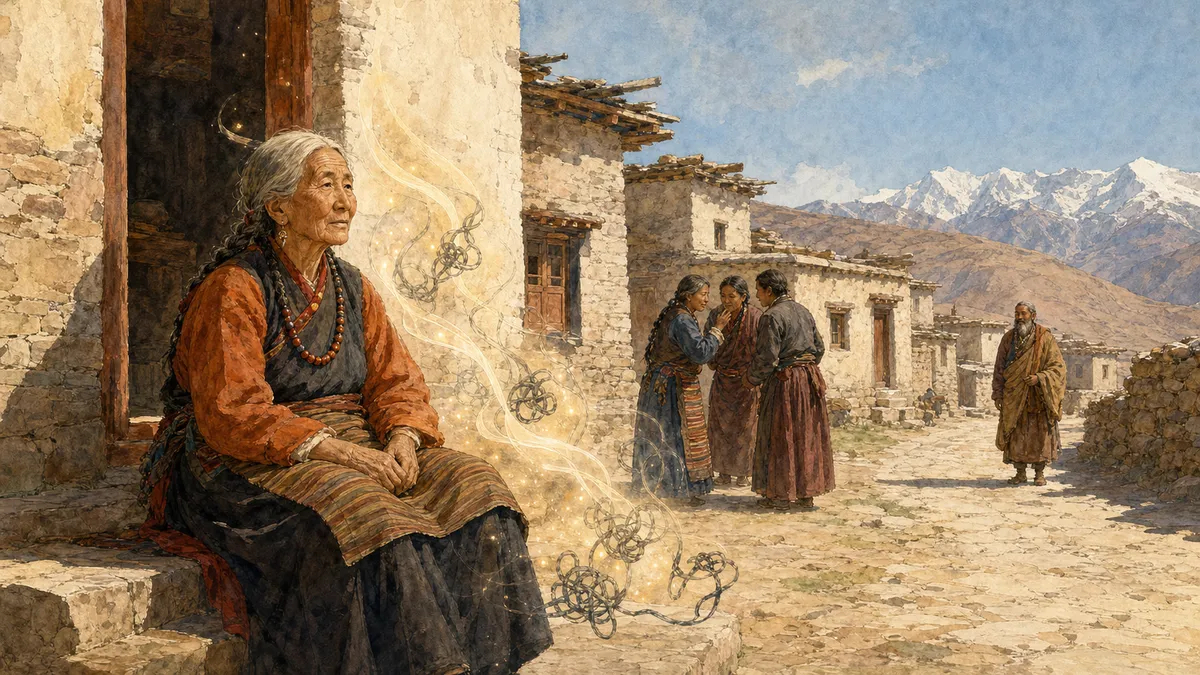
Pure vision, as it takes root, brings about a powerful change in reality over time. It is believed that if the practice of pure vision is applied under certain special conditions, when in pure vision we can contemplate certain repulsive, unpleasant, or even suffering-inducing moments, then this liberates a significant portion of yogins’ karma and, in a short time, dispels great dualistic notions, improves destiny, and increases lifespan.
In Tibet there was a saint named Drukpa Kunley. Many anecdotes are told about this saint. Once, wishing to help his mother, he began spreading various absurd rumors about her. Thanks to this, since his mother had to change her consciousness and do substantial spiritual work, her lifespan increased. She was able to see, in pure vision, the absurd rumors that Drukpa Kunley was spreading about her. And this dissolution of her dualistic notions benefited her. In fact, it was a manifestation of the saint’s compassion, who understood this principle.
Of course, since you are not Drukpa Kunley, you should not spread absurd rumors about anyone, hoping that they will perceive it in pure vision. For there is a high probability that you may not be perceived in pure vision. Pure vision is a very samaya-related point.
Samayas and the Principles of Studying the Teaching
So, when we have received samaya, it is very important to follow it. For example, when you follow the samaya of the relationship with the guru, you practice Guru Yoga; when you have the samaya of the siddhas’ teaching, you try to apply the teaching in order to feel its value and depth.
Usually, five yantras (sections) are considered in the teaching: the section of wisdom (prajna-yantra), the section of energy (shakti-yantra), the section of light (jyoti-yantra), the section of sound (nada-yantra), and the section of dream yoga (nidra-yantra). To study Laya Yoga means to thoroughly understand these sections, first theoretically and then through one’s own practice.
There are certain principles for studying the teaching: theoretical learning (dharma), the priority of mystical experience (siddha), and flexibility (malini). This means that first we must acquire a certain theoretical foundation, then we must practice in order to gain experience in the form of a certain siddhi, a mystical experience, considering mystical experience to be more essential. Then we must understand how to manifest our practice flexibly in everyday life. This principle of flexibility in applying knowledge to a specific situation is called malini.
The Section of Wisdom (prajna-yantra)
The section of wisdom (prajna-yantra), in turn, is divided into three lines: the line of contemplation, the line of divine pride, and the line of space. When you practice the line of contemplation, you primarily work with sankalpas, naked awareness, and meditations. In general, this is the art of meditation and awareness. Divine pride consists in cultivating bhava (one’s worldview), as prescribed. Finally, the line of space consists in mixing the inner and outer space by means of shambhavi mudra, in meditation on the heavenly space, and in applying the sankalpa “Infinite Space.” When you clarify these three lines and apply them in practice, you become an expert in contemplation.
The Section of Energy (shakti-yantra)
Question: What does shakti-yantra include?
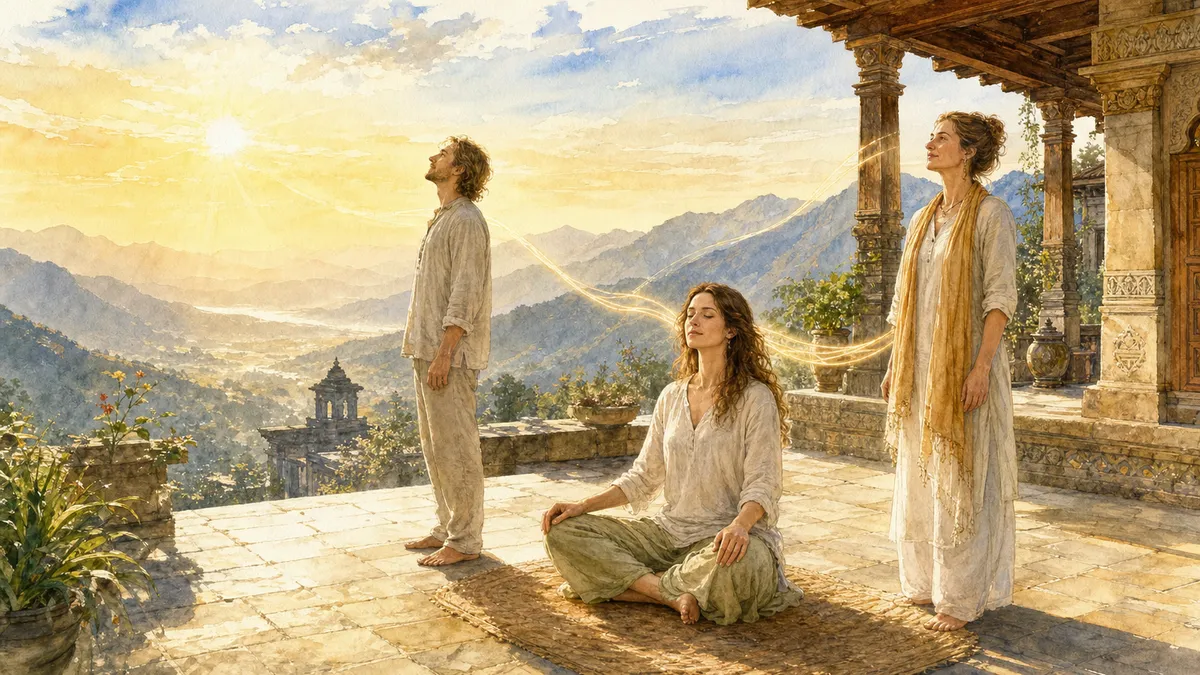
Practicing shakti-yantra, you first purify your body through asanas and pranayamas. Then, using the three bandhas, you awaken kundalini. Next, continuing to perform chandali yoga, you try to experience the nectar (amrita-varuni) — the cherished goal of yogins. As your practice continues to progress successfully, various kinds of experiences of bliss arise in the body, and then you work with the unity of contemplation of emptiness and bliss in the body. Finally, at the higher stages, you learn to work with the reverse flow, with desires and kleshas, sublimating them by the power of energy and presence. Such is the logic of the practice of shakti-yantra.
