Action Without Karma: The Path of an Enlightened Yogi
23.09.2026
0 мин. чтения
0
Share
copy
search
add
share
Commentary on the text “Shri Siddhanta Shikhamani,” Chapter 19 “Cessation of Actions”
The Sthala of “Cessation of Actions”
For a yogi whose body is the Supreme Being, all actions appear imaginary, just as a snake is mistakenly perceived in a rope.
What does it mean for a yogi’s body to be the Supreme Being? First, it is one who has united his expanded consciousness with the body, one who has eliminated the concept “I am the body” (dehatma-buddhi), realized himself as the immortal Atman, and united his will with the divine will; through uniting his will with the divine, he has also realized the body as subordinate to the divine will. This means a yogi whose body has united with the Supreme Being.
The process of contemplative practice in Advaita is not merely a process of consciousness—it is also a process of energy, a process of working with energy. Discovering the immortal Atman is only the beginning; next, we must bring this discovered consciousness into the subtle, energetic, and physical bodies and unite it with our behavior.
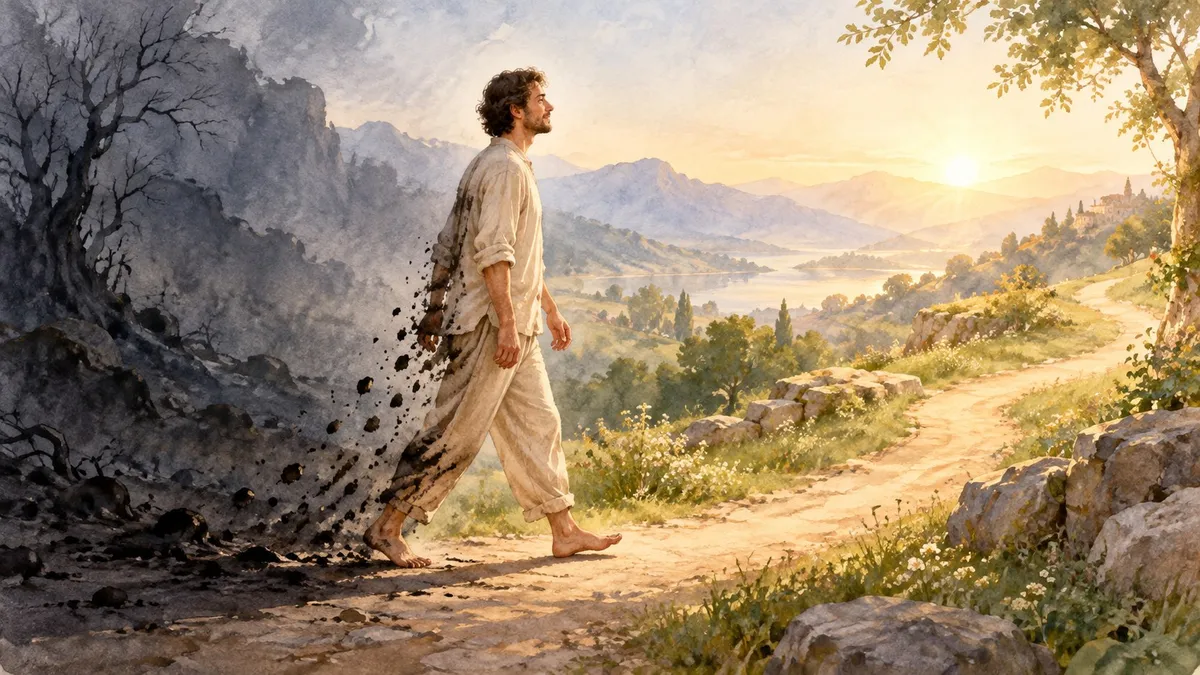
Therefore, this state of the yogi is called “cessation of actions.” The actions of sages do not become causes of rebirth. Thus, seeds scorched in fire cannot sprout. For a yogi who has rid himself of ego (ahamkara), what use are the actions he has performed?
Two Types of Actions
There are two types of actions. The first type is the action of a yogi, and the second type is the action of an ordinary karmic person entangled in actions. In the case of a karmic person, an action performed creates karma-phala (a result), and the results will always have to be experienced and received in return; in other words, there is no force capable of preventing these results from returning to us unless special methods are applied. The law of karma is so precise that everything will be repaid down to the smallest detail.
The second type of action is the action of a yogi who has transcended the law of karma and is unaffected by karmic consequences (karma-phalas); he has no karmic reactions. Whatever he does, he does not create disturbance in space, because he is one with nature, the elements, and Brahman.
Normally, when a person acts, he creates mental disturbance, creates identification, and his mental waves awaken reciprocal mental waves in the space of the cosmos, which inevitably respond to his actions. His thoughts attract thoughts from the surrounding space because he experiences “I am doing” and “I am the doer,” hopes for fruits and results, and all of this is accompanied by an emotional state. This leaves corresponding impressions; such impressions accumulate and create persistent tendencies (vasanas), and inevitably these impressions and vasanas will attract corresponding waves in space, in the ether, and these waves will be drawn to them.
In this sense, an ordinary person must always control his thoughts, must always take care of mental discipline, think only well, only about good things, only positive, proper, and pure thoughts, because improper, impure thoughts summon corresponding powerful cosmic waves that enter his destiny. Every act of his thinking is an invocation.
Thoughts can be compared to radio waves. People emit thoughts like radio transmitters; people are relays of thoughts, and there are those who emit pure sattvic thoughts, those who emit rajasic thoughts, and those who emit tamasic thoughts. Over time, their thoughts accumulate and surround them, forming a sufficiently dense aura that creates a mental body; this aura of the mental body forms the aura of the subtle body in the form of images, while thoughts become embedded as specific emotional states, emotions, feelings, and images. Then specific emotional and sensory states become prana, the energy body.
For example, a red aura is a rajasic aura, while there are also black, orange, white, yellow, golden, blue, green, and other auras. Finally, this affects the physical body. The face is considered an indicator of the subtle body and the mental body. Anyone who generates thoughts forms his aura from those thoughts; therefore, a yogi practices self-discipline in order to free himself from all these processes in the subtle bodies. A yogi practices abhyasa. Abhyasa means persistent, continuous training or practice, constant repetition—for example, mantra, upasana (worship), and contemplative practice—all of this is abhyasa.
When a yogin practices, other processes gradually arise within him; no thoughts arise within him when he does anything. His thoughts do not create new imprints, nor do they generate new images or new emotional states; instead, they dissolve into the natural state of the Mind. Since the yogin has learned to abide in the nature of the Mind, he does not accompany his actions with evaluations, reflection, judgments, comments, or false notions such as “I am doing this” and “the fruits and results belong to me”; thus, thoughts do not accompany his actions or leave imprints in the stream of his consciousness. Instead, each action reunites with divya-bhava, with brahma-aham-bhava, is related to God, and reunites with the divine feeling; then karma does not accumulate.
The cessation of actions means not accumulating karma while performing any actions—peaceful, neutral, or wrathful—while abiding in nondual contemplation.
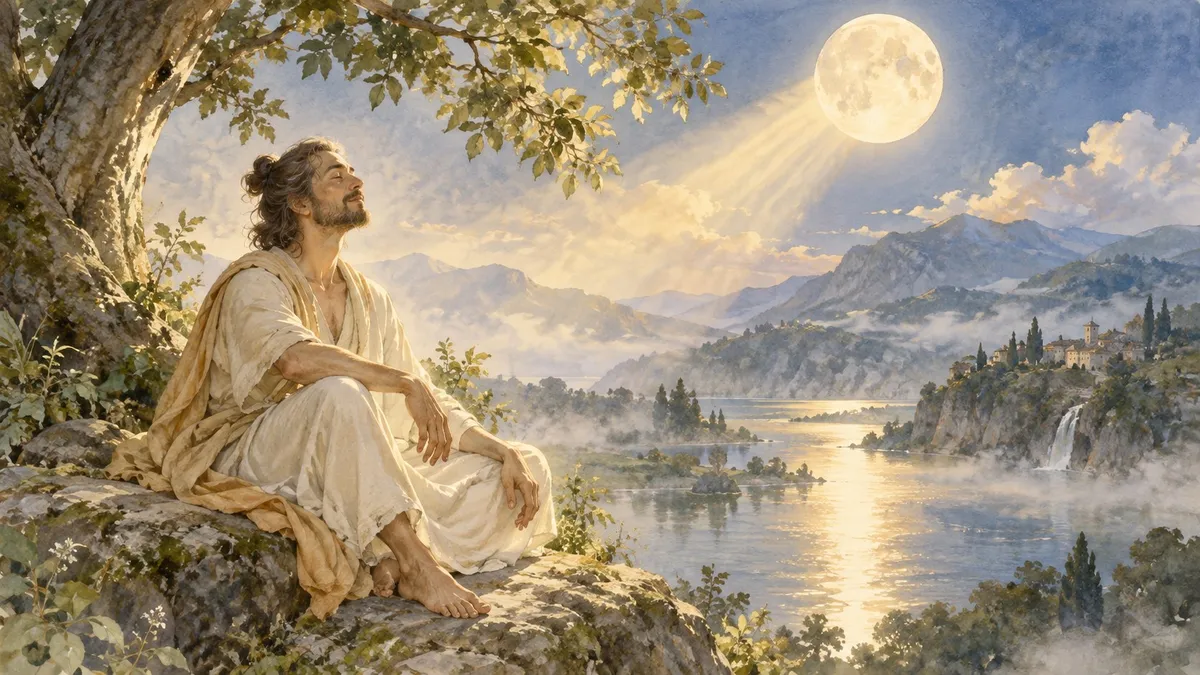
How can changes in the reflection of the moon affect the moon itself? Against the backdrop of clouds, it appears that the moon is moving. The same is true of the Atman: because of its connection with the body, it appears that the Atman performs actions. An enlightened yogin is not tainted by the fruits of actions, even when engaged in activity.
But the unenlightened person is tainted—one must know this; he is tainted one hundred percent, because he is always involved in activity. He cannot avoid becoming involved. This means that until enlightenment is attained, we must very clearly monitor, control, and direct which actions we should engage in and which we should not. We must understand how important it is, for example, to follow dharma, accumulate merit, and perform upasana and various good actions.
The Concept of Dharma and Purushartha
Dharma is translated as that which supports everything; derived from the word “dhir,” it means the proper functioning and purpose of any living or nonliving object, phenomenon, or regularity, while in relation to an individual, it is the mode of conduct most conducive to their spiritual development. Following one’s divine purpose is also called svadharma.
There are various types of dharma, but dharma is a reflection of the cosmic divine law—rita. Rita signifies the cosmic divine law governing the evolution of all living beings in the universe and creation. When it is projected onto an individual and material society, it is called dharma.
As long as our consciousness is not liberated and our actions produce karmic causes and results, we must follow dharma; we must follow the proper purpose of each person. Then we must understand what it means to follow dharma, what dharma is in my particular case, what types of dharma exist in general, how to act so that my karma does not accumulate, and how to act so that my karma is purified.
In accordance with this, we should consider that the Vedic tradition has the concept of purushartha. Purushartha means the goal of a human being, and another meaning is the power of self-manifestation.
Usually, purushartha includes four goals in human society: dharma, artha, kama, and moksha.
Dharma is the accumulation of sattva, the accumulation of merit, and conduct that allows one to accumulate only pure energy and not accumulate impure energy. It means accumulating only pure memories and not impure memories; in other words, dharma is goodness.
Artha means prosperity and material power, and artha relates to pleasure. If dharma is connected with sattva, then artha is connected with rajas. It means using rajasic energy to accumulate prosperity and make life pleasant.
Kama is connected with the bliss of life, and it is also connected with tamas. This also belongs to the category of “pleasant”: living while rejoicing in life, aesthetic pleasure, enjoying life, nature, food, relationships, and being in general. Such an energetic principle as living while being happy in the body includes a balance of energy, proper nutrition, and healthy relationships, the art of arranging one’s home according to Vaastu, orientation according to the cardinal directions, living among balanced natural elements, and harmony in the family—all of this also relates to kama, to the development of one’s aesthetic needs. It is all about making life more pleasant.
Moksha also belongs to the category of “the good,” that is, if artha and kama are the pleasant, while dharma and moksha are the good, meaning the true. There is a saying: “Everyone follows the pleasant path—only the wise follow the true, the right path.” Moksha means liberation from all duality, liberation from all illusions, liberation from karma and false identifications.
Ultimately, all four of these goals of life are intended solely for moksha, but moksha is such a lofty goal that few souls dare to set it as their goal in life. Dharma is considered a preparatory stage before moksha; it is impossible, for example, to leap directly from artha—the pursuit of material prosperity—or from kama into moksha. A process of accumulating sattva, a process of self-discipline, and a process of cleansing consciousness of karma are necessary so that the accumulated sattva makes such a leap toward moksha possible.
In order not to accumulate karma, it is necessary to follow dharma, and dharma is not simply a religion. Dharma, if we are speaking of Sanatana Dharma, is the way to properly fulfill the purpose of a human being and, in general, of any being in the universe. Moksha-dharma is the highest way of acting in order to liberate this living being so that it may attain the highest goal, the highest evolution in life.
For example, everything has a purpose. The purpose of a tree is to grow and bear fruit. The purpose of a human being is to discover their divine essence. The purpose of the sun, stars, planets, and time is to produce changes, and so on. When we follow dharma, we follow our purpose, and we accumulate sattvic power. When there is enough sattvic power, we can follow the path of moksha. The state of moksha grants freedom from karma, when actions no longer generate any new cause-and-effect connections.
The True Nature of Life
Life is not what we do—it is what we are. Usually, we are always identified with what we do. To act means to manifest the energy of the body, speech, or mind, and this is usually considered life, but in fact, it is not true life. Life is what we are, what we represent, the state of awareness in which we abide. As long as we are identified with actions, karma accumulates. When we remain in a state of awareness, we experience life truly, because life is Atman. To live means to abide in Atman. This does not mean acting—it means remaining in the natural, spontaneous awareness of Atman. One who can remain in the natural awareness of Atman is called kala kalan (the hero who has conquered death).
How can we distinguish truth from untruth, the true state from the untrue state (sat and asat)? Truth is that which always remains indestructible, untouched, indestructible, unchanging; that which survives, remains constant, pure, and unblemished always and everywhere. This is the test of what is true, completely true in life, and what is not.
For example, there are certain values, certain forces, energies, and states in relative life: a home, money, peace, fame, prestige, wealth, relationships, and all of that. These can be called only conditional, relative values insofar as all these things provide the comforts of life, but can all of this be called absolute truth? Of course not, because none of these things passes the test of the true state; they are all destructible. A house is destructible, and the people to whom we are attached are destructible; fame, as they say, is an unprofitable commodity—it is expensive to attain and difficult to preserve, and is destructible. Prestige, money, and wealth are all destructible things. All external things are destructible, meaning that they are not truth. They may have only conditional, relative value in the relative world insofar as they provide the comforts of life, but no more.
This means that under no circumstances should one assign them an important status in life, the status of absolute value, or chase after them. Therefore, one should look at them calmly and coolly, use them, but the goal in life is different; one must not devote all one’s time, life, energy, or soul to them, because by giving one’s soul to false delusions and false values, one inevitably finds oneself in a state of ignorance, suffering, and delusion.
What is tested by the power of time and does not perish? For example, you remain in meditation, in deep awareness, and your awareness has penetrated into dream sleep and even into dreamless sleep, and not even death will be able to take it away; changes over time cannot destroy it. Even if anything were to happen, it could not be destroyed.
The yogin experiences the bliss of abiding in God, or brahma-aham-bhava, the experience of nonduality, and it remains even in dreamless sleep, even beyond dreamless sleep—and who can destroy it? This is the test of truth versus untruth. It is actually easy to verify: everything is tested; it is put to the test. Can time produce changes (parinama) that destroy it? That which is destroyed is not truth; that which cannot be destroyed is truth, and that is what one should strive for.
Moksha Dharma points out to us how to attain imperishable eternal values. The yogin who strives to attain imperishable eternal values strives to immerse himself in what is called the “boundless lake of divine contemplation” (Shambhu Dhyana Sarovar). He learns to contemplate in such a way as to remain constantly immersed in this boundless lake. Such a yogin explores the cosmos of God; he devotes his entire life to exploring the cosmos of God and lives in it as in his own environment. He changes his environment of perception even while remaining in the body and living in the material world.
For example, if there is an astronaut who explores space and dedicates his life to it, goes into orbit, and strives to explore space as far as possible, then the yogin explores the cosmos of God and strives to explore this cosmos farther and farther. He reaches a certain orbit, raises his level in order to go farther.
The Path to Enlightenment
An enlightened yogin is not tainted by the fruits of actions, even if he is engaged in activity.
An unenlightened person, however, is tainted. We must always understand that an unenlightened person is inevitably tainted. There is no escape from this. How does one become enlightened so as not to be tainted? To become enlightened, one must continuously perform abhyasa—persistent, constant learning and practice—because if one does not perform it, one will be tainted. The unenlightened is tainted; the enlightened is not tainted—this is their defining quality. When we persistently practice, we gradually begin to become enlightened in our soul; we begin to resemble an enlightened yogin, and then we stop being tainted.
Enlightenment has a beginning, a middle, and an end, and a long period of time is the beginning. One should not underestimate the beginning of enlightenment—it consists of enormous phases that may last millions of lifetimes. They are much longer and perhaps even more important than the middle. The initial phase is very important because it is a point of bifurcation, where the soul has been in an unenlightened state for millions of lifetimes, millions of kalpas, and by some miracle it awakened in this life. This means that its enlightenment is not far away—perhaps seven lifetimes.
Billions of lifetimes before this, billions of kalpas, and it would have continued for billions more kalpas; from the perspective of eternity, although from the perspective of a human life seven lifetimes is a very long time, from this perspective it is not.
The beginning of enlightenment starts with the spiritual Teacher transmitting shravana and manana; he introduces the student to what is called discourse (the discourse of dharma), also called yukti (reasoning about dharma), svadhyaya (self-study), the explanation of texts and reflection—all of this is discourse, an entry into the discursive field. Discourse means learning to think in terms of dharma. One should not strive to meditate and contemplate immediately, before attaining shravana and manana, because even by applying the correct meditative practice, without prepared and accumulated sattvic, dharmic thoughts, we will erase the layer of superficial consciousness that is under our control, and we will enter the unconscious.
We will open ourselves to the unconscious, open Pandora’s box, because the unconscious does not contain pure thoughts or dharmic thoughts; it contains karmas. And what will we do if we have not carried out the preliminary work of creating the right discourse and accumulating the right mental waves, and we enter karmically wrong mental waves, into the mental sea? This mental sea will simply sweep us away. Then we will be forced to abandon our practice, and we will forget that we wanted liberation, because it was all superficial, and we will once again follow the trajectory of karma.
To prevent this from happening, there are the processes of śravaṇa and manana. There is a process of mental self-discipline and mental self-education—this is the discourse, when a disciple listens to the teaching and then studies on their own; this is śravaṇa and svādhyāya. Then they learn to develop logic and reason in accordance with the dharma; they think in accordance with the dharma. Then they comprehend and assess their situation, reflect on their situation—this is called yukti and manana. All of this creates within them an attraction to pure spiritual vibrations and pure spiritual thoughts; they become acquainted with the mental world of the dharma.
There is an expression: “Naimā tarkeṇa matir āpaneyāya” (“This knowledge of the Self cannot be attained through reasoning”), Kaṭha Upaniṣad. Enlightenment is not attained through discourse, nor is knowledge of the Ātman attained through it. Nevertheless, discourse is very necessary, because it makes it possible to form the right, pure mental waves.
When we have the right, pure mental waves, we have a powerful support—mental energy helps us in spiritual life. It often happens that a person has received a transmission of a mantra and a technique and has all the necessary conditions, but they are not inclined to practice or meditate; it is difficult for them, and even when they try, there is no inspiration, no grace, because their subtle body lacks the corresponding mental waves.
Their mental waves concern politics, their wife, their children, YouTube, the Internet, television, thoughts about prosperity and money—and this concentration continues for years, sixteen hours a day, all the time, and even in sleep. How can any technique or meditative saṅkalpa work here? Even if it arises, it will generate a small mental wave—a wave called brahmākāra-vṛtti—but all those previous thoughts will generate many other waves; this is called viṣayākāra-vṛtti. “Viṣaya” means material, worldly fluctuations of the mind, and during meditation they will spend two hours struggling: this small mental wave of ātma-vicāra, or mahāśānti meditation, or the meditation on the four immeasurables, will struggle, barely and unsuccessfully, against the enormous nine-meter mental waves accumulated earlier. What do you think—will it win or not? Hardly.
This is what is called a lack of merit—insufficient mental waves have been accumulated. After meditation, such a person does not feel grace; they do not feel that their strength or wisdom has increased. They feel: “I’m exhausted. I struggled. That’s all it was—two hours of struggle.” Imagine if you were fighting a storm or another person—you would be utterly exhausted. Two hours of fighting is extremely difficult.
Once, when we were sailing to the islands in the Dominican Republic, it took approximately two hours to get from one island to another. For two hours, the waves batter you, splashing you with spray, and you simply become exhausted. You think: “Do I really need this next time?”—and we had wanted to settle there somehow. Every time it was like this: two hours to get to the store, two hours back, and you became tired. In the same way, when such mental waves have not been accumulated and a struggle takes place, there is no grace, no samādhi, no gods—just struggle and exhaustion.
This must be changed through abhyāsa, through the processes of śravaṇa, manana, svādhyāya, and yukti—that is, constant listening, continuous self-education, reasoning with the help of dharmic terms (yukti), and manana—comprehension and the removal of doubts. We need to attract many more waves; in addition to this, there are upāsanā and mantra. When we practice in this way, we prepare ourselves.
Transmission of Bhāva—Seeing Through the Eyes of the Awakened
The second thing that a spiritual teacher transmits, besides such a mental field of discourse, is bhāva. In modern terms, one could call it a narrative. A narrative is a way of seeing—an awakened vision through the eyes of the awakened. A narrative means a first-person account, when we do not merely perceive or read impersonally, but see through someone’s eyes, through the eyes of another.
The “Yoga Vasishtha” is, after all, a text that cannot be separated from Vasishtha’s vision—it is Vasishtha’s vision itself. This is bhava, when we see the world through the eyes of Vasishtha or Valmiki, or when the “Avadhuta Gita” represents seeing the world through the eyes of Dattatreya, while the “Vivekachudamani” or “Atma Bodha” represents seeing the world through the eyes of Shankara. This is not merely intellectual information—it is a first-person view of the world, the view of one who is awakened. This is bhava, which is transmitted as a result of Guru-yoga. When we practice in this way, gradually, as a result of such persistent practice, this subjection to karma disappears.
The Yogi’s Actions as Lila
He acts like a tongue that tastes clarified butter and other food, but is never soiled by food. Whatever actions a yogi who has lost his connection with external attributes may be involved in, all these actions are merely an appearance. The yogi’s actions bear no fruit and dissolve within him.
Thus, the yogi who has severed his karmic ties and attachments to samsara—his actions, too, are like an appearance; they are like lila, like a game, but only when all attachments to samsara have been severed and no longer operate in the habitual way, when personal will is united with the divine and the world is seen as an illusion. Therefore, it is said: “Such a yogi does not act. God plays through him”—then he does not accumulate karma.
Purnima means the full moon. Guru Purnima—when there is a festival, why is it called that, and why is purnima identified with the principle of the Guru? Because the Guru, like the full moon, reflects the light of the sun; in the same way, he reflects the light of the Atman. Such a yogi also realizes the Guru-tattva within himself, and thus Guru Purnima takes place within him—his consciousness reflects the light of the Atman, just as the moon reflects the light of the sun.
Therefore, the yogi who has transcended his karma is always at the festival of Guru Purnima; he always celebrates the principle of Guru-tattva within himself because his Sadguru (the inner Guru), the Atman, is awakened. Guru Purnima is a festival, but such a yogi is always at Guru Purnima because he celebrates the Atman, and the Atman has no specific birthday. Its birthday is three hundred and sixty-five days a year. Therefore, one who has purified his mind and remains in devotion is always at the festival of Guru Purnima, while the festival of Guru Purnima is lila, a game, non-attachment, happiness, and ananda—it is a way of abiding in grace.
When the yogi acts in this way, his memory, which preserves past impressions, deeds, words, and thoughts, known as karmashaya, is purified and gradually dissolves into the light of the Atman. In place of memory arises pure divya-bhava; that is, Guru Purnima leads to divya-bhava.
Whether walking, standing, or sleeping... No one can remain inactive. Activity is inherent in the very nature of embodied beings, but the actions of sages bear no fruit. For one who experiences the perfect, great bliss of pure consciousness, there is no bustle of actions that yield various experiences as their fruits.
Thus ends the sthala “cessation of actions.”
Dharma
Karma
Atman
Moksha
Shravana
Manana
Abhyasa
Purushartha
Shri Siddhanta Shikhamani
Author Гуру
Read 20 times
Articles
Vidya AI
Search
Lectures
November 2, 2026
Mantra of the day
ОМ САХАДЖАЙА НАМАХ ОМ Естественному – поклонение!
Auspicious Times(Rome)
Brahma Muhurta:
04:53 - 05:48
Abhijit Muhurta:
11:33 - 12:14
Sayam Sandhya:
16:44 - 17:25
Mokshada Ekadashi (6 November)
Ekadashi of liberation. Helps to achieve spiritual enlightenment.