

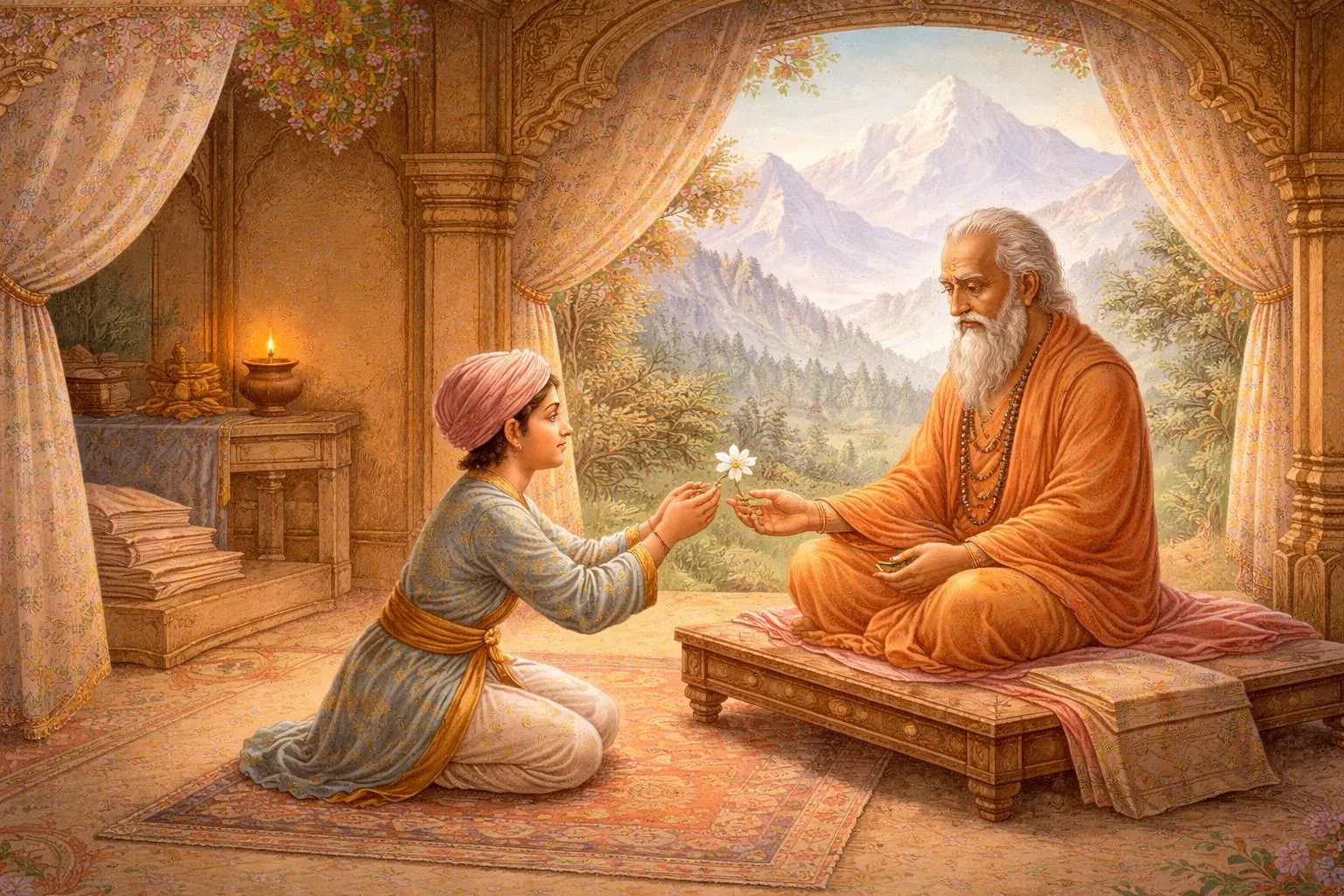
Commentary on the text “Foundations of the Path”
1. An Attitude Like That of an Intelligent Child
Having renounced personal will, entrust yourself to the Teacher’s guidance.
Just as an intelligent child does not act in his affairs according to personal will, but looks into his father’s face and, having surrendered to his will, acts accordingly, so too should you look into the face of the spiritual friend. In the sutra on samadhi for beholding the present Buddhas, it is said: “Always renouncing his own will, let him act as the spiritual friend indicates.”
However, it is said: “Act in this way toward a true Teacher who possesses spiritual qualities. One must not allow just anyone to lead one by the nose.”

This is the first attitude. It is said that at first a disciple must have the opportunity to analyze the qualities of the Teacher and his teaching in order to understand whether he has a karmic connection with him and whether he possesses worthy qualities. Once he has made his choice, he must have such an attitude as that of an intelligent child.
From the point of view of the sutra, the Teacher is regarded as a spiritual friend or brother who is more advanced on the path. From the point of view of tantra, the Teacher is regarded as a manifested deity. From the point of view of anuttara-tantra, the Teacher is regarded as non-duality, as Brahman itself, inseparable from the disciple. Therefore it is said: “To the extent that you regard the qualities of the Teacher, to that extent you receive blessing. If you regard the Teacher as an ordinary person, you receive the blessing of an ordinary person. If you regard the Teacher as a deity, you receive the blessing of a deity. If you regard the Teacher as absolute Reality itself, non-duality, you receive the blessing of absolute Reality itself.”
To renounce personal will is a practice in which we try to cast aside our distorted will, or rather the multitude of small wills called chaitasika, connected with past karmas, in order to perform self-renunciation or self-surrender. If a person possesses great pride, egoism, or does not understand the essence of the practice of Guru Yoga, then even this first step becomes a stumbling block for him, because, falsely considering himself to be the mind and body, he clings very strongly to his ego (ahamkara). He is more ready to abandon the practice than to give up what he considers himself to be. However, in the absolute sense, from the point of view of non-duality, if you have something that you can renounce or leave behind, then it is not the true. True contemplation or true awareness cannot be lost, because it is one, common to all. And by renouncing the lower parts of your “self,” you acquire the greatest, the great quality of your “Self,” absolute non-duality.
2. An Attitude Like a Diamond
“Strengthening the connection with the Teacher until it becomes unbreakable and constant, that is, a friendship that will not be disturbed by mara, bad friends, and the like.”

As it is said in the same sutra, avoid inconstancy and wavering in friendship. “Friendship” in this context is not a very accurate term. It is, rather, a mystical connection; it is not like worldly friendship, love, or anything else. A mystical connection is something much more subtle. Of course, this is not about any kind of conditioning or attachment. If we simply become attached to the spiritual Teacher as a person, at best it will resemble worldly love, but the goal of the Dharma is entirely different. And if a person has not understood the principle of tantra, he may think that this is simply a certain lack of freedom or a certain conditioning. After all, the goal of the Teaching is complete freedom, while accepting a Teacher and acquiring a connection with him is again a certain lack of freedom. This thought can indeed arise if you do not understand the principles of anuttara-tantra.
Once I was giving a lecture on the fourteen root downfalls of samaya in tantra, explaining these principles. The longer I spoke, the more uneasy one laywoman sitting in front became. By the end of the lecture she had entered an almost deranged state and said: “If there are so many different kinds of unfreedom here, then I don’t need the Dharma either.”
To think this way means to completely lose understanding of the principle of the teaching and tantra. Because the purpose of the teaching is to give us complete freedom beyond all conventions and beyond all limitations. The Teacher’s purpose is to lead the disciple into a state of absolute freedom, not to bind the disciple to himself in order to derive some benefit from the connection with him. To do this, one should understand the context in which such a practice is performed. The Teacher himself gains no particular benefit from the connection with the disciple. Of course, if he were a worldly person, then perhaps his pride or egoism would be gratified. But since he has no notion of himself as a personality and is not a worldly being, he receives no benefit in this respect. Since he has no desires, he also receives no benefit either in a material sense or in any other.
So, what is the principle of tantra? The principle of tantra means that we try to see the Teacher not as a body, but as boundless, absolute Consciousness, identical to the Absolute, as the Absolute manifested in form. When we constantly meet and communicate with the spiritual Teacher, we have a need to remember this. We must constantly awaken ourselves: “Do not forget that he speaks like an ordinary person, walks like an ordinary person, but at the same time he himself is the Absolute.” For us this is always a challenge; we must not forget ourselves. If we have a weak karmic connection with the Teacher, we may think: “If only he levitated or emitted rainbows from his body, or at least, like Virupa, made the sun and the moon disappear for several days, then I would believe that he is the Absolute. But since it is not evident that he does this, then he may be more advanced than I am, but still not the Absolute.” Such an attitude is an obstacle in practice. Whoever the Teacher may be, one should perceive him as the Absolute.
When the disciples asked Milarepa:
— You must have been a Buddha in a past life, since you possess such abilities and can perform such practice?
Milarepa answered them:
— Whoever I may have been in a past life, even a preta, if you look upon me as the Buddha himself, then you yourselves will receive great benefit from such practice.
This is indeed so.
From the point of view of absolute Consciousness, you cannot know for certain whether someone is a buddha or not. And even mystical powers cannot be an indication of this. All the more, you cannot know whether someone possesses mystical powers fully or not, since sometimes it is not beneficial to display mystical powers, because obstacles may arise. Sometimes it is beneficial to conceal one’s virtues or attainments. But if we take into account that the Teacher, after all, did not study and practice to become Copperfield or Harry Houdini, but sought first and foremost to develop nondual Wisdom, then these qualities are insignificant. From the point of view of transcendental awareness or the state of clarity, continuous awareness, his qualities may not differ from the qualities of the highest gods possessing bodies of light, or of the ancient saints of the past. When we reflect in this way, we understand that here the attitude is much more subtle.
When we perceive the Teacher in an absolute way, we are compelled to remember the Absolute continuously, and then our mind too becomes saturated with the energy of absoluteness. Suddenly we feel that we are constantly in contact with the Absolute, whatever we may touch, because we are in a state of transmission, of Guru Yoga. Gradually our mind begins to become saturated with absoluteness or with the feeling of absoluteness. Then, just as water from one vessel flows into another, we feel that we have come to possess the same qualities of absoluteness. This is the principle of Guru Yoga, or the pouring over of qualities. If pure water is constantly poured into a contaminated vessel, then after some time the contaminated vessel will contain the same pure water as the vessel from which it was poured. The point is that the practice of anuttara-tantra yoga is a path of radically changing oneself, one’s self-identification, transforming one’s vision of the world, reality, and being as such. This means another, paradoxical style of thinking and perception, opposite to the worldly, dualistic one. It is when two times two equals five, not four.
From the point of view of the fruit of awakening, someday we must necessarily recognize ourselves as the Absolute. We must necessarily come to the conclusion that we ourselves are the absolute God, that we ourselves are the Absolute. Therefore, in the sutras it is said: “If you see the Teacher performing ordinary actions and distrust arises in you that he can eat, sleep like an ordinary person and at the same time be the Absolute, then this is incorrect vision, because you yourself, while performing the same everyday actions, are the Absolute, but you do not understand this. You too, right now, are already the Absolute, but because of habitual tendencies toward dualistic thinking and old karmas to which you pay attention, you do not recognize your absolute nature. If you are able to recognize it in the Teacher, then you will very quickly recognize it in yourself as well.”
So, this principle implies that, recognizing such an absolute nature of the Teacher, we necessarily connect it with our own inner state; we reveal it as our own contemplation. Therefore, in laya yoga, the principle of Guru Yoga means that we continuously recognize this absolute state as inseparable from our own. And the more we recognize it in all things, the more we reveal it within ourselves.
The saints of antiquity were described as seeing the Absolute not only in the Teacher, but also in the most ordinary things. Dattatreya spoke of having had many Gurus, including the five elements (earth, water, fire, wind, space), the insects Bhramari and Kita, the prostitute Pingala, a brahmin, and many other beings. Each of them gave him some kind of pratyabhijna darshan, an unveiling of reality, a discovery of non-duality, precisely because he possessed such a pure view, such pure vision.
When we become established in this way in the vision of absoluteness, this vision of absoluteness begins to penetrate our consciousness as well; a blending arises. It is like a short circuit arising between two electrodes—a voltaic arc. And then our mind, infected with absoluteness, also begins to ignite until it burns up. When the false ego burns up, only one absoluteness will remain. Of course, this is always a challenge to our false vision and our egoistic perception, because we are firmly seized by the mara of our egoistic perception. Even when we practice, this egoistic perception fights desperately against the vision of non-duality. It desperately clings to our little “I”; it is ready to fight to the death for every millimeter of its own territory, because it feels that enlightenment is a great death for the ego, and therefore it will not simply surrender its positions. This egoistic perception constantly collides with the remembrance of absolute vision, when we find ourselves facing such a choice: either egoistic, conditioned perception, or absolute perception. In the process of such a collision, friction and sparking occur. Such sparking is called tapas by yogins. It is this that gives rise to a new awareness that helps burn karma and kleshas.
3. An Attitude Like the Earth
Bearing the entire burden of the Teacher’s affairs, that is, the absence of the slightest discouragement when the Teacher places the whole burden upon you.
According to what Potoba said to his disciples: “Having met your and my spiritual friend, to carry out his instructions is a great blessing—not a burden, but an adornment.”

From the point of view of dharma, everything we do as service and so on should not be regarded as something that serves some person, organization, etc. In the absolute sense, it serves for our own benefit. It is like the gods not rejoicing when offerings are made to them, for they have no desires, including the desire to receive offerings from people in the form of incense, bhajans, and the like. The gods do not rejoice when fruits and so on are offered to them, because they are completely self-sufficient beings; they possess everything in abundance and nourish themselves on nectar simply by contemplating it. It is a mistake to believe that deities need our offerings, that we are, as it were, feeding them. Such offerings help the one making the offering. In other words, it is people who receive benefit from venerating deities, merging their mind with their subtle energies. In the same way, the principle of offering and service is one-sided in the sense that it brings benefit only to the one who offers.
Ramana Maharshi said on this matter: “When villagers worship Lord Ganesha made of yellow sugar, it is like their pinching off a piece of yellow sugar from Lord Ganesha and performing puja, offering that same sugar to Lord Ganesha.”
4. An Attitude Like the Cross Mountains
Whatever suffering may arise—steadfastness.
When Chandgawa was in Rugpa, the health of the contemplator Yotanbara declined because of the severe cold, and he asked the teacher for advice as to whether he should go to the doctor, Mr. Shannu Dagu. Chandgawa said:
“Although you have sat for so long in Indra’s palace on a comfortable seat, only now has the opportunity arisen to entrust yourself to a friend of dharma and listen to the dharma. Therefore, sit where you are sitting.”

Ultimately, the connection with a true Teacher will end in one thing — absolute surrender of oneself to the practice and absolute surrender of oneself to the path of awakening.
There was one Teacher who, when disciples came to him, gave this blessing: “I bless you: may your wife leave you sooner, may all your worldly affairs quickly go downhill, may you be fired from your job. When all this leaves you, you will surrender yourself only to God and to nothing else, therefore I bless you.” It is said that all the laypeople fled from his blessings in horror. But the devotion of some was sufficient to accept such blessings. Having accepted them, after some time they truly left everything behind and surrendered themselves only to the dharma.
Therefore, when you meet the Teacher, expect that such blessings will begin to work. They will work until all your illusions leave you; otherwise there is no point in approaching the Teacher or calling yourself a disciple. Because entering into a relationship with the Teacher is a challenge to you; it means that from now on everything will be different for you, in another way, not as your false “I” would want, but in such a way that your great, true “Self” awakens from within you.
When a person frivolously says “I am a disciple” or “I want to be a disciple,” he must know that what he is uttering, this connection, will sooner or later be laid bare, and he will have to make a choice in order to become a real disciple. He will have to either continue following his illusions, or leap into the lion’s mouth. Because in the absolute sense, the true Teacher is naked, bare nondual awareness, in which there is no place for any human illusions, attachments, duality, and so on. To declare that you want to merge with this awareness and attain it means being ready for the most radical transformation. Otherwise, it cannot be called an enlightening dharma. Of course, the disciple always has the opportunity to avoid such a transformation. But when we follow the path of dharma, a true practitioner is always ready to leap into the mouth of this lion.
5. The Attitude Like That of a Servant of the World
Even if you have to perform all kinds of dirty work, do it without hesitation.
When the pandits gathered in Tsang, it turned out that the place was very dirty. Tonpa, tearing his clothes, cleared away the dirt and completely whitewashed the meeting place with dry lime, and also prepared the mandala. Then the teacher said: “Oh, there are people like you in India as well.”

6. The Attitude Like That of a Sweeper
This is the complete rejection of conceit and pride, the awareness of oneself as being lower than the Teacher.
It is said through the mouth of Geshe Tonpa: “In one filled with pride, the moisture of virtues will not appear.” And Chandgawa said: “Look, in the hot season, does the greenery begin to dry out from the high tops of the hills or from the lowlands?”

The rejection of conceit and pride should not be regarded as some kind of self-abasement. The principle of Guru Yoga implies absorbing the absolute consciousness of the Guru. Even when we manifest humility within, we must always be aware of our own absolute nature. Our absolute inner “Self” is always absolute, and it should not shrink or shrivel from the relationship with the Teacher. On the contrary, our false “I” should shrink and shrivel until it bursts like a soap bubble. Our absolute “Self,” however, should be laid bare, clarified, and expanded.
Those who are strongly attached to their illusory “I” have great pride, because they falsely transfer the qualities of their absolute “Self” onto their small false ego (onto ahamkara). When they feel that they are being asked to give up their small, false “I,” they feel confused; for them, it is equivalent to losing themselves. However, as we practice, we begin to possess discernment (viveka). Then our false “I” is seen as false, fake, untrue, while the absolute “Self” is laid bare, and we understand that if something can be compressed, blocked, or suppressed, then it is something false. The true “Self” can be neither compressed, nor blocked, nor humiliated, nor suppressed.
Therefore, the more we compress our little “I,” the greater the chance of expanding our absolute “Self.” That is why the attitudes “like a servant of the world” or “like a sweeper” mean absolute humility. This has nothing to do with self-abasement or some kind of downtroddenness. It is, rather, the humility of a spiritual warrior who has completely lost the sense of self-importance. One saint said: “You must become like a bundle of straw thrown on the road, which everyone walks on, and it experiences delight from being walked on, from being of benefit to other beings.” Until we become like such a bundle of straw, we cannot count on enlightenment.
As long as even a shadow of self-conceit, pride, or clinging to the “I,” this demon of the sense of self-importance, remains in us, we will never be able to merge with the light of self-born Wisdom, because the light of self-born Wisdom does not tolerate even the slightest manifestation of egoism; it requires complete, absolute self-surrender, without any admixtures. If you are not ready, you will have another life to practice. Such is the principle.
7. An attitude like a chariot
It is the joyful acceptance of even the heavy burden of the Teacher’s most difficult tasks.

8. An attitude like a dog’s
It is not allowing anger, even if the Teacher humiliates and scolds.
Every time the inhabitants of Tulung met the spiritual friend Lhabso, he would scold them. When teachers and students became infected with a certain dislike for this mentor, Lhabso’s disciple Negpopo said: “You perceive this as scolding, but for me, every time he does this, it is like the blessing of a wrathful deity.”
The Eight-Thousand-Line Sutra says: “Even if it seems that preachers or teachers despise and neglect you who thirst for the Dharma, do not respond in kind; strive even more for the Dharma. Be respectful and follow them tirelessly.”

Being conditioned beings, we take this reality at face value; we may also take the Teacher’s words or reactions at face value. However, from his point of view, this is not at all the case, and anger may simply be a skillful play in order to awaken certain qualities in the disciple. In the absolute sense, an awakened being has neither likes nor dislikes, neither affection nor aversion. Neither anger, nor attachment, nor anything else is capable in principle of coloring his mind; however, he may manifest these qualities in order to give the disciple spiritual progress.
I read that Yogananda once summoned one of his female disciples. Swami Kriyananda was present and was sitting behind. Yogananda was angrily reprimanding this disciple for something. She was literally sobbing, and Yogananda looked very angry. However, when he turned to Kriyananda, he smiled and winked at him in every possible way. Then he turned back again and began reprimanding the disciple. Kriyananda understood that this was merely Yogananda’s play, necessary in order to free this disciple’s mind from dualistic states, to clarify her true state.
If there is no devotion, then we simply fall into the ordinary human dualistic state: we love it when we are praised, and we dislike it when we are scolded. However, a true disciple who recognizes the Teacher’s absolute state recognizes even his anger. In other words, he will see it as a play, as the blessing of a wrathful deity.
For example, Neem Karoli Baba did nothing but scold his disciples, call them names, and give them all kinds of nicknames. His closest disciple said:
“You are a master of scolding and insults.”
In response to this, Neem Karoli Baba said:
— Only then will your mind become clear, when it ceases to be captivated by all this, and you will abide in a state of absolute openness.
9. An attitude like a ship
This is tirelessness in caring for the Guru’s affairs, whatever they may be.

“Tirelessness in caring for the Guru’s affairs” means that we must be involved in the process of learning. If a person, calling himself a disciple, remembers the Teacher from time to time but does not take part in cooperation, he simply closes himself off from the process of transmission. Even having two or three techniques or practices, in the end he proves unable to follow the path of practice.
This does not mean that the teacher dreams of placing any tasks on someone’s shoulders. The Teacher has no affairs of his own, he has no plans to build or organize anything, no worldly desires or achievements. He has the task of helping the disciple, and in order for this help to take place, the disciple’s involvement, his participation, is necessary. And since it is difficult to involve a disciple in constant practice immediately, and there is no need for it, the Teacher involves him through various skillful methods, because the disciple’s false “I” must be erased.
One person came to study the art of sword fighting with a famous sword master. The Teacher said:
— Good. Live here, clean the room, look after the goats, and I will teach you the art of the sword.
After two years he had still taught him nothing, although the disciple diligently looked after the goats, cleaned his small house, and performed other services. Then the disciple became indignant:
— What kind of training is this?! Two years have passed, and I have not even held a sword in my hands! After all, I came to learn the art of the sword!
The Teacher said:
— This is the kind of school I have. If you do not like something, you may leave. This is how I teach.
Finally, in the third year, the Teacher gave this disciple a sword to chop firewood with. And for a whole year the disciple chopped firewood with the sword. Then he came to the Teacher again and began to protest:
— What kind of training is this?!
The Teacher said:
— If you do not like it, you may leave. This is the kind of school I have.
Gradually, the disciple began to perceive much subtler things than the technical mastery of the art of sword fighting. Clarity, awareness beyond the ego, and nondual understanding began to awaken in him. And then the Teacher said:
— The main secret of my mastery is contemplation. When your mind is immersed in the Source, your hands become swift, and then all technique becomes irresistible.
When the disciple’s ego and kleshas had been completely erased, the Teacher transmitted the art of the sword to him in six months, and this disciple became an unsurpassed master of sword fighting.
In the same way, when we become involved in the process of service and take part in all of this, imperceptible subtle changes occur within us as the emphasis shifts away from our egoistic perception. That to which we were previously blind begins to open up to us.
Thus, when we follow such attitudes, we become, in the true sense, an “empty vessel,” ready to be in the transmission of Guru Yoga and to open to the light of self-born Wisdom, which always exists within us. Although it exists, it is hidden by our “I,” the ego, dualistic ignorance, and kleshas. And when we acquire this quality of openness, this Light begins to flow into us.
If we do not understand this principle, we may successfully meditate from life to life, but awakening will still not occur. If the disciple does not understand the most elementary principles of learning, he becomes like a “closed vessel.” Or he may perceive the process of learning as a kind of exchange: “I make offerings, listen to lectures, the Teacher gives me initiation, and I attain.” However, to think this way is a fundamental delusion. For this process presupposes the disappearance of the very one who is learning, the disappearance of the “I,” the ego of the practitioner. Here, simple formal training or the absorption of ordinary instructions spoken in words will not suffice.
Therefore, when someone becomes a disciple, his principle is this: “From a person who is favorably disposed toward the Dharma, to transform into one devoted to the Dharma. From one devoted to the Dharma — into a disciple. From a disciple — into a supreme disciple, fully capable of following the path of awakening.”
