Questions and Answers
Karma, Thought-Forms, and the Path of Purification
Question: If a person drinks alcohol, is it a weakness, a lack of willpower, or something else?
It is karma, and this karma does not want to surrender so easily, but it must be overcome; one must purify oneself. Our consciousness is constantly being colored by something; it generates projections. When we perform certain actions, consciousness generates projections. Some of these projections become thought-forms—stable and tenacious. And some of these projections can even become subpersonalities—semi-intelligent beings that seek to prolong their existence.
In occultism, such subpersonalities are called larvae: the mind, drawing upon a particular desire, has created an entity in the subtle world. This entity has received energy and even possesses pseudo-intelligence. It requires nourishment to sustain its life. Sometimes certain entities even seek to take possession of a person’s body and destroy it in order to free themselves, to separate from the mind. As long as there is a body, the person’s mind keeps this entity as if in a cage, while it wants to live freely, on its own. It then begins to cause problems for the person. If this entity becomes an alter ego, it will be your next life. As a rule, if it gains strength, the person may be reborn as a preta—a hungry ghost in the lower astral world.
From time to time, this entity asks to be nourished—perhaps not often, but it asks to be sustained when it grows weak. This entity must be purified; this thought-form—the entire charge of emotions and energies it has accumulated—must be dissolved in the Void by invoking the power of blessings and willpower, and by practicing tapasya—ascetic discipline.
Willpower alone is not enough here. If we begin to suppress it through willpower and harshly enter into a struggle with ourselves, we may fall into a depressive state. We need positivity; we must rely on a positive state and need the spiritual light of the saints. We should invoke the blessings of the saints more often. If you invoke the Refuge, the Grace of Bhagavan Dattatreya, and the grace of all the saints, you will free yourself from this.
I recommend reciting the mantra:
OM Nirava Grahaya Namaha—“Homage to Shiva, who is independent of everything.”
This mantra comes from the “Shiva Sahasranama Stotra.” Once a week, while reciting this mantra, make an offering of flowers and incense to an image of Shiva or Dattatreya, regarding Shiva as one with Dattatreya. And your independence from desires will begin to prevail.
“I Am,” the Witness, and the Nature of the Ego
Question: Are “I Am” and the inner witness one and the same?
Yes. Sakshi—the witness, the inner witness—means that you have found aham-vritti, the “I-thought.” You have become established in the center through the “I-thought.” And this center, this aham-vritti, is your ego, ahamkara.
The “I-thought,” the ego, forms a knot of consciousness joined to the body—it is called chit-jada-granthi. If we imagine the human body and the Absolute somewhere very high above, in the starry distance overhead, then chit-jada-granthi would be above the human body, over the person’s head—as the embodied ego, a knot joined to the body.
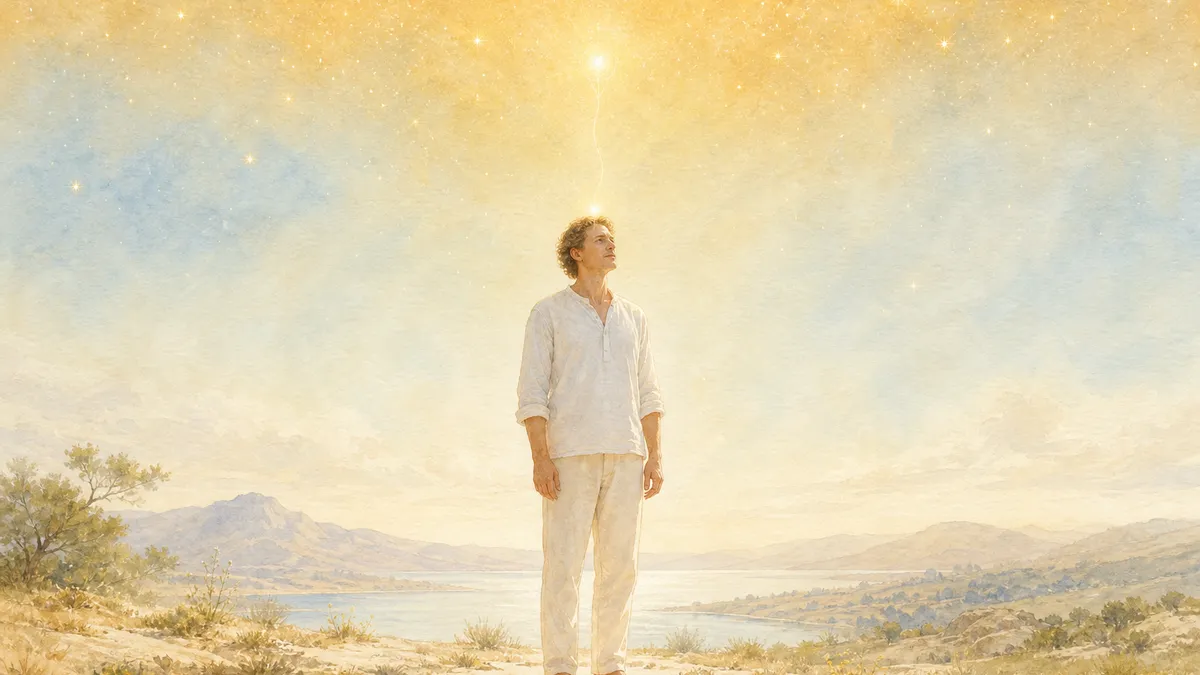
When we discover the “I Am” of the inner witness, it means that we have reached this knot. Now we must untie this knot and discover space and luminosity within it. Abiding in this space, self-surrender, and remembrance of it—this is the path of contemplation.
Maintaining the witness is not yet contemplation; it is the practice of attentiveness to the witness.
The volitional factor—who creates it? The same One who creates all factors—the Supreme Source, God, Bhagavan Dattatreya, the Absolute. The will within us is part of the divine will. Divine will is called ichchha-shakti. It is personified by the goddess Lakshmi. Lakshmi within you is will.
There are three principal shaktis:
- Jnana-shakti—the power of wisdom (Brahmi, Saraswati)—the feminine aspect of Brahma;
- Ichchha-shakti—the power of divine will (Vaishnavi, Lakshmi)—the feminine aspect of Vishnu;
- Kriya-shakti—the power of divine action (Raudri, Parvati)—the feminine aspect of Shiva.
Any will that exists in the human world is divine will, a manifestation of ichchha-shakti, the divine Lakshmi. Any awareness, wisdom, or intellectual capacity in the human world is a manifestation of jnana-shakti, or Saraswati. And any activity or dynamism in our world is a manifestation of kriya-shakti, the power of divine action.
Deepening the Witness and Revealing Space
Question: Observing the witness means that the witness observes itself. If you are able to observe the witness, it means that you have witness No. 2.
And then you must ask yourself: “And who saw witness No. 2?” If witness No. 2 was noticed, then you have distanced yourself from it, which means there is yet a third one. This is how consciousness becomes increasingly refined. Gradually, the witness begins to become elusive. And you realize that above the witness there is space, that there is pure space even deeper—that is, your witness, like a flower bud, begins to open, to unfold.
The witness, the “I-thought,” is always local, contracted consciousness, and you need to unfold it. In the process of correct observation, the witness unfolds in the space of divine presence—without boundaries, without a center, without a name, without form, without concepts.
But you do not need to form a long chain of witnesses—otherwise, you may create an entire group of observers.
Happiness, Fulfillment, and the Power of Consciousness
Question: How can I make myself feel happy if I do not have a place of my own to live? It depresses me.
It is impossible to make yourself feel happy—happiness comes of its own accord. And the first thing to understand here is that happiness is not connected with having a place to live. If you want a palace, do you want the palace itself, or do you want the satisfaction of owning a palace?
What is a dwelling, a home, a palace? These are images that pass through the retina into the optic nerve and reach the cortex of the occipital lobes of the brain. It is touch—you can touch the walls. It is sound. In other words, these are impressions in your brain. And what are impressions in the brain? They are consciousness, perception in the subtle body, and bhava—the inspiration and joy arising from the thought: “I own it, I live here, it is mine!”
When you want a home, for example a palace, you do not want the palace itself so much—you cannot eat the walls. All you need is this bhava—this inspiration and the notion: “I own it!” And this thought, “I own it,” this inspiration—where does it come from? It comes from the space beyond thoughts—not from the senses, not from external objects. It is hidden within you—it is simply divine grandeur, a sense of wholeness, a sense of fulfillment.
If you want to become happy, you need to understand that your happiness is not found outside. This sense of fulfillment is God within you. And you need to learn to seek it, explore it, trust it, open yourself to it, and gradually become imbued with it. Then happiness will be within you regardless of whether you have a place to live. Your wholeness and fulfillment will give you strength, and you will easily buy yourself a palace, let alone a place to live.
The fact that you do not have a place to live is simply a reality generated by your mind; your mind has produced a consciousness of lack and dissatisfaction. But your mind is the creator of any reality. The mind is like a magical printer that can print any situation, any possibility in three dimensions. You only need to configure the program of your mind. Your dissatisfaction with life, the bhava whose influence you have fallen under, and your karmas have created this situation—you are responsible for it. You need to install a different program in your mind, as if in a printer, so that your mind creates and materializes the situation: “I own a home. I own a home with many rooms, a palace, realms like a deity.” When you have sufficiently instilled such a program, your mind will print this situation and create it. But since your will may not be very strong, imagination alone may not be enough—you must also make efforts in the relative world to achieve it.
Your efforts are like magical offerings to a particular world of reality, which will shift you into that universe, into that probability where you have a home:
- here is a reality tunnel where there is no home and never will be;
- here is one where there is a small and uncomfortable home;
- here is one where there is a large home;
- here is one where there is a palace;
- here is one where you have an entire country of your own;
- here is one where there is an entire mandala of the pure dimension in a pure land;
- here is one where you create a universe like Brahma.
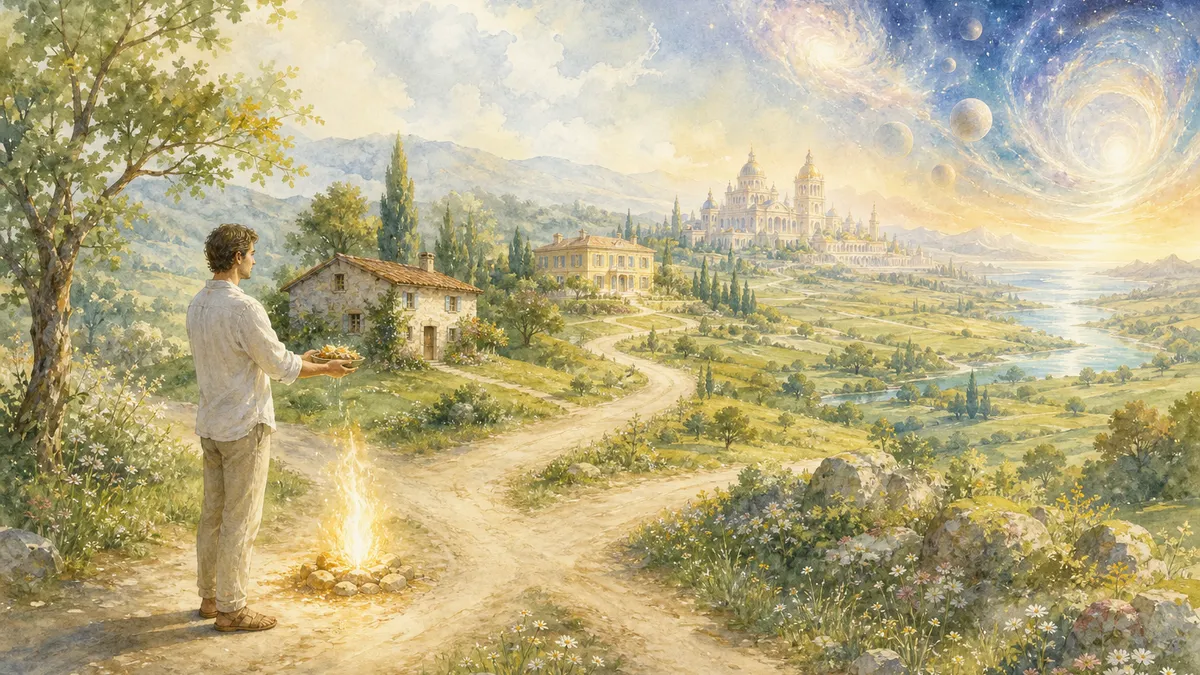
These possibilities are open to you; they all exist. But each possibility requires the power of consciousness. The power of your consciousness allows you to enter only the nearest reality tunnels, while the more distant ones are very far away—it takes maha-tapasya to reach them. But if you undertake a certain amount of tapasya, the nearest versions of reality will open up within a year or two.
But this tapasya should not be performed from a state of dissatisfaction. From the state of dissatisfaction of a hungry spirit, it is impossible to attract any favorable outcomes into your life. You need to act from the state: “I already possess everything, I already have happiness, I am already happy in and of myself.” If you perform Lakshmi arati on Fridays, Lakshmi will grant you such a mindset.
Health, Illness, and Harmonization of the Elements
Question: I have a headache and feel that my blood pressure has risen, so I took a hypertension pill. What should I do?
You should not perform asanas that require a great deal of effort, nor should you practice intensive pranayamas. If you practice simple anuloma-viloma pranayama, which is performed very gently, and relax, all of this will disappear.
Our illnesses are not physical in nature, nor are they even energetic. Their nature is consciousness. And the best way to heal illnesses is to harmonize the five elements, which means relaxing into one’s natural state. There is an excellent practice for harmonizing the five elements: Mahashava Mudra.