

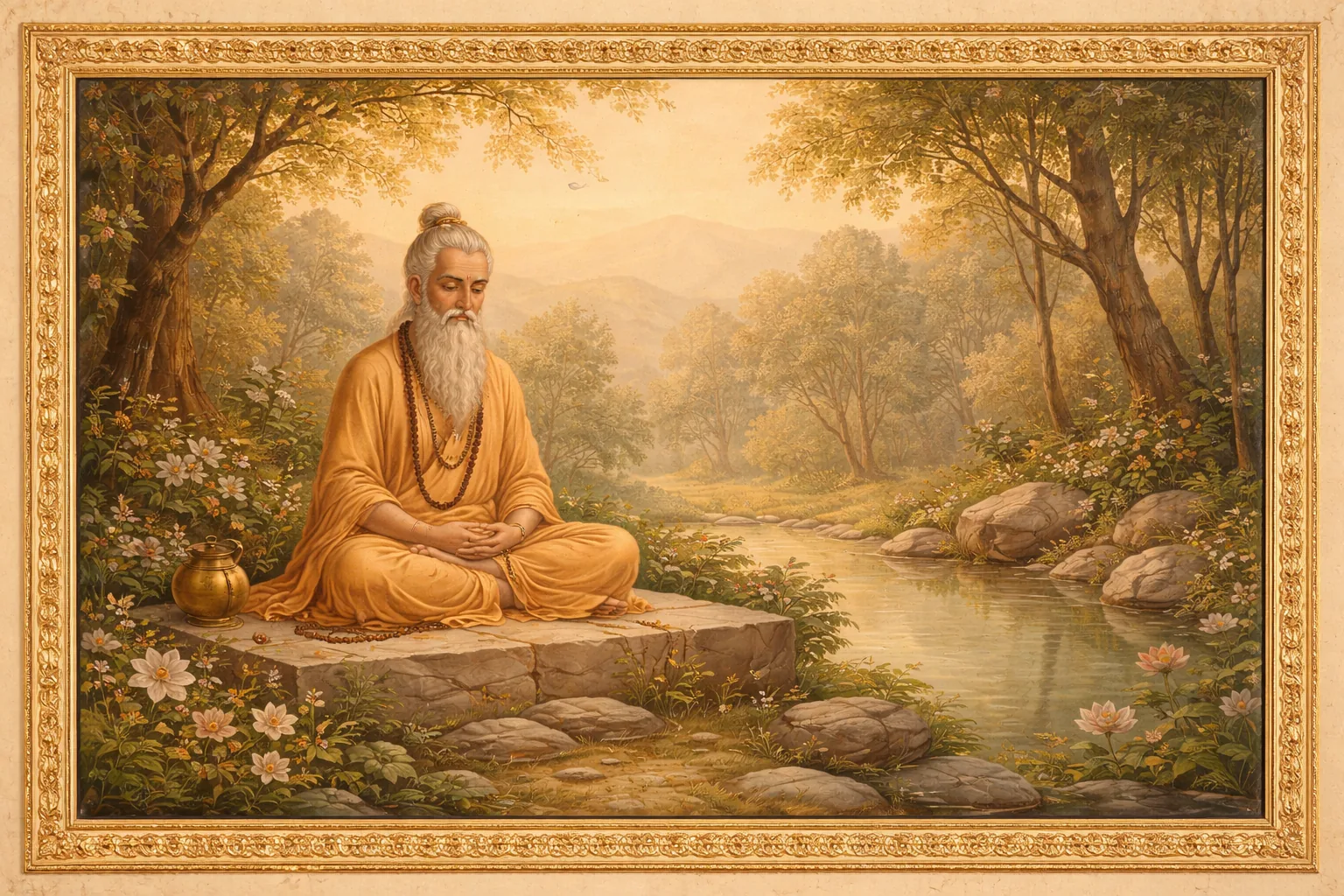
Commentary on the text “Tripura Rahasya,” Chapter 13, “Waking and Dreaming Are Similar in Their Nature, and Objects Are Merely Mental Images”
The relationship between space and objects, between time and events, corresponds to how you yourself evaluate them. There are no intrinsic internal relationships between them.
What people designate as external is simply the source and support of the universe, like a screen in its relation to the picture shown upon it.
There could have been nothing external to that exteriority except its own body.
Primary and Secondary Causes
There are the concepts of “primary cause” and “secondary cause.”
The primary cause is what we are, our accumulated, formed experience. Initially, the primary cause of everything is the one Sphere, the Supreme Source. But generally it is said that the primary cause is we ourselves, that is, our accumulated potential of karma.
The secondary cause is the surrounding conditions that manifest depending on time and circumstances. In fact, the entire universe is called the world of manifold secondary causes. It is precisely because of secondary causes that various states of mind, kleshas, rebirth, and so on manifest. A secondary cause is a catalyst that manifests something from our potential of karma. And until we change ourselves so that secondary causes no longer manifest, the wheel of samsara will continue.
One can give the following example of a secondary cause. Imagine that you are a king seated on a luxurious throne; you wear garments of gold brocade; in your hands are an army of ten million, a great state, many ministers and advisers. If you immerse yourself in such a state, certain qualities will begin to manifest in your mind. If the mind is impure, pride and arrogance may appear. But if you are a mature practitioner, then, on the contrary, wisdom, compassion, generosity, and the desire to benefit others will arise.
In this case, the setting, the royal status, will be the secondary cause that will manifest something from our consciousness, and it is this secondary cause that will play the decisive role in shaping your destiny. Your consciousness, responding to the secondary cause, will operate in such a way that an entire reality, an entire loka, connected with the concept of “king,” and so on, will be created. This will be, for example, a world resembling the world of the gods of passion. Thus, prarabdha karma located in the subtle body will be initiated and will develop until the secondary causes are exhausted. When the secondary causes are exhausted, this karma will also come to an end, after which new seeds of the stream of your consciousness will be activated.
There are seeds in our subtle bodies. They can be likened to grains that have not yet sprouted. Just as grains can sprout only under good conditions and not under poor ones, in the same way one can say that the seeds of our karma do not sprout on their own just like that; they need secondary causes.

The primary cause is the seeds, and the secondary causes are, for example, good conditions: soil, sun, moisture, and so on. If there are no secondary causes, the seeds will not sprout; but with the proper secondary causes, the seeds will certainly sprout.
Two Ways to Overcome Karma
There are two ways to overcome karma.
The first way: not to create secondary causes. That is, the seeds will never sprout if there is no moisture, soil, or sun; they will remain in a latent (embryonic) state. For example, a yogin renounces everything and meditates, spending most of his life in the state of pratyahara; therefore, even the karmas he had will not ripen. In other words, one of the ways is renunciation.
The other way: to roast all these seeds in a frying pan. Then they can be planted and watered, but they will still no longer sprout, because they are no longer fit to germinate.
By practicing in a monastery, you simply isolate your secondary causes; therefore, the karmas located in your subtle bodies will not sprout. Perhaps under other conditions they would have sprouted, but under these conditions they will not sprout. Of course, even if family life is indicated in your horoscope, but you spend a lot of time in retreat, there will be no family life, because you have surpassed your horoscope by the power of bhagavata karma. This is an example of blocking secondary causes. In this sense, monastic life is a very powerful means of overcoming karma.

However, on a deeper level, this cannot yet be called complete liberation from the problem. Even if in this life you do not allow secondary causes to manifest, accumulate enough sattva, but the seeds themselves remain, then in future lives, if secondary causes resonate with these seeds, they can still sprout. In other words, the true solution to the problem is the calcination of the seeds of karma.
Calcination of the Seeds of Karma
Calcination of the seeds of karma means that regardless of whether there are secondary causes or not, the seeds will never sprout again. This way of overcoming karma is connected with the attainment of sahaja samadhi, with the development of contemplation that can occur in any situation, regardless of secondary causes. Therefore, the second most important monastic practice is this: having blocked the secondary causes, to develop one’s contemplation in such a way as to calcine the seeds so that they never sprout again.
For example, if a practitioner has not developed awareness, then when he comes under the influence of secondary causes, his consciousness may change. If he enters an angry situation, secondary causes may manifest that will reveal the karma of the lower dimensions. If he enters a situation of the gods of passion, the karmas of the gods of passion may manifest. But if the practitioner has burned his own seeds of karma through the power of awareness, then regardless of secondary causes his consciousness will not change, and karmas will not unfold.
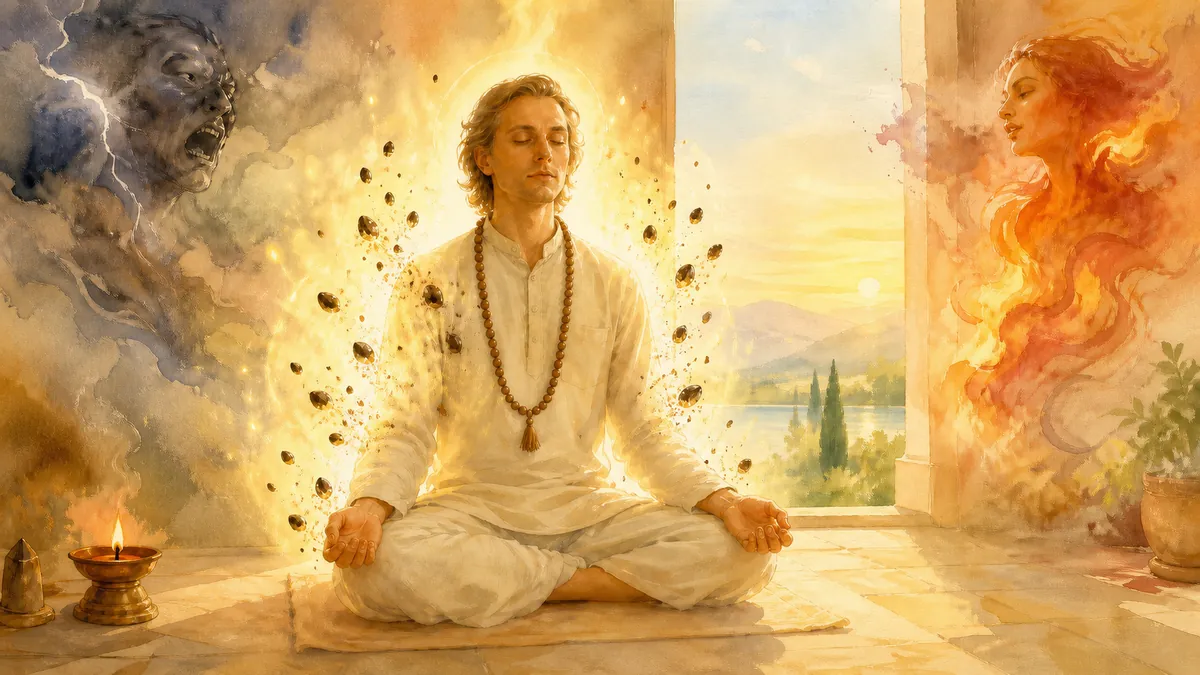
What does it mean that “karmas will not unfold”?
The unfolding of karma means such a response of consciousness when a new tunnel of reality opens, a new variable universe in which a certain layer of karmic vision unfolds.
It is similar to when you are sitting in retreat and, during mahashanti, a thought visits you: “It would be good if...” Then you already forget the theme of the mahashanti meditation, and this thought unfolds and gains strength; then a three-dimensional video image arises in which you are the acting hero and lose yourself. It may be like an entire film in which you are the main participant.
New karmas are created in the bardo in approximately the same way, but with the difference that there is a complete transference of consciousness, and the subtle body acquires a gross shell.
When the stability of self-liberation has been attained, the unfolding of new universes, new karmic tunnels, does not occur. They flare up but instantly dissolve in the Supreme Source. Then it is said that the yogin has burned all his own karmas; he no longer has causes for rebirth, and therefore he will no longer be reborn in any of the six worlds of samsara or anywhere else. Rebirth for him is possible only by his own wish, if that is his will.
The Influence of Secondary Causes on Consciousness
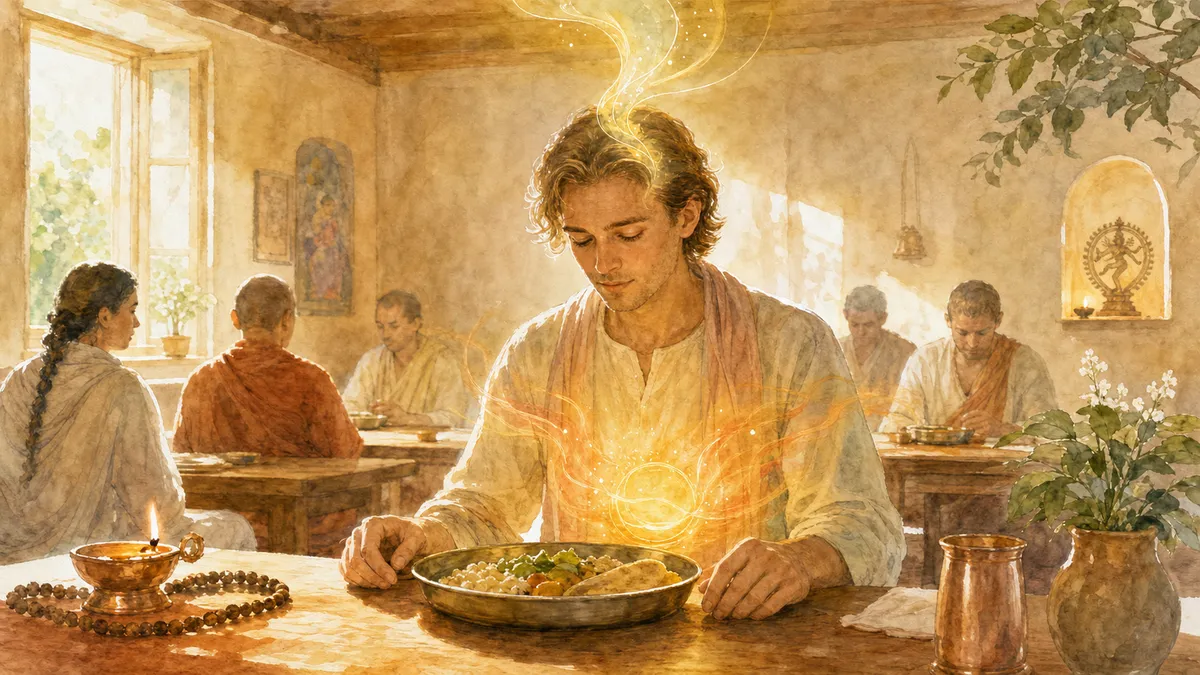
A secondary cause can open something elevated in a person, but it can also reveal something unconscious. For example, after a retreat you are walking in deep contemplation, then you sit down to receive prasad—your eyes light up; the sankalpa is forgotten, there is no longer any globality, majesty, or clarity, but only absorption. You receive prasad and then remember that a very subtle consciousness had been lost. Why does this happen? Because the powerful energy initiated by the manipura chakra excites the consciousness, and when it encounters such a great temptation, such energy, it does not manage to remain clear. This is an example of how a secondary cause can awaken a lower consciousness.
Or, conversely, you meet a holy person, encounter a sacred text, a statue, a bhajan, and this awakens an elevated feeling in you, leading to an expansion of consciousness. Your consciousness changes within minutes, as if an entirely new realm opens up, filled with inspiration, clarity, and understanding. This is an example of how a secondary cause awakens higher subtle karmas.
When a secondary cause is awakening, conducive to the expansion of consciousness, it is called merit. When a yogin accumulates many such positive secondary causes, he accumulates a great deal of merit—this is the meaning of service.
When many secondary causes have accumulated, meditative experience develops without obstacles.
