

Commentary on Ramalinga Swamigal's text “The Divine Song of Grace”
“I have crossed the seas of darkness and evil. I have reached the shore of light and truth. I have seen what must be seen. The doors of the temple of Reality opened before me, revealing breathtaking sights within. There I tasted the nectar of immortality, which removes all flaws and imperfections.
By the Light of God's Grace, I comprehended everything and resolved all doubts and questions. I attained the form and essence of eternal Wisdom. I attained the state of immortality.
My body, mind, and soul are immersed in ecstatic bliss. I am filled with Perfection and Reality as it is.
When I overcame all ignorance, imperfections, and evil, all the siddhis came to abide within me.
Hear this! All these are the blessings of the Lord's grace, dancing in infinite compassion in the heart of Reality.”
Spiritual life begins when we ask ourselves: “What am I? Who am I? Where am I?” We try to engage in inquiry—vichara.
Vichara is of two types: bahir-vichara, which concerns external objects, and antar-vichara, which concerns internal objects. Bahir-vichara explores external material energy—maya-shakti. Such external inquiry is undertaken by scientists who study the laws of the material world in detail. However, the study of external material energy does not lead a person to happiness, because external material energy is lifeless samsara, which by definition cannot bring happiness to a person.
There is another type of energy—marginal energy (tatastha-shakti). It is also called kshetrajna-shakti or jiva-shakti. We humans belong to the marginal energy. This energy is connected with our soul and our mind. By exploring it, we can understand what the physical body is, what the energy body and the astral body are, what the mind, manas, and buddhi are, what prana is, and what consciousness is. And to some extent, antar-vichara, directed inward toward the marginal energy, provides an understanding of ourselves and other worlds; it makes our consciousness freer and wiser.
However, by exploring the marginal energy, we cannot attain absolute, eternal happiness. Absolute, eternal happiness is contained in another type of energy called “atma-shakti” or “antaranga-shakti.” That is where our original home is; there lies primordial, infinite, eternal happiness. This is the place from which we came. It is the energy of God. And it is there that we must return—home, back to God. This is our original abode, our original essence; this is where we all came from at the beginning of creation.
The Unfolding of Creation and the Emergence of Karma
How did everything occur at the beginning of creation? Brahman began to unfold, and for this purpose His three powers—Brahma, Vishnu, and Shiva—manifested. From this, the unfolding of the universe began. And at the moment of this unfolding, some particles of Brahman understood: “I am Brahman,” and therefore they did not fall into delusion. The universe unfolded, but they remembered: “Aham Brahmasmi” (“I am the Absolute”); they did not lose this memory. And to this day they retain this memory and delight in it because they possess nitya-sukriti. These are the gods Brahma, Vishnu, Shiva, and Dattatreya. Owing to their nitya-sukriti and possession of jnana, these divine souls did not lose their awareness or their unity with the Absolute.
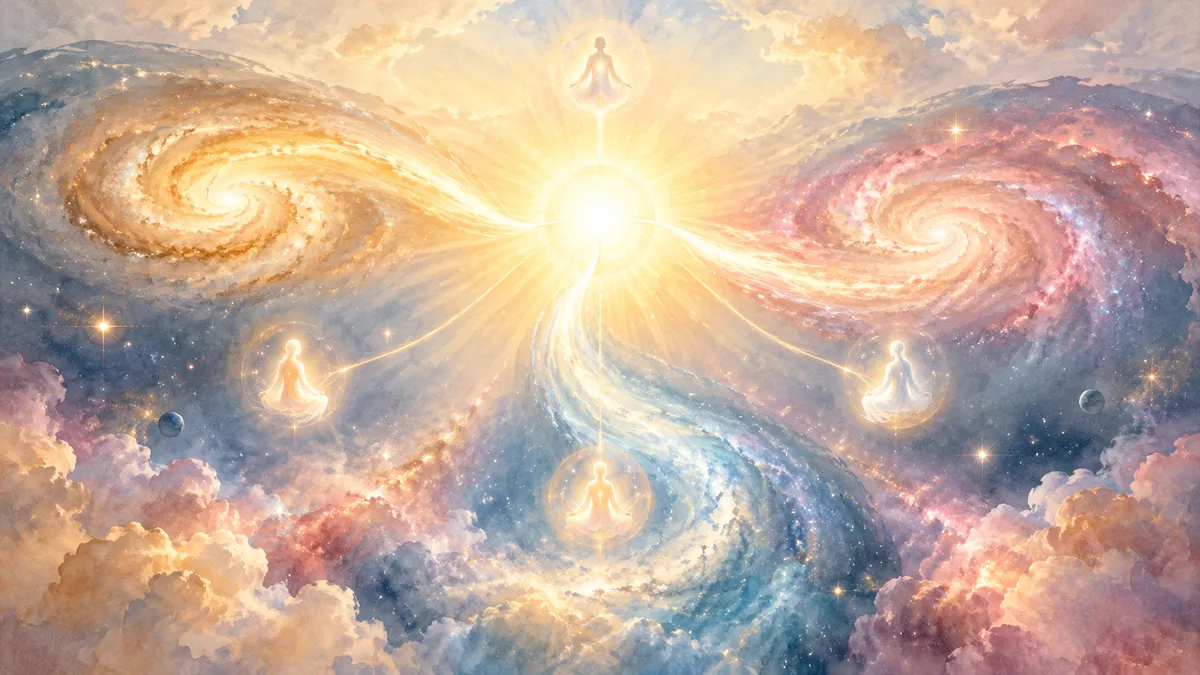
But there were other souls as well. These were souls that lost their memory of unity with the Absolute and became conditioned by the unfolding energy. And those souls are us. These souls became conditioned, fell under the influence of material nature and the five elements, began to lose their luminosity, and developed an identity in accordance with their karma and body. Before the souls began to be conditioned, while they still identified themselves as “Aham Brahmasmi,” there was no karma at all; they were like a blank sheet, a clean slate. But as soon as the first bound souls (bandhikas)—that is, souls dwelling in ignorance—appeared, they spontaneously began to identify themselves: “This is what I am.” At the same time, memory and karma began to arise. In other words, karma had not existed before; it began to appear together with their ignorance.
Karma does not originally exist, but at the moment when the soul identifies itself, karma, in the form of memory, is, as it were, loaded by the Absolute so that it can be processed. Identification arises, and as a result, cause and effect arise. It is similar to how there is no karma in a dream, but when a person enters a dream and acts within it, a certain identification and a kind of memory arise, and the person becomes entangled in all of this; once they are entangled, karma already exists.
Our task is to return to that original state in which there is no karma and which is free from the creation of the material universe. This state is the energy of God, atma-shakti. We should direct our inquiry not toward the external material energy (maya-shakti), nor even toward the marginal energy (tatastha-shakti), but toward the energy of God (atma-shakti). We need to deeply explore the nature of this Divine energy, in which there is no karma, creation, time, or space. It is a world composed of absolute categories—the world of sat-chit-ananda, the world of infinite parameters.
If we take infinity and subtract infinity from it, the result will be infinity. If we take infinity and divide it by some number, the result will still be infinity. If we add infinity to it, divide it by infinity, then multiply it, then divide it again, and perform a great many mathematical operations, the result will remain the same infinity. This is because the laws of human history, human mathematics, human logic, human relationships, biology, chemistry, and physics do not apply in the world of God. And this is the original world of God from which we fell and set out to wander through the endless cycle of samsara.
The Necessity of Faith and Self-Surrender
Through the exploration of this Divine energy, through inner self-inquiry (antar-vichara), we need to turn toward this Divine energy. However, inquiry alone is not enough. Shraddha—faith, sharanam—refuge, shuddha sharanagati—pure, complete self-surrender and devotion—these are also necessary.
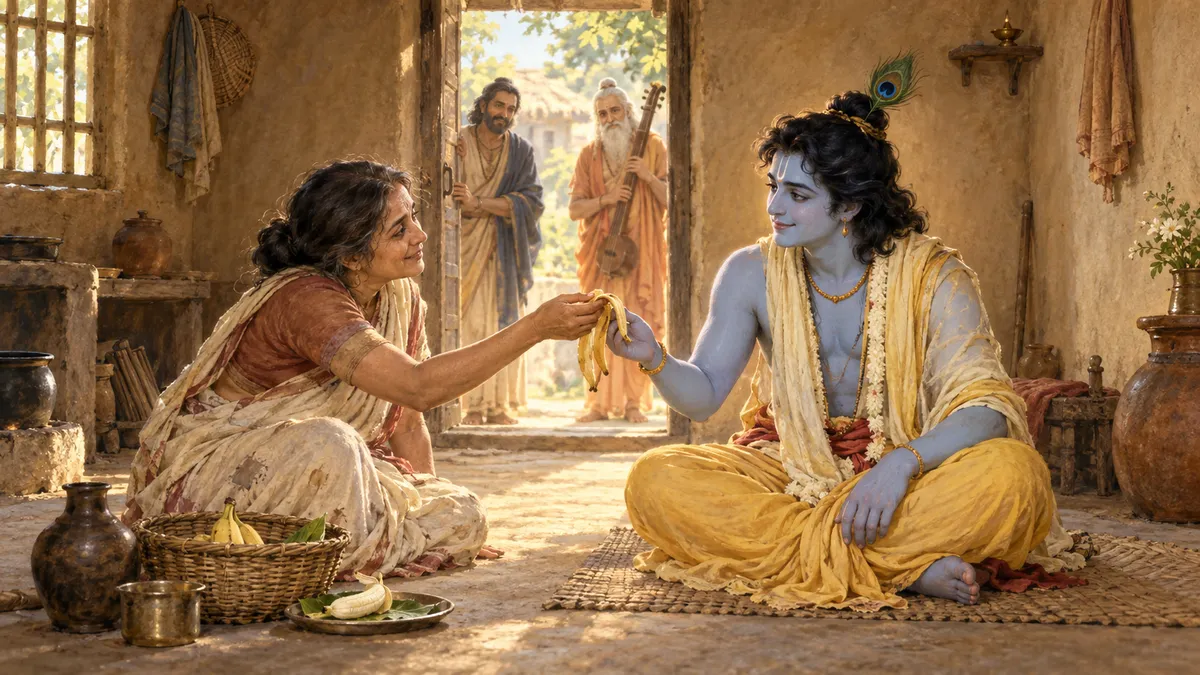
Krishna had a disciple named Vidura. Vidura had a wife. One day, while Vidura was away from home, traveling somewhere through other worlds with the sage Narada, Krishna happened to visit Vidura’s house. Vidura’s wife was so inspired by devotion that she decided to feed Krishna, but since they were poor and had no special prasada, she took some bananas. When she began peeling them, in her excitement she threw the bananas themselves into the trash and offered the peels to Krishna. But Krishna, as though nothing were amiss, took the peels and ate them. She was so overwhelmed by devotion that she seemed somewhat beside herself. At that moment, Narada and Vidura returned home and saw Vidura’s wife gazing at Krishna with deep devotion and feeding him banana peels while throwing away the bananas themselves, and Krishna was eating the peels. Vidura began shouting, “What are you doing?! Look, you are throwing away the bananas and giving Krishna the peels!” Narada began calming him, saying, “She simply became overwhelmed.” And Krishna said to them, “I am eating neither the fruit nor the peel; I am accepting her devotion!”
This is a very important point. Our devotion is what matters to God. Our outward offerings do not matter to Him; what matters to Him is the bhava and the intention behind our offerings. It would be naive to think that Dattatreya could not do without the yogurt, incense, or flowers that we offer, but sankalpa, intention, faith, and devotion are what establish the connection between jiva and Shiva, between the soul and the Absolute.
Contemplating the Greatness of God Reveals Another Reality
“My Lord! You are the incomparable amrita of Grace that transforms young souls into mature ones.
You are the Deity eternally present before my eyes.
You are the magnificent Presence filled with bliss.
You are the mountain of merciful Light.
You are my Father, loving me as all the mothers in the world combined would love.
You are the Supreme Lord, the One without a second.
When I think of Your greatness, I become absorbed in the contemplation of Your greatness, and my entire mouth is filled with nectar, my entire mind is filled with nectar, my entire intellect is filled with nectar.”
Listen to these magnificent instructions! These are direct instructions on how to be a saint and how saints think.
What does it mean to think about the greatness of God? In the terminology of the Laya Yoga teachings, this is called Brahma-vichara. Throughout our lives, we must follow two things: Atma-vichara and Brahma-vichara. In essence, they are one and the same; we merely enter through slightly different doorways. Here, Ramalinga gives instructions on Brahma-vichara, saying, “I contemplate the greatness of God.” To contemplate the greatness of God means to abide in the state of Brahma-vichara. This means first reflecting on the Absolute with the help of the intellect and non-conceptual awareness, contemplating the greatness of the Absolute and its qualities, and then proceeding to direct non-mental contemplation. Ramalinga says, “When I contemplate Your greatness, my mouth fills with nectar.” This means that the processes of Chandali Yoga begin. He experiences ten types of nectar. “My mind fills with nectar”—this means that the fruits of immortality blossom in consciousness, and another reality—transcendent, beautiful, wondrous, and magical—unfolds.
Realization does not occur in worldly reality, in profane reality. Divine realization does not occur in the realm of political realities. Nor does realization occur in the realm of the economic realities of the international community. Realization also does not occur in the realm of scientific knowledge, scientific concepts and notions, or in the realm of mathematics, physics, and biology. Realization does not occur within an ordinary, everyday mentality. All these are realms where the Divine is forbidden, where realization is forbidden. These are realms of humanity’s conditioned and impure karmic vision, which, from the perspective of the saints, collectively follows the path of ignorance, the path of delusion. And although the saints constantly try to guide it somehow, admonish it, inspire it, and sometimes even save it, the fact remains: the world is the world. It would not be the world if it did not follow the path of ignorance—this is, one might say, its dharma.

The dharma of this world is to follow the path of ignorance; that is normal for it. At first, this may even cause great surprise, but later we understand that it is normal. For the beings of hell, it is normal to suffer; it is normal for them to be tormented. For beings from the realm of hungry ghosts, it is normal to be dissatisfied, despondent, constantly yearning, full of grievances and greed. For beings subject to the factor of ignorance, it is normal to be dull-minded. For asuras, it is normal to compete and wage war; this is normal for samsara.
For this material world, it is normal to abide in ignorance. But for a sadhu, this is not normal, because he knows that divine realization does not occur in the dimension of this world at all. It occurs, as it were, on the other side of the looking glass—in a sacred, pure, exalted, divine dimension where the laws, relationships, vision, and understanding are entirely different. And the sadhu gradually purifies his heart through faith, devotion, refuge, and seva. He enters this sacred, pure dimension, and it is precisely there that realization occurs. Moreover, this realization does not occur through effort; it occurs through the descent of divine grace. In other words, God assumes responsibility for our realization. Just think—God has taken responsibility for your realization! Lord Dattatreya and the saints have taken responsibility for your realization. But they can assume responsibility for your realization and lead you to it only if you enter this sacred dimension. Only then. If you do not enter it, they cannot take responsibility for you.
This resembles the following situation. If a person arrives in a particular country, then until they cross its border, that country assumes no responsibility for their medical insurance, safety, protection, provision of services, and so on. But once they have crossed the border, they become a guest of that country and are covered by all the benefits, insurance, and services that the country undertakes to provide as the host.
And we must enter this dimension. Only then will Anugraha, divine grace, touch us. We must move into this sacred dimension in which realization is possible. If we remain in an ordinary state of mind—egoistic, worldly, dualistic, attached—the saints will say, “We cannot yet.” Lord Dattatreya will say, “He still needs further preparation; he does not yet come under our law of blessing, our law of Anugraha.”
Preserving the Nectar of Divine Blessings
“How can I hold fast the all-consuming bliss born of this nectar?
O divine Light, surrounded by the bliss of Grace and bestowed upon those who are pure in heart!
O mighty Lord, standing in the heart of the field of turiya!
O Lord, my Master, abiding at the center of Creation in Your ineffable radiance of Grace!”
Ramalinga says, “How can I hold fast this bliss bestowed by its nectar?” What does he mean? How can it be held fast? Here Ramalinga is speaking of nididhyasana. Nididhyasana is the third step among the three main principles in Sanatana Dharma, in Laya Yoga. Nididhyasana means that you truly take hold of God’s feet and never let them go. You have caught this bhava, you have caught this experience of nonduality, and you continuously sustain it. This bestows constant bliss, ananda. But your task is not to lose it. You cannot hold fast divine bliss (ananda), the state of awareness, continuous presence (sahaja samadhi), even if you take pliers or some kind of vise and begin tightening it. It can be sustained only by two things that always go together: continuous attentiveness and continuous devotion, continuous self-surrender.

Ramalinga says, “Only one who is pure in heart.” In the course of practice, our heart must be cleansed of six undesirable qualities: krodha (anger), kama (lust), lobha (greed), mada (pride), matsarya (envy), and moha (delusion). Again and again, we must remain vigilant, cleansing and purifying our spirit of these qualities. These are anarthas, that is, undesirable qualities; they are like weeds that grow in a greenhouse. If the soul is likened to a beautiful garden in which you want to grow beautiful flowers, then undesirable qualities (anarthas) are like weeds that accompany all work in a greenhouse, and you must notice them in time and uproot them mercilessly. You should ask others—more senior sadhus, wiser and more experienced sadhus—to help you do this. Without embarrassment or any inhibitions, you should tell them, “If you see something in me, please help me. Even if I do not see these things myself, please help me and point out these weeds so that I can pull them out.” If you approach senior sadhus in this way, they will always help you, because experienced, skillful sadhus never wish to humiliate you, taunt you, catch you making a mistake, exploit your negative qualities, or manipulate you. They only wish to help you. Sometimes they may behave delicately and not even intervene. They may think, “He sees everything himself and will figure it all out on his own.” But sometimes it is very helpful to receive guidance from senior sadhus, and the more direct such guidance is, the better it is for your spiritual life.
When we are able to uproot all anarthas (undesirable qualities), our heart becomes pure, and then we can hold such nectar of Divine blessings; we can always remain in the state of prapatti yoga—in self-surrender, in meditation on the Absolute. And then the qualities of sat-chit-ananda gradually begin to seep into us. There is a saying: “If you gaze long into the abyss, the abyss begins to gaze into you.” If we begin to gaze at God for a long time, to live by the realities of the divine dimension—not by selfish earthly realities, but by transcendental realities—then these realities gradually become part of our lives; we become their bearers, we become saturated with them. The following example may be given (though it is not entirely dharmic): if a plum is placed in alcohol, it will become so saturated with it that whoever eats it will become intoxicated. In the same way, we need to become like such a plum, saturated with the nectar of the Divine. And when we are sufficiently saturated with the nectar of the Divine, our karma departs, our illusions depart, and our ego also gradually recedes through the power of this nectar.
Preparing for the Coming of the Lord
“My Sister!
The time has come for the Lord of mercy to arrive.
Hurry to light countless beautiful lamps.
When lighting them, I implore you, use only fresh cow’s ghee.
Anything else may mar the wondrous countenance of my Lord.
Sister!
Do not ask: ‘But there is no darkness; it is still morning, so why light the lamps?’
Understand that fire is an auspicious symbol of my Lord’s coming.
Listen, my sister.
Do not be troubled; let your mind be clear.
Countless suns, moons, and burning lamps taken together cannot even begin to compare with the radiance of my Lord.
My Sister!
You say: ‘Tell me about your Lord.’
My Lord is boundless Energy manifesting in manifold ways.
He spoke as though to me alone, with words that brought sweetness to my entire being.
“My sister!
You ask me: ‘How sweet were the Lord’s words?’
Let me try to tell you.
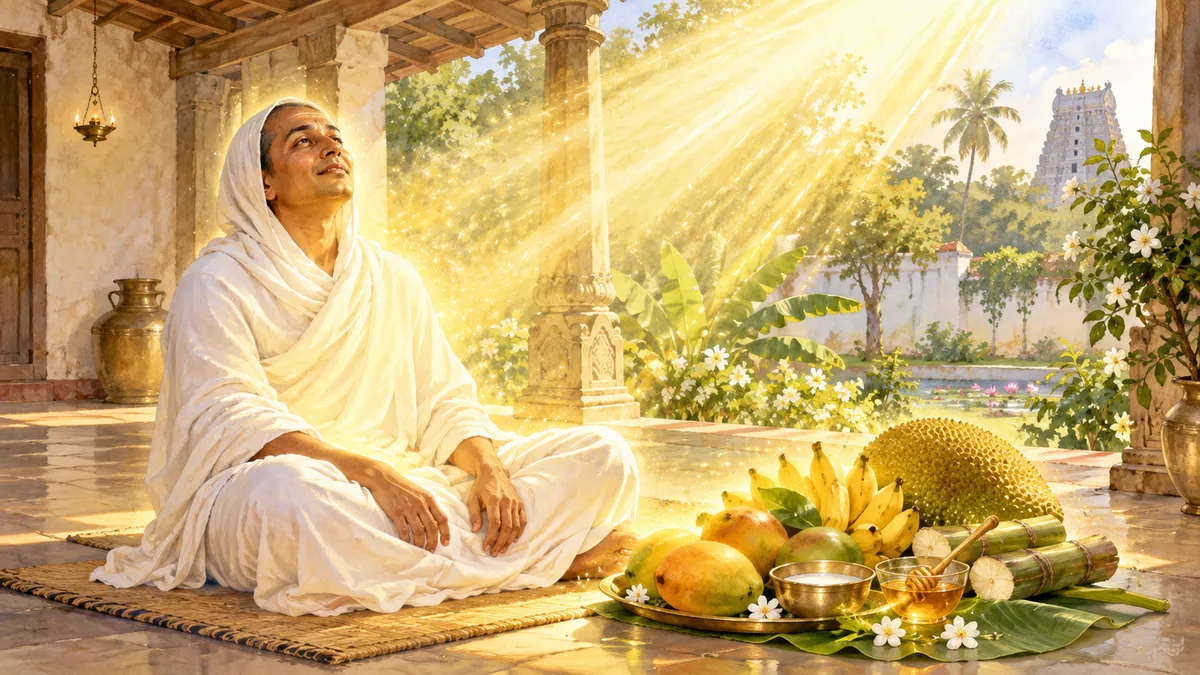
Choose the most delicious fruits of the finest mango, jackfruit, and heavenly banana.
Squeeze out their juices, strain them, and blend them together.
Add the fragrant juice obtained from the heart of the sugar cane,
Pour in cow’s milk.
Add fresh honey from the honeycomb.
Blend all this into the purest amrita.
As sweet as this amrita is to your taste, so sweet were the words the Lord spoke to me to my entire being.”
Ramalinga speaks of sweetness, but this is not human sweetness; it is the sweetness of experiencing ananda. And he says that this ananda arose from certain words that God spoke to him. But God does not speak in human language; God speaks in paravani—the non-conceptual language of nondual bhava. When Ramalinga says that He spoke words to him, this is nothing more than a metaphor. He speaks words by kindling light in consciousness, by kindling nondual Brahma-ananda. And what Ramalinga heard from God awakened this rasa within him.
“My sister!
You say: ‘Tell me of the greatness of your Lord.’
Truly, by speaking to me in words that were nectar to my entire being, the Lord betrothed me, and I became one with Him.
But do you really think I can express His greatness?”
“The Lord has betrothed me, and I have become one with Him” means that Ramalinga attained sayujya-mukti; he attained the third stage—pratyabhijna (self-recognition). When he surrendered himself completely to the Absolute and united with Him, he attained sayujya-mukti, and at that moment complete self-recognition occurred. Complete self-recognition means that the jiva realizes: “I am Shiva.” The soul realizes: “Aham Brahmasmi.” It realizes: “I am not Prakriti; I am Purusha, and Purusha is the Absolute.”
After this realization, the soul is free to choose any rasa, any lila (dvaita, advaita, vishishta-dvaita), and use it to play within the relative. The soul abides in the relative, but in the absolute it is always inseparable from God—this is how view and conduct are united. In conduct, the soul manifests within the relative, using all relative categories, while in its view it maintains the spirit of nonduality. Some souls manifest nonduality in their conduct, other saints choose duality in their conduct, while still others choose the inconceivable identity of duality and nonduality (achintya-bheda-abheda).
The Inconceivable Greatness of the Divine
“No, my sister! Having become one with my Lord, it is utterly beyond my power to express His boundless and inconceivable greatness.
Hear this! The form of my Lord is limitless Energy manifesting in countless ways.
Listen, my sister!
Myriads of minute particles emerge from the sandals of the lotus-like feet of my Lord, who dances in the heart of Creation.
Some particles become countless millions of great Rudras, Mahadevas.
Some particles become countless millions of Brahmas seated upon lotuses.
Other particles become countless millions of Indras, kings of the gods.
Becoming lords such as Rudras, Narayanas, Brahmas, and Indras, they perform the cosmic functions of creation, preservation, and destruction.
My sister! If such is the greatness of the minute particles emerging from the sandals of my Lord’s lotus-like feet, who could comprehend and express the boundless and inconceivable greatness of His holy feet?”
A sadhu is one who constantly concentrates on God. And when you become disciples of a guru, everything the guru teaches you within a line of unbroken succession is the ability to comprehend God and His energies. He does not teach you worldly wisdom, the psychology of relationships, or worldly sciences, considering them not so important. All these things are transient, temporary, and based on delusion. Worldly sciences are helpful in worldly life, but they do not help resolve life’s central question: “How can one go beyond the cycle of birth and death? How can one attain supreme wisdom, happiness, and understanding?”
A sadhu is one who concentrates on God at all times and learns to comprehend Him. But Ramalinga says: “He cannot be comprehended; He cannot be described,” if merely one realm of Divine reality gives rise to countless Brahmas, Vishnus, and Rudras who create new universes.
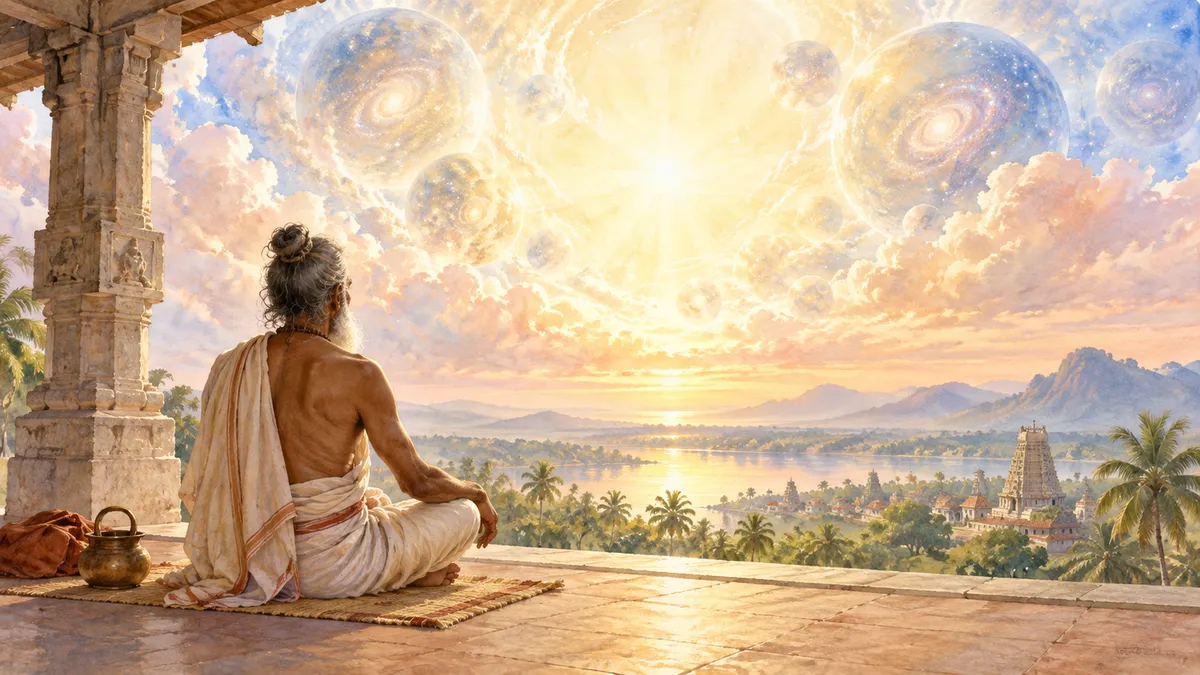
We now live in the Milky Way galaxy. This galaxy belongs to the so-called Local Group. And the Solar System is located somewhere on the outskirts of one of this galaxy’s arms. The nearest neighboring galaxy to the Milky Way is the Andromeda Galaxy. And the Andromeda Galaxy is hurtling toward the Milky Way at a speed of four hundred kilometers per second. Scientists have calculated that in four billion years, the Andromeda Galaxy will eventually crash into the Milky Way, and something incredible will happen—the two galaxies will collide and merge. Most likely, our Milky Way galaxy will then disappear. The Sun will collide with something; the Earth, all the planets, and the stars—everything will be mixed together, and this will happen in just four billion years. If humanity has not moved to another galaxy by then or learned to fold time and space like a hide, it will face serious difficulties.
But from God's perspective, these global metacosmic processes are nothing. Four billion years is merely an instant before the face of God. Galaxies are merely specks of dust before the face of God, for myriads of Rudras, Brahmas, and Shivas are constantly being generated from the state of Divine reality, and new universes without end are constantly flaring into existence.
We cannot comprehend this with our ordinary mind; it can be realized from the state of samadhi, from the state of self-surrender beyond the mind. It can be understood from the sacred reality in which Ramalinga lives, but it cannot be understood by the human mind. No hundreds of volumes of scholarly books can describe it. All scholars are fools in the face of this experience.
Realization Occurs Through Divine Grace
“Hearken, inhabitants of the Earth!
The time is drawing near for the coming of my Father, the Supreme Lord, the One without a second. This is indeed true.
The Lord gave me beautiful ambrosia for my mind; its sweetness was like that of a fragrant fruit.
The Lord transformed my human body into the immortal body of eternal Truth.
It is no wonder that the sages of all seven worlds marvel at the merciful miracle wrought by my Lord.”
Notice that Ramalinga does not say, “I attained an immortal body”; he says, “The Lord transformed me into an immortal body.” He calls it a miracle because it happened through the descent of Anugraha. In the same way, all realization occurs as Divine grace through the descent of Anugraha. You cannot attain realization. But you can achieve success in yoga by performing asanas and pranayamas well.
For example, there are jala neti championships. People compete to see who can pour the most liters through their nose and how quickly. There are even jala neti champions who pour as much as 30 liters. Such maha-yogis. I laughed so much when I learned about this. You can attain this too, if you wish. But a true sadhu would be bewildered by such achievements.
There are hatha yoga championships. If you practice hatha yoga very diligently for six hours a day, you may even earn the title of “The Most Flexible Person on the Planet.” Hatha yoga competitions are held annually. I practiced hatha yoga for twelve years, but I never considered myself a hatha yogi. Hatha yoga is a specific set of exercises, but it never even occurred to me to try to attain anything through hatha yoga. You can purify the channels, you can awaken kundalini, but realization is attained through Divine grace, through the descent of Anugraha; you yourself cannot attain anything here.

The most you can do is simply step aside, become empty, and not hinder God from enlightening you. The entire problem on the spiritual path is that God is ready to enlighten us with the light of His Wisdom, but we hinder Him; we stand there, clinging on with our teeth and elbows, and we do not let Him enlighten us. What we are is our ego, our mind, our karma, our dualistic notions. Finally, when we understand that we must simply step aside and make the space empty, this process of descent becomes possible. And Ramalinga says that God made him. It was not I who made myself; God made me.
The Body of Light Is Formed by Proto-Elements
“The Lord gave me all the powers of perfection.
Now the time has come for my Lord to establish me in the highest bliss—Shivanandam.
I prayed for an eternal, imperishable, godly life unaffected by wind, earth, space, fire, water, the sun, the moon, and the stars; unaffected by death, disease, deadly weapons, and planets; and unaffected by the violent influence of other beings and forces.
My Lord did not delay in granting it to me.
O inhabitants of the Earth, do not take lightly these gifts that I have received.
Follow this path, the path of my Father, the path of the radiant Lord of Light.”
Through Divine grace, Ramalinga attained a body impervious to pain, suffering, death, earth, water, fire, wind, and space. This body is made of atma-shakti, the purest energy of God. In the state of the Absolute, there is no worldly water or worldly earth, no impure fire or impure wind; all the tattvas are absent there. Or, if they are present in combination, they are present there in pure vision. Pure water, pure fire, pure air, pure wind, and space are proto-elements.
Proto-elements are the divine essence of earth, water, fire, wind, and space. And Ramalinga received a body composed of divine proto-elements. These divine proto-elements make him impervious to wind, fire, cold, rain, hunger, death, destruction, and harm from other living beings. His body is not composed of external energy (bahiranga-shakti, maya-shakti), nor is it composed of the energy of the subtle world (jiva-shakti, or marginal energy). It consists of the energy of God, of the elements of God, and this occurred through the descent of grace and Ramalinga's self-surrender.
Guru Brahmananda attained the same kind of body. It is sometimes said that he died in 1986 and that his body is in maha-samadhi in Omalur. But he merely left behind a body so that it could be worshipped as a relic, and he continues to be seen to this day. If he continues to be seen, how could he have died? He is immortal. For beings such as Brahmananda and Ramalinga, death does not exist. It is something like a performance for others: “Here is a body for you; here it is, dead and shrunk to sixty centimeters. Worship it, build a maha-samadhi shrine, visit it, come and meditate nearby, while I continue to roam freely.” This is the level of realization attained by Ramalinga and Swami Brahmananda. Dattatreya is also an immortal who appears before those who sincerely invoke him. They all have their abode on the plane of God's energy, and their bodies are made of the elements of God.
Bliss Surpassing All Worldly Joys
“My Lord!
The gentle, nectar-like moon radiates its refreshing light.
The flowers in the garden, amid the cool waters, lavishly bestow their fragrance.
The whispering southern breeze blows softly.
Enchanting music drifts across the marble courtyard, made even more mesmerizing by the moonlight, while cool rosewater drips from the sky.
All this splendor is crowned by the grace of the Goddess, who, like a virtuous wife, offers the pure amrita of her loving tenderness.
Truly, this is a rare joy!
Yet even it pales and seems insignificant and meaningless beside the bliss that You, God of gods, have bestowed upon me, Your poor servant, through Your great grace. This bliss stretched before my eyes like a river of the nectar of immortality, so that it might flow through this body as a life-giving stream.”
The state of awareness begins with attentiveness, atma-vichara, and sustained observation, but it does not end there. Sooner or later, it must unfold into something greater. One aspect of this greater state is the experience of ananda (bliss). Becoming established in awareness and self-surrender, the yogi proceeds from lesser bliss to greater bliss, and from great bliss to still greater bliss.
Along with bliss, he reveals another aspect of purity—pure vision, about which we speak so often. At first it is intellectual, but then the yogi discovers purity as an essence, as the tattva underlying all the elements. He then discovers the purity of all the tattvas and proceeds from one degree of purity to an even greater purity. And these two factors—purity and bliss—accompany the sadhu throughout his entire spiritual path. He moves toward ever greater purity and ever greater bliss.

He rediscovers what previously seemed ordinary to him. He rediscovers all the surrounding tattvas, all the relationships around him on the spiritual path. He discovers the principle of the guru as immeasurably deeper, he discovers the principle of the ishta-devata as immeasurably deeper, as well as the principle of samaya, the principle of worship, and the principle of his own self. In everything, he discovers ever greater depth. He no longer seeks anything outside himself; he does not intend to perform any great deeds or be a great doer; he does not seek progress outside himself. He understands that his entire evolution, all his progress, lies in deepening and revealing these aspects of the Divine—ananda, purity, and many others. He reveals them more and more fully.
