Commentary on the “Shiva-Stotra-Vali,” Hymn 20. The Savored Meaning
I worship the Teacher, the Lord of the Three Worlds, gray with ashes, three-eyed, wearing a serpent as a sacred thread and the crescent moon as a crown. Reverence to Him who wears as His own garment a brilliant halo of radiant rays, adorned with a gleaming garland of skulls for the festival of the dance at the end of the world. I bow before the eternally sacred abode whose deity is Hara, whose energies are worthy of Hara, whose breath and life are dedicated solely to Hara. Beyond Your sovereignty lies yet another of Your diversions: through absolute will, I discover spontaneous means for Your magnificent deeds. When the entire universe worships this very diversity of Your splendor—the mere play of the world—how infinite must Your bliss be! How could anyone beloved by Hara’s Gauri not be happy, and how could Hara not be Gauri’s supreme beloved?
Signs of the Purification of the Mind and the Development of Spiritual Qualities
A sign that you are purifying the mind and purifying karma is that you establish a connection with God and begin to experience devotion, love, and happiness as the other side of contemplation. Contemplating the experienced mind beyond concepts, moving away from concepts and definitions into pure awareness, is a sign of the development of brahma-aham-bhava; the development of devotion and love for God is a sign of the discovery of divya-bhava.
A great many people who are interested in Advaita Vedanta argue extensively about it, but these arguments lead nowhere because they are not based on truth but arise from the mind. Sometimes from the gross mind and sometimes from the subtle mind; however, to avoid arguing from either the gross or the subtle mind, the tradition of Advaita Vedanta relies on the sacred scriptures.
Reliance on the Sacred Scriptures
“Mumukshuh shrutim ashrayet, kutarkam santyajya mumukshuh shrutim ashrayet” (“Having cast aside false disputes or deceptive, fallacious logic, the seeker of liberation [mumukshu] must surrender to the shastras”), rely on the shastras and use the shastras. The shastras are, for example, the Upanishads, the Agamas, and revealed scriptures given by gods and saints. Relying on one’s limited experience and understanding, a person cannot judge such great matters until they have become a saint. Perhaps Brahman is like this, or perhaps like that, or perhaps not like that. Perhaps it is this way, or perhaps that way—everyone may have their own opinion, but we cannot rely on opinion. Faith cannot be built on opinion, nor can spiritual life be built on opinion; therefore, the tradition of Sanatana Dharma relies on sacred texts, on the shastras.
One should not rely on false logic (kutarka). Instead, one should rely on true logic (sattarka). Sattarka is logic shaped by knowledge of the sacred scriptures and grounded in them.
Grace as a Criterion of True Practice
A great many souls who have no spiritual experience engage in disputes, yet they themselves are unhappy. If they were happy, they would not even argue; they would be happy and would transmit ananda and impart wisdom to others. But the absence of happiness means the absence of grace; that is, spiritual life has not led to grace, has not opened the space beyond the mind, has not opened the space of ananda, has not opened the space of freedom, has not opened the space of independence and self-liberation from all opinions, and has not opened the space of purnatva (self-sufficiency), where there is no need to assert one’s point of view, where every point of view is accepted in all-embracing acceptance, yet each is assigned its proper place.
The source of grace is devotion and love for God, both in Advaita Vedanta and in Shaivism. A grace-filled practice is always true. A graceless practice is always false, and it is easy to determine whether grace is present by how satisfied a person is with their spiritual path, or whether they are dissatisfied.
For example, there may be someone who holds certain ideas about Advaita and defends them very forcefully. They fear that if they fail to defend them, their point of view will collapse, and their belief about Advaita will be destroyed. But how necessary is this if you abide in the non-conceptual vision of Brahman, if you are filled with grace? You do not need it; you bless everyone. A grace-filled practice leads to the experience of the true Brahman, the experience of the true Shiva, and the experience of true contemplation.
Just as the roots of this sacred tree lie in majestic and eternal recognition, so too are the branches of perception formed. When the thirst for devotion flares brightly, worship enters one’s being like the great setting of a tarnished jewel.
The Unity of Jnana and Bhakti
Thus, the thirst for devotion must be accompanied by the thirst for contemplation. The thirst for liberation must consist of two thirsts—the thirst for contemplation and the thirst for devotion. The thirst for contemplation is jnana, and the thirst for devotion is bhakti. At the same time, in the traditions of Shaivism and Advaita Vedanta, bhakti yoga differs from, for example, bhakti yoga in Vaishnavism or in certain dualistic teachings. Nondual nirguna bhakti does not imply a separation between oneself and God in one’s view.
As these two thirsts—jnana yoga and bhakti yoga—deepen, they develop into something concrete. Thirst means that there is a search, an intention to follow this path, an invocation of this path, and entering upon it. The thirst for devotion becomes Guru Yoga, Ishta Devata Yoga, Ishvara Yoga, and a concrete practice—upasana, mantra yoga, illusory-body yoga, in general, tantric sadhana of worship and specific sadhanas. When our thirst for devotion develops into a specific yogic practice and is performed in a specific way, this thirst is satisfied—it is satisfied by divine grace in response.
The thirst for nondual awareness, for nondual contemplation, is jnana yoga, and it too develops into concrete practices. Shravana, manana, nididhyasana—listening, cutting through doubts by means of analysis, and continuing meditation on Brahman (pancha-kosha-viveka), revealing the meaning of the mahavakya “Tat Tvam Asi,” proceeding to meditation on the mahavakya “Aham Brahmasmi,” entering natural nondual awareness, discovering it, deepening it through Mahashanti meditation and the twelve sankalpas, followed by the further practice of contemplation and progression through the seven grounds of wisdom.
This is concrete jnana yoga—that is, both bhakti yoga and jnana yoga. These two thirsts—the thirst for devotion and the thirst for knowledge of the Absolute—develop into two yogas; the two yogas develop into concrete practices, and two forms of grace come in response. The grace of bhakti yoga comes as divya-bhava, devotion, divine majesty, divine love, and the transformation of energy. The grace of jnana yoga comes as brahma-aham-bhava (awareness of Brahman). These two forms of grace shape the yogin’s spiritual path. Without these two kinds of grace, it is difficult to speak of spiritual realization.
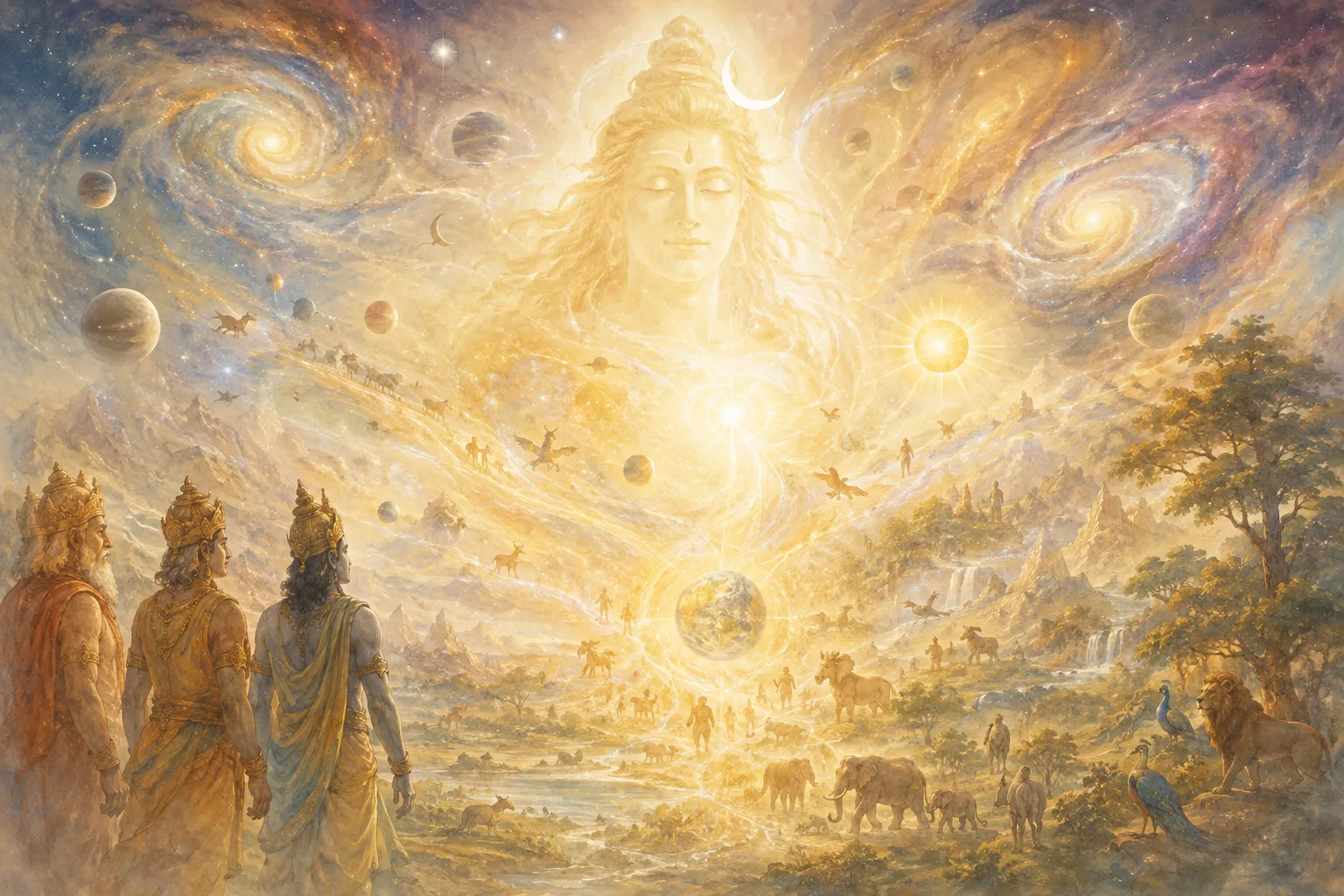
Glory to the Teacher, whose play is the act of creation, who delights in preservation, and who rests contentedly, satisfied with the food of the three worlds. I bow to those who, going nowhere and acknowledging nothing, nevertheless see all of this as your magnificent abode. What more is there to desire for those who revolve in the abundance of devotion? For those deprived of it, what else is worthy of desire? Where even suffering is transformed into pleasure and poison into nectar, where the world attains liberation—this is the path of Shankara. In the initial, middle, and final stages there is no suffering for your devotees, O Lord. Nevertheless, we suffer. What is this? Tell me. O Lord, some try to attain you through knowledge, through yoga, or by means of other disciplines. But this realization shines constantly only for devotees who possess free will. There are neither complaints nor anxieties for devotees, for their own selves are identical with you. Even in the outward state, the indescribable word “O Shiva” is upon their lips.
Conditions for the Development of Jnana and Bhakti
To develop jnana, the Shiva-granthi and Rudra-granthi must be purified, and the chidakasha must be active. When the ajna chakra is functioning, jnana becomes intuitively clear and natural. When the Rudra-granthi is not untied, the winds do not move, the white drop is not active, and jnana yoga is not intuitively understood. It becomes a collection of philosophical words and arguments. If you were to sit down with someone somewhere, perhaps at a railway station, and invite them to talk about Nirguna Brahman, Saguna Brahman, the Atman, and the manifest and unmanifest God, then if their ajna chakra is closed, they would even find it unpleasant to discuss abstract subjects, because nothing moves and nothing resonates within them.
To cultivate devotion, one needs a developed energy of love contained in the anahata chakra—in the hridakasha. This means that the Vishnu knot must be untied. If the Vishnu knot is not untied, devotion and love for God evoke no response; they seem like incomprehensible sentimental emotions, with no clear purpose or reason. But the Vishnu-granthi must be untied; then devotion becomes the same as contemplation. Devotion, however, is movement through energy, using the energy of love and relying on love and energy.
O Lord, I praise Your kriya-shakti, the light of all lights, filled with the universal consciousness that “I am all this.” O Merciful One, all beings, including Brahma, Indra, and Vishnu, regard Your objects as food; therefore, I glorify the universe as consisting of You alone. Since being and non-being are relative, everything separate from me is unreal. This alone is the meaning of Your play of dissolution, O Lord. Through mere recognition, O Giver of all blessings, Your transcendent form appears before those who revolve in an abundance of devotion, and thus they overcome all causes of suffering. As though intoxicated with the wine of the nectar of devotion, their vital organs radiant with pleasure and ecstasy, recklessly bold, they dance through the night with Shiva’s servants, the host of spirits. With the same devotional disposition with which I began these hymns, allow me, O Shambhu, to become even more faithful.
The Path of Self-Surrender
Thus, devotion is the surrender of oneself—it is the path of not-self, in which we begin to give God everything with which we identify ourselves. If there is an opinion—give it to God; if there is a fixed idea—give it to God; if there is will—give it to God; if there is egoism—give it to God; if there is a body—let it serve God. If there are abilities (siddhis)—offer them so that they may serve God. If there are material possessions—engage them in the service of God. If there are power, status, and wealth—put them to use. They are not yours—they belong to God; offer them to God and use them in the service of God. When kleshas, anger, attachment, dullness, lust, greed, envy, and pride arise—give them to God. Constantly surrendering oneself is the path of self-surrender and the path of devotion; when we continually give away what we regard as ourselves, the innermost light begins to awaken.
Brahman as Light
Brahman is light, but not the light seen with ordinary eyes. In Vedavyasa’s “Brahma Sutras,” in the chapter on the inquiry into Brahman, it is said: “Light is Brahman.” In the fourth chapter it is said: “Along the path of light, the departed soul of one who has realized Saguna Brahman goes to Brahma-loka after death.” Another section also says: “Light is Brahman.” The “Advaya Taraka Upanishad” describes various kinds of light.
In the Nirguna aspect, Brahman has neither qualities nor attributes. In the Saguna aspect, it possesses both qualities and attributes. In the Saguna-Nirguna aspect, it manifests as the Shivalingam and as light. One who follows the path of devotion and the path of jnana experiences Brahman as infinite, formless light. On this path, one’s knowledge develops through the seven grounds of wisdom.
Sometimes a person who is not entirely familiar with the sacred scriptures may argue that Brahman in Advaita Vedanta is not light, that it is beyond all this, and that Brahman is supposedly not something that can be perceived, smelled, seen, or heard. Yes, that is so if we are speaking of Nirguna Brahman. But if we are speaking of the path of realizing Brahman, of Saguna Brahman, then it is also light. Otherwise, why would Baba Gorakhnath have said: “What can a yogin who has not realized the five spaces within his body hope for?” They are enumerated in the “Advaya Taraka Upanishad” and the “Mandala Brahmana Upanishad”: chidakasha, paramakasha, tattvakasha, suryakasha—various kinds of light. In the teachings of Tantrism and Shaivism, in Anuttara Tantra, Brahman is always a luminous divine reality that the soul must inevitably realize.

Different Types of Samadhi
But why does the question arise that Brahman is Nirguna and therefore cannot be light? It is simply because there has been no samadhi. When samadhi has occurred, you yourself understand that you enter absolute consciousness through light. Or, when there has been an incorrect samadhi—a dark one—the state of pralayakala, in which neither the causal world nor the state of turiya was experienced, but rather sushupti (dreamless sleep), with sushupti being experienced through the eyes of the subtle body. When sushupti is experienced through the eyes of the subtle body, it is called svapna-sushupti, that is, you are somewhat asleep in dreamless sleep and see the causal world. Then the causal world is experienced as a vague, dim, infinite space—svapna-sushupti.
But this is not realization. One must pierce the state of svapna, enter sushupti-sushupti, and realize turiya. And when turiya is experienced in sushupti, or sushupti-turiya, then Brahman will be experienced. Perhaps these are difficult subjects to understand. But in general, one must understand that when proper samadhi is absent, Brahman is not experienced as light. It is experienced either as speculative concepts, as mere logical understanding, as certain fixed ideas, or as subtle nonconceptual clarity mixed with duality—which is also mind.
Subtle nonconceptual clarity mixed with duality is, of course, not realization at all. The fact that a person has stopped the mind and abides in unmani while the subtle body has not been dissolved does not at all mean that they know Brahman. They simply know how to stop gross thoughts—but that counts for nothing. Gross thoughts have been stopped, but have subtle images been stopped? Have the bijas been stopped? Have subtle thoughts been stopped? They are waiting for you right here.
Only proper samadhi liberates. Or a person may even have stopped gross thoughts, stopped subtle thoughts, stopped subtle images, and entered a state without thoughts or images, into the causal body, and they think: “Oh, nirvana, Nirguna Brahman, there is nothing,” but this is merely a state of the subtle body. They have not even gone beyond the subtle body; from the subtle body, they are, as it were, looking into the causal world, but it is dark there because the power of clarity is insufficient. This is called svapna-sushupti, when it is impossible to break through the subtle sheath, impossible to ascend into the anandamaya kosha. There is a certain attributeless, formless Nirguna state, but it is dim—this is also called false nirvana.
Question: Om, Guruji, so does this mean that one can say that Brahman is light, that is, at the same time, a guide? You read the texts, and they say: “Brahman is this, Brahman is that,” yet nothing can be said about it except that it is not that.
Yes, Brahman is indefinable in that sense, if we are speaking of Nirguna Brahman. But on the path to Nirguna Brahman, you necessarily experience different states of light. You cannot fail to experience them; you must necessarily pass through them. They are specific manifestations of Brahman, the various kinds of light (vyoma-panchaka). The Upanishads say: “Atman is radiance, Brahman is radiance”—luminous Brahman, the concept of brahma-jyoti. You must necessarily pass through the light.
Another matter is that, at a certain stage, this light ceases to be visible to the eyes or perceived by consciousness as an attribute. When it is said, “Brahman is neither this nor that; it cannot be reduced to attributes, images, or characteristics,” it means that there is nothing conceptual in it, and therefore the word “light” itself is not literal in the human sense, but conventional. It is the radiance of consciousness beyond even our perception of such a concept as “light.” But this does not mean that the soul will not pass through it, nor does it mean that Brahman is darkness.

Different Levels of Realizing Brahman
The levels of light must necessarily be traversed—they absolutely must be passed through, which is why the Vedanta Sutra says, “Brahman is light,” and there is also the concept of vyoma-panchaka. After all, every living being has a different realization of Brahman. It is just like the understanding of mathematics, which differs from person to person. Some understand mathematics at the level of arithmetic; others know fractions—and those who know fractions are at a higher level. Some can extract square roots and solve quadratic equations. Others work with integral calculus, non-Euclidean geometry, highly complex things, non-classical mathematical analysis, Lobachevsky geometry, infinite quantities, Graham’s number, and many other things.
There are people like Perelman, a mathematician who turned down the Nobel Prize, a man detached from the world; he lives in the world of mathematics and is interested in nothing else. These are different degrees of understanding mathematics. In the same way, the realization of Brahman also varies, and people argue because their capacities for realizing Brahman differ: they are at different stages. What a person at a lower stage understands is easily understood by someone at a higher stage. But the person at the lower stage cannot understand the one at the higher stage, and these stages are called the grounds of wisdom.

The First Ground of Wisdom—The Desire for Enlightenment
The first ground of wisdom begins simply when such a person wishes to attain enlightenment and find God. It corresponds to seeking the moon through the sixteen kalas and encountering the light. They may have mystical experiences, but in general they are a seeker—this stage is called “the desire for enlightenment” (shubheksha).
A person strives for enlightenment, makes initial efforts, purifies themselves, practices something, works on themselves, visits pilgrimage sites and ashrams, but everything still remains concealed. They may have some experience, and the experience may impress them, but they are unsure how to move toward it and whether it is the right experience.

The Second Ground of Wisdom—Investigation
The second ground of wisdom is called “investigation” (vicharana). On the path of investigation, such a person meets the Guru and receives a method, and begins to move along the path of enlightenment by bypassing the mind, meditating on Mahashanti and practicing atma-vichara. They learn to transcend concepts; they learn self-inquiry, such as atma-vichara and brahma-vichara. In terms of the sixteen kalas, this corresponds to the stage of transmission.
At this stage, the yogin already has some grasp of non-conceptual consciousness and can even dissolve certain dualistic thoughts, returning to the state of no-mind. For example, they continually train in investigation by practicing atma-vichara. They can overcome gross thoughts and gross emotions. One who is always firmly established in self-inquiry, who possesses a certain degree of self-liberation of thoughts and emotions, and who has realized the stage of transmission may be abiding on the second ground of wisdom, provided they have received confirmation from the Guru.
Question: You said that one must experience the light before the stage of transmission. Is it necessary to experience light in meditation, or can one receive transmission without experiencing the light?
“Light” is a conventional term for various signs. Even if you do not experience light and have never had an experience of light, but your mind has somehow opened wide, this can be called transmission. Entry into non-conceptual awareness, the dissolution of dualistic notions—transmission can occur in different ways. The main thing is that you have the ability to orient yourself toward non-conceptual awareness and, with the help of this non-conceptual awareness, can dissolve your grosser dualistic thoughts and notions.

The Third Ground of Wisdom—The Subtle Mind
When the yogi succeeds in self-inquiry, the third ground of wisdom arises—“subtle mind” (tanumanasa). “Subtle mind” means that the yogi has advanced sufficiently far along the path of contemplation and can dissolve subtle and gross thoughts from morning until evening. He has completed the cycle of the day; his mind has become subtle, and he always lives on a subtle level of awareness.
His subtle level of awareness has become detached from thought and dualistic notions. He is no longer bound by concepts, any point of view, theory, dogma, or philosophical doctrine. He has entered the state of amanaska; his mind is sufficiently open and clear, and he maintains this clarity and openness throughout the day, having attained a subtle mind.
His mind has become subtle; he possesses subtle consciousness, and this subtle consciousness changes his outlook on life and directly enables him to see God as long as he remains undistracted throughout the day—this is what completing the cycle of the day means. He does not leave the nature of Mind, although the natural state is not yet very deep; nevertheless, this is already a definite initial realization.
As he advances further, he succeeds in entering the path of nididhyasana, and the third ground of wisdom corresponds to conception—that is, this stage is not easily attained. Great effort is required to experience conception, and there are signs by which conception is recognized.

The Fourth Ground of Wisdom—Self-Realization
If the yogi continues practicing nididhyasana and succeeds in completing the cycle of the day and the cycle of the night, at a certain level the fourth ground of wisdom arises. It is called “self-realization” (sattvapatti), and the yogi receives the title “Brahmavid.” Brahmavid means one who knows Brahman.
The fourth ground of wisdom corresponds to the stage of birth among the sixteen kalas. This is already genuine realization, through which the yogi attains one of the levels of mukti—salokya, samipya, sayujya, or sarupya.

The Fifth Ground of Wisdom—Non-Attachment
If the yogi delves deeper into his practice and, by sustaining the stage of birth, begins to nurture the nondual consciousness he has attained, endowing it with such power and flexibility that he draws gods and dakinis to his side, becomes their essence, and begins to control the various energies of the forces of nature, while his consciousness itself deepens and becomes absolutely and completely detached—he attains the fifth ground of wisdom.
It is called “non-attachment” (asamsakti), and among the sixteen kalas it corresponds to nurturing, cultivation, and tempering. This is a very difficult stage: the yogi must undergo genuine tapas, temper his attainment in the fire of yoga, and test it under difficult conditions. Through this, the yogi who has tempered his consciousness receives the title “Brahmavidvara” as one who has realized the fifth ground of wisdom.

The Sixth Ground of Wisdom—Non-Perception of Objects
When the yogi releases his tempered natural state and allows it to be completely effortless and natural, at the stage of play he passes to the sixth ground of wisdom, which is called “non-perception of objects” (padartha-bhavana).
The sixth ground of wisdom is very difficult to describe: the yogi sees nothing but God. This does not mean that his eyes do not see or his ears do not hear, but what his indriyas see, hear, smell, and touch is not registered by the mind, is not copied by the mind, and does not remain in consciousness, because he looks through the eyes of jnana and sees God alone. Such a yogi receives the title “Brahmavidvarya.”

The Seventh Ground of Wisdom—Transcendence
When the yogi progresses even further along the path of nonduality, he enters the dimension of the mandala, and his energy is transformed. He merges with Ishvara, and this ground of wisdom is called “transcendence” (turyaga), and he receives the title of “brahmavidvarishtha.”
This is a very high attainment, and those who attain such a ground of wisdom dissolve their body at the moment of death or after death into a rainbow body, attain a body of light, fully realize the three bodies, and attain sayujya-mukti and sarshita-mukti. Such is the progression in contemplation through the seven grounds of wisdom.

Experiencing Light on the Different Grounds of Wisdom
Question: Please tell us which kind of light is experienced at each stage of progression through the seven grounds of wisdom.
These lights may be experienced beginning with the fourth ground of wisdom. Only the ability to sustain them and the depth of realization may differ. All these kinds of light begin to be experienced from the fourth ground of wisdom onward. But it is one thing to experience this light for a certain period, as on the fourth stage or at night, and quite another to attain this light, acquire a body within it, and live in it, as on the seventh ground of wisdom.
The siddhas and jnanis of the seventh ground of wisdom have merged with this body and attained the jnana-kaya; they live as vast expanses of light, moving within it as in their own natural environment. Light and sound are the bodies of the siddhas, within which their infinite consciousness moves, manifesting its body at any point in space on the seventh and sixth grounds of wisdom.
On the fourth ground, these kinds of light are experienced simply as a meditative experience of continuous consciousness, as a perception with which union has not yet occurred, but as something that is seen and inspires.