

The Tenth Stage: Nurturing
When the immortal child—the great moon of awareness—has grown, the yogi should lovingly provide it with proper nurturing.
One of the steps at the nurturing stage is strengthening the vision of a single “taste.” This refers to a single “taste” in view, not yet in conduct. A single “taste” in conduct begins to manifest at the stage of play. But at the nurturing stage, a single “taste” begins to be realized in one’s view.
Paramartha-satya relates to view. Samvritti-satya relates to conduct. In this regard, I will first read an excerpt from “Bhuta Vidya,” the Ayurvedic demonology.
The Teaching on Chhidra—the State of Obscuration
In the “Ashtanga Hridaya Samhita,” there is a section describing the symptoms of a person possessed by some evil or benevolent spirit. It is believed that when a spirit—whether evil or benevolent—enters a person, there is nothing good in this, since the individual’s personality is partially or completely suppressed and subjugated.
This text states that the causes of demons or spirits entering a person are sinful (improper) activities, either in this life or in a previous one, arising from karma and one’s own desires. This leads to mistakes in observing the rules of conduct and vows, following a righteous way of life, maintaining relationships, and relating to subtle things worthy of worship and reverence. Such a sinner, or one who makes such a mistake, is then considered a destroyer of their own soul. They may be ruined either by evil spirits or by demons, which are subtle beings and enter precisely when some rule or prescription is violated, when some sinful activity takes place and consciousness becomes obscured.
This moment is called “chhidra” in the text. Chhidra is the time when obscuration begins, when sinful actions begin—actions that contradict all the rules of proper conduct and relationships, religious commandments, and so on.
The rules listed here are specifically for householders, for Vedic grihasthas. However, they are applicable to all humanity.
Obscuring (sinful) actions include:
- failure to maintain cleanliness, especially failing to bathe after using the toilet
- living in places abandoned by other people
- pretending to be another person
- staying at night in cremation grounds and burial places, in unclean places or places forbidden to visit
- self-mutilation or attempts at suicide, inflicting wounds or burns
- completely exposing one’s body in public
- insulting a teacher, holy person, clergyman, child, elderly person, or guest
- behavior that offends someone’s religious or moral feelings
- violating family traditions, if one is a Vedic householder
- fear caused by threats or beatings
- sudden fright
- killing animals, especially a cow, goat, or snake
- engaging in illicit sexual relations
- improper conduct during a sacrifice, the chanting of sacred hymns or prayers, or the offering of a sacrifice
- gluttony, lust, laziness, malice, greed, envy, fickleness
- betraying friends, loved ones, or spiritual ideals
- selfishness
- carrying out harmful actions toward another person, especially someone close, a relative, or a friend (this may be classified as a violation of samaya)
- eating from a dirty, unclean, or cracked vessel
These are actions that, under certain conditions, may fall into the category of chhidra, that is, the state of obscuration. When performing these actions, a person seems to open themselves to the influence of evil forces. The text says that pregnant women and young children are most often susceptible to the influence of demons, since at this time they are especially open to the astral world.
Next, the sage Kashyapa (this text is from the “Kashyapa Samhita”) says that there are certain symptoms characterizing the entry of such a spirit and its influence, especially on a child. For example, constant crying, fever, irritability, yawning, howling, barking, imitating animal cries, sobbing, restlessness, grinding the teeth, a distressed gaze, and so on. At the level of the nervous system: fear and laughter without cause; hair standing on end; a tense, trembling tongue; a wandering gaze; an unconscious state; drowsiness; dizziness; hallucinations; irritability; and so on.

A Single “Taste” as Protection from Obscurations
If we make any mistakes or take wrong actions, we open ourselves to negative influences. Why does this happen? Why does the law of karma operate? Why can demons and evil spirits enter during the chhidra? This happens because we lack a single “taste.” If there is pure vision and a single “taste,” we cannot open ourselves to negative informational influences. But when there is no single “taste” and no pure vision, we are always vulnerable. We need to act firmly in accordance with accepted rules, prescriptions, principles, norms of moral conduct, virtues, and so on.
Actions are secondary causes. Every action is like a certain kind of magic, a ritual. When we perform certain actions, they affect the state of our mind, and our mind changes quickly. It tunes in to a particular plane in the subtle world and connects with it. Accordingly, if the action was bad, the secondary cause initiated a bad, obscured state of mind. And in such an obscured state of mind, an immediate connection occurs with the corresponding bhutas from the lower lokas (for example, Patala or Rasatala), with spirits from Yama’s abode, and so on. A person establishes a connection with such bhutas, and then they may enter him during his lifetime, or they may remind him of themselves at the moment of death during Yamaraja’s judgment, when Chitragupta begins examining the record of his karma.
It is believed that Chitragupta, Yamaraja’s secretary, is also a very powerful being, a powerful spirit. Essentially, this is the state of our evaluating mind. That is, Chitragupta and Yamaraja are different states of energy residing within our consciousness, different deities. Chitragupta can be likened to a subtle, clear mind that accurately registers our right and wrong actions. For example, the text “Garuda Purana Sarodhara” says that if Chitragupta wants to find out someone’s dossier (request their personal file from the database), he turns to the shravanas and their wives, the shravanis. Shravanas are certain aerial spirits who know everything about every person at any given moment; their service is to always know everything about everything, down to the smallest details: who said and did what and when, even if no one saw it. Shravanas (from the word “to hear”) always hear everything, as do their wives, and keep such records.
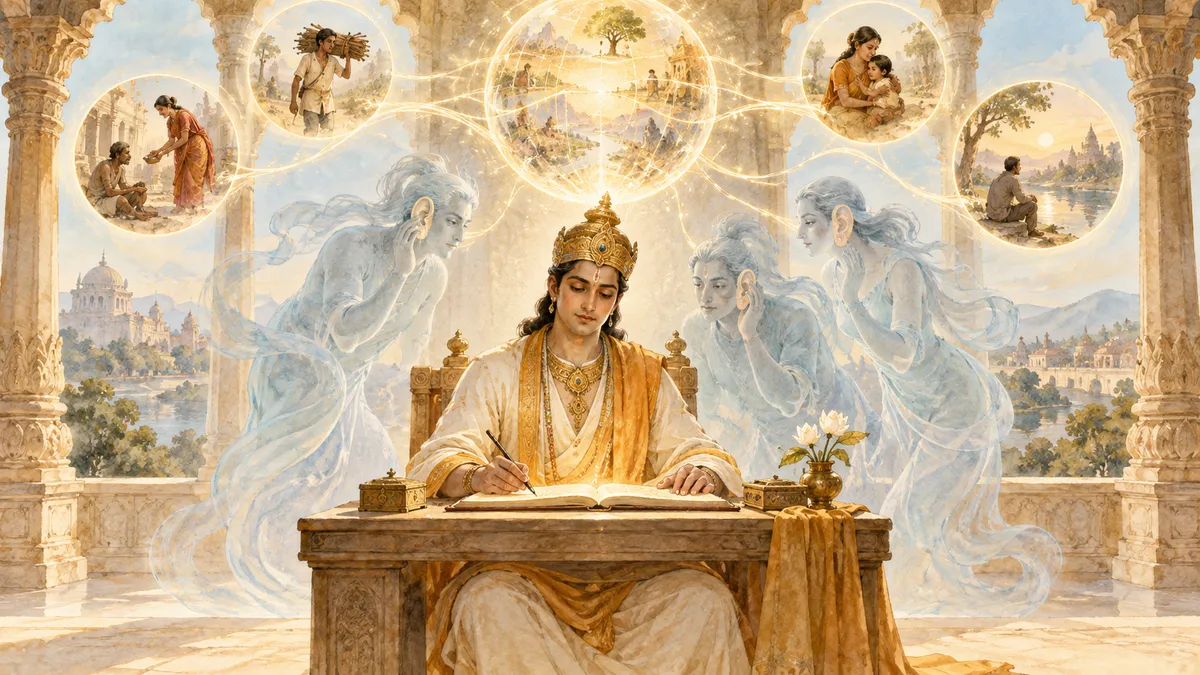
And how can this happen in the bardo? In the bardo, a person may not necessarily stand as it is described in texts dating back three thousand years. A modern person may stand in the bardo in a huge round hall, with an enormous computer screen before them displaying a minute-by-minute record of their actions from the very moment of birth. And if they concentrate, something resembling video clips unfolds, which can be replayed in every detail. When the shravanas or Chitragupta himself reveal this and display it, a person, seeing actions they disliked, may say: “I didn’t do that.” They will be told: “Look, this is your record.” Then the person will be unable to object, fall into a gloomy state, and become obscured. If they cannot object to Chitragupta and fall into an obscured state, this means that their awareness has declined; therefore, another version of the universe, a more negative one, opens up for them, and the spirits are told to send them there. Such a person was unable to change Chitragupta’s consciousness; they were unable to unite with the subtler and higher energies of their mind and fell under the influence of their own obscurations. This is what the absence of a single “taste” means.
When any rules or principles are violated, impure vision is initiated in a person, because they divide things into this and that, pure and impure, bad and good. Even subconsciously, their discriminating consciousness operates very clearly and quickly. Instantly, in one-sixtieth of a second, they manage to evaluate their actions at the subconscious level. Even if, at the level of superficial consciousness, they understand the principle of a single “taste,” this does not yet mean anything. Their subconscious makes rapid distinctions within a fraction of a second; it manages to evaluate things faster than the conceptual mind.
On the contrary, if a person has established themselves in pure vision and a single “taste,” they have an entirely different vision from the outset. Suppose, for example, that a virtuous householder lives at a cremation ground: they may enter the state of chhidra, a sinful state, or even an entranced state, whereas a siddha-avadhuta possessing a single “taste” may well remain there in pure vision. Another matter is that some people may imagine themselves to be siddha-avadhutas without having freed themselves from impure vision or truly realized a single “taste.” Here it is very important to understand your level and not try to claim what has not been realized; to know the system of values, behaviors, and rules within which you currently exist.
Secondary Causes and Karmic Connections
We are currently building a temple to Vashishtha. Why does this bestow merit? It is a secondary cause that opens another dimension in our consciousness and in our channels. We establish a connection with a great saint. Since we perform certain actions and concentrate, there is a reciprocal influence on our consciousness. Then we begin to think about him—and suddenly we may open up an entirely new version of reality, an entirely new variable universe in which Vashishtha becomes very important to us. Before that, he was as if he did not exist at all. Since we are building a temple to Vashishtha, there must surely be a karmic connection with him. Without a karmic connection, we cannot do anything.

We are building a temple specifically to Vashishtha—not to Christ, Kali, Buddha, or Padmasambhava. This means that we created and established this connection beforehand. Where does it come from? It comes from the guru. This means that the guru, just like you, is also a channel for certain ideas and energies of Vashishtha. And if the guru serves the energies of Vashishtha, then who is the guru? Where did this connection come from in the first place? And we enter an entire tunnel of reality in which even our past changes. Suddenly we see that this connection is very ancient and very long-standing, and that we ourselves may perhaps be certain illusory bodies or energies of Vashishtha. If the guru was born so that this temple could appear, so that the energies of Vashishtha could manifest, and you may have been manifested as deities to help bring this about, then perhaps this has been Vashishtha’s lila from the very beginning, his plan, while we are merely channels. And Vashishtha, being the son of Brahma, is an incredibly powerful being, so there are no obstacles to this being exactly what is happening. Then we begin to feel a very deep connection with Vashishtha. All this happened because the temple, as a secondary cause, opened within us a particular version of reality in which even the past began to change and our destiny began to change. But if we had not done this, perhaps we would not have shifted into this version of reality. This is the principle of accumulating merit and the law of karma.
Why is it necessary for us to build temples? Why can’t we say that everything is a single “taste,” and therefore it makes no difference whether we build a temple, a cowshed, or a secular establishment? In fact, it is not so; there is a difference. If we build a cowshed, what is initiated within us are not spiritual samskaras but worldly ones, and therefore other versions of reality and another version of the past open up. Perhaps we do not possess sufficiently pure vision to see a cowshed or a secular establishment as a divine structure, in which case impure realms and worldly things are activated. The significance of all religious vows lies precisely in the fact that they activate certain samskaras and vasanas that lie dormant but, when unfolded, can create an entire world. By consciously accumulating merit and directing our actions toward service, we activate the realms we need and suppress those we do not need. Perhaps you would have performed these actions in your life anyway, even while living in the world, but then they would have activated different versions of reality.
The Practical Realization of a Single “Taste”
Pure vision presupposes a stage at which, regardless of the circumstances or the actions performed, a pure state is always initiated within you. The state of chhidra (a moment of obscuration) cannot arise in principle, because you remain in highly vigilant awareness (avadhana), possessing an impeccable view and the clarity that flows from this view. At the moment of performing any action, integration takes place within you; the clarity arising from the nondual view self-liberates any negative karmic reactions, instantly transforming them into pure vision. In other words, you begin building a cowshed—and see it in pure vision; you see the cow as a deity. Then you are no longer building a cowshed; everything turns out as a temple. You cannot do anything impure; only pure aspects emerge from you.

A state of obscuration cannot arise when we have established ourselves in pure vision and in “one taste.” How does one become established in “one taste”? First, there is a cutting off of our own judgments and projections of the mind. Instead of becoming attached to our own discernment, through the method of self-liberation we use naked awareness to cut through judgments and projections. At the level of view, we abide in a state of total acceptance. I am speaking specifically about the view; at the level of conduct, we may demonstrate the behavior expected of us, required by our status and by the particular relationships involved. When, through naked awareness, this cutting off has taken place, we perceive the situation in pure vision; that is, we do not agree with impure judgments, but, having generated awareness, we try to remain in pure vision. In parallel with this, we discover the drashta, or sakshi (the witness), that is, we give rise to clarity and awareness. Abiding in the state of the witness, the one who is aware (drashta), we become established in clarity, in discriminating wisdom (viveka). This is the minimum that even the most novice practitioner must possess: to instantly change the state of their mind and, cutting through judgments and shifting the mind into pure vision, discover the drashta.
If clarity and viveka have arisen and we continue to contemplate, we enter into this clarity and open the space of viveka—the space of boundless clarity, similar to emptiness. When we touch this space, we become filled with bhava—the divine power, greatness, and glory. We draw bhava from the space of clarity. To the extent that we can surrender to bhava, to that extent we will receive it. Finally, we unite this bhava, which we commonly call divya-bhava and divine pride, with the pranas and try to transmute them. When these processes take place, “one taste” is truly realized.
Then we are free from entering into any state of obscuration. We cease to be dependent on entering an obscured state. Such a person cannot, in principle, perform any sinful or obscuring action, because they cease to be subject to the laws of secondary causes. Secondary causes can no longer initiate negative karmic reactions in them. Negative tunnels of reality in the deeper layers of their subconscious can no longer be activated.
Categories of One Taste
One taste implies erasing dependence on dualistic states. There are many categories in which one taste is realized. Pure and impure is only one aspect of one taste. There are other categories as well, for example right and wrong, that is, attachment to one’s own mental attitudes. There is also the category of “self and others.” There are practices in which the yogin trains to “exchange” self and others, mentally switching roles with them. This category is one of the strongest; it may even be stronger than pure and impure. To exchange oneself with another, to see another as an expression of oneself—this is genuine one taste. If one taste has been realized, in the body of another you will see yourself, only with a different mentality and bodily destiny. If it has not been realized, the other is another; they cannot be you. If one taste has been realized, your consciousness constitutes aura-loka—a completely open state in which you abide in all bodies. Perhaps you cannot move or speak through them, but as the subtle spirit of awareness, you penetrate all bodies, even the bodies of cats and dogs.

For example, if you can come to an agreement with the deity of a dog or the deity of a cat, you will be able to control it, and siddhis will then arise. If, in a lion, you can see the deity governing all lions, make a mental offering to it or pacify this deity, then that lion will obediently lie down at your feet, or all the lions will come running to you. There are magical rituals that make this possible, since all living beings are governed by subtle states. These siddhis arise through the realization of one taste, when the boundaries between “self” and “others” dissolve.
Aspects of One Taste
Another aspect of one taste is when inner and outer space unite. This occurs only at the stage of Anugraha, when the yogin deeply experiences the descents of power.
The realization of one taste in the aspect of “meditation and non-meditation” occurs only after accepting the “great decision” and entering into the “great non-doing.”
The realization of such an aspect as “liberation and bondage” occurs after liberation itself, when the yogin understands that liberation does not mean becoming liberated, but rather becoming one who has never been bound. Many people hold views such as: “I will become a liberated person!” But this is impossible in principle. There are no liberated people. There are not even liberated gods. Gods may be immortal and powerful, but only Bhagavan, the Absolute, can be liberated, because liberation is a symbol of the Absolute. Liberation does not mean becoming liberated, but leaving the principle of “bondage-liberation” and becoming one who has never been bound, who can never be bound.
Likewise, the single “taste” is connected with the unification of such categories as:

- samsara — nirvana
- birth — death
- truth — falsehood
- masculine — feminine
- good — evil
- action — inaction
- pleasure — suffering
- past — future
When all these categories are transcended, the yogin realizes the single “taste.”
Cultivating the Single “Taste”
Partially or to a high degree, this realization of the single “taste” should be completed at the stage of cultivation. Cultivation presupposes that we penetrate all these categories, begin to see through them, and cultivate our spirit to unite with them.
We already have space, and we maintain it, but we need to give this space experience. We need to expand it, confront it with different experiences, and cultivate it in order to establish this space, so that it can unite with different categories of pairs of opposites. At the same time, we maintain the single “taste” at the level of the view. At the level of conduct, of course, other relative laws operate, which are also important.
Karma in the Intermediate State
Why is a being in the intermediate state subjected to its karmas? Because superconscious beings, deities, and spirits arrive, generated by its own actions with which it has identified, and envelop it in subtle prana. Because of this subtle prana, it cannot move or think clearly. These beings impose their own meaning and their own view of the situation upon it; they instill in it a sense of sinfulness and guilt. Since it is enveloped in subtle prana and its mind is incapable of seeing clearly, even if it had the beginnings of awareness, it loses them, and therefore is forced to submit to their energies. It cannot even say anything—all its layers of awareness seem to have been erased, as though its memory had been erased. And then it is simply forced to obey the spirits of the intermediate state, the instructions of Chitragupta, and the instructions of Yama.

But it could stop this situation if it were aware; it could manifest its merits and dissolve it. It could enter bhava and illuminate the space around itself, in which case the negative spirits and Chitragupta would disappear, and blessing deities would appear. But this can be done only at the stage when your consciousness is clear, when you are accustomed to remaining in the single “taste.” Negative energies will not be able to entangle your mind, even if they manifest, because you will recognize them as harsh energies of the natural state.
That is precisely why one who realizes the single “taste” is considered liberated during life.
The True and False Single “Taste”
At the same time, the single “taste” does not mean a certain indifference, a balancing toward grayness or negativity—such a single “taste” is not considered realization. For example, a person once experienced exalted states while communicating with deities, a spiritual teacher, and the Dharma, but then five or eight years passed, and they became simply an indifferent connoisseur of the Dharma, with no fire of devotion, no faith, and no pure, deep, authentic state. They think: “It’s all the same... Been there, done that.” And they become gray within. Naturally, such a single “taste” must be avoided, because it is an anartha (an undesirable state). The single “taste” does not mean that we lower everything, that we reduce deities to the level of the ordinary; otherwise, it is merely a dull indifference. We think that everything is the same, but inwardly we possess only worldly ordinariness, when we experience no inspiration, feel no exaltation or devotion. This is not the single “taste.”

One “taste” means that, on the contrary, we elevate the world to the divine. We elevate even the ordinary: there is always a positive experience of the sublime, bhava, and pure vision. Therefore, one “taste” is always connected with pure vision and purification. There is no one “taste” without pure vision, because Unity is realized precisely through purity (shuddha-vidya).
The Danger of Advaitic Cynicism
I knew practitioners who became lost in the view, lost in the perspective, in the boundless ocean of Advaita. Having read a great deal but not having had time to properly assimilate it, they became indifferent Advaitic cynics. This is frightening, because a person effectively ruins their life.
To become an Advaitic cynic means to destroy one’s spiritual sadhana. But a true practitioner, upon becoming familiar with the Advaita view, never becomes an Advaitic cynic. They become an Advaitic holy deity.
To become an Advaitic cynic means, having equated good and evil at the level of superconsciousness, failing to understand the principle of purity. Such a person then becomes a ranting madman, reviling saints, while still having kleshas. They move toward impure vision. This is the path to becoming a bhuta (spirit). Something like what is described in the song about Milarepa, when an old hag told Milarepa tales about nonduality, trying to convince him that she was a great practitioner of the Dharma. But Milarepa laughed at her and said: “If you were a great practitioner of the Dharma, you would not have been born now as a spirit—a hag who provokes kleshas and worldly desires in others. You made a mistake, and that is why you were reborn as a preta, a bhuta.”
This is a very subtle point, the misunderstanding of which can cost dozens of lifetimes, because slipping in one’s view into the realm of spiritual cynicism means becoming a bhuta for many lifetimes. Many brahmins, instead of becoming Brahman, the Absolute, became brahmarakshasas precisely because they did not receive proper spiritual instructions in their time and made mistakes in their spiritual practice.
Therefore, we always say that the realization of one “taste” is always connected with samaya and pure vision. These are things that are sacred at every stage of the spiritual path, and thanks to this, it is impossible to make a mistake.
