

Commentary on the text by Sri Ramana Maharshi “Be As You Are”
Question: What do you consider to be the cause of the suffering of the world? How can we contribute to its change individually or together?
Maharishi: Realize the Atman, the true “Self.” This is all that is necessary.
If Maharishi had given a different answer, he would not have been Maharishi. Ramana does not listen at all to what he is being asked about — this is a sign of a true Teacher. He has no concern for what is said to him, or who says it to him. He is concerned only with awakening from illusions, and everything else has no meaning for him. When such a saint abides in the state of absolute Reality, he sees no problems other than the understanding or non-understanding of this very absolute Reality, and everything else is unimportant to him. Either there is awakening with regard to absolute Reality, or there is incomplete awakening, or there is no awakening at all, but rather persistence in delusions. Whatever path awakening may have been attained by, whatever price had to be paid for it, in the final analysis this is not important. It is like awakening, when all illusory dreams lose their value; we simply laugh that we were so distressed about what we dreamed, although in reality there was nothing, only our dream.
Thus, Ramana says: “There is only your dream. There is neither the world nor suffering, but there is the fact of your non-awakening in relation to absolute Reality, the fact of your delusions and false views.” This fact requires acknowledgment, and then work with it and its elimination.
Question: Will I ever be able, in this life surrounded by limitations, to realize the bliss of the Atman?
Maharishi: This bliss of the Atman is always with you, and you will discover It if you seek sincerely.
This bliss is always with us; we simply do not have sufficient sensitivity and subtlety to recognize it. Self-surrender is the direct method. If day after day we could abide in a state of non-egoism, we would continuously be in this bliss. But we are not like that: our mind is very cunning, and the ego is very resourceful; it cannot accept this, it constantly tries to project something onto reality and then cling to its projections.
The Ego as the Source of All Suffering
“The cause of your suffering is not outside life, for it lies within you as the bearer of the ego. You first impose limitations upon yourself and then struggle with them in vain. All misfortunes are caused by the ego. It is because of it that all your troubles arise.”
This should be repeated many times before we become convinced of it and believe in it. The ego is our persistence in dualistic views, in our own delusions. This persistence is akin to animal stubbornness. Animals are very straightforward in the sense that their consciousness works in a one-pointed way: food, sex, warmth. When we persist in our egoistic perception of reality, it is because of our sincere misunderstanding of things as they really are. It is like a person who has jaundice seeing everything as yellow.
“What is the point of attributing to the events of life the cause of suffering, which in fact lies within you? What happiness can you gain from external circumstances? And when you attain it, how long will it last?”
On the path of spiritual practice, we need to discard all ideas of social reorganization or of changing others, understanding that the only thing we can change is our own conditioned view. With its change, everything else also changes, because everything around us is only our own karmic imprints. All phenomena are not self-sustaining; they are manifestations of our own nature. This means that if we change our own consciousness, then all phenomena will also cease to exist for us in the previous way.
For this we take a vow to follow enlightenment, to go toward the Truth to the very end. It is very important to take such a vow, because spiritual life is a complex labyrinth in which it is easy to get lost. We may have many experiences that can change our original intentions. Nevertheless, we take a vow to follow the path of enlightenment to the end, no matter what, since we know that all other experiences are something smaller, secondary, and unworthy of attention.
If a student comes to a martial arts master wanting to master this art and become the same kind of master, the Teacher says to him: “Good, then you must train diligently.” After some time, the student feels that he has already learned something. He came with the intention of attaining the same mastery as the teacher, or even surpassing him, in order to win a very important tournament. Having studied for only two years, he begins to imagine that this is already enough for him. The Teacher says: “Of course, you can already do something, but in the tournament you dream of, you will not win, do not even hope for it. If you are satisfied with this, you may stop your training, but I believe that what you have learned is worth nothing.”
In the same way, we make a vow to go all the way to awakening, ignoring our relative achievements and experiences. Even helping others can become a stumbling block. Until you understand that there are no others and no you as the one who helps, until any attempts of your false “I” disappear, your help to others will not be effective. It will be like a sleeping person in a dream helping another sleeping person, and as a result both will fall even more deeply asleep. True help to others arises from compassion that flows from the opened Mind. This is not selfish compassion, but the self-radiant nature of the energy of the opened Mind. It is free from illusions, has no selfish motivation, and radiates equally upon all living beings. In true compassion there is not even a shadow of illusion, conditioning, selfish self-expression, and the like. Just as the sun has the property of shining, in the same way true compassion spreads in all directions for the benefit of living beings.
“If you reject the ego and burn it by ignoring it, you will be free. But if you accept it, it will impose limitations on you and plunge you into a futile struggle to overcome them.”
The rejection of the ego, all practices of self-surrender, belong to a very high level of sadhana. It should be understood that anuttara tantra itself, self-liberation, and so on are transcendental. However, self-surrender is the penultimate and final levels of self-liberation in Laya Yoga. Self-surrender means that non-conceptual awareness has been revealed. Now it is necessary to cut off egoistic judgments, to work with karmic factors. To cut off egoistic judgments means to maintain constant vigilance with regard to one’s own “I.” When we encounter various situations, we must constantly manifest awareness.
Being the Atman
“Being the Atman, which you in reality are, is the only way to realize the bliss that always belongs to you.”
Often, when we hear the Vedantic sayings “Aham Brahmasmi” and others, we forget that before “Aham Brahmasmi” can be realized, complete self-surrender, complete selflessness must be realized. Those people who think that “Aham” means the little “I” of the individual are fundamentally mistaken. Here “Aham” means our self-born Wisdom, in which the ego has been drowned, has completely disappeared, has completely dissolved. This means that our false “I” must by that time become completely obedient, completely dissolved. We cannot become the Absolute; we can only step aside—then only subtle awareness remains, and it begins to recognize itself as the Absolute.
Question: If in reality there is neither bondage nor liberation, then what is the cause of the actual experience of joys and sorrows?
Maharshi: They seem real only when a person turns away from his true nature. In reality, they do not exist.
Imagine that there is an all-encompassing space of consciousness, and our body is as if injected into one of the worlds by the force of karmic vision. For a time, a conglomerate is formed from physical matter, tattvas, and pranas, which is the body. It appeared by chance, due to karma, just as an illusory body arises in dreams when we walk somewhere, having the image of our body. This body is like a net; it is not substantial. If the mind is mobile, the body can change its form.
In one Russian village there lived a sorcerer. He performed his magical practices and had the ability to turn into animals. A woodcutter who worked for him spied on this sorcerer and heard the spell that the sorcerer recited. When the sorcerer left, the woodcutter stole his magical knife. Then he recited the spell, stepping over the blade of the knife, and did everything else the sorcerer had done. After doing this several times, he turned into a wolf. When his relatives began looking for him, they turned to this sorcerer. After three years he was found, and after the performance of a magical rite he became human again. His body was covered with hair, he had a wild appearance, but he retained a human psyche. Later he told how he had received the body of a wolf, how he hunted, how he ran up to his native village and feared people, how gradually his consciousness became accustomed to life in the physical body of an animal. This is a true story.

When karmic vision changes, the form of the physical body also changes.
The Nature of Creation and Karmic Vision
Question: Was the world created for happiness or for suffering?
Maharshi: Creation is not good or bad: it is as it is. It is the human mind that imposes interpretations of all kinds upon it, viewing things from its own perspective and interpreting them according to its own interests.
We see the world through the prism of our own karmic vision. Our karmic vision is conditioned by the karmic imprints of past lives, by old experience. This means that right now each of us dwells in our own world, created from individual karmic imprints. In some respects, of course, as human beings we share a common karmic vision, that is, we see the world more or less the same way, but not entirely.
If we were gods, this hall would seem to us much larger and more attractive. Its walls, for example, would be covered with intricate ornaments. And we ourselves would have far more elegant clothing and appearance. The Guru’s voice would be four- or five-dimensional and would penetrate the very essence, as if with a quadraphonic effect. Communication would most likely take place not through words, but through vibrations. Gods and goddesses would be sitting here.
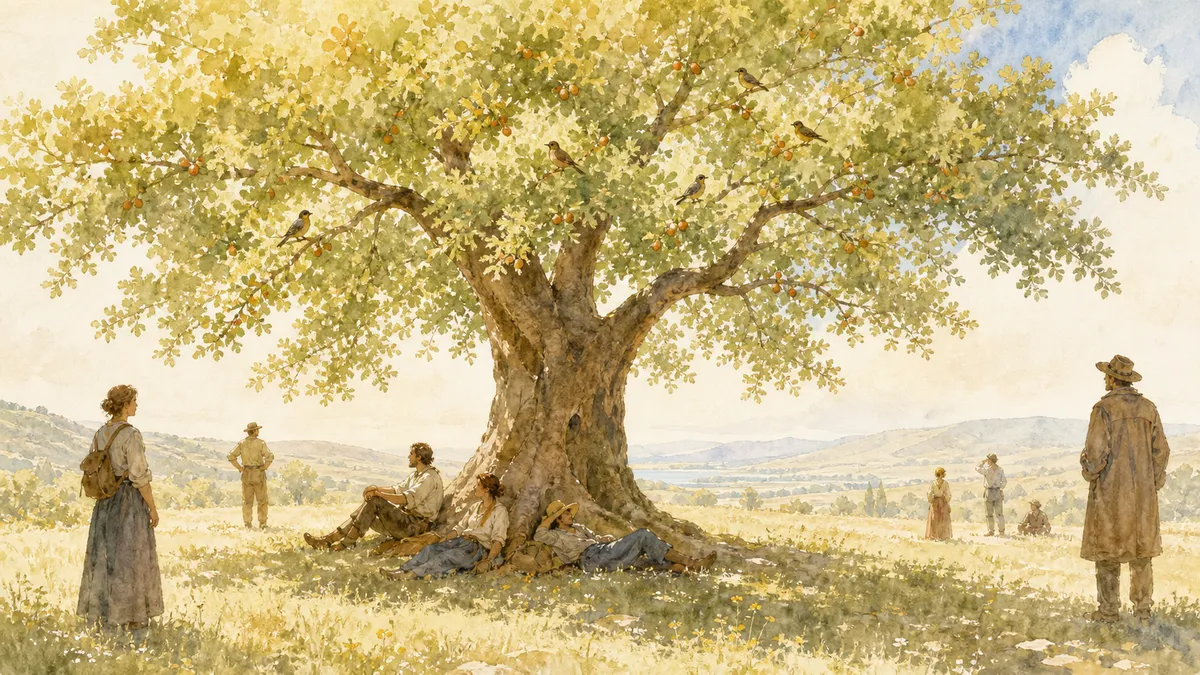
“A woman is precisely a woman, but one mind calls her ‘mother,’ another ‘sister,’ a third ‘aunt,’ and so on. These value judgments are the cause of all suffering in the world. Creation resembles a tall, spreading tree: birds fly to it to feast on its fruits or shelter under its branches, people enjoy the coolness of its shade, but some may even hang themselves from it. Nevertheless, the tree continues to live a peaceful life, indifferent to what is happening and unaware of all those who make use of it. It is the human mind that creates its own difficulties and then calls for help. Is God really so partial that He gives peace to one and sorrow to another?”
Whenever we have problems or experiences, we should think like this: “It cannot be that my problems and experiences are real. If they were truly real, everyone would have them, but only I have them, while others do not. It cannot be that my attachments and desires are something genuine. Most likely, they are false. If they were genuine, others would have them too. But others are beside me and are not thinking about this at all. Therefore, these are purely my karmic impressions; this is the result of the data I have accumulated.” Understanding this, we have enormous freedom; we know that we can work with karmic imprints, that we can transform and purify them.
“There is a place for everything in creation, but man refuses to see the good, the significant, and the beautiful. Instead, he keeps whining like a starving person sitting before delicious food and, instead of reaching out his hand and satisfying his hunger, grieving. Whose fault is this—God’s or man’s?”
Many people often say: “Why does God allow suffering in this world?” or “Why did the Lord make it so that I suffer?” However, that Reality which is called the Lord does not participate in the suffering or enjoyment of an individual person. In essence, it is an incomprehensible, boundless Reality which, in the absolute sense, has no concern for our little “I.” And our little “I” experiences joy and suffering in accordance with its actions. In this Reality we can find any dimensions: the palaces of the gods and the hot cauldrons of boiling water in hell. Everything exists in this Reality, but we find what is close to us according to our karmic impressions. It is like the internet. We can find sutras on the internet, and we can find any worldly information. Everyone searches for what interests them, and when they come into contact with certain information, it influences them. No one can complain that they are so unhappy, because each of us chooses this information ourselves.
The Doer and the Sufferer
Question: If God is everything, then why does individuality suffer for its actions? Are not the actions for which a person suffers allowed by Him?
Maharshi: The one who considers himself the doer is also the sufferer.
When we are not free from the ego, experience is suffering. When we are one with the Source and abide in contemplation, all suffering is regarded as part of this Source, and therefore, in essence, there is no suffering. Of course, the body may suffer in the relative dimension, but consciousness never suffers, because the experiences of joy or suffering are equalized in the mind.
Question: But actions are prompted by God, and the individual is merely His instrument.
Maharshi: Such logic is applied only when someone suffers, but not when he rejoices. If such a conviction were held at all times, there would be no suffering either.
Question: When will suffering cease?
Maharshi: Not before individuality is lost. If both good and bad actions belong to Him, then why should you think that enjoyment and suffering are yours alone? The one who has done useful or harmful deeds enjoys pleasure or suffers pain. Drop all this and do not impose suffering upon yourself.
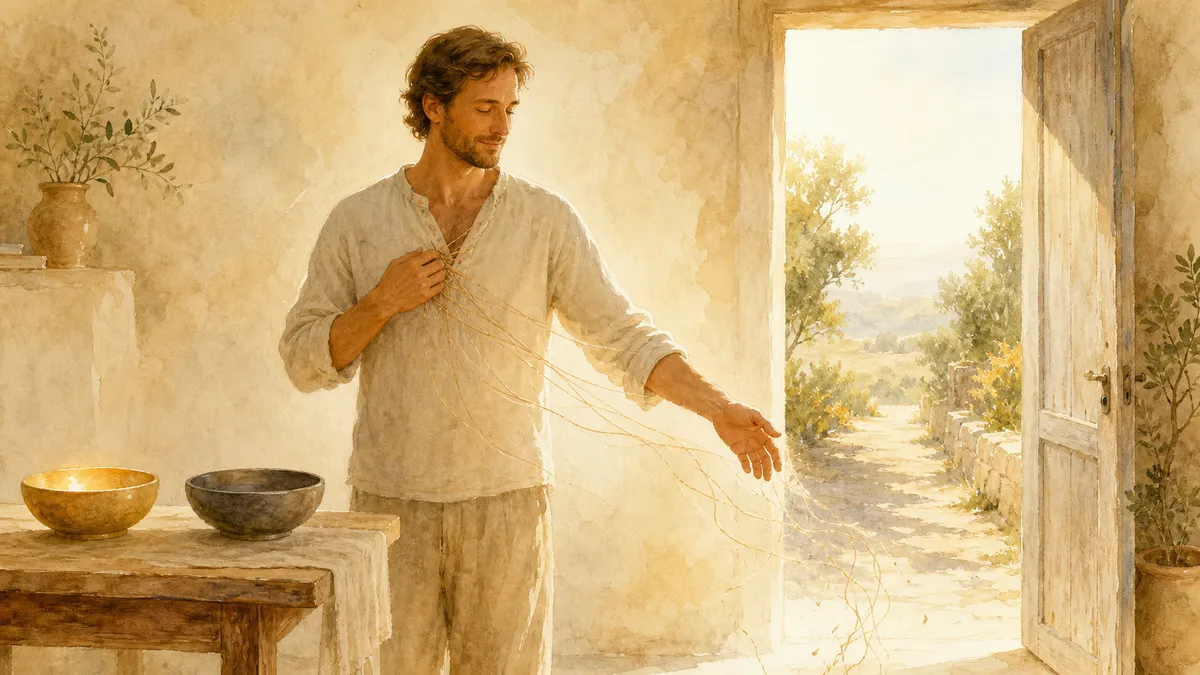
At first we abide in the illusion of this world. When our awareness increases, we are continuously conscious, and therefore illusions cannot seize us; then what is called “great doubt” appears in us, and suddenly we understand that everything is devalued. When the mind is open, everything we lived by before and cherished ceases to have meaning. What was inside us and outside us is devalued. All this is perceived like a magic show, like the trick of a skillful magician, like a three-dimensional film or virtual reality. Suddenly we see that nothing perceived outside or inside is connected with the awareness that we are discovering.
A person who has realized such awareness may think that he has attained enlightenment, or he may develop a negative attitude toward reality, toward the principles he previously followed. He may even become a rebel for a time, wishing to prove to others and to himself that he has understood something in this world. However, in the true sense, spiritual practice only begins from this level. After that we humbly begin to practice deepening awareness and dissolving the energies in the body. It is like being an actor in a play, but taking that play for reality, and then suddenly waking up in the middle of the play through practice. When we woke up, we discovered that everything is a big show, a performance, where the Guru is perhaps the director. Then we abandon our role and shout to everyone:
“But this is a play!”
Suddenly more experienced actors come up to us and say:
“Why are you making such a fuss? Everyone has known this for a long time. Continue playing your role. If you simply sit in the corner and watch, you will not get any enjoyment from the play.”
The Guru says:
“We are training in the art of acting. And the fact that you took all this for reality—that is your problem. Only now have you understood what we are doing here.”

If, however, we leave this performance and simply sit in the corner, that is, assume the tendency of losing awareness in emptiness, then this means that we deprive ourselves of the opportunity for further development, the opportunity to polish our acting skills. But if a person does not have proper guidance, then, trying to prove to others what everyone has long known, he really begins to rush about like a madman in the middle of the performance, only spoiling the play for others.
Question: How can you say that suffering does not exist? I see it everywhere.
Maharshi: A person's own reality, shining within everyone as the Heart, is itself an ocean of pure bliss. Therefore, like the unreal blueness of the sky, suffering does not truly exist; it is simply a product of imagination.
When we say, “There is no suffering; it is simply a product of imagination,” we need to know that we can say such things only after we have become rooted in the deepest contemplation. Otherwise, we will not be able to repeat these same words when our little sufferings come. On the relative level, we understand that for us there are certain sufferings; however, in the absolute sense, they are simply a product of imagination.
“Since one's own reality, which is the sun of jnana, hidden by the dark delusion of ignorance, itself shines as happiness, suffering is nothing other than an illusion caused by the imaginary sense of individuality.”
Suffering and the individuality of the ego are inextricably linked. Suffering exists as long as we exist. When the “I” dissolves in the Absolute, suffering disappears, because who then will suffer?
“Truly, there is no one who has ever experienced this imaginary illusion. If a person carefully investigates the Self, which is bliss, then there will be no suffering at all in his life. A person suffers by taking the body, always different from the Self, to be the Self. Suffering is entirely conditioned by this delusion.”
The Discovery of the Radiant Nature of Consciousness
As our practice progresses, when we engage in self-inquiry and meditation, we penetrate ever more deeply into the nature of consciousness, we increasingly discover its emptiness, openness, non-connection with objects, its radiant nature. When we fully recognize it as our own, all suffering disappears. We stop considering ourselves Monk Vitaly or Yogaraja. We know that we are the wide-open ocean of Light. And if someone sees us as mind or body, that is their problem, while we have no problems.

We accustom ourselves through the practice of inquiry and meditation, and then we truly feel that we are the Reality spread out in all directions, radiant, always perfectly pure, without name, form, color, foundation, center, boundaries, taste, or smell. We are this Reality and nothing else, while everything else—the body, the world, manifestations—is the play of our energies. When we continuously feel ourselves this way, then truly we are free.
The question is that we do not trust this Reality, even when we have glimpses of it. Maintaining contemplation means continuous sensitivity to this subtle Reality. This Reality is God, and there is no other God. Other kinds of God are either concepts or external material idols, which in fact are simply a projection of this primordial Reality.
