

The Guru's answers to questions from disciples and seekers on August 3, 2010
Principles of Transmitting the Dharma
Question: There are people who practice—Christians, Buddhists, or followers of Osho. To what extent can I suggest that they study the teachings of Laya Yoga? It is clear when it comes to beginners, but what about those who already believe in something?
If they themselves show interest. The Dharma is a jewel, and a jewel is not given to just anyone. On the contrary, it is safeguarded and even concealed. If a person is interested and you feel that there is a connection, you may share it. But you should not impose your views on the Dharma upon others. Everyone has the right to see the Dharma as they see it. But if a person has a connection, then of course you may speak about it. If a person is not interested, there is no point in speaking to them; they should follow their own Master if they believe in them. But if a person has no Teaching and no Teacher, then you may tell them about it.
Gradually, more and more spiritual seekers and schools will emerge in Russia. We will have to develop ethics and culture, such as those found in India. Unfortunately, we do not have such culture and ethics in Russia. For many years, we had no culture of any kind. Our spiritual people are still uncultivated in the spiritual sense. This culture of relationships, relationships between samaya brothers and sisters, the ethics of teacher-disciple relationships, and the ethics of relationships between different spiritual schools and organizations—these are very subtle, divine things. The etiquette of showing consideration and respect for one another and for higher beings—all this is culture. India has a culture spanning many thousands of years. We have the culture of communism, and it is unclear what other culture we have. There is no culture yet; we will have to create and develop it.
The Dharma cannot exist in a vacuum. It is always transmitted through people, and people do not exist outside culture or civilization. We need to create a new civilization based on spiritual values. The culture and civilization that exist now bring happiness to no one. All this is part of culture. At the Advaita Congress, the teachers tried to establish such a vision and adopted a resolution. I think this will mark the beginning of the creation of a new culture in Russia.
This is not the culture of ordinary people; it is the culture of sadhus. We are familiar with the culture of ordinary people; we are living in it now. But sadhus are not quite ordinary people. They are people of a different order. They must have their own culture. What is right for ordinary people may be wrong for sadhus. What is right for sadhus may not be accepted by ordinary people. These are simply two different, parallel cultures that must coexist peacefully.
For example, in the room where I am staying, there is an inscription: “How wonderful it is to drink vodka.” That is a different culture. Stuffed animals and fish, photographs of people standing proudly beside those dead animals—that is a different culture. It is not the culture of sadhus. Everyone has their own values, their own reality tunnel. We should not impose our values on other people. We should respect our own values and respect those of others, but clearly distinguish between them; they must not be mixed. When they are mixed, chaos ensues. People are different. Not all people are the same.

The Nature of the Ego and Consciousness
Question: Arya Deva said that everything is consciousness. In that case, the idea of the ego is not entirely clear. What is the relationship between the ego and consciousness? How can a teacher of truth speak of the ego as though it exists?
It does not exist.
Question: Then what are we talking about? Why does it arise—for the sake of awakening? But who awakens?
Are you awake now? Why did you come here?
Question: Perhaps to receive this answer.
All of this serves only one purpose. Dances, songs, conversations—all serve only one purpose. This is called “skillful means.” The ego does not exist for the teacher. But it exists for the disciple. When we go somewhere or seek something, we are driven by motivation. What does motivation mean? Motivation means that we have made a choice, made a decision, because we were dissatisfied. We became seekers and began to search. If we were buddhas, would we have come here? We would be teaching others and sitting quietly by ourselves. We were driven by motivation. This motivation is dissatisfaction. We recognize our limitations. We came here to seek. What caused the dissatisfaction? It arose because there were limitations. These limitations arise precisely from the ego.
The ego does not exist from the standpoint of the view. But in the relative dimension, it exists, as it were. If a rope in the dark looks like a snake, does the snake exist? It is merely an appearance, yet it causes real fear. It does not exist, but it can frighten you badly. In reality, there is no rope, no snake, yet it frightens you. Therefore, on the relative level, we consider the ego to exist. We acknowledge the conventional nature of its existence and then develop an entire system for circumventing it.
We need to understand our inner instrument. There is a certain mechanism, a certain system within us. It is like a sophisticated computer running a program. If we understand it, we will better understand how we function. This entire mechanism is called antahkarana, the inner instrument. What does it consist of?
It consists of manas, the conceptual mind. The conceptual mind, manas, is the operating system. It too is a kind of program that we use to operate and solve logical problems.
Second, there is buddhi within us. Buddhi is a very subtle, highly complex system: subtle intuitive awareness, the cosmic intelligence within us, our inner conscience, and our will. All of this is buddhi. With the help of buddhi, we develop our values in life, set priorities, and engage in strategic thinking.
We also have chitta. It is like a file in which all the records of our memory are stored in archived, compressed form. It is the repository of the tendencies of our mind and of all our perceptions. It is folded up, but sometimes it can unfold. When spirits or devatas meet a person, they can effortlessly read their memory files. They can tell you what you did during any period of your life—at the age of three, at the age of five. They can repeat every word you have ever spoken; everything is recorded there. The archives of our memory are chitta. Therefore, when they encounter a living being, they immediately enter the archives of their memory and see what kind of person is before them.
Manas, chitta, buddhi, and the fourth—ahamkara. Like glue, ahamkara joins these three into a single integral entity, a single being that perceives itself as an individual, a person. On the relative level, this instrument functions, and functions quite well. Chitta, manas, buddhi, ahamkara. In the Vedanta tradition, these four components of the antahkarana—chitta, manas, buddhi, and ahamkara—are traditionally described by Shankara and other saints. In the Siddha tradition, one more component is described—chaitanya.
Chaitanya is the principle of awareness. It is our inner observer, the space of our awareness. Each of these instruments has its own functions and qualities. All of this is within us. We need to understand how all these things work: chitta, manas, buddhi, ahamkara, and chaitanya.
Spiritual Transformation of the Inner Instrument
The spiritual path means that we need to purify chitta. Our chitta is overloaded. It is as if our computer's memory were cluttered with various recollections. All of this needs to be cleared out. Manas, the mind, needs to be subdued. It is like a program that has spun out of control. It begins evaluating and passing judgments uncontrollably. The practice of concentration is the subduing of the mind. Ahamkara, the ego, must be discarded. Self-centeredness must also be subdued. It is like an invader that has tried to seize power. Buddhi, on the other hand, should be encouraged in every way and developed through jnana yoga, analytical meditation, and concentration.
A major restructuring of this inner instrument must be carried out. The computer of our inner “self” is constantly malfunctioning, reflecting reality inadequately, and freezing. When the Master comes, he explains what its problem is and says that it needs to be reconfigured. Some things must be blocked, while others, on the contrary, must be opened and cleansed. This is because this sophisticated instrument perceives reality inadequately. It is incapable of properly engaging with the cosmic players.
Ahamkara is the glue that binds all the parts of our computer together. It exists. As long as we are not Buddhas, as long as there is no Enlightenment, of course it exists. Just as you have a liver and a heart, you also have ahamkara. No problem. Therefore, one cannot say that the ego does not exist; the ego does exist. The ego is not a bad thing at all. The ego is a useful instrument. But it becomes bad when it tries to subjugate you and your awareness, when it begins making decisions for you.

From the absolute point of view, everything is the one Consciousness. Chitta, manas, ahamkara, buddhi—all these are playful manifestations of this one Consciousness. The one Consciousness is not only emptiness; it is also power, shakti. It can assume any form of power. But at present, the circumstances are such that this playful manifestation enslaves us and forces us to suffer. When a person is identified with the ego, they see others through the prism of the ego; let us say the ego is like a hat. The person thinks, “I am the wearer of a hat.” They look at others: “This person wears a yellow hat. This person wears a red hat.” They do not see the person, only the hat. In the same way, when we are identified with the ego, we do not see the supreme Essence but perceive everything through the ego.
Arya Deva spoke correctly, but this must be understood. No one can understand it without becoming a Buddha. Otherwise, these will be mere words. A path is needed to go through this. Often, spiritual seekers on the path of Advaita in particular begin reading Advaita texts saying that there is only Brahman, that there is no path and no limitations, and they fall into very strange states.
Question: Is this spiritual egoism?
It is rather a form of spiritual delusion that we call “loss of action in awareness” and “loss of action in the view.” In the teachings of Laya Yoga, there is a classification of every conceivable and inconceivable mistake a seeker can make. All this was described long ago by the saints; commentaries based on the sacred texts have been provided, and all this is known to those who study.
Having heard that everything is consciousness, a spiritual seeker falls into the following state: there is no path, everything is an illusion, there is no me, who is there to practice, and why practice at all? At the bhandara, Brahmachari Muktananda told me that when he described how he practiced Advaita in the West, his teacher said that people consider themselves Brahman without freeing themselves from limitations.
The Three Levels of Advaita
That is, we must understand that the Advaita of the ground, the Advaita of the path, and the Advaita of the fruit are different things. They must not be confused. There is the view, there is conduct, there is absolute truth, and there is relative truth. This must be clearly understood.
The Advaita of the ground is the primordial Brahman, independent of us, in which everything is truly transcendent
The Advaita of the path is the path we must traverse ourselves, realizing this knowledge through ourselves
The Advaita of the fruit is our personal realization, when Brahman has been realized in this mind, in this body
These are also called kriya-jnana and shuddha-jnana. Only Dattatreya, Buddha, and the highest saints possess shuddha-jnana. This is shuddha-jnana, realized jnana. All others possess kriya-jnana. Kriya-jnana is so-called relative jnana; everyone has jnana according to their level of understanding. And there is adi-jnana. Adi-jnana is the primordial jnana that existed before Buddha and Dattatreya appeared, before we appeared. The primordial state.

The Unity of View and Conduct
In our view, of course, we must adhere to Advaita. If we do not, then we are not Advaitins. In our view, we must truly hold and believe that Sarvam Eva Brahman—everything is consciousness, and the whole world is an illusion. Not two, but one. Yet we must then understand that there is relative conduct, and in our conduct we must understand our own circumstances. Everyone’s circumstances are different. We must work with these circumstances. Then everything will be correct. We must not confuse view and conduct but keep them separate.
There is a saying: let my view be as infinite as the sky, while my conduct is as meticulous as sifted flour. I will understand the circumstances, the structure of the pranas and channels, and work with them. This is what a novice is taught immediately upon entering a monastery. When we cook soup in the kitchen, we do not say that the soup is illusory, who is there to cook it, everything is Brahman, the soup is Brahman, I am Brahman, so why eat? We cook the soup, understanding that this must be kept in mind while our hands must make the soup. In the same way, a sadhu practices sadhana, a method, an upaya.
There are advanced stages of contemplation for siddhas when, on the contrary, the view must be united with conduct. The so-called stage of “tempering” is already sadhana after Enlightenment. This is when the yogi truly practices letting go of conduct and being guided solely by the view, accepting everything that happens along this path through the view, without relying on the relative anymore. This is a very high level. It is the level called the eighth type of tantric conduct, “dog-pig,” without making distinctions.
Ramana Maharshi was once asked: “Suppose there is a thief who practices Advaita; for him there is no sin, whether he steals or not. Is he allowed to steal? Is it a sin or not?” Ramana said: “If you steal and everything is nondual for you, and then you are put in prison and say that everything is an illusion; if you are beaten and it is all an illusion to you, all Brahman, everything perfect, no problems—then you may.”
Development of the Antahkarana
Question: Can an ordinary person build the antahkarana without yet being a disciple? Is my aspiration a path toward building the antahkarana?
Of course. We are already building it even in ordinary life. It is simply that when we practice, we build it purposefully. Without practicing, we build it haphazardly. The entire process of evolution consists in carefully building the antahkarana, this inner instrument. The purpose of our earthly incarnation is precisely to accomplish the task of developing the antahkarana.
Question: Blavatsky also wrote about this, but interpreted it somewhat differently.
Alice Bailey and Blavatsky studied Vedanta and, taking it as their starting point, founded Theosophy, calling it esoteric Budhism, but some people thought it was Buddhism because they did not notice the letter “h.” They began criticizing it, saying that it was not Buddhism but something they had invented. They simply called it Budhism—wisdom.

The Space Beyond Concepts
Question: Today I spoke with Arya Dev, and in literally half an hour he explained what I had been unable to understand after reading about it for several years. I saw this aspiration within myself and realized that it is one space, but with a great many images in which one can become confused.
It is all mind, concepts. When we study the Teaching, our mind can thoroughly confuse us. On the mental level, we can generate many logical theories. But if we go beyond concepts and simply abide in what is, we will see a certain space—the space of clarity, of nonconceptual awareness beyond logic, beyond the “I.” This space will contain everything. Teachers use language and terms of the mind simply to help disciples. If teachers merely remained silent or said that everything is space, the disciples would understand nothing. But in fact, this space beyond the mind is the most important thing. If you understand it, the essence of all scriptures, theories, and philosophies will be revealed to you.
For example, I am anti-intellectual to the point of madness, to the point of holy foolishness, yet, on the contrary, I give the impression of being an intellectual, philosophical person. It is simply a kind of game. The opposite. A way to communicate with disciples. Because at the other end, there are no grounds for communication, no possibility of teaching, no possibility of establishing a connection and benefiting others. There is not even any notion that someone is unenlightened, that they suffer, or that something needs to be done about it. But at this end, we have logic, can operate with it, communicate, and study the Teaching. This benefits someone.
Recognizing this space is the cornerstone of sadhana; it is the most important thing in the Teaching. The text “The Treasure of the Mirror of the Serene Ocean” was written by me around 2005 to clarify the Teaching. If you understand this short text, you will understand the very essence of the Teaching.
The Fundamental Error of Perception
Until the supreme reality of the primordial “I” is known, there is always ignorance, suffering, birth, and death due to mistakenly identifying oneself with the body and mind.
There is an error (bhranti), a fundamental error in our lives, whereby we consider ourselves to be the body and mind. As soon as we begin to regard ourselves as the body and mind, various forces, karmas, principles, laws of the Universe, impermanence, suffering, birth, death, and reincarnation come into effect. All of this begins to operate. Because of this error.
But why did the error occur? Because the essential nature of the Mind is not recognized. Manas, this program, is coarse and incapable of recognizing it. It recognizes only what is coarse. Buddhi is blocked and does not function. Ahamkara clings tightly to everything, expands, tries to perpetuate itself, to gain a foothold and create a kind of field of glued-together perception. The ego clings to everything. Chitta accumulates impressions and stores them, constantly preserving them, and the ego identifies with them as well. These impressions are not erased. This inner instrument functions incorrectly as a result of bhranti, error.
When did this error arise? It is said to have arisen in the unknown past, when we departed from God, from our own nature, when the jiva separated from Brahman and conceived the desire to be an individual in its own right.
Experiencing the Primordial Mind and Transmission
This primordial mind always exists in the depths of the “I,” but it is not recognized because of the superficial mind’s habits of clinging, acceptance, and rejection. This immutable mind is beyond thoughts, inexpressible, and without qualities. It has no form, color, support, or fixed point. It is beyond time, boundaries, and space. It is like the sky, without edge or center.
We cannot recognize this mind just like that; even if we hear about it, we must experience it. When we experience it, we enter a special state called sahaja, the state of natural awareness. But before we enter it, we need to receive transmission from the Teacher.
Union with the Master’s mind is the root of all instructions. In the lineage of the Teaching, receiving blessings from divine beings, saints, and the Master is considered very important. Receiving transmission. Transmission is the root and foundation. Why transmission? Because it is precisely transmission that can occur at the subtlest level. Otherwise, we may have some minor experience and try to assign it the status of the Higher Self. But transmission will not allow us to do that. It comes from outside, beyond the ego. Having undergone some experience, the ego may fixate on it and assign it the status of the highest experience.
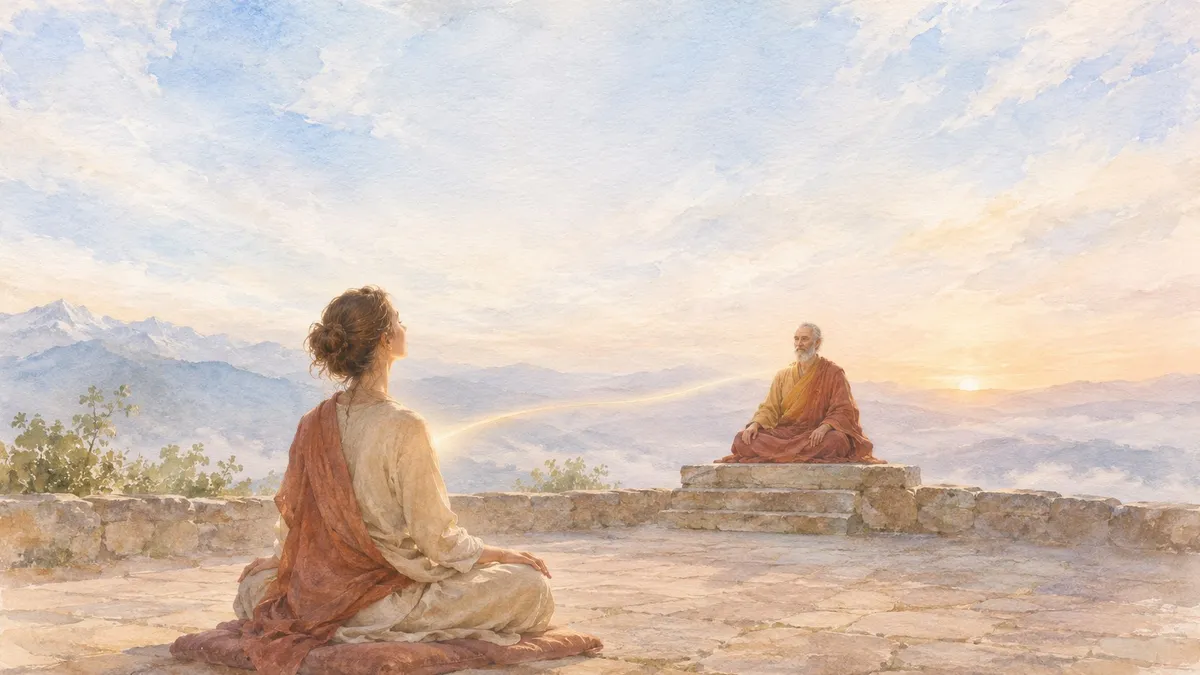
Therefore, in the Teaching, the disciple regards the Teacher’s mind as self-born Wisdom, as the primordial source of transmission, and merges their mind with the Teacher’s mind while preserving the purity of samaya. In this way, they discover the essence of the unborn Mind. This principle is called Guru Yoga and transmission. Transmission takes place through Guru Yoga. This is a very important principle, provided that samaya—the special spiritual relationship and spiritual commitments between disciple and teacher—is observed. There are fourteen samaya vows.
I can give lectures for eight hours, for six hours, but not everyone can listen to them for that long. I can explain the Teaching for twenty hours a day.
Choosing a Teacher and Devotion to the Path
Question: What must I do to embark on the path of discipleship? What if certain obligations keep me tied to worldly life—small children, for example?
You can first become a disciple while living in the world. If you have small children, you cannot leave them; they are your responsibility. You need to begin practicing under the circumstances in which you find yourself. Small children will not always be small; they will grow up. The children will grow up and marry, and you can become a brahmacharini, a nun, a hermit. Freedom, sadhana.
Question: I met Sumiran, Kamal, and now you. Is that already preparation?
Of course. But initially, when it comes to discipleship, you have a whole system of training. You can begin with the basic practices. In the basic practices, we concentrate on a point, recite the Om mantra a million times, perform prostrations, and practice analytical meditations on the four awarenesses: impermanence, the law of karma, the preciousness of human birth, and suffering. All these are basic practices. After completing the basic practices, you then undertake retreats. This is how sadhana is usually structured.
Whichever teacher you choose, each teacher has their own school, method, system of training, and system of instructions. You simply have to follow them. Whichever teacher you choose, you must believe in them, surrender yourself completely to this process, and follow it to the end—to realization, to awakening.

At first, you should visit many teachers, like a bee visiting many flowers, and listen to many teachings. Then, just as a kite dives like a stone upon its prey and chooses one animal to eat, in the same way you must choose one thing, without scattering your attention—make a definite choice. It is like a girl who dates many young men at discos, but then decides to marry one of them. You cannot marry five men. Only in the case of the Pandavas in the Mahabharata. You cannot even marry two. Only one. One school, one system of practice, one Master. That is how you can practice. Then, once you have entered, you simply need to practice. Go deeper and deeper, receive transmissions, attend retreats, receive initiations—sadhana, sadhana.
This principle is generally taken very seriously in India. In Russia, this culture does not yet exist. But in India, if a disciple who has been with one Master, Teacher, or Guru comes to another, the latter asks, “Why did you leave your Teacher? Did he fail to teach you, or did you not believe in him?” He takes this seriously. Teachers always disapprove when disciples wander here and there, from one Master to another, unable to make up their minds.
Of course, this can be called the “bee” path. On the “bee” path, everything is permitted. You can fly back and forth on the “bee” path; that is normal. But on the “deer” path, and even on the “dove” path, you must complete your search, concentrate on the one thing you have chosen, and follow it to the end with faith and fearlessness, whatever the cost. No path will be easy for you. Do not hope that it will be better somewhere else. That is all an illusion. Whatever path you are on, your karma will still be with you. But you must believe in your path. For no teacher and no school will walk your path for you. You must follow the path toward which your heart is drawn.
The Spiritual City Project
Question: I was very interested in your city project. What will it look like? How do you envision it?
My understanding is that there is Divya Loka, and around Divya Loka a new Russian Auroville—Arya Loka—can be created. My disciples settle around Divya Loka. Around these disciples, within a radius of fifty or even a hundred kilometers, any spiritual seekers may settle: those belonging to spiritual schools, those who have masters, those who have no masters, and those who do not belong to any spiritual school. We simply say that you may settle here and you will be welcome. We do not regard anyone as a competitor. We are well-disposed toward all schools; we have no desire to have people only in our own school. Everyone must choose where to go. But if everyone settles nearby, a spiritual environment will be created that is generally conducive to spiritual life. Masters will come there, and spiritual seekers themselves will interact with one another.
How do we envision it? It would be better for you to come and see for yourselves. For now, we leave everything in your hands. You can come, buy land, purchase houses, build log cabins or any other kind of dwelling. Live, settle in, and practice. The more spiritual seekers there are, the better. We are developing Divya Loka and our own settlement, and we invite other schools to develop their own settlements, just as we do.
Question: And how will the economic issue be addressed?
Padmasambhava has these words: “Never in history has a practitioner died of hunger or for lack of clothing.” A practitioner’s inner complexity and capacity for self-organization are such that they can easily provide for themselves. People simply need to unite and think about how to do it. The monastery and Divya Loka address this in their own way. Monks have their path, and lay disciples have theirs. All of this is possible. You can plant a vegetable garden and grow vegetables there, just like the local residents.
When we arrived at Divya Loka, we simply arrived, and that was it. We came first and then began thinking about how we would live. Because we had such an intention. You have to make an effort, you have to work, and you have to show willpower and diligence. Nothing will simply appear on its own. A spiritual culture will not be created unless we work for it. Everything is created and comes into being through labor, tapas, tapasya. Divya Loka is the result of tapasya—the great tapasya of those who live there: monks and novices. Concentration, willpower, casting aside selfishness, work, work, work, together with sadhana. Then everything appears. In the same way, if you are committed to such joint work, having created a community of your own, a community of a particular Master, and you are devoted to it, you will accomplish everything; you will achieve everything.

Establishing Centers and Maintaining a Connection with the Teaching
A center can be established in any city. If you become a disciple, practice the Teaching, and qualify for a certain level, you can establish a center. There are examples of successful centers, and there are examples of centers that have fallen apart because people were not ready to devote themselves to service or build ethically sound relationships. People are only human. This happens because there is no practice. But if practice is maintained, retreats are completed, and the Teaching is studied, the centers operate well: Zaporizhzhia, St. Petersburg, Yekaterinburg, Chelyabinsk, and other cities. Where there is no practice and faith is weak, centers fall apart.
For a center to exist, you must maintain a connection with the Guru and his disciples, and with the monastery. This connection must be continuous. If it weakens, the center also ceases to develop. If you want to establish a center, you need to accumulate the potential of personal practice and spiritual experience. Then your faith and your experience of practice will accomplish everything.
Question: So it is the same as within. If there is a certain confidence, if it is necessary, then it will manifest.
Of course. You must believe in your decisions. People often try to create something themselves without truly believing in their intentions. Something happens, and their resolve wavers. And when can you believe in your decisions? When you feel it from within, when you are absolutely, one hundred percent certain of the rightness of what you are doing, of its necessity, power, and divinity. Then you will come to any clearing and say, “The second Ostankino Tower will stand here,” and it will appear. All the devatas and spirits will begin serving you when they see your aspiration and faith. Any decision materializes if you believe in it.
Criteria of Awareness and the Relationship Between Faith and Knowledge
Question: What are the criteria of awareness in practice? And what is the relationship between faith and knowledge?
At first, the criteria of awareness are as follows: the growth of pure vision; one’s attitude toward samaya sisters, brothers, other people, and the world; increasing devotion to the root Guru, the Dharma, and the Refuge; equanimity of perception; and a single “taste” in assessing all phenomena. These are the initial criteria for the growth of awareness. An increase in inner and outer harmony.
A deeper criterion of awareness, in addition to awareness while awake, is the emergence of awareness during dream sleep. An even deeper criterion of awareness is the emergence of awareness during dreamless sleep. Awareness during dream sleep is unavailable to ordinary people. It is available to a sadhu. But awareness also varies. When we speak of awareness during dream sleep, we mean the ability to maintain the same level of contemplative presence as while awake. To attain awareness during dreamless sleep, you will have to practice tapasya throughout your entire life. This is a very high level; it is a criterion of Enlightenment.
As for the relationship between knowledge and faith, faith is higher than knowledge. Faith is a fundamental principle of the universe. Even if you do not know something but have faith, faith will reveal all knowledge to you. Faith comes from the heart, whereas knowledge is already an indirect reflection closer to consciousness, to the mind. The Universe is made of faith. It is the building block from which the universe is constructed. This entire world is Brahma’s faith. Brahma believes and creates the Universe, creates intelligence. He believes in his sankalpa, in the power of intention. Knowledge, however, is already reflected reality in the minds of higher beings. Faith is bhava.

When we see this, we see that we all have little faith; we lack faith. We need a great deal of faith. Faith does not appear immediately; it is cultivated. Faith must be transmitted by one who embodies it, by the Master. It cannot simply arise on its own. It is transmitted. In addition, it is nurtured and cultivated. Even that is not enough. It is tempered. It must be tested and tempered. And knowledge helps you.
Shankara spoke of viveka (discernment), vairagya (dispassion), mumuksha (aspiration for liberation), and six special qualities, among them shraddha. Shama, dama, uparati, titiksha, samadhana, shraddha. Samadhana is steadiness of mind; shraddha is faith. These are qualities necessary for a sadhu.

The Nature of Faith and True Faith
For example, someone may say that they are not a believer, but in fact all people are believers. Worldly people are believers too, even fanatical believers. But they believe in their own system of values. They recite their creed: I believe in family, in money, in society, in television, in my ego, in my mind. These too are symbols and objects of faith. The point is that there are no unbelievers; everyone believes in something: in the scientific paradigm, in a model of the world, in their own values, in their own thoughts, in the ego. The point is that there are truer, more profound objects of faith, and there are more false and superficial objects of faith. The point is to have true faith.
The question is: what is true faith? If your faith is without attributes, without qualities, beyond logic, like pure awareness, then this faith is most adequate to the Absolute. If faith is conditioned by desires, emotions, and logic, then this faith is superficial and will easily be destroyed.
For a jnani, knowledge and faith are one and the same. A jnani knows and believes. He knows that he is the Absolute, and he believes it. If two siddhas meet, and one performs miracles while the other seeks to prevent those miracles from materializing, who will prevail? The one whose faith is stronger. One believes that he can fly, while the other believes that he can bring down those who can fly through the power of his thought.
Once there was such a dispute: the Christian Saint Peter and Simon Magus decided to demonstrate their powers before the Roman emperor and settle their differences. Simon Magus was jealous of Peter: he possessed various abilities to change his appearance and fly through the sky, while Peter could not do these things, but he had strong faith. Simon Magus wanted to be accepted among the Christians—it had already become popular to become a Christian—but on the condition that he be given some status or position, that he be appointed a bishop of some kind. Otherwise, he would not agree. He was a magician and sorcerer. But Peter refused. Simon wanted to bribe him. This is where the word simony, bribery, came from. Then, before a great crowd, Simon Magus flew up into the sky and began performing various miracles. Peter then did something, and Simon Magus fell.
Peter believed more strongly in his own reality, in his own description of the divine, than Simon Magus believed in his magical system of the world. Whoever has the stronger faith prevails.
Question: But is the question who will prevail?
No. The question is whose faith is stronger. Victory is not important; faith is important.
Question: But faith that requires constant proof.
No, all of this is for people, for emperors. What is there for a jnani to prove? When jnanis play various games for others, for people, for the emperor, try to direct the course of history and influence society, that is politics.
Question: Ultimately, Rome adopted Christianity.
Peter's faith was sufficient to influence the course of history. The Roman Empire disappeared, and the Vatican emerged with Catholic Christianity, which determined the entire future of humanity for the next fifteen hundred years. If you believe in Advaita, then Advaita will become dominant in Russia. If your faith is weak, another dominant religion will arise, belonging to those who believe. But the point is not for one to dominate another; the point is to have profound faith in your own path. That is already politics, and it does not interest us.

Seeking and Choosing a Teacher
Question: Now I simply cannot figure it out. I see Advaita, I see many Advaita masters. I feel something, and at the same time I understand that the methods differ. How, then, should I choose a Teacher?
Do not rush; read the sacred texts and reflect. Then decide how to choose a Teacher. First you choose the Teacher, and then he chooses you.
One disciple spent many years searching for a perfect Teacher. Many years passed, and he found one. He was a very great saintly and ascetic Teacher. The disciple thought that he had found his Teacher. But he was told: “This Teacher accepts only perfect disciples.”
A teacher does not seek disciples; he does not strive to have them. He does not depend on them; he is self-sufficient. If he teaches disciples, it is only because he is asked, because there are reasons, because there is an occasion. No occasion—that is fine too; there is an occasion—excellent. Self-sufficiency. But a disciple must seek a Master; it is important to him. It is not merely important to him—it is everything, it is his life, his destiny, his future.
