

Continuation of the instructions on the natural state. Maintaining the state of emptiness. The truth is both bitter and wondrous at the same time. Bitter in the sense that nothing truly exists to the fullest extent possible; that is, not even a speck of dust truly exists—just as in a dream, no matter how much you walk, you will not find even a single real pebble. The truth is bitter only for those who are attached to appearances. From the point of view of the saints, any attachment is the greatest foolishness. Moreover, this refers not only to attachment to a person, but to attachment in principle in general. The joy of truth is such that this emptiness permeates everything and is primordially the perfection inherent in us every second. Even if we do not want to be perfect, this perfection still exists regardless of our will.
Meditation means the continuous preservation of such understanding. When this understanding is continuous, it develops into meditation. To understand that all objects are empty does not mean to renounce activity or contact with energies; we are not those who strive for the unmanifest, for nothingness, because that is a deviation. To understand means to come into contact with energies, to manifest activity, but proceeding from its empty foundation—that is, on an entirely different level.
“Everything that arises from the energy of the mind’s discursive thinking—whether it is the kleshas belonging to the true cause, such as anger and passion, or sensations and feelings related to the truth of suffering, such as joy and sorrow—is simply fluctuations of emptiness, if you understand that the inherent nature of these discursive thoughts is emptiness itself.”

The nature of thought and relationships is emptiness itself. What does it mean to self-liberate? It means to continuously see the nature of these thoughts, to trace it back to emptiness. When we do this, we enter into living contact with emptiness and begin to understand that the point is not the thoughts, not to examine them and enjoy them, but to establish direct contact with this luminous emptiness. Thoughts seem attractive only at first glance; in reality, there is nothing of the sort. Identifying oneself with thoughts is like chewing gum that you can never finish chewing. Abiding in identification on the mental plane takes away a great deal of energy; spontaneity, clarity, and freedom are lost. On the contrary, to come into contact with primordial emptiness means to partake of the reservoir of inexhaustible universal energy. The universe of our Mind is boundless, immeasurable, and wide open. When we partake of this reservoir, only then can we truly interact with the energies of the manifest world.
Understanding Words and Emptiness
Saraha said: “Only the one who has understood what lies beyond words begins to truly understand the value of words.” Until we discover emptiness, we may be mistaken about the words of the Teacher, the teaching, and our own words. We may attribute to words what they are not, and fail to understand what they are pointing to. As emptiness is revealed, such a state will arise in us: suddenly we will feel such a global Source that it crosses out or devalues all words. If we are not entirely experienced, we may even develop an aversion to words, like the Zen monk who tore up a sutra. He had read it for years but could not understand what it was pointing to. And when, in meditation, he attained the experience of emptiness, he simply tore up that sutra. This is a kind of variety of nihilism. We may develop such an attitude toward words: “Words express nothing, are worth nothing; all words are lies, illusion; all words are merely the skillful devices of saints to help others.” I will tell you that this is indeed so. One of the perfections of the awakened one is called the “paramita of skillful means”; the awakened one is also called “one who is skilled in deceiving living beings.” In what sense “deceiving”? Not in the sense that he deceives them out of some self-interest, but in the sense that speech is very inadequate to this emptiness, and when it is spoken, speech appears as deception in comparison with emptiness. But since there is no other way to transmit the teaching, it is said: “The Buddha is skilled in deception.” That is, the awakened one applies these deceptive means in order to awaken people’s consciousness to the understanding of emptiness.
When we understand a higher realization of emptiness, however, a different vision arises in us. We see speech not only as deception, and words and thoughts not only as that which leads into illusion, but as that which is inseparable from emptiness itself, as its energy. At this stage of tantra, words, thoughts, and speech cease to be deception; they become a jewel. Therefore we say that the teaching is a jewel. It is deception when we ourselves are deceived, when we do not see what stands behind the words. But when we discover emptiness and see what these words point to, we understand: since emptiness is so precious, then the words that point to it, and the methods as well, are also precious. Therefore Saraha rightly said: “We begin to understand the meaning of words only when we discover this luminous emptiness.”
The Necessity of Meditation
“Usually, even if through the view you have gained understanding, but do not reinforce it with meditation and slide into ordinary forgetfulness, you will be attached to the cycle of existence by the same old way of thinking.”

This is said of those who have realized a certain vision, an understanding of nonduality, but do not bring meditation into their lives, limiting themselves to intellectual comprehension. It is like casting a seed but not allowing it to sprout. Such a person, despite intellectual understanding, will not be able to free himself from samsara, because the disturbing pranas have a very strong influence on his mind.
Many people are under the power of illusions. They think they are free, but this is not so. In addition to samsaric, ordinary bodily unfreedoms, they are controlled by superphysical, subtle-material beings, and in the bardo their fate will be decided by the lords of karma, not by themselves. Or they are controlled by subtle beings—guardian gods. One can free oneself from the law of the lords of karma and the guardian gods only when one’s consciousness is subtler than theirs, when they do not see you, that is, when you have fully realized the nature of Mind.
Therefore it is difficult to free oneself from samsara if meditative realization has not been achieved. In other words, your consciousness will be drawn by the winds of karma into a particular world.
The Great Spontaneous Abidance
“Since in this way you will become distant from the Dharma, you will be no different from ordinary people. Therefore, it is necessary constantly to maintain the great spontaneous abidance outside meditation, always and under any circumstances.”
When you are doing something or communicating, it is useful to check yourself: “What state am I abiding in: the state of infinite space, of openness, or the state of samsara?”
“Thus, this is not a method in which specific antidotes are applied to overcome each individual klesha or thought that may arise when the mind is in a calm, active, or any other state. On the contrary, the single sufficient antidote that liberates all thoughts and kleshas consists in recognizing precisely this view with which you have already been introduced—recognize the essence of emptiness.”
From the point of view of dualistic teachings (the teachings of the sutra), one must apply an antidote to unconsciousness. When an impure movement of the mind arises, one must apply an antidote and rein it in. But in anuttara tantra, the antidote is the infinite space of our Mind itself. When we directly show an impure state to infinite space, it absorbs it. It is said that the boundless space of our Mind feeds on kleshas, on impure states, self-liberating them in an instant. How is this done in practice? It is done by simply abiding in the nature of Mind and leaving everything in its own state. However, if the space of your mind is not deep, this method will not work, and therefore any methods that bring benefit may be applied.
The Clear Light of Mother and Son
“Whatever discursive thoughts and kleshas arise by themselves, they are nothing other than the primordial wisdom of emptiness. Since the nature of these thoughts is the genuine radiant basis of emptiness, if you recognize this, it is called the Clear Light of the Mother, abiding as the original basis. If you recognize the view of the Clear Light of the self-existing natural state, with which the Guru has already introduced you, this is called the Clear Light of the path of practice. When you abide in the very nature of the indivisible unity of both of them, the Clear Light of the basis and the Clear Light of the path, this is called the meeting of the Clear Light of the Mother and the Clear Light of the Son.”
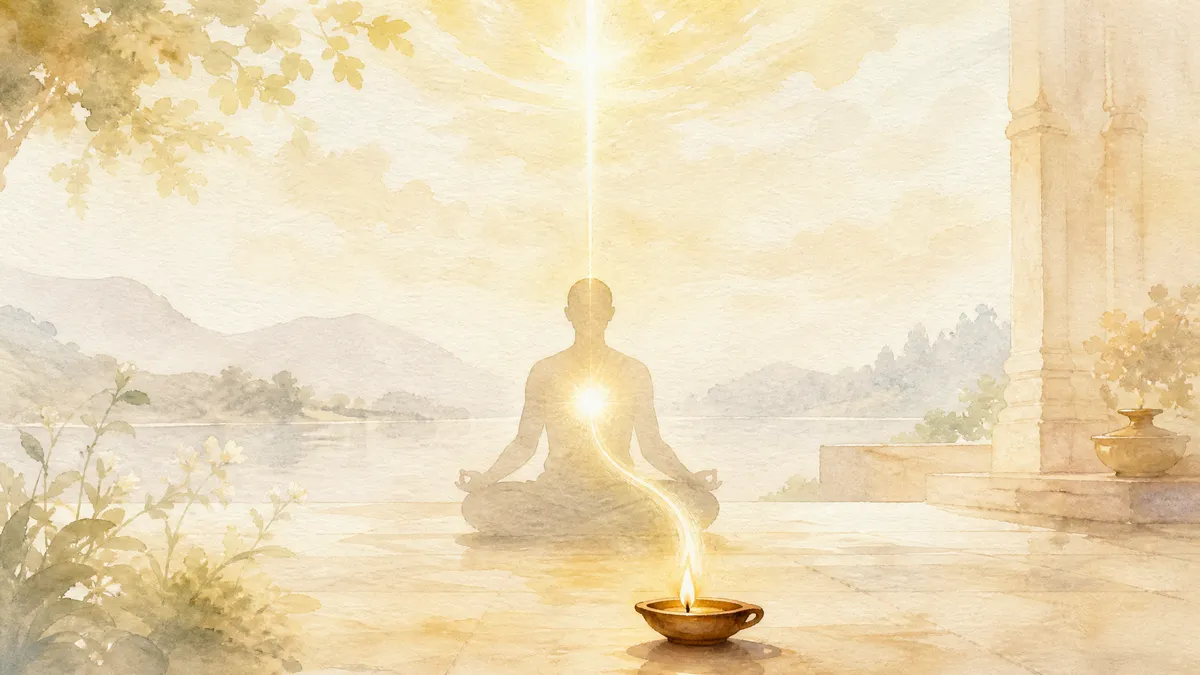
It is said here that ordinary thoughts, kleshas, and samsaric states in general are inseparable from luminous emptiness. Moreover, they are its expression, and not only pure and good thoughts, not only conscious states, but any thoughts and any states are an expression of this luminous emptiness.
In the traditions of Aghora or in the Kaulika schools, they meditate on impure states in order to recognize their basis, luminous emptiness. In this way they enter the state of a single “taste,” and then from there—the natural state.
In the tradition of Laya Yoga, it is different. We practice the path of presence; this gives rise to the natural state, and then the single “taste” itself resolves the contradiction between pure and impure. For example, there are many unconscious, negative, impure states. Of course, one needs to purify oneself of them; nevertheless, in the highest sense, even they are a manifestation of the pure light of presence. If you practice pure vision, you must understand well what is being said. Suppose you see a person who does not possess the consciousness of a practitioner; he has many kleshas, but in pure vision you try to see him as a deity. What does this mean? Undoubtedly, there is a subtle part within this person. It may not yet be revealed and may be hidden in his subtle channels. This hidden part is the deity within him; one could say that the person is its vessel, its bearer. This deity acts through this person; it is simply not yet visible. And when you look not at the person, but at his subtle part, then this subtle part is worthy of admiration; it is very conscious, it is blessing itself.
A saint sees the Absolute and the subtle part anywhere: in a dog, in a criminal, in a degraded personality, in a saint, in a worldly person. He knows that the body and the vibrations of the mind are merely an expression, while all of this is governed by a subtler luminous part—the inner deity. The inner deity itself is the generation of boundless emptiness, completely luminous. Then he sees that if a person manifests in this way, it does not in the least diminish the fact that primordial luminosity manifests through him, that the deity plays through him. Of course, such a person will experience all the actions of karma, since his mind and body are impure, but his subtle deity acts independently of his body; his luminous emptiness and basis will never be shaken.
For example, on the battlefield, a saint observes not a battle, but a play of energies; he sees how some deities play with others. Of course, these deities are wrathful—otherwise why would Krishna have begun to fight, saying to Arjuna: “Fight; they have already been killed by time.” Krishna understands that there are laws of a universal scale that one person cannot change; he sees that many wrathful deities have gathered to play. They manifested through the channels of specific people, through their karmic vision. These wrathful deities decided to make a wrathful offering to the primordial luminous space. When energies play, people simply embody them, because they cannot help but embody them if this is their karma. The basis of all these wrathful and peaceful deities is primordial emptiness, primordial clarity. A saint sees the battle on the field of Kurukshetra, the play of wrathful deities, and primordial emptiness simultaneously, and he has neither confusion nor suffering, because he sees everything as it truly is.
Not Accepting and Not Rejecting
“Thus, constantly remember the view of the Clear Light, recognized within oneself, and abide in this state. Most important of all is not to reject or accept the thoughts and kleshas arising as an expression of this state; not to obstruct them and not to indulge them.”

Not accepting means not clinging, not allowing the mind to stick. Even when we try to practice awareness, the mind constantly sticks to objects, or a state of rejection arises in it, because one’s own experience is superimposed onto something. A true practitioner attains such flexibility that the mind does not stick to anything and does not reject anything, when the mind is genuinely free. How can one achieve such a state?
For example, when you see a person and your mind begins to cling, you should practice pure vision. Think in this way: “This is a deity playing with me and testing my awareness: will my mind cling to his form and speech or not, am I aware or unconscious? If my mind has clung, if I have perceived him dualistically as an ordinary person, then I have lost; if I have managed to recognize his subtle state, then victory is mine.”
There is also a method: when you see something, in order for the mind not to cling to it, instantly imagine how you expand to the scale of the Universe and look at what you see from that scale. This is a skillful means of maintaining such a non-clinging state.
Disrupting Fixed States
“If you are a beginner, then when you remain in this state for a long time, the true face of your innate nature will be obscured by experiences of bliss, clarity, and emptiness. But if you strip the husk of experiences from the naked face of the natural state, this will increase the clarity of wisdom. For it is said: ‘The yogin’s meditation improves through disruption, the force of a waterfall increases through its fall; therefore, again and again disrupt stillness, bliss, clarity, and the activity of the mind.’”
Here it is not speaking of external disruptions, such as the “Vinaya Samhita,” but of disruptions of fixed states of mind. When the mind has a tendency to cling to something, to enter some state, it loses freshness and becomes shriveled. A yogin must necessarily notice this and disrupt such a state in order to return it again to primordial emptiness. Suppose, for example, you imagine an enormous hall of five thousand square meters and fifty meters high; you will have a sense of space. But if you spend a long time in a small cell, you also feel compressed. The art consists in having neither constriction nor attachment to space, but in being beyond this.
“How, then, is this disruption to be carried out? When an experience of peace, clarity, and bliss arises, as well as a feeling of joy, admiration, and pleasure, it is necessary, with the powerful sound ‘Phat,’ like a lightning strike, to tear this attachment to the experience to shreds.”
When such attachment has arisen in you, you can use the syllable “phat,” which was discussed, the practice of falling with the sound “ha” in the vajra stance, or simply a sharp shout without a specific sound. In this way, the conceptual mind is swept away for a time, its fixation is eliminated, and you once again find yourself in a boundless state.
In many Soto and Rinzai schools, the method of training was built on this. There was not even any theory or pranayama there; the teachers simply shouted at the students and hit them with sticks about five times a day. Of course, they did not shout at and beat the students because they had such a desire or because their sadistic tendencies were manifesting. This was a specific method of practice given by Rinzai—to deafen, shock, and stun the mind so that the natural state would open wide. The student knew that from around some corner a blow, a shout, or a clap from the Master might follow, and therefore he walked very vigilantly. He knew that awareness must not be lost even for a moment, that being unconscious was dangerous. During the day he received direct introduction five times, and this went on for years. This is a very serious practice, because the ego and the mind have nowhere to go; they are constantly thrown back into the natural state. After some time, the student discovers that the openness of the mind is actually being attained, and he begins to get used to it, so he no longer needs shouts or koans.
In the same way, you too should walk as if someone behind the door were ready to strike you with a stick or shout at you. (Although, of course, we do not do this here.) This means that the mind must be continuously in a state of vigilant readiness to contract completely and open to infinite space, until this space replaces your conceptual mind and completely subdues it. Students often attained complete awakening, the state of a Buddha, after such direct introduction; their minds opened completely, and there was no longer any way back.
The Unity of Meditation and Everyday Life
“Thus, thanks to the continuous connection with this key point of meditative experience and the preservation, always and under all circumstances, of the transparency of the inexpressible natural state, there will be no difference between sitting meditation and the period after it.”

Ultimately, we come to the understanding that boundless space and perfection exist everywhere: whether we are sitting in meditation—there is emptiness and light; whether we rise— the same occurs in movement. However, your surface mind must become accustomed to contemplation so that this emptiness is not some kind of shock. When there is a great gap between the surface mind and the great emptiness, it always seems like something distant, limitless, shocking. The habit of contemplation eliminates such remoteness. Therefore it is said that the truth of the awakened one is no farther away than your palm.
“Therefore, essence-focused meditation during sessions and behavioral meditation during breaks do not differ from one another.”
Integrating Emptiness into Everyday Behavior
When emptiness is revealed, it is very difficult to bring it into behavior. Revealing the empty ground during retreat or walking is easy. But in order to reveal it in behavior, one must truly become a master. We have no other choice, because all the time apart from formal meditation, we are compelled to behave in a certain way.
What is behavior? Behavior is the manifestation of energies, the manifestation of qualities, and not only the manifestation of us as individuals; it is the manifestation of the qualities of the deity and of emptiness itself. But sometimes we make many mistakes because we lose our connection with primordial emptiness. Then our inflexible mind, ego, kleshas, and conditioned experience interfere, and so we begin to behave like an ordinary person. This is often observed. Even a person who has gained experiences in retreat may sometimes behave inflexibly because of their inexperience. In everyday life, they may behave like an ordinary person, because their emptiness has not yet merged with the body, with energy, with manifestation; they have little experience of how to act. One could say that even if they are a master in sitting meditation, in this matter they are still a beginner. Therefore, masters who have succeeded in meditation often engage in active activity in order to gain such flexibility.
Behavior means that we train in how to respond from the state of emptiness to the diversity of situations, while not losing awareness and manifesting the qualities that are needed. The practice of behavior makes the mind completely pliable and refines the natural state. If one does not practice in this way, the natural state will be weak and inflexible, and under heavy energies it will be lost. But the one who has merged behavior and meditation becomes an invincible warrior. To bring meditation into behavior means to reach a new level of awareness, where we truly become masters. Such a yogin will not make a single unnecessary movement, will not utter a single meaningless word, will not do anything foolish; he fully realizes the situation. It cannot be said that he calculates everything; rather, his presence makes it so that everything is already calculated from the very beginning. He fully realizes the entire depth, all the connections in the situation, and responds from the empty ground of his consciousness.
Harmonious Integration into the Sangha

If a person comes into the sangha or is already practicing in the sangha, but their behavior is inflexible, and they encounter problems and difficulties, this means that they have not been able to integrate into the situation, into the sangha; they are responding inadequately, they have failed to take something into account, they have made a mistake somewhere. Perhaps they have not understood how to observe the principles of vinaya, have not realized the principle of “senior-junior,” have not understood the routine—that is, they have not yet realized the situation in which they find themselves.
The sangha is a mandala; it has its own principles, its own patterns. If you are integrated with it, you can immediately read this pattern. But if you lack awareness and do not notice it, then these energies begin to act in another, less harmonious way.
One who abides in presence has a flexible mind and is harmonious in any situation, because their empty ground makes it possible to take everything into account down to the smallest detail. They can always act in such a way that everything will be perfect. However, it is difficult to manifest this empty ground in flexibility, so that there is no great gap between life and samadhi, so that it is not the case that in meditation we soar into cloud-high distances, while in everyday life we are ordinary people experiencing attachment, anger, acceptance, rejection, and so on.
The Danger of Unintegrated Experience
There was once a Zen monk who had an experience, but this experience was not genuine. He was told to go to a Master and receive confirmation. This monk had a very high opinion of himself, so in the note that he was to hand to the Master, the senior monk wrote as follows: “This monk has a high opinion of himself, so point this out to him in order to show that he has no realization.” The monk came to the Master to receive confirmation, but after reading the letter, the Master shouted at him very loudly. Then this monk instantly entered a state of shock, and his mind was damaged. He never came out of this state, and therefore could no longer practice. Later he was seen attaching himself to a Zen monastery and living there as a holy fool; from time to time he would gather children, tomcats, and cats in the meditation hall, arrange retreats for them, and if they violated the rules of discipline, beat them with sticks. He may have experienced emptiness, experienced the natural state, but his surface consciousness drifted so far away and became so detached that he became a holy fool, ceasing to respond adequately to this world.
In order for there to be no shock, the state of contact with emptiness automatically evokes bliss, clarity, abiding in emptiness, and an inexperienced mind may cling to these experiences.
