
Before you learn contemplation, you should intellectually clarify for yourself all the subtleties of the practice of prajna-yantra. Without this, the other types of energy-work practice will not progress.
One brahmachari came and began asking me: “How does the Buddha differ from Vishnu, this from that?” I thought that he was not asking about the right thing, because these differences do not concern us. We are more interested in the mind that realizes its natural nature, and the mind that does not realize it. Therefore I told him: “Whatever I answer you, it will not help you until you understand who it is that is asking. When you understand who is asking, the confusion concerning the Buddha, Vishnu, and Shiva will also pass.”
There are these words about the vehicle of the supreme path of self-liberation: “If you understand this teaching in the morning, you become enlightened in the morning, and if you understand it in the evening, you become enlightened in the evening.” Why? Because the method of laya yoga is direct and very transcendental. However, the whole essence here lies in the word “understand.” In other words, understanding is equivalent to awakening. When a disciple listens to the teaching countless times, this is shravana. In the process of such listening, a new understanding arises in him, and therefore various incomprehensible states of the dualistic mind go away.
Overcoming Deluded Thinking
“When the waves of deluded thinking roll in, coarse discursive thoughts that anticipate their objects obscure the intrinsic nature of the Mind. Therefore, even if we are introduced to it, we will not discover it.”
Even if the nature of the Mind is pointed out to us, it is difficult for us to discover it, since it is covered by thoughts and emotions that incessantly roll over us. It is always there, but thoughts are also always there, which is why they conceal it. And because it is concealed, it is difficult for us to believe in it, to work with it and orient ourselves toward it. It is like telling a king: “You are the king,” but because a strong wind is blowing, the words barely reach him; he hears them, but cannot fully recognize what is being said to him.

Relaxation as the Key to Practice
“To eliminate coarse discursive thoughts, first of all, relax the mind.”
Relaxation is a key point of practice. If your hands are clenched, as if stiffened, the wind accumulates in the area of the throat and shoulders, and an imbalance of pranas arises. Then your energy is constricted, and so is the mind. When we relax, our energy is balanced, and we discover an enormous depth within ourselves. Then the thoughts that arise cannot compare with this spatial depth; having arisen, they cannot take us out of this center.
Many, while trying to practice awareness, for example atma-vichara, felt that they lost it at the slightest fluctuation. The stream of dualistic thoughts makes the mind cling to something. This happens because the practice has a narrowed character. But when we are relaxed, we have an enormous spatial depth, as if we were a walking universe. Then the mind will not be able to cling to the arising stream of dualistic thoughts, because it sees this alternative.
Such a state of an enormous universe is achieved through relaxation and letting go. This is a key point in practice, which is why a true yogin is always relaxed in any situation. Our body instinctively contracts at moments of danger or in tense situations. This should be noticed deliberately and worked with: when you notice tension, you need to give yourself the instruction to relax.
Artless Wisdom
“This very abiding in one’s own artless mind is radiant Wisdom. By applying skillful methods, one will not realize the true nature.”
When we are relaxed and discover this inner universal abyss, we should recognize it, acknowledge it as our own central, main state. Even if it has not yet been fully revealed and these are only some glimmers, nevertheless, in order to work with it, we need to acknowledge it so as to gain a certain confidence.
Our petty, restless mind suddenly sees that in its depth there is something absolute, global, wise, something higher than itself. Then this petty and restless mind must turn to this global dimension; that is, the focus of our consciousness is gradually transferred to it.
Suppose that within even a frail person there is a sense of greatness, but it is simply suppressed due to upbringing, conditions, and karmas. But if this frail and petty person begins to pay more and more attention to inner greatness, then after some time his qualities of frailty and pettiness will yield to greatness, and he will increasingly be imbued with greatness and grandeur akin to divine pride. This principle can also be applied to spiritual practice, and then the practitioner’s petty qualities will yield to greatness, which over time will become his continuous quality. Petty qualities will still manifest from time to time, but he will immediately catch himself and return again to the majestic state.
Working with Thoughts
“In order to show that uncontrived, co-emergent primordial Wisdom abides within you yourselves, it is said: ‘Do not expand and do not gather thoughts—no thoughts!’”
In the wide-open state, this global space is not connected with thoughts. If we expand thoughts, emit them from ourselves, and become carried away by them, we lose this state. Then we want to block them. When we block them, this is also considered something that works, but only for a while, artificially. When, however, we become rooted in this nature, we see that whether thoughts are emitted or not, it does not interfere with this global space.
The Three Traps of Meditation
“If you are still a beginner, then even if you are able to maintain the natural state of mind resting in itself, you still will not be able to surrender to experiences, for example: experiences of bliss, clarity, non-thinking, which are aspects of such a state. Therefore it is said: ‘Abiding relaxedly in the state of equanimity.’”
Even if a yogin has the experience of dhyana, meditative concentration, but has not mastered the method of relaxation and self-liberation, then he is no better than a samsaric god or a god of the world of form; that is, as soon as heavy energies influence him, his state will immediately be destroyed. For example, the gods of form are influenced by collective and personal samskaras; when their samadhi ends, they have to incarnate again. Arhats abiding in nirvana are also influenced at the end of a kalpa by collective samskaras or by some other circumstances, and after a long life in emptiness their stream of consciousness is swept away.
A warning about the lesser nirvana for novices may sound like mockery; nevertheless, intellectually one should know such instructions in order to remember them in the future, when they become relevant.
“Having freed yourself from attachment to such experiences, fully reveal the true nature of the completely transparent, naked natural state.”
Texts remind us again and again of the three traps: bliss, clarity, emptiness. Nevertheless, experience shows that no matter how often one is reminded, if a yogin himself begins to experience them, he will inevitably fall into one of these traps. Most often, good yogins “fall for” clarity, while the best fall for emptiness. These are very powerful temptations, and therefore these instructions must be imprinted in the surface mind.
Personally, I myself was enchanted by emptiness and did not wish to perceive this world, to the point of denying it completely, because when you approach emptiness, your consciousness changes. It is as if a person were injected with a powerful drug and was not prepared for it—his consciousness would change; but if he is trained, then even in a drugged state he will be able to remember certain things and choose the right path.
In some intelligence schools, employees are taught how to behave during psychotropic interrogations, that is, how not to reveal secrets even when they are injected with drugs or other substances that loosen the tongue. These substances affect a person in such a way that he constantly wants to talk. But intelligence officers are trained, in such cases, to talk about something irrelevant—for example, their childhood pranks. That is, they do not lose awareness even during psychotropic interrogations, because they have been taught this and have had the appropriate training.
In the same way, if you have assimilated the instructions, your consciousness will not fall into delusion either in dark retreats, or in ordinary year-long retreats, or during the awakening of kundalini. You will always know how to choose the right path; you will not be confused even if you see gods or maras; you will certainly find the correct point and will not be distracted from the natural state, whether you experience very joyful states during practice or, conversely, suffering.
The “Phat” Technique and the Transparency of Consciousness
“Suddenly shout ‘Phat’ at the thought that is crushing you. Since it is very important to cut off the stream of thoughts and destroy meditation generated by the mind, the sound ‘Phat’ must be strong, sharp, and brief. In this moment, free from all notions, such as, for example, this mind, liberation manifests, and therefore there is nothing—only complete openness. In the emptiness free from all notions, in the aware aspect of this complete transparency, there abides simply the mind as transcendent primordial Wisdom. In this openness there is absolute transparency. This absolute transparency also goes beyond such extremes as arising and cessation, or Being and non-Being. This is the root, innate, inexpressible primordial Wisdom, abiding beyond the conceptual activity of speech and mind—absolute transparency, which is inexpressible.”
Such a quality of contemplative presence as transparency indicates that it is not colored by anything, but exists in itself. This means that this transparent, uncolorable state remains continuous even when we experience some thought or emotion, because the thought or emotion passes through it without affecting it in any way.
When a practitioner has become established in the natural state, he too acquires this quality of transparency. He becomes, as it were, nothing in particular. He can be anything, but in himself he is nothing in particular. This means that he has no pronounced character traits to which he clings; no habits he could not give up; no aversion to some things or attachment to others. His qualities become streamlined, transparent. He becomes a non-individual; his personality can change flexibly depending on circumstances: depending on the situation he is in, he may respond in one way, or he may respond in another.
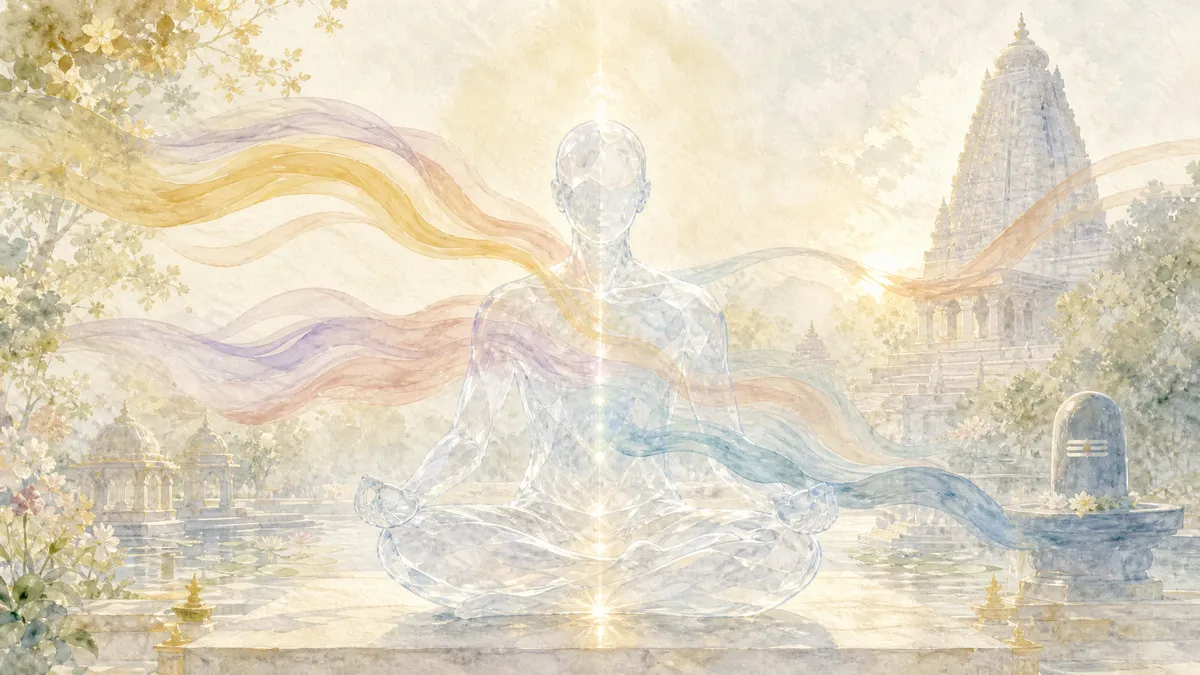
This happens because he has acquired this quality of transparency. The more we practice, the more transparent we become; that is, we have less and less acceptance and rejection. Having mastered the quality of transparency, the yogin is at home everywhere; he abides everywhere in harmony and comfort, and every second he is fully appropriate to the circumstances.
A beginning practitioner is not transparent. He has a strong “I,” strong thoughts, kleshas, emotions, and preferences, and therefore it is difficult for him to move through the world, because somewhere or other he will be caught. But as we practice, we become more and more transparent. This is the only way not to be seized by the objects of samsara.
The Absolute View and the Unity of Practices
“The key meaning is that the natural state is inseparable from the basis of emptiness. This is the absolute view of the yogin’s path, primordially pure and free from mental constructions. No matter how much one practices meditation, until one recognizes this single fact, it is impossible to go beyond the artificial view and meditation fabricated by the mind. And since they are as far from the approach of natural great completeness as earth is from sky, they miss the meaning of the unceasing Clear Light of non-meditation. Therefore, recognizing this single fact is extremely important, and thus it is said: ‘Recognize in it the emptiness of the natural state.’”
Here it is said that the main point is that the yogin has a pure absolute vision, free from mental constructions, in which the yogin is invited to abide continuously. If this view has not been acquired, then meditation practices and other methods are intended only to open it.
To put it more simply, an ordinary person feels: “I am me; here is my body and my thoughts.” This is the consciousness of one who is asleep. The practitioner’s view and sense of self are different: he does not feel “I am this body”; he experiences a sense of boundless expansiveness and openness, like the one that arises when you look at the starry sky. He continuously feels himself in this way, training to abide in this state more and more deeply.
It is said that recognizing such a state is extremely important, and if it is not discovered through vision, then there will be nothing to support through meditation. That is, the most important thing is to reveal such a vision. When such a vision reveals itself, all the practices being performed suddenly find a magnet—a center of attraction; they become complete and meaningful. There is a certain deep harmony that shines through behind all the practices; there is no longer any gap between them, everything becomes one continuous unified flow. Prasad, service, the bhajan mandala, techniques, retreat, trips, lectures—all of this is not a multitude of discrete, separate situations, but one continuously unfolding situation.