

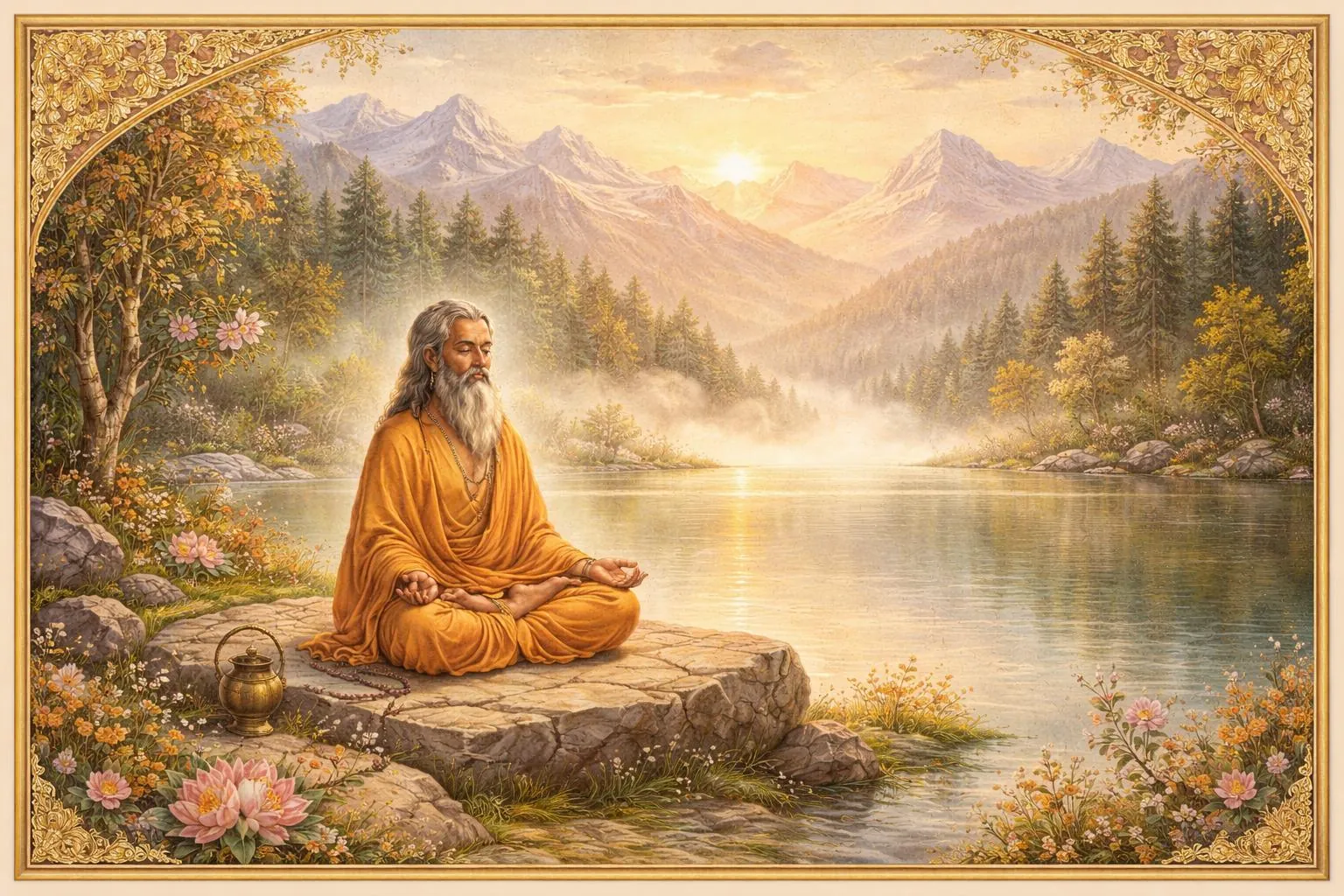
I represent the lineage of Laya Yoga teachings in the Mahasiddha tradition. As you know, we are monks, which means we have come from a monastery, and any monastery is an institution associated with religion. Ours is a yoga monastery, although the distinction between religion and yoga is relative. Ultimately, the central question of both yoga and religion is the same: the path to the Absolute (God), the relationship between the individual “I” and the Absolute, between the soul and God, to use Christian terminology.
A truly religious person lives with thoughts of God and the soul. They think about Him, work for Him, pray to Him, meditate on Him, read about Him, and direct their mind toward how to reunite themselves with God. In the Laya Yoga tradition, there is no concept of God as such, as there is in Orthodox Christianity. Vedanta has the concept of Brahman (the Absolute)—transcendent reality. Moreover, from the perspective of Advaita Vedanta, God is none other than the human being. This is highly unusual for traditional Christianity, since God is always conceived as something opposed to the soul (the individual “I”), dwelling somewhere far away in Heaven, in Paradise, as the One who either punishes a living being for their evil deeds or, conversely, raises them to Heaven for their merits and pure consciousness.
The Teachings of Advaita Vedanta
Vedanta is translated as “the end of all knowledge” or “the final stage of all knowledge.” Advaita is translated as “that which is beyond duality.” In English, “no duality.” The teachings of Advaita dissolve the opposition between the soul and God, the individual “I” and the Absolute. They state that the very mind of every living being is, at its core, the Absolute. Each of us is God in our soul (potentially, of course). Although this may not be manifest, every living being is nevertheless the Absolute. There is absolutely nothing apart from the Absolute. The entire world is merely a projection of our consciousness. But even if we analyze what consciousness is, consciousness as such is fundamentally pure emptiness, in the sense that it contains space and luminous clarity. When we analyze this emptiness, we discover within it the universal Mind, which in yoga is called Brahman or Atman, and in the Laya Yoga tradition, as a branch of Advaita Vedanta, it is the primordial self-born Wisdom (prajnana).
From the perspective of Laya Yoga, the most important thing is the principle of developing awareness. As we develop our awareness, we discover this universal Mind, which has always been inherent in us, and try to reunite with It. This does not mean some God far away from us, dwelling in Heaven and possessing a form. Gods, as well as Heavens, do exist; that is true. However, we are speaking of a higher transcendent plane that lies beyond the duality of subject and object.
The saints assert that until we enter the state of non-duality, we will remain within the illusion of our own perception. Even Gods and Heavens are nothing other than projections of the universal Mind. But this universal Mind is, at its core, our pure “Self.” It follows that all hells, worlds, and Heavens are projections of our great “Self,” just like this world. The fact that they are projections does not mean that they do not affect us. They do affect us, and very powerfully, because we ourselves—our body and our “self”—are one of these projections.
Until we have entered this state of the absolute “Self,” we are like a person wandering among reflections while being one of them. We do not know our own absolute nature; we are mistaken about the most important thing—our own absolute “Self”—and therefore all our actions are misguided, and we suffer. But when we leave the state of reflections and enter the state of the mirror, suddenly all our actions become absolute, correct, and sacred, because we know the most important thing: the entire world is a projection of our own “Self,” and our own “Self” is the Absolute.

Difference from Traditional Religions
When traditional religions preach, they try to convince a person of something, to change their mind. “You are living wrongly; you need to turn to God because if you live a wicked life, you will go to hell, but if you behave well, you will go to Heaven.” “You do not know this scripture or that one. You need to change your views so that they may lead you to God.” This is what is usually said, and there is nothing wrong with it. However, the saints of the Laya Yoga tradition maintain that this view is nevertheless based on concepts and thoughts, while all concepts are a function of the superficial mind, which can never reach the truth because the conditioned conceptual mind is actually nothing more than a finger pointing at the moon, but not the moon itself.
The Absolute is incomprehensible to the mind, so we say that first we should change not our opinion about something, but our level of awareness. We need to shift our awareness to a deeper level. What kind of level is this? It is the level at which we are beyond concepts; that is, we transcend the ordinary moving conceptual mind and reach a level deeper than concepts. We then discover that all our thoughts, opinions, and ideas are empty; they possess no inherent essence or independent existence. All ideas are an illusion, like the horns of a hare. Even the final idea—our own “self”—is also empty in the sense that there is no individual, self-sufficient, separate “self” that truly exists. Our small individual “self” is merely a manifestation of this global Mind, this self-born Wisdom. When we analyze what our “self” is in its fundamental essence, what this global Mind is, and what the primordial self-born Wisdom consists in, we discover that our consciousness is like an empty, luminous space containing everything. All external objects, including the body, manifest from this empty, luminous space, which is always pure, perfect, and incomprehensible.
The Natural State and Its Maintenance
When we can enter a state beyond concepts, we can discover this pure space beyond thoughts. The level of awareness of a yogi, or of someone who practices meditation, depends on whether they can be aware of this pure space beyond thoughts and whether they can maintain this state in everyday life. It depends on how they act: from conditioning or from the spontaneity inherent in their inward, completely pure space.
In Laya Yoga, there is the concept of sahaja. Sahaja means “spontaneous perfection, naturalness, that which requires no effort.” There is also the concept of sahaja-sthiti—natural stability. When we discover non-conceptual awareness, the yogi’s most important task on the spiritual path is to maintain this awareness. In fact, maintaining the natural state is the key point of the practice. Having once discovered it with the help of the Teacher, such a yogi trains to maintain it day and night: while eating, walking, talking, working, standing, sitting, lying down, and even while asleep. Of course, maintaining it during sleep is the highest level of mastery in spiritual practice. Thus, the yogi trains from second to second, minute to minute, week to week, month to month, year to year, throughout their entire life, until their awareness gains strength and they attain perfection.

Types of Samadhi
What is perfection? It is samadhi.
At first, the yogi experiences savikalpa samadhi (lower-level samadhi), when, for example, they can visit the worlds of the gods, separate the subtle body from the physical one, and undergo many different astral experiences. In reality, these experiences are not of any value, yet most spiritual seekers attribute enormous importance to them and often become fixated on them. But the saints say that none of this has any value, that it is neither bad nor good. It is as if you were riding a trolleybus and saw people and trees flashing past; all of this should be left without judgment or speculation, and you should simply continue on your way.
When we let go of our absorption in astral experiences, our consciousness penetrates deeper—into the plane of the formless world. Then the yogi can enter the state of nirvikalpa samadhi. In savikalpa samadhi there is duality: subject and object, the experience and the one who experiences it. In nirvikalpa samadhi, duality disappears: there is no subject, no object, but only pure awareness, which is incomprehensible. Nor are there any experiences associated with form: no gods, no spirits, nothing else. There are only experiences related to space, light, and awareness. In nirvikalpa samadhi there is also no state of “I am experiencing.” There is undoubtedly experience, and there is awareness, but at that time there is no subject who could say, “I am experiencing,” because to begin saying this and adopt the subject’s point of view means to fall out of this plane of awareness.
Nirvikalpa samadhi is considered the highest attainment in the Siddha yoga tradition, as it is in any other tradition. But from the perspective of Laya Yoga, even nirvikalpa samadhi is not an end in itself, because when the yogi emerges from the trance state and encounters the objects of this life, that state is lost. Yet it is important to unite what has been experienced with all objects in ordinary life, since many people are unable to remain in samadhi constantly. Moreover, we have sense organs with which to see and hear, and a body with which to act. But if we simply act, we remain in a conditioned state. The teaching explains how to bring awareness into our actions, how to remain in a state of samadhi while acting. This brings us to the third type of samadhi—sahaja.
Sahaja samadhi means that the yogi may not even be sitting in meditation, yet his samadhi does not cease; all actions, sounds, smells, and images, everything seen and heard, are integrated into his contemplation. This type of samadhi is truly liberating and is what the holy mahasiddhas teach. They teach that until you are established in the natural stability of sahaja samadhi, you are still a novice, a beginner. Sahaja samadhi has different levels. At the higher levels, the yogi can remain in this state not only from morning until evening (during the day), but also at night, in dreaming sleep and in dreamless sleep. The saints themselves say: “If you want to find out whether you are truly enlightened or not, test your awareness in dreaming sleep, and especially in dreamless sleep.” The state of awareness in dreamless sleep is the criterion of genuine enlightenment.
A Story About Testing Enlightenment
An old monk was meditating high in the mountains. He was about sixty years old. He came to the Venerable Seongcheol Sunim and said, “I know that I have attained the state of a Buddha, but some acquaintances advised me to come and receive your confirmation anyway.”
There is a tradition of confirmation. Confirmation means that a disciple comes to a Teacher and asks him to confirm his experience or spiritual level. Such confirmation is very important because, until we have attained genuine realization, we may be under an illusion about our own spiritual level. Instead of continuing to practice and diligently advancing along the path, we may simply rest on our laurels after having some minor experience, thinking that we can now congratulate ourselves and relax. But when we try to obtain confirmation, that is something different, because the Teacher analyzes the disciple’s consciousness and gives him a more accurate assessment, showing him how things really are. Therefore, receiving such confirmation within the teaching tradition is very important, so that we do not remain under an illusion created by our own consciousness.
Seongcheol Sunim was the patriarch of the Jogye Order of Zen Buddhism in Korea. He was a very renowned saint who spent ten years in a cave, meditating continuously. He was also known for imposing a rule on his visitors: “If you want to speak with me, you must perform five thousand prostrations.” Journalists and politicians came to see him, and many left before they had even reached the third thousand. He would say, “If you do not have that kind of determination, then perhaps you do not really need it that badly.”
And so, this old monk came to Seongcheol Sunim and said:
— I have no questions, since I already know my level, but I have come just in case.
Seongcheol Sunim said:
— Very well. Perhaps you have indeed acquired some treasure after meditating for thirty years, but tell me, does this treasure remain with you in your dreams?
The monk’s eyes widened, and he asked:
— What? In my dreams? No, this state lasts only during the day, and in my dreams I lose it; I sleep just like an ordinary person.
Then Son Chol Sunim, feigning anger, grabbed the kettle and began hitting the monk on the head with it. He said to him:
“And you dare claim that you were meditating?! You let yourself relax! Even if ten people were to beat you to death right now and you fell into hell, that punishment would be too lenient for you!”
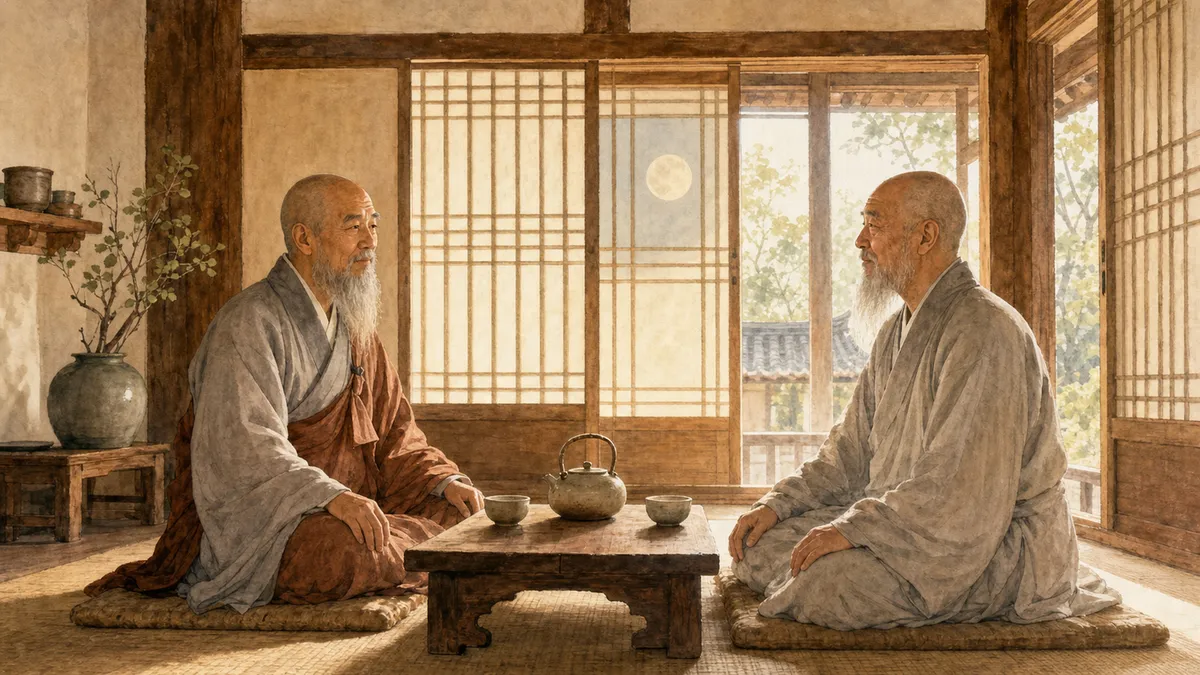
Such harsh treatment is common in Zen. But in this way, he wanted to show how important it is to acknowledge one’s mistakes and move forward. This old man (the monk) was humble enough to admit his mistakes, so he once again withdrew into a twenty-year retreat to continue his meditation. It is said that he succeeded in making the breakthrough the Master had spoken of and attained the highest state of enlightenment.
Saruba Samadhi and the Rainbow Body
Thus, all these experiences pertain to the state of sahaja samadhi. Finally, the highest culmination of samadhi is saruba samadhi. Saruba samadhi means that meditation and awareness permeate a person’s consciousness and energy so deeply that the energy of the physical body begins to transmute. This transmutation affects the cells of the physical body and the pranas, and the elements within the body begin to dissolve. This happens either during one’s lifetime or, most often, at the moment of death, because for a true practitioner the moment of death, when the channels (nadis) and the elements of the physical body disintegrate, can be an auspicious time for complete realization. Then their consciousness emerges from its cage like a bird and instantly unfolds, and they attain the rainbow body. The physical remains are transmuted so that only the hair, nails, and clothing are left behind. The physical body dematerializes and disappears. The reality of such phenomena has been demonstrated by many saints from various traditions, including our own. Of course, the level of saruba samadhi (the transformation of the physical body) is a very high level of spiritual attainment, and in fact only a handful of the saints who have lived on Earth have attained it. Nevertheless, such a level of attainment does exist; moreover, there are specific methods that reveal whether or not you can attain it and what is required to do so.
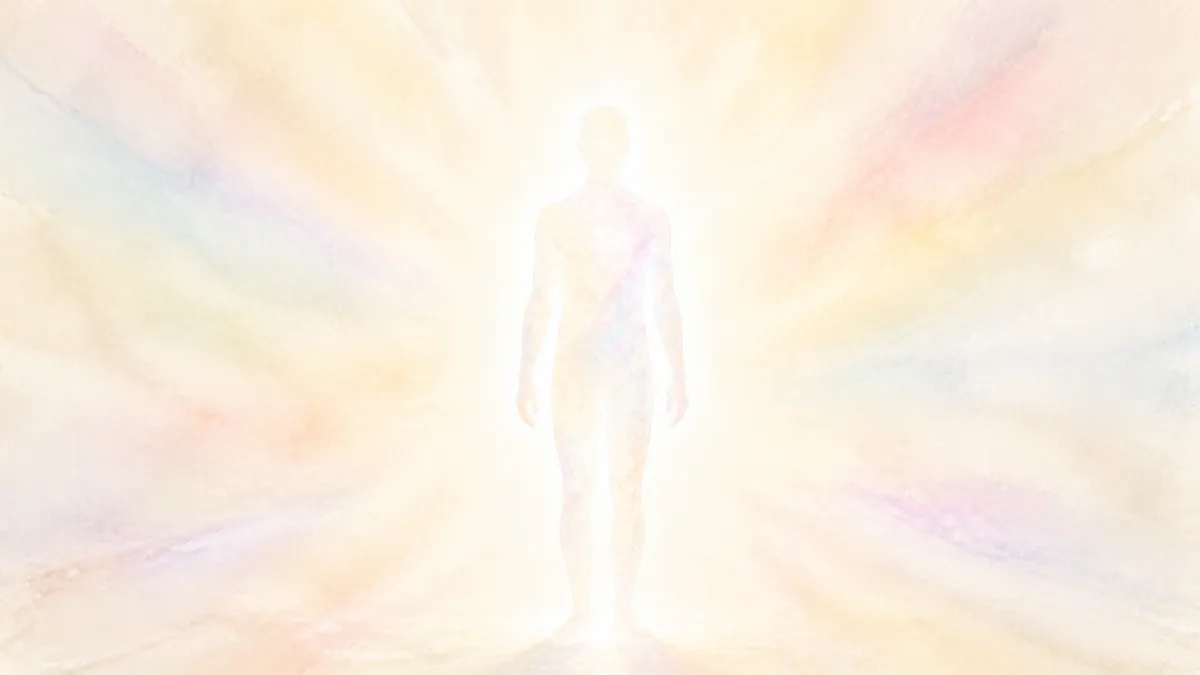
Thus, saruba samadhi is the culmination of the teachings of Laya Yoga, which makes it possible to attain the rainbow body. Through the dissolution of the cells of the physical body, a person attains the rainbow body either during their lifetime or at the moment of death. The rainbow body is a body composed entirely of energy; it is the divine body of Light, manifesting as the five colors of the rainbow. This body is immortal and can travel to any world. It can be visible to people, yet it is not composed of material cells. It can function like an ordinary body in the human world, yet it is completely independent of the processes of eating and sleeping; it has no need for sex and does not suffer from cold, heat, or warmth. It is a completely transmuted body. Various saints have demonstrated the reality of such a transformation through their own experience. One of the most recent examples was Ramalinga Swamigal, a renowned saint from the state of Tamil Nadu.
Shravana, Manana, Nididhyasana
There are three principles in Laya Yoga. The first principle is called “direct introduction to the natural state.” In Sanskrit, it is shravana. Direct introduction means that, in some way, the Master helps the disciple enter the natural state beyond duality, beyond the mind, and beyond concepts. If the disciple’s mind is devoted, open, and unbiased, they can enter this state quite quickly. Those who are strongly fixated on mental ideas, or whose minds are not in the state of an empty vessel, will need more time. When the disciple enters the natural state, they receive confirmation from the Master as to whether or not this is indeed the state. They then dispel their doubts. Since this state is very new, they may doubt it. And when they have clarified their doubts and their understanding of the natural state, they attempt to become established in it. This is the second principle—“cutting through doubts.” It is called reflection (manana). Once all doubts have been completely cut through, there is a third principle called nididhyasana—“continuously maintaining the natural state.”
Continuously Maintaining the Natural State
Once the disciple has entered the natural state and cleared up all uncertainties, they train to maintain the state of contemplative presence continuously. At first, this is very difficult. One might say that the disciple constantly loses it. They sustain it for three seconds and then become distracted. Two hours later, they remember it and return to it again. Then they lose it again for three hours and only remember it during a lecture when they are reminded of it.
Nevertheless, years of diligent practice change the disciple’s disposition, and they acquire the ability to maintain the natural state continuously. Although it is still sometimes lost, the disciple can now quickly return to it. Finally, at the highest stages, it is no longer lost: the mind is like a finger stuck in glue that can no longer be pulled away. In the same way, the yogi places their consciousness in nonduality and never loses it again.
When the yogi remains continuously in contemplative presence, it begins to grow. In fact, simply entering contemplative presence is quite easy; nurturing and maintaining it is much more difficult. Many people can spontaneously enter contemplative presence simply by reading books on Advaita, associating with a saint, meditating, or practicing Kundalini Yoga techniques. Sometimes it can happen spontaneously. But most people are unable to recognize this state as genuine, confuse it with astral experiences, and quickly lose it. And even if this state is recognized as genuine, many people do not know how to maintain it or work with it.
Nevertheless, the teaching of Laya Yoga provides precise instructions on how to work with this state, how to integrate it with everyday life, and how to deepen it. Finally, when it has taken root and become very strong, the yogi practices various methods to attain complete perfection. This is the path usually followed within the teaching.

The Search for Absolute Truth
When we follow the teaching, we understand that it is something very precious because we want transformation; we want to change. And why do we want to change? Because we understand that there are universal realities that transcend our little “self,” such as the Absolute, the universal Mind, death, the mysteries of birth, and karma. There is also our suffering from not understanding any of this, our existential confusion about ourselves and the world, when we feel like a tiny speck of dust cast into the cosmos.
There are the social options that society offers us in the form of traditional values, material acquisitiveness, family, and career. Of course, this is the lot of people whose consciousness is incapable of encompassing more universal truths. And if we reflect on universal truths, we understand that these values are something transient; they are not what our soul is seeking. If we give our soul to them, we lose something more valuable—the search for Absolute Truth, the search for how to transcend death, suffering, illusion, and conditioning.
Awakening from Illusion
Until a person attains enlightenment, they remain in a confined state; their mind is shriveled and constricted. They are rigidly conditioned by the belief “I am this body” and have a mistaken perception of the world. But the saints say that the world is entirely illusory, that the world is like a dream lasting from morning until evening. When we go to church, listen to this lecture right now, communicate with our relatives, or watch television, we remain in illusion; we remain asleep.
This illusion is projected by our own consciousness, and we ourselves are part of this illusion. Therefore, the saints say that the world is a virtual reality, a magical hologram, a collective visualization, or a magic show arranged for us precisely in accordance with karma. Until we understand this, we naturally have various plans within this illusion. But the saints say that all these plans are like the plans of a person in a dream. And if you want to have a genuine plan, there is only one: to understand how to awaken.
When we awaken, we emerge from this illusion; we cease to be part of virtual reality. We understand that the creator of this virtual reality is our own “Self.” Our own “Self” is God (the Absolute), but previously we identified ourselves with the body and mind and did not understand this. When we discover our own “Self,” our mind opens wide. We see that it is like a space filled with light, that it has no boundaries.
Our mind is boundless; our mind is God Himself. Of course, we are not speaking of the superficial, petty mind that judges, accepts, and rejects. This mind, naturally, is not the Absolute; it is something small. What is meant is the mind at its deepest foundation, the transcendental Mind. We will not delve into the terminology of Advaita Vedanta philosophy here, but two kinds of mind are commonly distinguished. The first is the notional or superficial, conceptual mind, which accepts, rejects, and judges. The second is the non-conceptual mind, or our fundamental “Self” at its very foundation. This fundamental “Self” at its foundation is like the space from which all other things are created.

The Flame of Transformation
When we become aware of this magical show staged by our mind and called samsara, an intense desire arises within us to escape the cage, attain freedom, and achieve enlightenment. This is not merely a minor desire; it becomes a flame that burns our heart, makes our blood boil, and causes our flesh to tremble. The saints say that if you do not have such a desire for transformation, it is still too early for you to follow the path of Laya Yoga. To attain liberation, you need such a blaze in your heart that it makes your blood boil, and then you will be able to embark on the path of the practice of liberation. Therefore, it is very important to understand how strongly we desire transformation and whether we are truly prepared to follow the path of such transformation to the very end.
The spiritual path is very difficult and profound; it requires special qualities from us. There are many temptations and enticements on the spiritual path, and Masters often test disciples before transmitting the teaching to them. They test their qualities: the strength of their faith, patience, endurance, their ability to let go of themselves and relax, their flexibility, their ability to accept any situation, and so forth. Therefore, in the Mahasiddha tradition, it was often said that Masters might test a disciple for twelve years. For example, this is how Tilopa tested Naropa in Tibetan Anuttara Tantra.
And when a disciple passes through such trials—and the trials themselves are already a form of training—the disciple discovers that they have completely changed, that their small, shriveled “self” has opened wide, and that they have attained a very profound state of awareness. Then, in a short period of time, the Master transmits the teaching and practices to the disciple, and the disciple attains a state of very profound samadhi.
The Four Vehicles: From Shamanism to Anuttara Tantra
The Laya Yoga tradition belongs to Anuttara Tantra. What is Anuttara Tantra? “Anuttara” translates as “transcendent, supreme.” One translation of “Tantra” is “that which liberates,” “that which carries one across,” or “secret method.”
When speaking of the paths of the teachings, Tibetan and Hindu Tantrism contain a classification that can roughly be regarded as common to both:
The Shamanic Vehicle, or Shamanism
Sutra
Tantra
Anuttara Tantra

The Shamanic Vehicle
Shamanism is what is most widespread today. It is called the “Vehicle of Cause and Effect.” Suppose you engage in communicating with spirits or having astral visions for the sake of some benefit; that is the vehicle of shamanism. It helps in worldly affairs. However, those who practice shamanism do not usually set themselves the goal of realizing liberation, comprehending the emptiness of the mind, or entering samadhi.
Shamanism is the vehicle of benefit. If someone is ill and faces obstacles caused by spirits, those spirits can be found and an offering made to appease them; they will then leave the person alone, and the person will recover. If one needs to predict someone’s fate or gain an advantage in business, shamanism is useful; it really works. And shamanic vehicles exist in every tradition: Hindu, Tibetan, and Russian as well. However, shamanism does not liberate; it merely helps our personality somehow negotiate with the elements, spirits, and forces that surpass us.
The Sutra Vehicle
If we are talking about liberation, however, there is another tradition—the sutra tradition. The sutra vehicle is mainly associated with renunciation; it corresponds to Raja Yoga in Hinduism. Here, the yogi works with consciousness. When he practices meditation, renouncing everything worldly, then, if he is diligent enough, he can enter the state of nirvana. For example, Theravada Buddhism belongs to the sutra vehicle. Raja Yoga can also be classified as part of the sutra vehicle.
The Tantra Vehicle
The third vehicle is tantra. Tantra is a path of transformation, not renunciation. On the sutra path, emotions, thoughts, attachments, anger, lust—that is, everything worldly—are usually cut off and harshly suppressed. In general, the sutra vehicle is very close to Christianity. All of this is considered sinful, so a negative attitude toward it is cultivated, but it is impossible to work with it.
The tantra vehicle teaches otherwise. It says that desires, kleshas, so-called sins, impurities, and the external world are not something bad; rather, they are unconscious, and they should not be denied or labeled as sinful. In tantra, there is no sin as such; there is only one sin—unconsciousness. Tantra says: “You can work with all of this. It is simply energy. If you learn to control it, you can purify all of it.”
Therefore, tantra is associated with controlling inner energy, with pranas, channels, and subtle energies in the body. If a yogi can control this energy, he is able to completely subordinate all impure karma to his pure consciousness. Tantra is usually divided into outer, inner, and supreme tantra. Outer tantra is Kriya Tantra; it is associated with actions, rituals, and so forth. Charya Tantra is associated with visualizations, in which the yogi visualizes himself in the form of a deity. Yoga Tantra is mainly associated with Hatha Yoga and pranayamas, as well as the visualization of channels. Yoga Tantra focuses on controlling energies and on esoteric techniques.
Anuttara Tantra
Finally, the highest tantra vehicle is Anuttara Tantra, which stands apart. It is the most transcendent, the highest state, like a soaring eagle. One could say that it is the cream of all the preceding teachings. Anuttara Tantra does not seek benefits through spirits, nor does it work with the methods of rituals, visualizations, or energies. It achieves all the same things through contemplative presence. Simply by placing his mind in its natural state, the yogi attains complete realization; simply by abiding in the effortless natural state, he attains the rainbow body. This is why Anuttara Tantra is also described as follows: “It is the teaching on how to attain everything without rejecting anything.”
This may be very difficult to understand, which is why the learning process requires the student to possess the necessary initial qualities and preparation.
It is generally believed that it is advisable to try and pass through the lower vehicles. That is, it is advisable to experience the sutra vehicle and the lower tantras “from the inside,” to master control of the pranas and channels in Yoga Tantra, and then to move completely to the level of Anuttara Yoga Tantra—the level of non-action, contemplative presence, self-surrender, and nonduality. But in the Laya Yoga tradition, it is said that the student should be given the highest teaching from the very beginning. In other traditions, the highest teaching is concealed, as if it were a delicious dessert saved for last. The highest teaching is not disclosed so as not to confuse the student. But in Anuttara Tantra, on the contrary, the highest teaching is given from the very beginning. Later, however, when the student feels that he is unable to grasp this highest teaching right away, the lower paths are explained to him. Thus, by combining the lower paths, the student tries to enter the highest state immediately.
The Three Jewels
When we practice the spiritual path, it is necessary to learn from a Teacher. At the very beginning, this is not especially important, but as we advance, it becomes extremely important, because there are certain things that one cannot discover on one’s own. Therefore, when someone practices and asks me questions, I say: “The most important thing for you now is to find a qualified Teacher and try to follow his instructions completely.”

The moment when a disciple meets a Teacher is very important. It is a moment when a fundamental turning point may occur in one’s spiritual life and practice. Or, of course, it may not occur, because everything depends on the disciple. Rather, it is a potential opportunity to bring about such a fundamental change. If we practice without knowing the teaching and without receiving guidance from a Teacher, it is like walking through a dark corridor with a dim candle. We may never reach our destination because we might spend thirty years of our precious life wandering through some dead-end maze, only to return to where we began.
The teaching given by the saints is like a map, and the Teacher is like a guide. When the teaching and the Teacher appear in our lives, we gain assurance that we will avoid many dead ends and strive to reach the highest goal. This is why we say that there are Three Jewels.
The first jewel is the Teacher. By the Teacher, we do not mean a specific individual, but the very light of self-born Wisdom (the Absolute), which naturally manifests as a specific individual. In the absolute sense, the Teacher is a manifestation of the disciple’s consciousness. In Advaita, the Teacher and the disciple form a single whole; they are one, and there is no relationship between two people. Rather, there is one consciousness and two bodies. The point is that the disciple does not understand this, while the Teacher does. In Laya Yoga, the Teacher is more of a collective symbol of all the saints, a symbol of the disciple’s own Higher Self. Nevertheless, on the relative level, it is important to receive relative guidance from a specific Teacher.
The second jewel is the Teaching. The Teaching is not a collection of words that we must memorize. The Teaching is a map of our consciousness that shows us the stages of spiritual progress, possible mistakes and dead ends, and also explains how to avoid them. Although the Teaching is non-conceptual, methods nevertheless exist, and on the relative level the Teaching is very important, which is why we call it the second jewel.
Finally, the third jewel is the community, the Sangha—those who practice alongside us, those who help us in our spiritual life.

When we have these Three Jewels, it is said that we have a favorable environment for spiritual growth. In the absolute sense, the Three Jewels are interpreted as follows: the Teacher is our Higher Self; the Teaching is our discerning wisdom, which connects the individual self with the Absolute; the Sangha is the entire world of manifested phenomena, everything seen and heard, everything that is called the world. Depending on which perspective we adopt—the absolute or the relative—it is said that there are absolute or relative Three Jewels. Naturally, in the beginning we are entirely immersed in the relative, while the absolute has not yet been revealed to us. Therefore, on the relative level, it is very important to understand what these Three Jewels mean.
With this lecture, the teaching of Anuttara Tantra has come to this city. Since it is one of the jewels, I congratulate you on having been able, in this lifetime, to hear and connect with this teaching. This is a potential opportunity that opens the way to a great many things. Of course, the question is how you will make use of this potential opportunity.
