

Commentary on the text “Hastamalaka Stotra”
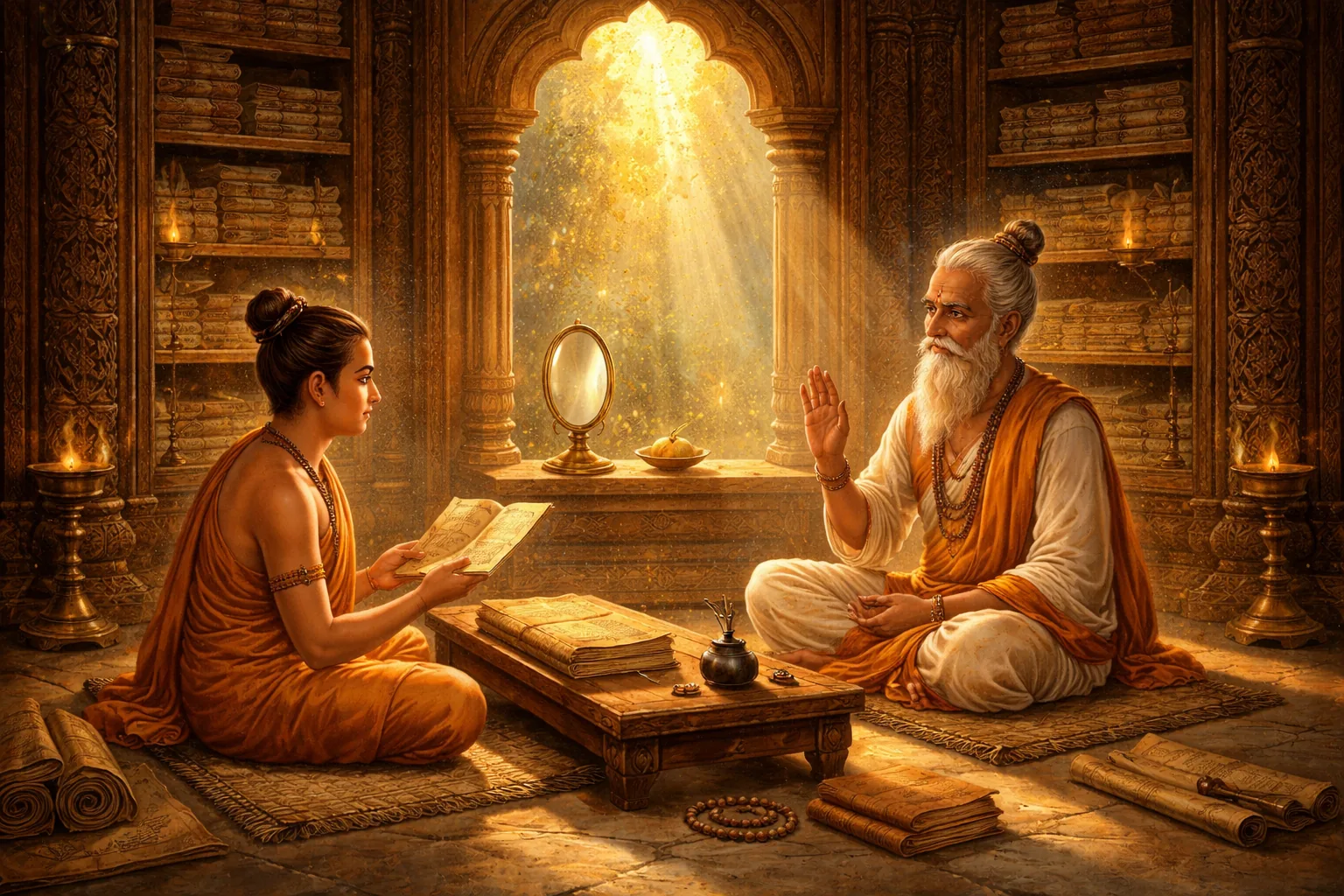
When Shankara, the Guru of the world, was traveling through the western regions of India and defeating representatives of various schools of philosophical thought in debates, he once came to a village called Shrivali. When one of the villagers, the brahmin Prabhakara, heard of his arrival, he came to him with his thirteen-year-old son. He and his son prostrated before Shankara; then the brahmin explained that the boy had been mute since childhood, that he was free from love and hatred, feeling, praise and blame, and that he was completely inactive. The Guru himself lifted the boy up and asked him joyfully.
Shankara met a brahmin who said that the boy was mute, that he made no distinction between love and hatred, praise and blame. Then Shankara asked:
Who are you? Whose child are you? Where are you going? What is your name? Where have you come from? O child! I would like to hear the answers to these questions.
Thus Shankara asked Hastamalaka.
Ignorance differs from awakening in one thing. Those who abide in ignorance believe that they can answer the question “Who am I?” That is, they think that they are themselves. The spiritual path, the search, is always the question “Who am I?” Even if you begin with the search for an external Absolute or God, you will still have to come to the question “Who am I?” And if you begin with yourself, asking “Who am I?”, you will have to come to the recognition of the Absolute. That is, a person standing on the spiritual path begins with the recognition of the fact that he is in complete ignorance regarding himself, that he does not know the answer to the question “Who am I?”, that what he thinks of himself as “I” does not satisfy him at all.
This means that we are constantly trying to understand our existential status. If I am a human being, then, of course, I need to go to school, enter university, get married, work, have children, gradually grow old and die, and in between these things engage in many other foolish activities.
But if I am not a human being, then the question “Who am I?” arises. And if I am not a human being, then perhaps I do not need to engage in all this at all? Perhaps I need to do something completely different? Perhaps, if I find the answer to the question “Who am I?”, then everything that could bring me benefit, as I think, as a human being, is in fact of no use to me at all?
In magic there is such a thing: if someone, in a dream, in the subtle body, travels to the world of other beings, then these beings offer him prasad, something to eat. It is believed that under no circumstances should one take this prasad and eat it, because to taste prasad means to remain in that world, that is, to let the energies of that world into oneself. This is known to those who come into contact with non-physical beings, spirits, and the like. It is the same with the world. If in worldly life you absorb this worldly karma, this worldly prasad, then you remain in this world. For to absorb means to lose awareness and the search. To absorb worldly prasad does not mean not to eat; it means not to absorb the karmic vision from which you are trying to free yourself.
Hastamalaka’s Answer
Who are you? Whose child are you? Where are you going? What is your name? Where have you come from? O child! I would like to hear the answers to these questions.
Thus spoke Sri Shankaracharya to the boy, and Hastamalaka answered as follows:
I am neither a human being, nor God, nor a yaksha, nor a brahmin, nor a kshatriya, nor a vaishya, nor a shudra, nor a brahmachari, nor a householder, nor one living in the forest, nor a sannyasin, but I am only pure Consciousness. Just as the sun is the cause of all actions in the world, so too I—the all-present, conscious Atman—am the cause of the activity of the mind and the manifestations of the senses. Again, just as ether is all-pervading yet devoid of any special qualities, so too I am free from all qualities.
I am the conscious Atman, ever-present and connected with everything just as heat is always connected with fire.
I am that eternal, indistinguishable, unshakable Consciousness by virtue of which the insentient mind and senses act each in their own way.
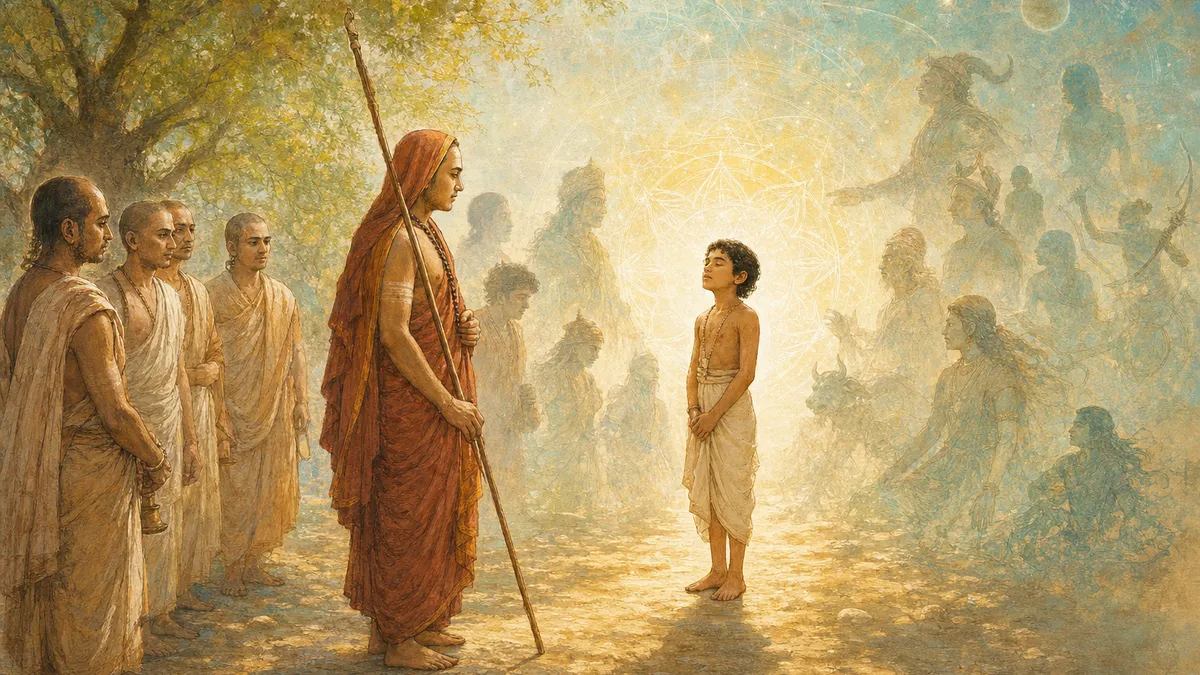
And so, the boy answers him: “I am neither a human being, nor a god, nor a yaksha. I belong neither to castes nor to ashramas. I am the cause of the activity of the mind and of all manifestations, while I myself am free from qualities. I am eternal, unshakable, non-dual Consciousness.”
The boy had no problems with divine pride. That is, he had realized this state since childhood, since he was the rebirth of a great saint. In the same way, a yogin who has realized the true “Self” in contemplation continuously identifies himself as “I am not this, not this, not this, but I am the aware, all-pervading Atman.”
If you are a limited human being, then you have hopes, goals, aspirations, fears, doubts, oppression, desires, and so on. If you are the Atman, then you are free from all of this. When can you say this? Only when you have cultivated this bhava within yourself. Some think that if they repeat two lines like these, they can consider themselves the Atman. You will be able to say this only when you completely change your vision of yourselves as human beings, as people, and gain the vision of yourselves as the Absolute manifesting in a human body. This is roughly how celestial beings, higher gods, and saints feel. They have a mind like space and inseparable from the Atman, and they have energies that manifest in the form of a body or many bodies.
The Ego’s Dependence on the Atman
Then the boy answers:
I am that conscious Atman upon which the ego depends, just as an image in a mirror is not independent of that which is reflected.
He says that the Self is fundamental Being, Consciousness, and the ego depends on it. Our “I” depends on this fundamental Consciousness, even if we do not understand it. The ego is merely a drop in this fundamental Consciousness. It depends on it completely, that is, in much the same way as a wave depends on the ocean. A wave may imagine something about itself, but the ocean rolls it on and on, dashes it against a stone, gives rise to it again, and rolls it on again. Along the way the wave imagines many things about itself, talks with another wave, sorts out its relationship with it, envies it. But the ocean does not even speak with them, because it knows that they are itself. It rolls them from the center, then dashes them against a rock, and then gives rise to them again. Something similar happens with living beings. When will the wave understand that it is immortal? When will it stop clinging to its status as a wave and begin to consider itself the ocean? When will it lose its petty consciousness? That is, the ego must be absorbed by this ocean of Consciousness and continuously identify with it.
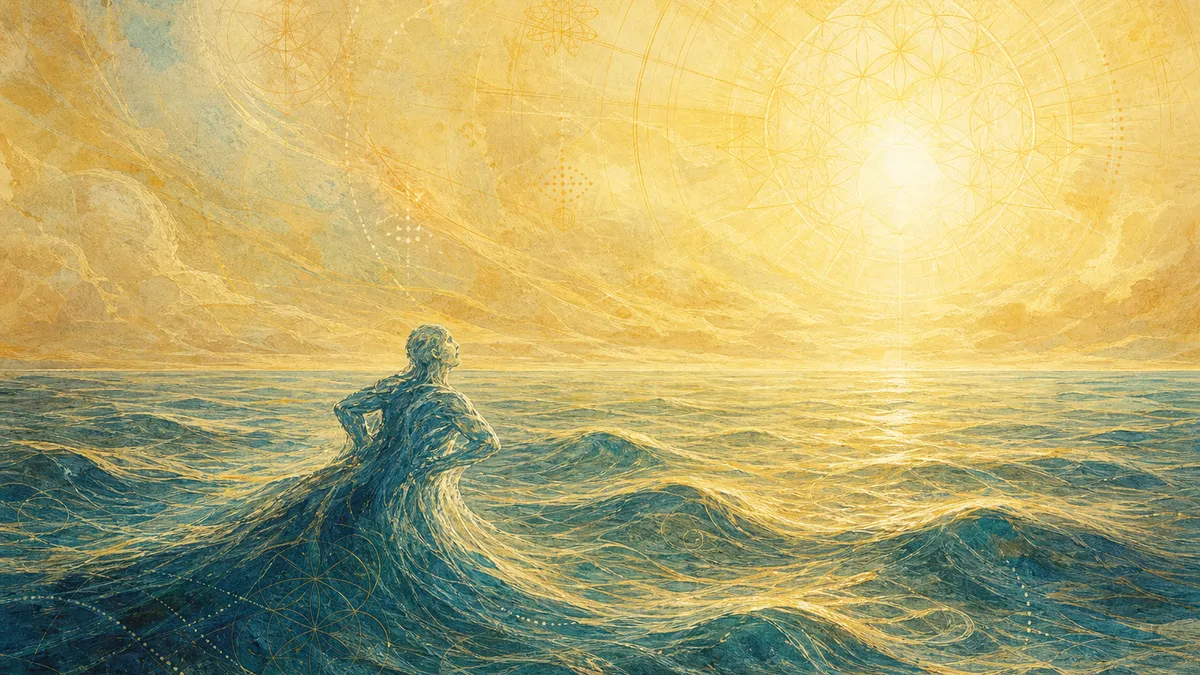
Thousands of times the ego forgets this ocean, thousands of times it turns away from it. Various illusions whirl it around again and again and lead it by the nose. Nevertheless, in a practitioner the ego cannot turn away for long, and after some time it again plunges into this ocean. Therefore it is said that a practitioner who has realized deep understanding is always happy, because he does not fall out of this ocean. Nothing can pull him out of this ocean: passions, desires, suffering, pleasures, grief, joy, blame, praise, material things — in fact, nothing at all. He cannot be tempted by such subtle things as self-expression, creativity, and so on. He knows that the most precious thing is abiding in this ocean.
Consciousness Beyond the Intellect
I am the qualityless, conscious Atman, existing even after the fading of buddhi (the intellect), just as an object remains the same even after the removal of the mirror in which it is reflected.
The intellect can also be compared to a mirror that reflects the higher Consciousness. The light of the Absolute falls upon the intellect, illuminating it. Buddhi transmutes this light and passes it on to manas. Manas formulates it into logic, formulations, concepts, notions, and on this basis makes various decisions. Ahamkara creates the illusion of self-existence, of oneself as a person, as an ego, bringing together memory (chitta), that is, the storehouse of mental tendencies, manas, and buddhi, and identifies itself with this. But all of this receives light from the fundamental, absolute Consciousness. One saint said: “Those people who do not serve God are thieves and swindlers. And this is a civilization of godless people, thieves, and swindlers.” This is said in the sense that when ahamkara, manas, and buddhi act disjointedly, separately from fundamental Consciousness, they can accumulate nothing but impure karma.
The Eye of the Eye, the Ear of the Ear
I am the eternal Consciousness, existing separately from the mind and the senses. I am the mind of the mind, the eye of the eye, the ear of the ear. I am not knowable by the mind and the senses. I am the eternal, solitary conscious Atman, reflected in various intellects, just as the sun is reflected on the surface of various bodies of water.
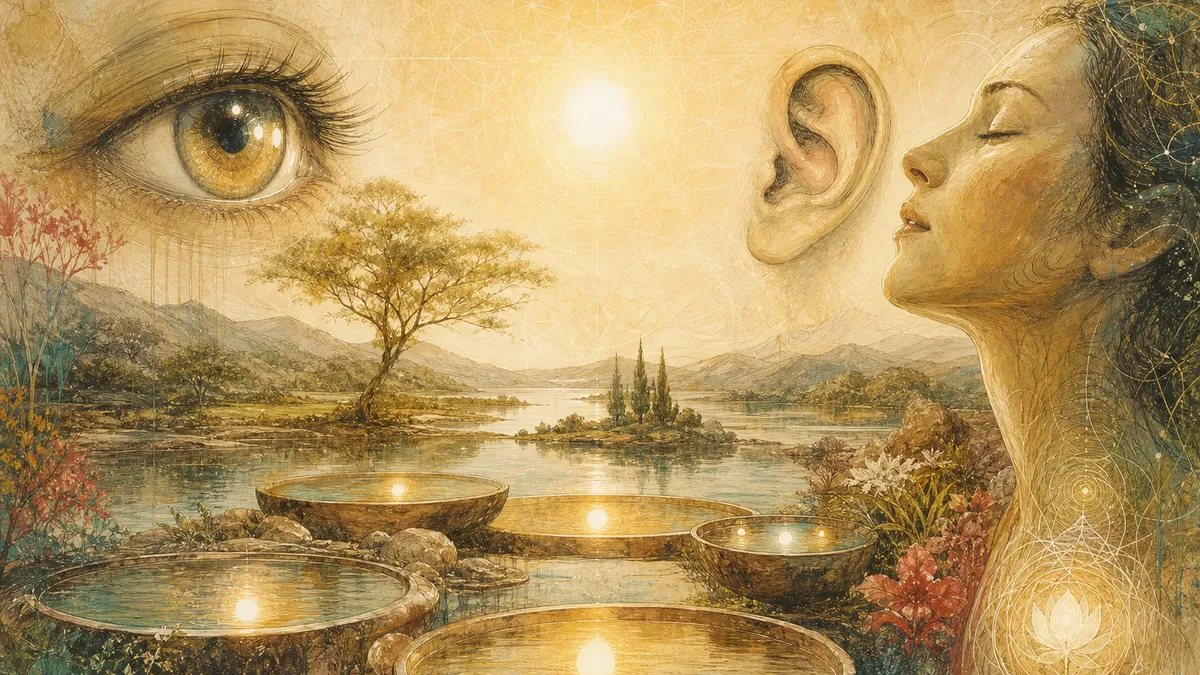
There is a visible object. There is sight as a faculty. There is visual consciousness. There is the organ of sight. Does everyone understand this? A bell is a visible object. The eye is the organ of sight. Visual consciousness is my inner consciousness, which is capable of representing a visible object even without seeing it. This is our visual imagination, visual memory, all the vision that exists within us.
So, we have a visible object, the organ of sight (the eye), the faculty of sight to reflect an image on the retina, and visual consciousness (the ability to perceive). But behind all this there exists a subtler faculty, which is called “the eye of the eye.” This is the knower itself, the subject itself, Consciousness as such, which is even deeper than visual consciousness.
There is sound. There is the organ of hearing—the ear. There is the ability to hear. There is auditory consciousness: our memory of sounds, the ability to imagine sounds, to hear them in sleep, the ability to hear nada sounds. These are all different things. But there is a consciousness that is called “the ear of the ear.” This is the one who perceives all of this, that is, Consciousness beyond sounds, which we seek in nada yoga.
The same can be said of all the other sense organs.
Viveka, discriminating wisdom, means finding the eye of the eye, the ear of the ear, the nose of the nose, the source of touch, smell, and everything else. Whatever sense organ you work with, you will discover this Consciousness, this Source.
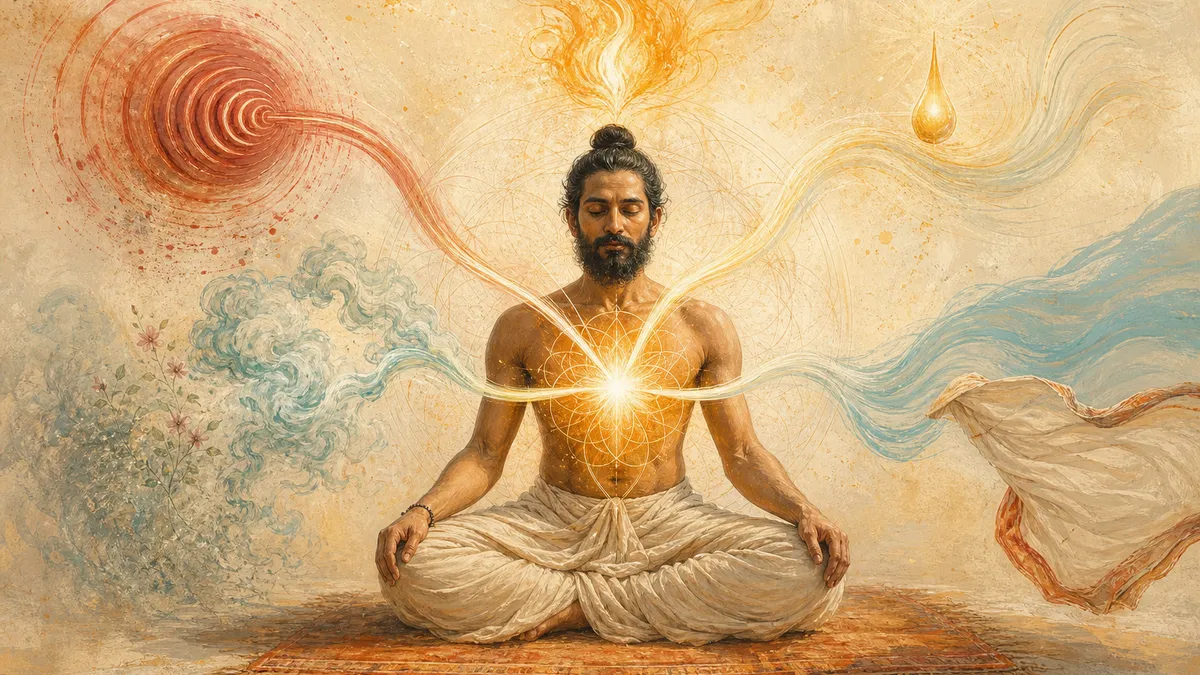
Nada yoga is based on our search for the tanmatra of sound, the subtle sound. Jyoti yoga is based on our search for the tanmatra of light, the tanmatra of images, subtle divine forms. In the same way, there are tanmatras of the other elements. The tanmatra of sound is the tanmatra of the element of space. The tanmatra of light is the tanmatra of the element of fire. All five elements have their manifestation. Their subtle manifestation is called a tanmatra. When we investigate the subtle manifestations (tanmatras) and go deeper, we discover the fundamental consciousness, the Source. We see that any perception (hearing, sight, smell, taste, touch) has come from this fundamental Source.
Discrimination and Pure Consciousness
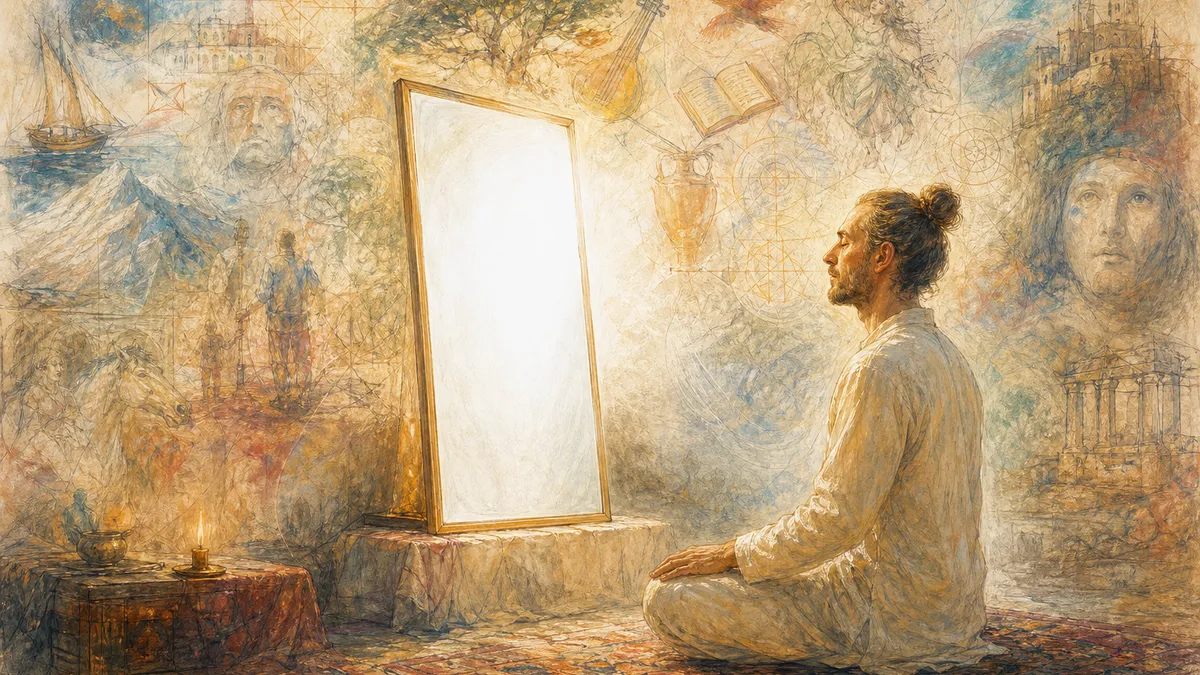
What is discrimination? It is when you understand that the fundamental Source is not an object. You detach consciousness from the object, abstract yourself so that it does not concern you at all. Then you understand that it is not the perception of the object either; it is not the active attention that is present. You also understand that it is not the memory of the object either. That is, you say: neti, neti, not this, not this. And then you come to the question: “What, then, is consciousness without an object, without the perception of an object, without the memory of an object?” And you discover that it is pure, unstained primordial Consciousness. When you investigate in this way, you become convinced that pure unstained Consciousness is your foundation. You begin to understand that the memory of the object, the process of perception, and the object itself have no relation to your pure Consciousness. They are like objects that appear and disappear on the surface of a mirror.
What does it mean to be in presence? It means to become established in that consciousness which is unstained by anything, which is beyond objects and perception. It means that we refine our consciousness to such an extent that we constantly perceive this space, which is the source of objects and sounds. What is coarse, worldly, klesha-obscured consciousness? It is when you distinguish neither the object, nor the process of perception, nor the visual consciousness within yourself. For you, all of this is something single; everything is so clouded that you cannot understand anything in this world. And when consciousness is coarse, then the Source, that is, the deepest Consciousness, is all the more something you do not discern. For you, it is something altogether incomprehensible. You see only moving external objects that completely capture your attention.
A yogin who trains in contemplation always distinguishes all these things: he sees the object, he understands the process of perception, of interaction with the object, he sees his own visual consciousness, that is, visual memory and imagination, which manifest in dreams. That is, he understands that within him there is an entire visual universe. Finally, he separates himself from all of this and sees only that pure Consciousness, which is a blank sheet, a clear mirror that perceives all of it. And he always identifies himself only with this pure Consciousness. And when he identifies himself in this way, it is said that he is a true practitioner of contemplation.
Samsara and Nirvana
Samsara is always the identification of oneself with external objects or perception. Nirvana is the identification of oneself with the pure mirror of Consciousness. Nirvana in the sutra is when everything is negated, and only pure consciousness is affirmed. Nirvana in tantra and anuttara tantra is when there is an object, perception, and visual or auditory consciousness, but at the same time the orientation toward fundamental Consciousness is still constantly maintained. That is, you see an object, yet you perceive fundamental Consciousness within it. When you do this, it is said that you integrate, abide in contemplation, and unite.
Some people think that if they walk around looking at everything, it means they are integrating. They even say: “Here I am, walking, integrating...” But integration is one of the highest stages of contemplation. It presupposes that we abide in deep presence, which has already matured in us to such an extent that we can see everything around us, yet remain in emptiness. That is, we can see the emptiness of everything and at the same time see forms; in other words, we can perceive the emptiness of all forms. Only in this case can it be called integration.
One Consciousness in the Diversity of Intellects
I am the only conscious Atman, illuminating all intellects just as the sun simultaneously illuminates all eyes so that they perceive objects. Only those eyes that are aided by the light of the sun are capable of seeing objects, and not others. The source from which I receive my power is I myself. Just as the reflection of the sun on restless waters appears fragmented, while on calm waters it appears perfect, so too I, the conscious Atman, am not recognized in agitated intellects, although in tranquil ones I shine clearly.
So, it is said here that although there are many different intellects, all these differences are not essential; behind them all stands one Consciousness. In the relative world, you have one intellect and your neighbor has another, and you can argue with him until you are hoarse, asserting that you are right. Nevertheless, in the absolute sense this resolves nothing, since both of you receive nourishment from one Source. From the point of view of the Absolute, this dispute is merely a game.
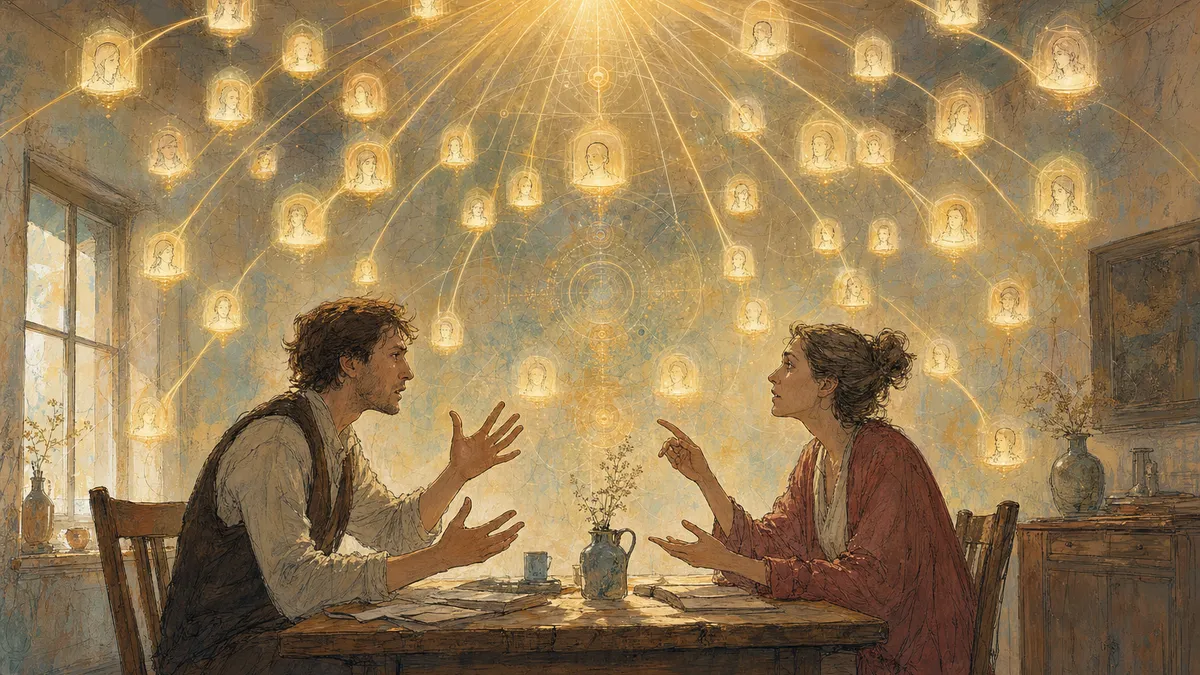
There are saints who adhere to different philosophies. And in India, unlike the strict Tibetan schools, it is generally considered that one muni is one philosophical school. This means that if a muni does not have his own philosophy, then he is not really a muni at all. That is, everyone there has his own view of the universe and of other things. In Tibet everything is much stricter: there are eight vehicles, four schools, and everyone more or less adheres to these four schools. In India there is much greater diversity; there is freedom of creativity in the philosophical sense. This is what distinguishes the Indian school. When munis gather together, each of them asserts his own point of view. And it may even seem that they are all wrong. After all, it seems that hundreds of people holding different philosophical views cannot all be right at the same time. Nevertheless, this is possible because they know that, in the deeper sense, they are all right, since behind them stands a single Source, and all of this is merely different forms of its games.
Just as a fool thinks that the sun has disappeared forever when it is hidden by dense clouds, so too people think that the ever-free Atman is bound. Just as ether is all-pervading and is not affected by influence, so too the eternally conscious Atman pervades everything without being touched in any way. I am that Atman.
The Practice of Identification with the Atman
As your practice progresses, you must learn to draw strength from your identification with the Atman. If contact has not yet been established in you, if you still cannot attune yourself and receive strength and clarity from this all-encompassing Consciousness, then this cannot be called mature practice.
A yogin who abides in presence always has a living and direct connection with the Absolute. Depending on his inclinations, this occurs either through bhava, or through naked awareness, or through the practice of space. He always has a direct connection with the Absolute. Of course, such a connection is realized through the Guru. However, in the absolute sense, the yogin always finds a direct connection with the Absolute and discovers the Guru as essential consciousness.
Just as a transparent crystal takes on the features of its background but does not change in any way, and just as the full moon, when reflected in restless waters, appears to be wavering, so it is with you, all-pervading God!
The Example of a Transparent Vase
When speaking of the Atman, the example of a crystal is given. For instance, this vase takes on the color of the background. If you place it against a blue background, it takes on a blue color; if the background is yellow or golden, it will appear yellow or golden. If you place it against a dark gray background, it takes on a dark gray color. Nevertheless, the vase’s own color is transparent, and it does not change in any way. Has the glass’s own color or transparency changed depending on where you placed the vase? No, nothing of the kind happens.
All these various backgrounds and colors can be called karma, actions, moods, experiences. But the vase, pure consciousness, always remains unstained. When the vase is removed from the background, it reveals its transparent structure. This can be compared to pure meditation, when you withdraw all the sense organs from objects, and then you finally see this transparent pure state. But the point is to understand that this transparency is never lost. Even when the background is present, the vase’s own purity is not lost.
Discriminating Knowledge and the True Self
In fact, one who has mastered discriminating knowledge can flawlessly abide in contemplation by the power of discriminating knowledge itself. He will never again be misled by any lower kinds of consciousness, lower kinds of perception. And you must fully understand this principle; otherwise, naked awareness may remain unknown to you even after many years of practice.
You must not say, “Oh, I don’t understand this!” You must understand it! You must understand it very well! How can it be that you do not understand this? You must thoroughly sort out where the pure vase is, where all these backgrounds are, and how to distinguish one from the other. There is an object, there is perception, and within there is perceiving consciousness, which can evaluate the object or remember it. And all of this is not the Self. The Self is the one who is deeper, who observes both the object, and perception, and the remembering consciousness. The Self is the one who is not stained by any of this. One who always remembers this will never leave the true state.
So, the boy told Shankaracharya who he was. Why was the boy able to say this? Because the boy looked, but did not see Shankaracharya. He did not perceive him, but perceived his own true Consciousness, and this true Consciousness was the Absolute itself. Abiding in the Absolute, he saw Shankaracharya as part of this Absolute. This Consciousness freely seeped into the body through the mind, the buddhi of this boy, and answered Shankaracharya as to what it was. This means that the boy was fully enlightened. He was a saint.
The Story of the Boy Saint
The boy’s father was struck speechless by the wonder of these words. But the Acharya said to him, “He became your son because of his unfinished tapas. Such is your fortunate destiny. In this world he will be of no use to you. Allow him to remain with me.”
Shankara, asking the father to return home and taking the boy with him, continued on his way. Later, the disciples asked him how the boy had attained the state of Brahman without hearing shravana.
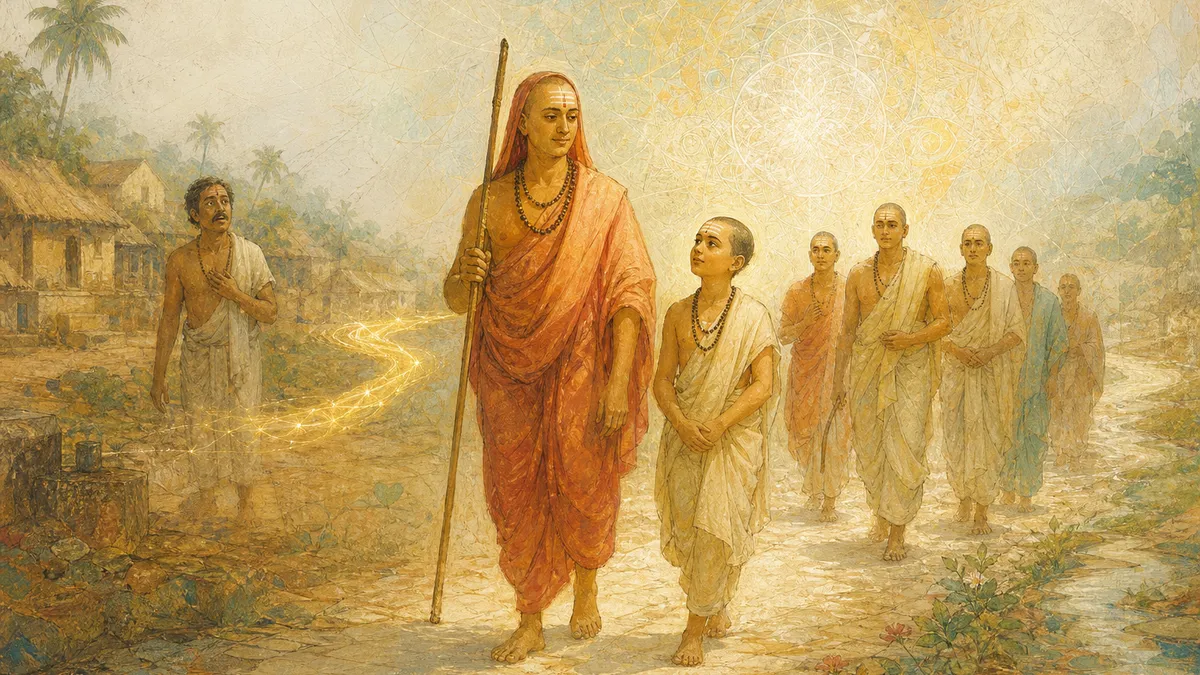
The Guru replied: “His mother asked a great and highly advanced yogin, who was practicing tapas on the bank of the Yamuna, to watch her two-year-old child, while she herself went to perform ablutions together with several women. The child crawled into the water and drowned. Out of compassion for the inconsolable mother, the sadhu left his own body and entered the body of the child. That is why this boy attained such a high state.
The lesson of the last shloka is this: even a high-level sadhu should not try to take on the duties of householders, because nothing but trouble will come of it. Therefore there is a rule: not to take on any obligations, not to make promises outside monasticism. We fulfill our duty to the universe and to all living beings by carrying out our monastic work. And that is more than enough.
