

Commentary on the text “The Platform Sutra of the Sixth Patriarch”
“What is called Paramita?
It is a Sanskrit word meaning the attainment of the ‘other shore.’ When you comprehend its meaning, you are freed from births and deaths. But when you become attached to external circumstances, birth and death arise.”
I hope each of you constantly remembers your choice. This choice is to free yourself from the cycle of births and deaths.
The other shore is liberation. In order to follow the path of liberation, our motivation must be very deep, because we are freeing ourselves from ourselves, who abide in ignorance. When we realize that we are like a traveler over an abyss in the countless ocean of births and deaths, we choose the path to attaining the “other shore.” Until we have reached the “other shore,” we are deluded about ourselves.
Scientists conducted an experiment on a flea. They placed it under glass. At first the flea jumped high, but when it jumped, it struck the glass that was above it. Since the glass limited it, it became accustomed to jumping low. The glass was lowered further and further. After some time the flea no longer jumped, but only crawled.
In the same way, we too, having forgotten our true nature, abide in a narrowed, limited consciousness. We ourselves do not know who we are until we attain enlightenment. We do not suspect the boundless creative potential, the greatest profound, luminous goodness that we all possess. It is like a poor man with gold sewn into his lining who does not suspect that he is already a millionaire.

The Nature of Reality and Awakening
“Like waves rising on the water — this is our life on ‘this shore.’”
When we abide in ignorance, there is this life, this world, subject, object, action, activity, passions, kleshas, attachments, and we take all this at face value. When the mirror of our mind is purified, we discover the emptiness of ourselves, the emptiness of external objects, the emptiness of thoughts, emotions, kleshas, worldly desires, and attachments. We discover that they do not exist in themselves, that they come forth from the single Source.
For example, if this hall were made entirely of gold, it would not be so important whether it was the floor, a candlestick, or glass. The material would not be so important, the form would not be so important. The Source (gold) would hold our attention.
In the same way, emptiness is discerned behind all objects as soon as we purify the flow of our consciousness. From the point of view of absolute emptiness, there are no objects, no subjects, no karma, no birth, no death, no hells below, no gods above. In the relative sense, of course, they exist. And as long as we possess a body, the law of karma operates absolutely. But from the point of view of this absolute emptiness, they are so unreal, so insubstantial, that they are like mirages in the sky.
This world is like dreams. When a person sleeps, he sees dreams. All the phenomena in the dream are real for him: he suffers, hates, or flees, yet at the same time he does not leave his bed. In the same way, the awakened one realizes the unreality of this world. This world, just like a dream, is unreal. We are born, love and hate, seek the Dharma, suffer, practice, but when we gain insight, it turns out that we have not even risen from our bed. It turns out that our empty awakened clarity has always existed, while all our karmas, activities, emotions, attachments, and illusions were like such dreams. Life and death are like such dreams. When a person sleeps, he is not aware of life. When he lives, he is not aware of the dream. But if we open the boundless emptiness of contemplation, we live as if in a dream with dreams. We die every day and are born every second. Such is this great state! We emerge from the state of reflections, while continuously abiding in the Source. We discover this profound, self-awakened, spontaneously perfect, eternally pure clarity, nature, the foundation of everything — the non-dual Atman, which is the essence of all. Atman, self-born Wisdom (prajnana), is only a concept, a certain label of the human mind; in essence, it is impossible to express it in words.
When we abide in the Source, we discover the emptiness of all objects. Emptiness does not mean some kind of negativity or lifelessness. On the contrary, this emptiness contains the most immense potential for manifestation, the play of energy, the dance of Shakti. Everything we see, everything felt and perceived, is the radiance of this emptiness; it is the radiance of our own consciousness. At lower levels, this radiance is not recognized.
Purusha is emptiness; prakriti is material energy, radiation, shakti. At the lower levels, the sutras say, one must first attain the state of cessation, the cessation of radiation (kaivalya), rejecting prakriti in order to realize purusha.
However, on the path of Laya Yoga we say something different: prakriti is not different from purusha, manifested radiations are not different from emptiness, everything is a manifestation of our consciousness. As long as we wander in the illusory projections of prakriti, we will never find purusha, our own “I,” the lord. We will be enchanted by these projections and will never experience satisfaction or even anything resembling liberation.
A man came to see a psychologist and complained that he was depressed. The psychologist said:
“You know, a comedian has come to our city—a great master, a jester, Bob Parker. Go to his performance, and your depression will go away.”
The man looked at the psychologist and said:
“You don’t understand anything; I am that very Bob Parker.”
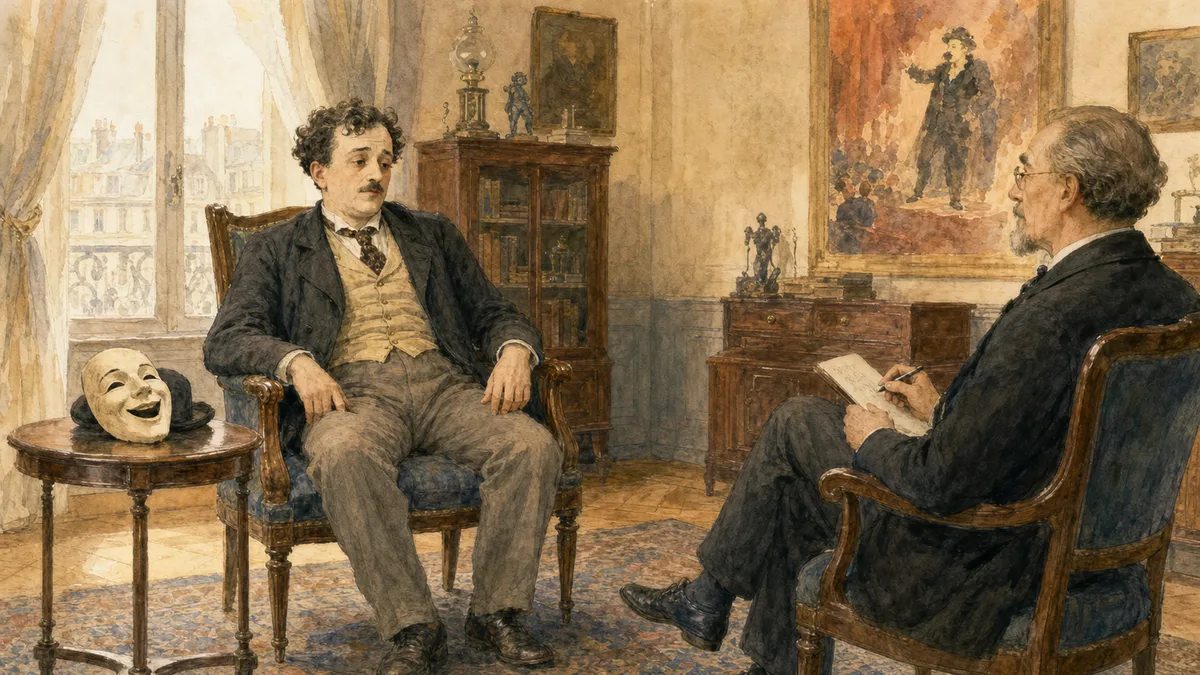
As long as we wander in external projections, as long as we do not turn toward ourselves, we will always remain in such illusions, like a jester who has lost himself. But when we penetrate this Source, everything falls into place. Suddenly we discover that the pursuit of material or even spiritual achievements was a dream, a chimera arising from the duality of our “I,” generated by the subject. The subject itself was a chimera, an illusion, and if some illusion gives rise to certain goals, then these goals are illusory as well. Suddenly we discover that the issue was not achievement, but the discovery of the substancelessness of this subject, its emptiness, its unreality. When we discover the substancelessness and emptiness of this subject, we see that the subject as such never existed, that there was a certain idea of the wholeness of the personality and the ego, but this idea was based on nothing.
Then we suddenly awaken to what lies beyond duality, where there is neither subject nor object: there is a single field of consciousness, and we all are this single field of consciousness. Someone might say: “Yes, of course, we all, like ships in the sea, bathe in this field of consciousness; we are all one.” No, that is not so. To say this is a profanation. It does not mean that we are all one like ships in one sea, like fish in one ocean. It means that there are no fish; there is only one ocean, and there is no one there to say, “We are one!” Even the very concept of the ocean is a conditioning. When you open this field of consciousness, you become it, and therefore, apart from you, there is no one with whom any kind of relationship could be established. Because the fish, the ships, all sentient beings of the Universe, the gods, the hells, and the spirits—all become your great body of bliss.
Therefore it is said that transcendent Reality is one. It is not lonely; it is unique, the only one. There is no alternative to it; there is no other. Having realized this, we suddenly discover the deepest feeling of kinship with the entire Universe, as though all living beings become your mothers.
Liberation from Births and Deaths
“To be free from external circumstances and not be subject to births and deaths is like the surface of water becoming calm and the waves merging into a single great stream.”
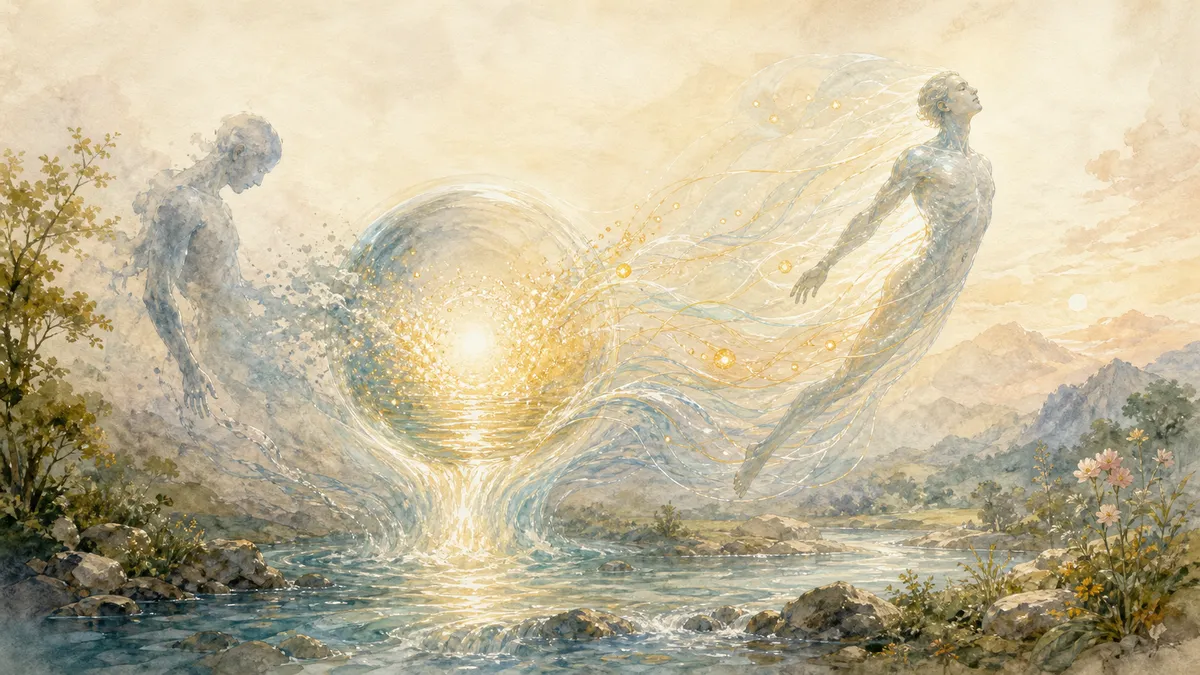
Our life is like a wave. The life of one person is like a wave: here is the tide, here is the ebb, and then—a smooth surface. One birth is like a wave. There are countless such waves. In the brief moment of the tide, when the crest of the wave reaches its peak, one wave looks at another and says, “We will be together,” not even suspecting that the next tide will come, that neither this wave nor the other will remain, and that there is only the ocean. In the brief moment of agitation, the wave looks at itself in the mirror of the ocean’s surface and admires itself, thinking that it is something. But the next ebb comes—and there is nothing but the mirror of the ocean. Such are births and deaths.

Enlightenment means understanding that the wave is a fiction. In itself, it is inseparable from the single oceanic awareness. When we practice contemplation — the basic practice of Laya Yoga — this is not some kind of attentiveness to the state of the wave. At first, it may be a certain attentiveness toward the body, toward one’s own “I.” But the deeper you penetrate into contemplation, the better you understand that true contemplation means maintaining the oceanic state, not maintaining the state of the wave. Over time, we discern the essence of the ocean and discover that the wave has no essence in itself, and that we always are and have been this great ocean. When you discover this, you can exclaim: “O hell, where is your victory? O death, where is your sting?” You become completely free from illusions, karma, ignorance, kleshas, passions, conditioning by your own “I,” body, and so on. Even the gods have no power over you; even the laws of karma now cease to be applicable to you. This happens when the surface of the water calms, and the waves merge into one great stream. That is why it is called “reaching the other shore.”
The True Nature of Contemplation
“When there is ignorance during thinking, this is not true Being.”
Here the subtle points of contemplation are being examined. I comment on this with absolute confidence, since the principles of contemplation at the level of the sutra are the same.
When we meditate, we establish an interval between two thoughts. When we consciously remain for a long time in the interval between two thoughts, we feel an awareness that does not depend on thinking. Having found it, we roughly understand what we need to hold on to in meditation. We understand that this is the right path and that we must further expand this interval. We understand that the whole matter lies in this interval, if we practice mahashanti. It is like polishing a mirror. However, when we come out of meditation, we lose this interval between thoughts, and along with it we also lose awareness. Then, along with thoughts, ignorance comes again; once more we become an ordinary samsaric being, as if falling asleep.
However, the principle of contemplation does not depend on sitting in meditation. Nor does it depend on whether we observe the interval between thoughts or not. If we contemplate correctly, thoughts and actions are not an obstacle. Therefore the Sixth Patriarch says: “If thinking interrupts your awareness, if you lose your presence in contemplation, then this is not true Being; this cannot be called true practice. But if, in the continuous flow of thoughts, you constantly practice prajna, then this is what is called true Being.”

The true way of contemplation means that even when radiation, external shakti, perception arises, we continue to maintain the wisdom of contemplation. The wisdom of contemplation is not separated from thoughts, from visible, felt, and heard objects.
Our mind is like boundless empty space. This boundless empty mind encompasses everything, including external objects, which are within it. To think that the perception of external objects can cloud our boundless space is to be mistaken.
The Three Bodies of Awakening
“One who has become enlightened by this teaching has become enlightened by the teaching of wisdom and practices wisdom. And one who does not practice is a profane person. In one who practices the enlightenment of consciousness, the dharma body is identical to the body of the Buddha.”
When we discover this enlightened wisdom and stop following objects, no longer losing ourselves in projections, we discover emptiness within, emptiness without, emptiness as such, which is primordial purity and perfection.
When we become established in this emptiness, merging with it, our body of wisdom is identical to the body of all great saints. In essence, it is no different from it. The three awakened bodies that we realize are as follows:
Jnana-deha — the body of wisdom, like the emptiness of boundless space in dreamless sleep.
Pranava-deha — the body of precious energy, like the body in a dream. For example, you may see the illusory body of the Guru or a deity in golden light. This resembles pranava-deha, when you realize such a body. This body is created from pure karma and only prana and mind, and within it is saturated with the energy of the Clear Light.
Finally, the manifested body is like the body of an avatar, an incarnation that acts in the material world.
Kleshas as Enlightenment
“Wise friends! Your kleshas are bodhi (enlightenment). When past thoughts are obscured by ignorance, you are an ordinary person; and when future thoughts are enlightened, you are awakened.”
The phrase “kleshas are bodhi” echoes the statement from the tantras: “Yoga bhogayate, mokshayate samsarah” (“Yoga is bhoga; moksha is samsara”).
“Kleshas are bodhi” is one of the most famous sayings, characteristic of different schools, including ours. This is the highest level of understanding. If you understand it incorrectly, you can easily end up in the lower worlds for many lifetimes. But if you understand it correctly, you will become awakened in this very life.
When the essence of the mirror of our mind is fully realized, arising thoughts are not an obstacle, arising emotions are not conditioning, and radiating energies are not impure. They are liberated instantly at the very moment of their arising. Therefore, they are fully enlightened and are never separate from the primordial mirror of our mind.
This, of course, is only if true awakening exists. In the case of ordinary people, this is not so. When our emptiness has gained power, we discover that all thoughts that generate ignorance are inseparable from emptiness; they are its play. All emotions, manifestations, visible and audible objects—what previously seemed an obstacle, samsara, ignorance—reveal their purity, their stainlessness, their perfection. Suddenly we understand what the saying “Sarvam Eva Brahman” means. Suddenly we see that everything is the absolute Truth, everything is like gold. Nowhere does even a drop of impurity exist; nowhere does even a drop of unenlightenment exist. Everything is perfect, everything is awakened, everything is enlightened, everything is filled with God, everything is absolute. Wherever we cast our gaze, everything is pure and sacred. This is the true view of all saints; it is the quintessence of all the mystical experiences of saints of various religions when they say: “Everything breathes God. Trees, birds, and animals glorify God and are His pure devotees. A dog possesses Buddha-nature.”

Therefore it is said: “Kleshas are bodhi.” In the ordinary state, kleshas are not bodhi. The emotions and passions that bind us to the illusions of this world are by no means enlightenment. They are what they are—defilements that compel us to be born, receiving the body of a god, an animal body, a hellish body, or a human body, because this is karma. But in the state of true awakening, we suddenly discover that thoughts have emptiness as their source, and that any feelings and external objects also have emptiness as their source. They are its expression, play, manifestation. They are not something wrong, impure, or sinful. They are sinful only when consciousness becomes attached to them and conditioned by them. They do not carry ignorance with them; in themselves they are completely pure and empty, because they flow from a pure source. This is what we discover when we realize empty consciousness.
Liberation from Past Experience
“When past thoughts are obscured by ignorance, you are an ordinary person.”
What does the phrase “past thoughts are obscured by ignorance” mean? It means formed experience. When we think of ourselves within the framework of the past and rely on our formed experience, we initially, as it were, confirm our own ignorance.
People would come to a certain sage and say:
“I have such-and-such problems; such-and-such has happened to me.”
This sage would ask:
“Let us try to find the root of these problems. You say that you have problems, but where did your very concept of problems, of problem-ness, come from?”
Then the person would answer:
“But that is what I think, I feel it, I have read it.”
The sage would ask again:
“You are relying on your past formed experience, on something artificial, on something generated. But before you were born, did you know this?”
The person would answer:
“No, perhaps I did not.”
Then the sage would suggest to him:
“Try returning to the state before birth and looking from there through the eyes of this unborn state. Do you have these problems there, or not?”
A person would turn inward for a while and then say:
— There is not even the concept of a me there who could have problems. How can there be any problems there?
Then this sage would say:
— You see! Simply remain in this state, and you will never have problems again.

In essence, this is identical to the direct introduction into laya yoga, pratyabhijna darshana. The whole question is to enter this unborn state and remain in it. Then you will not be obscured by your conditioned experience.
“When future thoughts are enlightened, you are a buddha.”
Enlightened Future Thoughts
What does the phrase “future thoughts are enlightened” mean? This is a very important point. For ordinary people, their future thoughts are not enlightened. Their future thoughts are like chains around their necks. Their future thoughts are like cages. Their future thoughts are like weights on their feet.
With their future thoughts they build a road for themselves into a new birth, because when they think, they do not know that thoughts are empty. They identify with thoughts, and by identifying with thoughts, they generate karma. By generating karma, they create a subtle body that will take the form of this thought in the next life. Therefore, their future thoughts are not enlightened.
Just as for the siddhas from “Gorokho Bijoy,” who were enchanted by shakti and desired something, all thoughts were fulfilled, so too do people, desiring something, receive what they desire. If you dream of power, you generate corresponding thoughts which, having accumulated, will grant you such pleasure in the next life, but at the same time you will receive all the karma corresponding to power. If you dream of pleasures, these thoughts, having accumulated in the subtle body, will manifest in the next life from the causal body (karana-sharira), and you will receive what you desire, and along with the pleasures, all the karma they carry.
The Mechanism of Rebirth
At the moment of rebirth, the causal body remains, while the astral body disperses. But since in the causal body, in the universal source of our “I,” there is subtle information in the form of particles of light (bijas) that carry information about our karma, after some time our astral body, corresponding to our desires, manifests again from our causal body, just as a fish leaps out of the water. Just as in a dream you find yourself instantly in some dream, although before that there was nothing, so too in rebirth do we receive such a subtle body. This subtle body is created by future thoughts.
Enlightened Thinking
In what case are future thoughts enlightened? When they are not separated from contemplation, when we integrate everything with contemplation. There is a great difference in how one thinks. An ordinary person, perceiving something, makes evaluations and judgments. Making evaluations and judgments, he becomes attached to them, and becoming attached, he falls into kleshas and duality.
What happens to one who is awakened or abides in contemplation? Perceiving objects, he does not make judgments. Even if he makes judgments, he does not become attached to them. And even if he accidentally becomes attached, he does not allow this to develop into harmful passions.
“Future thoughts are enlightened” means that although we think, we are continuously in the state of the ocean. Then all thoughts are like waves, flowers, a magical play of illusions. They do not become karma; we do not become attached to or conditioned by our thoughts. They are like an echo in the mountains or the babble of a madman; they are like the thoughts of a child. They are like circles on water that spread out at the very moment they arise. They are like dew that instantly evaporates when the sun shines.
Thus, whatever a yogin thinks, it does not become his karma. Everything instantly disperses, evaporates through the power of his liberating presence. The question is whether there is presence at the moment thoughts arise or not. This is the root of all instructions. If presence is there, then thoughts are like an ornament; they carry no karma, but are the creative play of energy. If presence is absent, then thoughts carry karma, as with ordinary people.
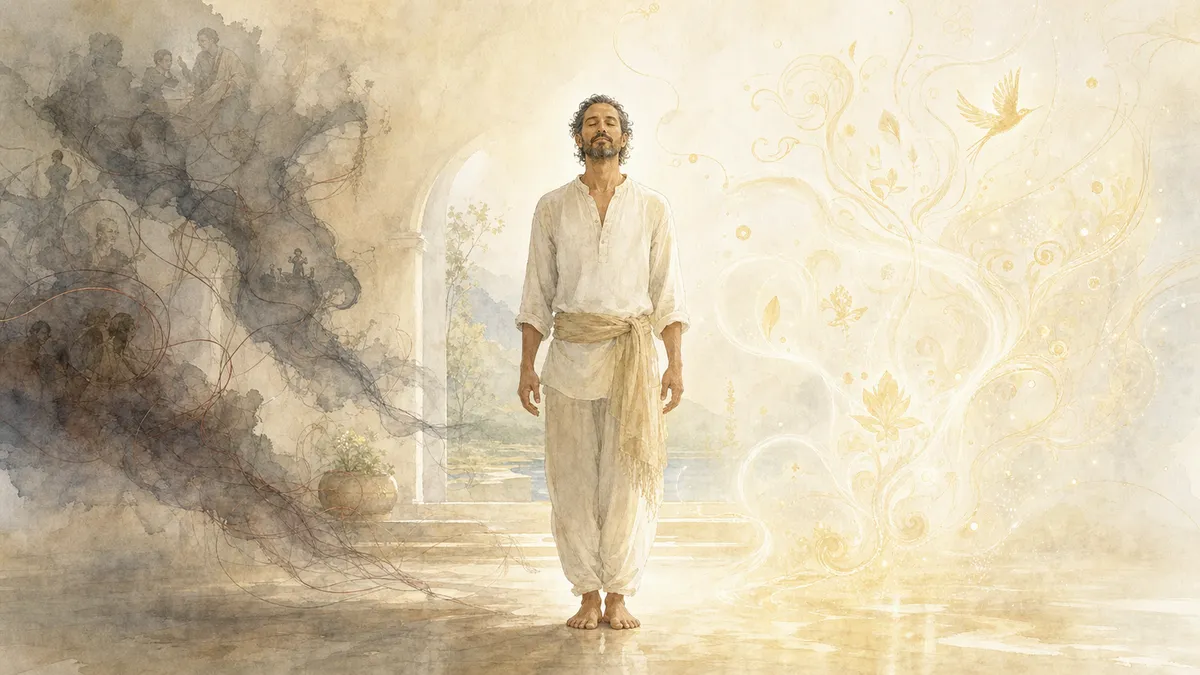
“Future thoughts are enlightened” means that we make an immense choice when we are in contemplation. It is the choice to live without a future, not to cling to the past, to contemplate while abiding in nonduality, to abide in choiceless awareness, not to identify with thoughts, emotions, or anything else except contemplation. And whatever thoughts may then arise, we are awakened.
