

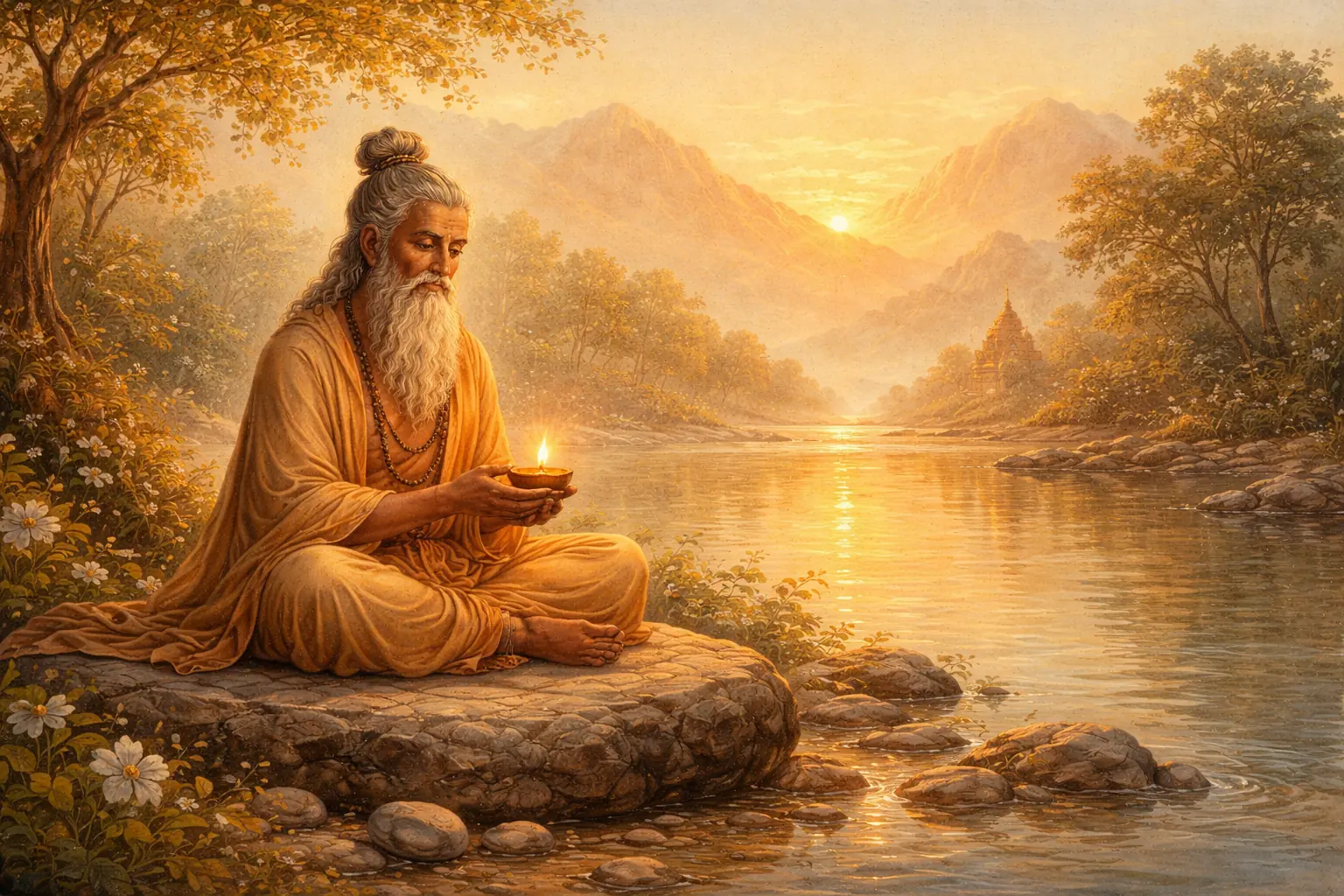
A disciple practicing jnana yoga eliminates all thoughts about objects. Through the power of discernment, he dispels the darkness, and then a radiant light appears before him.
Eliminating all thoughts about objects does not literally mean giving up thinking. Rather, it means pushing thought to the periphery and discovering an inner center beyond thought (amanaska). Whereas previously our thinking occupied one hundred percent of our lives, now we have discovered a certain center beyond thought, a state of no-mind, of non-mental clarity. Very free, perhaps undefined like the mind, it is also subtle; yet it can also be clear if we abide in contemplation, and it operates according to somewhat different laws, so it takes some time to get used to it. It is very subtle and highly intuitive; there is a great deal of freedom in it, there are no patterns, and it looks at the world in an entirely different way. It is like moving from Aristotelian logic to fuzzy logic—the logic of ambiguity.
At this stage, a great many sadhus lose their way. There once was a man, a righteous man, who followed all principles, vows, and commandments literally. He believed in them, but his mind took them too literally. Still, he was disciplined because life kept him in check. Then he began to discover the state of no-mind, and suddenly a kind of miracle began to reveal itself to him: that the world is ambiguous, that everything is ambiguous. This ambiguity also caused his yogic discipline to falter. It is like a centipede that began to become aware of all its legs and eventually got confused about how to walk; it became aware of too much. Before that, it was unaware and ran freely; then it became aware, got confused, and stopped altogether. It is very important not to become such a centipede. In our soul, we may experience ambiguity, but at our level birth and death are unambiguous; sadhana must be practiced unequivocally, and one’s dharma must be fulfilled. Only it should now be fulfilled not from the mind, but from this inner intuitive center.
Thus, it is not so much the suppression of thoughts as pushing them to the periphery and discovering a non-mental center within ourselves. When we establish this non-mental center in our everyday reality and become accustomed to living in it—and it is very comfortable to live in it and natural to look at the world from it—then our thoughts about objects, people, or anything else no longer trouble us. They are no longer the subject of our thoughts at all; we understand that reality is not an object of thought, but an object of awareness. What concerns us is our awareness—for example, its breadth, openness, depth, and purity—while thoughts no longer concern us.
For example, if you see a homeless person on the street, you might previously have thought, “What an unclean person, a terrible person. What a miserable fate,” and so on, and those thoughts would have caused obscurations. In this state, however, you have no such thoughts. They rush about somewhere on the periphery and fade away, while at your center there is a thought-free state of awareness, and you are concerned with something entirely different. This person does not trouble you; you accept him as he is. He simply exists, like a tree or a cat. You have no grievances against him and do not judge him, but what concerns you is whether, at your present level of awareness, you can remain in the state of awareness next to such a person—that is what concerns you.

You accept him and do not judge him, but you are concerned about whether you can preserve the depth, breadth, purity, and openness of your awareness. This is an example of a different attitude toward the universe—an entirely different attitude. You see the world as energy; you no longer see men and women, the poor and the rich, the beautiful and the less beautiful, the intelligent and the foolish. That is, you still distinguish all these things, but they cease to be important. You see the world as one vast, living, playful energy in which you, too, abide and with which you interact through awareness, and this awareness has nothing to do with thoughts. This energy is ambiguous; it cannot be evaluated unequivocally as black or white. And you understand that there is no single truth for everyone; there are many truths, and each person has their own, but ultimate truth is one. Yet this ultimate truth is non-conceptual; it lies beyond thought. This is where you are born as a jnani: when you have reached this level, discovered the amanaska state, the non-conceptual state of awareness, and perceive the world more as energy united with consciousness, without attaching labels or value judgments to reality—this is where you are born as a jnani.
It takes a certain amount of time to become accustomed to living in such a state, for it to become natural—perhaps twelve years, perhaps longer—but we gradually grow accustomed to it. In the course of this acclimatization, many of our dualistic notions dissolve, many of our doubts disappear, and we become increasingly convinced: yes, this is the correct vision of the world, this is the correct fundamental state of consciousness.
Stages in the Development of the Nonconceptual State
He experiences dizziness, then emptiness (akasha) manifests. Next, moha (delusion) arises. The jnana yogi dispels this moha through inquiry, or vichara. Thus, having passed through the stages of darkness, light, deep sleep, and moha, the sage finally reaches the stage of nirvikalpa samadhi. He enjoys absolute peace; he attains true jnana.
When the nonconceptual state (amanaska), the unsupported state (niralambha), is discovered as sahaja (natural), all that remains for the yogi is to become accustomed to living in it, to abide in it, and not to leave it. He cannot break through to anything higher, but he must not descend below this state, and it takes a long time for this state to begin functioning and become active. At first it is inactive; it has opened somewhere deep within the soul, but we cannot even make use of it yet. We preserve it as a kind of inner secret, as the most intimate thing that has ever existed and still exists in our lives, as the pinnacle of our understanding. It may take five or ten years before this inactive state begins to manifest and gains strength and energy, and then it will begin to help us in life. But until then, it does not even help us in life, as though it were living a life of its own while we lived ours, because our body and mind retain their inertia and interests for a long time.
We know that we possess a certain inner secret of awareness, but it still seems separate from us, because our mind and body have entirely different interests and are not yet truly connected with it. We live a kind of dual life in which the mind and ego have interests—this is karma, of course. What other interests could they have but karma? Even if we have bridled them through yoga, bridled them through Dharma, they still try to pursue interests of their own. Willpower and self-discipline are needed here, but we feel that our nondual awareness beyond the mind is still separate from all this. Here we simply have to nurture it, fill it, and saturate it with the blessings of the saints, with upasana, mantra, yukti—with every kind of nourishment available. One day it will gain strength, and this strength will begin to manifest by helping us; little by little, we will begin to make use of it.
The first way it will begin to help is by dissolving moha, our ignorance, which exists in vast quantities across different dimensions. For example, it will help dissolve negative dreams, dissolve tamas during dreaming, and bring clarity into dreams. It will help dissolve gross and subtle worldly desires; when they arise, we will no longer feel that we are betraying this state. We will simply allow this state to actively come to the forefront, and all the gross and subtle desires of the mind will suddenly cease, as though subdued or paralyzed. This means that our inner awareness is gradually beginning to activate and function, and we are beginning to make use of it little by little. It will begin to help us in meditations such as Mahashanti, because it brings genuine depth and effortlessness into Mahashanti, allowing Mahashanti to be practiced for a long time. It enables us to dispel tamas during deep, dreamless sleep, which is very difficult even for yogis and yoga teachers who have practiced for a long time, throughout their entire lives. Once it becomes active, it begins to assume many functions that we had never even suspected. We thought it was merely some small state we had discovered, but behind it an immense, subtle divine power—or great mercy and grace—is revealed.

Question: Guruji, several satsangs ago it was said that all these identifications, mahavakyas, and so forth work once you have reached the causal level, the level of the causal body, where the nature of the “I” is contained. So one needs to remain in the state of jagrat-sushupti, correct? Then this inner awareness will begin to function—the thing you are talking about—is that right?
For it to begin functioning means that you have begun to experience this jagrat-sushupti, though not yet fully, but only at the very beginning. So, broadly speaking, yes.
— It can only be fully activated in the state of sushupti, right?
Full awareness of sushupti means the complete functioning of this state, yes, and awareness of sushupti both in dreams and while awake, in the subtle body and in the causal body itself. Sushupti-sushupti, svapna-sushupti, and jagrat-sushupti are all spheres in which the dimension of sushupti operates, with the exception of turiya-sushupti.
The Ocean of Eternal Jnana
He becomes an ocean of eternal jnana and all-pervading absolute consciousness. He plunges into the ocean of nectar and enjoys endless bliss, where there is only the seer, with no objects to be seen.
All this does not come at once, but only after we have dispelled our doubts and our natural awareness has awakened. At first, it is attained at the stage of encountering the light, when it is simply experienced; then it matures over a long period of time. When it becomes somewhat activated, this means that we have approached the stage of transmission: we are able to use it a little in life, and it begins to merge with our life, though only to a very slight degree, enabling us to resolve minor issues. For example, it can dissolve doubts about dualistic concepts and dissolve minor emotions—this means that it has begun to manifest its shakti, its activity, to some extent, but this is still insignificant and requires a long period of maturation. It is like a child who is growing and cannot do certain things until they have grown up. Finally, at the stage of conception, it gains sufficient strength and brings a genuine experience of depth into our life, uniting with various situations; it dissolves all dualistic concepts instantly. You no longer become confused when the Guru asks you, “Why does the monkey eat stones?” You do not even think about it. The answer comes instantly; it is not, “Well, I need to think about it,” followed by an answer containing impurities.
There, pure answers arise in a fraction of a second—instantaneous, clear, extremely precise, and swift—and there are no doubts in them, because the Guru asks questions from this state, and the disciple answers from this same state. There can be no doubt there—it is an instantaneous resonance; this is the stage of conception. It is brought into life, and as life gradually unites with it, life becomes a play. It dissolves your sense of authorship, takes away your striving for fruits and results, takes away your pride and your sense of self-importance; it changes a great deal in your life. That is, it comes to the forefront, and great grace is discovered behind it. It has not yet become the continuous ocean of depth and grandeur described here, but it is already beginning to act; at your level, it has begun to change you. This means that you are on the right path, but you still have a very long way to go.

Question: Guruji, it was just read that there is an ocean of boundless grandeur where there is only the seer and nothing seen. Is this the state of sushupti? Is there only a subject there, with no objects?
This is where the level of sushupti begins—sushupti starts here, as does the transition to turiya. This seer is revealed ever more deeply as perfect emptiness extending to the very limits, filled with divine energy.
Question: Om, Guruji, how can this be attained through energy? Is it possible?
Since consciousness and energy are interconnected, it is possible if you activate udana-vayu and vyana-vayu through kundalini yoga, but it is difficult to remain in that state. In kundalini yoga, entry into this state is faster, but maintaining it is more difficult.
The Nature of Jnana and the Various Types of Samadhi
His mind acquires the nature of jnana. He becomes chit, consciousness itself; free from any appearance of objects, he maintains consciousness in its proper state, like an ocean abiding in its natural equilibrium without the churning of waves. The sage, free from all attraction to objects, acquires the nature of all-pervading wisdom. He attains a state of jnana that abides above all things, in which nothing exists except truth, and he becomes an ocean of eternal jnana and all-embracing absolute consciousness. The hamsa frolics in the infinite ocean of spiritual bliss. The sage delights in his own Atman, or true Self.
This becomes possible when one passes through the various types of samadhi described by Shankara in the text “Drig-Drishya-Viveka”:
Shabda-anuvid-nirvikalpa-samadhi
Drishya-anuvid-nirvikalpa-samadhi
Antar-nirvikalpa-samadhi—the three internal ones
Bahir-drishya-anuvid-savikalpa-samadhi
Bahir-shabda-anuvid-savikalpa-samadhi
Bahir-nirvikalpa-samadhi
When all these samadhis are experienced in various situations, everything gradually moves toward samadhi becoming natural and uninterrupted. One samadhi, occurring in flashes, leads to the experience of another samadhi, which then flows into a third. In fact, these are not different types of samadhi; they are one and the same samadhi, but there are differences between them because different pranas are involved, as are different perceptions of objects, different body postures, and different states of mind. Ultimately, a unity, a single “taste,” can be traced through all these types of samadhi, and one becomes accustomed to the fact that this is natural: that being in samadhi is natural; being at the center of one’s “I,” beyond the mind, is natural; acting from beyond the mind and with divya-bhava or brahma-aham-bhava, uniting these bhavas with the indriyas, thoughts, feelings, desires, and external objects, is natural.
Our entire way of life, perception, and thinking is restructured, and our entire former experience appears to have been a state of complete sleep, especially in the beginning. At a higher level, even our past worldly experience is seen as Shiva’s perfect play. We no longer speak that way, but in the beginning, all our past life experience appears to have been a completely foolish delusion. You think: “How unawakened I was in my actions. How could I ever have acted like that? What foolish things I did. I was asleep, I was not awakened, I understood nothing. I was not aware.” You feel as though you have awakened from a long, dark, heavy sleep, and you are overcome by a feeling of jubilation that you have awakened—what happiness!—and you treasure it greatly and are very afraid of losing it, because it is the most precious thing in life.
The most precious thing in a dream is not the objects found in the dream, nor houses, nor even palaces; the most precious thing in a dream is to wake up. It is the same here, and you naturally feel that in the material world all material objects, all fame, all power, and all wealth are worth nothing, because the most precious thing in it is to awaken. As your consciousness deepens further, you suddenly realize that even in that sleeping, unawakened state, there was some awakened particle within you; that even then your chiti-shakti was still partially awake; that all your unawakened, foolish, unconscious actions were also Shiva’s play; that from the very beginning there was no evil. From the very beginning there was no delusion, from the very beginning there was no karma—there was simply no you, but only the perfect play of Shiva’s energy, and Shiva himself, who had always been there. He was simply playing as you—not merely that he existed; he was playing as you—he was you and he is you, while you are merely an invented character. It turns out that Shiva has always existed, Shakti has always existed, and he played as all living beings; then the mind appeared, invented characters, imagined something, and superimposed it all upon this, and you laugh when you discover this mind, discover this character, and discover that it has nothing to do with the play of Shiva and Shakti. Suddenly you understand: the past is perfect, the present is perfect, and the future is perfect; indeed, they do not even exist, because nothing exists apart from Shiva and the play of his Shakti, while the desires, fears, reincarnations, and identifications produced by the mind turned out to be mere scum, a false fabrication that must be cast aside—the only thing that must be cast aside and completely reconsidered.

Question: Guruji, it is interesting—let us take my past, for example. In my past, Shiva played with those states, those karmas, those movements of the soul. Did he have free will—or, more precisely, freedom of choice—in that state, or was it already a specific flow, a sort of reality tunnel, with chains of events that had to occur exactly as they did?
The Supreme Shiva within always has free will; his svatantrya-shakti is never interrupted. That was the manifestation of his free will. As for Shiva at the lower levels of the tattvas, the one called Purusha—that is, Shiva bound by the kanchukas, indriyas, and antahkarana—he had none; he had to live with what was given.
Question: Om, Guruji, I wanted to know: does samadhi transition into nirvana, or is nirvana some other state?
Nirvikalpa-samadhi is nirvana; savikalpa is not.
Question: My second question is: is there a state in which the observer disappears, in which everything disappears, including the observer? Is this already the transition into nirvikalpa-samadhi?
For the transition into nirvikalpa samadhi to occur, all vikalpas must become silent; that is, in this field of awareness, where an observer is present or disappears, all fluctuations of the mind must cease. The mind must become very calm, but as long as there are vikalpas (modifications of the mind), all this belongs to the category of savikalpa—with vikalpas (modifications).
Question: So vikalpas are fluctuations. When the observer disappears, does that mean the fluctuation also disappears, that there is nothing left to cling to, and then one exits?
Yes, one could put it that way.
Four Types of Jnanis
There are four types of jnanis: Brahmavid, Vara, Variyan, and Varishtha. They are distinguished according to the level of sattvic ego present in a given jivanmukta. Brahmavid, Brahmavidvara, Brahmavidvariyan, and Brahmavidvarishtha are the four types of jnanis.
A Brahmavid is one who abides on the fourth bhumika (sattvapatti)
A Brahmavidvara abides on the fifth bhumika (asamsakti)
A Brahmavidvariyan abides on the sixth bhumika (padartha-bhavana)
A Brahmavidvarishtha abides on the seventh bhumika (turya)
A Brahmavidvarishtha is always immersed in samadhi and must be fed by others. He is a videhamukta and is incapable of performing any activity for loka-sangraha.
In the case of jivanmukti, he does not need to be spoon-fed; he feeds himself. He can move and speak perfectly well. In the case of videhamukti, nirvikalpa samadhi, his soul, consciousness, and attention constantly abide in the dimension of turya and possibly in the dimension of sushupti-turya and the dimension of turya-turya beyond the body; that is, he is not in the physical body. It is as though an anesthesiologist has administered a solution: he is under anesthesia and does not feel the body; all his pranas are in the sushumna, and they do not leave the sushumna. This is the state of videhamukti—one who is beyond the body.
In the state of jivanmukti, the pranas are not only in the sushumna; they also move through ida and pingala, but most of the prana is in the sushumna, and such a yogi can see the world, speak, act, and move; he manifests the divine play. He also abides in the profound state of sahaja samadhi and may likewise be on the seventh jnana-bhumi. Examples include Shripada Shri Vallabhacharya, Guru Brahmananda, and Krishna—all of them abided on the highest jnana-bhumi.
Jada Bharata, Mauni Swami of Kumbakonam, and Akkalkot Swami of Maharashtra were all Brahmavidvarishthas. They had no body-consciousness. A Brahmavid or Brahmavidvara has a very faint awareness of the body in the form of a certain mental residue or samskara.
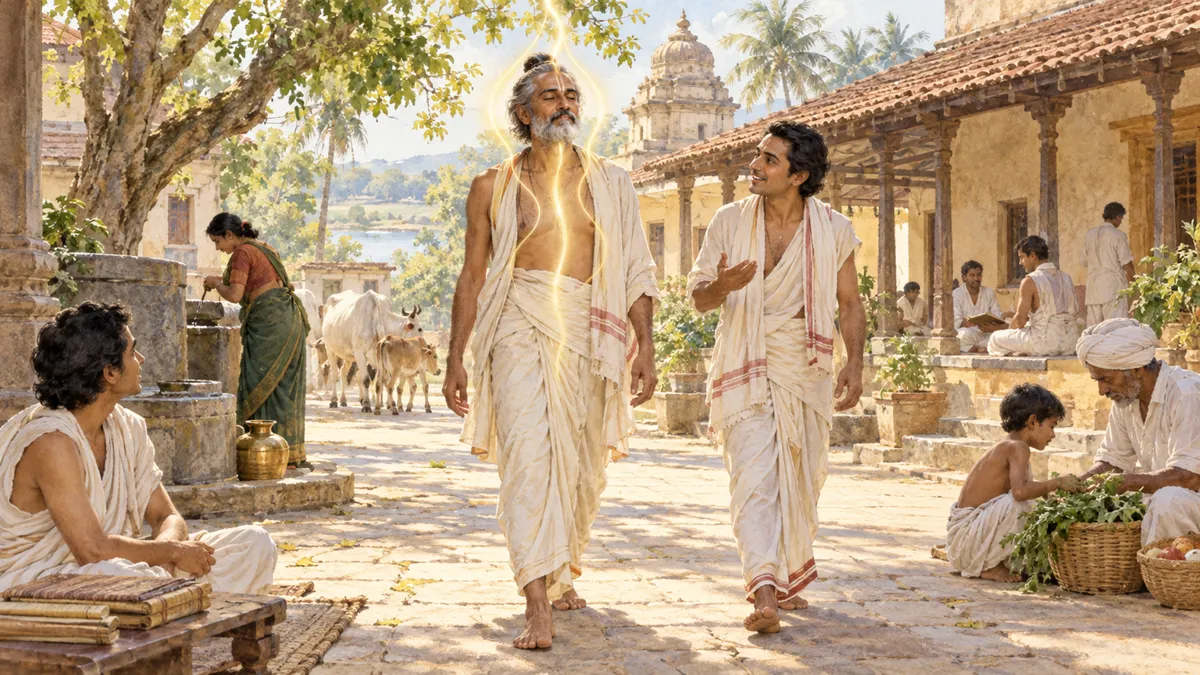
Another possibility is that a yogi on the seventh jnana-bhumi remains in samadhi without leaving his cave or kutir, while a part of his mind creates an illusory body. This illusory body appears among people and engages in preaching or missionary work, or amuses itself as it pleases, travels, and so forth. This portion of the mind is so powerful that the illusory body can clothe itself in the five elements and may even be tangible and visible, and can even speak, but it cannot perform physiological functions, while the yogi’s primary body remains motionless. This is why people are sometimes confused about jnanis and have so many discussions about them; this is simply how siddhis manifest. Therefore, siddhas are always incomprehensible beings, since they transcend the laws of biology and physics of this world.
A Brahmavid or Brahmavidvara has a very faint awareness of the body in the form of a certain mental residue or samskara. Both a Brahmavid and a Vara can still work in the world. Some people imitate the state of an avadhuta and tear off their clothes. An avadhuta is completely naked; he is always established in Brahman, forgets the body and the surrounding world, and his clothes fall away by themselves, as happens with a drunkard. One must be very careful in one’s judgments here.
Brahmavid—the fourth bhumi—and brahmavidvara—the fifth bhumi—mean that such a yogi acts as if in a dream. Most of his mind abides in turiya. He recognizes the illusory nature of the world, its emptiness, its luminosity, and the play of energy. He recognizes the emptiness and nonexistence of the “I,” the emptiness and nonexistence of anything whatsoever; conversely, he recognizes the radiance of Brahman. He recognizes that only Brahman exists, and if he focuses his attention on the aspect of Ishvara—on active Brahman—he realizes that only Ishvara exists, only Shiva exists, and nothing else, and that “I am one with Him; I am wholly a part of Him,” and he abides in this state as if in deep sleep. At the same time, part of his consciousness remains active and can manifest, but it manifests without attachment, spontaneously propelled by past prarabdha karma, by past vows, promises, and pledges to serve God and the Dharma for the benefit of all living beings, without choice, acceptance, rejection, or clinging. Then all the actions of such a yogi are like a play filled with bliss and nonattachment.
Question: Guruji, I have a question about nirvikalpa samadhi. When a saint enters nirvikalpa, the vasanas, any movements of the mind, and everything else cease there—that is, everything stops. But something must remain, because when he returns, otherwise everything should have dissolved completely. He returns to the body, that is, to the body after nirvikalpa samadhi. It is the same body that he had before entering nirvikalpa samadhi, not some other body, for example, isn’t it? He returns, but then he already has a different body; that is, there must be something that, so to speak, fixes his position in this world—perhaps some kind of chitta that does not dissolve, or what exactly is it?
Everything depends on how deep the nirvikalpa samadhi was and how long it lasted. If it was deep nirvikalpa samadhi and it led to manonasha (the destruction of the mind and of identification with the mind and body), then he dissolves into Shiva in the state of Shiva-sayujya. He realizes himself as Shiva, and self-recognition (pratyabhijna) occurs. When he returns to the body, manonasha has taken place, and accordingly, vasanakshaya has also taken place, as has vikalpakshaya (the former fluctuations of the mind)—they too have been destroyed. He returns to the body somewhat different; he does not return to the body as the old jiva (soul) with its karmic illusions and tasks—he returns to it as Shiva.
When he has returned as Shiva, it turns out that the consciousness of the body and the consciousness of the personality have been entirely given over to God; they are, as it were, leased to Shiva, and he becomes Shiva’s illusory body, having surrendered his body and consciousness to Shiva, and he returns to it as Shiva, not as a personality. We think that this is the same person, but it is Shiva in a body—the body and consciousness that were given to Him in the process of self-surrender (prapatti). Even if some vasanas remain in the body, since the body may not yet be completely purified, these vasanas are no longer being worked out by the individuality of that yogi. What they turn into is difficult to say—it now depends on Shiva.

Question: Guruji, the same thing you described can also happen without nirvikalpa samadhi—it is possible to set this process in motion too, right? I am That; that is, at the level of the view, I know for certain what the scriptures say, what the Guru says, and what the surrounding sadhus confirm: I am That. Knowing that I am That, I can, as it were, say that the Absolute is simply playing through my body, through these five sheaths, and my task is not to interfere with it.
The view is correct, but that is not enough—it must also become your contemplation. There is a difference between the view, when we know this inwardly as absolute truth, and contemplation, when we adhere to it every second. It is important for the view to develop into contemplation, into constant remembrance at every moment without distraction.
Question: Contemplation is essentially Guru Yoga, then, isn’t it? One of the ways, one of the methods of abiding.
If by Guru we mean the Absolute, then contemplation, nididhyasana, is always contemplation of the Absolute. In this sense, Guru Yoga and nididhyasana are one and the same. This is precisely what Guru Yoga is intended for: to enable a sadhu to enter contemplation.
Question: Upasana is also understood in this way, and all the other methods too, right?
All practices and all methods are intended solely for this. If we follow the path of Advaita or Anuttara Tantra, we must acquire a single “taste” with regard to all methods and perceive them in unity.
Question: So there is no point in strongly desiring nirvikalpa samadhi; rather, one should desire the energy of the Absolute itself?
Aspire to nididhyasana, and when nididhyasana becomes stable, nirvikalpa samadhi will come.
Paroksha and Aparoksha Jnana
Question: Guruji, it was already mentioned today that the mahavakyas work only after a certain degree of realization, and that statements such as “I am That,” as well as their confirmation by other sadhus or scriptures, work only after a certain degree of realization. How can one avoid confusion here?
They work as paroksha jnana, but at the initial level they function as paroksha jnana, also called kriya jnana—training jnana. This does not mean that we cannot use them as a guide and apply them; we simply know that this is training. Ramana Maharshi was once asked about this, and he replied, “Do not think that you are That; be That.” Thinking that you are That means practicing the view, kriya jnana; analytical meditation is perfectly fine. But paroksha jnana is knowledge obtained from books, the Guru’s instructions, or one’s own memory, whereas being That is aparoksha jnana. There is a great distance between the two. What is the difference between paroksha and aparoksha? Aparoksha leads to vasana-kshaya and mano-nasha, whereas paroksha does not do so to the same extent. Is that clear?
Question: Is aparoksha always conscious? That is, when we have samadhi, do we know it, and only then is aparoksha truly possible? Or could it be Shiva playing, while the manas...?
It is always conscious. You cannot attain aparoksha jnana without even noticing that it has arisen; that cannot happen.
Question: Guru, I have a question. There is a female disciple of one of Ramana Maharshi’s disciples, and when she entered that state, her mind shut down completely; that is, she became like a five-year-old girl, and afterward she had to relearn how to eat, walk, and dress herself.
In our tradition, this is called an error in contemplation. Perhaps it is not regarded as an error in that tradition, but in ours it is called the loss of the capacity to act while maintaining the view and awareness.
Question: Is this not aparoksha?
Perhaps aparoksha jnana arose after that experience. It was an excessively shocking event for the mind of an eighteen-year-old girl, and her mind took a very long time to process it before adapting. It surrendered so completely, and sankocha shakti drew it so deeply inward, that only a weak part remained, sufficient for the intellect of a five-year-old. But then, gradually, that mind unfolded again, sankocha shakti weakened, and the mind somehow adapted to coexist with the nondual experience. The first experience of nonduality can greatly constrict the mind. Then our attention senses that everything the mind sees is wrong and unimportant, while the nondual experience alone is the truth. We must proceed very gently and gradually. We should not literally destroy the mind; we should displace it to the periphery, while our abilities, intellect, and viveka (discernment) must not be lost.
The Seven Stages of Jnana
The seven stages of jnana are: shubhechha, vicharana, tanumanasa, sattvapatti, asamsakti, padartha-bhavana, and turiya.
Shubhechha
Shubhechha: when a person feels that they dwell in ignorance and sincerely wishes to attain spiritual knowledge, they are at the stage of shubhechha.
Shubhechha, the first bhumi, means that a person serves saints and sages, remains in the right company, and strives for liberation.

Vicharana
Vicharana: when a person is convinced of the worthlessness of the world and deeply reflects on the methods of eliminating ignorance and attaining spiritual knowledge, they are said to be at the stage of vicharana.
If shubhechha is sometimes the state of a novice householder karma sannyasi, then the second bhumi is often the state of a brahmachari in an ashram who sincerely tries to understand the principles of contemplation, applies the methods, and is at the stages of shravana and manana.

Tanumanasa
Tanumanasi: when the mind becomes as subtle as a thread due to dispassion toward worldly objects and becomes deeply immersed in contemplation of the Self, it is at the stage of tanumanasa.
Tanumanasa is already an experienced monk, most likely after twelve years, who continuously abides in contemplation at the stages of conception and gestation, who has experience of samadhi or the subtle body, the awakening of kundalini, light, lucid dreaming, and light in dreamless sleep. He has discovered a very subtle mind, and this very subtle mind gives clarity and the experience of brahma-aham-bhava; it bestows divinity, divine majesty, divya-bhava, purity, love, and devotion, and he no longer has any doubts about this subtle mind. He knows what to hold on to, he constantly abides at this level, and he is nourished by the very subtle mind, but this state may still be very unstable. This is not yet realization, but it is already on the threshold of realization: certain karmas must be purified, and one must become firmly established in this subtle mind; then, perhaps, a breakthrough can occur and one can make the leap to the fourth ground.

Sattvapatti
When the mind becomes pure and sattvic and is established in the true Self as a result of prolonged contemplation, this is called sattvapatti.
Sattvapatti means that the yogin has been established in the subtle mind for a long time, has remained in gestation, and then made the breakthrough from the stage of gestation to the stage of birth. He completed the cycle of the day in continuous contemplation, and he completed the cycle of the night. He came into contact with svabhasvara (the Clear Light); his consciousness continuously touches pure light, his consciousness continuously shines, and therefore sattvapatti means the lord of sattva. Sattva is luminosity, radiance; he has recognized the subtle luminous layer of his mind and constantly remains in contact with this luminous layer. He has become established in it, and he has been born as an awakened Purusha. This means that he is now what is called a brahmavid (knower of Brahman). He has not reached its depths, but he has discovered it and knows it aparoksha (immediately, directly) through personal experience. He no longer needs to ask questions or read the scriptures, although he may do so both for himself and for others, but he has this experience.
Asamsakti
When a person becomes completely detached from the objective world through knowledge of the true Self, this is asamsakti.
At the stage of asamsakti, this light has already accomplished a great deal of work and erased all memory of past impressions and vasanas, severed the rnanu-bandhas, and purified the channels; it now separates this yogi from the world in a way unlike before. The yogi feels separate from this world, even though he lives in it, but he no longer lives as a person or a body—rather, he lives as a character in a dream. He plays in this world without acting.
Question: So the fourth ground is birth, right? And the fifth is already something like nurturing?
The fifth is what follows birth, yes. We are born as jnanis on the fourth ground, which is why the title brahmavid is conferred. On the fifth ground, detachment from the world occurs. On the fifth bhumi, only nondual reality remains, and it is comparable to the state of deep sleep. Even if the yogin is involved in a variety of activities, he remains unaffected within. It corresponds to nurturing, upbringing, and tempering. On the fourth ground, the yogin sees consciousness in everything through a mind free from divisions. Division has ceased; unity and nonduality are constant. He also perceives everything as if in a dream, just as on the fifth, but on the fifth it is deeper, and on the fifth profound vairagya, detachment from this world, arises. That is why it is called non-attachment (asamsakti).

Question: Om, Guruji, as I understand it, at the tanumanasi stage udana and vyana are activated, but when birth occurs, what is activated then?
Birth means that you have realized the dimension of turiya. Dreaming sleep means a minor birth; dreamless sleep means a great birth, and the same thing happens there, involving the same pranas. It is simply a description from different perspectives.
Padartha-bhavana
When a person realizes that the objects of the world are actually immaterial and are nothing but Brahman, this state is called padartha-bhavana.
At the stage of padartha-bhavana, non-perception of objects arises; that is precisely what it is called. He realizes: “I am neither real nor unreal, nor do I even exist as an ‘I’; I am beyond duality and unity.” All the subtlest doubts have ceased; he lives like a painted lamp. He is nothing within, nothing without, nothing like an empty full vessel. At the stage of padartha-bhavana, the yogi plays, but it is not so much the yogi who plays—Shiva plays in the yogi’s body and consciousness, and chit-shakti-vilasa (the play of the energy of awareness) unfolds. Shiva exists independently in the yogi’s body.
Question: Is this already a letting loose, a play—this fifth stage?
Play, yes; letting loose, play—all of this belongs to the sixth bhumi.

Turiya
When a person completely negates the world’s numerous distinctions and realizes the indivisible (akhanda), the single essence (ekarasa), sat-chit-ananda (being, consciousness, bliss), this state is called turiya. This state of turiya is also called the state of jivanmukti, or liberation while living.
Turiya, turyaga, is the seventh bhumi; a yogi at this stage is given the title of brahmavidvarishtha. These are free, incorporeal beings whose state is indescribable. Among the sixteen kalas, this corresponds to the stage of transition into the dimension of the mandala and becoming Brahma the Creator.

Classification of the Stages of Spiritual Development
The intense desire awakening in a person to attain moksha, to enjoy the bliss of our true Self through vairagya and indifference to sensory pleasures, the aspiration to begin studying the Atma-jnana-shastras and to associate with those who have realized Brahman—this is shubhechha, or the first stage.
When the seeker is endowed with the four means of liberation, when he hears the shruti and comprehends at the Guru’s feet the meaning of the mahavakya “Tat Tvam Asi,” and then deeply reflects on what he has heard—this is vicharana, or the second state.
So, analyze which ground of wisdom you would assign yourselves to; then I will raise my hand and say it, and you raise your hands to indicate which ground you place yourselves on.
As a result of the practice undertaken at these first two stages, the mind acquires the ability to focus on Brahman through an effort of will. It becomes like a thread, and brahmakara-vritti is generated—this is the third stage, called tanumanasi. Through the practical cultivation of the three processes described above, all desires are eradicated, tattva-jnana develops, and the mind becomes filled with purity, or sattva—this is the fourth bhumika, called sattvapatti.
Who considers themselves to be on the first ground of wisdom? Who is on the second ground of wisdom? Who is on the third ground of wisdom? Good. We will test this. It is not enough for me to say it—you also need to understand it.
Question: Guruji, does that mean complete detachment from sensory pleasures only occurs on the fourth ground, that is, when birth has been realized? In its entirety.
It would seem so. The fourth ground of wisdom truly bestows vairagya, because turiya burns away the vasanas; it brings about vasana-kshaya and mano-nasha.
Question: Om, Guruji, I do not understand the classification of the grounds of wisdom well enough to analyze myself, but are there any key points specifically between the first and second, or the second and third, that one can use as a basis?
The first sign is serving saints and sages; if you serve them, then you have the first sign. Such a person seeks the truth, serves saints and sages, performs seva, visits temples, participates in worship services, takes an interest in spiritual matters, and remains in the flow. The second is studying the scriptures, practicing methods, investigating the mind, and using atma-vichara to clarify awareness and explore the principles of consciousness more deeply. The third is having developed subtle consciousness and constantly abiding in subtle contemplation. The fourth is having developed the supersubtle consciousness of turiya and having no interest in the world, either within or without. For now, the first four are sufficient.
The Fifth and Sixth Stages
At the fifth stage, asamsakti, the seeker is no longer bound to objects or to their samskaras and sankalpas.
At the fifth stage, severance takes place: through pratyahara, the subtlest connections and pranas linking objects, the indriyas, and consciousness are severed. This is possible only when we experience the five signs of day and the five signs of night from the perspective of illusory-body yoga. It becomes possible when our mind grows subtle and reaches the most refined layers of contemplation, and the winds enter the sushumna in contemplative yoga. Asamsakti does not merely mean that we are unattached; rather, at the level of consciousness and the subtle winds, the connection between the indriyas and objects is severed, and bhuchari-shakti is brought to an end.
Then comes the sixth stage—padartha-bhavana. All perception of objects, both external and internal, is lost, and bhava-pratiti remains.
At the sixth stage, the yogi experiences a boundless ocean of light behind all objects. One might say that he perceives the ocean of light of the one Brahman more than anything else, and is more absorbed in its bhava than in external objects; he never loses the presence of this ocean of light and never loses brahma-aham-bhava or divya-bhava.
Even if a jnani perceives objects, he does so only due to external compulsion. At the seventh stage—turiya—the jnani immerses himself in atmic bliss; he has completely freed himself from every notion of multiplicity. There is now no triputi, either externally or internally.
Triputi means the subject, the object, and the process of cognition.

Titles of Sages at Different Stages
One who functions on the first three bhumikas is called a mumukshu. One who functions on the fourth bhumika is a brahmavid. One who functions on the fifth bhumika is called a brahmavidvara. One who functions on the sixth bhumika is called a brahmavidvaryan. One who functions on the seventh bhumika is called a brahmavidvarishtha.
All of us, as living beings, are situated somewhere on this ladder of the seven bhumis—the saints on the altar and we human beings here; all of us are on it. Sometimes an entire lifetime is needed to move from one bhumi to another—this is what evolution consists of. Our task is to make the leap. It is precisely for this purpose that people become sannyasis, sadhus, or karma-sannyasis and perform tapasya: to burn away karma quickly, dissolve the mind, awaken awareness, and move from one bhumi to another.
The karmic vision of a person on the first bhumi and that of a person on the third bhumi are very different; they differ greatly. The visions of those on the third and fourth bhumis are very different. With each successive bhumi, the experience of Ishvara’s qualities becomes deeper, the experience of nondual Brahman becomes deeper, the perception of the illusory nature of things becomes deeper, and there is progressively less ego, less “I,” fewer karmic identifications, and fewer dualistic notions.
It is like the difference between a two-year-old child, a five-year-old child, a ten-year-old, a fifteen-year-old, and an adult—all of them have very different views of the world. Therefore, one who abides on the first bhumi will not understand one who abides on the third. One who abides on the third will not understand one who abides on the fourth, but one who abides on a higher, more advanced bhumi will always understand one who is below. In the same way, an adult will easily understand a fifth-grader, a fifteen-year-old, a ten-year-old, and a three-year-old, but a three-year-old, a ten-year-old, or a fifteen-year-old will not understand an adult because they do not have that experience. This is the difference in jnana, in the realization of reality.

Question: Guruji, so you said that the indriyas are severed from objects at the fifth stage. How does that work exactly? Do the indriyas remain but are no longer attached to the person?
The indriyas remain, but the subtle winds that produce identification no longer move through them. Yes, there is no attachment, attention withdraws, and the transporting prana does not flow out.
So there is perception, but no attachment, and the ocean of light on the sixth—that which you spoke of—is asti, bhati, and priya, correct?
Yes, they are already realized—not intellectually or analytically, but directly.
Great Sages and Their Distinctive Traits
Vamadeva, Jada Bharata, Akkalkot Swami, and Mauni Swami of Kumbakonam—they are all brahmavidvaryans and brahmavidvarishthas. They are perfect avadhutas; food had to be forced into their mouths, and they were completely unaware of either their own bodies or what was happening around them. They could no longer work for loka-sangraha, that is, for the welfare of the world, as Sri Shankara did. Only jnanis of the fourth and fifth bhumikas can work for the world; Sri Shankara and Raja Janaka belong to this category. If a jnani of the sixth or seventh bhumika wishes to elevate the world, he will have to descend to the fifth or fourth bhumika.
The situation here is rather nuanced. Sometimes, in order to work for the benefit of humanity and the world, jnanis of the seventh bhumi either create a separate body or lower their level of interaction—not that they lower their level of realization, but they lower the level of its manifestation to the fifth or fourth bhumika. They cannot manifest the seventh bhumika because it cannot be expressed in everyday life. It is a completely transcendent state, subject to no limitations and no laws of physics or biology; if they were to manifest it, it would be like a nuclear explosion, so to speak, for the human world.
Therefore, they consciously conceal themselves, enveloping themselves in tirodhana-shakti (the energy of concealment), hide their realization of the seventh bhumika, and demonstrate their fourth or fifth bhumika to humanity.
While abiding in the fourth or fifth bhumika, they can perfectly well play the roles of teachers, missionaries, saints who open temples, mentors, preachers, and benefactors of humanity. But they never demonstrate or manifest the seventh bhumika, although they always possess it and never lose it—this is a subtle play. Only they themselves, as well as the gods, gurus, and saints, know about this subtle play; no one else can understand it.

Thus, we encounter two types of saints: those who create an illusory body while themselves remaining in the seventh bhumi, creating another body to provide help; and those who envelop their realization in tirodhana-shakti and manifest the lower fourth or fifth bhumi in order to help humanity, because only in these states can they do so effectively.
Question: Guruji, does that mean that Brahmananda did exactly this—if he abides in the seventh bhumi, then his bodies are on the fifth and fourth?
Yes, sometimes the sixth and seventh bhumis would break through in him, and there are many instances when this happened, but he concealed them. All his miraculous manifestations were manifestations of the sixth and seventh bhumis.
— So when you begin ascending through the bhumis, you become guided; you no longer manifest your own vision, but rather something happens through you.
Guided by God.
— That is, the decision that I need to descend comes as a kind of necessity.
It is God who tells the sadhu: “Descend to the fourth bhumi so that you can help people.”
— So this comes from above; you no longer decide this yourself?
Yes, approximately so. The point is that at this stage individuality as ego ceases to have any significance for the yogi. Only God’s will matters to him, and he is guided one hundred percent by divine grace and divine will.
Distinctive Features of the Seventh Bhumi
A jnani who is absolutely established in the seventh bhumika and possesses no body-awareness whatsoever cannot live for more than fourteen days—from two or three to fourteen. Within those fourteen days, the body falls away; Western psychologists give an even shorter period—seven days.
All such statements are ambiguous. They apply only in the case of nirvikalpa samadhi. Some claim that a yogi can remain in nirvikalpa for twenty-one days and after that cannot return to the body. Others say that he can remain there for a year or even several years and then return to the body and continue his activities, but they are countered with the argument that this was not nirvikalpa, which means it was savikalpa: he was simply in the pure lands, in heavenly dimensions in a subtle body; his subtle body did not dissolve in Brahman, even though his physical body was motionless.
One school of thought states that knowledge of Brahman awakens at the fourth bhumika. Another school says that genuine supreme knowledge of Brahman can arise only at the seventh bhumika, while the fourth, fifth, and sixth are merely preparatory stages. Depending on the degree to which the vasanas have been destroyed, these different stages have been given different names.
Question: Which samadhi did Pilot Babaji demonstrate publicly? Savikalpa or nirvikalpa?
Both.
— He remained in them for quite a long time, didn’t he?
Yes, for a month.
— He was able to return, and nothing happened, meaning that the body continued to function.
Turya and Turyatita
In turya, dual consciousness is present. The jnani identifies himself with Brahman but is also aware of his state as sakshi (the witness) in the avasthas of jagrat, svapna, and sushupti. In turyatita, sakshi-bhava disappears.
Thus, the witnessing bhava remains in turya: there is the experience of turya, but there is also the experience of the witness in jagrat, svapna, and sushupti, which perceives these states. In dreaming sleep, dreamless sleep, and the external world of phenomena—the waking-state world—the witness remains in turya. In turyatita, not even the witness remains.
Dual consciousness means that you abide in the subtlest transcendent dimension, but to interact with the world you form an antahkarana—it forms naturally—and you form a play personality and a play perception, and, responding, you act through the energies of this world, while your inner witness abides in turya and remains unaffected. Your conduct and view are separate. Your conduct is playful, in accordance with place, time, and circumstance, while your view and contemplation abide in Brahman. In the state of turyatita, there is no longer any separation: view and conduct become one, and there is no longer an observer. There is Brahman itself.

Those who manifest in this way are avatars. Avatars can act even while abiding in the seventh bhumi; they can act on any level. To do this, as I have said, they simply envelop themselves in tirodhana-shakti and form an antahkarana, manifesting realization of any level or even not manifesting realization at all. They may even display dullness, tamas, anger, belligerence, or worldly samskaras—it does not matter to them. This is because the transcendent consciousness of turyatita always exists in the background, while they may play the roles of madmen, warriors, kshatriyas, king-rulers, as Parashurama did, for example, worldly people, or anything at all, as Dattatreya sometimes manifests. They may even manifest as a bridge, a crow, a cow, a dog, or a tree—that is, there are no limitations for them. But if they manifest as humans, they do so with some hidden mystery, with a purpose, with a sankalpa (intention).
Question: Guruji, does that mean turyatita is beyond all sixteen?
Turyatita is beyond all kalas, beyond all questions and questioners, beyond cognition, beyond all categories; it is indescribable. Nothing whatsoever can be either affirmed or denied about it.
— So this is Paramashiva, then?
We may call it Paramashiva; we may call it Brahman—it is merely a matter of human naming. But turyatita itself is beyond definitions and words—that is what must be remembered. One must completely refrain from limiting turyatita in any way whatsoever through philosophies, concepts, and names.
Videha-mukti
In turyatita, sakshi-bhava disappears. The jnani becomes established in pure nirvikalpa. There is absolute abhava—the absence of the external world, the internal world, and everything else. Those who have attained the level of turyatita are sometimes called videha-muktas. Some say that a jnani can attain videha-mukti only after casting off the physical body, but this is incorrect. Videha-mukti can also be attained during one’s lifetime. Janaka was called Videha (bodiless); Vamadeva, Jada Bharata, and Dattatreya were all videha-muktas while still alive. In videha-mukti, the jnani is unaware of the body, which is why this state is called videha-mukti.
Ishvara also possesses dual consciousness; only during cosmic pralaya does he abide in the pure consciousness of nirvikalpa. To pass to the seventh bhumika, a jnani must renounce all loka-sangraha activity. A person who has performed a little tapas and attained vairagya (dispassion), titiksha (patient endurance), and control over the physical body and its movements (kashtha-mauna) is also sometimes mistakenly taken for a sapta-bhumika jnani (a sage of the seventh stage). A jnani of the seventh bhumika is extremely rare.
Pure Vision and Reverence for All
A sapta-bhumika jnani is an awakened sage of the seventh ground of wisdom. In fact, you cannot discern the fourth, fifth, or sixth stage in any way. Perhaps you can recognize that the third stage is higher, but as for everything beyond it, you simply lack the discernment. Yet as you discover these bhumis within yourself, you will also be able to recognize them outwardly. That is why they say in India, “Just in case, we bow to everyone.”
We do not know who someone may be—perhaps he is on the seventh ground and has veiled himself with tirodhana-shakti, displaying the fourth in order to help living beings, or even the third. Perhaps he displays worldly consciousness while actually abiding on the seventh bhumi. He may even have come as a novice to help the Guru here in his seva and to help the brothers and sisters, veiling himself—no problem. He is merely playing; he is immortal. What does it cost him to play here for two hundred years, then elsewhere, assuming one state of consciousness and then another? We do not know. Therefore, just in case, so as not to accumulate aparadha, we practice pure vision toward all brothers and sisters. This is how we should regard them.
The Difference Between Tapasvins and Jnanis
A jnani of the seventh bhumika is extremely rare. The tapasvins mentioned above may display the outward signs of a jnani, but this is merely an induced mechanical state resulting from a change in habits. A person is quite capable of acquiring new habits: he may sit in one place, avoid looking at anyone, or fix his gaze on a single point through the practice of trataka. He may show no food preferences, roll on hot sand, or lie on ice, but none of this has anything to do with being a jnani. Jnana is a pure inner state of anubhava. A tapasvin possessing titiksha may not have the inner state of brahma-vichara.
Of course, it may also be otherwise. A tapasvin, an ascetic sadhu with titiksha and a certain degree of patience who abides on the second ground of wisdom, may resemble someone abiding on the sixth ground of wisdom; as for the seventh, once again, you will not be able to tell the difference. Induced habits mean that he has adopted the external habits of a sadhu but lacks the inner awareness of realization. Only through prolonged, close interaction can you gradually discern such a sadhu—how he reacts in various situations, whether he maintains detachment, whether he possesses self-liberation, lightness, and playfulness, and whether he always preserves purity. You can come to understand the depth of his awareness.
When the Buddha was asked, “How can one distinguish a person who has attained nirvana from an ordinary person, and can this be done immediately?”, the Buddha replied, “You must live with him and observe how he thinks, what he says, and how he acts in different situations.”
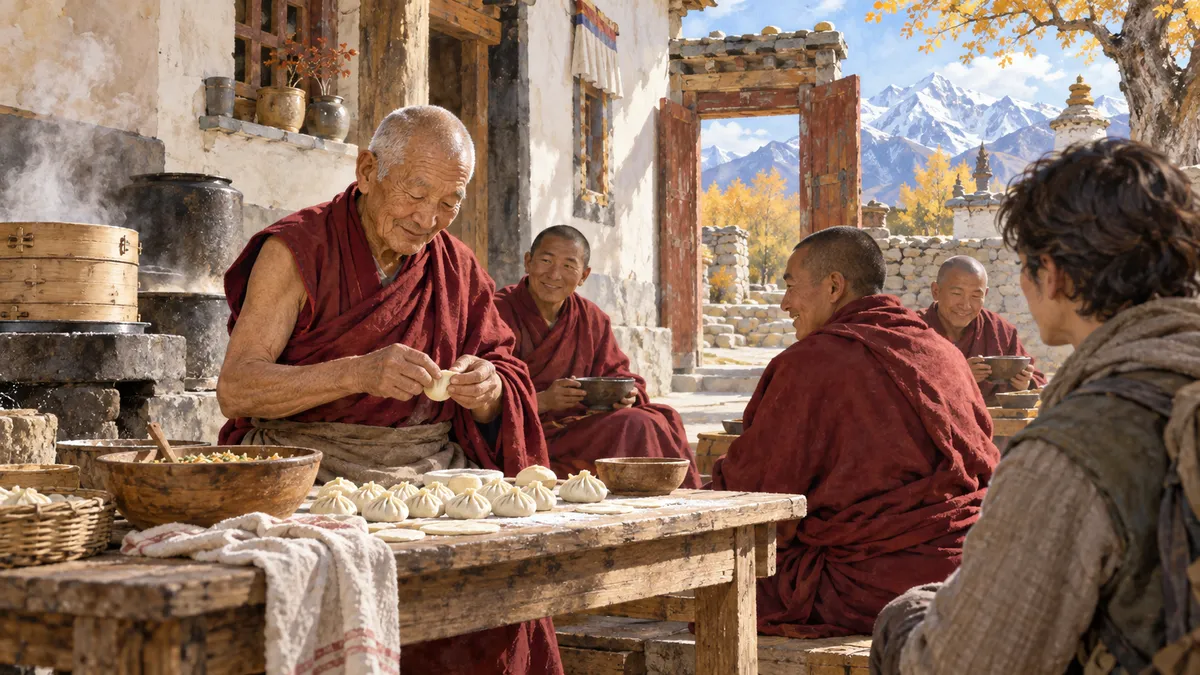
A Buddhist monk from Tibet was once asked by a monk from our monastery, “How do you determine who among you is enlightened and who is not?” He replied, “Those who, in old age, just before death, tremble with fear have not attained enlightenment; but if they do not tremble, then they most likely have.” That was their simple criterion. Another criterion was this: whoever behaves humbly has attained enlightenment; whoever does not behave humbly has not yet attained it. He himself was a fairly experienced monk with a certain degree of spiritual realization, but when asked who he was, he would say, “Oh, I’m just traveling with the monks here and making pies for them.” He tried not to draw any attention to himself at all—this, too, is a certain sign of realization. We do not cling to our ego at all; we do not care how others judge us, and so on.
Caution in Assessing Spiritual Realization
You must be very cautious in your judgments. You need to be a very pure person, to have lived alongside a jnani for a long time, to remain constantly in his company, and to investigate his past, his former life and conduct, his study of the shastras, his life of tapas, his Guru, and so on, very thoroughly. Only then can you draw well-founded conclusions. Only a Shakespeare can recognize a Shakespeare, and only a jnani can recognize a jnani—recognizing a jnani is a very difficult task.
It is like recognizing a precious stone: you can do so only if you are a jeweler, because a jeweler deals with stones every day and lives by them. A person who does not live among stones and does not deal with them finds it very difficult not to mistake a precious stone for a semiprecious one, or a semiprecious stone for something extremely valuable; such a person lacks discernment.
Siddhas are extraordinarily inventive in how they manifest, conceal themselves, reveal their grace, conceal their grace, and play—their consciousness is highly creative, ambiguous, playful, spontaneous, and multidimensional. We can never calculate the mind of a siddha, because it surpasses us just as a child’s mind cannot comprehend the consciousness of an adult.
Purnatva—the Sense of Wholeness
Question: Guruji, regarding the fourth stage according to the sixteen kalas, it is said that, upon meeting an appointed spiritual friend, you should question him about the essence of your own “I” until you are satisfied. How should this be understood? What does “satisfied” mean?
Satisfaction is purnatva. Purnatva is a sense of wholeness and completeness, when you feel that you are in your rightful place. People say, “The soul is out of place,” whereas purnatva, on the contrary, means that the soul is at the very center of being and experiences satisfaction, harmony, happiness, joy, and bliss, as though, in the deepest sense, it has come home. It does not need to go anywhere in search of something outside; it simply needs to absorb what is and become established in it.
When purnatva arises as a result of the soul settling in this center—the hridayam—and a feeling of peace, harmony, inner wholeness, joy, happiness, and bliss emerges, that is the beginning of purnatva. Such purnatva (wholeness) must appear. This means that raga-kanchuka ceases to operate. Raga-kanchuka deprives you of purnatva, but you have blocked it through study, tapas, and learning from the Guru.
Question: But purnatva is not inaction; in fact, is it not the opposite?
No, it has nothing to do with action at all. It concerns only the inner state—the eyes, ears, hands, and feet may act or remain inactive; that is already external. It concerns the soul—the soul abides in non-action, in wholeness, in the experience of “I have done everything,” while from this state, as a form of play, in accordance with place, time, circumstances, and previous vasanas, tremendous activity may unfold, but it will already be play. It will be action arising from non-action.
For example, Rama accomplished tremendous deeds, but inwardly he was actually beyond action. The actions performed by Krishna—we are still encountering them and their consequences today: the Bhagavad Gita and so on. If it were not for Krishna, India in its present form—as a Vedic civilization—might not even exist, yet Krishna himself did nothing; he was beyond action.
The same is true of Shankara—the Vedanta that exists today, just as all Western philosophy after Plato consists of notes in the margins of Plato’s writings. Likewise, after Shankara, all Vedic philosophy consists of marginal notes, notes in the margins of Shankara’s books. An immense action—this is what we see, an immense result—but inwardly they themselves abided in non-action; this is purnatva. It can produce tremendous effects, yet inwardly there is neither a doer nor any doing, nor any raga—only contentment. Everything happens by itself through God’s grace.
Question: Does each soul have its own place, so to speak, specifically in the relative realm? There is a particular incarnation, a personality—has it found its place or not?
This is not connected with the material world or with one’s place in the material world. On the material level, of course, such a place is found, but this concerns the soul’s place within—sahaja.
