

Commentary on the text “Tripura Rahasya,” Chapter 15, “What Must Be Known and What Need Not Be Known, and on the Nature of the Supreme Essence.”
As you know, the “Tripura Rahasya” is an extensive dialogue between Dattatreya and Parashurama, which took place in the previous yuga, preceding our present Kali Yuga, that is, many millennia ago, in the time of Dattatreya and the ancient rishis whom we mention in the Refuge Tree.
Why did this dialogue take place at all? Because Parashurama, the son of a rishi, a brahmin-warrior, a battle mage, had accumulated a great deal of bad karma, that is, sins, by 21 times committing the killing of kshatriyas throughout the earth, while possessing enormous magical powers. Wishing to wash away the entire burden of the accumulated karma—the killing of kshatriyas—he came to Dattatreya to ask Him about the path to awakening.
The Story of Kartavirya Arjuna
Although Parashurama possessed enormous magical powers bestowed as a result of his birth to a great rishi, nevertheless he failed to restrain his anger when a mystical cow named Surabhi was taken away from his father’s ashram. She was taken away by another disciple of Dattatreya, a king named Kartavirya Arjuna. Kartavirya Arjuna, in the previous yuga, was also a disciple of Dattatreya, receiving various instructions from him, performing practice and, finally, attaining samadhi.
Thanks to Dattatreya’s instructions, Kartavirya Arjuna, being of royal lineage, gained an understanding of the profound essence of the Nature of Mind and certain magical powers. For example, the ability to change his form. He also gained the ability to travel on a vimana (a celestial chariot) to various worlds, including the worlds of the gods, in his own illusory body.
The Birth of Pride
Although Kartavirya Arjuna was pure of soul, his fate was such that for a time his mind became clouded; therefore pride took hold of him, and in his heart he often criticized the brahmins. Being himself a king, a kshatriya, he jealously watched how the brahmins, rishis, and hermits practiced. It often seemed to him that the brahmins were focused only on donations for performing rituals, that the result of their spiritual practice, of sitting under trees, was only good donations; therefore, in his heart he slandered the brahmins. He thought: “They are brahmins, professional priests, hermits, and yet there is no benefit whatsoever from their spiritual practice. But I am a kshatriya, a king, I govern a state, yet I possess mighty powers no worse than theirs, and I can be in samadhi if I wish.” Kartavirya Arjuna’s fate unfolded in such a way that little by little pride began to take hold of him.
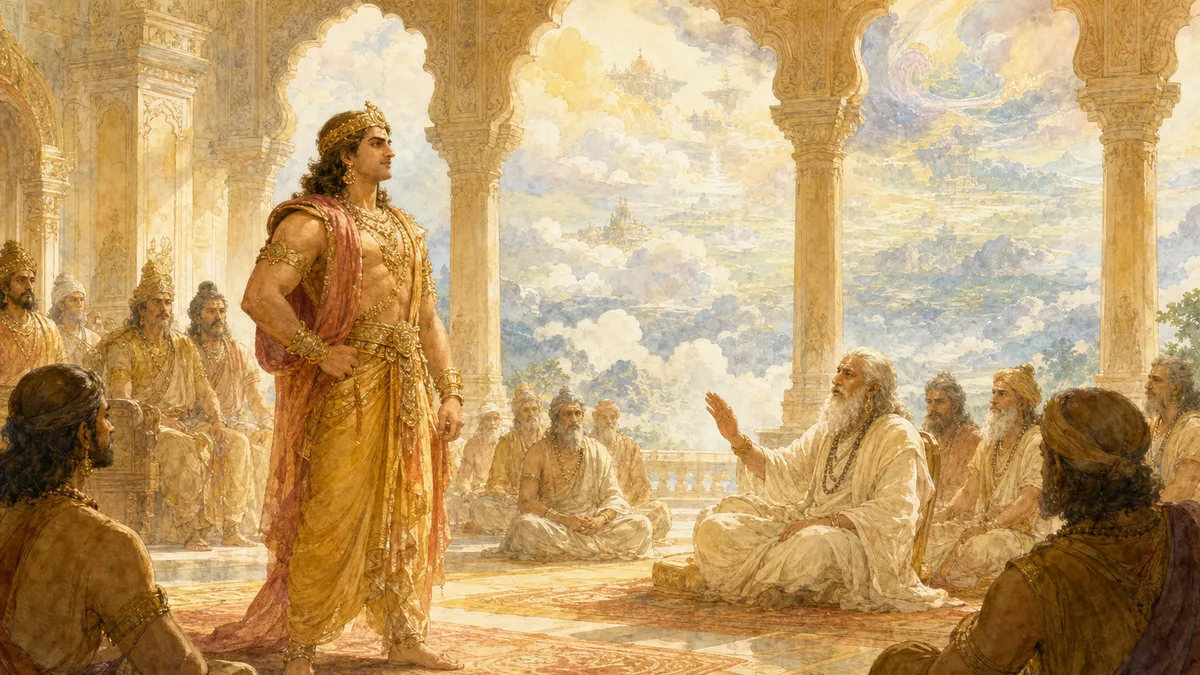
One day pride so strongly possessed him that, coming out in the royal assembly, he said:
— There is no one equal to me in all the three worlds! And the result of the spiritual practice of these hermits and ascetics is only good donations from their sitting on the roots of trees.
One of the saints said:
— Kartavirya Arjuna, are you in your right mind? You must not speak that way about great ascetics and hermits. They are all known for their holiness. Although you too possess an understanding of dharma, you should know that all your merit comes from the blessing of Lord Dattatreya. Do you really think there is no one above you? Think of the great gods, a single thought of whom makes all universes tremble. Who are you before them, to put yourself on display like this?
For a time Kartavirya Arjuna did indeed regain humility and apologized. But still, his tendencies of inner pride, coming from past lives, began over time to prevail.
Meeting with the Rishi Vasistha
When he was out hunting, they accidentally wandered into an ashram. There were the rishis Jamadagni, Vasistha, and other great rishis. The rishi Vasistha received him, spoke with him very courteously, told various stories about dharma, and gave instructions on the path of a king. Vasistha said to Kartavirya Arjuna:
— O King, stay with us for the night. We will provide you with a royal reception. Do not worry about anything. You will have all the appropriate comforts. All your companions will also be shown due respect.
Kartavirya Arjuna smirked to himself, thinking: “Yes, the brahmin has nothing to eat, yet he promises me a royal reception. The brahmin has rather boasted, it seems.” But Vasistha summoned the cow, the mystical animal named Surabhi, and said:
— Here, Mother, your time has come to show your skill.
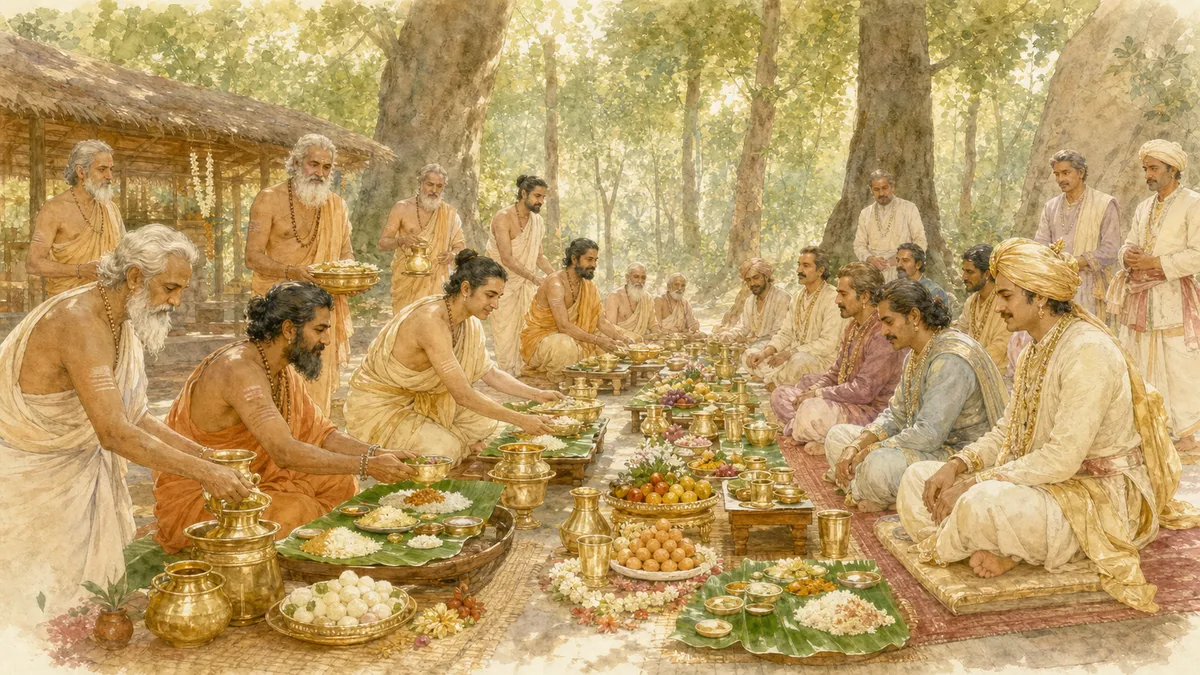
The mystical animal merely nodded its head and disappeared. After some time, in the jungle, where the huts of the rishis and ascetics stood, there suddenly appeared such an exquisite palace, with courtiers, servants, delightful ornaments, and a variety of dishes, that the royal palace looked rather poor in comparison.
When they began to treat the king’s ministers and servants, the king felt disgraced as he heard his subjects saying:
“Yes, you see, these poor brahmins, if they wish, can manifest luxury greater than that of the king. This is what true spiritual practice means.”
And others said:
“What sense is there, then, in serving the king, if the brahmins treat guests so well and live so exquisitely? As royal ministers, we have never seen such luxury as among the brahmins in the jungle. Perhaps we should go into the service of the brahmins instead?”
The Abduction of the Cow Surabhi
Kartavirya Arjuna, hearing these conversations, was simply furious. He wanted somehow to restore his self-esteem. He thought: “All of this is thanks to the cow, not thanks to the siddhis of the rishi. This divine animal can manifest such magical powers. This animal must be mine.” He approached Vasishtha and said:
“This divine cow is remarkable.”
“Yes, but she is not just a cow. She is to me like a mother, a daughter, and a sister. This animal was sent down by the gods.”
And the king said:
“You know, after all, I am the king. And therefore everything on this earth belongs to me. By right and by law, this cow is mine.”
The rishi tried to explain that this was impossible:
“I am not free to give her away, much less to sell her. She is not mine; she was sent down by the gods. She is not even my property. She lives here of her own will.”
Kartavirya Arjuna was unyielding:
“Since she is not yours, it means she will come with me.”
Vasishtha tried to dissuade him from this undertaking, saying:
“Come to your senses, O king! You are not in your right mind! You are committing unrighteous acts, unworthy of a king, and all the more of a practitioner, a disciple of Dattatreya.”
But Kartavirya’s mind had already become clouded and was seized by a sense of wounded pride and the desire to possess this cow.
Vasishtha then said to the cow:
“Go, Surabhi. Forgive me for not being able to keep you here.”
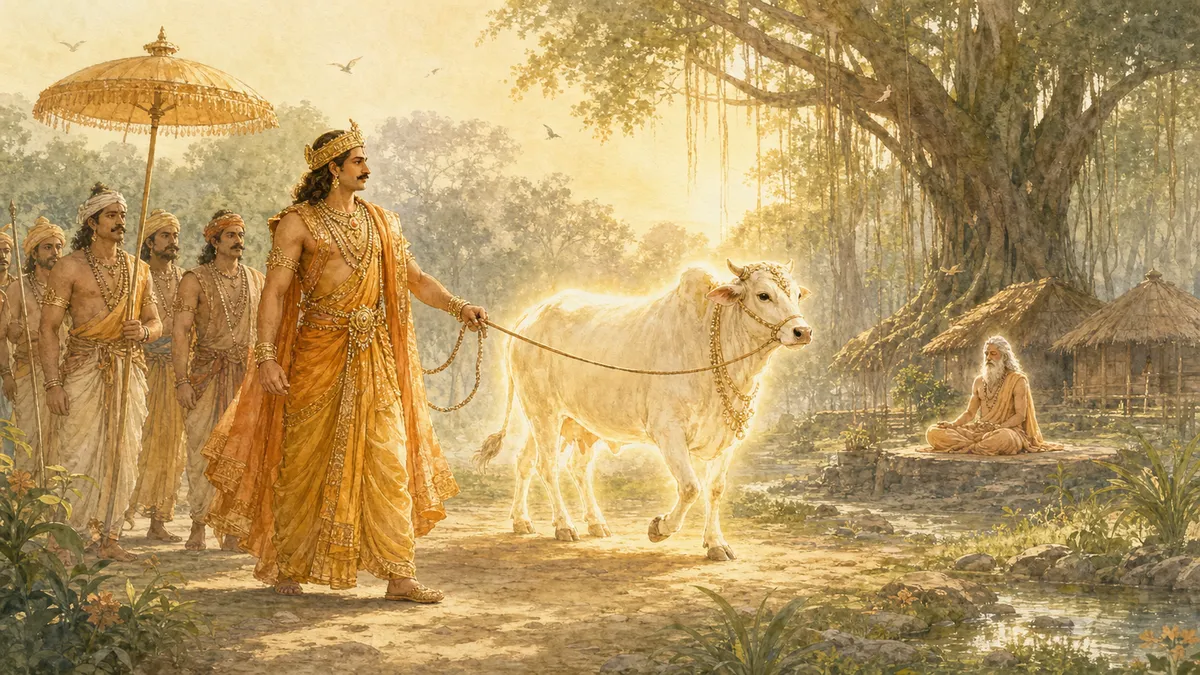
The soldiers took her by the horns and led her away. Everyone in the ashram was shocked by such dishonorable behavior on the part of Kartavirya Arjuna.
Parashurama’s Revenge
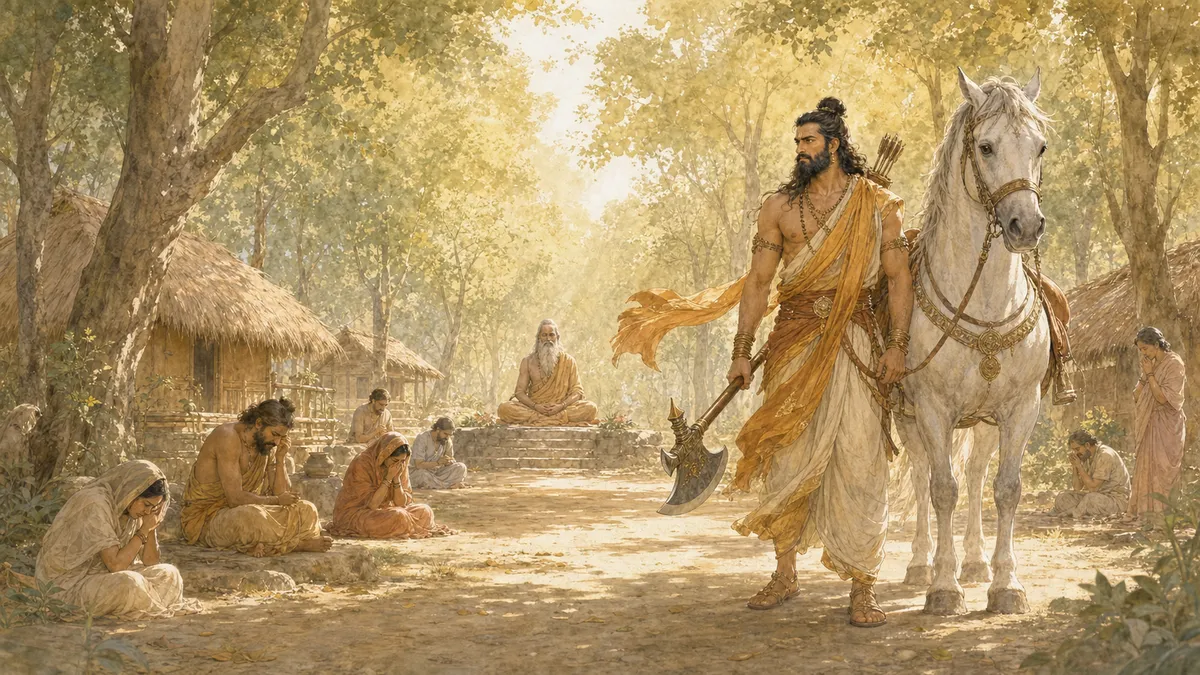
At that time, the son of the rishi Jamadagni, Parashurama, was outside this ashram. And when the soldiers had left, he returned and saw that everyone was grieving, while the rishi himself was in samadhi, as if nothing had happened. Parashurama flew into a rage and vowed that he would return the cow and kill Kartavirya Arjuna for the insult to the brahmins. And like Yama himself, the god of death, he put on a battle headband, took up various kinds of weapons, mounted his horse, and rushed off to catch up with Kartavirya Arjuna, beside himself with anger.
The Divine Origin of Kartavirya Arjuna
Kartavirya Arjuna had received many blessings from Dattatreya. However, one day Dattatreya said that only one equal to him could kill him. And since Kartavirya Arjuna himself was the incarnation of one of the gods close to Vishnu, after some time he was overcome by great pride, and his actions often provoked complaints in Brahma-loka.
In fact, the story of Kartavirya Arjuna’s birth is the story of the punishment of one of the gods. Once, having gathered under the leadership of Vishnu, the gods said:
“One of us has become very proud of his mighty powers. He does not understand that all his mighty powers come from higher beings, and that he himself is not as mighty as he seems.”
And one day they summoned him to an assembly and said, calling him to repentance:
“Yes, you are truly great. We live only by your grace.”
He did not even see the hidden smirk, the irony, and took these words completely seriously, at “face value,” saying to all the other gods:
“Yes, I am very great! You live only by my grace.”
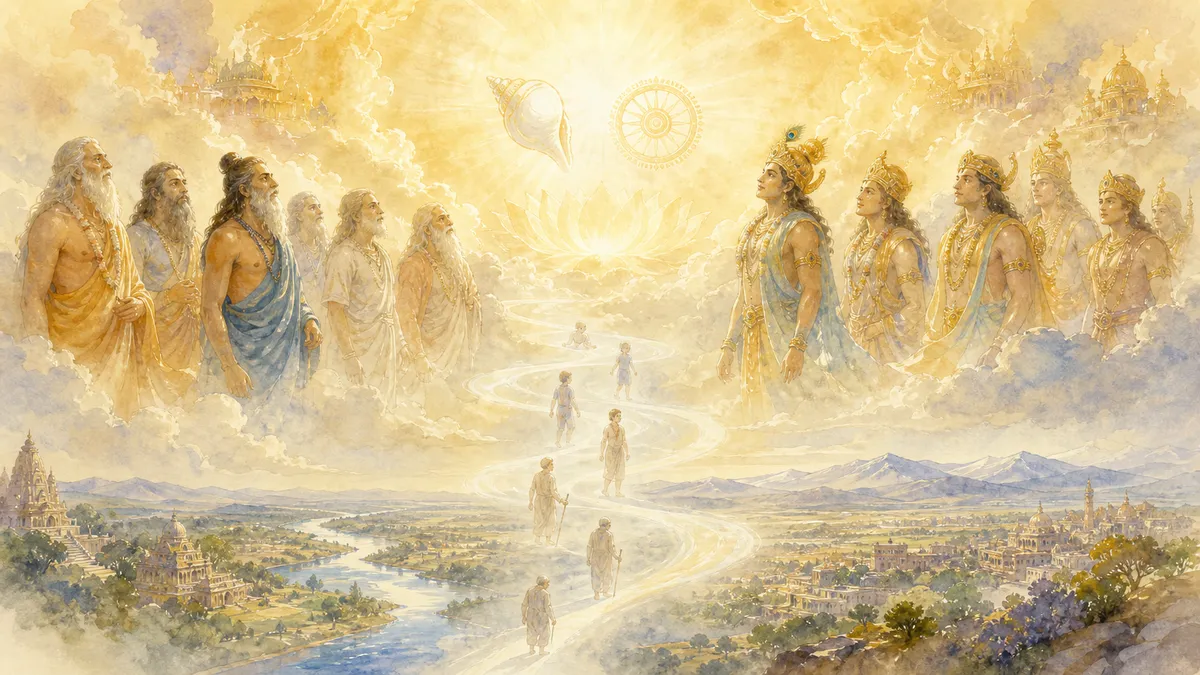
When the gods had already grown tired of his arrogance, the elder gods, the ancient rishis, the lords of vast universes, decided to punish him and appealed to Vishnu. Vishnu said that he would be born in the world of humans as a mortal, in order to learn how punishable pride can be.
Vishnu placed a curse on him that he must lose his memory, be reborn, and spend several lives in the body of a mortal. In fact, this is precisely why Kartavirya Arjuna was born. But this feeling of great pride remained with him even in the physical body. Although he was a disciple of Dattatreya, his samskaras and destiny manifested in such a way that the time came for him to outlive this feeling. Parashurama was precisely the messenger who had to kill him and free him from the physical body in order to return him to the world of the gods and complete this lesson.
The Duel Between Parashurama and Kartavirya Arjuna
When Parashurama caught up with Kartavirya, he shouted to him from afar: “You, who call yourself a kshatriya, who call yourself a king, come here.” It was simply unheard of that anyone could issue such a challenge to a king, even the son of a brahmin. But then Kartavirya Arjuna remembered that this was obviously the very person, equal to him, who was to defeat him according to Dattatreya’s prediction, and he thought: “Now we shall see whether he is equal to me or not.”
Parashurama was the embodiment of rage itself. He was a very skillful warrior-magician, that is, a battle mage. And although he was a brahmin by birth, it was said of him: “The strength of a kshatriya, the energy of a brahmin.” By all signs he was not an ordinary brahmin, but a warrior through and through. While all the brahmins read the Vedas, meditated, and fasted, Parashurama had a bow, arrows, a battle band, and he lived very ascetically, like the most skilled warriors.
When they began to fight, Parashurama did not expect Kartavirya Arjuna to manifest such powers, since he considered him an ordinary king who was no match for him in mastery of weapons. But suddenly Kartavirya Arjuna revealed his true form as a practitioner and began to manifest magical powers, demonstrating illusory bodies. Parashurama also had to exert enormous strength in order to finally defeat Kartavirya Arjuna. Since they were equal in strength and skill, the duel was evenly matched. At first, Kartavirya Arjuna began to defeat Parashurama, pressing him from all sides, showering him with a hail of arrows, using all his magical abilities. But Parashurama, being the embodiment of wrathful Vishnu (Parashurama is one of the avatars of Vishnu), outplayed Kartavirya Arjuna despite his siddhis and mastery, defeated him in combat, and killed him.
The Destruction of the Kshatriyas and Parashurama’s Repentance
After that, Parashurama returned home with a sense of duty fulfilled. And all the sons of Kartavirya Arjuna, all his relatives, ministers, and generals vowed to destroy the rishis. They began to gather an army to attack them and avenge the death of the king. After this, Parashurama fought the kshatriyas many times and, as a result of fierce battles, destroyed all the kshatriyas 21 times, so that not a single kshatriya remained afterward. Kshatriya women even had to conceive children from brahmins in order to continue their lineage. It is believed that all kshatriya clans after this period of time are descendants of brahmins, because the kshatriyas themselves throughout the world were destroyed by Parashurama, who possessed enormous, mighty powers.
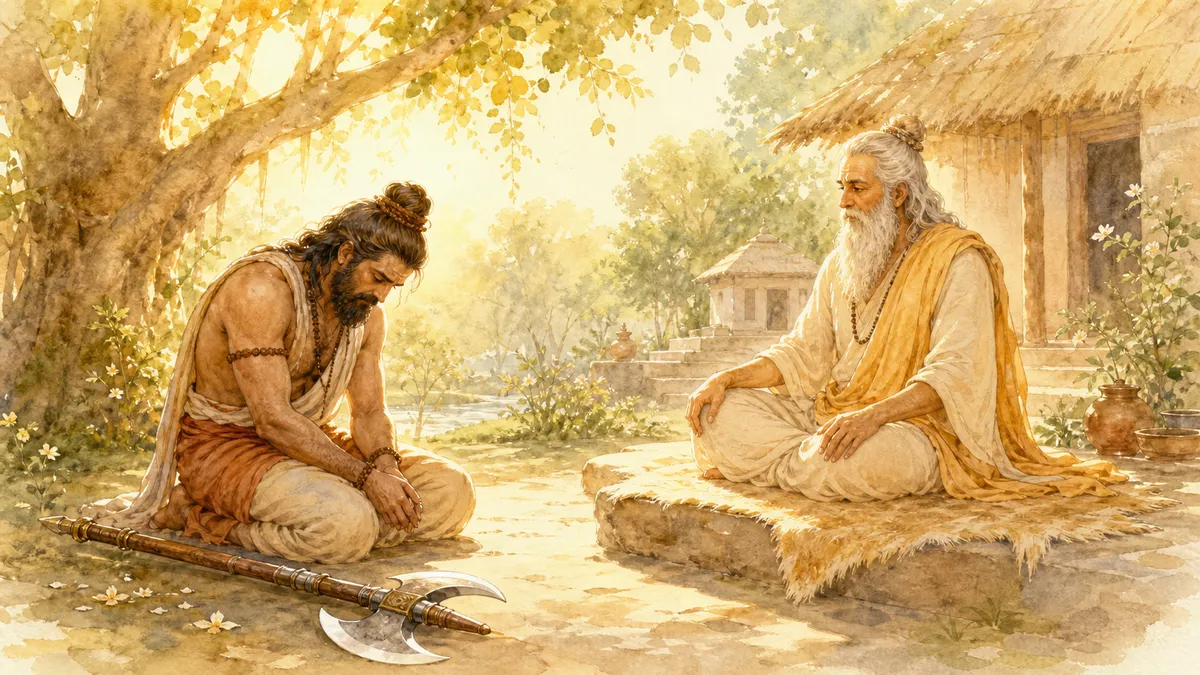
“Parasha” translates as “hatchet” (a type of weapon), that is, Parashurama is Rama with a hatchet, a symbol of war. He is recognized as a great warrior-avatar. After Parashurama had destroyed all the kshatriyas throughout the earth, he realized what bad karma he had accumulated. He became disillusioned with everything and felt a profound emptiness after all these karmic actions. With great repentance and the desire to put an end to his fate as a kshatriya, he turned to Dattatreya for instructions.
Dattatreya comforted him by giving instructions and said to him: “Do not worry; you were an instrument of the divine will. If you had not been the embodiment of Vishnu himself, could you have done this? Through you acted the power of the gods themselves, which came to give a lesson to Kartavirya Arjuna and to punish the one who needed to be punished. You were simply the personification and embodiment of these forces, although this does not relieve you of karmic responsibility.”
And the rest of the “Tripura Rahasya” is an explanation of the spiritual path to Parashurama, in which Dattatreya, through various examples, dispels all his illusions.
The Example of King Janaka
This is one of the examples explaining what one should and should not know about the nature of the Supreme Being.
This king was called Janaka; he was very wise and knowledgeable both in this world and in that which lies beyond it. One day he was performing worship, with sacrificial rites, to the Goddess who abides in everyone and everything in the form of the Supreme Essence.
On this occasion, all the Brahmins, pandits, ascetics, critics, those versed in the Vedas, participants in the sacrificial rites, and so on, gathered there.
At the same time Varuna, the lord of the waters, wished to perform a similar sacrifice, but worthy people did not accept his invitation, for they had been appeased by Janaka, who honored them in the proper manner.
Thus, Varuna wanted his sacrifice to be honored by many living beings from the world of humans, but they refused him. Then his son stealthily entered the royal assembly and decided, by insulting the Brahmins, to provoke them into a philosophical dispute, under the terms of which, if they lost, they would nevertheless have to descend into his father’s realm and take part in the sacrifice.
Then the son of Varuna, who was a great polemicist and had perfectly mastered the art of debate, came to them. He assumed the appearance of a Brahmin in order to lure away the Brahmins who had come to the king. Entering the royal chamber, he duly blessed the king and addressed him before the entire assembly with the following words:
“O king! Your assembly is not as good as it ought to be. It resembles a beautiful lotus lake spoiled by crows, jackdaws, and herons. It would be better without this jumble of incompetent representatives.”
“I do not find here even a single individual who would be the ornament of a great assembly, like a swan on a beautiful lotus lake. May God bless you! I do not wish to have anything to do with this crowd of fools.”
Philosophical Dispute
Thus insulted by the son of Varuna, the entire assembly turned to him in anger:
“You Brahmin charlatan! How dared you insult everyone who is here? What knowledge have you learned that we lack? A wicked man like you is simply a bluffing deceiver! You must not leave this place until you prove your superiority over us. Great pandits from all over the world have gathered here. Do you really hope to surpass them all with your learning? Tell us, what is it that you have studied, in which you imagine yourself to be more skilled than we are?”
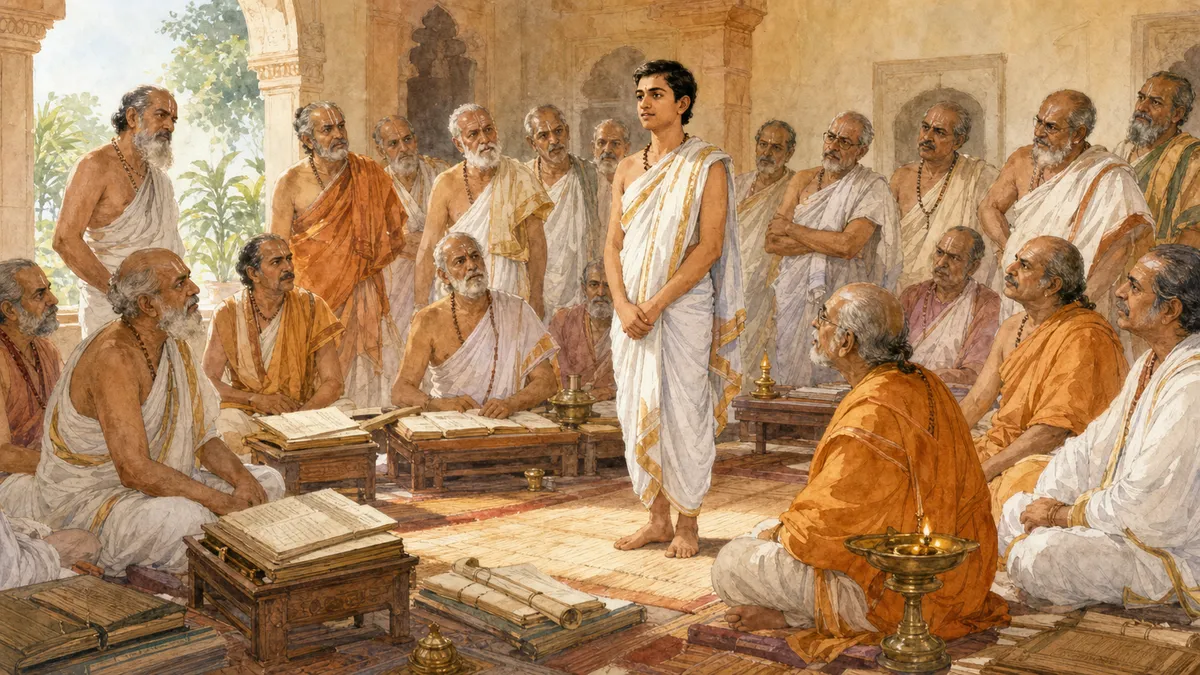
Challenged by these words, Varuni (the son of Varuna) replied:
“In a minute I shall surpass you all in debate! But the debate will take place only on this condition: if I am defeated, you will throw me into the sea, and if you are defeated, I shall send you into the sea one by one. If you agree to this condition, then let us begin the dispute.”
They agreed, and a stubborn debate began. Soon the pandits were defeated by the opponent’s deceptive logic, and they were immersed in the sea by the hundreds.
And then Varuna’s servants took the drowned pandits and brought them to the place where Varuna had conceived of performing the sacrifice. They were received with due respect, which made them very pleased.
Ashtavakra Avenges His Father
Among those drowned in this way was a certain man named Kahoela. His son Ashtavakra, hearing of his father’s fate, hastened to Janaka’s palace and challenged this debater, skilled in sophistry (deceptive argumentation), to a duel. Now the pretender was defeated and immediately sentenced to be thrown into the sea by the young avenger. Then Varuni cast off his mask in the palace and brought back all the people who had previously been drowned in the sea. Kahoela’s son began to swell with pride and behaved offensively before the assembly. The pandits felt humiliated and wounded by this youth.
Disappearances of People and Contacts with the Gods
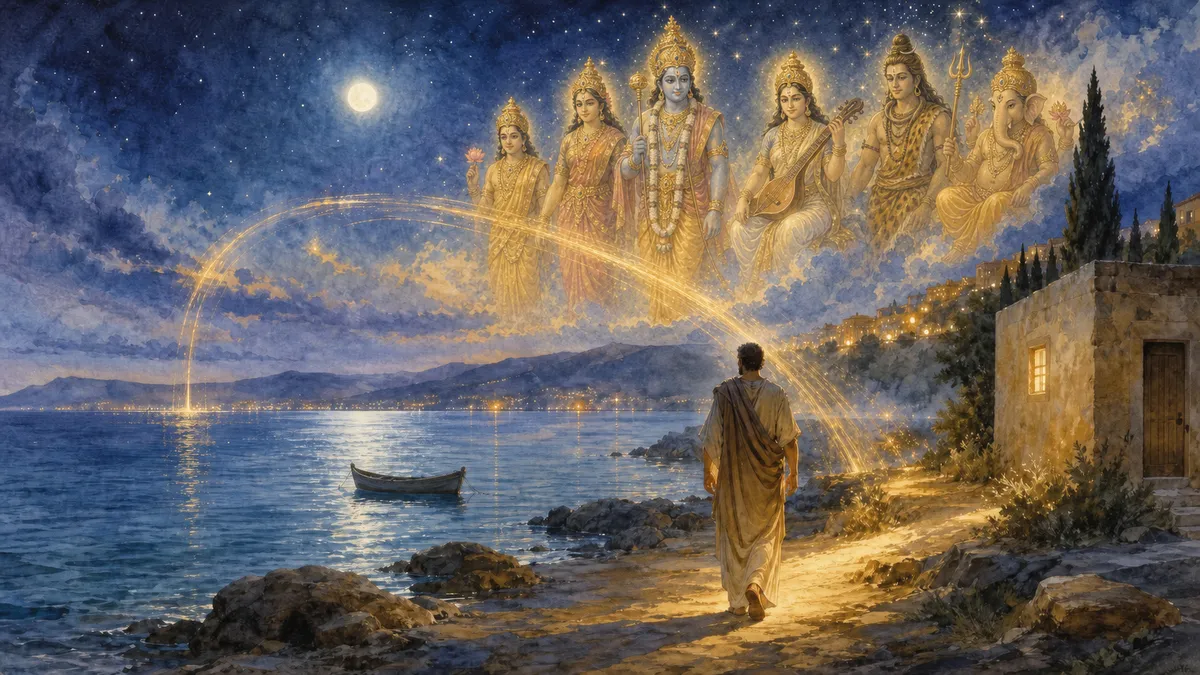
What does “drowned” in the sea mean? Both in ancient times and to this day, there have been cases of people being abducted by gods. To move the consciousness together with the physical body of an ordinary person is, for some beings, no more difficult than it is for you to carry an object from one place to another. Neither walls nor a medium such as the ocean or the air are an obstacle for them.
Every year, dozens and hundreds of people disappear in the area of the Bermuda Triangle, just as they do in various other places. At present, there are about 30,000 officially registered cases of people being abducted by various beings who are called aliens. But in reality, this is not only a phenomenon of our century. Similar things have always existed in the world, because in parallel with human civilization the world is inhabited by many other, more highly developed beings belonging to the category of devas (gods).
People disappear in their physical bodies for several hours or several days, and after they return, some marks are found on their bodies. Sometimes they even disappear from their bedroom, from within four locked walls. But that is a separate topic. Thus, what is described here is not something unbelievable even in our time. And in another yuga the state of the elements and tattvas was different, so the worlds of gods and humans were much closer; there were not such rigid boundaries between the worlds as there are now, and therefore people quite often and more openly came into contact with the gods.
The Appearance of the Hermitess
And at that moment, right in their midst, a hermitess appeared, to whom the offended assembly turned for help. Inspiring them with expectation, the enchanting maiden with matted locks and the garb of a hermitess was accorded great honor by the king. She spoke in a pleasant but firm voice:
“O child! Son of Kahoela! You have indeed attained a very high degree of perfection, since these Brahmins were saved by you after you defeated Varuni in debate. I want to ask you a short question; please give a direct answer to it, unambiguous and frank.”
The son of Kahoela saved the Brahmins by defeating the son of Varuna with the power of his knowledge. As a result, he too was overcome by pride. He began to reproach the Brahmins for their weak knowledge, saying that he, even as a boy, knew Vedic philosophy and the art of debate better than they, the famous scholars. To teach him a lesson, a hermitess appeared who wished to ask him a question.
The Law of Equilibrium and Pride
Whenever pride arises in you, you transmit some deviated energy into the universe, and according to the law, forces of equilibrium are drawn to you, which begin to restore the balance of the hypertrophied false ego. The restoration of this balance is felt in the form of such light flicks, light “taps on the nose.” That is, events begin to unfold in such a way that you are flicked from one side, then from another, then from a third, so that you simply read these signs and accept them as a guide to action, indicating that something within yourself needs to be changed.
If, however, you do not see these signs and are blinded by your false pride, these signs begin to flick you on the nose more and more strongly, until you pay attention to them. If you still ignore them, they will no longer merely flick you on the nose, but simply strike you. This is a law that is inherent in practically all processes in the universe.
As soon as a certain identification, pride, the desire to attribute certain qualities or achievements to our ego and cling to them arises in us, situations occur that show us the absurdity and falsity of all this. And the more strongly pride manifests, the more effort external forces apply toward us in order to restore the disturbed equilibrium.
The Question of the Supreme State
“What is that state, upon attaining which absolute immortality comes; upon knowing which all doubts and every uncertainty disappear; and after becoming established in which all desires vanish? If you have realized that unlimited state, please tell me about it directly.
When asked by the hermitess, the son of Kahoela answered with confidence:
“I know it.”
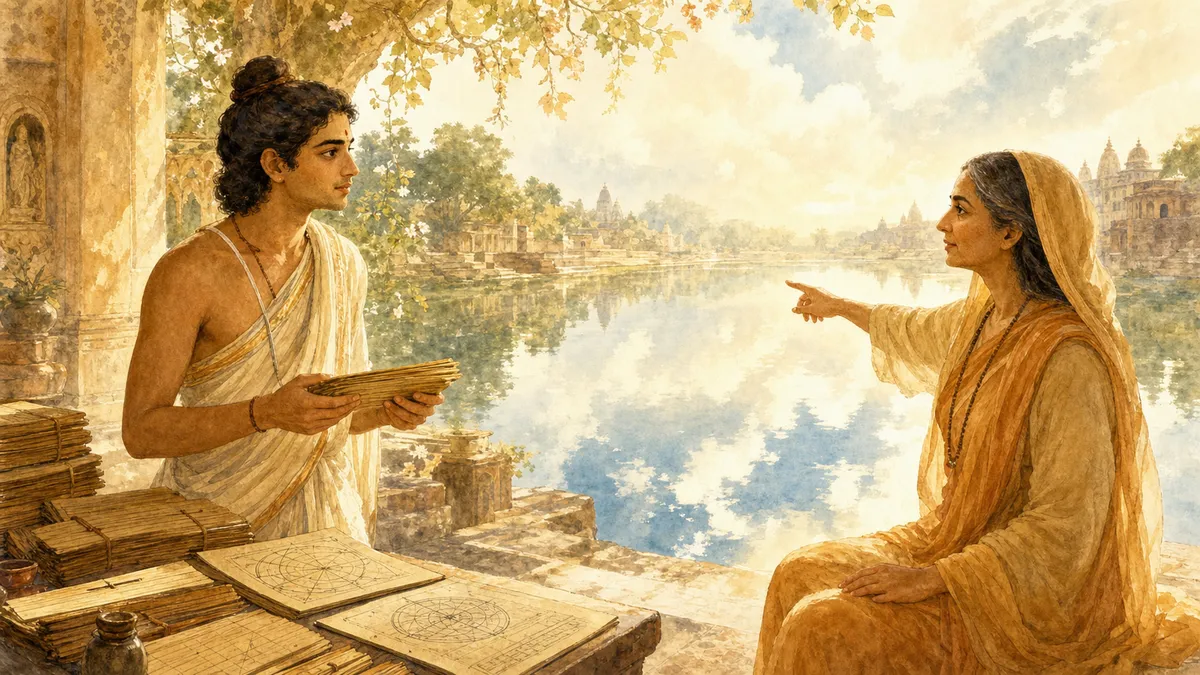
Thus, the hermitess, bypassing philosophical debates, asked him to give her the most direct answer. She was not asking him about concepts or philosophical notions. She asked him about a state.
The Difference Between a Philosopher and a Practitioner
A philosopher always abides in concepts, in theories and various doctrines, whereas a practitioner abides in states. For a practitioner, dharma is not concepts, but the state of one’s own consciousness, because dharma is experienced by him through the prism of meditation and contemplation. Concepts are not rejected; they are simply a confirmation and an adequate expression of the state, yet it is the state that is primary.
If, however, someone is not a practitioner, then for him concepts are more important than the state; he does not know this secret. But a true practitioner always knows that concepts are a confirmation, description, and expression of the true state. With regard to the state, everything is simple: you either experience it, or you do not experience it. If you experience it, you can express it.
And here the hermitess asked Ashtavakra precisely about the state in which all doubts disappear, and after becoming established in which all desires disappear. The son of Kahoela, not noticing the catch, confidently continued: “Yes, I know it,” thinking that the hermitess would continue questioning him on the basis of quotations from scripture.
Ashtavakra’s Answer from the Scriptures
“Listen to what I shall say. There is nothing in the world that I have not yet known. I have studied all sacred literature with great thoroughness, so hear my answer.
That which you ask about is the primordial and effective cause of the Universe. This cause has no beginning, middle, or end, and is untouched by time and place. It is pure, unbroken, unified Consciousness. The whole world is manifested in it, like a city in a mirror. Such is that transcendent state. Upon its awareness (realization), a person becomes immortal. Then there is no longer any place for doubt and uncertainty, no longer any cause for ignorance as there was before when observing countless reflected images, and there will no longer be any place for desire, because transcendence has already been experienced.”
Based on his knowledge of the Upanishads and Vedic texts, the son of Kahoela, not noticing the catch in the hermitess’s question, briskly quoted to her, as if nothing were amiss, everything he knew from the texts about this supreme state. But his entire answer is mechanistic, mental; it is based on the action of manas (the conceptual mind), logic, conceptual thinking, and therefore it is doomed to defeat from the very beginning.
“It is also incomprehensible, because there is no one who would know it apart from that state itself.”
It seems that Ashtavakra is saying everything correctly. In principle, his words can be found in the words of the mahasiddhas and in the tantras; all saints say the same thing. However, the difference is enormous. Ashtavakra speaks, but he himself does not understand what he is saying. He is simply demonstrating a good memory.
“Hermitess! I have now told you the truth as it is contained in the sacred scriptures.”
The Hermitess’s Logical Trap
After Ashtavakra had finished his speech, the hermitess spoke again:
“Young sage! What you have said is correct and accepted by all. But I want to draw your attention to that part of your answer where you acknowledge the unknowability of that state because of the absence of a knower who would abide beyond consciousness, and also that knowledge of it bestows immortality and perfection.”
Ashtavakra said that this state is incomprehensible because there is no duality in it, no subject, no object, and therefore no process of cognition, because the process of cognition always implies subject-object relations, when a subject cognizes something objective. And since there is no subject there, how can there be an object, and how can there be a process of cognition? The entire triad disappears in this incomprehensible state. It is called incomprehensible precisely because there is no one there to comprehend. From Ashtavakra’s point of view, all this looked very beautiful and very logical. But the hermitess, in turn, asks him a question:
“How can these two statements be reconciled? Either admit that consciousness is incomprehensible, that it has not been known by you, and thus conclude that it does not exist. Or say that it exists and that you have known it, and therefore it is not incomprehensible.”
The hermitess found the simplest logical contradiction in his statement. If you say that you have known everything, then you yourself contradict yourself when you say that this consciousness is incomprehensible because there is no knower there. Since consciousness is incomprehensible, you must admit that you have not known it, that is, the assertion that you have known everything is false. If, however, you have known it, you must admit that it exists objectively, outside the knower, and then you again contradict your own words.
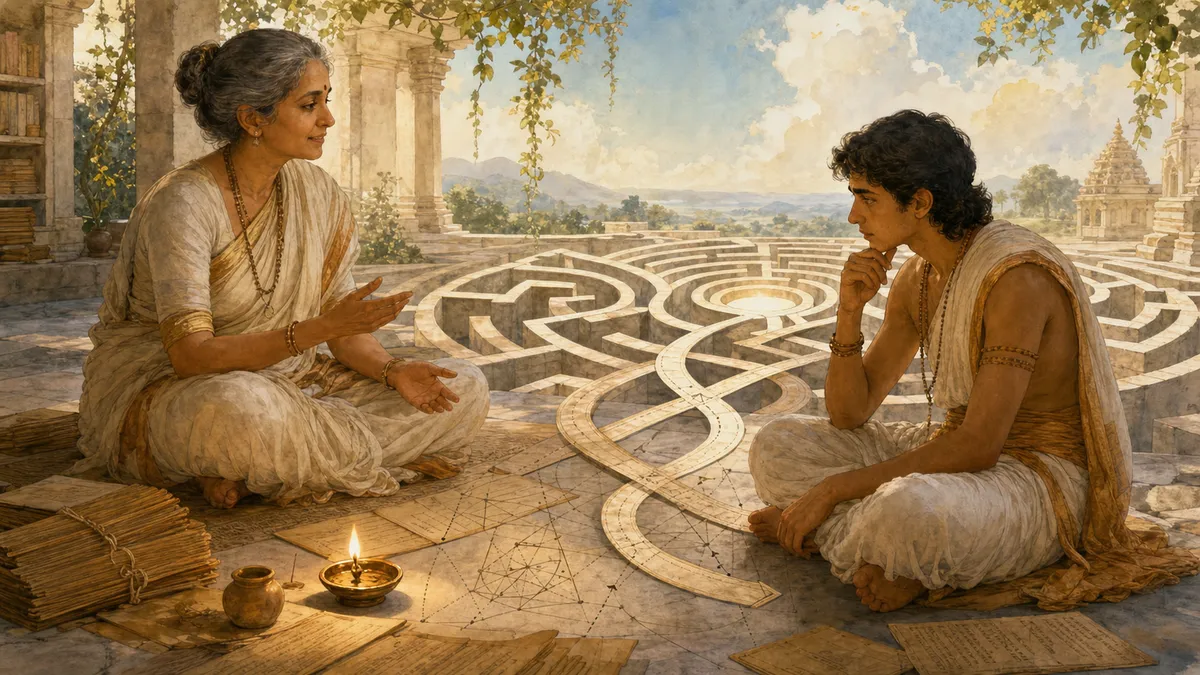
It can be said that she brought him to the state of a Zen koan, a semantic paradox in which logic ceases to function. Either Ashtavakra had to admit that he had not known this state and accept defeat, or he had to admit that he had known it, but then it followed that this state could not be true, since earlier it had been defined by him as incomprehensible because of the absence of one who comprehends. In other words, however one looked at it, it was impossible to get out of this labyrinth.
The Difference Between Images and the Mirror
“It is perfectly obvious that you are expressing knowledge obtained second-hand, drawn from the sacred scriptures. It is clear that you have not realized it, and therefore your knowledge has not been obtained by you on the basis of your own experience.
Think—your words themselves say this—you possess your own knowledge of images, but not of the mirror. How can that be?
Tell me now, are you not ashamed of evading the answer before King Janaka and his assembly?”
The hermitess says: “You have seen only the reflection, but not the moon itself. You have seen only the images, but not the mirror itself.”
In the same way, if we operate only with concepts, we always see the reflection. If, however, we recognize the non-conceptual essence of all concepts, we begin to notice the mirror.
Ashtavakra’s Defeat and His Humility
“Having received this remark from the hermitess, Ashtavakra was speechless for some time, because he felt ashamed and disgraced; he bowed his head, pondering her words. However, the young Brahmin could not find any satisfactory answer to her question, and then he bowed before her with great humility.”
All of Ashtavakra’s knowledge was based on mental logical assertions; therefore, when the hermitess, who possessed intuitive knowledge, asked a question that brought his mind to a dead end, he was struck dumb and could say nothing.
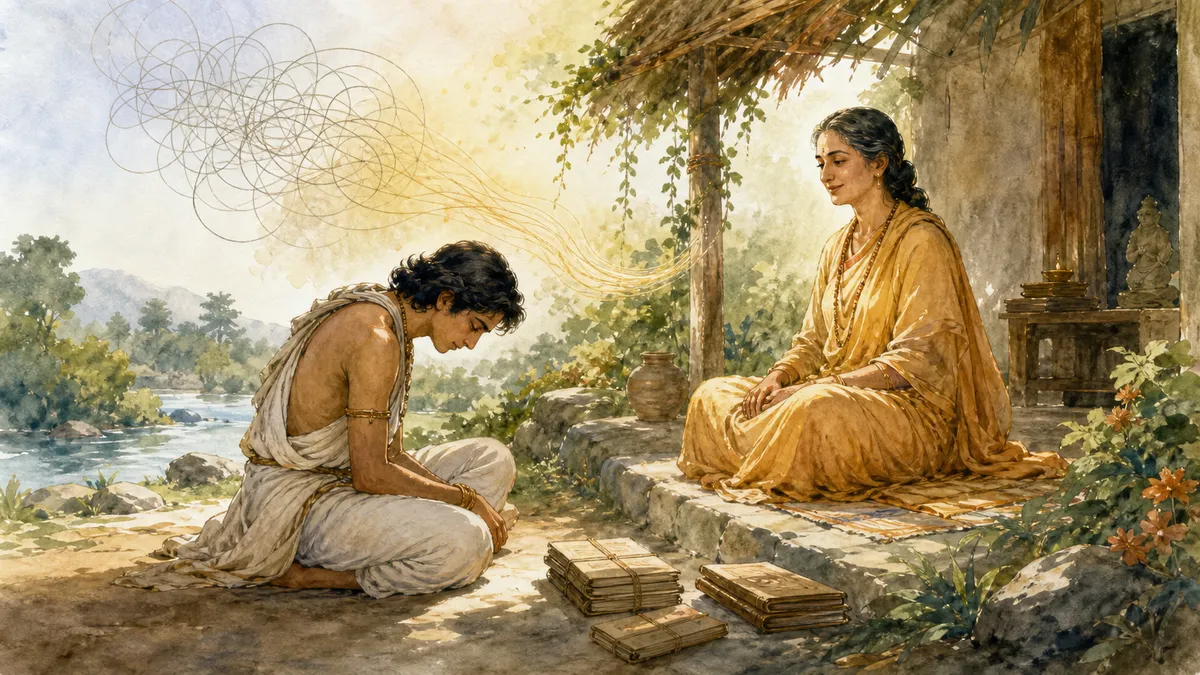
“O hermitess! Truly, I cannot find an answer to your question. I bow before you as your disciple. I implore you, tell me how to reconcile these two statements of the sacred scriptures. But I assure you that I did not speak a deliberate lie, for I know that any merits of a liar may be nullified by his falsehood, and he will be condemned as unworthy and contemptible.”
This is one of the most interesting episodes in the “Tripura Rahasya,” concerning the clarification of the very essence of the teaching. And then comes the answer of the hermitess, who gives instructions to Ashtavakra. Whenever you experience any doubts about your own understanding, you can read this answer of the hermitess, which describes the absolute truth.
