

When we begin collective practice, we start with namaste-kriya, or prarthana-mudra; that is, we enter contemplative presence by closing the lunar and solar channels. If you do this correctly, your presence develops. If you do it incorrectly, of course, it does not develop. The bhajan mandala is a practice containing many subtle nuances and aspects that should always be remembered and carefully performed.
What is the meaning of performing Guru Yoga, the bhajan mandala, and the concluding meditation on the four immeasurables? The meaning is to enter contemplation, to gain the experience of the bhava of divine pride, and to restore the samaya connection with the lineage. I explained this in detail to laypeople at a lecture during the last retreat in Moscow.
The Refuge Tree and Guru Yoga
When we practice Guru Yoga, we visualize Om in the center of the chest. First we visualize Om, then we visualize light radiating from Om, and within it the Refuge Tree arises projectively. It is desirable to imagine it roughly as it is depicted in the mandala.
What is the Refuge Tree, and what is the meaning of Guru Yoga? A very clear example can be given from everyday life. If you want to use mobile communication services, you need to contact someone. That is, you do not appeal directly to radio waves or to space; rather, you contact specific companies with a request to connect you to mobile communication services. When the connection is established, you can communicate thanks to this connection. When we perform Guru Yoga, one could say that we are also trying to establish such a spiritual connection, only it is very subtle and incomprehensible to us as long as our chakras have not been purified. This connection is subtle-informational, but it exists. It is precisely thanks to this connection that we then carry out our practice.
We perform Guru Yoga by establishing a connection with the Refuge Tree—a symbolic mandala embodying all the saints and Gurus. In the Refuge Tree are deities, rishis, and mahasiddhas with whom we have a connection, who embody the spiritual knowledge we receive, the teaching.
The Principle of Samaya and the Lineage
The original Vedic knowledge is called “apaurusheya,” which means “non-human.” That is, it was received from suprapersonal, superhuman sources, as divine revelations. It is not the invention of some clever parapsychologist, some brilliant scientist, or a mythological creation. This is knowledge that was transmitted by divine beings to other teachers, saints, or divine beings, and thus came to us. Therefore we speak of the principle of the teaching’s samaya, of the purity of the lineage, of “maintaining the samaya connection.” The meaning of maintaining the samaya connection and of Guru Yoga is that we establish a connection, connect ourselves to the company of very spiritually developed people or supernatural beings who even now, being immortal, abide in other realities. Although these beings are incomprehensible to us or are too far away, nevertheless they exist. When such a practice is performed, a connection with them is gradually established.
In reality, there are far more saints in the Refuge Tree, but here those with whom we have a karmic connection are singled out. These are my spiritual teacher, Mahasiddha Achintya (some also say Asinta), Mauni Baba, Mahamurti Baba, Anama Prabhu—our direct lineage. Then Siddha Shankara, who is the founder of Advaita. One could say that to practice Advaita is to meditate on Shankara and merge one’s consciousness with Shankara, that is, to look at the world through Shankara’s eyes. Our famous niralambha meditation, or divine pride, is directly Shankara’s darshan; it is his transmission, set forth in the texts “Brahmanu Chintanam” and others. That is, the entire dharma of Shankara can be reduced to the mahavakya Aham Brahmasmi and to the meditation of divine pride. In fact, this very practice is the key for us in the dharma.
Further on the Refuge Tree you see the siddhas Tirumular and Boganathar (they are the most famous of the eighteen Tamil siddhas) and all the other Tamil siddhas. The siddhas Matsyendranath, Gorakshanath, Charpatinath, Jalandharinath are the best known from the canon of the nine Naths, as well as the other Naths. Above them are gods of the Brahma-loka level, in particular the lineage of gods associated with Saraswati, who is the goddess of wisdom, since for the practice of awareness and contemplation this is a very important quality. Still higher you see a cohort of rishis, whom the texts call the Saptarishis (the seven rishis). They are represented by the seven stars of the Big Dipper.
Rishis and Cosmic Connections
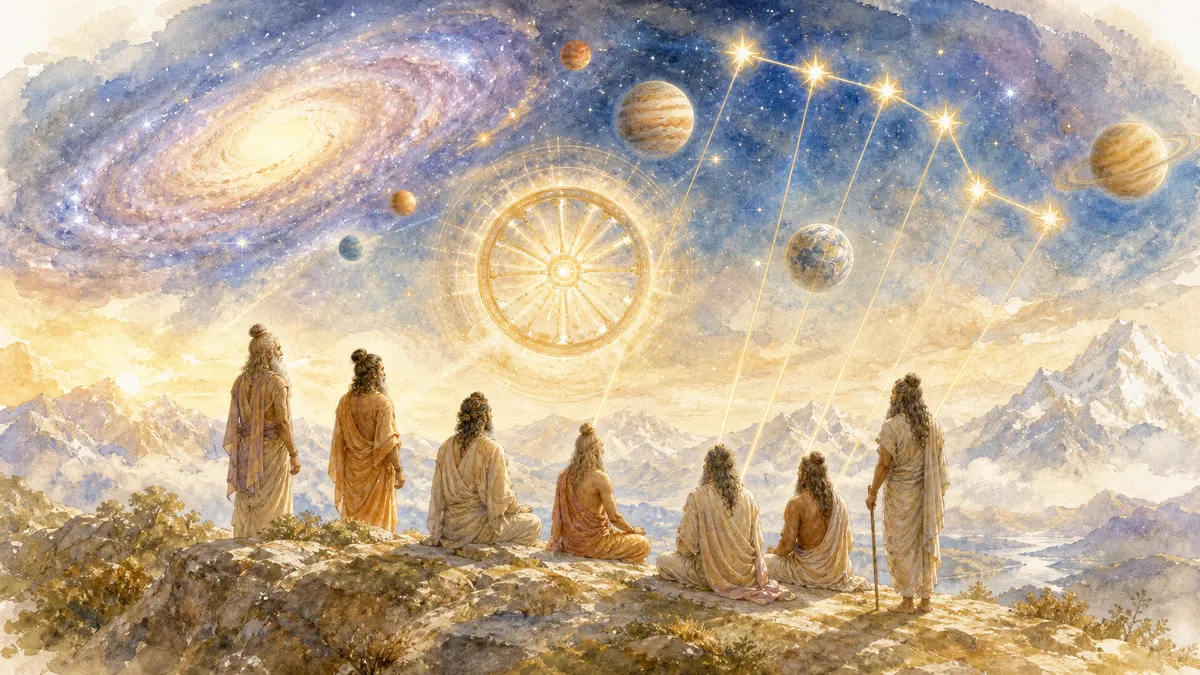
In general, it is believed that the rishis are connected with the constellation of the Pleiades. Someone might think that this is simply mythology, when certain persons are linked with the stars. But in reality, it is not so simple. In the universe there are many very subtle non-material connections, and beings, gods, saints, planets, and so on are inscribed into them. When it is said that they “personify” something, this is not a metaphor, but rather a specific informational connection. For example, a star may be one of the emanations of a rishi. That is, the deity of a star may be one of the illusory bodies of a rishi.
Deities exist everywhere. For example, there are deities of the second, the day, the month, the year, planets, star systems, and galaxies. One could say that these are super-intelligent, creative, spiritual structures that are still beyond our understanding. Some of them may once have been human beings. In the same way, various constellations and galactic systems have their own deities, and this is precisely why it is said that the rishis are connected with the seven stars of the Great Bear. It is believed that these saptarishis rule precisely in our epoch. In the previous epoch there were other rishis. And more ancient rishis, such as Narada, belong to another epoch. For example, when a guardian of the Dharma goes somewhere, he leaves someone in his place to perform his duties. In the same way, when conditions in the universe change, other beings assume certain powers of authority. This is precisely why it is said that in our epoch the seven rishis from the canon of the saptarishis rule.
One can speak a great deal about the lineage of transmission, and I hope that various treatises will be written on these topics, deeply revealing the essence of one siddha or saint or another.
The Practice of Guru Yoga
When we practice Guru Yoga, we include within the principle of Guru Yoga the connection with the spiritual teacher, with the Refuge Tree, and with the Absolute. Its meaning lies precisely in establishing such a connection. The same thing happens when we recite the Refuge mantra or perform the bhajan mandala, invoking the saints. If we perform this practice deeply enough, such a connection is established. In essence, to practice Guru Yoga means to remain constantly connected in this way. It is believed that all saints are connected by a single samaya; that is, through the practice of contemplation we connect with all the saints.
When we perform Guru Yoga with Om, at the first chanting of Om we visualize the Refuge Tree. At the second Om we visualize absorption, or receiving light; that is, we, as it were, receive the wisdom of the saints of the Refuge Tree, which was activated by the first Om. At the third Om we abide in unity, dissolving the Refuge Tree and our own body in light.
Guru Yoga is very important in terms of contemplation and connection to the Refuge Tree, so it can be performed not only before a lecture, during the bhajan mandala, but also in the morning when you wake up, as well as at any other time.
Question: It is said that in different cases before taking Refuge, while visualizing it, one can depict a particular saint on a larger scale, activating a certain aspect that is especially manifest in him. Could you tell us about the forces activated by one or another saint in our Refuge Tree if they are visualized larger?
A separate lecture will need to be devoted to this.
Briefly, it can be said as follows:
- the energy of Gorakshanath gives impeccability in yogic practice when performing techniques and kundalini yoga; that is, it is the shakti of the vira yogin;
- the energy of Matsyendranath gives understanding of the single “taste” and pure vision; that is, this is an aspect related more to tantric practice;
- the energy of Dattatreya gives understanding of a very deep single “taste” and self-liberation;
- the energy of the siddhas Boganathar and Tirumular gives understanding of the very subtle processes of alchemy in kundalini yoga;
- the energy of the deities located above gives understanding of the subtlest aspects of the clarity of the world of forms and spiritual purity;
- each rishi is connected with some shakti, but if we speak about the energy of the rishis in general, it gives understanding of the governing siddhis (prakamya-siddhi), divine pride, and the status of Brahma;
- the energy of Achintya Baba gives understanding of the single “taste” and self-liberation through the method of crazy wisdom (however, this method is not suitable for everyone, at least at present, because it requires a certain potential); Achintya Baba is considered a great master of situations and of the darshan of introducing disciples, through situations, directly into the state of the single “taste” (I have experienced this myself).
