

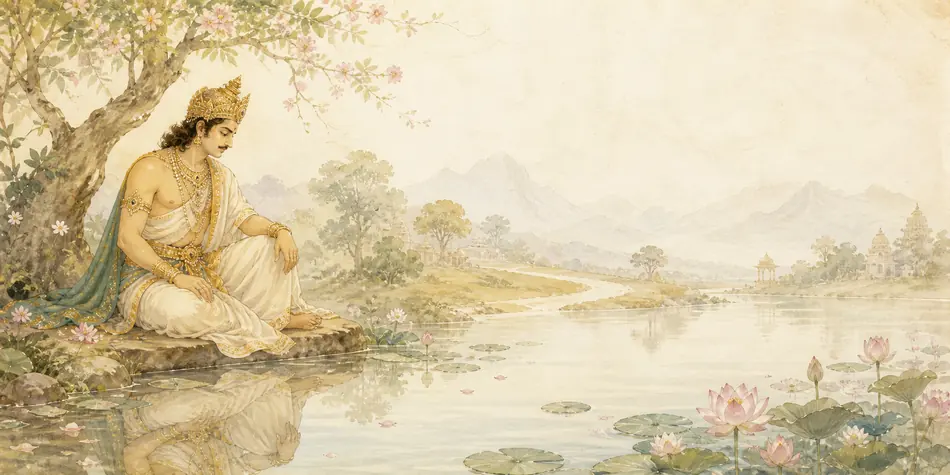
“Alas, like a tethered elephant, King Vipashchit had to endure countless sufferings. What terrible afflictions arise from an inaccurate perception of reality and a distorted understanding of truth. It is astonishing how powerful illusion is: although it is unreal and does not exist, it can create all manner of apparent worlds within infinite consciousness.”
Inaccurate perceptions of reality are the very essence of ignorance and the cause of suffering. This is known as the three impurities: maya-mala, anava-mala, and karma-mala.
One of them, maya-mala, is the impurity of individuality. It is the impurity caused by our sense of “I,” our sense of separateness, when a certain veil is cast and maya-shakti (divine will) acts as limitation and bondage. Such a veil is not cast without reason—it is Shiva who does this; it is not because we are somehow bad. There is a divine will to limit and bind. Shiva himself wishes to experience limitation—this gives rise to Purusha-ajnana. Purusha-ajnana is ignorance regarding the nature of one’s own self. For example, we remain ignorant of the nature of our “I.”

The veil of anava-mala conceals the true nature of the self—this is the fulfillment of Shiva’s will, the will of the Lord, pati, to become a limited, atomic being. Shiva commands: “Become a limited, atomic being.” But whom does he actually command? He commands himself. His command is: “May I become a limited, atomic being in the course of this lila. May I experience my limitation.” When he commands this, a part of his consciousness, having already become this limited being, loses the memory that it is Shiva and begins to imagine itself to be someone else. And this Shiva, having imagined himself to be someone else, no longer remembers himself as Shiva and no longer remembers his own command. Shiva seemingly forgets in the course of issuing this command—this is how maya-shakti operates.
Two Aspects of Anava-Mala and Two States of Shiva
Anava-mala has two aspects:
Bodhata is an enlightened state, but enlightened without shakti; that is, it is consciousness deprived of independence in terms of shakti. There is no kriya-shakti, no iccha-shakti, no energy of sovereignty, no ishana-shakti.
Abodhata is an unenlightened state. It is independence deprived of awareness; that is, I think: “I seem to be independent. Some kind of energy is operating within me, but I lack an understanding of who I am.”
Bodhata is consciousness deprived of independence; abodhata is independence deprived of consciousness. These are the two aspects of anava-mala.
The two states of Shiva and the two states of the divine will toward limitation have the following aspects—unmesha and nimesha:
Nimesha is the closing of the eyes. The closing of the eyes in a figurative sense; that is, the disappearance of the vision of samvit, pure nondual consciousness.
Unmesha is the opening of the eyes. It is false knowledge through which the self is mistaken for the non-self.
Nimesha—I see nothing at all; my eyes are closed, and I do not see nondual divine consciousness at all. Unmesha—I sense my divine nondual consciousness, but I mistake it for something else; I superimpose upon it that which I am not. Both of these states are conditioned states within anava-mala. This is precisely an inaccurate perception of reality.
The Importance of Mumukshutva—the Aspiration for Liberation
This is only one mala, while there are also karma-mala and maya-mala, as well as many other aspects. One can only be horrified and saddened for living beings by how inaccurately they perceive reality and by how important it is to follow the path of liberation. If this is explained to a person, one might say: “What, do you still not want to attain liberation? You do not perceive things accurately; you do not understand. You need to eliminate all these factors so that you can begin to perceive reality accurately, or at least give rise to such an intention.”
Mumukshutva is the desire to perceive reality accurately, the desire to understand reality clearly. Mumukshutva is the aspiration to reunite with God in order to eliminate ignorance and understand reality accurately and clearly. When we give rise to mumukshutva, this is the most important action for the soul. One must possess great determination for such mumukshutva to arise and never lose it.
As long as there is no accurate vision of reality, all actions and all hopes are temporary and of little significance; as the saying goes, “It is written on water with a pitchfork,” because it all dissipates. When our vision of reality is accurate and clear, everything changes. You understand the processes; every person would like to attain liberation and would abandon their false, conditioned views, but the will toward limitation is such that it is not so easy to overcome.
A person who can overcome it and give rise to the resolve for liberation in God is considered endowed with a precious human birth. It follows that for one who is not yet capable of overcoming the gravity of Shiva’s will, the preciousness of their human birth remains in question; whether or not it will become precious is a deeply mystical question.
The Play of Shiva
On the one hand, there is the will of the individual, and on the other, the will of Shiva. The individual’s will toward liberation is also Shiva’s will; another will of Shiva is Anugraha. And here there is a kind of play, a contest between two wills of Shiva, with himself. Shiva thinks: “Should I liberate myself, should my Anugraha prevail, or should my binding power of conditioning prevail?”—and only he knows what will occur to Shiva.
At a certain stage, we become more aware, and the buddhi within us, our consciousness, accepts the will of Anugraha, accepts the will to follow the path of liberation. This means that the liberating Shiva within us, Ishana Shiva, who bestows mercy and grace, has defeated within us the binding Shiva—such is this incomprehensible lila.
“Many people wander in samsara because they have not attained true knowledge or enlightenment. Here is a king who has wandered in samsara for the past one million seven hundred thousand years. Ignorant people take an interest in the nature of the objects of the world; samsara carries them along, and they cannot break free from it. This creation exists in infinite space as a mere concept in the mind of Brahma the Creator. Just as ants run to and fro across the surface of a sphere, so people move across the surface of this earth. In space there is no ‘down’ and no ‘up.’ The direction in which an object falls is called ‘down,’ and the direction in which birds take flight is called ‘up.’
In this world there is a place called Vatadhana. In that kingdom there were three princes. They decided to reach the boundaries of the world in order to see everything within it. For some time they explored the objects of the earth, and then the oceans. They were born again and again and continued pursuing their goal: to obtain complete knowledge of this earth. They could not reach the ‘end’ of the earth because, like ants on a ball, they merely moved from one place to another. Thus they continue wandering the earth even now.
Thus, there is no end to illusion in samsara. Since illusion arises as a concept in infinite consciousness, it likewise appears infinite. The essence of the concept is the Supreme Brahman, and the reverse is also true; both are pure consciousness, and there is no difference or division in consciousness, just as there is no boundary between space and emptiness. The currents and whirlpools appearing on the surface of water are nothing but water. Since nothing can exist apart from consciousness, how can anything be outside consciousness? Infinite consciousness alone shines by itself as this world, without even intending to do so. Wherever it wishes to manifest and in whatever form, it manifests there in precisely that way, experiencing its own essence in that form for as long as it wishes.”
The Power of Attention and Sankalpa
Wherever consciousness wishes to manifest, there it manifests. This applies not only to Shiva’s consciousness but also to our own consciousness. Our attention animates spanda (cosmic vibration). Cosmic vibration (spanda) materializes in the form that corresponds to our expressed desire.
When we express the desire for moksha, our attention activates the reality of moksha. When we express the reality of the holiness of the heavenly worlds, sooner or later—when our desires are completely purified and old tendencies are cleansed—holiness and the heavenly worlds manifest. When we express the desire to attain a divine body in the form of a deity, sooner or later it is attained; everything depends on our dharana, dhyana, and samyama.
When we express a desire for pure vision, purity in relationships, purity of thought, and purity of karma, if we persevere in this practice, sooner or later it manifests. Our attention is capable of creating any configuration.
When we express the intention to serve the divine will, to carry out the divine will, and to help all living beings on the path to liberation, if our intention is one-pointed, sustained, and strong, then not only our next life, but also our present life changes after some time, and we find ourselves completely absorbed in serving the divine will and all living beings.
If someone expresses a desire to abide in ananda (bliss), then, as time passes, their negative karmas are purified and their tendencies disappear, and they discover that they are constantly abiding in ananda and bliss. If someone desires clarity and discriminating wisdom (viveka), and perseveres in this, viveka arises within them.
Thus, whatever our consciousness desires will be fulfilled with some degree of delay:
If a person is in a sattvic state of consciousness, the delay will not be long
Rajasic consciousness postpones the realization of sankalpa, if it is a very pure sankalpa, for a certain period until the rajasic tendencies subside
Tamasic karmas delay the realization of this sankalpa even further
Nevertheless, sooner or later, once purified, even tamasic consciousness will change its nature; it is only a matter of time.
Bhasa's Account of His Travels
“Within the atom of infinite consciousness lie the possibilities of all experiences, just as there are stones in this mountain. Experiences exist constantly and everywhere, undergoing their own particular kinds of experience. In reality, of course, they do not exist as they are experienced, but only as infinite consciousness. All these diverse experiences taken together are called the world, which is the radiant appearance of Brahman. It is truly astonishing that infinite consciousness, never departing from its own reality, thinks of itself: ‘I am an individual consciousness.’ Now, O Bhasa, tell us of your adventures.”
Bhasa said: “I have seen many things and traveled extensively without rest. I remember all of it perfectly. I have experienced many joys and sorrows in many different bodies and places throughout this infinite space. Because of blessings and curses, I had various bodies, and in them I saw many things. I wanted to experience and see everything. This was my desire, which the god of fire promised to fulfill; therefore, although I inhabited different bodies and spaces, I continued to follow my desire to learn as much as possible about this world.”
As you may recall, Vipashchit first performed a ritual and sacrificed his body to the fire in order to defeat his enemies. In place of himself, he created four illusory bodies endowed with immense power. When the war was won, he appealed to the god of fire a second time, appearing before him in his four radiant bodies, and asked for a blessing that would allow him to know this universe, explore its farthest reaches, and undergo a variety of experiences.
Vipashchit was not awakened; he was a siddha, a tantric magician, a thaumaturge, and a master of gupta vidya (the secret knowledge of mantras and rituals), but he did not know the nature of Mind, because if he had known the nature of Mind, he would not have asked for such a blessing, nor would he have had such a desire.
In the tantric teachings, there is an expression: “What is here is everywhere. What is not here is nowhere.” This is echoed by the Tao Te Ching (the Taoist philosopher), which says: “Without looking out the window, one can know the Tao. Without leaving one's room, one can see the whole world.” Without leaving the Trimurti Ashram or any other ashram, you can know the entire universe as if you had traversed it on foot, because if you know the Atman, the nature of the consciousness of the entire cosmos, you know everything. Even after traversing the entire universe and other planets on foot, one may still fail to know one's Atman and fail to grasp the essence. And Vipashchit wandered in this manner for many thousands of years, but the time for his awakening came.
Numerous Incarnations
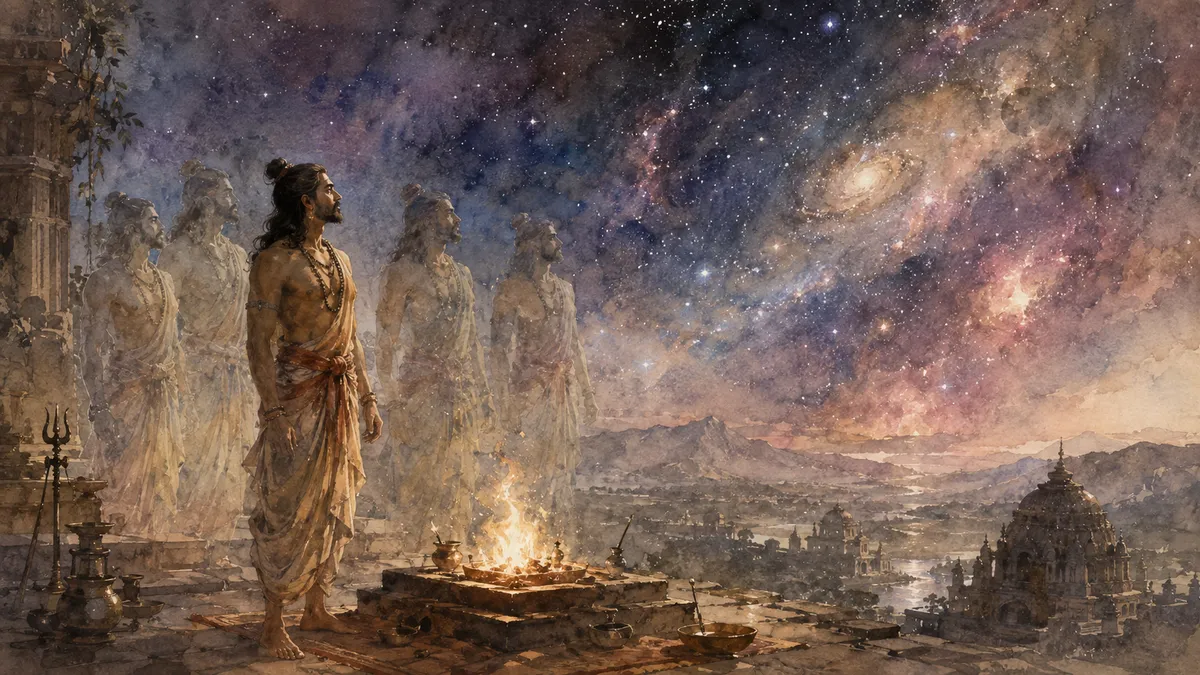
“For a thousand years, I lived as a tree. I went through many things. My mind was completely focused on itself; abiding in an unmoving state of mind, I produced flowers and fruit. For a hundred years, I was a deer on Mount Meru. I had a golden hide, ate grass, and loved music. I was a very small and gentle deer; later, I became an eight-legged creature stronger than a lion (a sharabha). After that, I was a celestial being, then the son of the swan upon which the Creator Brahma flies. I was a swan for fifteen hundred years. Then, for a hundred years, I listened to the divine music of the celestial attendants of the god Narayana, and afterward I became a jackal and lived in the forest. A huge elephant trampled the bush where I lived, and as I was dying, I saw that elephant being killed by a tiger. Then I became an apsara in another world and lived there alone for half an epoch. After that, I became a bird for a hundred years. When our nest was destroyed, I lost my mate and lived out the rest of my life alone somewhere far away. Then I became an ascetic because I had developed some indifference to pleasures. I saw many fascinating things; I saw a world made entirely of water. Elsewhere, I saw a woman in whose body all three worlds were reflected as in a mirror. When I asked who she was, she replied that she was pure consciousness and that all worlds were her limbs.”
Vipashchit traveled throughout the entire universe, but we are not very different from Vipashchit. We, too, are on a journey and in a state of constant transformation, and if we fully remembered our past lives, we could tell of the many beings we had been. I have told the monks a little about my past lives; likewise, as you practice, you gradually begin to recall what happened to you before. Like Vipashchit, you can say: “We are on a pilgrimage, on a journey toward God. It is simply an unconscious journey.”
The soul is constantly undergoing reincarnations, transmigrations, and changes, being born first in one womb and then in another, remaining there for a time, then dying, and then being born again. It experiences different connections, relationships, and upbringings; it has its own culture and way of thinking, conditioned by the pranas and the body.
This present life is also part of that vast, vast journey, but because we do not remember what happened before birth, there is a kind of gap in our memory. We know only the span from the moment of our birth—and even then, only from the age of two up to the present. We have regained a little awareness, we have come to our senses a little, but we do not remember this entire vast process. Yet when we reveal and purify the nature of Mind, we begin to remember and restore our state.
We begin to understand how immense our journey as a soul is and how separate our consciousness is from all of this. This means that viveka (discernment) arises in us. Gradually, vairagya is born within us—a reluctance to undergo transformations and a desire to free ourselves from all of this. Gradually, we begin to separate the pure nature of Mind from all the transformations that happen to us—the body, connections, and karma. This means that we are following the path of liberation. This is the state we are in now.
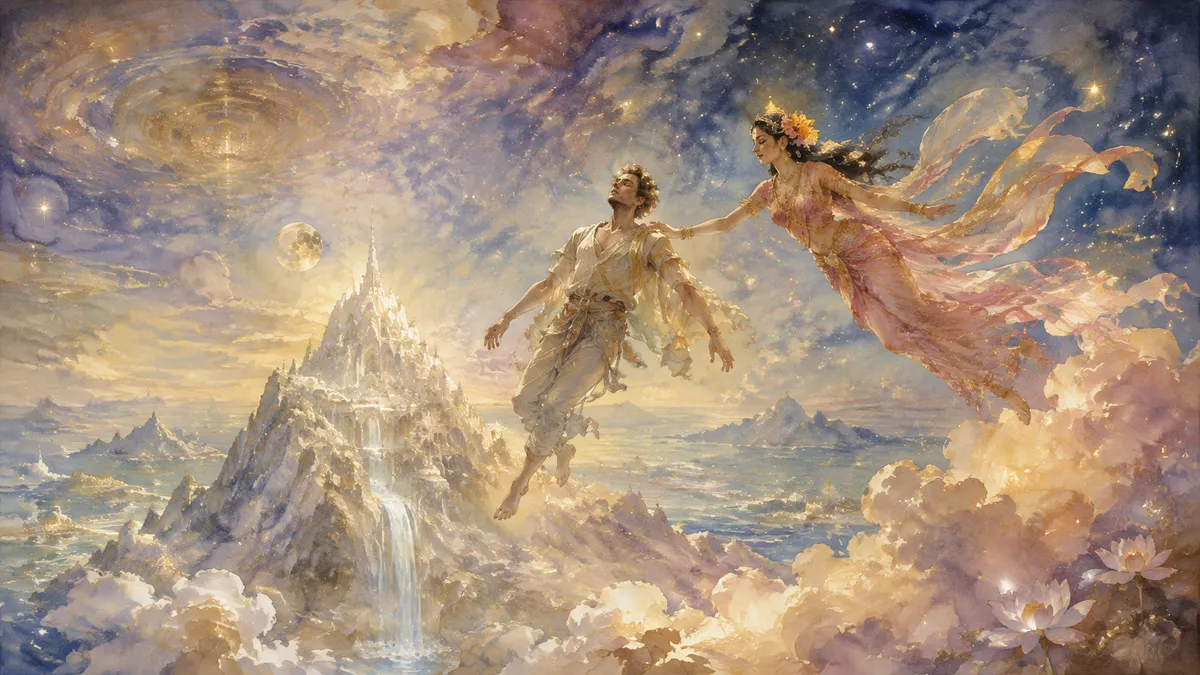
“I saw countless beings emerging from her and disappearing back into her. Elsewhere, I saw an unusual cloud formation from which bolts of lightning showered down upon the earth. Another strange sight was that the whole earth was shrouded in darkness, and entire villages flew away toward distant worlds. I saw worlds without a sun, moon, or stars, where there was nevertheless no darkness—all the inhabitants shone by themselves. There is no world I have not seen. Once, I was sleeping with an apsara in a garden. Suddenly awakening, I found myself floating with the current like a blade of grass. I asked the apsara what was happening, and she explained: ‘Nearby, there is a mountain made of moonstone. When the moon rises, the streams flowing from this mountain fill with water and flood everything around them. Sorry, I forgot to warn you.’”
“Having said this, she took me and flew up into the air, and then I lived with her on the summit of Mount Mandara for seven years. Then I saw a world where there were no directions such as west and east, no days and nights, no scriptures and debates, and no distinction between gods and demons. Then I became the celestial being Amarasoma and lived as an ascetic for fourteen years. After the god of fire promised to fulfill my wish, I was able to fly through space at tremendous speed. At times I fell into a vast ocean; at other times, it only seemed to me that I was falling. Flying through space became my sole occupation, but after a while I grew tired of it and fell asleep for a long time.”
“In my sleep, I entered the realm of dreams. Here I once again saw a multitude of worlds and various objects. I wanted to see everything. Whatever my eyes beheld instantly drew me toward it. From there I would see something else and immediately find myself in another place, regardless of the distance. Thus, passing from one world to another at tremendous speed, I spent many years, but I never saw an end to the manifestation of the misunderstanding called the ‘objective universe.’
