


Thoughts as the Radiance of the Mind
Thoughts, which are the radiance of the mind, should not be avoided.
In Mahashanti, of course, it is desirable to attain thoughtlessness. However, it should be understood that in Mahashanti we must cut off thoughts and penetrate into thoughtlessness only in order to discover the subtlest luminous layer of the mind. Blocking thoughts is not an end in itself. Later, when we discover the luminous, subtlest layer of the mind, we can stop worrying about thoughts, allowing them to arise as they please, and simply not pay attention to them. Then, having arisen, they lose their power and disappear on their own.
It is good to attain deep thoughtlessness and samadhi in meditation. However, when you come out of meditation, it is still impossible to maintain complete thoughtlessness, because you at least need to think about how to prepare prasada and so on. If you want to be completely in thoughtlessness, you will not succeed in this in the relative dimension. Therefore, we say that thoughts should not be avoided; rather, involvement in them should be avoided.
If we take the mind of a worldly person, his thoughts are like sticky threads of a spider’s web or very long chains that emerge from his nature of Mind. They intertwine, change, and new links are created in them, which, joining into complex configurations, strands, and ropes, in the end entangle him himself. And when he is entangled in them, he feels that he cannot even move. All thoughts seem to twist together into a kind of tight cocoon. And for an ordinary person who is in this cocoon, it is generally difficult to understand what non-conceptual thinking is, how one can be independent of thoughts.
In the case of a practitioner who has attained liberation, something different happens. His thoughts are very subtle, they are immaterial and arise as a light stream. They flow playfully, arise for a moment and then enter back again; they do not even have time to weave themselves together seriously or form some long chain. They instantly flash like a light haze and disappear again. It can be said that the thoughts of a practitioner who has attained liberation are like lightning: it flashed, illuminated something, and then disappeared again, withdrawing into the sky. Therefore, the practitioner is never bound by thoughts; he does not avoid them. Sometimes he allows them to flash, and then they disappear again into the sky. And then, whatever teachings he absorbs, whatever he thinks about, thoughts do not become ropes that bind him; that is, his sky does not close.
It can often be seen that those who perform complex services, who need to invent a lot, calculate, communicate, and build multi-step combinations, entangle themselves with such ropes. They concentrate so diligently, their head becomes so entangled in these thoughts, that they feel their sky grow dim. And then their soul becomes sorrowful, because they lose connection with the fundamental Source of themselves and begin to resemble ordinary people. Because of this, their mood changes.
But for a yogin who has realized the secret of liberation, this is altogether impossible; that is, he knows that the sky above his head cannot be lost, and he always remembers this. And thoughts cannot bind a yogin. Since they are not substantial, he does not attach any importance to them; that is, they do not change his consciousness.

The Yogin’s Play Space
Suppose that if someone were to scold any one of you, at first you would not attach importance to it, but then it would penetrate the one being scolded deeper and deeper, and after some time his consciousness might change. But in the case of a practitioner who has opened this great space, insults will be a motivating factor for strengthening presence, since he will instantly transform them into ambrosia; that is, he will transform poison into nectar. He will see that all of this is like a harsh psychological game that spurs awareness.
When you are in this state of heavenly presence, everything appears unreal, everything is perceived as a game; sometimes as a divine game, sometimes as a harsher one. And when you are in this game, you never forget yourself. Therefore, a true practitioner does not live in the ordinary sense, that is, like all people; he lives in the dimension of play. Sometimes he is penalized, but he still understands that this is a penalty for breaking the rules of the game, that it is still part of the game, an important element of it, but he does not identify with it. Sometimes medals are hung around his neck, but he still knows that this is simply an important element of the game, like a cup for winning a hundred-meter race. This is already another dimension, not worldly, not substantial.
When a yogi is in the space of play, spiritual life also reveals its playful nature. Samsara ceases to reveal its rigid karmic laws and instead manifests its state of playfulness. When you are in such a dimension, everything for you is the play of the Absolute, and however this play may unfold you, by and large everything in it is favorable; there are no losers in it, because play in itself is a creative, pleasant, joyful process. Even those who lose still receive a great deal of pleasure from the game itself, from the process itself. Therefore it is said that when a yogi has entered true contemplation, he cannot, in principle, lose.
Thoughts and Forms as a Revelation of Reality
Thoughts and forms that are a revelation of reality should not be avoided.
What is meant here are subtle thoughts that in some way clarify the essence of the natural state. Thanks to such subtle thoughts, one can clarify various nuances of spiritual practice. Although they themselves do not express the natural state, nevertheless they should not be avoided, because by relying on them one can comprehend something. That is why we read sutras and the instructions of saints.

Two Extremes: Eternalism and Nihilism
There are always two extremes. The first is eternalism, when a judgment, thought, or object is taken at face value, that is, when their illusory nature is not understood. The second extreme is nihilism, when we have heard many times that everything is emptiness, that everything has no independent existence, and we think: “Then everything must be rejected. I do not even want to hear all these teachings, since they are all an illusion. After all, the teaching is beyond concepts, everything is emptiness. Nothing exists, and I want to be only there.” Nihilism is a peculiar variety of youthful maximalism, an infantile disorder of leftism in consciousness. The saints knew this very well and left many instructions on this subject for future disciples, in order to protect them from these two extremes.
Why are these two extremes? Because in the first case we fall into the extreme of acceptance, and in the second case, rejection. And in the case of nihilism, we cling no longer to thoughts and objects, but to our nihilistic vision. That is, sometimes we are afraid of thoughts, so we immediately reject them. This happens because our contemplation is still very unstable, and we feel that as soon as we begin to think, our emptiness comes to an end, and therefore we reject thoughts. But this is still the state of an unstable practitioner.
When we have become firmly established in contemplation, it does not matter to us whether thoughts arise or not, and therefore we neither accept nor reject them, but only derive benefit from them. They are obedient and subordinate to us as an instrument. Suppose a person holding an instrument was told: “You are not this instrument. You are this body.” He thought: “Ah, so that’s what it is! I thought I was both this instrument and the body. Since I am not this instrument, I must destroy it, throw it away.” But one who is more experienced knows that the instrument does not need to be thrown away; it can be used.
The Right Attitude Toward Passions
The obscuration of passions that remind a person of the divine wisdom which grants liberation from them should not be avoided. If used correctly, this gives a person the opportunity to experience life in its fullness and thereby attain the destruction of illusions.
This is a difficult description of practice to comment on. Who can comment? Who is a great specialist in passions? Who is so troubled by them that he constantly thinks about how to use them?
Question: It is not exactly about using them, but about struggling with them, feeling that this is a cessation in a good form. You cannot yet use them, and at the same time you do not follow their lead.
These lines are always difficult to understand, even for experienced practitioners. Of course, the obscurations of passions should be avoided and purified, especially if you are entangled in them. For example, if a person constantly overeats and tends to be overweight, one could say to him: “It’s all right, you don’t have to change yourself; just be attentive. That is the main thing.” You would be giving him the right advice, but it would not be effective. That is, in behavior a yogin should by all means avoid the obscurations of passions. Nevertheless, when we contemplate, the practice of contemplation is connected neither with acceptance nor with rejection; therefore, at the level of view, we do not regard passions as something sinful or low. That is, we do not allow the thought at all that there can be anything sinful, low, or impure in the Universe that we must reject at the level of the mind or somehow evoke a certain panicked attitude toward. This is a very important point. Until a yogin understands this, he will always encounter experiences with which he will not know what to do. Therefore, it is said here that the obscurations of passions should not be avoided.
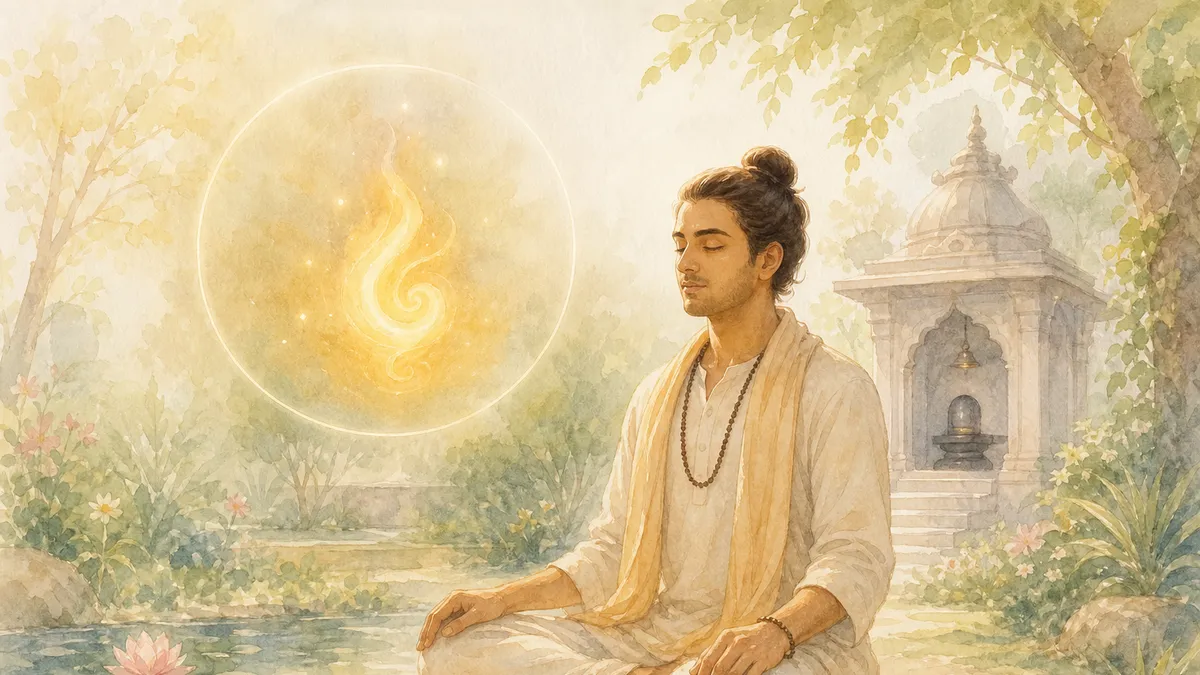
This means that, instead of somehow judging the passions and the feeling of guilt that arises along with them, or entering into an irreconcilable struggle with them and losing because of an incorrect approach, the yogin applies a wiser approach—the approach of the natural state. When passion arises, he perceives it as part of the natural state and, instead of allowing his consciousness to contract from the perception of passion, he allows consciousness, on the contrary, to expand. When we reject something or become attached to something, the mind definitely contracts. However, when we abide in a choiceless state, neither accepting nor rejecting, the mind expands, and suddenly we feel that we can cope with passion without contracting the mind. People, not understanding this, see the meaning of self-control as simply strongly contracting the mind in some area. But the principle of the natural state lies not in contracting the mind, but in expanding the mind even more. When, having expanded the mind, we observe some klesha, passion, or desire, we as if devalue it, and it loses energy, because our mind is greatly expanded and possesses great power.
Tantra describes methods in which the obscuration of passions is used as the path. However, tantra also gives many warnings so that beginners or inexperienced people do not use this approach, because the difference between a Master and an ordinary person is like the difference between heaven and earth, and what one can digest may be poison for another if he uses it without being prepared. Nevertheless, when we apply such a view at the level of behavior, it is recommended, as far as possible, to purify the kleshas and restrain the passions, since there is a difference between behavior and view.
Practical Examples of Working with Passions
For example, if some passion or emotion arises, you do not think that it is bad; you know that it is part of the natural state, and therefore there is no need to panic about it or consider it dirty, sinful, or impure. You try to view it in pure vision. You unite it with your contemplation and, at the moment of contact with the passion, abide in presence. But at the same time, at the level of behavior, you know that it is better for you not to touch it, that it is better for you to adhere to your line of behavior and practice, to preserve your energy. That is, you act as a true practitioner.
For example, at a railway station you meet a person of repulsive appearance from a lower caste who tries to speak with you or touch you. If you think that this is a terrible, degraded being of hell and become angry with him, that is not entirely right. From the point of view of pure vision, you should think that this is some wrathful deity or avadhuta and look at him with the eyes of pure vision, so that there is no aversion in the mind. Then you should think that Brahman plays and spreads through all forms, and therefore consciousness should not contract. Nevertheless, you feel that it is better for you not to remain near him for long, because after talking for ten minutes you will feel a lump in the vishuddha chakra, in the anahata chakra, and in the manipura chakra. You will think that, of course, this is a wrathful deity at play, but it is far too wrathful; that this is an avadhuta, but his energies differ far too much from mine; that if you stay here for a long time, your pranas will not withstand it. This means that at the level of the mind you see purely, but at the level of behavior you know your measure. This is the basic principle of how to relate to any obscuring passions.

For example, if sexual desire arises, then lust, from the point of view of Christianity, is a sin that plunges one into a feeling of guilt. But if you simply observe it while remaining in presence, without trying to evaluate it in any way, then you understand that it is simply energy, and it cannot be bad or good. It is like your right leg: it cannot be either bad or good; it is simply a part of the body. Likewise, sexual energy is simply a part of your life energy, which manifests itself in a particular way in the svadhisthana chakra. You have no judgments about this, but you know that to give in to it and follow it, to allow yourself to lose energy, is a path that does not suit you, since you must preserve energy. That is, you should not give in and indulge your consciousness, yielding while recognizing that this energy comes from the nature of the Mind. By and large, it is simply energy; nevertheless, you control sexual desire, you control the mind so as not to fall under the influence of this desire.
This is an example of how to deal with passions from the absolute point of view and how to act from the relative point of view in order not to lose your way.
The Right Attitude Toward Prosperity
Prosperity, which is fertilizer and water for spiritual growth, should not be avoided.
Attachment to material goods should be avoided, but material goods themselves should be turned to the benefit of the dharma.
There was one saint who simply threw all the offerings made to him behind his back into a cave. Money, gold, fabrics, which were even rotting, accumulated there in this way for years. Another Guru learned that this saint was using the offerings in this way and said, “This brainless hermit does not know how to use offerings properly.” The saint heard this and began to give away the offerings so that they could be used for making statues, building temples, sewing clothes for monks, printing sutras, and other dharmic deeds. In the same way, we also relate to material resources.
If you become attached to anything material, then you have forgotten who you are and what path you have entered. If you have the opportunity but do not use it to advance the dharma, then this means that you are not fully manifesting in material energy.
The ideal is a monastic community, when all material resources can be directed toward helping the practice of dharma, but personal attachments cannot arise, because monks use a very limited number of things, and everything else, as it were, does not belong to them.
Illnesses and Grief as Teachers
Illnesses and grief, which are teachers of piety, should not be avoided.
When illnesses or suffering arise, one should think as follows: “Oh, this is the strongest instruction I have ever received. This is the most uncompromising Guru, who in this way gives me darshans.” Impermanence, impeccability in contemplation, cutting off hope and fear—this is precisely how they should be perceived. One should think: “This is the harshest training that advances me.”
Of course, one should not think: “If only I were to fall ill, then I would test my contemplation and cut off hopes and fears.” Since you serve the sangha, you should not think about how to damage the property of the sangha—your body. And since achievements in tantra require a strong physical body that does not suffer from illnesses and has no obstacles, it is better to have the siddhis of health and longevity, to live more than a hundred years. And in general, it is better to think about how to become immortal in order to realize the most significant attainments, since a yogin must go through a great deal in his spiritual life. But it happens that this cannot be avoided, so one should not fall into panic when it manifests, but think that these are valuable instructions and an excellent way to cut off hope, fear, and clinging to the “I,” to lay bare one’s contemplation and non-attachment.

Enemies and misfortunes, which are a means of inclining a person toward spiritual advancement, should not be avoided.
Accepting Challenges as Spiritual Practice
If you lose awareness when unpleasant things happen, when you encounter so-called enemies, strong opposition, insults, or threats, then you fall into ordinary samsaric vision. If you think: “How vile this is, what scoundrels they are! How could they possibly have acted like that?!”, then you simply have the samsaric thinking of an ordinary person. But when you are in deep awareness, you see that this is the same game, only with harsher energies, and that you must accept this game with dignity without losing awareness.
Such a game is the very best way to train your awareness, so at the moment when these things happen, you should think: “This is great! I have been given an excellent opportunity to observe my reactions with regard to anger, attachment to myself, self-importance, pride, the sense of my own importance, the poor little me complex, and wounded vanity.” All these complexes immediately pop up one after another. Therefore, a true practitioner is like a walrus diving into an ice hole. The colder the water, the better it is for the walrus; it only invigorates him, and if the water is not very cold, he even gets upset and thinks: “Well, this is not serious.” Likewise, a true practitioner, when faced with coarse manifestations, thinks: “This is great! This is a test of my tendency toward identification.” Therefore he never falls into resentment, pride, or emotional judgments of situations. He no longer plays these games, because he has gone beyond these dimensions.
Prudence as a Manifestation of the Natural State
That which arises by itself, being a divine gift, should not be avoided. Prudence, which in any action is the best friend, should not be avoided.
Prudence is your adequate response to a situation, when the depth of your presence manifests as wisdom in relative life. It is relative clarity in the relative dimension. For example, there is a saw, but twenty people cannot cut up a house with this saw, so firewood has to be ordered. I see that there is a lack of ordinary clarity that needs to be applied to this service. Conversely, when a yogin in contemplative presence creates masterpieces in music, painting, literature, or in the publishing group at the computer, when he impeccably manages a monastery, this can be called a consequence of clarity manifesting as the natural state. All of this is a reflection of his natural state.
As your natural state increases, there are more and more such reflections, and you can manifest yourself impeccably in many areas. You become like a many-armed deity, in each of whose hands there is a sign leading into some world: here—music, here—literature, here—painting, here—management, here—clarity with regard to worldly sciences, here—clarity in relative service, here—plasticity, here—gestures, here—artistry. And all of this blossoms spontaneously by itself. That is, you simply become a fountain of auspicious qualities that blossom in you from the channels and chakras. Conversely, if you are given the service of slicing a banana and laying it out, and you do not know how to approach it, it is evident that in the relative dimension you have some kind of gap between presence and everyday life.
True Help for Others
Such virtuous exercises of body and mind that make a person capable of helping others should not be avoided.
Here the relative dimension is being discussed. Accumulations of merit, purification practices, and that which develops clarity should not be avoided. Thoughts of helping others, whatever the limitations may be, and the opportunity to help others should not be avoided. At the same time, in the absolute sense one should always adhere to the view, that is, abide in nonduality, where there is neither an “I” who helps nor others who need to be helped.
If you help while in a dualistic state, then this is simply another part of samsara. But when you have thoughts of helping others and at the same time not a single thought of helping others, only then will your help be something real. This means that you have compassion not conditioned by dualistic vision, and you help others not in the sense of worldly fixed ideas, but manifest the true natural state in the relative dimension.
In fact, helping others is a certain conceptual label for expressing the descent of light. What are compassion, helping others, and so on? It is the descent of light from the causal world into the astral bodies of people; the light touches the surface mind of the one who helps, and then manifests in the actions of his body and is already seen as help. But originally, behind this help stands the energy of the Clear Light. Therefore, when speaking of helping others, we should understand this as the descent of presence into the dense layers of matter and its extension to others.
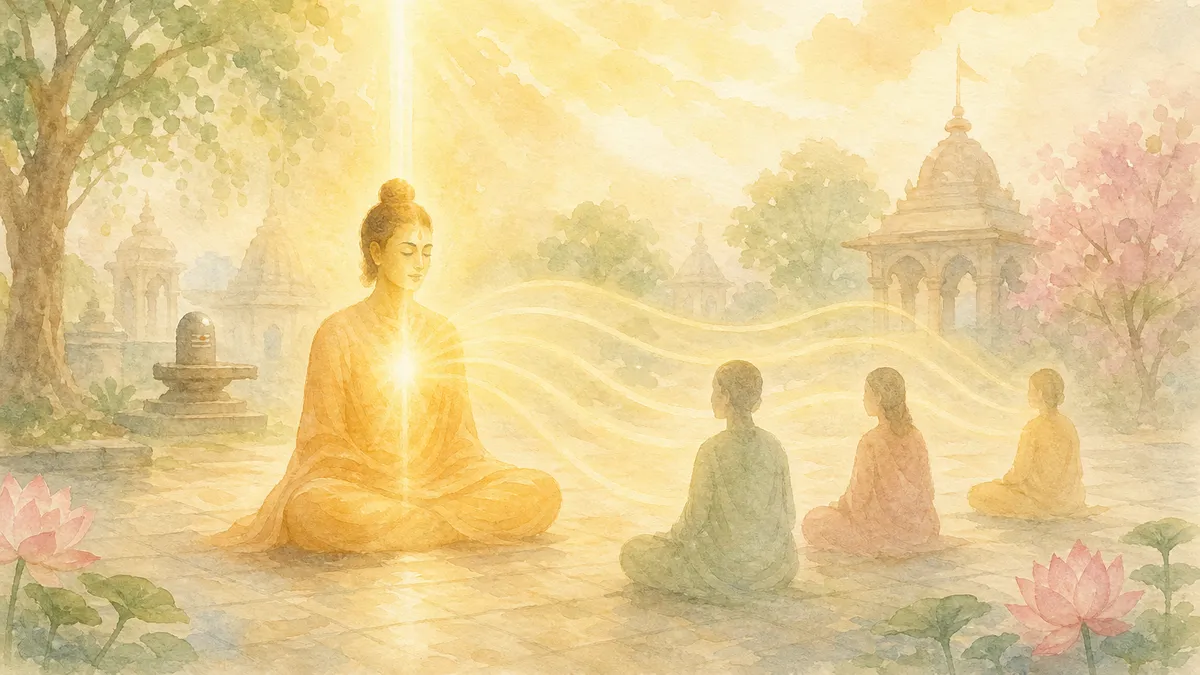
For example, I do not have the feeling that I am helping anyone. I know that to have any stable thoughts at all and to take them seriously means to become lost in the natural state, to see others and oneself as doers. Nevertheless, I know that the process of the descent of the Clear Light in the relative dimension continues, and that in the relative sense this is the very best help I can offer to others.
In the same way, we should always think about how to help others while having no thoughts of helping ourselves or others. It is like the way the sun shines. When the sun shines, some people pray: “O Lord! Thank you for sending us the sun.” However, the sun itself, when it shines, does not think: “I am sending light to living beings so that they may warm themselves, so that they may be warm.” The sun itself abides beyond such limiting thoughts. In principle, it has no such thoughts. The essence of the sun is light, and its task is to shine; therefore absolutely everyone can bathe in its rays.
Non-dual perception of good and evil
The same is true of help and compassion. When you attain the natural state, its light descends by itself, because luminosity is inherent in it from the very beginning. People who thank God for sending them the warmth of the sun and, when needed, rain, do not think to thank God for suffering, illness, old age, impermanence, wars, and catastrophes. They say that all this is sent by the devil. That is, in their view, the Lord sends only everything good, while the devil sends everything bad. Then the question arises: “Why does the Lord allow this? Is the devil really as powerful as the Lord?” Then it turns out that one could also worship the devil so that he would protect one from various misfortunes. It turns out that God cannot protect us from the devil. These people say: “No, that is not so. This permission is given by the Lord for a special purpose. The devil is allowed to act in this way because people have free will, and people must constantly feel the fear of God.” However, the next question arises: “Is the Lord really such a sadist that He allows this?” Even in the human world, a normal loving parent will not allow their child to be beaten and hurt. So there must be some other issue here.
It turns out that the Lord does not divide things into pure and impure, bad and good. It turns out that for Him both are positive and wondrous, and there is no other devil who sends all this. It turns out that the Lord sends both the good and the bad. Then one may ask the next question: “Why does the Lord send the bad, if the Lord is only good, perfection, purity, beauty, and kindness? How can He do such nasty things?” And then we come to the conclusion that what is bad for people is not bad at all for God, that He has a completely different scale of values. We consider certain things to be bad, while He does not consider them so at all; on the contrary, from His point of view and according to His design, all of this is normal. He has an entirely different scale of thinking, and therefore the Earth for Him is no more than a speck of dust, and cleaning the Earth of scum by removing a billion people is, for Him, an ordinary working process. For people, however, it is not so; for people all of this is very important. And we come to the conclusion that we simply need to change our scale of values and our system of thinking in order to understand this. We need to have the same global thinking in order to learn not to divide the world into good and evil, pure and impure, bad and good, but to try to enter into contemplation.

When we contemplate, we look at the world with the same eyes as the Lord. At least, we come closer to this. And when we look with such eyes, we will see that everything has a single “taste,” everything is equal. First, everything is illusory, and therefore there is no suffering, since suffering is an illusion. Second, everything that manifests has a single “taste.” The good manifests — it is the Lord; the bad manifests — it is also the Lord, it is also good, only in a more fierce form; it is simply harsher energies. And then suddenly this division into happiness and unhappiness, God and the devil, falls away. We stop asking ourselves such questions, because we know that they are absurd and are the result of our mind simply being captured by logic. But beyond concepts, all of this is clearly seen as part of the natural state. The natural state inherently includes both pure divine energies and fierce, impure, destructive ones, and so on.
Knowing this, we simply perceive everything as energy. Nevertheless, we do not try to come into contact unnecessarily with any strong or destabilizing energies and pranas, knowing that we are still inexperienced practitioners and therefore need to protect ourselves.
