

Commentary on the text “Tripura Rahasya,” Chapter 16, “On Consciousness, the Restraint of the Mind, and Sleep.”
Initial Perception and the Obscuration of the Mind
“But this basic state is obscured (the experience of it is removed) by the stream of thoughts that fill the mind immediately after the moment of apprehending the object, when the phase of reflecting on the object and evaluating it begins.”
At the very first moment of perceiving an object, when conceptual thinking has not yet been activated and no evaluations are being made, there is a fresh perception, not clouded by conceptualization — it is precisely at this moment that we can know genuine presence. But in the next instant, this presence begins to be obscured by superimposed interpretations, which usually immediately follow perception. Interpretations arise naturally, as a consequence of the movement of prana during the perception of the sense organs and contact with objects. As it moves, prana gives rise to thoughts. It can be said that thoughts are the result of the movement of pranas in the nadis. If the pranas in the nadis do not move, then there are no thoughts either.
Your state of thinking in meditation depends very strongly on what posture you assume and how you maintain it. If you manage to assume the correct posture, the winds stop in the channels, and thoughts, accordingly, cease to trouble you. However, contemplation in movement, of course, does not imply maintaining a stable posture; it is precisely contemplation with energy, with movement. And instead of stopping thoughts completely, we learn to work with them through the method of self-liberation.
Contemplation in Movement and the Effectiveness of Actions
To master self-liberation and presence in movement is the true practice of presence. Other types of contemplation have a drawback in the sense that when we begin to move, they can easily be lost. If you are contemplative in movement, you bring your awareness into every action. And then your actions are precise, rational, harmonious, and correct. Moreover, you have no sense of doership, no goal-setting, no attachment to results, no apprehension, yet the activity itself is supremely effective.
If a person is in presence, then he alone can do in a day what would be difficult for five or eight people to do, because his very clarity simply responds to diverse situations. Let us imagine a person who is going to do something, but he has no awareness, or his awareness is frozen, unintegrated, inflexible, unable to respond. And then he is afraid to connect with the situation, he does not know how to approach it, and no thoughts or plans arise in him regarding it. Even if he tries to do something, he succeeds only with great difficulty. This is the result of the absence of contemplation in the process of activity.

For example, when I simply walk without any plans, it is enough for me to glance at something, and a couple dozen ideas immediately arise in me as to how it can be done. At the same time, I do not plan this deliberately: for example, even if there were three or five hundred monks here, in a short time I would find what tasks to give them. At the same time, I communicate with many laypeople who are engaged in different kinds of activity; I have plans for the development of “Divya Loka” and many other projects, yet I do not feel somehow puzzled or tired. This is the result of my contemplation, which simply responds to how the Dharma can be advanced in different directions. I do not even make an effort, because it happens naturally.
Creating the Mandala and Divine Clarity
This is exactly how, in the future, you will create the mandala. A mandala is a bioresonant environment that responds to your consciousness when you, applying clarity, create a world that consists of your own consciousness. This is precisely how gods are liberated from the cycle of birth and death: abiding in deep contemplation, they apply clarity to all limitations, lower energies, elements, and obstacles, and thanks to the deepest clarity they arrange everything in such a way that suffering cannot touch them even in the slightest form. The gods are immortal because they know thousands of ways to avoid death by manifesting clarity with regard to the tattvas, time, prana, the management of samskaras, the postponement of the manifestations of fate, and so on.
Transition into the mandala means the continuous manifestation of clarity with regard to everything. Such clarity is generated through continuous remembrance; it should not be generated artificially. The guru’s task is to lead the disciple into this state of clarity, the state of the mandala, and to help him reveal his inner deity. Those of you who practice successfully and approach the twelve-year milestone will certainly transition to this state; you will feel it. As a teacher, I vouch for this.

The Disappearance of the Mind and the Freshness of Perception
“The wise say that the mind is immersed in deep sleep when it illuminates the unmanifest state. The disappearance of the mind (or its dissolution, pushing it into the background), however, is not limited to deep sleep alone, for this also happens in the initial moment of apprehending things.”
Here it is said that the pushing of the mind into the background occurs not only in deep sleep. It happens at special moments that are important for us. And one such moment, as we have already said, is the first instant in the perception of some phenomenon or thing.
It happens that we enter a monastery for the first time, and it simply shakes us to the core. Or we see a spiritual teacher, and experiences arise in us, energy rises, we enter into presence. But then we do this ten times, a hundred times, a thousand times, and the freshness of perception disappears, because hundreds of our assessments and interpretations have already been imposed upon the perception, closing off the original perception, which was the strongest.
A true yogin does not act in this way. He always abides in the freshness of consciousness and sees the world as if for the first time, self-liberating all accumulated interpretations. Even after decades in a monastery, you must live as though you had just come as a novice and are living your first day here. And one should communicate with the spiritual teacher in the same way, perceiving the most elevated states.
Maintaining Samaya and Faith
In the same way, you should observe samaya. Sometimes it seems that we possess tremendous faith; sometimes our spirit is very elevated, but at times our own karmas, obstacles, and conditioned thinking can obscure samaya and faith; it recedes somewhere, becomes unserious, blurred, unholy. At best, on the level of the intellect, we remember that samaya must be observed. But a genuine practitioner will never allow himself to lose the spirit of authenticity in samaya, despite any pranas, obstacles, or mental assessments. He knows that faith and samaya are that for which one must pay the full price, and therefore his faith is never clouded.
The art of presence consists in catching and constantly maintaining this connection. It is like mobile communication: sometimes your phone has a good signal, and sometimes you end up in places, for example on a train, where it is impossible to get through. But for a genuine practitioner, the connection is not lost even in the most unfavorable life circumstances.
By virtue of what is such a connection not lost?
- First, by virtue of the power of discriminating clarity, which can always separate the wheat from the chaff, when it is seen that self-knowing clarity is genuine, while mental assessments, interpretations, emotions, or egoistic judgments are all false and are therefore cut off.
- Second, by virtue of vigilance, when we do not give our own unawareness any leeway, when some part of our consciousness is constantly, as it were, on alert.
- Third, by virtue of devotion. When within us there is an understanding of how to maintain the spirit of samaya under any conditions, then devotion burns away, like some immense flame, any obstacles, impure samskaras, and identifying movements of thought, because it is stronger than they are.

The Story of Indra and Vritra
“Now I will speak to you from my own experience. This subject puzzles even the most accomplished individuals.”
In the Puranas there is a story that tells how even Indra, the king of the heavens of the thirty-three gods, once lost his strength of spirit. Several kalpas ago, the leader of the asuras, Vritra, began threatening the universe, disrupting its balance, and then Indra decided to challenge him to a duel and fight him. Vritra had received a blessing from Vishnu, possessed colossal spiritual power, and was the ruler of thousands of worlds. When Indra, by his divine power, entered his abode, he saw that compared to him, Vritra was like a huge pillar rising into the sky. And everything within Indra trembled before such might.
When Vritra saw Indra, he did not even take him seriously, so great was his power. Nevertheless, Indra challenged him and began to fight, summoning many gods, gandharvas, and apsaras, using all his magical powers. The celestial beings, rishis, and siddhas watched curiously from the sidelines to see how it would all end, without taking part in the battle. With his magical power, Vritra began to shake the universe, destabilizing the five elements, and the power of the earth element, in the form of enormous stones and mountains, began to crash down upon the gods, who fled in terror to their own dimensions, and Indra’s army was scattered.
Then, by the power of his magic, Vritra clouded Indra’s mind, and Indra lost awareness so completely that he even forgot who he was. Then the sages decided to come to his aid. Rishi Vasistha began to sing hymns to him, praising him as the lord of the gods, instilling faith and determination in him. He said: “Why are you, Indra, so indecisive and timid in battle? Why have you yielded to the sorcerous magic of the asura? See, the rishis and the great gods, seeing your future, foretell victory for you, so be confident.”
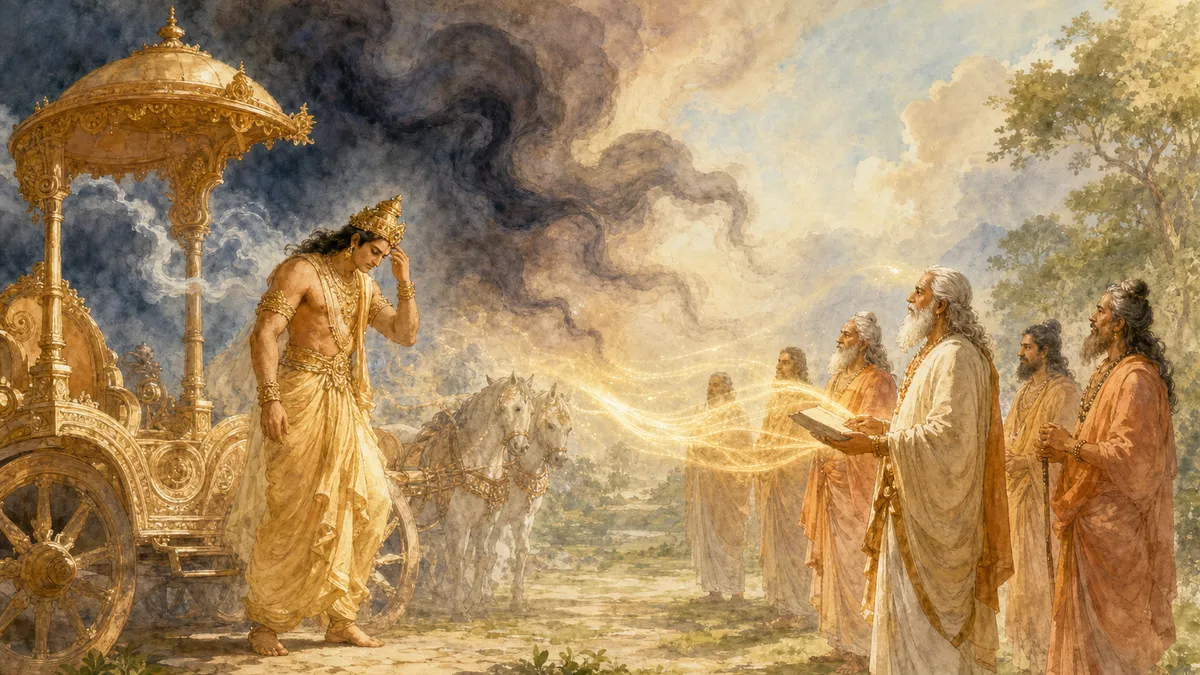
Thanks to Vasistha’s instructions, Indra came to his senses and continued the battle again. Then the sages, seeing that Vritra had greatly disturbed the balance of forces in the universe, went to Brahma at Vasistha’s request and asked him to bring about Vritra’s defeat. Indra could not overcome Vritra. Only thanks to the support of Rishi Vasistha, the sages, and the intervention of Brahma himself was Vritra defeated. He was such a powerful demon that Brahma himself predetermined his fate.
When the mighty energy of Brahma descended upon Vritra, Indra hurled his thunderbolt weapon at him and killed him. From Vritra descended a being called “the death of brahmanas.” It was a special, dark, harsh energy that took the form of a very ugly woman, and this wrathful deity nevertheless clung to Indra. Although Indra tried to get rid of it and flee, he received the final curse of the asura Vritra. His life was already hanging by a thread, and then, on the advice of the rishi, he turned to Brahma and asked him to save his life. Brahma called upon this wrathful goddess, saying to her in a gentle voice:
— Please find another place; do not touch Indra, do not take his life.
The goddess said displeasedly:
— You yourself gave me this task, and so I am carrying it out. But since you ask, I will leave him; however, tell me—into whom and where should I enter?
Her power was so great that Brahma began to distribute this negative energy among different beings. He summoned the spirits of trees and the gods who govern trees (the gods of the second heavens), saying to them:
— Take upon yourselves a portion of this negative energy.
They replied:
— We are already burdened, for trees are killed, cut down, and so on, and grass is mown. And now there is this energy as well.
Brahma said:
— You will be able to rid yourselves of it.
Then he summoned the deity of water and told it to take upon itself a portion of this energy. The deity of water asked:
— And how am I to rid myself of this energy?
Brahma answered:
— You may send this energy upon those who defile the waters while bathing, who defecate in them, urinate, spit with impure thoughts, and do not honor the deities of water.
Then he summoned the apsaras, and they asked:
— And how are we to rid ourselves of it?
Brahma answered:
— You may safely transfer this impure energy to anyone who has intercourse with a woman during her menstruation.
Then the deity of fire asked:
— And how can I rid myself of it?
Brahma answered him:
— You may transfer this energy to those who treat you disrespectfully and do not make offerings.
Thus, this negative energy was distributed among many different beings.
Presence as Protection from Negative Forces
When we are in presence, we are invulnerable to negative energy. When we have strong faith, the elements are favorably disposed toward us, because presence itself invokes the higher divine universal forces (shakti), and then the entire guru-parampara, the gods, the creator gods of universes stand behind us; that is, presence itself is capable of invoking powerful divine forces. It can be said that, by entering deep contemplation, we already cease to be human, because for that time we activate the divine forces that fill our consciousness. One cannot be a human being in presence, because presence is always the presence of the Absolute, and a human being is only its conduit. As humans, we cannot generate our own small presence, because presence is something global to which we can only connect by tuning ourselves correctly. This global principle begins to attract powerful universal forces as well, and when these divine forces descend, we gain a greater ability to withstand kleshas, obscurations, obstacles—everything that causes limitations.
The Three States of Consciousness and Absolute Reality
“All these three states (namely: nirvikalpa samadhi, deep sleep, and the initial moment of apprehending objects) are characterized by the absence of agitation (confusion) of the mind, when only the basic, unmanifest state remains in consciousness. Their difference lies in the subsequent evaluation of the respective states, which produces different perception. Absolute Reality manifests in samadhi; emptiness or the unmanifest state is the distinguishing characteristic of sleep; diversity is characteristic of apprehension in the waking state.”
During nirvikalpa samadhi, deep sleep, and the first moment of apprehending objects, there are no vrittis (fluctuations that disrupt the primordial presence), since there is no perception of objects. However, such vrittis then arise. The subsequent activity of the mind gives rise to vrittis, and then different evaluations in perception or in the apprehension of objects change consciousness. But the absolute Reality, the Source of light, is one and the same in all these states; it always remains unstained, which is why it is called absolute Intelligence.
The yogin’s task is to meditate constantly on this Supreme Source of light. Put more simply, the yogin’s task is to direct the mind continuously toward God and to think of God. From the point of view of Laya Yoga, being in presence and thinking of God are one and the same.
