

Commentary on the text “Tripura Rahasya,” Chapter 10
How, thanks to the instructions of his wife, Hemachuda attained samadhi despite continuing outward activity, and remained in the state of liberation while still alive.
The Knots of Karma and the Seeds of Future Births
“These knots are millions in number, and they are created by the fetters of delusion, which is nothing other than ignorance of the Supreme Essence. These knots give rise to erroneous notions, the chief of which is the identification of the body with the Supreme Essence, which in turn causes the unceasing stream of happiness and suffering in the form of the cycle of birth and death.”
What are these knots? They are the seeds of future births, located in the causal body. They are called bijas. It is believed that until these seeds are burned away by intense meditation and contemplation, a person will take a new birth in a body.
What are these seeds? One could say that they are information at the level of the subtlest intentions of consciousness. They are very subtle movements of consciousness at very great speed, located in our causal body. When such seeds take form, in the astral body they appear as concrete images. We ourselves created these seeds in past incarnations through certain powerful experiences, acts of will, or intentions.
Everything we think sooner or later manifests. What we dream of, what we want, will certainly manifest. Even if we carelessly thought about something, but that thought was fairly strong, someday it will manifest in our life; we will inevitably encounter it. And imagine that there were a great many such dreams.
Sankalpa Vidya: The Art of Managing Intention
The practitioner learns to dream one-pointedly while abiding in contemplation. He dreams: “Aham Brahmasmi” — “May I become a deity! May I become a mahasiddha! May I attain the Divine Body of Light! May I become immortal! May I acquire divine pride! May I manifest as a deity dancing in the center of the mandala! May I recognize everything as the play of the Supreme Mind! May I recognize the world as a mandala, everyone as deities, my actions as lilas, and all sounds as mantras!” Again and again he creates such a sankalpa by the power of his intention. When such a sankalpa is nurtured for a long time, the yogin, by the power of his intention, draws from the space of the universe’s maha-akasha energies that correspond to his sankalpa. These energies replace the old energies that he accumulated in past lives. Thus acts sankalpa vidya — the art of managing intention.
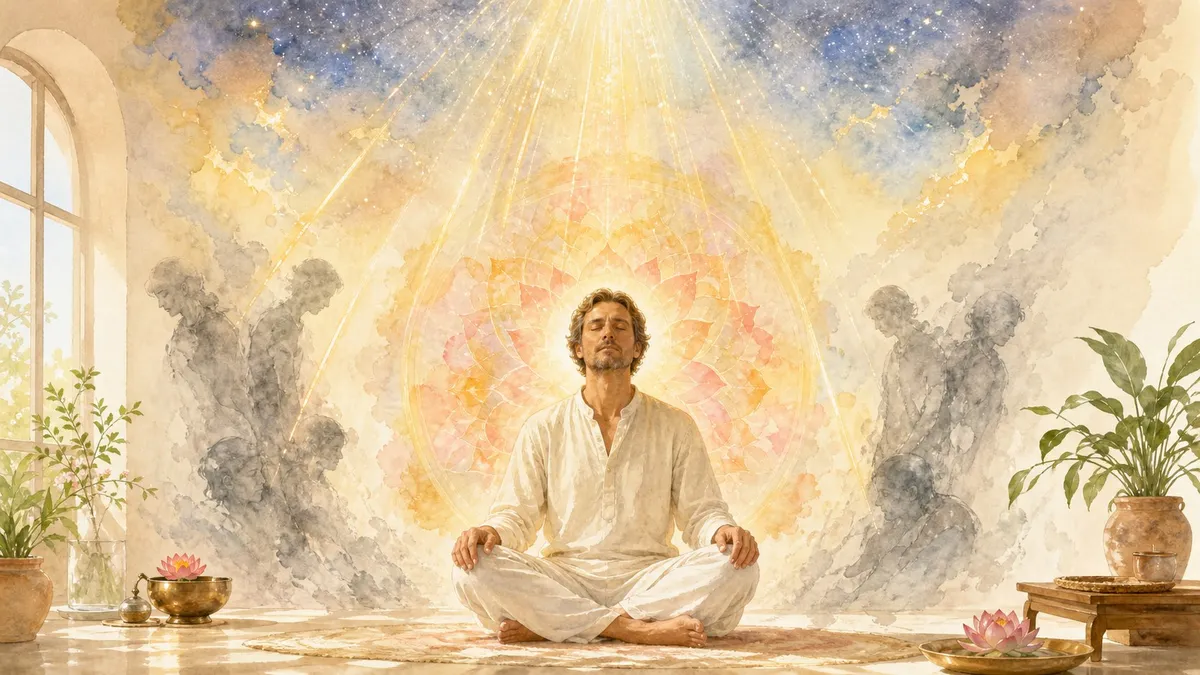
Again and again we generate such one-pointed intention. Ultimately, our meditation is the intention to reunite with the Absolute. Our contemplation, our awareness, is nothing other than the sankalpa “Aham Brahmasmi.” We do not pay very much attention to mental intention; we say that true intention is non-conceptual, that it arises at the level of bhava. Nevertheless, you should always have such a directedness of consciousness; that is, you should be like an arrow flying toward a single target — “Aham Brahmasmi,” “May I become an immortal deity! May I become an immortal mahasiddha! May I reunite with Brahman!”
At the same time, when you generate a sankalpa, you do not dream about it while passionately desiring the result and becoming upset that it is not working out, because expressing a sankalpa in this way is the worst kind of practice. Precisely when we generate a sankalpa in this way (with hope, fear, clinging, and anxiety about the future), rest assured — it will not be realized.
True Sankalpa: From Desire to Certainty
True sankalpa is when you do not generate a passionate desire to have something, but acknowledge it as an absolute fact, in the manner of: “I do not desire; I am certain. I do not merely want; I intend.” This is the highest dharma of self-recognition and abiding in presence. You do not dream of how to become Brahman; you are certain — “I am Brahman.” You have no doubts whatsoever about this; it simply takes time for these energies to manifest in their fullness, simply takes time for this to unfold in your consciousness. You do not dream of someday being in this state; you are already, right at this very moment, in this state and position yourself as a deity in the mandala. Perhaps this is visible to no one, including you, but that is no reason for discouragement. If you abide one-pointedly in this certainty, this feeling will accumulate and, over time, will manifest—not immediately. This is precisely how the dharma of the direct path works.
Positioning yourself as “I am a deity, I am Brahman” is precisely what it means to be in the natural state, because this is truly your natural state. I repeat: you do not hope, you do not passionately desire; rather, you already realize this as an accomplished fact, as a given, you congratulate yourself and blossom with joy in connection with the accomplished fact. Of course, you are required to establish yourself again and again in this sankalpa so as not to lose it. This is presence. This is exactly how a genuine master of the natural state practices.
One who practices in duality hopes, desires, passionately strives, fears, and becomes upset when things do not work out. The more he hopes, the greater his hopes and fears. But a genuine practitioner does not strive, does not hope, does not desire; he is, and in being, he continuously establishes himself in this status.
Of course, in order to truly manifest all the qualities, it is not enough to declare once: “I am.” What is meant is that, having made the decision “I am Aham Brahmasmi,” we remember it constantly, being every second. When we practice in this way, all the knots of karma are untied.
Malas: Limitations of Consciousness
“The second knot is the separation of the world from the Supreme Essence, whose conscious nature is a mirror in which phenomena are simply reflected. It is similar with the other knots, including the notion of the separateness of beings from one another and their separation from the universal Supreme Essence.”
Here we are speaking about malas, about knots in general, about states of limitation.
So, the first mala (limitation) is when we identify the body with the Supreme Essence, and the second mala is when we separate the world from the Supreme Essence. Looking at the world, we consider it a heap of disparate objects, although in reality the world is countless vibrations that emanate from the space of the Supreme Source. These vibrations are inseparable from the single Sphere; they are the play of this very single Sphere.
When you see a cat, a dog, a stone, a tree, a house, a person, these are, first and foremost, vibrations emanating from the single Sphere, manifesting in the form of a cat, a dog, a house, and a person. And secondly, they are, of course, living beings.
There is also another knot: the notion of the separateness of beings from one another. At the level of human vision, beings are all separate; each exists on their own. And you can certainly say: “He is not me, I am not him.” And when the feeling “He is not me” arises in you, various relationships appear, which can be reduced either to attachment or, conversely, to aversion.
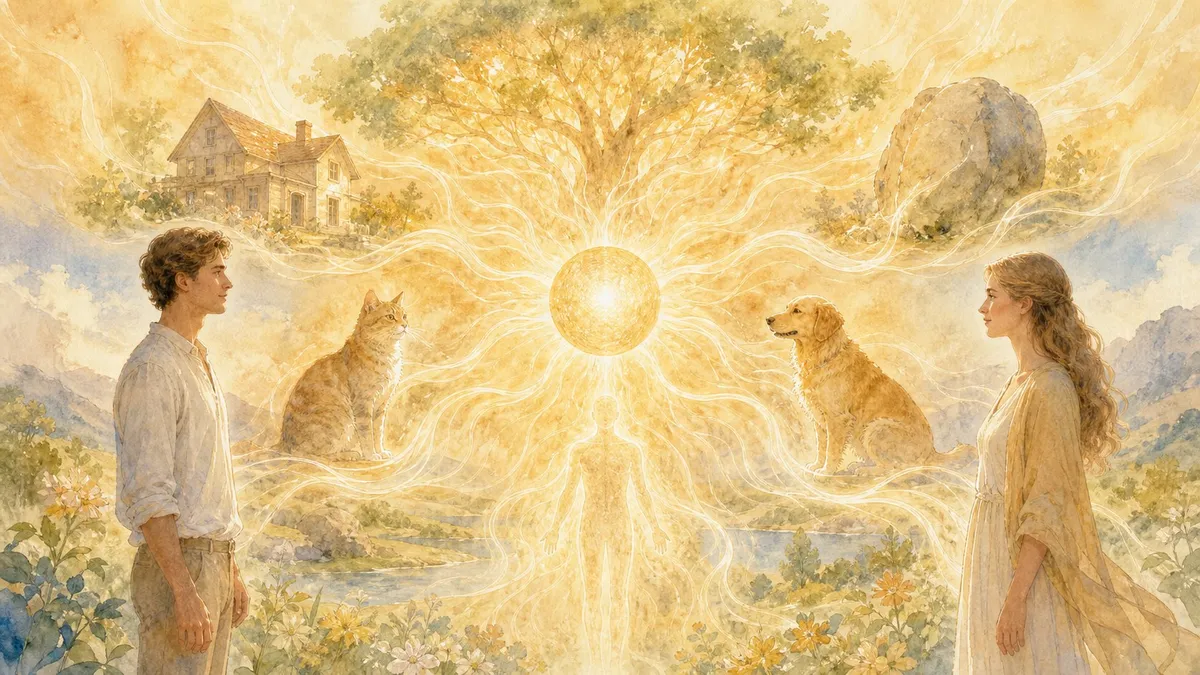
When you feel “He is not me,” this is delusion. In the absolute sense, the separateness of living beings does not exist, although in the relative sense, of course, relative differences do exist. In the absolute sense, you know that “he is me.” For example, there is some person you do not like, or with whom you have disharmony. If you abide in ignorance, you think: “What a bad person he is! There is not even any point in contacting him.” But if you know: “He is me,” then you understand: “He is some part of my consciousness, and this part is dissatisfied; it is signaling to me that at some point I built my relationship with it incorrectly. There is no point in taking offense at it, getting angry, or judging it as bad. I need to send it my awareness, my love, and harmony, because it is I myself, it is another part of me, with which I may have acted incorrectly in past lives or in this life.”
This is a completely different view of life, a non-egoistic one.
So, it is said here:
“These notions arose in time immemorial, and they will surface again and again until ignorance disappears.”
The task of the practitioner is that when these notions surface, he must dispel them by the power of a new vision. His new sankalpa must erase all these notions, no matter how many of them surface.
It is said that a person will not attain final salvation until he frees himself from these countless knots of ignorance.
Integrating Contemplation into Everyday Life
“You cannot be content with the state that comes after closing your eyes, since in reality it is pure mind and eternal truth, surpassing all else, and at the same time serving as a magnificent mirror reflecting the phenomena that arise within itself. Prove, if you can, that even something is not contained in it, and you will fail, for everything is in it.”
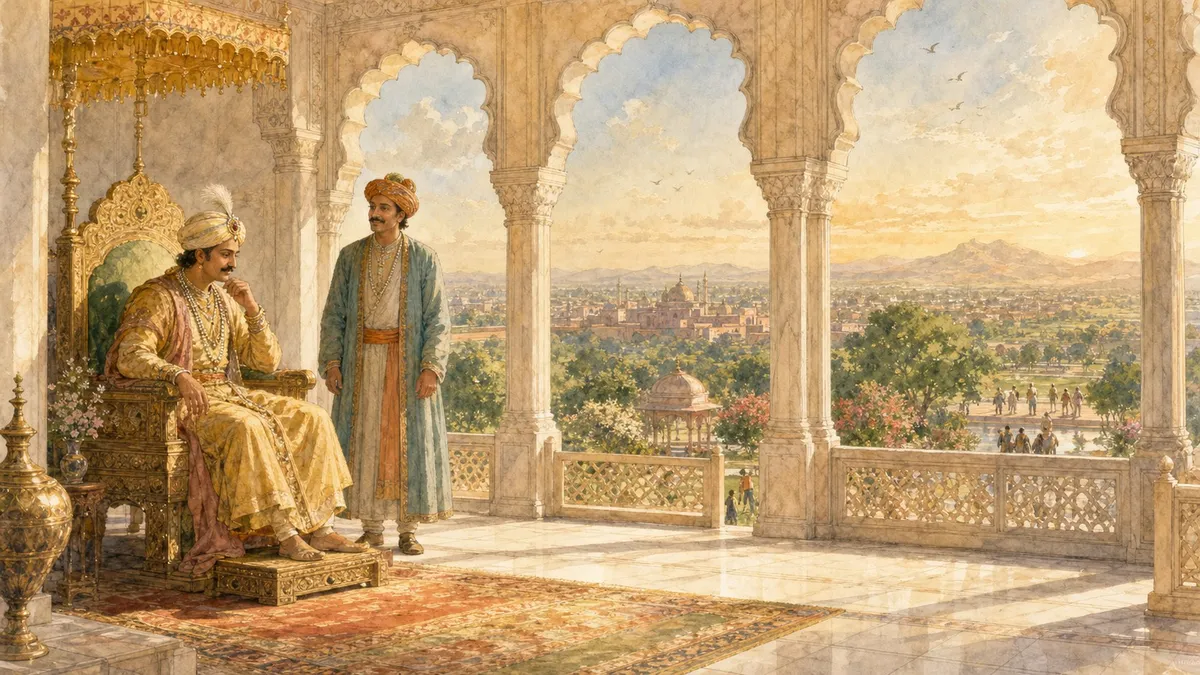
One day, his adviser Birbal came to the great emperor Akbar.
Akbar, wishing to test his quick-wittedness, asked him:
“Tell me, who is greater—God or I?”
Birbal thought for a moment. Akbar was known for his unpredictable temperament. If he said that God was greater, who knew how he would react? But, on the other hand, to say that Akbar was greater than God was also nonsense. Then Birbal said this:
“O lord! Of course, you are greater than God.”
But Akbar was quite wise, and he asked:
“Why do you think so? Is this such crude flattery?”
Birbal replied:
“No. For example, you can banish anyone you wish from your kingdom, but God cannot banish anyone from His kingdom, because He is everywhere. Wherever He might banish someone, that person would not leave His kingdom.”
Akbar fell into thought. This answer shook him very deeply.
In the same way, whatever you perceive is always immersed in the true Essence. And for a practitioner of contemplation, it is said that whatever he encounters, he must unite with it, integrate it into his natural state, unite it in presence.
Here it is said that the practitioner should not be satisfied with meditative absorption in the state of meditation with closed eyes. When he moves, feels, perceives, his meditative state must continue. He has no alternative but to learn to unite at the moment of such movement and perception.
“To unite” means that I look at the world through the eyes of non-duality. I do not mentally evaluate it, I do not separate the world and myself, I do not project my stereotypes onto the world. I look at the world simply: without judgments, without mental interpretations, without the experience of bad-good, right-wrong, without liking or aversion. When I look at the world in this way, this is integration, union. And then I know that the world is a manifestation of the energies of the primordial Source in which I am immersed.
