The Trials of Dattatreya: Pure Vision Beyond Duality
16.07.2026
0 мин. чтения
0
Share
copy
search
add
share
Commentary on the text “Inexhaustible Stories about Dattatreya”
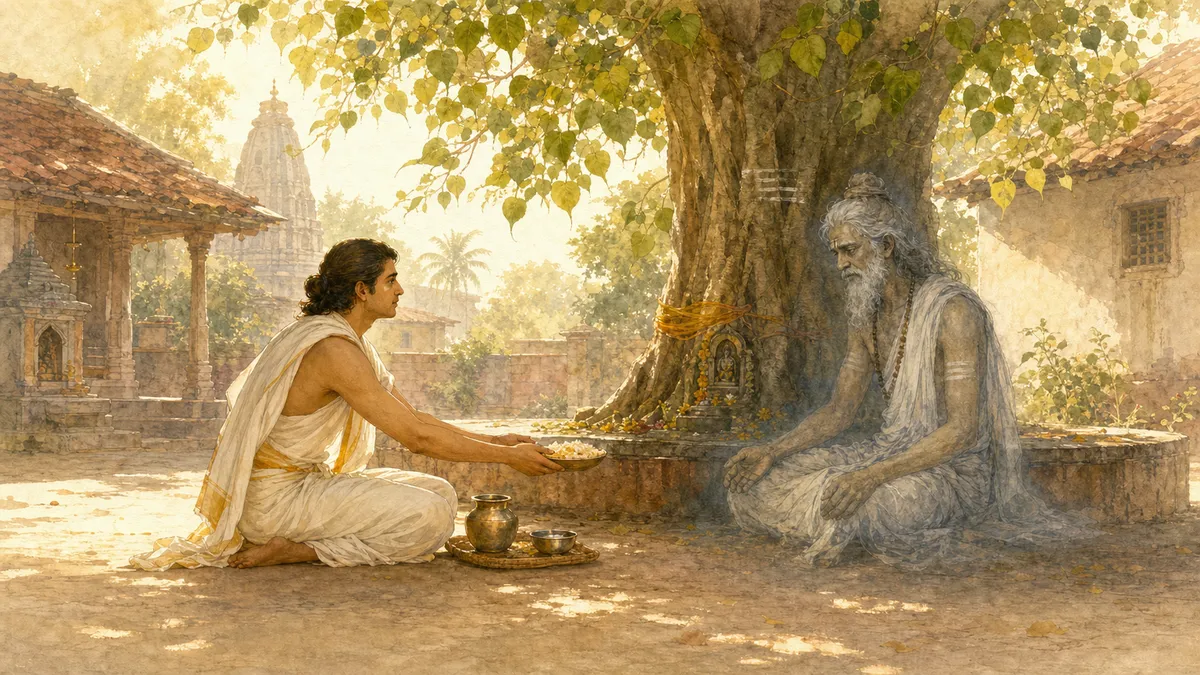
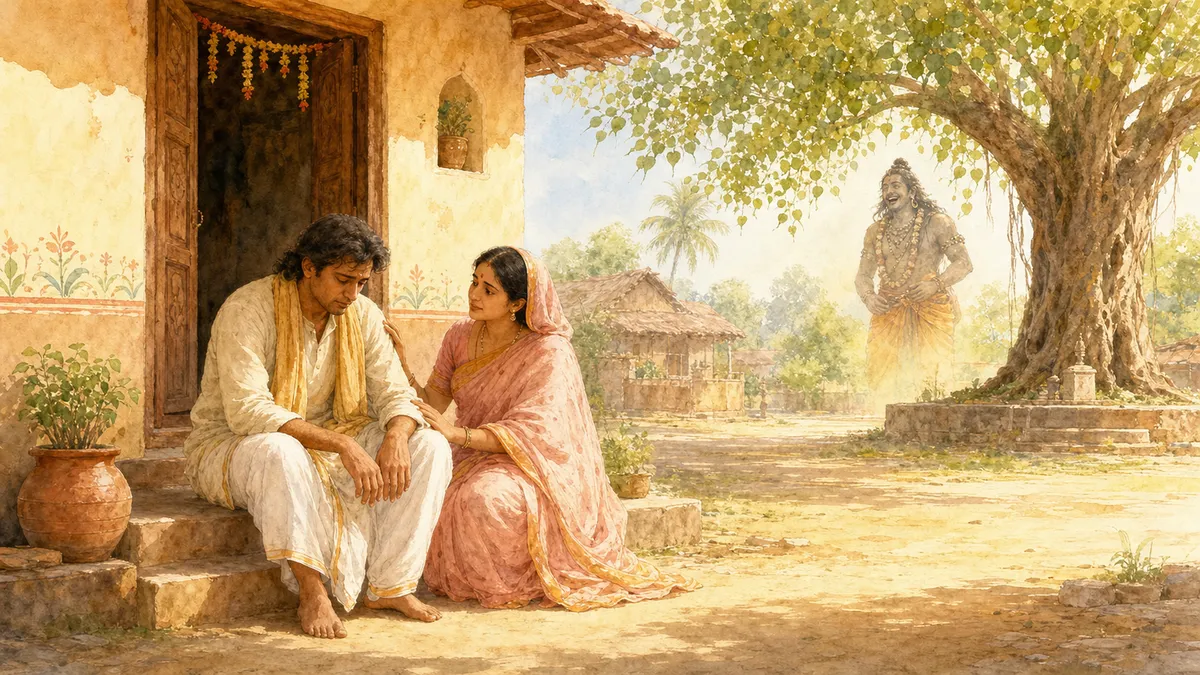
“Near Sahyadri there is a place called Matapura, where there lived a Brahmin named Vishnudatta. He was very learned in the study of the Vedas and steadfast in their application. His wife Sushila was exceedingly devoted and beneficent. I have no way to describe the steadfastness, asceticism, and absence of desire characteristic of this noble couple. They worried about nothing and lived in their own world, simply following their religious customs. If the villagers gave them a little grain, treating Vishnudatta as a good Brahmin, it was great wealth for them. Gradually even the villagers stopped paying attention to them.
In front of their house grew a pipal tree, on which a brahmarakshasa lived. He gathered and ate the grains of cooked rice offered daily by Vishnudatta to all living beings after making offerings to all the deities. Therefore the brahmarakshasa did no harm to that couple; instead, he often vexed other people. Gradually he realized that harming others is a sin. He himself was surprised by these thoughts. Over time, his piety increased more and more. Soon he understood that all this was the result of the sacrifices performed by that pious Brahmin.
As his kindness increased, so too did his feeling of gratitude. It reached the highest degree of a desire to repay the Brahmin for his kindness. One day he became brave enough to appear in his true form before Vishnudatta, who was placing offerings of cooked rice beneath the tree. The Brahmin was frightened, seeing his repulsive and terrifying appearance, but the brahmarakshasa asked him not to be afraid, expressed his gratitude with all possible courtesy, and told Vishnudatta that he wished to thank him for his kindness and that he could ask him for anything he wanted. Vishnudatta was utterly bewildered. The brahmarakshasa insisted that he state his wish. However, no matter how hard the Brahmin tried, he could not think of any wish.”
A brahmarakshasa is a being possessing certain spiritual knowledge and powers, but reborn into a bad existence because of some spiritual falls that had been allowed. It is said that they are fallen Brahmins. That is, if some yogin or Brahmin practiced and achieved some success, but violated samaya or committed some defiling actions, then he may be reborn as a brahmarakshasa. This is also called brahmabhrashta, that is, one who has made a mistake. It very often happens that spiritual practitioners make certain mistakes: they confuse view with conduct, neglect the relative, and so on. And this brahmarakshasa received offerings from Vishnudatta, since he made such offerings.
In the subtle world around us there are many living beings. Sometimes they are very weak and even frightened. For example, pretas. They will not approach if you do not invite them yourself by making an offering to them. And during great yajnas, offerings are usually made not only to the deities, but also to all lower beings.
“Finally, Vishnudatta thought it would be better to consult his wife. At first she, too, could not think of a single wish, but after much reflection one idea came to her. She said to her husband: ‘Have you not long desired to receive the darshan of Lord Dattatreya? The brahmarakshasa evidently possesses great powers; perhaps he will be able to help you.’ He liked her suggestion very much, and he presented it to the brahmarakshasa.
No sooner had he heard the name of Dattatreya than the brahmarakshasa jumped up and recoiled in panic. He said threateningly: ‘O Brahmin, you must forget your instructions. Never repeat that name, at the sound of which our hearts burst and we die. How can I lead you to him? Could anything be more unjust than this?’
Why does the brahmarakshasa speak this way? Because his very body, his very vision, the brahmarakshasa himself, is the embodiment of some mistake, some obscuration. And in the presence of Dattatreya, any obscurations and mistakes burst like bubbles on water. This means that the entire body of the brahmarakshasa, consisting of obscurations and mistakes, begins to be purified from the mere name of Dattatreya, and since this purification is very strong, this body simply disappears, dissolves.
The First Meeting with Dattatreya
Vishnudatta became upset and said:
“All right, it seemed to me that you possessed superhuman powers; that is why I asked you, believing that nothing was impossible for you. Forget it. I want nothing. I will regard it as if you had already done me a kindness. So do not worry.”
Because of the new inner reverence that had arisen in him, the brahmarakshasa did not even think of taking back his promise, but he could not guarantee success either. After long wrangling, he nevertheless made up his mind and said: “O Brahmin, eating your food, I cannot deceive you. You are so uncompromising and say that you desire nothing else. Very well, I will do what you wish, but on one condition. The one you mentioned is a great yogi. Moreover, he is a great magician and can assume the most incredible forms. He moves through forbidden places. I will find out where he is, return, and show him to you from a distance. Then you must go without hesitation and fall at his feet. I myself cannot come close to him. Remember: touch his feet and serve him with faith. But I warn you, I will not take you to him more than three times. Then my promise will be fulfilled.”
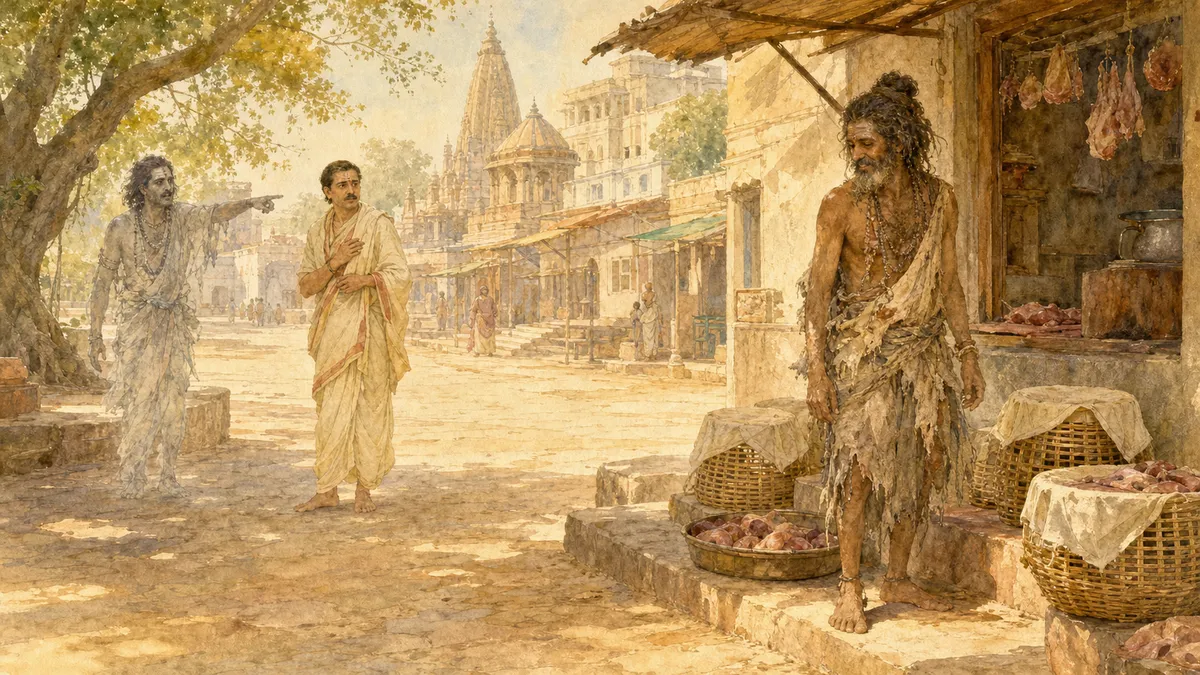
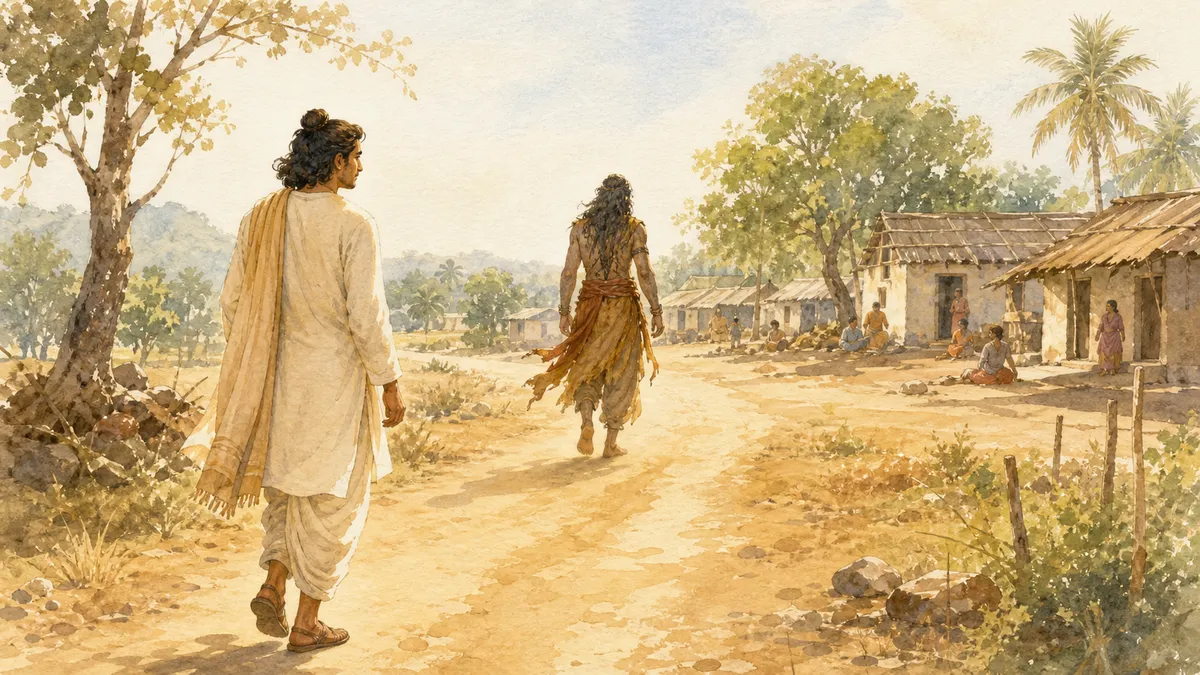
Having said this, the brahmarakshasa left. Later he suddenly appeared and said in an excited voice, “Come with me,” and led Vishnudatta to a meat shop. There was a madman there, walking around and begging for pieces of meat. His appearance was frightening, and his face was terrible. His large eyes burned like coals. It seemed that he was drunk and thoroughly soaked with palm liquor. Now swaying, now stopping in hesitation, now falling and then getting up, he staggered unsteadily back and forth. When he moved, the flies swarming all over his body scattered. The gleam of his burning eyes suggested that he was looking for an opportunity to strangle someone.
Pointing to him from afar with his finger, the brahmarakshasa said, “Do you see that madman? That is your Datta. Run and fall at his feet.” And in fear he left.
Can you imagine such a darshan of Dattatreya and Vishnudatta’s state? Imagine that you enter a meat shop and see an insane drunken man. To understand that this is Dattatreya means to completely overturn your karmic vision. This is both a symbol and a real state. It is an expression of our obscured states, of our inner energies that are kleshas, which we must see directly and illuminate with the power of devotion, pure vision, and compassion, until they are completely transformed into inner deities and the radiant space of light.
Karmic Vision and the Three Worlds
In each of us there are kleshas, impure karmic vision. We live in the world only within a narrow spectrum. Above our human world is the space of pure vision: gods, heavens, saints, pure lands. This is our future, that which is inaccessible to us. Below is impure vision. And our spectrum is pure-impure vision, human vision. We strive to be pure, but we do not fully succeed. Below is impure vision: suffering, pain, filth, fear, greed, avarice, anger, death, wars, murders, lust—that is, everything connected with the muladhara chakra and the svadhisthana chakra. The hell worlds, animal energies—all these are the lower worlds. The seven lower worlds—Patala, Vitala, Rasatala, Talatala, and so on—are powerful energies of the lower worlds. And all of these are energies of entropy, chaos, and impurity. All living beings have their own frameworks of impure worlds and chaos, and their own frameworks of pure worlds. But as a rule, they occupy their own niche of karmic vision.
We all strive to get rid of the impure and strive toward the pure. What is the impure? It is chaos, entropy, destructiveness, disorganization—that is, that energy in the universe which we do not control. We know that if we touch this energy, we will not be able to do anything. It can obscure our mind. If we become too immersed in anger, lust, greed, fear, pain, physical weakness, illness, the limitations of the body, or any other state of the lower world, then we will feel our spirit fading, sankalpas swept away, meditation departing, and the level of prana falling. We will feel that our life force and consciousness cannot withstand such pressure. Only great saints are capable of sublimating the energies of destructiveness, pain, chaos, greed, fear, lust, horror, death, and murder. This is an enormous layer of the lower worlds, which we do not notice while we live in the human world. But as they say, “Hell is no farther than your palm.” That is, the lower worlds, the energies of chaos and destructiveness, are always nearby, just like the upper ones; we are simply deeply immersed in our karmic vision.
The Single “Taste” and the Level of an Avadhuta
Saints like Dattatreya have realized the power of holiness to such an extent that they can freely immerse themselves in these energies and play with them. Their level of holiness is such that, by immersing themselves in these worlds, they can create pure lands, peaceful and wrathful mandalas from them, and manifest as wrathful deities (for example, as the manifestation of the ten wrathful Mahavidya goddesses). But ordinary pious people in pashu-bhava, who follow Vaishnava-chara and Veda-chara, have rather fixed notions of purity. And for them, purity is always associated with sattva.
Everyone understands that purity is sattva, that one must cultivate sattva and strive for it, that one must avoid tamas and rajas. And many Tantric schools attach special importance to purity—sattva. In many spiritual schools or traditions, there are very high standards of purity, especially in Brahmanical traditions: performing ablutions three times a day, wearing only clean clothing, not associating with those who are lower and whose minds are obscured, eating only consecrated food from clean and beautiful dishes, repenting or performing purification after associating with those whose minds are obscured, and so on.
However, Dattatreya himself did not adhere to such an approach to purity. Dattatreya is an avadhuta; he is the embodiment of the single “taste” (samarasya). For him, the standards of sattva are not some kind of limitation. And the single “taste” means that if the natural state is deeply realized, consciousness can integrate with rajas and even with tamas. Complete purity implies that not only sattva is integrated, but also rajas and tamas. Therefore avadhutas are not bound only by sattvic notions. Vamachara and Kaulachara, which belong to the seven acharas of the Hindu classification, say that the level of a siddha, the level of an avadhuta, is always the ability to unite purity with very deep, even rajasic and tamasic destructive, entropic energies of chaos. The power of the natural state is such that it can integrate with these energies. This is the single “taste,” which no longer separates anything and sees the whole world as Brahman.
But Vishnudatta did not belong to the same category as Dattatreya. He had various dualistic limitations.
The Trial of Brahmanical Purity
“The best among the Brahmins felt as if a whole apple were stuck in his throat and a boulder were pressing down on his chest. His first problem was how to endure that terrible smell. ‘O God, after such a pure life, now I must go to this terrifying place because of my friendship with a rakshasa.’”
A Brahmin is a high standard of purity. An unequivocal refusal of alcohol, meat, fish, and eggs. Fumigation with incense, consecration of the body with mantras, and so on. In Brahmanical traditions, the standard of purity is extraordinarily high. Therefore Vishnudatta faced the dilemma that, because of his friendship with a rakshasa, he would have to violate these standards of purity.
“Did the rakshasa tell the truth that this disgusting man of indecent conduct is Lord Dattatreya? It does not seem that the rakshasa was joking. But is it possible to imagine that the god Dattatreya, the beloved son of Atri and Anasuya, would be like this? Even if he is an avadhuta, how can he be so terrible? But it seems that the Brahmarakshasa is trustworthy. What benefit would he gain by deceiving me? Perhaps he is telling the truth. However, how can a knower of the Vedas enter such a shop? How can I enter there and touch such a terrifying person? What will those who see this say about me? If only I knew what I should do.”
For a Brahmin, entering a meat or wine shop is equivalent to losing his reputation as a Brahmin. And in small localities or villages where everyone knows him, it is equivalent to losing social status, because such a person will no longer be considered knowledgeable in the Vedas and spiritually pure.
“While the Brahmin was thinking in this way, the madman disappeared. When the Brahmin searched for him everywhere, the astonished Brahmarakshasa returned and said:
‘O Brahmin, at first I told you that this man is a great deceiver and that his appearance inspires terror. I said that you would not believe me. This chance has been missed, but I will show him to you again. At least then have a little common sense.’”
The Brahmin trembled: “Truly, what a mistake I have made! The Lord governs dharma and adharma. The Vedas are His breath; the worlds are His toys. What rules of conduct can exist for Him? What breaches of propriety? I lost my reason; I did not pass the Lord’s test.” Thus Vishnudatta was tormented by remorse.
“A few days later, the brahmarakshasa came again in haste and said, ‘Come, He is passing nearby.’ He took Vishnudatta to the cremation ground. There, amid a heap of charred human bones, was an executioner. He was surrounded by dogs. Together with the dogs, he was pulling half-burned corpses out of the funeral pyre and seemed to be eating them. His eyes were like red embers from a tamarind tree, smoldering in the ashes. A garland of bones encircled his neck. And intestines hung from his ears. His entire body was smeared with blood. Such was his terrifying form.
Pointing to him, the brahmarakshasa said, ‘Look, this is your Lord. Be careful.’ And he ran away as fast as he could.”
Wrathful Deities and Inner Energies
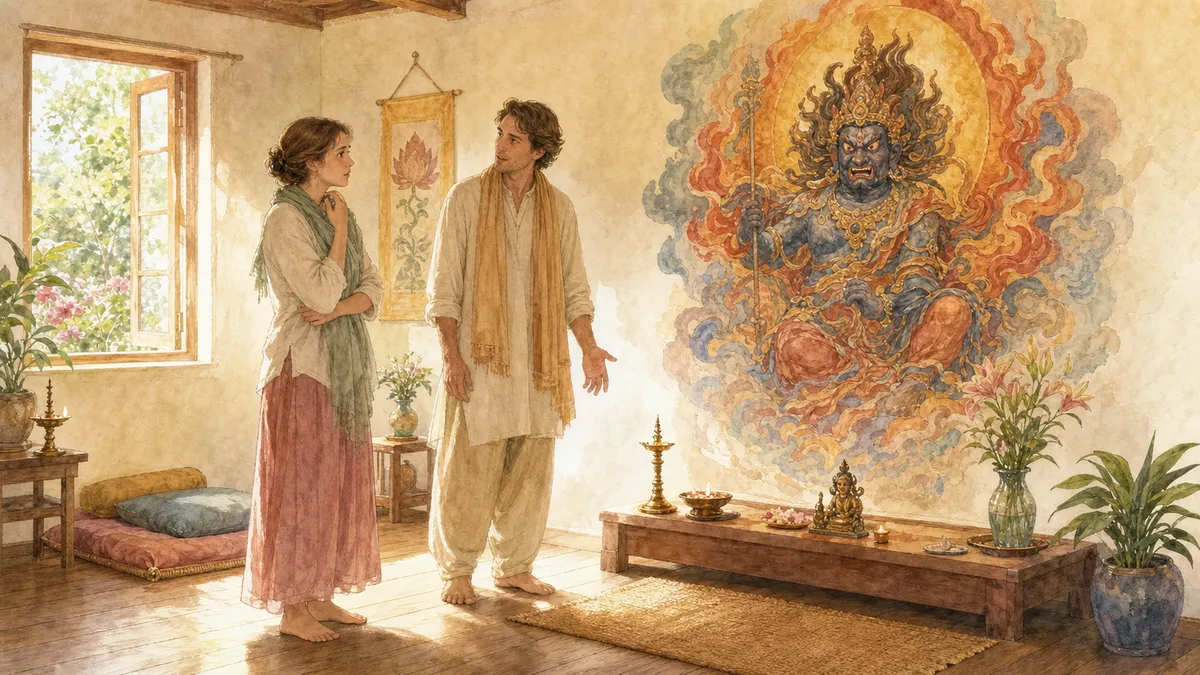
There are wrathful deities. Often, when looking at images of wrathful deities (for example, Kali, the wrathful form of Tara, Kalabhairava), we see them in terrifying guises, rather than in the way peaceful or joyful deities are usually depicted. Wrathful deities have a necklace of skulls, a skirt of human arms; in their hands they hold a curved knife dripping with blood, or a skull cup. It would seem: what could be divine in such demon-like beings?
Once, when we had an ashram in Ukraine, a man came to us who, upon seeing the wrathful deities, said, “I do not want to worship such beings! I am an advocate of nonviolence.” He was very confused and even frightened. I tried to explain to him that it is not so simple, that this is an expression of our inner energies, and that it should not be understood literally, eternalistically.
Whether we want it or not, there are different energies in the universe, not only peaceful ones. Peaceful, joyful, and wrathful—these are the three types of deities. Peaceful deities are connected with the aspect of shanti (peace). Joyful ones are connected with the aspect of rajas (passion). Wrathful ones are connected with the aspect of tamas (anger). These wrathful energies exist within our pranas, within the body. Usually we do not come into contact with them, but in certain states (in samadhi, in the intermediate state) we can come into contact with them.
Upon rebirth, every person sees the personification of his energies. For example, he sees his personified muladhara in the form of the terrifying Kali. If he sees her and becomes frightened, he will fall into duality, and his mind will be clouded. But if he recognizes her as an inner deity, unites with her, and sees her in pure vision, dissolving her into emptiness, then he has a chance to be liberated in the intermediate state.
View and Conduct
The single “taste,” pure vision, divine pride—the full realization of these three principles means the manifestation of pure vision in relation to the three types of deities (peaceful, joyful, and wrathful), the unification of contemplative presence, and its integration (merging) with any manifestations.
If, however, we turn on the dualistic mind and are unable to do this, then pure and impure, bad and good begin to exist for us, and therefore we will not be able to experience the bhava “Aham Brahmasmi” in its entirety. There will always be duality, and therefore we will not be able to speak of a single “taste.”
At the same time, we must clearly know what is view and what is behavior, so as never to confuse them. It would be a great mistake to think: “Since in the view everything is pure and non-dual, there is no need to purify oneself and cultivate sattva.” Undoubtedly, this would be a great mistake, because abiding in pure vision at the level of view and at the level of behavior are different things. For example, even after realizing pure vision in one’s view, one should maintain in behavior the conventional division into pure and impure, since only great saints such as Dattatreya can truly come into contact with destructive (entropic) energies. An ordinary person, by doing this, can very easily create the prerequisites for bad rebirths. And here there is always a boundary of awareness that shows to what extent your pure vision manifests in the view and to what extent in behavior.
Dattatreya’s Third Test
“Vishnudatta prepared himself for this moment with a vigilant mind, having decided that whatever form the Lord might take, he must not become confused. At that moment he had no doubt. He was frightened, yet he controlled himself. Trembling, he approached him and prostrated. When the executioner stepped aside, his body seemed to be engulfed in tongues of flame. He struck Vishnudatta with the bone he held in his hand. Poor Vishnudatta felt as if his life was about to fade away. Meanwhile the dogs began to bark and rush at him. The Brahmin was beside himself with terror. He gathered all his strength and ran.
Having reached home, he collapsed. The Brahmarakshasa sitting under the pipal tree laughed merrily at him: “Greetings, learned Pandit. I did not think you could run so fast. Fortune has left you again. Dattatreya’s tests are not easy. You are not the only one who has failed. I hoped that this time you would endure. And why do I worry about you? I will give you one more chance if you dare to go again.” Having said this, the Brahmarakshasa disappeared.
Feeling deep shame, Vishnudatta sat on the threshold of his house, where his wife Sushila found him and comforted him with gentle words: “My poor husband, you tried very hard, but fortune did not favor you. Forget it. The merits we have are enough. This rakshasa said that the Lord is a great trickster. Why should you stretch out your hands toward bunches of grapes that cannot be reached.”
But for Vishnudatta, his attachment to the body was an unbearable thorn in his heart: “How could I run away, fearing that this body would be harmed?” Therefore he felt shame and guilt while performing his religious rituals.
One day, the Brahmarakshasa came and called him again. This time he was not afraid. “O Brahmin,” said the Brahmarakshasa, “according to my promise, I give you the third and final chance. You have already lost two of them. Remember this, and do not waste this one as well.” This proved that he did not believe the Brahmin would pass this test.
Vishnudatta followed the Brahmarakshasa with desperate determination: “Can there be a fool equal to me? How can I attribute faults to the Lord Himself and accuse Him of improper behavior? How unfortunate I am that, although I know that He alone and only He is the Lord who protects all the worlds, and even after that, having seen Him with my own eyes, I fled, overwhelmed with fear, afraid that my body would be harmed. This must happen again; this is the final test. There are only two possibilities: to receive the Lord’s grace or to die.”
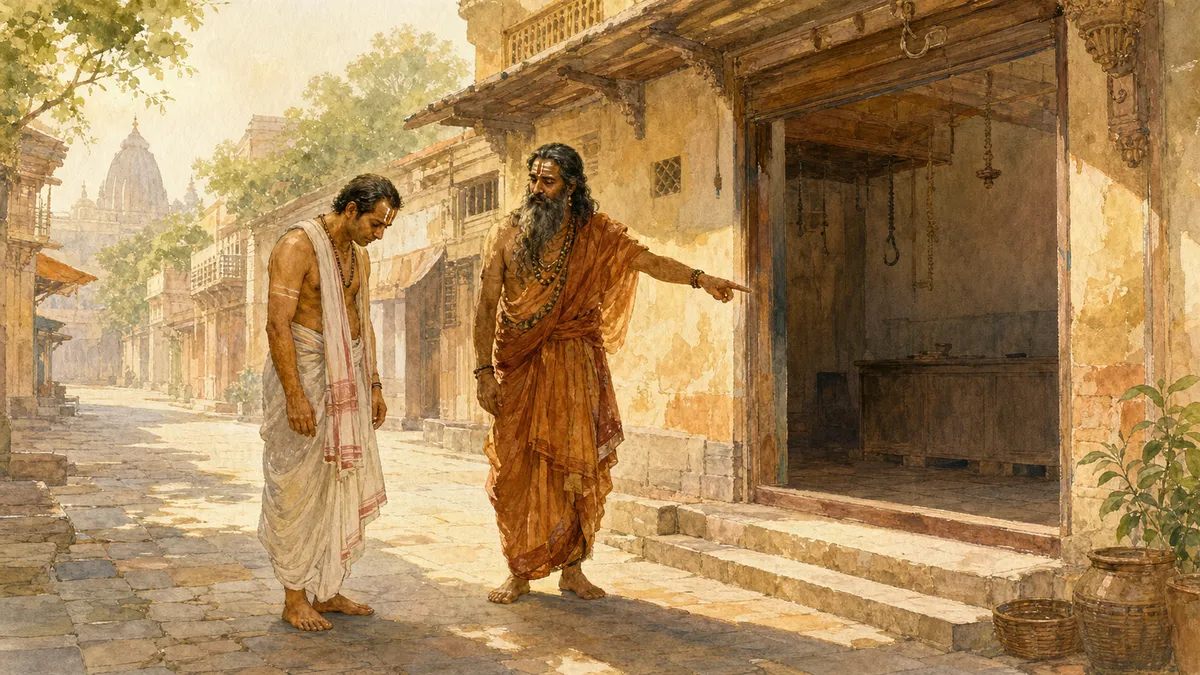
At this time, the Brahmarakshasa led him to the settlement of the Harijans. Now there was not a single drop of doubt in Vishnudatta’s mind.”
“Harijan” literally translates as “children of God.” They are the untouchables. For a Brahmin to go to a Harijan settlement, to allow the shadow of an untouchable to fall upon him (I mean not a twenty-first-century Brahmin, but an orthodox Brahmin of the medieval period), is equivalent to ritual defilement and expulsion from his caste, the loss of social and religious status.
“Now there was not a drop of doubt in Vishnudatta’s mind, nor the slightest fear in his soul. Rushing forward, he fell at his feet and, grasping them, held on tightly, saying: ‘Lord, I seek your protection! Please be merciful to me!’
The harijan struck the brahmin in the face and began to insult him. He even spat on him, beat him, and tormented him in various ways.”
Imagine that a brahmachari (a candidate for novicehood) arrives and is greeted in this way by some senior monk. How many seconds after that would he remain in “Divya Loka”? After how many seconds would his faith and his desire to become a novice disappear? I think one could start a stopwatch. The time would probably be measured in hundredths of a second.
And this happens because we do not have truly deep faith and pure vision. All of this is still superficial for now. True faith awakens later, over the years, when we are truly able not to lose faith and pure vision even in such situations. Sometimes masters in the siddha tradition try to resolve the matter immediately, right now: either you have faith, or goodbye.
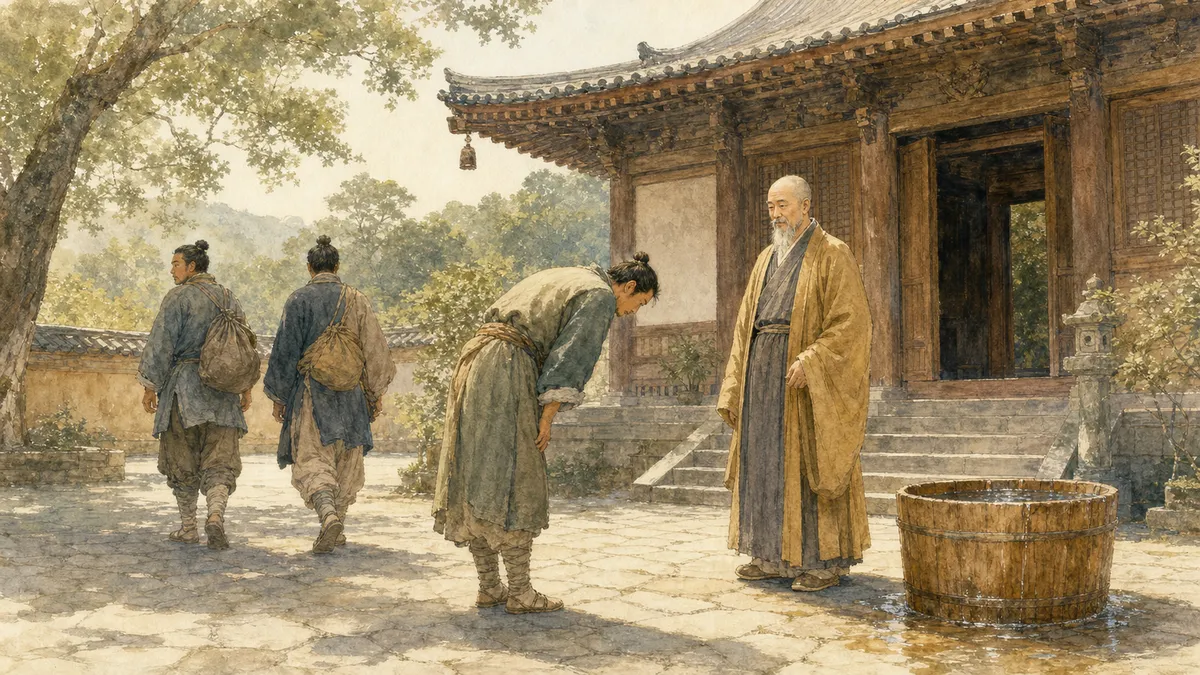
For example, when three candidates for monks came to an enlightened master in a Zen monastery, instead of giving them a benevolent welcome, he simply shouted at them and scolded them, and then took a tub of cold water and poured it over them. Two of them became frightened, were very embarrassed, and went back. The third, however, proved more persistent. He bowed to the master and said:
“I have traveled such a long way in order to attain enlightenment, so I am not going to leave just like that, because of some foolish feelings of my own. Please instruct me!”
The teacher answered him:
“Well then, you are suitable.”
And this boundary, when a person is suitable or not suitable, is determined by his faith.
Very often we lack faith. In general, there is never enough faith. But the question is, can we strengthen it? Twice Vishnudatta lacked the faith to approach Dattatreya and receive his darshan.
Read 17 times
Articles
Vidya AI
Search
Lectures
November 3, 2026
Mantra of the day
ОМ САДРЩАЙА НАМАХ ОМ Видящему равно – поклонение!
Auspicious Times(Rome)
Brahma Muhurta:
04:54 - 05:49
Abhijit Muhurta:
11:33 - 12:14
Sayam Sandhya:
16:43 - 17:24
Mokshada Ekadashi (6 November)
Ekadashi of liberation. Helps to achieve spiritual enlightenment.