

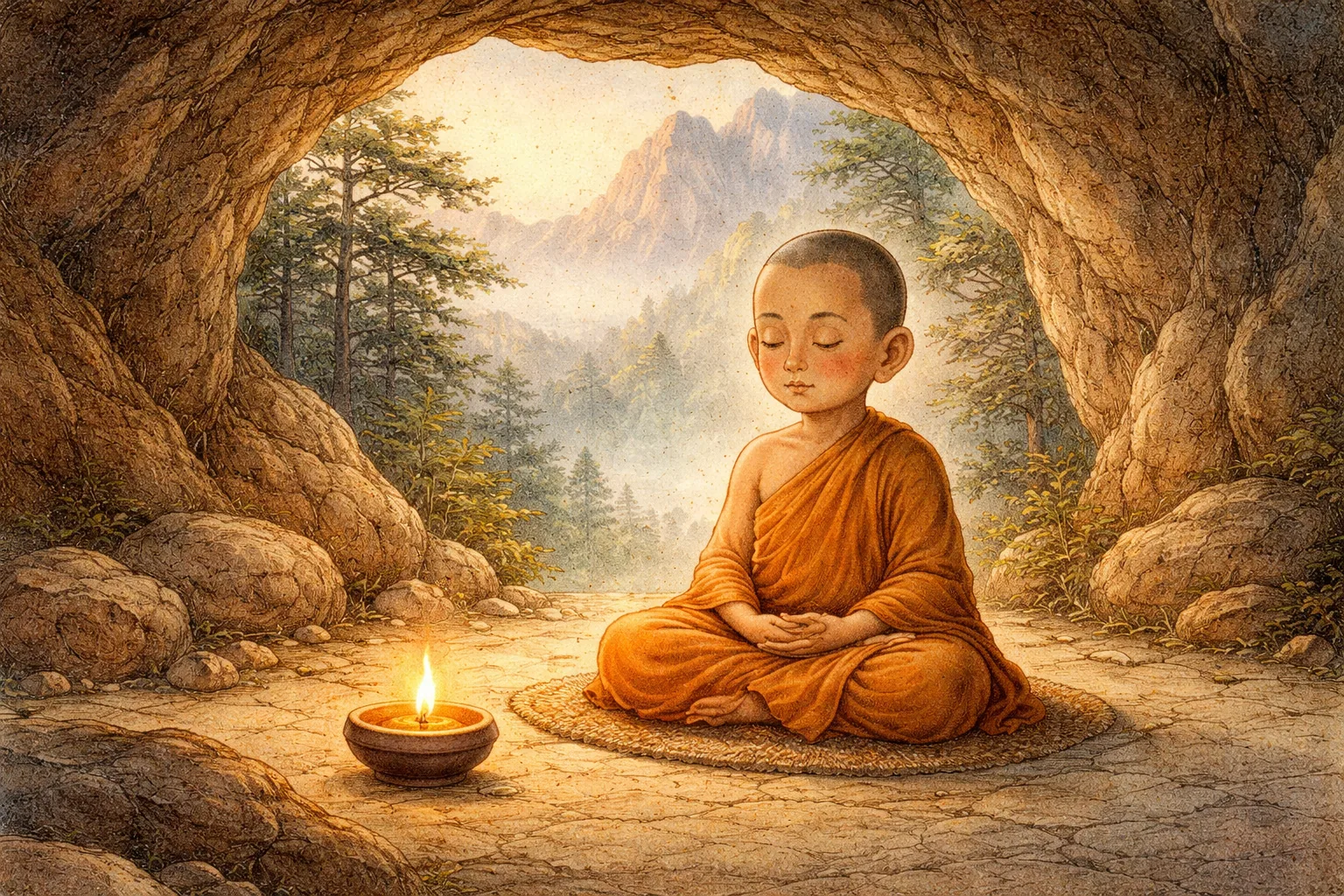
Commentary on the text “The Story of Nanda’s Conversion”
In Shravasti, the venerable Nanda was saying aloud to many monks: “I am not satisfied, dear friends, with the brahmin life. I cannot endure the brahmin life. I shall abandon discipleship and return to what is inferior.” A certain monk told the Blessed One about this. The Blessed One ordered Nanda to be summoned to him and asked him whether this was true.
“Yes, venerable sir.”
“But why?”
“When I was leaving home, venerable sir, my beloved from the Shakya clan, before she had even finished painting the parting in her hair, looked at me and said: ‘Come back soon, my lord.’ And so I keep remembering her.”
And then the Blessed One took the venerable Nanda by the arm and, as quickly as a strong man might straighten a bent arm or bend a straight arm, disappeared together with Nanda from Jeta’s Grove and instantly transported him to the heavenly abode of the Thirty-Three (meaning the abode of the thirty-three gods). And there at that time about five hundred apsaras had come to Shatra, that is, to Shiva, the leader of the gods, to entertain him, and their feet, painted with red dye, resembled the little feet of doves.
“Apsaras” literally translates as “one who glides on water,” that is, these are semi-divine beings of the female kind associated with the element of water—the svadhisthana chakra. They are very sensual, artistic beings who, thanks to their shakti, possess prabhava-siddhi—the siddhi of charm, allure, and even enchantment. Apsaras are often associated precisely with dance, with sexual temptation, that is, with just this kind of energy. It is believed that apsaras are dancers in Indra’s palace. They are highly skilled in dancing, in the art of charm, seduction, temptation, and the like. They test the spiritual strength and steadfastness of yogins by appearing to them and displaying their energy. For them this is a kind of amusement; that is, they see that some yogin or monk has acquired a certain self-importance and think: “Now let’s see what you are worth. Entertainment for us—a lesson for the monk.” It is believed that they have no prescribed rules of conduct; that is, they belong to a class of beings who create their own rules of behavior. They adhere to certain criteria of their own as to what is good and what is bad.
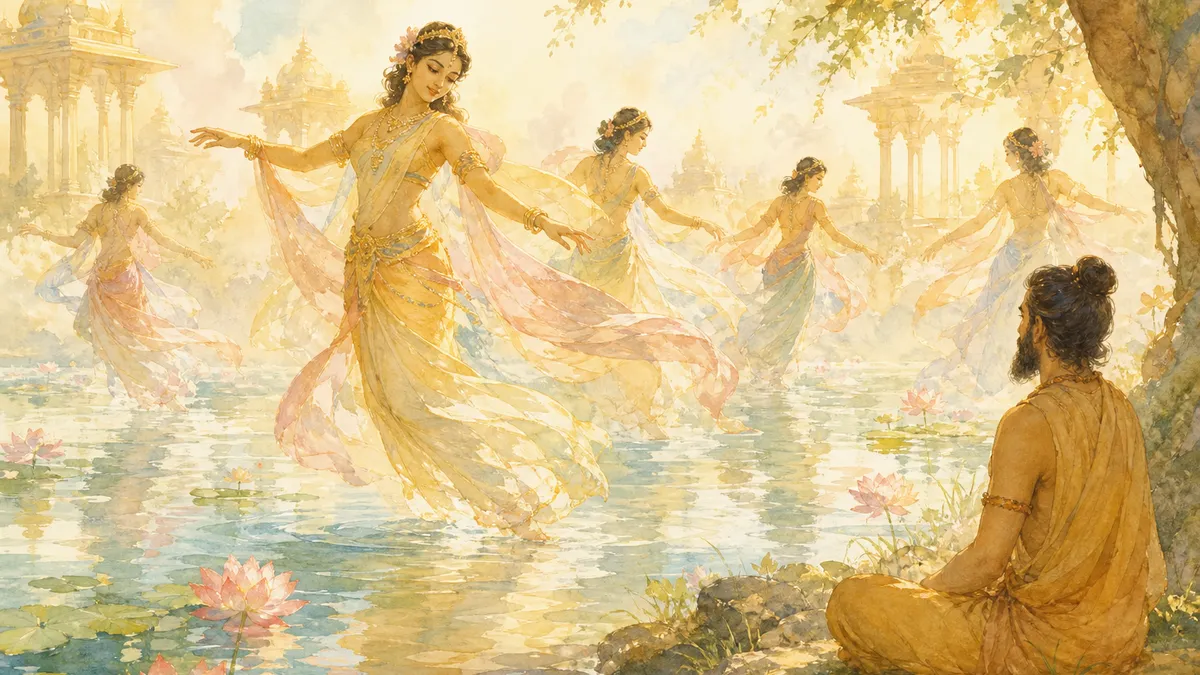
Deities are incomprehensible beings, while apsaras are beings of a semi-divine nature. There are cases when a yogin or rishi, through his asceticism or tapas, manifests such powerful energy that the worlds begin to tremble; that is, this tunnel of reality undergoes strong oscillations, so even the gods become concerned. Indra, with his divine sight, identifies such ascetics. And if a yogin performs tapas in some incorrect or disharmonious way, causing his consciousness to project strong spiritual waves, Indra says: “In the world of humans there is such-and-such a yogin, whose tapas makes our world tremble. We must cool his ardor, send him a temptation or enticement.” Then he summons one of the apsaras and sends her to this rishi or yogin so that she may seduce him and thereby destroy the power of his tapas. There is a similar story about the rishi Kashyapa and the apsara Menaka. Here, however, the Buddha took his disciple to the heaven of the Thirty-Three Gods in order to show him the heavenly dancers, since he was pining for the woman he had left behind in worldly life.
And so the Blessed One addresses Nanda:
“Do you see these apsaras, Nanda?”
“Yes, venerable sir.”
“What do you think, Nanda, who is more beautiful? Who is lovelier? Who is more charming? Your beloved from the Shakya clan, or these five hundred apsaras with red feet?”
“My beloved compared with them, venerable sir, is just like a scorched monkey, noseless and earless. She does not count, she does not bear comparison, she is not worth even a small fraction of them, so much more beautiful, lovelier, and more charming are these five hundred apsaras than she.”
“Rejoice, Nanda, rejoice, Nanda! I assure you, these five hundred apsaras with red feet shall be yours.”
“If the Blessed One himself assures me of this, I shall be satisfied in monastic life.”
And then the Blessed One took Nanda by the arm and transported himself with him back to Jeta’s Grove. The monks heard about this and began calling the venerable Nanda hired and bought:
“You have been bought, Nanda. You are for sale, Nanda. You live the monastic life for the sake of apsaras.”
And the venerable Nanda, humiliated, tormented, and harassed by these nicknames, withdrew into seclusion and was thoughtful, zealous, diligent, and became one of the saints.
In other words, at a time of spiritual weakness, the Buddha supported him by giving him such an experience. It was as if he made a deal with him: become a monk and a saint, and all five hundred maidens will be yours. And Nanda thought: “This is worth practicing for.” But when the other monks found out about this, they began to mock him quite literally. Later, of course, he renounced such desires and attained true holiness.

A Lesson on True Motivation in Spiritual Practice
We must always understand, when practicing in monastic life, for the sake of which apsaras we practice, and how sincere, pure, and unblemished our spiritual motivation is. And we must always clarify our true motivation, remembering that temptations are not always external in the form of apsaras; they can also be internal: a feeling of complacency, the desire to attain emotional comfort, the desire to hide from failures in worldly life, the need to be in a certain environment, and so on. But in reality, all of these are false kinds of motivation. For a true yogi, genuine motivation in sadhana is absolute devotion to the Dharma, to the path of awakening, to the path of the saints. For some, even siddhis (supernatural powers) can be apsaras (temptations). And on the path of practice, we must always cut off false motivation and awaken genuine motivation, because sooner or later the time will come when a yogi will have to come face to face with his false motivation. And since false motivation does not withstand the test of strength, he will either have to acquire motivation anew, changing it along the way, or he will face serious spiritual problems.
