

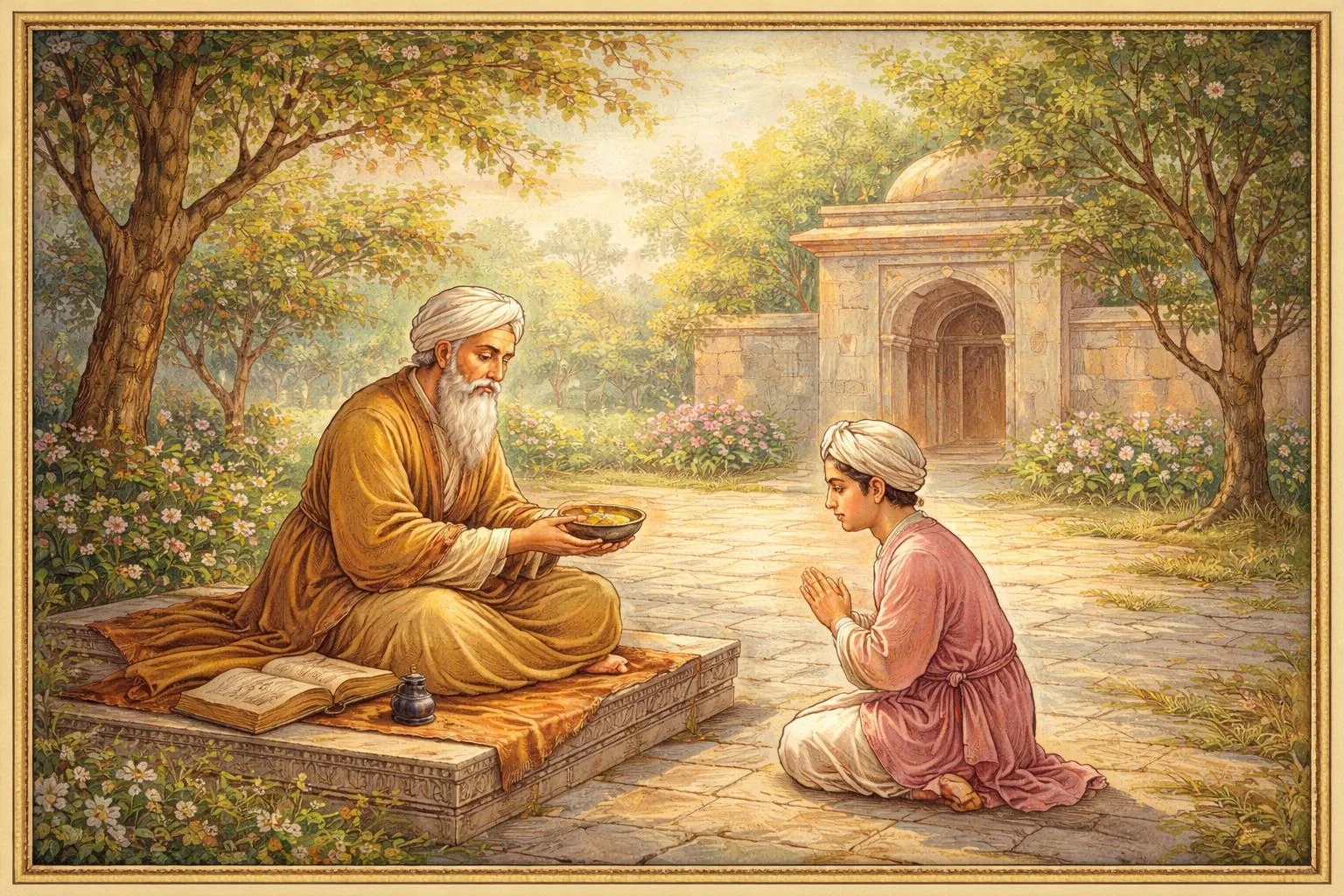
Commentary on the text “Bhakti Sutra”
Bhakti Yoga: Self-Liberation, Self-Transcendence, Self-Recognition
In this chapter, devotion is understood as the essence of the highest self-surrender—paraprema.
Now we shall expound the path of devotion. It is the essence of immortality. Having attained it, a person becomes perfect, becomes immortal, becomes completely satisfied. Having reached it, he desires nothing more, does not grieve, harbors no anger, does not rejoice, and does not fuss. Having known it, he becomes as if intoxicated, he becomes motionless in the ecstasy of samadhi and finds delight in the “Self.” By its nature, it is desirelessness. Its essence lies in restraint. Restraint implies the renunciation of all worldly and even religious activities of doing in relation to the divine. In this renunciation is contained indifference to all things that oppose this devotion.
Indifference (ananyata) means abandoning all other refuges. Indifference to all secular and religious things that oppose this devotion is the performance of those activities that are in harmony with this devotion. Let attentiveness to the teaching be manifested even after the fortress of consciousness has been attained. Otherwise, there is always the possibility of falling away from the truth. Therefore, attentiveness is required even with regard to the smallest worldly activities, such as eating, until the end of life. True devotion exists when all actions are dedicated to Him. And it is also the experience of a state of supreme bewilderment upon forgetting Him.
The Three Pillars of the Spiritual Path
At first, we speak of awareness, of attentiveness, which we need to develop. Over time, when our attentiveness becomes continuous, we discover the great Source. This Source is contained in our own awareness. Then we understand that we need to enter this Source completely and live in it twenty-four hours a day. We need to drown all karmas in it, to throw our little “I” into this fire, to cut off all remaining hopes, fears, and clinging. This is the second stage, which is called “cutting off attachments to the ‘I’” (prapatti); literally, it means casting oneself away. Only when this stage has been passed can we carry out the third stage—self-recognition (pratyabhijna).
Pratimoksha (liberation through personal effort by means of attentiveness), prapatti, and pratyabhijna are like three pillars. If prapatti is not accomplished, then our pratyabhijna will be merely a formality, a fiction. We often read:
“You are the indivisible, all-pervading Consciousness. You are Brahman Himself,” or “I am Brahman Himself.”
Then we think:
“Of course, I am Brahman. But when I leave after the lecture, I am not Brahman at all.”
As long as we are aware, everything seems absolute, but then we may think that this is actually some small experience rather than true self-recognition and realization. We always have such doubts because our ego, our fixation on the “I,” and the karma of attachment exceed our small understanding of self-recognition. Even if we have had a certain flash of nonduality, it is cut off in a brief moment because our karmas and our ego interfere. True self-recognition is possible only when even the tiniest part of egoism has been cut off, when all egoistic karmas have been drowned in the great Source of awareness, when all hopes and fears have been cast aside, when even the slightest clinging has been cast aside. Only in this case can it be said that self-recognition has gained strength, and that the yogin will no longer be born in samsara, but will merge into the Supreme Source like oil into oil.

Spiritual Materialism and the Subtlety of the Ego
The spiritual path endures any things. The only thing it cannot tolerate is egoism, the manifestation of the “I.” Since our individual “I” has been nurtured over the course of many karmas, it can manifest itself in very sophisticated ways. It can even turn spiritual practice into a means of self-reinforcement. Moreover, very often new fetters for egoism grow out of spiritual practice. We may read many texts or sacred scriptures and acquire some semblance of knowledge, although this knowledge will be merely external. Or we may succeed in performing various methods, which in itself is not bad; however, if they are not transcended by self-surrender, then this too will be a manifestation of spiritual materialism. Or we may rely on ascetic practices and other things. However, if all of this comes from the ego, from the “I,” then it will be nothing more than new props for the evil spirit of the “I.” This is a very subtle point, when we may not see the manifestation of spiritual materialism. Therefore, it is usually considered that spiritual practice under the guidance of a Guru helps ensure that they are eliminated.
True Devotion and the Fear of Deviation
What does it mean to acquire true devotion?
First, after we have discovered the great Source of awareness, we begin to understand that none of our illusions is self-existent, that all illusions and attachments must be offered to this Source. Second, for the first time we develop a fear of deviating from this awareness, of losing it even for a second, a fear of falling back into the habitual conditioned dualistic state. Previously we did not have such fear, because one who was asleep and had never awakened did not even know the taste of awakening. But when we awakened and understood how tremendously important it is, we become very afraid of losing this awareness.

When I hear that someone wants to outsmart karma, I think this happens because his karma does not yet allow him to be impeccable. If your karmas had been purified, you would never allow yourself such a thing. You would try to be as impeccable as possible even in the smallest detail. It is like an athlete from a backyard team who does not pay attention to details; he does not know a high standard, does not give himself totally to what he is doing, and therefore always loses. But if this is a master of the highest class, he lives by it; he will not miss even a trifle, will calculate all the details, he is afraid of allowing any lack of impeccability even in the very smallest thing, and therefore he always wins.
When we analyze the lives of saints and siddhas, we see that they belonged to the second type. They made incredible efforts, manifested miracles of self-surrender. When our level of purity becomes similar to theirs, we can follow the same path of dharma practice. Only such a way leads to liberation. One must understand the high standard of the siddhas in relation to spiritual practice.
Examples of Self-Surrender in the Tradition
Once Tilopa was walking with his disciples. They approached a foul-smelling puddle, and Tilopa said, “If I had a devoted disciple, he would surely drink from this puddle.”
Day and night Naropa wanted to receive the teaching from Tilopa; in fact, he was not satisfied with his understanding and had acquired great devotion to Tilopa. At first all the disciples stood there hesitating, but Naropa rushed to the puddle and drank from it. This is one example of such self-surrender.
When you acquire a relationship with a spiritual Teacher, it is a way to eliminate all your illusions. In essence, if you manage to eliminate all illusions through self-surrender, your realization will not be slow to manifest. At the same time, it does not matter how or what you do. I am trying to draw the disciples’ attention to this.
Swami Sivananda told his disciple Satyananda: “Do not try to bring the Light. It is better to work, giving yourself completely, and the Light will manifest from within, as your own essence.”
Swami Satyananda Saraswati worked in the ashram for four people; he was one of the first to attain realization. He carried out the will of his Guru literally in everything; he had no time to think about himself, because he was absorbed in service. Of course, when such a practice is applied to the personality, the ego is faced with a harsh choice: either to die and allow the will of the Absolute to manifest, or to stop such practice. If the choice is made in favor of self-surrender, then the ego naturally disappears, and non-duality is realized.

Dangers on the Path of Awareness
Even when we are in a certain state of attentiveness, karmas exist within us. Know that heightened awareness is projected onto everything, including these karmas. We begin to become aware not only of the spiritual aspects of ourselves, but, unfortunately, also of the non-spiritual, worldly aspects of ourselves. We make everything part of awareness, any aspects, even going to the toilet. And suddenly we see that there are many things we were not aware of before, but have now begun to become aware of. From the point of view of awareness, these things may also seem attractive. At this time, the yogin is tempted to look once again at these attractive things, so self-surrender and devotion are always needed in order to cut off the desires to look at the attractive things in our subtle bodies.
We may feel a certain kind of comfort, a certain satisfaction, because we have risen above the ordinary level of unconsciousness. We feel that we can maintain a certain attentiveness wherever we may be. And our spiritual ardor gradually becomes imperceptible; it almost comes to nothing. We maintain a level of self-satisfaction similar to that of the gods of the realm of desire.
The gods of the realm of desire have greater clarity than humans. But precisely because they have become captivated by their self-satisfaction, they will never attain liberation. In the same way, we feel that the problem of suffering and the problem of unconsciousness have somehow disappeared, that we are sufficiently aware, that we have a certain level of impeccability, that we no longer have anything to fear, and so we relax. Then we look around and see that there are many different things pleasing to the heart that our ego has not yet fully worked through: maya, various relationships, plans, and so on. If we have no self-surrender, this will be a serious stumbling block.
For yogins, for monks, this happens when the stage of “siddhi” or the stage of “spiritual experiences” begins, that is, many wondrous visions appear; one can send the subtle body to Babaji’s ashram, to one heaven or another, see this or that. The yogin feels that an entire new universe is opening up before him. On a lower level, this manifests simply as an interest in one’s own karmas; on a higher level, as psychic experiences. Then the mind tends to become strongly involved in these psychic experiences. Therefore it is said that sadhanas that grant siddhis and the awakening of visions are not intended for beginners, because this is where everything will end.

When we have acquired a stable capacity for self-surrender, we are not captivated by such things. This means that another level of impeccability is required; an iron, unshakable consciousness is required, one that withstands any karmas and any movements of consciousness.
The Three Jewels and the principle of cutting off clinging
When you come to the sangha in order to learn the Dharma from the spiritual Teacher, you recite the Refuge mantra. The Guru in the absolute sense is transcendental Consciousness, but in the relative sense he manifests as a specific Guru. The Dharma is our clarity that is being realized. This transcendental Consciousness realizes our own awareness. But in the relative sense, it is a specific Teaching and methods. The Sangha is all the fields of sensory perception, and in the relative sense, it is the place where you study.
Where should one begin? By acquiring absolute, complete, total commitment to these Three Jewels, placing it above the small self that practices.
There is a saying: “Zen takes the sword from the samurai and bread from the hungry.” Zen, as a non-dual teaching close to Laya Yoga, says roughly the same thing: “One must cut off all clinging, and then self-born Wisdom will manifest.” If you cling to anything and cannot cut it off, know that this is a great problem that will serve as the vector of the next rebirth. This principle should be understood from the very beginning. Suppose, if someone comes and wants to practice mauna, but if he develops clinging to mauna, then I will certainly advise him to stop this practice for a while, because in this case mauna is clinging, a continuation of his own ego factor.
If attachment to some diet arises, and this diet is made into an object of attention, then this too should be cut off. In other words, one should observe everything that arises in oneself as attachment and cut it off. In the past, I often observed disciples in order to determine where their attachments were rooted. Then I showed them what they so passionately desired and suggested that they detach themselves from it. Until we understand this principle, even spiritual practice will be a continuation of our illusions.
One day a disciple came to Marpa who wanted to receive teachings from him. He arrived with all his possessions. He brought everything he had and made the ultimate offering. Then there was a feast offering. Marpa said:
“Have you donated everything?”
The disciple replied:
“I have donated everything; only one lame sheep remains. I think you will not like it.”
Marpa flew into a rage:
“You say you have donated everything, yet you have hidden such a fat sheep! Surely you have hidden the very best sheep. Do not think that you will receive initiation from me while concealing part of your property!”
Since Marpa himself, when he was a disciple, had received a good lesson from Naropa about what complete self-giving means, he said to this disciple:
“Do as you wish, but go back and bring me this sheep!”
With a heavy heart, the disciple returned home again. Since he lived in another part of Tibet, it took him two weeks to walk home and then another two weeks to come back. Upon returning, he offered the remaining sheep. Then Marpa said:
“Now I am satisfied. Perhaps you do not understand, but this is very important. It is necessary to eradicate even the slightest impulse of selfishness if you want to fully realize the teaching.”

Clearly, the matter was not the sheep, but the subtle parts of selfishness that remained in the disciple and served as an obstacle to receiving the teaching. As long as such obstacles exist, contact between Teacher and disciple is hindered, and the inflow of true awareness is hindered.
This devotion is even higher than ritual, knowledge, and the accepted forms of yoga.
This is so because devotion is the essence of the fruit of all these approaches. Moreover, devotion is higher than other paths because the Absolute does not accept vanity, and because of its fondness for the humility of the one who worships.
I often tell incoming disciples: “Behave in such a way as to please the monks. If you can please them, then you will be able to please me as well. And that means you will have the right attunement with the Guru.”
In some tantras it is said that liberation will be attained by one who can worship washerwomen, low-born women or prostitutes, and so on—that is, one who can see absolute Consciousness in the most ordinary forms, even non-Dharmic ones. In the same way, if, while practicing in the sangha, you see the Absolute in everything you practice, you will certainly realize liberation.
Devotion is realized primarily through self-giving to something greater. But contact with something greater is difficult to attain, and its grace is inexpressible and imperishable. Only such devotion and self-giving should be followed. Only it should be followed.
From the point of view of bhakti, devotion and self-giving mainly concern the image, name, and form of the deity. In laya yoga, however, the approach is different. Several fundamental points are important here. First, it is a matter of the principle of Guru yoga, which in tantra, including anuttara tantra, is very important. Devotion mainly concerns the relationship with the Guru. Second, when awareness manifests and becomes clear, the object of devotion is discovered as one’s own awareness. Self-giving is directed precisely to this Source, which we discover in our own awareness. However, this is fully possible only when we have gained genuine spiritual experience and spiritual purity. When this Source has not yet been fully discovered, then, of course, it is useless to perform complete self-giving, because it is mixed with impure karmas.
When Yeshe Tsogyal reached a high level of enlightenment and realized samadhi, Padmasambhava came and said to her:
“And now the time has come to practice the sadhana of yogic asceticism; the time has come to test your realization and cut off the last clingings.”
He gave her special practices so that she would go to various places of power filled with wrathful spirits, or to cemeteries, and perform various sadhanas there, training her awareness. After she had performed them, he recommended another practice to her. He said:
“Now, whoever comes to you, perceive it as a pure manifestation of the Buddha. Whatever they ask for, give it to them. Even if they ask for a part of your body, give it to them.”

Since she lived in the mountains, other people would sometimes come to her. These people had various requests: some asked for healing, others asked for something else. And Yeshe Tsogyal practiced in such a way as to give everything away, forgetting attachment to herself. One day a man came whose knees were very diseased, and therefore he needed an operation to transplant his kneecaps. He complained to her that he had no way to have such an operation. Then Yeshe Tsogyal made cross-shaped incisions on her own knees and pressed on her kneecaps. It is said that the kneecaps popped out from under the muscles with a “crack” sound. She gave them to him. This is a very high level of cutting off attachment to the “I.” Through such practice, Yeshe Tsogyal eliminated the last dualistic state in the stream of her mind and, at the end of her life, attained the rainbow body.
Who truly crosses the sea of delusions (maya)? The one who abandons attachments. The one who often experiences the great experience of absolute self-surrender, free from the feeling of “mine.” The one who visits secluded places, and the one who breaks the slave shackles of the world, becomes free from the three qualities of nature and abandons every thought of gain or accumulation.
Traps on the Spiritual Path
When we deepen our meditation, our mind and ego will always try to oppose this, using past karmas, playing on the subtlest strings of our “I.” Sometimes a yogin may be seized to the point of tears by a feeling of attachment to relatives. This is one of the ways Mara plays on subtle feelings of attachment. Sometimes a yogin may feel pride and intoxication with his meditative experience. Sometimes experiences and mystical powers arise. Sometimes there arises a desire to teach others, to manifest oneself, to radiate one’s atma-shakti.
All of these are traps set on the path of every yogin, and all experienced practitioners pass through these traps, knowing where they are. Inexperienced practitioners do not suspect where they have been set and fall into these traps one after another. When you follow the path of perfect self-surrender, you are protected from being caught by such traps. If there is no such self-surrender, it is easy to get stuck in one of these traps and not reach the end of the path of spiritual practice.

The one who abandons the fruits of actions, who even rejects actions and becomes indifferent to the fruits of his actions, who abandons ritual actions, attains serene absolute self-surrender; he truly crosses this ocean of samsara. Those who have fulfilled such self-surrender are always perfect. By their presence they sanctify holy places; they make all actions right; they endow the scriptures with true meaning; they are filled with it. Then the ancestors rejoice, the gods dance, and this earth gains a protector in the truly surrendered one. In them all distinctions are absent: in birth, in knowledge, in beauty, family, wealth, occupation, and so on, because they are His essence.
The Example of Sri Chaitanya
At first, Sri Chaitanya was a pandit. He studied the philosophy of the Nyaya Shastra. Then, when he awakened to true reality, he understood the complete futility of philosophical manifestations and became a bhakta. When he was asked about the philosophy of the Nyaya Shastra, he would begin to explain philosophy from the standpoint of devotion. Chaitanya was a very famous pandit, so people came to study with him from other regions. Later they began to say that Chaitanya had gone mad, because he explained grammar and philosophy from the standpoint of self-surrender to the Absolute. Then everyone began to protest: “What kind of grammar is this?! What kind of philosophy is this?!”
But in fact, after some time Chaitanya began to demonstrate various signs of realization, and many gurus, one after another, saw in dreams his various forms in the image of a deity. After this they recognized him as an avatar—an incarnation of the god Vishnu. Chaitanya manifested various miraculous abilities. It is said that he was continuously in the state of sahaja-samadhi. Sometimes he could behave like a madman; sometimes he manifested various mystical powers or an illusory body. Chaitanya gave impetus to many bhakti and sahaja movements within Vaishnavism.
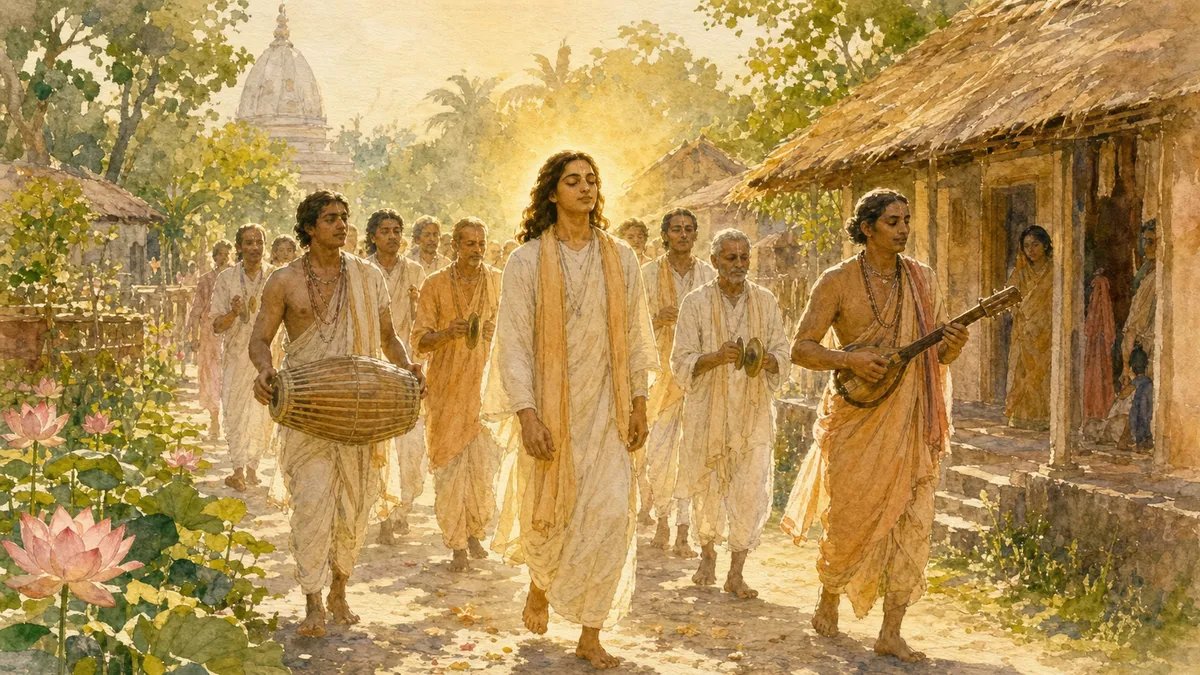
He was very uncompromising with his disciples. It is said that once, during the singing of bhajans, the younger brother of his closest disciple accidentally glanced at a woman, and improper thoughts arose in him, so he deviated from the bhajan. Chaitanya banished him forever. He said: “One who thinks of anything other than God for even a single second is not my disciple.”
Awakening of Aspiration
As we practice awareness, aspiration suddenly awakens in us, like a burning torch. If such aspiration does not awaken, our awareness will give us some clarity, but afterward we may simply stop in the state of manolaya, satisfied with our own meditative experience. Awakenedness like a torch is continuous aspiration, when you constantly move forward, increasing contemplation, when your impeccability grows to a very deep level, when you become very demanding of yourself and do not indulge your egoism even in the smallest things.
To be demanding in meditation means to think: “Even the Buddha needed six years to realize enlightenment. How diligent, then, must I be in meditation.”
To be demanding in renunciation means to think: “Even the mahasiddhas did not want to enter the homes of worldly people; even such a great soul as Milarepa spent his entire life in solitude. How much, then, must I avoid the encroachments of the mind into the world?! How careful must I be?!”
To be demanding in service means to think: “Even great saints like Naropa and Milarepa, striving to receive the Teaching, to work through their karmas and attachments. They carried stones on their backs until sores appeared. How much, then, must I strive in service, casting aside my ‘I’?!”

When you practice in this way, your ego will truly begin to yield its positions, and the flawless diamond of self-born Wisdom will manifest. Therefore one should always practice absolute, total, unconditional devotion without hope for a result, without desire for the fruit. If you think that it is enough to practice meditation, yoga techniques, and contemplation, that is wrong. Many saints of the schools close to our school say that contemplation, devotion, and compassion must go hand in hand. If something is lacking, then over time you will certainly discover this flaw.
On Traditions and Sources of the Teaching
In this edition, the “Shiva Samhita,” “Gheranda Samhita,” “Goraksha Shataka,” “Hatha Yoga Pradipika,” and “Shat Chakra Nirupana” belong directly to the siddha tradition, originating from the siddhas of the Nath school. The “Vijnana Bhairava Tantra” belongs to the school of Kashmir Shaivism. The “Yoga Sutra” belongs to Maharishi Patanjali. The “Damar Tantra” belongs to the extensive canon of tantras related to the teaching of kaya kalpa, or methods of transforming the physical body.
The Boundlessness of Knowledge
When you study the teaching, always think that what you have studied is only a tiny grain, because knowledge is boundless. When someone says: “I have understood how the world is created,” it brings a smile. Not a single mahasiddha, and not even God who creates the world, can say that he has understood it completely. When you receive the teaching, think that it is wondrous and unfathomable, and that what the Guru has now told you is only one one-hundred-and-eighth part of what you will come to know further.
For example, if you came to the ashram but were not given the teaching, did not receive initiations and transmissions into practices, and only performed service, you would surely have different ideas about the teaching. And when they suddenly began to give you the teaching, you would be amazed at how deep and unfathomable it is. What you have yet to study is far greater than what you already know. However, the teaching unfolds in accordance with the logic of transmission. In other words, there is no need to reveal the teaching if the preliminary stages have not been completed, or if the person has not passed through certain steps.

Jyoti Yoga, Taraka Yoga, or the esoteric aspects of Kundalini Yoga are what evoke admiration. When we come into contact with such teachings, we begin for the first time to understand how profound spiritual practice is; we may even reconsider our views on spiritual practice. Personally, I myself am always in awe of the teaching. Since I have studied many different teachings throughout my life and visited many teachers, I have the opportunity to compare and understand the depth of different teachings. And when you encounter the true depth of a teaching, it simply inspires admiration in you as a specialist.
The Value of the Method
When we train in practice, we shorten the period of our spiritual realization not by lifetimes, but by kalpas, which is why this is so important. Many people do not take learning very seriously. They think that twelve years is a very long time. But they do not think that by saving twelve years, they may lose twelve lifetimes.
“Tantra” is translated as “tan” (skillful method) and “traya” (liberation). Yoga refers to certain methods of tantra, and it is valuable precisely because it possesses the method. If there is no method, then we, as living beings conditioned by karmas, kleshas, and ignorance, need a great deal in order to attain realization. When we possess such a method, the time required for realization is significantly reduced, despite our karma and conditioning. Therefore, the teaching is like a miraculous elixir, which should be treated with great reverence. When we treat the teaching with great reverence, we are able to follow the algorithm of the teaching, to pass through all its steps or stages. The spiritual path is akin to alchemy—the teaching of medieval philosophers.
The Right Attitude toward the Teaching
It is difficult to step over oneself. This is a major problem, but it must be done; otherwise, we will not come into contact with the teaching. One should seize the teaching as a person drowning in the ocean seizes a lifebuoy. Do not wait for the teaching to come to you; do not wait for the Guru to offer you the opportunity to receive it.
At first, when we come to learn, we may not understand the depth and value of the teaching. But the Teacher relates to the teaching in a completely different way, and therefore he can turn us toward its depth and value. Usually such understanding is transmitted by the Teacher to the student through testing assignments. In some tantras it is directly stated that when a student acquires a certain devotion to the Teacher, after that the Teacher must test him in various ways for no less than a year. And in some tantras it is even recommended that the Teacher behave in such a way as to shake the student’s resolve: to unsettle him in various ways, to make him somehow lose faith, to drive him away, and so on. If the student does not waver, then this means that he is a worthy vessel, that one can deal with him and transmit the teaching to him.

This is indeed so, because many of the teachings that are transmitted belong to the category of deva (gods). It is said that the gods are displeased when high teachings are transmitted and not properly valued; the siddhas are displeased when teachings are treated incorrectly, when the full price is not given for them. The teachings are regarded as the most innermost part, which is extremely valuable; therefore, if we do not learn to relate to the teaching correctly, it will be difficult for us to follow it, we will not give it due importance, or we will give importance to something secondary. It is precisely when we properly value the teaching that the transmission of the teaching becomes alive, and it works.
