

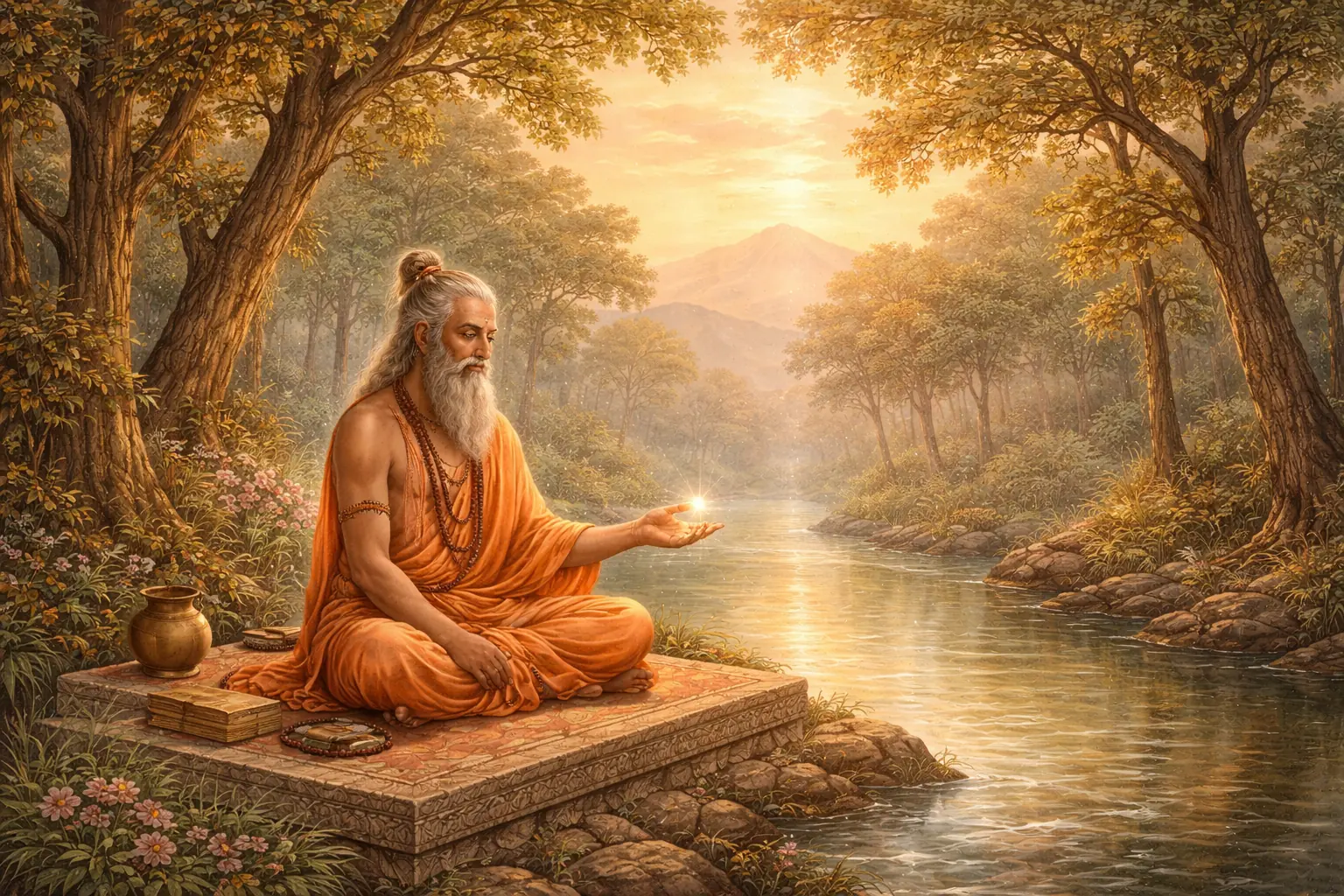
Commentary on the text “Yoga Vasistha,” Chapter 6, “On Liberation.” Description of God.
Vasistha continued:
Shiva dwells in a place known as Kailasa.
I too lived there for some time, praying to Shiva and engaging in spiritual practices. I was surrounded by sages, and together we discussed the true scriptures.
One evening, I was praying to Shiva. The atmosphere was filled with peace and silence. The darkness in the forest was so dense that it could have been cut with a knife. At that moment, I saw a great light. With my outer sight, I saw this light, and with my inner vision, I inquired into its source.
I saw that it was Shiva himself, walking hand in hand with Parvati. The bull Nandi walked before him, clearing the way. I told the disciples of the deity’s presence, and we went to meet him. I greeted Shiva and bowed to him with reverence. For quite some time, I contemplated the divine vision.
Shiva said to me:
“How are your practices progressing? Are there any difficulties? Have you attained that which alone is worth attaining? And have your inner fears disappeared?”
In reply, I said:
“For those fortunate enough to pray to You, nothing is impossible to attain, and they experience no fear. Everyone in the world welcomes and bows before one who is devoted to You and constantly remembers You. Although by Your grace I have attained a state of fullness, I wish to know more about the One. I beseech You, enlighten me. What is the method of praying to God that destroys all sins and promotes bliss?”
Shiva said:
“Do you know who God is? God is not Vishnu, Shiva, or Brahma. Neither the wind, nor the sun, nor the moon, nor the king, nor I, nor you, nor Lakshmi, nor the mind is God. God is formless and indivisible. That bliss and majesty which was created by no one and has neither beginning nor end is God, who is pure consciousness. This alone should be praised and worshipped, for this alone is everything.
If one is unable to worship the formless Shiva, then one should worship a form. This brings limited results, whereas the former leads to infinite bliss. One who ignores the infinite in favor of the finite abandons a beautiful garden and seeks a thorny bush; nevertheless, sages sometimes playfully worship a form as well. Among the means used in worship, the foremost are wisdom, self-control, and the perception of the supreme Self in all beings. The supreme Self is Shiva, to whom the flowers of wisdom should be offered.”
In dualistic teachings and external tantras, when forms of deities are used, a distinction is assumed between the worshipper and the object of worship. That is, a person separates themselves from the deity. The person says, “I am a limited being, a suffering being with limitations, while You are a great deity. Please allow me to establish a connection with You; help me dispel my illusions.”
In the higher tantras and nondual teachings, even if the form of a deity is used, the style of practice is different: there is no prayer or worship, and even if worship and prayer are performed, they take place in a different context. No distinction is made between the person and the deity, or between the object of worship and the worshipper. The person regards themselves as the deity and the deity as part of their own consciousness. From the very outset, they adopt the position of nonduality.
The principal practice for such a person is the principle of contemplation, the unification of presence; however, if any need arises, they perform relative methods, invoking the energy of a particular deity. In doing so, they hold the view that they are invoking the energy of their own primordial Self, their original Mind. This is precisely the position we adopt when invoking the siddhas, when we perform bhajan to the siddhas, and generally in our interactions with deities.
The Nature of Pure Consciousness and the World
I asked Shiva:
“I beseech You, tell me how this world transforms into pure consciousness, and how this pure consciousness becomes individual consciousness and other things.”
Shiva continued:
“Truly, only this infinite consciousness, which remains after the cosmic dissolution, exists even now, completely free from objectivity. Concepts and notions, illuminated by consciousness within itself, appear as this world in exactly the same way that dreams arise within a dream. It is utterly impossible for an object of perception to exist outside the omnipresent infinite consciousness.
All these mountains, the entire world, individual consciousness, and all the elements that constitute the world—all this is only pure consciousness.
Before the so-called creation, when there was only this pure consciousness, where was all this? Space, creation, consciousness—these are merely words, and they point synonymously to the same Truth. Just as the duality experienced in a dream is illusory, so too is the duality implied in the creation of this world.”
What is meant by the statement, “the duality experienced in a dream is illusory”?
In dreams, we often find ourselves in worlds created by our own consciousness. For example, you think about something, and in a dream you may enter the realm of your thoughts. There, the realm of your thoughts will appear to materialize; everything will seem very real. If you think about a certain person, you may meet that person. It will not be the soul of the actual person, but only your thought-form. Although it is also possible to bring about a meeting with another person’s soul. But in dreams, we often enter precisely the realms of our own thoughts. There, the so-called illusory dream body is also created by the power of our mind. And in this illusory body, having mistaken ourselves for the body, we may walk through the rooms of some palace; we may even get lost in that palace and search for a way out, or flee from pursuers, without understanding that everything is actually quite different: that we are not the body in this dream, and that the palace and the pursuers are simply our own materialized thoughts. If we wish, we can make both the palace and the pursuers disappear; however, because of the deeply ingrained habit of regarding ourselves as the body, we fall into duality in dreams, acting in the same way as we do in this limited world. But the palace, our illusory body, the pursuers, or simply other people—all of this is one. This one thing is our own individual creation, a product of our consciousness. It has no additional independent existence of its own. This is duality in a dream.
It is said here that this so-called “real world” is only as real as duality is real in a dream. In other words, duality in this world is identical to duality in a dream. It is simply that duality in this world has a denser, coarser nature, which exerts an even greater influence on the mind. Both in a dream and in this world, the dreamer is the only reality.
Once the dreamer is discovered, the power of this duality begins to lose its hold over us. Just as in a dream a person imagines that they are someone’s son, daughter, mother, or father, that they live in a certain place, and then believes this by identifying with all these things, so too in this physical world a person imagines themselves to be this or that, but in the truest sense they are neither. All of this is merely a set of thought-projections.
When we contemplate, we do not take a position of rejection toward these thought-projections. We change our attitude toward them; we regard them as the pure play of the manifestation of the Absolute’s energies.
When we were children, we imagined that we had been born; our mind formed such intentions. Now our imagination is different—we imagine that we are monks striving for awakening. This is a very important part of our imagination, which we consciously nurture and develop.
When we accumulate more merit and our mind is purified, we may even acquire a divine form. Nevertheless, even becoming a deity is still part of the Absolute’s universal cosmic imagination.
Just as objects seem to exist and function in the inner world of consciousness during sleep, objects seem to exist and function in the outer world of consciousness during wakefulness. In reality, nothing happens in either of these states.
Just as consciousness is the reality in the dream state, consciousness is likewise the only reality during wakefulness. This is God, the supreme Truth, that which you are, that which I am, and that which everything is.
True Worship
Shiva continued:
“Worship of this God is true worship, and through such worship everything can be attained.
He is indivisible and cannot be divided, is nondual, and is not created as a result of activity. He cannot be attained through external efforts. Worship of him is the source of joy and bliss. External worship of a form is prescribed only for those whose intellect has not awakened.”
If we put it that way, then it is prescribed for almost everyone.
We cannot completely ignore any external forms. With regard to form, we take the position of integration, of unification. Unlike dualistic teachings, integration, unification, is worship without a worshiper, worship without an object of worship.
What is called worship (bhakti) in dualistic religions is called integration in Anuttara Tantra—unification in presence. A bhakta attunes to their deity through worship, recitation of mantras, ritual practices, service, prescribed sadhana, visualization, and prayer texts. Through this, they concentrate the Mind on the chosen form of the Deity. The aim is to attain twenty-four-hour concentration on the chosen deity and then become imbued with its bhava, so that this bhava and the image of the deity displace all obscurations and dissolve the dualistic states of karma.
For us, however, the object of integration is the pure space of awareness, which, unlike a deity with form, has no attributes or, conversely, may manifest with attributes. And instead of worship, the principle of integration, of awareness, is used. For example, the meditative technique of Brahma-vichara is such a practice of nondual worship, as is the sankalpa “Divine Pride.”
If someone lacks self-control, they use flowers for worship. Such worship is pitiful, as is the worship of an external form. Yet these immature worshipers derive satisfaction from worshiping an object they themselves have created. They may even obtain useless results from such worship.
Now I shall describe how advanced practitioners like you should worship.
The God worthy of prayer is truly the one who contains the entire creation, who is beyond the reach of thought and beyond description, beyond even such concepts as “all” or “collective totality.” Only that is called God which is undivided by time and space, whose light illuminates everything, which is pure, and which is absolute consciousness. He is the consciousness that stands behind all its parts, that is hidden in everything that exists, that is the essence of everything, and that veils the Truth. This Brahman at the heart of existence and non-existence is God and the Truth indicated by OM.
He exists everywhere as the nature of the flower within the flower. This pure consciousness that is in you, in me, and in all gods and goddesses—this alone is God. O sage, even other Gods with form are nothing but this pure consciousness. The entire universe is pure consciousness. This is God; this is all that I am. Everything is attained through his grace and proceeds from him.
This God is close to everyone, O sage. Nor is he difficult to attain: he is always present in the body, and he is everywhere like space. He does everything—eats, walks, breathes, and knows every part of his body. He is the light in which all these parts move and in which all the various actions take place. He dwells in the cave of everyone’s heart. He transcends both the mind and the five senses, and therefore cannot be understood or described by them, but for the purpose of instruction, he is called consciousness. Thus, although it appears to do everything, in reality it does nothing. This consciousness is pure and appears to be involved in the activities of the world just as spring is involved in the blossoming of flowers on trees.
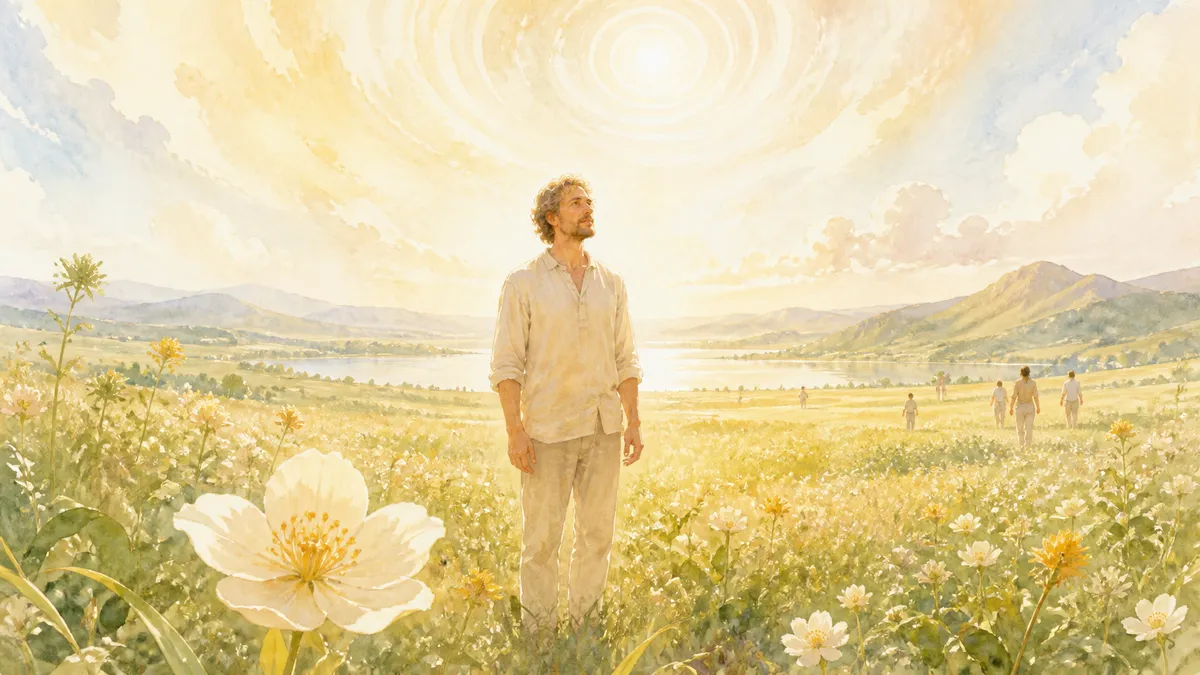
Consciousness as the Foundation of All Manifestation
God continued:
“In some places, this consciousness becomes space; in others, action; elsewhere, matter, and so on, always without any intention of doing so. Just as all the different oceans are one indivisible mass of water, consciousness, though described in different ways, is one vast mass of consciousness. In the lotus-like body, it is the same consciousness that pervades sensation, which is like honey gathered by the tireless bee-like mind. In this universe, all the diverse beings (gods, demons, mountains, oceans, etc.) arise from infinite consciousness, just as foam and waves appear on the surface of the ocean. Even this wheel of ignorance, which causes the wheel of life and death to turn, revolves within this cosmic consciousness, whose energy is in constant motion.
It was consciousness that assumed the form of the four-armed Vishnu, who vanquished the demons as a thunderstorm quenches the earth’s thirst. It is consciousness and nothing more that assumed the form of Shiva and Parvati, the creator Brahma, and the other diverse beings. This consciousness is like a mirror that appears to contain reflections within itself without undergoing any change. Without any modifications, this consciousness appears as all the diverse beings in this universe.”

Thus, the famous theory of the mirror and reflections—the theory of pratibimba-vada—is presented here. It is originally a Vedic theory that was subsequently adopted by various other traditions.
It states that pure consciousness, like a mirror, remains unchanged and undergoes no modifications even when various objects are reflected in it. For example, if we take a mirror and the Buddha is reflected in it, followed by a dog, a person, or billions of other things, the mirror itself is in no way sullied or affected by the results of those reflections. When the images disappear, the mirror shines as purely and pristinely as it did before the billions of reflections. In the same way, material phenomena are reflections on the surface of the pure mirror of the primordial Self. It is never sullied by them, even when it seems to be constantly obscured by these reflections.
It is only through this infinite consciousness that all this is thought, done, and expressed. It is infinite consciousness alone that shines in the sun. This infinite consciousness manifests in all bodies, which are in fact inert and, by coming into contact with one another, give rise to various sensations. This consciousness is like the wind, which is itself invisible, but in which dust and dry leaves rise and dance as though of their own accord. This consciousness seems to cast a shadow within itself, and this shadow is called inertia.
In this body, thoughts and concepts lead to action only in the light of this very consciousness. Without this consciousness, it is impossible to sense or understand an object, even if it is placed directly before a person. This body cannot act or exist without this consciousness. It grows, eats, and dies. This consciousness creates and sustains all moving and unmoving beings in the universe. This infinite consciousness is the only thing that exists; there is nothing else. Only consciousness can arise within consciousness.”
A human being resembles a spiritual or intellectual giant whose memory has, for some reason, been blocked by programmers during rebirth, leaving him with five percent of his consciousness instead of one hundred percent. This five percent is enough for him to survive, build relationships, and contemplate certain things. He does not even suspect what colossal potential lies within him. This colossal potential is buddhi—intuitive consciousness.
As intuitive consciousness (buddhi) unfolds, the perception of the Atman begins to shine forth in its primordial form.
Buddhi (intuitive consciousness) resembles a mirror covered with dust, which cannot reflect clearly enough simply because there is so much dust on it.
Manas (the conceptual mind) is already a secondary reflection of this mirror, arising in this “dust-covered” state. This is precisely why the conceptual mind is highly susceptible to fixed ideas, acceptance and rejection, and attachment to the conceptual level.

By purifying the mirror of buddhi, it is as though we remove this blockage, and our potential begins to unfold fully.
The Nature of Identification and Liberation
Then I asked God:
“If this consciousness is omnipresent, how can someone lose consciousness and become inert? How can one who has consciousness lose it?”
God praised the question and replied:
“The omnipresent consciousness, which is all in all, exists in this body in both a changing and an unchanging state. Just as a woman may dream that she is not herself and that her husband is someone else, so the same consciousness may mistake itself for something else. Just as one person may behave differently in an ordinary state and in a fit of rage, so consciousness associates itself with another aspect of itself and acts accordingly.”
When we identify with samsaric problems, this indicates that we are mistaking ourselves and others for someone else. It is precisely due to such confusion and mistaken judgments that what is called samsara, karmic life, and karmic vision arises.
For example, if someone approaches a person, thinking that he is a police officer, and asks for help, but that person is not a police officer at all, he says, “You have mistaken me for someone else.” The person addressing him then says, “I’m sorry; in that case, there are no further questions.” That is all—the entire situation immediately disappears.
In the same way, when we act in samsara, we mistake ourselves for the body and the role assigned to it. Likewise, we mistake others for what they are not. As a result, dualistic vision arises. The mind becomes deluded, and various desires arise within it. Following these desires, it passionately pursues them and begins to hate whatever obstructs their fulfillment. This is how attachment, hatred, and duality—that is, raga and dvesha—are generated.
Vasishtha says that such a mind becomes a victim of anger and lust, goes through good and bad times, experiences pain, enjoys pleasures, hopes, suffers, becomes filled with what is desired and undesired, and all of this intensifies delusion. Once sufficiently deceived, it moves from one error to another, from misunderstanding to even greater misunderstanding.
Vasishtha says:
“Understand and assess the power of misunderstanding: merely by forgetting its own true state, consciousness suffers and passes through horrors and falls.”
Primary Self-Identification as the Foundation of Practice
In other words, our misunderstanding lies in the fact that we regard ourselves as ourselves. It is precisely because we regard ourselves as ourselves that we are ourselves, and only afterward does the thought arise that, of course, we need to liberate ourselves and attain enlightenment. Then thousands of actions that we need to perform come into play. All this happens because, at the subtlest level, in the very first instant, the fact arises that we regard ourselves as ourselves.
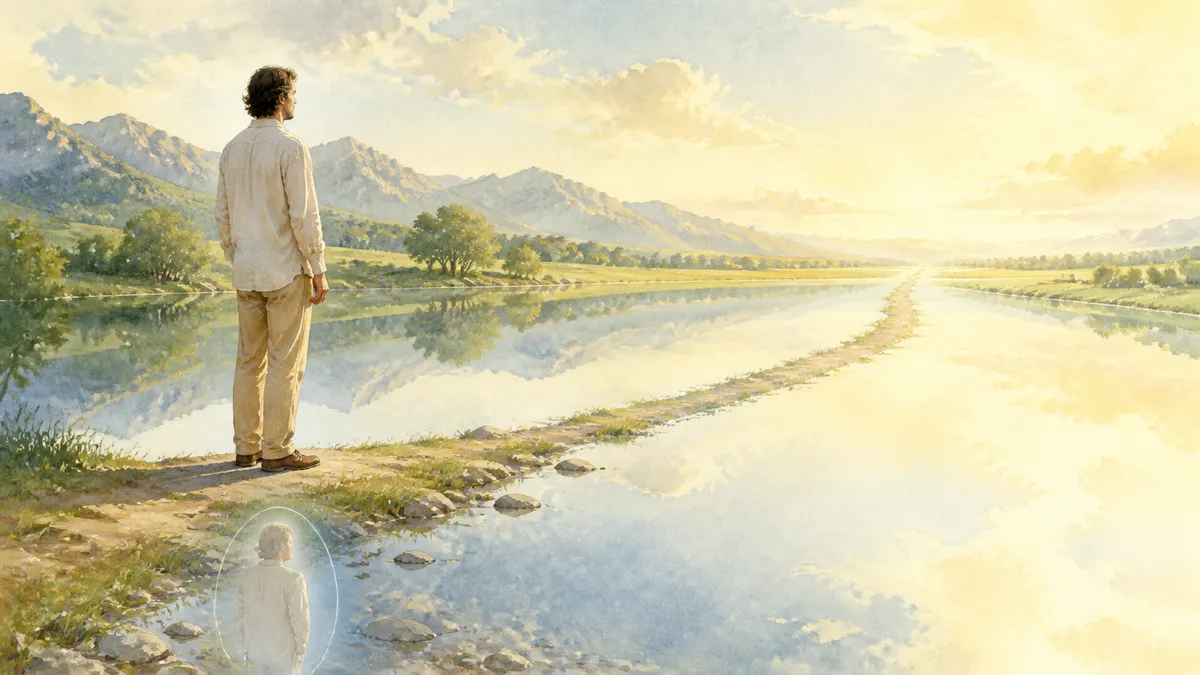
That is, if we regard ourselves as ourselves, then, of course, we need to liberate ourselves, since our present form and status do not satisfy us at all. But if we do not regard ourselves as ourselves and instead regard ourselves as the Absolute, then an entirely different situation arises. Entering into presence in Advaita means precisely detecting and catching this very first moment of identification—that is, the false judgment and belief that one is a limited self—and replacing this false identification with another: “I am Brahman” or “I am the Absolute.” This means that one must begin to build all of one’s sadhana and one’s entire life precisely by changing one’s primary self-identification, and then the whole practice is established on a deeper level.
This, of course, does not negate relative practice, but it changes our attitude toward it in the sense that, from the very beginning, we adopt the position of abiding at the summit. Some successfully regard themselves as the Absolute, while others are less successful in regarding themselves as the Absolute. Logically, all monks, even novices, should train from the very beginning to regard themselves as the Absolute; nevertheless, everyone succeeds at this to a different degree.
Some people regard themselves this way for five minutes a day during a lecture, and then spend twenty-four hours a day reciting this mantra: “I am a limited being, I have this and that, I am such and such.”
Others regard themselves at the level of vision, sustain themselves at the level of contemplation, and begin to reveal within themselves the powers inherent in it, which manifest as their clarity, creativity, samadhi, and so forth.
The Practice of the View and the Attainment of Faith
Nevertheless, all of you have high potential from the very beginning. And, of course, it is not enough to regard oneself as the Absolute merely at the level of declaration, that is, simply to state: “Yes, I regard myself as the Absolute.” No matter how many times you say, “I am the Absolute,” it will not help.
There was a female student who asked me questions about awakening, and then she came to the conclusion: “Well, I am already a Buddha.” I said: “Your problems and limitations will not disappear after you declare this. It is correct in terms of the view, but it is wrong to relax in terms of meditation and conduct.”
Regarding oneself as the Absolute is a practice of the view (vision, outlook) to which we become accustomed. Such self-perception becomes meditation, worship, and contemplation, which gradually washes all our limitations out of the dualistic mind and reveals divine powers.
And gradually, a yogi should develop faith in the view. That is, regarding oneself as the Absolute is the view, while understanding how to do this non-conceptually is the true view, rather than an intellectual one.

At first, we acquire an intellectual view. However, an intellectual view is useful when writing treatises and taking examinations, but in terms of enlightenment it cannot lead to liberation, although it is very important as a foundation. Then we must awaken to the non-conceptual view “I am the Absolute” as awareness on a non-conceptual level. After that, we must gain great confidence and faith in it, constantly relying on it so that it begins to give us spiritual power.
One who does this diligently, correctly, and without distraction becomes that very thing. After some time, one becomes like Brahma (the creator of the universe), like Vishnu (the preserver of the universe), or like the gods and siddhas, because one becomes established in the same fundamental ground.
