


Commentary on the text “Shri Guru Charitra,” the biography of Narasimha Saraswati—the incarnation of Dattatreya
Sage Parashara said: “O king, your son lived for only ten years. Beyond that, he had only eight days left.”
Then the king prayed to the sage to show him how death could be avoided. The sage said: “The only way is to surrender to Shankara and perform Rudra-japa.”
The True Nature of Surrender
To surrender to Shankara means to surrender to the supreme good. For many, the term “surrender” is not clear. For example, Shri Ramana Maharshi was asked the following question: “Well, I have surrendered. What next? I can see that the problems have not gone away.” Ramana replied: “That means you have not surrendered in the way you say you have.”
In the teachings of laya yoga, such a question cannot arise in principle, because we say that true surrender is possible only when we have mastered contemplative presence. And if we have not mastered contemplative presence, there is no one to surrender. It is unclear who should surrender to whom, and what surrender means. If contemplative presence has not been developed, words about surrender will merely be phrases borrowed from other people, not felt inwardly. It will be imitation, copying, or simply an emotional perception.
Many try to practice surrender in bhakti yoga. They often experience tremendous confusion when their minds become somewhat clearer and they begin to reflect: “Who should surrender to whom? How does one surrender correctly?” They go through enormous mental difficulties. Why? Because before surrender, a great deal of spiritual work must be done, during which the yogin must clearly understand that surrender is not giving oneself over to anything external, but rather the subtlest process of contemplation and transformation of karmic perception, when awareness shifts from the level of ahamkara (ego), rises to the level of buddhi (intuitive intellect), and then to the level of Atman.
This shift of awareness, accompanied by a tremendous re-evaluation of values, is surrender. All other forms of surrender are not genuine. Surrender is not connected with ritual practice or anything else, although ritual practice can help it. Surrender is connected precisely with a change in the level of awareness. And a monk experienced in contemplation, even if only to some degree, understands what it means to be in the ego and what it means to be in the transcendent.
“Then the king summoned Brahmins to perform Rudra-japa and performed abhisheka beneath the sacred tree. Every day they bathed the king’s son, Sudharma, with holy water. They performed japa 10,000 times. On the eighth day, the king’s son lost consciousness. Rishi Parashara recited sacred verses and sprinkled Sudharma with holy water. Thanks to Rudra-japa and abhisheka, Sudharma’s life was saved.”
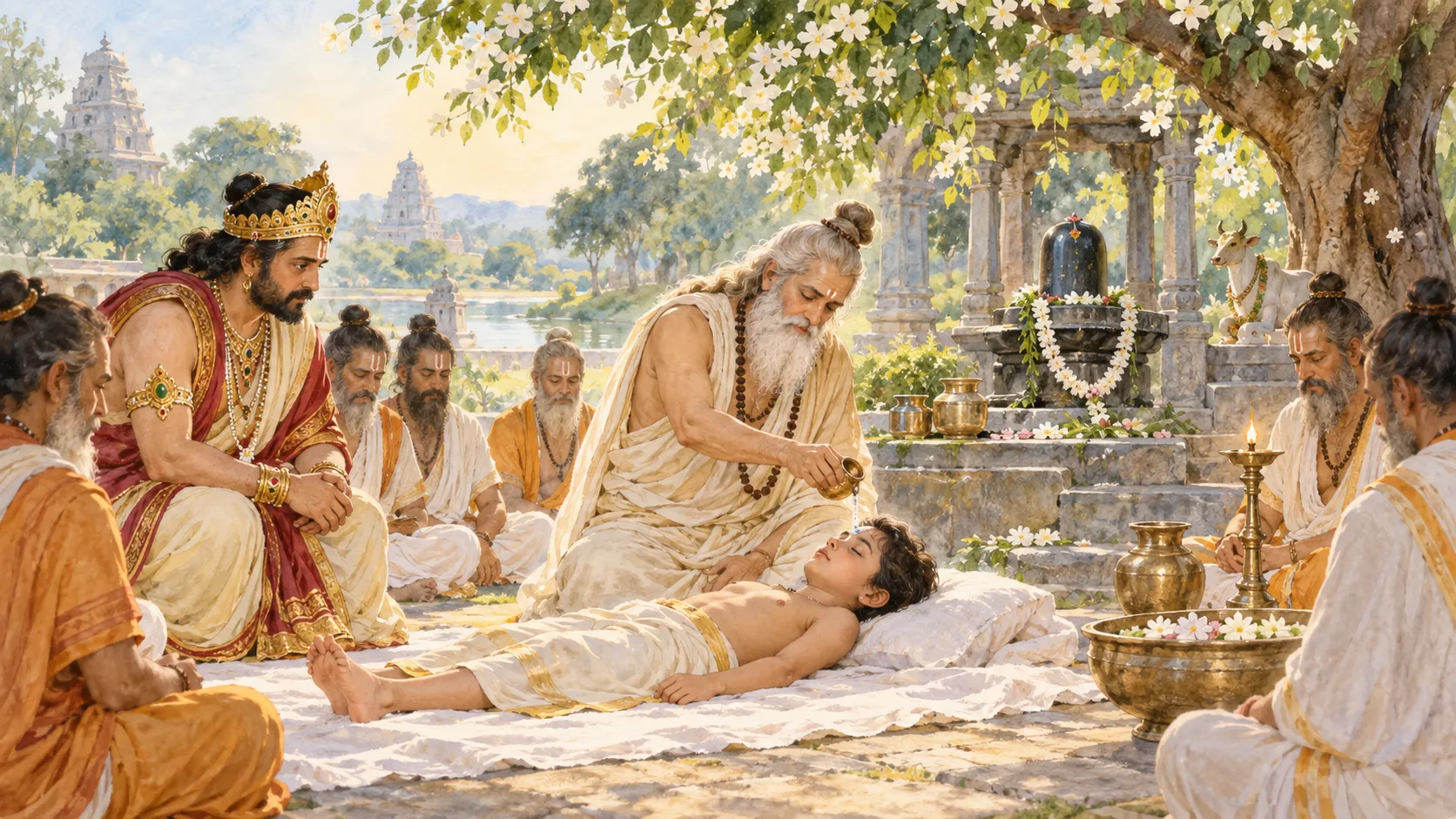
This describes how a saint, using the magical means of tantra and mantra recitation combined with contemplative presence, removed an obstacle from the life of the king’s son. According to karma, the king’s son was destined to face insurmountable obstacles: he was supposed to leave his body at the age of ten. Thanks to the power of the incarnation of Dattatreya, these obstacles were dispersed, so the king’s son lost consciousness but remained alive.
The Nature of Obstacles and Overcoming Them
Obstacles can be different. Sometimes they may simply cloud your clarity. As a rule, a yogin of superior abilities is not afraid of obstacles; they can self-liberate them. For a person who does not practice, obstacles connected with an unfavorable astrological situation, the influence of spirits, the formation of karmic knots, and so-called dharma-karma (difficult-to-overcome karma) are serious matters.
It is said that obstacles usually come at night. They disrupt the flow of astral energy from the causal body to the mental body, from the mental body to the astral body, and from the astral body to the etheric body; this then manifests on the physical level and at the level of events. At first, all events occur on a subtle level, and only afterward do they materialize. A highly accomplished yogin can track these events on the subtle level and, even before they materialize, enter into them and change them. Then they do not materialize on the physical level.
Human illnesses and the difficult situations that happen to us are the result of battles lost in the subtle body. If a yogin wins these battles—that is, self-liberates them, unites them with contemplative presence, and brings negative energies to the state of pure vision, to the mandala—then they cease to be obstacles; this is the principle of pacification. If a person is unconscious, however, obstacles can enter their destiny in various ways.
I often warned various people about possible obstacles. Some believed me, others not so much. And when these obstacles actually arose, these people would say to me: “You were right! I should have listened to you.” But then I thought that even if you warn someone who does not engage in spiritual practice about possible obstacles, they are unlikely to be able to change reality. Only a practitioner who is familiar with the subconscious, whose power of intention can truly influence a situation—and even then only to a certain extent—can change the astral situation and thereby alter reality.
There are three types of karma:
dridra – karma that can be changed even with little effort
adridra – karma that cannot be changed no matter what you do (that is, something beyond you, arising from certain universal plans; you can only accept it by letting yourself go)
adridra-dridra – karma that can be changed, but only by making a very great effort

When we practice natural contemplation and self-liberation, at the very least we can learn to accept any obstacles, self-liberate them at least on the level of consciousness, and not identify with them. This harmonizes the mind and the pranas. Even when suffering comes, your mind remains sober and clear; it does not panic but simply contemplates, integrating with the suffering. In other words, a true yogin turns even obstacles and suffering into practice, viewing them as a blessing, as a wrathful play of energies.
The saints say that evil is just as full-fledged a part of God as good. It can be compared to the venom of a snake. If there is a snake, then there is also venom. Evil is simply a kind of wrathful shakti. But when a person is not present, they deny it and cling to something, which is why suffering arises. A yogi abiding in contemplation denies nothing; instead, they remain in total acceptance, uniting everything with presence. And then, paradoxically, even suffering and obstacles are eliminated, becoming part of the spiritual path, integrated into the field of their energies. To integrate suffering into the field of one’s energies means to pacify it, calm it, and make it part of the mandala, part of pure vision.
For example, when Milarepa decided to leave his body and accepted the poison offered to him by a woman, he said: “This is my play. For me, even illness is like an ornament. I simply already want to go to the Tushita heavens, to another world, so I am using this situation.”
Managing Events through a Change in Consciousness
When a yogin’s power of intention is even greater, they can stop and pacify any obstacles. They can influence a situation so that another possible course of events manifests—one without obstacles. They can open another version of the universe, where the situation develops in a completely different way. This is indeed possible because there is a field of possibilities, and we always have a choice. The thing is, this choice can be realized only if we possess deep contemplative presence. Conditioned people, of course, do not have such a choice, so they cannot change events; this question does not even arise for them. But through the power of their consciousness, a yogin can control events by opening up other possible developments. Everything depends on the depth of one’s immersion in the Source.
Why does the field of possibilities exist? Because an infinite number of events are occurring simultaneously throughout the universe. The universe has infinite dimensionality. And when events occur, this means that, in accordance with our karma, certain events come to light that simply correspond to the configuration of our consciousness, our bhava. And if, through presence, we change the configuration of our consciousness, it is capable of bringing other possible developments of events to light. In the relative dimension, it will seem that we have changed the course of events, but in fact we have brought to light a completely new, independent, autonomous possibility for the development of reality. And an experienced yogin who possesses prakāmya-siddhi understands that he can influence a situation by changing himself from within, because the entire situation is merely a consequence of the state of his consciousness.
As practitioners of laya yoga, we are interested in a global transformation of our situation—the accomplishment of the “great transition.” Influencing a situation in minor ways is an unserious pursuit, although it can sometimes be useful. We do not consciously engage in this, because it is akin to sorcery and shamanism. At the very least, it is not something that liberates one from suffering in samsara.
When we practice the path of contemplation in the siddha tradition, we want to change the situation not in minor ways, but radically and globally. We are not satisfied with small changes. We want to change the situation so that we no longer have to deal with isolated events, but so that everything changes completely once and for all; so that our world changes; so that we enter another karmic dimension—pure vision. This is called the principle of the mandala. The very goal of the yogin is to accomplish the “great transition,” when, through presence, the situation changes radically and the yogin enters pure vision.

The Power of Vows and Their Influence
“A sinner will be purified if he listens to ‘Shri Guru Charitra.’ Whoever has faith in Shri Guru can obtain everything.
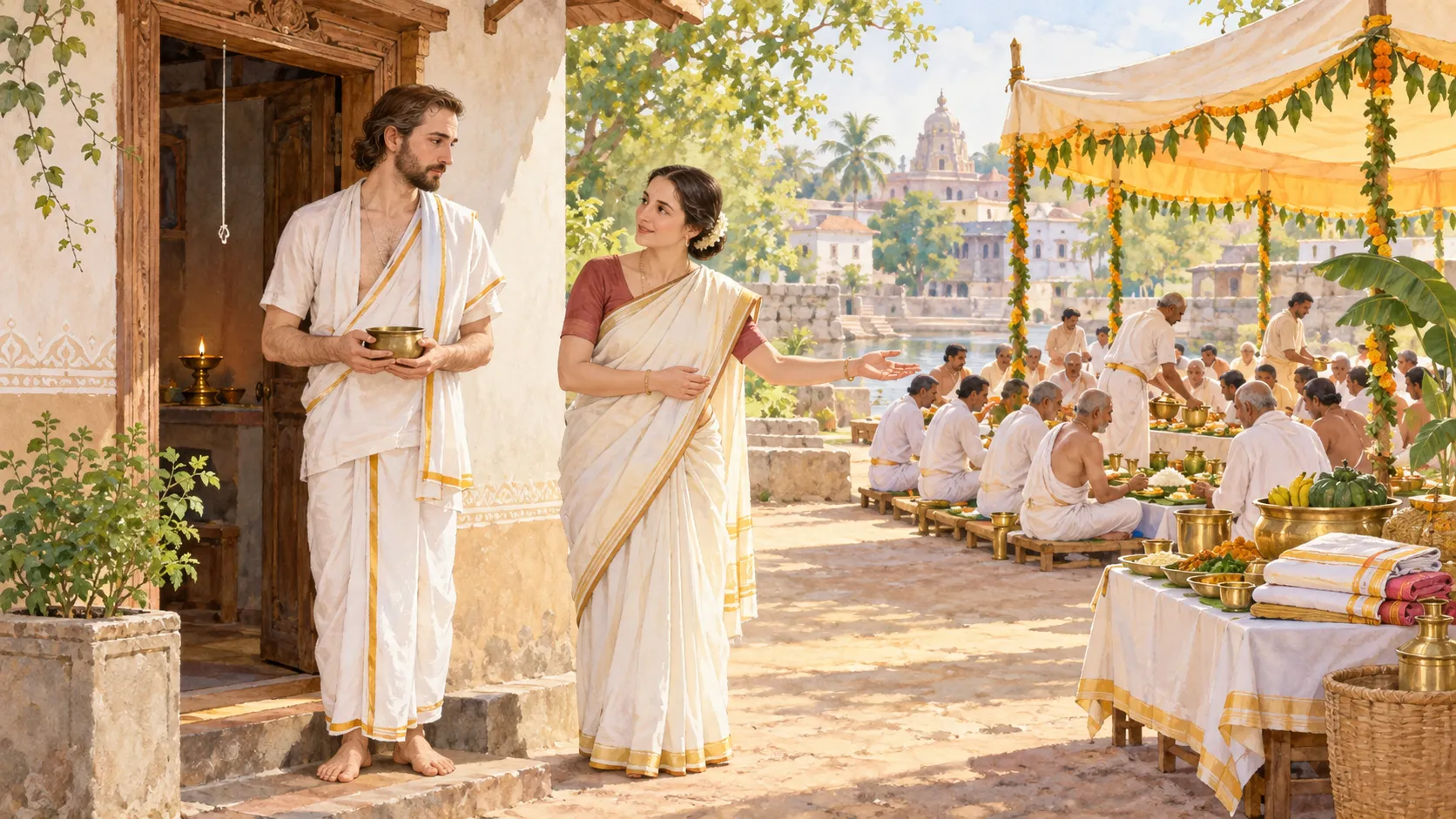
There lived in Ganagapur a brahmin who was free from attachments. He had taken a vow not to accept food anywhere except in his own home. He would receive food through bhiksha and eat at home. His wife did not like his way of life. Every day, brahmins would usually eat in the town, and she thought to herself: ‘How unfortunate I am! I cannot attend these festivities because my husband has vowed not to eat outside the home.’
One day, a communal feast was organized. The brahmin’s wife said to him: ‘Look, brahmins are being invited, and they are being given abundant food as well as gifts. Do not refuse this invitation.’
The brahmin said: ‘You may go to the feast and enjoy yourself.’ When she informed the organizers of the celebration that she would come alone, they told her that the invitation was for two people and that they should come together. She became sad, went to Sadguru, and told him about her wish. The Guru called the brahmin and said: ‘Go to the celebration together with your wife. Women should not be disappointed; their wishes should be fulfilled.’
At Shri Guru’s command, the brahmin went to the feast with his wife, but while she was eating, she felt as though she were eating in the company of dogs and pigs. She left the feast in disgust, and both of them prostrated themselves before Shri Guru. The brahmin said: ‘Because of her, my vow not to eat outside the home has been broken.’
Sadguru said: ‘Your wife’s wishes have been fulfilled. Now she will not want to eat anywhere. You accepted food with my permission, and therefore you are not to be blamed. There is no disgrace in accepting food in the home of the guru, his disciples, one’s uncle, father-in-law, or respectable and honest people. But it is certainly sinful to eat at the homes of misers, the envious, people who cause harm, dishonest people, or murderers. If you do so, you will have to suffer for your sins for a long time.’
The Brahmin made a vow. When someone makes a vow and truly fulfills it, this is called the “principle of vrata,” an obligation. The power of the vow provides additional shakti. For example, if a mother’s child was ill, she would make some kind of vow: to eat only with her left hand until the child recovered, or not to untie her hair. Through the power of the vow and self-restraint, her tapas created an astral situation in which healing took place. The texts also contain stories of how someone insulted a Brahmin, after which the Brahmin vowed not to tie his shikha (tuft of hair) until he had taken revenge on the offender. In other words, this is the practice of prakamya-siddhi, strengthened by the addition of a vow.
When the Brahmin’s wife went to the communal meal, she inadvertently entered the sphere of the Brahmin’s vow. Since the Brahmin had broken his vow, certain aparadhas occurred. His state was not very good, so the woman felt as though she were eating in the company of dogs and pigs. But Shri Guru removed these aparadhas by explaining everything to the Brahmin.
If you have made some kind of vow, it can be lifted only if the guru lifts it from you. That is, some ritual must be performed; otherwise, the vow must be fulfilled in some way so that aparadhas do not arise. If this does not happen, you find yourself in a rather unfavorable situation in which bad karma returns to you or obstacles arise. If an initiation is given that cancels the vow, then this is fine. In the case described, Shri Guru did indeed cancel the vow.
The Influence of Consciousness on Food
He also explained to the Brahmin that one should not eat food prepared by people with impure consciousness and impure prana. If you consume food prepared by people who are possessed by desires, you absorb their karma and their sins. They charge this food with their impure prana, and when you taste it, your subtle body becomes contaminated.
Once I ate in a cafeteria, deciding to practice a single “taste.” But later I thought that it would have been better not to eat at all. In other words, for training in a single “taste,” this can be useful if your prana is strong. But after eating food prepared by people with impure prana, you may even feel ill. That is why we have certain requirements for food preparation. These requirements are always taken into account among siddhas. Of course, if the level of your prana and presence is immense, you can even eat from the hands of a leper and nothing will happen to you, because you can transform this food into pure vision. However, you should not do this until you actually possess such a purifying presence.
Those who prepare prasad must always be in a pure state of mind. You must not be irritated, angry, or in a tamasic state. The energy of your thoughts blesses the prasad, and those who eat it will certainly feel this if their subtle bodies are sufficiently sensitive.
Once, a disciple of Nagarjuna brought an offering. Nagarjuna said: “Throw this offering away. It was given by an impure woman. If you eat it, you will encounter obstacles.” This shows that the siddhas took such matters seriously.

Instructions on Traditions and Worship
“Shri Guru explained the tradition that Brahmins should follow. He said: ‘You should use deer skin in the home and keep the house clean. The prayer room should be clean and decorated with rangoli. Meditate in silence and worship God. You may worship stone and wooden images, because they are forms and abodes of God. Sit on a good, clean seat and perform pranayamas. Worship God with flowers. Worship Vishnu and Tulasi with faith, because he loves Tulasi. Worship Shiva with bilva leaves. Ganapati loves the trident. After noon, feed your guests.’”
What does “worship” mean in the Laya Yoga tradition? There is no dualistic worship in the Laya Yoga tradition. In other words, dualistic worship is characteristic of Dvaita and Vishishtadvaita, whereas in Advaita, the worshipper and the one who is worshipped are essentially one. Therefore, when worship is discussed from the perspective of Advaita Vedanta, it means contemplation and integration through invoking universal energies. Essentially, worship is a process of integration, of attuning oneself to a particular energy.
If you invoke any deity according to the prescribed rules, it means that you are calling forth the energy of that deity from the space of the universe, and at some point it will certainly respond. This energy may manifest in the form of visions in dreams, as some miraculous phenomena, as sound, or as experiences in meditation. But unlike the dualistic approaches of dvaita and vishishtadvaita, we speak of invocation and integration. This means that even when performing invocations of certain deities, we remain in contemplative presence, without dividing reality into the worshipper and the one who is worshipped. That is, we regard them as a single state of contemplation in non-duality. And when any divine or universal energy arrives, we regard it as part of the nature of Mind.

Rules of Diet and Lifestyle
“Lotus leaves and banana leaves are good for eating. Eat sweet dishes first. Rice should not be eaten first. Overeating is forbidden. There is no harm if someone eats with clarified butter. After eating, one should study the Vedas. One should not sleep on the ground where cremation has taken place, in a ruined temple, on the bank of a river, near an anthill, or at a crossroads. Rishi Parashara established these rules and this dharma. There are no difficulties for one who follows this tradition as it is written in the sacred scriptures. Even the gods honour him. Kamadhenu will come to his home. Lakshmi will reside in such a home forever. Such a person will become a brahma-jnani.
The Brahmin was happy to receive such instruction in dharma and said: ‘O ocean of compassion, you have taken this incarnation to save your devotees. You are like a beacon of knowledge. You dispel darkness.’
Having said this, the Brahmin bowed to the lotus feet of Shri Guru. The Guru blessed him. Such is the story from the “Shri Guru Charitra.” Whoever listens to it will gain great knowledge. It is a source of light that dispels ignorance.
