

Commentary on the text “Ashtavakra Gita”
The “Ashtavakra Gita” is Ashtavakra’s instruction to King Janaka.
Have faith, my dear, have faith. Do not allow yourself to be cast into delusion. You yourself are the Lord, whose possession is knowledge. You are beyond the law of karma.
The body, following the senses, stops, sits, or moves. But you neither go anywhere nor come from anywhere, so why worry about anything?
The True Nature of Faith and Contemplation
Here it says: “Have faith.” If you have the correct understanding of faith, then for you faith and contemplation are one and the same. Faith is inseparable from contemplation, and contemplation is inseparable from faith.
When we speak of faith (the Sanskrit term “shraddha”), we do not mean the faith accepted in theistic religions and based on external worship and mental dogmas. We have a different understanding of faith. Faith based on external worship and conceptual dogmas is dualistic, and therefore there is little use in it (except in those cases when a person becomes so strongly absorbed in such dualistic faith that it completely dissolves their false “I”). Such faith is blind; it has no genuine depth or contemplativeness; it is mental, and therefore cannot liberate one from the ocean of birth and death.
When speaking of faith, we mean a connection with the subtlest body, or the channel of atma-bhava. For us, to be in a state of faith means to be in the channel of buddhi (intuitive knowledge) and, through this channel, to be connected with the supreme Source. As monks, you open this channel with the help of instructions and guru yoga, and then for years you nurture it and train to maintain it so that it always remains very pure. In fact, to be in a state of faith means to be in uninterrupted contemplation of the natural state, to reach the causal body, to experience brahma-aham-bhava (the feeling of unity with the Absolute). It is precisely such faith that is very important for us.
And what does it mean to lose faith? It means that you have lost access to your subtle body, and therefore the channel of atma-bhava has closed. Why does this happen? Because of inattentiveness, a low level of energy, kleshas, and insufficient clarity.
Here it says: “Have faith.” That is, what is being spoken of here is the need to have this connection with the subtle body. If you act on the basis of this connection with the channel of buddhi, you are in intuitive consciousness, which gives you a completely different vision of the world. If you have faith, you cannot be offended, you cannot be in anger, in suffering, in confusion, in doubt. Even if there are some temptations on the gross level (and in samsara they are always present, because samsara is a wrathful mandala, a world of impure vision), on the level of consciousness you do not have even the slightest wavering, suffering, or hesitation. All of this completely self-liberates.
True faith means abiding in the channel of atma-bhava, and this changes everything, because then “God burns in your eyes.” You do not need to listen to Vaishnava bhajans in order to encourage yourself, because your own bhajans are playing in both of your ears. You do not need to orient yourself toward something external, because from this channel of atma-bhava you receive a colossal charge of shakti that melts everything around you.
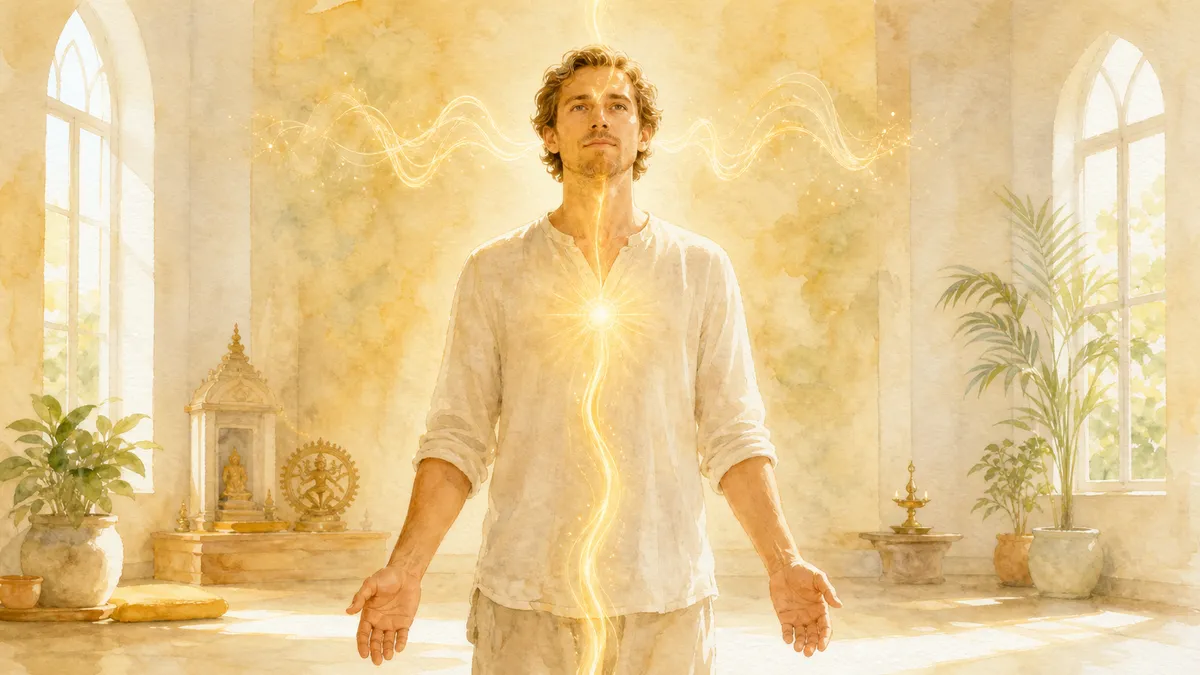
A saint is in a state of faith nonstop. And true contemplation is being in such an uninterrupted state of faith; it is a constant connection with the causal (intuitive) body.
Abiding in Pure Consciousness
Let the body live until the end of time. And even if it comes to an end right now, what do you, the one who consists of pure consciousness, gain or lose?
If you are in the intuitive body and you have this state of faith, in fact you receive nothing from external conditions and lose nothing. But if you become distracted, do not have discerning wisdom, and the channel of connection is lost, then you immediately slip into identification with “I am the body, I am the mind,” and then a new universe opens before you. It may seem that you remain in the same world, but for you everything immediately changes.
Let the waves of the worlds rise, or let them subside according to their own nature, in You, the great ocean. This is neither gain nor loss for You.
Here the famous method called “leaving everything as it is” is described. Leaving everything as it is implies your stable abiding in the subtlest body. And then you are in such a vision that nothing gives you any benefit, nothing can bring you harm, because your consciousness is already so whole and complete that you no longer depend on any of this; your mind does not waver, and you simply allow events to happen.
Of course, you take external conditions into account and maintain various games of the relative dimension; nevertheless, on the inner level you simply allow events to happen. You do not cling to them, do not evaluate them as bad or good. However, if the circumstances are such that something needs to be considered bad and something good, you allow that too. But these are no longer judgments, but simply games that you accept for the convenience of existing in the relative dimension.

Unity with infinite consciousness
My dear, you consist of pure consciousness, and the world is a part of you. So who is to accept or reject, and how, and why?
What birth, karma, or responsibility can there be in this one unchanging, peaceful, stainless, and infinite consciousness that is you?
Usually, when beginning practitioners hear about infinite and stainless consciousness, they think it is something distant, that it is the Absolute that must be reached. Nevertheless, this describes your ultra-subtle body, which you have right now in exactly the same way as the heart, liver, and other organs of the body. Whether you want it or not, it is inherent in you by right from birth. You can acknowledge this and become rooted in it, or you can be unaware of it and continue to be deluded.
Practices in lucid dreaming
You can benefit if, while in a lucid dream, you perform some practice there. For example, you can perform Guru Yoga based on Om or Guru Yoga with the recitation of the names of the siddhas. By practicing in this way, you will purify dreams and be able to receive blessings, and your clarity will increase significantly.
If you want to remember a dream, to unite the dream and the waking state, then immediately after awakening perform Guru Yoga based on the syllable Om and unite contemplation in the dream with contemplation while awake.
If you want your thoughts to gain power and come true, remember that you have the practice of dedication of merit, which you perform on Saturdays. Dedication of merit is a very powerful practice. For example, if you read a certain line from the text of dedication of merit and sincerely dedicate your merit to it, you can give blessings to others.

The practice of dedication of merit consists in your recalling all the spiritual power you have previously accumulated, all your tapas that you have performed for the sake of enlightenment, and then, through the power of intention and benevolent aspiration, connecting a person to this information and sharing with them a particle of your tapas. You can do the same in a dream: recall your merits and express some intention (sankalpa), repeating a line from the text of merits. For example, in this way one can free from suffering in the bardo a being who cannot emerge from a lower state. If your merit is truly great, you can give the blessing of long life. But this should not be done often.
