

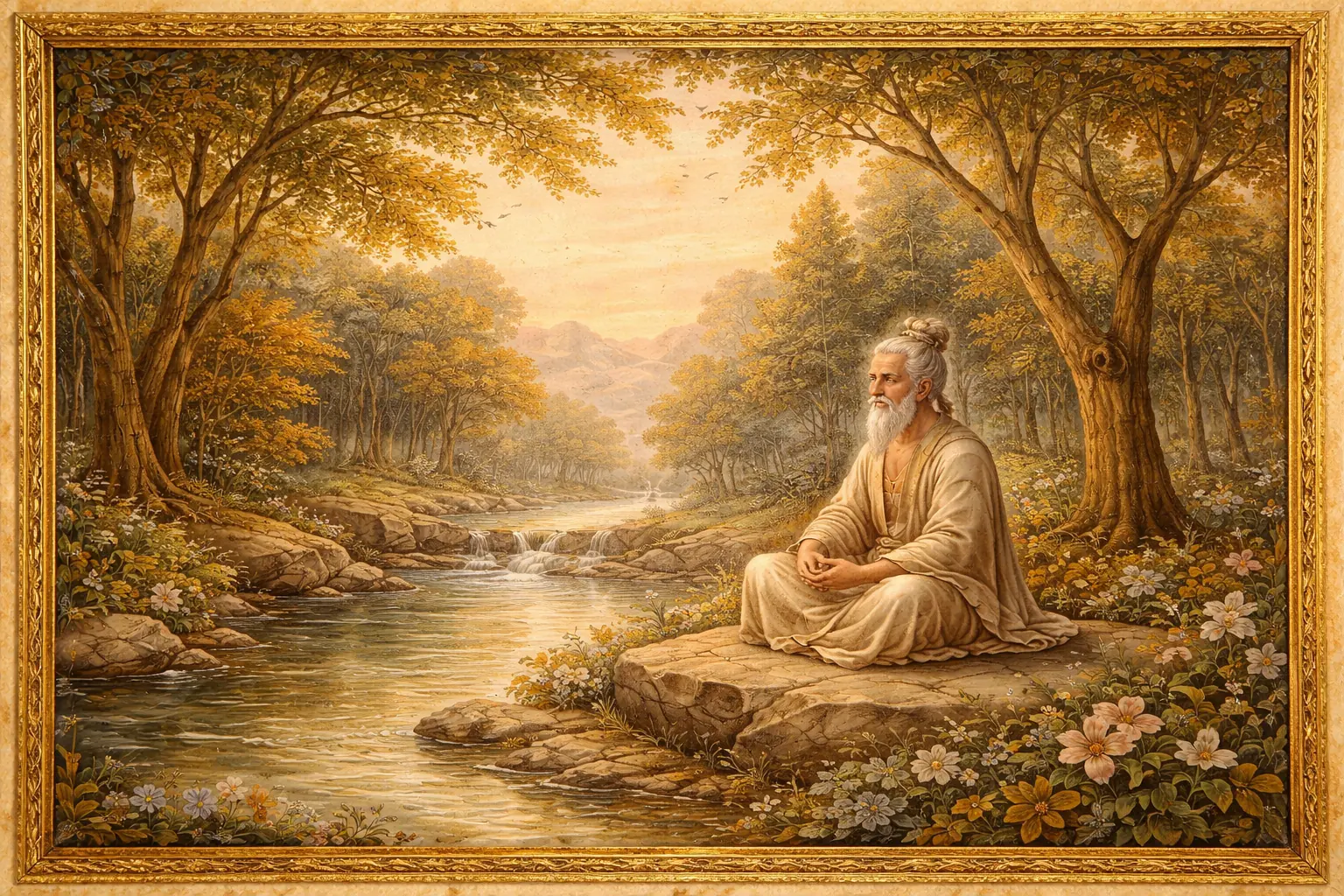
Commentary on the “Yoga Vasistha,” Chapter Six, the story of King Sikhidhvaja and Chudala
Using her magical powers, Chudala flew to Mount Mandara. From above, she saw that her husband had changed greatly and was quiet and alone.
Fearing that Sikhidhvaja would once again disregard her teachings, considering her a foolish girl, Chudala transformed herself into a young ascetic and descended directly before her husband. Sikhidhvaja saw the young ascetic and was overjoyed. The two gazed at each other with a radiant inner joy. The young ascetic was incomparably more radiant, so Sikhidhvaja took him for a heavenly angel. Accordingly, he greeted him. Chudala accepted the greeting and remarked, “I have traveled all over the world, and nowhere have I been received with such hospitality! It is a pleasure to see your serenity and your austerities. You have chosen to walk the razor’s edge, renouncing your kingdom in favor of life in the forest.”
Sikhidhvaja replied:
Surely you know everything, O son of the gods! I have a beautiful wife who rules my kingdom, and you somewhat resemble her. Please tell me who you are and to what I owe your blessed arrival.
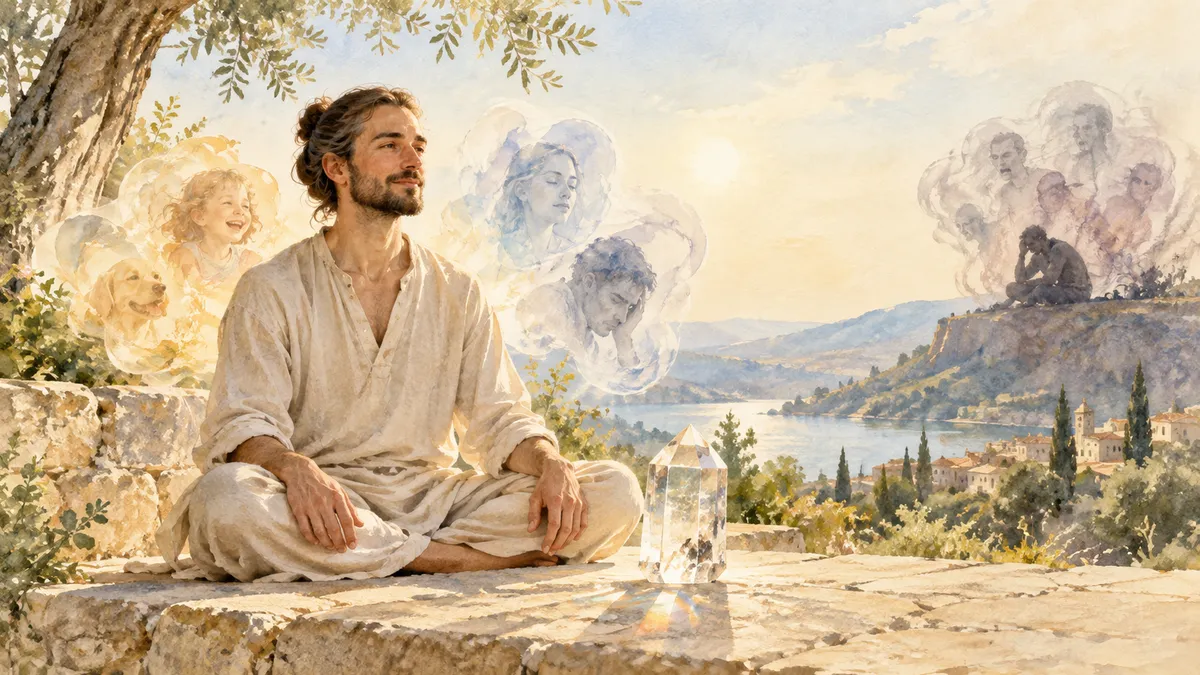
The young ascetic (Chudala) introduced himself as Kumbha, the grandson of Brahma, and told the story of the holy sage Narada:
In this universe there lives the holy sage Narada. One day, he was meditating in a cave on the banks of the sacred Ganges. When he finished meditating, he heard the tinkling of the bracelets of those bathing in the river. Out of curiosity, he looked in the direction of the sound and saw several naked celestial nymphs splashing in the water. They were indescribably beautiful. His heart felt delight, and his mind instantly lost its equilibrium under the influence of attraction.
Question: Sikhidhvaja asked, “Although the holy man was a sage versed in the great sciences and, moreover, enlightened, although he was free from desires and attachments, although his consciousness was as boundless as the sky—tell me, how did he come to feel attraction?”
The Teaching on the Nature of Perception and Attachment
The young ascetic (Chudala) explained:
O sage, all beings in all three worlds, including the gods in heaven, have bodies subject to the influence of opposing forces. Whether they are foolish or wise, as long as they are embodied, the body is subject to happiness and unhappiness, pleasure and pain. When enjoying pleasant objects, they experience pleasure, while deprivation (such as hunger, etc.) brings pain. Such is their nature.
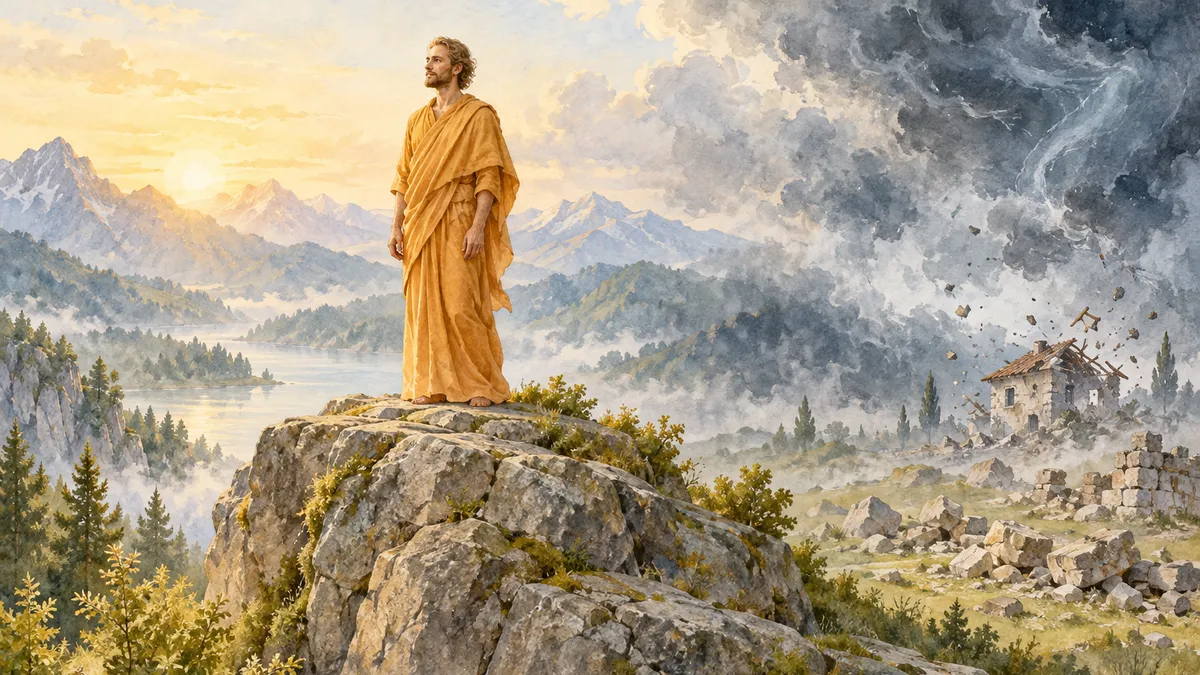
If the true and pure Self is forgotten even for a second, perceived objects expand in the mind’s perception. If attention is continuous, this does not happen. Just as darkness and light are firmly associated with night and day, the perception of pleasure and pain confirms the existence of the body for the fool. For the sage, however, even if pleasure and pain are reflected in consciousness, they leave no imprint. Like a crystal, a wise person reflects an object only when that object is actually present and nearby. But objects affect a fool so strongly that their influence does not disappear even when the object is no longer nearby. A weakened susceptibility to (attachment to) objects is liberation; intense susceptibility (strong attachment), created by the mind, is prison and bondage.
Chudala says that objects make an enormous impression on one who has not realized their true nature. A sage and a fool may use objects in the same way, and sometimes they may appear outwardly indistinguishable; nevertheless, these objects make an enormous impression on one of them and change his destiny, acting as powerful secondary causes that unfold his karma. The other, however, treats them lightly and leaves them without attention.
Why is there such a difference? Because the former has no inner center like a magnet that attracts iron filings. When there is a little more prana, energy, and impressions, the object becomes significant. It possesses its own gravity (force of attraction), warping karmic space.

For example, science has still not established what gravity is. Generally speaking, the force of gravity as such does not seem to exist, because gravity is simply the curvature of space. The more massive an object is, the more strongly it attracts something and the more it curves space. By analogy, the more powerful a karmic object is, the more strongly it curves our karmic space when we come into contact with it. But if our karmic vision is based not on superficial perception but on this inner center, then even a powerful object will be unable to distort our karmic vision. It will remain unchanged, and the object will make no impression on us. This is because, while abiding in profound unity with this inner center, we will be able to harness the energies of that karmic object, and our karmic vision will not change.
The following example may be given. A person who abides at the level of concepts may read a certain book. It will make a strong impression on him; he will be deeply affected by it, and it may even change his entire life. Then he will read another book that will impress him even more and change his life as well. His life will constantly change depending on the information he receives. Or he may hear news from the media, and that news may also shake him to the very core.
I experienced such things too, but only in childhood. For example, when I read about the adventures of Amundsen, the great Norwegian polar explorer, I wanted to become a polar explorer and planned to go to the North Pole; when I read about intelligence agents, I planned to become one myself; when I read about cosmonauts, I had no thought other than becoming a cosmonaut. In other words, there was complete identification while reading.
In the same way, we identify completely with the information we encounter if our essence, our “I,” abides on the same level to which external objects belong. But when we become established in nondual awareness, information no longer has power over us; it can no longer impress us, alter our vision or the course of our lives, or act as some powerful factor that changes our destiny and destroys our foundations, because we abide at a deeper and subtler level.
For example, if a person does not engage in spiritual practice, then upon encountering the Dharma or a practitioner, the foundations of his life and his core values may be shaken. This is because the foundations of his life are built upon something superficial. But to shake the foundations of an experienced practitioner requires a great deal of effort; that is, the object must be far subtler. And if the person is an accomplished being, a deity, or a siddha, they cannot be shaken even if the universe dissolves in pralaya or mahapralaya. This is precisely the capacity for self-liberation.
The Mechanism of Perception and Liberation
Thus, in response to the question, the ascetic Chudala explains:
The cause lies in the impression left in the heart (memory) through the body, the eyes, and so on. Then this perception expands its scope. When the heart is agitated, memory agitates the individual consciousness, which in turn agitates the nerve centers in the body. The perception of pleasure and the perception of pain agitate them in different ways.
Through pleasure, the nadis become saturated with bliss and seem to blossom. That is, the energy of pleasure is such that one part of it saturates the central channel, while another part activates the nadis. This is why all living beings seek pleasure. At such times, their nadis blossom, and the wind enters the sushumna, bestowing heightened awareness.
A Sufi mystic, whose name, I believe, was Hafiz, once said: “Life is like a very precious bride. The bride-price for her is life itself.” This is exactly how all unawakened beings live—they pay a very high price for this way of perceiving the world.
The ascetic Chudala then explains to King Sikhidhvaja:
If the individual consciousness does not pay attention to the agitated centers, it is liberated.
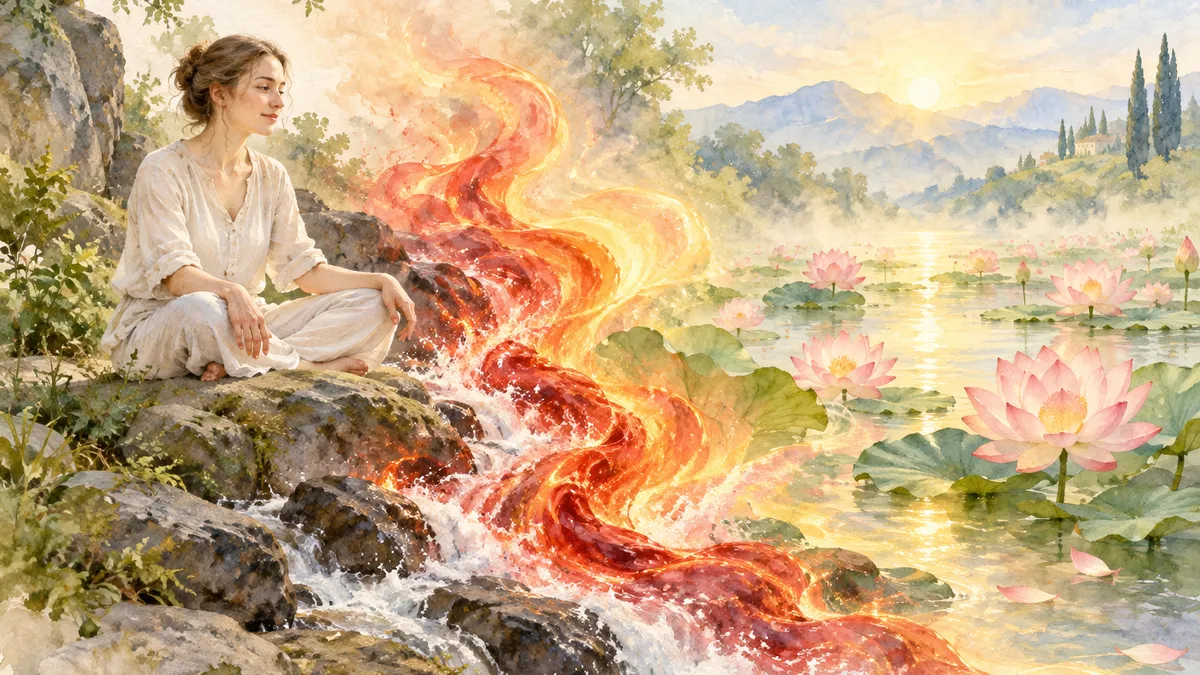
For example, your Muladhara chakra or Svadhisthana chakra is activated and emits disruptive, agitated, harsh prana. There are two possible ways to respond. The first is to satisfy desires, indulge emotions and kleshas, and express them; you then enter an uncontrolled karmic flow in which you have almost no control over events. The other is to disregard the excited centers while remaining in presence, combine this prana with presence, and transform it into something very subtle, enlightened, harmonious, and divine. This is the union of emptiness and bliss—the principle of sukha-shunya, or what is called “mahamelana” in yoga.
There is also a third way: to suppress the energy, to suppress your energy centers—that is, not to work with prana and to remain in a state of detachment, but one as lifeless and joyless as that of some Jain ascetics criticized by Rajneesh. You will have no desires, but neither will you have the perception of prana or the maturity of self-liberation. The approach of Anuttara Tantra is far more mature in that it teaches you to understand your energy, work with it properly, and skillfully sublimate it.
Chudala then continues:
Bondage (samsara) is nothing other than the identification of individual consciousness with pleasure and pain; when there is no such identification, there is liberation. Individual consciousness becomes agitated at the mere sight or anticipation of pleasure or pain. However, if, as a result of self-knowledge, it realizes that pain and pleasure do not truly exist, it will return to equilibrium.
Thus, the ascetic Chudala explained to him the nature of consciousness.
Continuing the story of Narada, he related that although Narada’s mind wavered—that is, a vibration arose within it—he instantly liberated that vibration and remained in presence. Nevertheless, his intention had already produced a certain vibration. And from this vibration, through the power of thought, a child was conceived in the beautiful apsara.
Narada gave the child a name and, in due course, imparted the highest wisdom to him. The boy was in no way inferior to his father. Narada then took the boy to his own father, Brahma the Creator. Brahma blessed the boy, whose name was Kumbha. This boy, Kumbha, the grandson of Brahma, now stands before you. I wander the world playfully because I need nothing from anyone. When I come into this world, my feet do not touch the ground.
But in fact, this was the young Chudala, Shikhidhvaja’s wife.
King Shikhidhvaja’s Confession
Kumbha said:
I have told you the story of my life. Now tell me who you are and what you are doing here. How long have you spent here? Tell me without concealing anything, for hermits speak only the truth.
Shikhidhvaja replied:
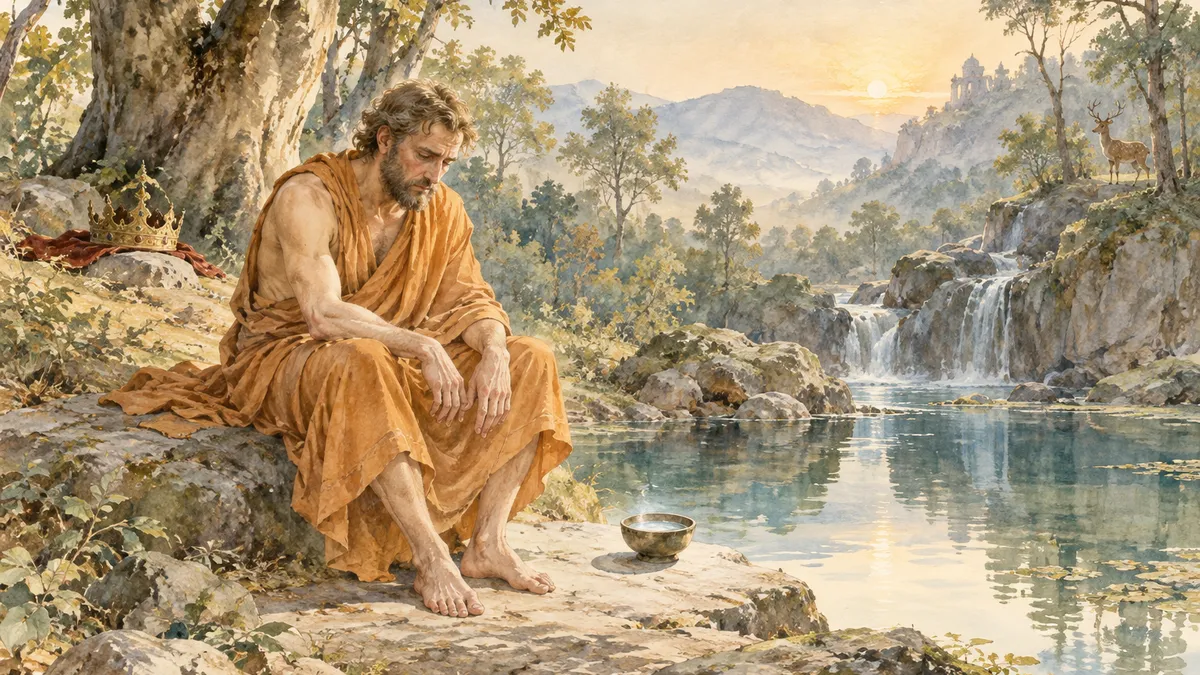
O son of the gods, you already know everything exactly as it is. What more can I tell you? I live in this forest because I fear this unending cycle of life and death. Although you already know all this, I will briefly tell you my story. I am King Shikhidhvaja. I abandoned my kingdom. I fear this unending cycle of life and death, in which everyone constantly experiences the alternation of pain and pleasure, life and death. Yet although I wandered everywhere and tormented my body in every possible way, I found no peace or tranquility. My mind is restless. I engage in no activity and seek no gain; I am alone and attached to nothing, yet inwardly I am parched and empty. I practiced every kind of yoga without interruption. But I only move from sorrow to even greater sorrow, and even nectar turns to poison for me.
And here Shikhidhvaja expressed this regret: “It seems that I am a useless practitioner. I probably have no aptitude for practice.”
Teachings on the Superiority of Wisdom over Methods
Then Chudala, in the guise of an ascetic, said:
Once I asked my grandfather which is higher: the practice of various techniques or knowledge of one’s own nature? And he replied to me: “Undoubtedly, knowledge of one’s own nature is supreme, for only through knowledge can one know the one thing that is. Various practices, on the other hand, have been described in appealing words, but they are merely games and amusements.”
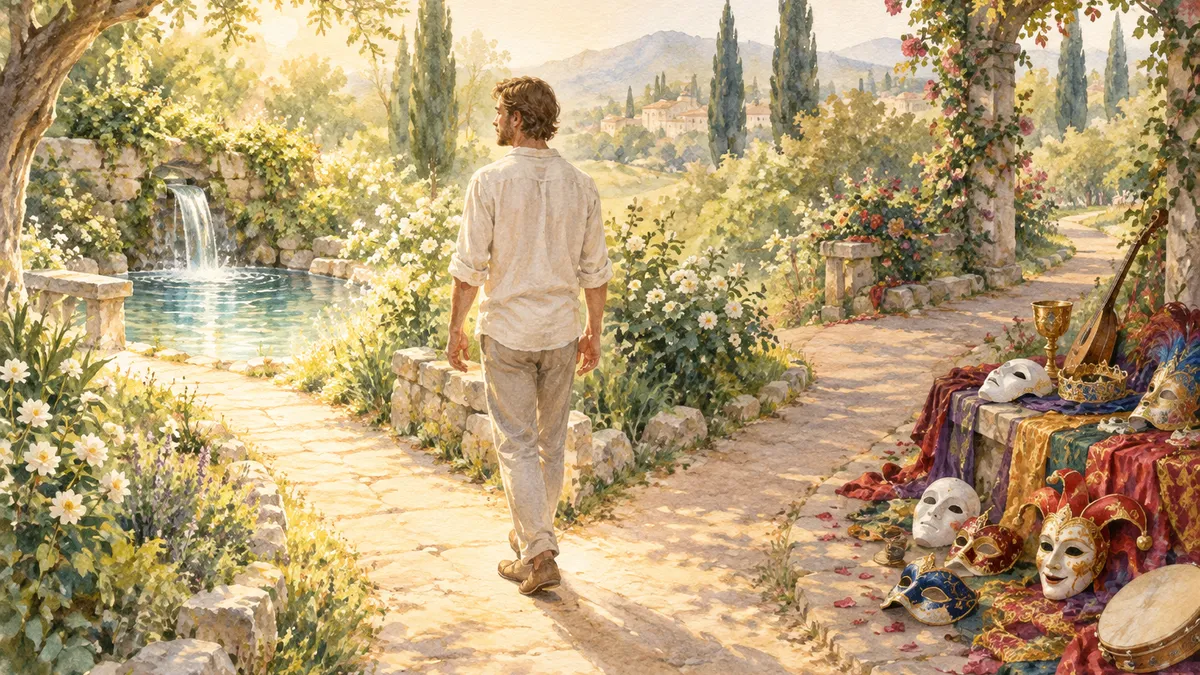
Thus, the young man Chudala instructed him in wisdom, saying that even the gods (Brahma and others) declare that knowledge alone is supreme.
The teaching contains method and wisdom. Many people do not fully understand these concepts. The most important thing is to develop contemplation—at least intellectually at first and then intuitively—and an understanding of the principle of wisdom. Once you understand the principle of wisdom, you can work with methods without difficulty.
A person who does not know the difference between method and wisdom, especially one raised in the Theravada Buddhist tradition, may think: “To attain nirvana, one must concentrate, meditate, and be mindful. But why sing, why recite mantras? These are all some kind of magical devices and tricks; nirvana cannot be attained that way.” And such a person sincerely does not understand the purpose of any external activity and so forth.
The point, however, is that the view of Anuttara Tantra is much deeper, because in addition to consciousness, Anuttara Tantra works with energy, and energy deals with the relative dimension. And when it comes to energy and integrating contemplative presence with energy, you can practice visualization, recite mantras, and perform dances of presence. You can do anything at all, including work, because everything now serves your enlightenment. And this will not be an activity belonging to the lower magical tantras (Kriya Tantra or Charya Tantra), where you attain abilities through mantra recitation. It will be the highest practice of Anuttara Tantra, since it involves the contemplation of nonduality and integration with any manifestations.
This is a fundamental point; it is what distinguishes Laya Yoga, for example, from Zen and from the Buddhist Theravada path. One might say that at the level of consciousness practice, at the level of wisdom, it does not differ in general (although, of course, there are some differences in the details), but at the level of method or approach, it differs greatly.
The Teaching on True Renunciation
Chudala then asks:
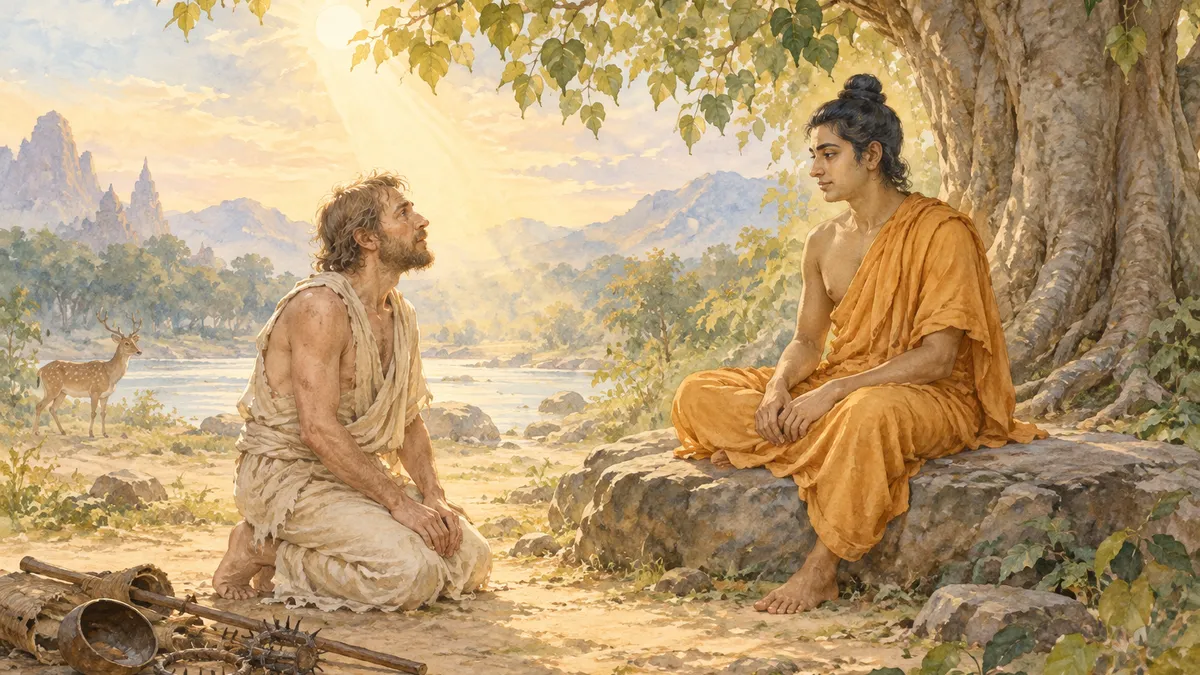
Why, then, do you remain a fool? Why do you think that “this is that” and “this is this,” and continue to flounder in the sea of ignorance? Why do you not ask, “Who am I?”, “How did this world arise?”, “How does it disappear?” Why do you not attain enlightenment through a detailed examination of the mechanisms of freedom and bondage? Why do you waste your life on useless mortification of the body and other practices? Only in the company of sages, by serving them and questioning them, can you know the nature of your Self.
Sikhidhvaja said:
You have awakened me, sage. I cast aside my foolishness. You are my teacher, and I am your disciple. Please reveal to me what you know—that very knowledge after gaining which there is no more sorrow.
The young ascetic said:
I will tell you if you are able to listen, understand, and follow my words. It is useless to give instruction in response to questions if the other person has no intention of listening, showing respect, and absorbing the teaching.
The young man Chudala gave him various instructions. He said:
After turning away from everything, you came to this remote forest, yet one thing remained—your sense of ego. If the heart leaves movements and thoughts undisturbed, it comes to understand the Absolute, but you are still haunted by the thought of renouncing everything, and your very renunciation nourishes the ego and thought; therefore, you lack the peace that arises from true renunciation. One who has renounced everything worries about nothing. But if a tree branch sways in the wind, can it be called motionless?
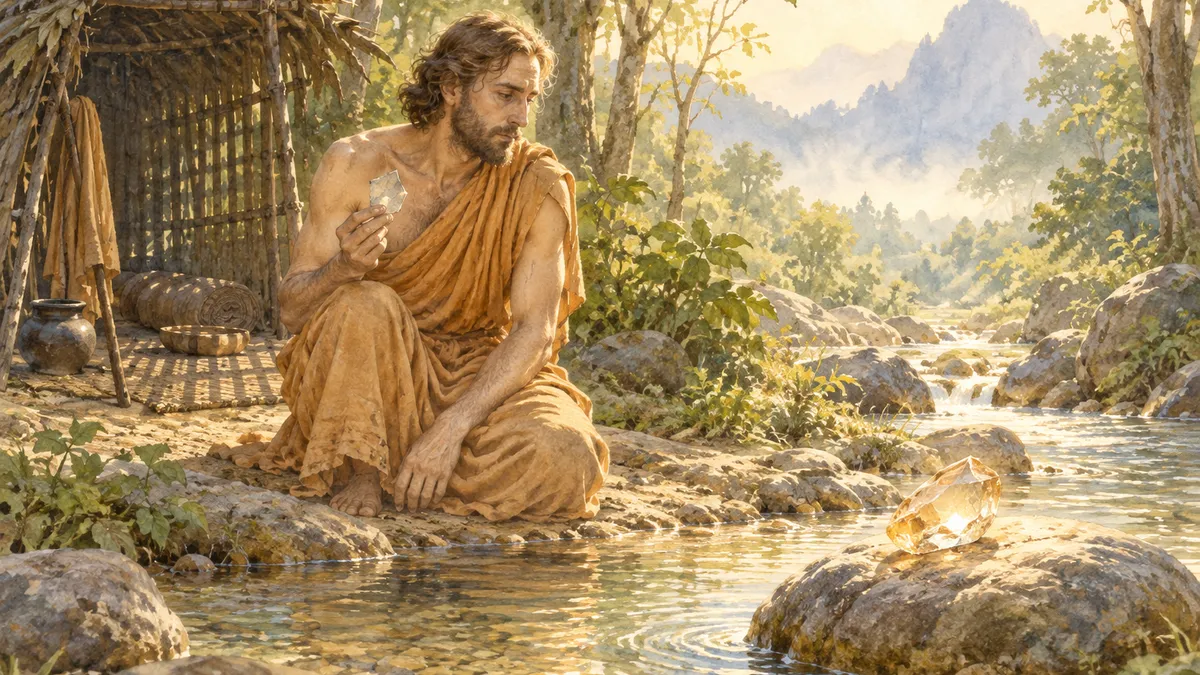
These disturbances, or movements of thought, constitute the mind. If thoughts are still in motion, how can it be said that the mind has renounced anything? As soon as the mind is stirred by thoughts, the three worlds immediately arise, and samsara continues. As long as there are thoughts, there is no complete, total renunciation of everything. As soon as thoughts arise in your heart, your renunciation leaves your heart. You yourself did not understand the spirit of renunciation and did not even cultivate it fully, so it left you. Instead of the precious jewel of true renunciation, you took a “piece of glass”: external methods of mortifying the flesh, ritual practice, recitation of mantras, and so on.
The Art of Self-Liberating Thoughts
What did the yogi Chudala point out to Sikhidhvaja? He pointed to the ability to self-liberate thoughts. This concerns the renunciation of thoughts. By the renunciation of thoughts, practitioners of Anuttara Tantra mean the art of self-liberating them, cutting them through with the sword of discriminating wisdom.
One might think that the renunciation of thoughts means skillfully mastering mahashanti meditation, that is, meditation on stopping thoughts and mastering emptiness. But in fact, the art of stopping thoughts and abiding in emptiness without thoughts was never praised by the siddhas as the art of complete liberation.
Undoubtedly, the art of stopping thoughts is important. But it has always served only as preparation for penetrating true wisdom; it was never considered genuine renunciation of thoughts.
Genuine renunciation of thoughts has always been understood as the art of self-liberating thoughts immediately after they arise. This means that you master not only stillness but also movement. Yet within this movement of thoughts, you discover a state in which thoughts are released into emptiness. And such a state far surpasses the realization of someone who has merely learned to stop thoughts and enter dhyana.
The Genuine Practice of Self-Liberating Thoughts
The art of dhyana in a state where thoughts have ceased is called a game for well-prepared practitioners, but only a game—that is, preparation for genuine practice. The genuine practice of Anuttara Tantra begins when we master the art of self-liberating thoughts while they are in motion. This was the error that the ascetic Chudala pointed out.
He then described some of Sikhidhvaja’s mistaken views:
“Because of your own delusion, you begin to value glass, failing to see the precious gems. You have exchanged the unconditional, independent, infinite consciousness for meaningless tortures of the flesh, while the flesh has a beginning and an end. And you cannot indulge in this forever. One who casts away infinite happiness that is so easy to attain and instead pursues the impossible is undoubtedly a fool. He follows the path of self-destruction. In the same way, you have fallen into the trap of a secluded life in the forest, forgetting to maintain the spirit of complete renunciation of everything. Although you renounced your kingdom, you have once again been ensnared by what is called the ascetic life. Now you are even more preoccupied than before with cold, heat, wind, and similar things, and they bind you just as your samsaric attachments did. Foolishly thinking that you possess the philosopher’s stone, you do not even possess a fragment of that philosopher’s stone.”
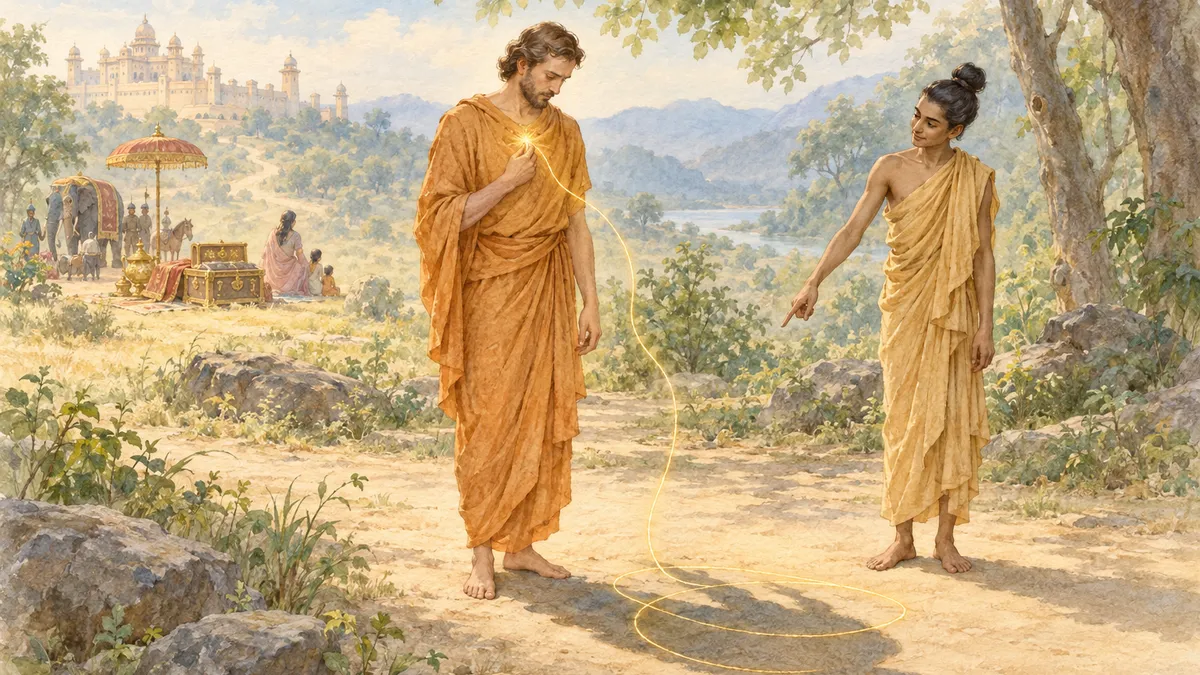
Thus, he said: “When you went into the forest, you did not destroy your identification with the mind. That was your mistake. Misunderstanding arose again, and it trapped you once more.”
Then he said:
“O King, why did you not listen to the wise words of your wife Chudala, who truly knows the truth? She is among the foremost knowers of the nature of the one consciousness, and her actions do not contradict her words. Everything she says is a truth worth putting into practice. But even if you did not listen to her before, why have you not truly renounced everything?”
Sikhidhvaja said:
“I left behind the kingdom, the palace, the entire country, and my wife. Why, then, do you think that I have not left everything behind?”
The young ascetic (Chudala) said:
“Wealth, wife, palace, kingdom, land, the royal parasol, and all your relatives—none of these are truly yours, O king, and giving them up does not constitute total renunciation! There is still something else that seems to be yours and that you have not renounced, although renouncing it is the highest form of renunciation. Renounce it completely, leaving no trace, and you will find freedom from suffering.”
The Search for True Renunciation
Sikhidhvaja said:
“If the entire kingdom and all it contains are not mine, then I renounce this forest and everything in it.”
Having said this, Sikhidhvaja mentally renounced the forest.
In response to the ascetic’s words that none of these things were his in the first place and that there was therefore no point in renouncing them, Sikhidhvaja said:
“Very well, then this wretched hut is now everything to me; it is mine. I give it up as well. Surely now I have renounced everything!”
The young ascetic (Chudala) said:
“And yet this, too, is not yours. How, then, can you have renounced it? There still remains something you have not renounced, but which constitutes the highest form of renunciation. By giving it up, you will attain freedom from suffering.”
Sikhidhvaja said:
“If this, too, is not mine, then I renounce my staff, hides, and so on.”
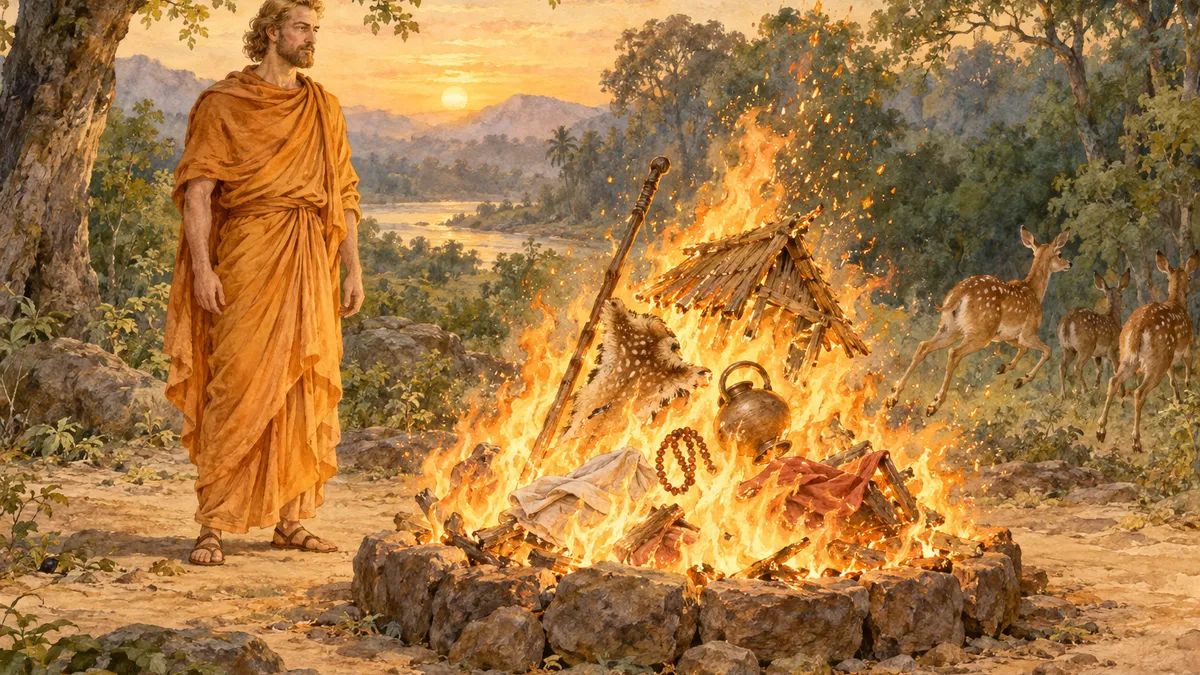
Having said this, he sprang to his feet. While the young ascetic watched calmly, Sikhidhvaja gathered everything he possessed and built a huge bonfire. He threw away his prayer beads, saying, “I am free from the delusion that reciting mantras is sacred, and I no longer need these beads.” He burned the tiger skin on which he practiced meditation. He threw his water pot into the fire.
He said to himself, “I renounce once and for all everything that must be renounced; otherwise it will regain its power. Once and for all, I cast everything into the fire.”
Having made this decision, Sikhidhvaja gathered everything he still had and burned it.
Then Sikhidhvaja set fire to the hut he had previously built. After that, he gathered what little remained and burned that as well. He burned everything, including his own clothes. Frightened, even the animals fled from the fire.
Sikhidhvaja said to the young ascetic:
“Awakened by you, O son of the gods, I have abandoned all the concepts I upheld for so long. Now I have firmly realized pure and blessed knowledge. My mind turns away from everything that could cause attachment and remains in equanimity. I have renounced everything. I am free from all bonds. I am completely at peace with myself. I am victorious. The air is my clothing, space is my dwelling, and I myself am like emptiness. Is there anything beyond this renunciation, O son of the gods?”
The young ascetic (Chudala) said:
“You have not renounced everything, O king. Therefore, stop making a fool of yourself and acting as though you were enjoying the bliss of supreme renunciation! As before, there is still something you have not renounced, yet it is the most essential part of renunciation. Only when this, too, has been cast aside without a trace will you attain the highest state, free from suffering.”
This is a very important point. Even within practitioners who renounce many things, much remains that they do not renounce. Everyone should reflect on this as well. But a great deal depends precisely on the extent to which we can inwardly renounce these things—the very essence of realization itself depends on it.
Renunciation of the Body and the Discovery of True Renunciation
After some reflection, Sikhidhvaja said:
“Only one thing remains, O son of the gods—this body, a lair for the venomous snakes of the senses, composed of blood, flesh, and so on. I renounce it as well and will destroy it in order to attain complete renunciation.”
As he was about to carry out his decision and leap into the bonfire, the young ascetic said:
“O King, why do you wish to destroy this innocent body? Let go of your irritation; this ascetic body is inert and possesses no intelligence. It has nothing to do with who you are. Therefore, do not try to destroy it. This body remains what it is—inert and insensible. Other bodies and energies impel it to act. The body is not responsible for sensations of pleasure and pain. Moreover, destroying the body is not total renunciation at all. On the contrary, you are casting away something that can aid in renunciation! If you are able to renounce that which acts through the body, that which makes this body move, then you will completely renounce all sins and temptations, and then you will attain total renunciation. If you renounce this, it will be a renunciation of everything, including the body. Otherwise, sins and temptations will be overcome only temporarily and will later regain their power. This alone is total renunciation—the renunciation of that which is everything, which is the sole cause of everything here, and in which all that surrounds us is contained.”
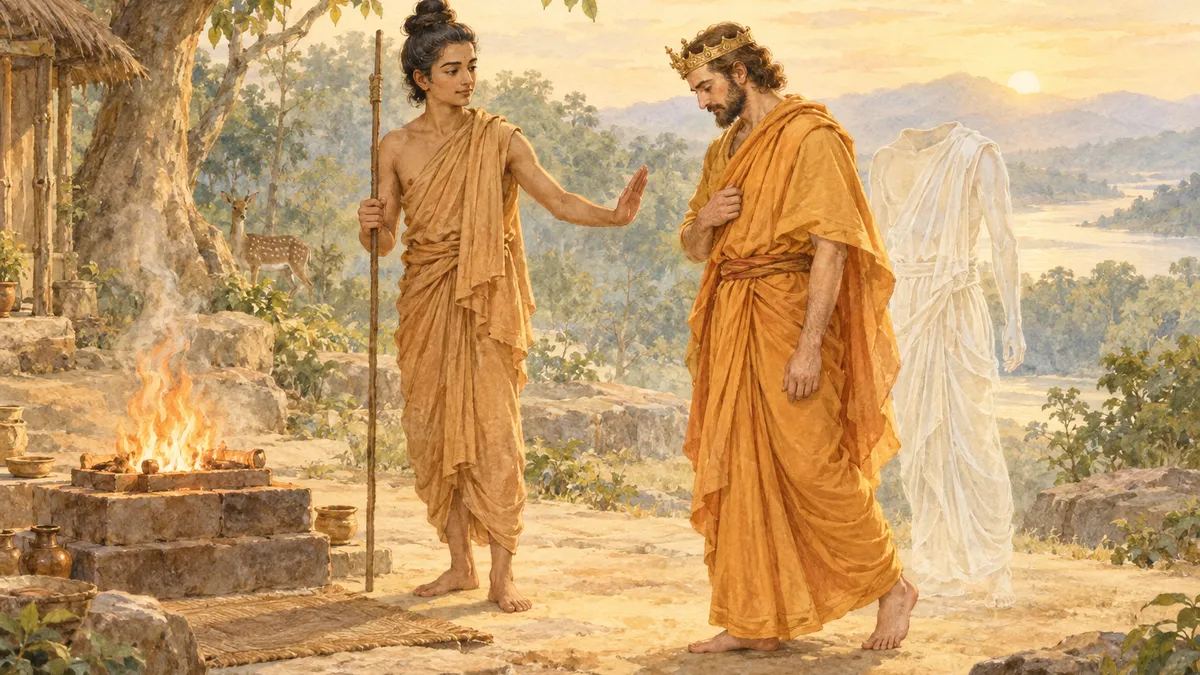
Sikhidhvaja pleaded:
“O sage, please tell me, what is it that must be renounced?”
The young ascetic said:
“O King! It is your mind, which is neither inert nor non-inert, and which abides in ignorance, which is ‘everything.’ The mind is false knowledge, it is the human being, it is the world, it is everything. It is the seed from which the kingdom, the body, the wife, and everything else sprout. Only when this seed has been renounced is there total renunciation of what exists in the present and even in the future!
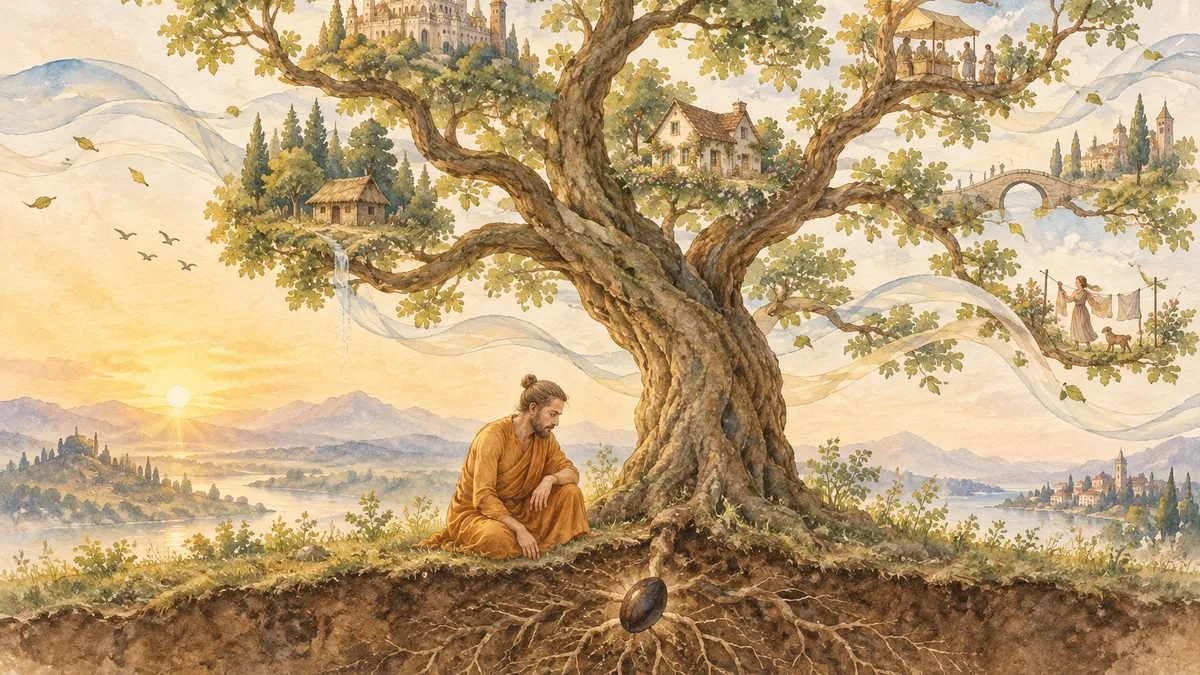
All of this—the good and the bad, the kingdom and the forest—causes suffering to one who is under the influence of the mind and gives immense delight to one who lives in the state of no-mind. Just as a tree sways in gusts of wind, so the body sways under the gusts of thought. Everything experienced by beings—old age, death, birth, and so on—including even the steadfastness of sages, is nothing but modifications of the mind. This mind is called by various names—the ego, the soul, the cosmos, and so on. Abandoning it is the total renunciation of everything. As soon as it is renounced, the truth is revealed. All concepts of unity and diversity end here. Tranquility remains.
On the other hand, by renouncing what is not yours, you create division within yourself. If you renounce everything, then everything exists in the emptiness of the one infinite consciousness. Abiding in this state of total renunciation, like an oil lamp without oil, you shine with the supreme light, like a burning lamp. Even after renouncing the kingdom, you continue to exist. Likewise, when you renounce the ego/mind, this infinite consciousness will continue to exist. Although you burned everything in this enormous bonfire, you did not change in any way. When you renounce the ego/mind as well, no change will occur either. One who has renounced everything does not fear old age, death, or the cataclysms of life. This alone is infinite bliss. Everything else is terrible suffering. OM! Accept this truth and do as you wish. The supreme truth of knowing your own nature lies in total renunciation, just as jewels are kept in the complete emptiness of a pot. Through total renunciation of everything, the Buddha attained a state beyond doubt and problems. Therefore, O King, having renounced everything, remain in whatever form and state you find yourself. Renounce even the concept ‘I have renounced everything’ and remain in the state of supreme tranquility.”
As long as the egoistic seed of individual life grows within a person, this seed will bear fruit; but when, through flawless understanding, self-liberation, and self-surrender, this seed is split apart, it ceases to bear fruit and produces no further fruit other than enlightenment.
Abiding in the Mirror of the Mind
What does the absence of renunciation mean? The absence of renunciation means that a person, lacking the ability or failing to understand how to abide in the mirror, abides in the reflections—that is, in their various inner states, which continually give rise to different tendencies within them.
On the contrary, when a yogi abides in the bright and awakened mirror of the mind, the genuine spirit of true renunciation arises within him. He no longer identifies himself with any of the reflections.
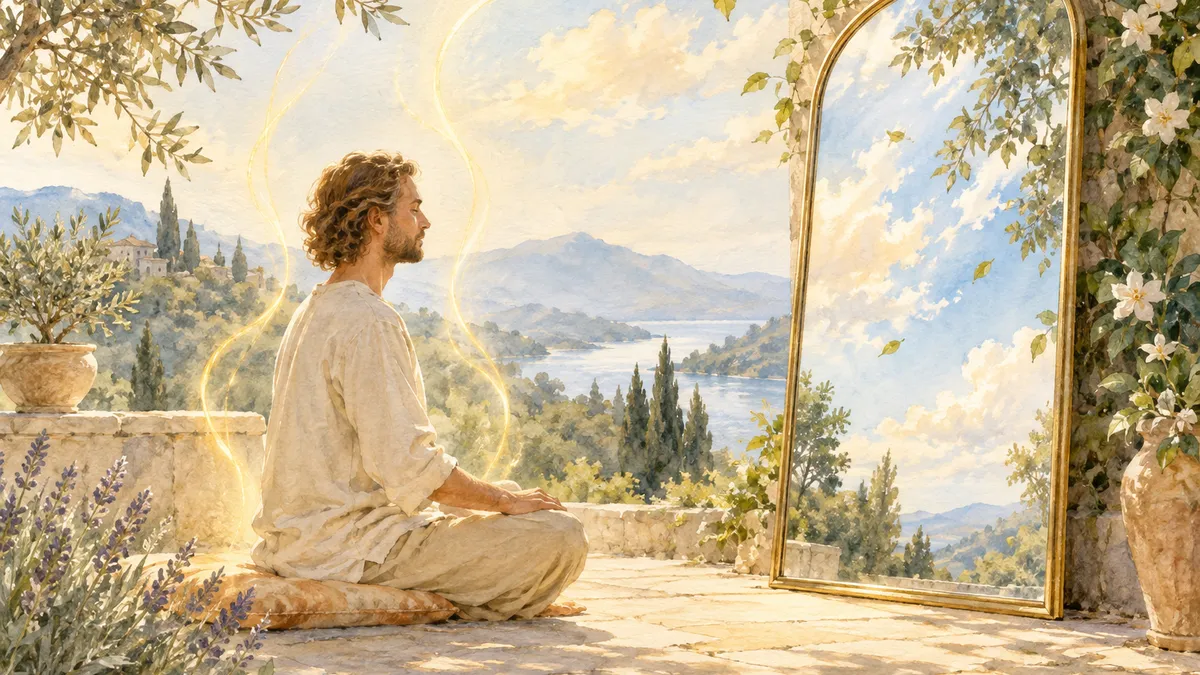
Sometimes a person thinks: “If I practice a great deal, perform pranayamas, or practice in retreat, I will have a tremendous amount of energy and extraordinary abilities.”
In reality, much depends on the state of mind in which you abide in everyday life: whether you remain in the state of the mirror every day or lose it and fail to abide in a state of renunciation. When the spirit of renunciation and liberation is present, you accumulate tremendous energy. And this energy continuously nourishes you. It is precisely thanks to this energy that you can untie and release the obstacles, limitations, and karmas that exist.
A true yogi lives by God and God alone. Through this, he develops great renunciation.
As a result of such renunciation, he first develops faith in this state and then devotion to it. And devotion eventually reaches the level of great devotion and becomes continuous self-surrender. When self-surrender incinerates all karmas, it turns into Self-recognition.
For example, when a person experiences certain difficulties in spiritual practice, this does not happen because the difficulties actually exist. I tell him: “Let us look at the root of the problem. Let us not analyze the details of these difficulties; the problem is simply that you are not in a state of ecstasy from the love of God. As soon as you are able to abide in it and look at your problems through the eyes of this state, you will see that they do not exist. And until you solve this problem at its root, all the other problems will constantly plague you. You will solve them, but they will keep returning.”
This does not mean that all problems will be solved as if by the wave of a magic wand. But it can be guaranteed that they will disappear for you at the level of your state of mind, in your soul.
There was a Tibetan teacher who gave lectures. He delivered them in great detail and with great care, describing, on the basis of ancient texts, the states of the hells, karma, the suffering of living beings, and so on. Sometimes the lectures began at nine in the evening and ended at four or five in the morning, lasting for many hours. And the lay students who listened to them were utterly overwhelmed. They thought: “How can anyone give these lectures for so long?!” Even simply sitting on the floor for that length of time was a real ordeal. But then they realized that these were not actually lectures, but a genuine practice of transforming consciousness and renouncing what they had been. Many derived tremendous benefit from these lectures precisely because they were conducted in this manner.
Likewise, when we have the right attitude toward the Dharma and are able to let it into our lives so that it enables us to renounce everything, this Dharma grants us everything that is possible.
The Three Jewels
What does the Refuge mantra mean?
It means: “I take refuge in the spiritual teacher” — “Namo Guru Deva.”
From the relative point of view, the guru is the master with whom you establish spiritual contact through the lineage of transmission. The guru is also the lineage of transmission itself. Ultimately, it turns out that the guru is you yourself; it is your higher Self, which you discover.
The Dharma is the teaching through which you develop. At a subtler level, it is your discerning clarity, the intuitive consciousness that realizes Brahman.
The Sangha consists of your Dharma brothers and sisters bound by samaya, with whom you share the path. Ultimately, it is the lineage of transmission, all the saints, awakened ones, rishis, and siddhas, as well as the dimension of pure vision transformed within your nondual consciousness.
Thus, when we take Refuge, our understanding of the Three Jewels, or the Three Treasures, unfolds before us ever more deeply.
When we take Refuge, what does it actually mean? It is very important not to merely repeat some Sanskrit magical phrases as a formality, imagining yourself to be a great magician, but to understand the meaning of what you are doing. This is very important.
The Meaning of Refuge
What is the meaning of Refuge?
Refuge means that we are trying to establish a connection, to make contact with something; we are trying to direct the meaning-forming vector of our lives in a particular, definite direction.
It is not so much that we find Refuge as that we change it, because even now we already have a refuge, but it is a refuge in illusions. Before finding Refuge in the Three Jewels, in the teachings, in the spiritual teacher, and in the path, each of us already had many refuges. Everyone understands this. It may be refuge in worldly goals, in one’s ego, in work, in one’s hopes and plans—that is, refuge in a certain mental illusion.
When we take Refuge, it means that we are trying to find a new refuge in something deeper, to direct the meaning of our lives toward something truly important. Therefore, taking Refuge, in my view, is a very significant event in life. It is even more significant than a birthday, because at the moment of taking Refuge, we shift a particular vector in our lives onto a new path that we have chosen.
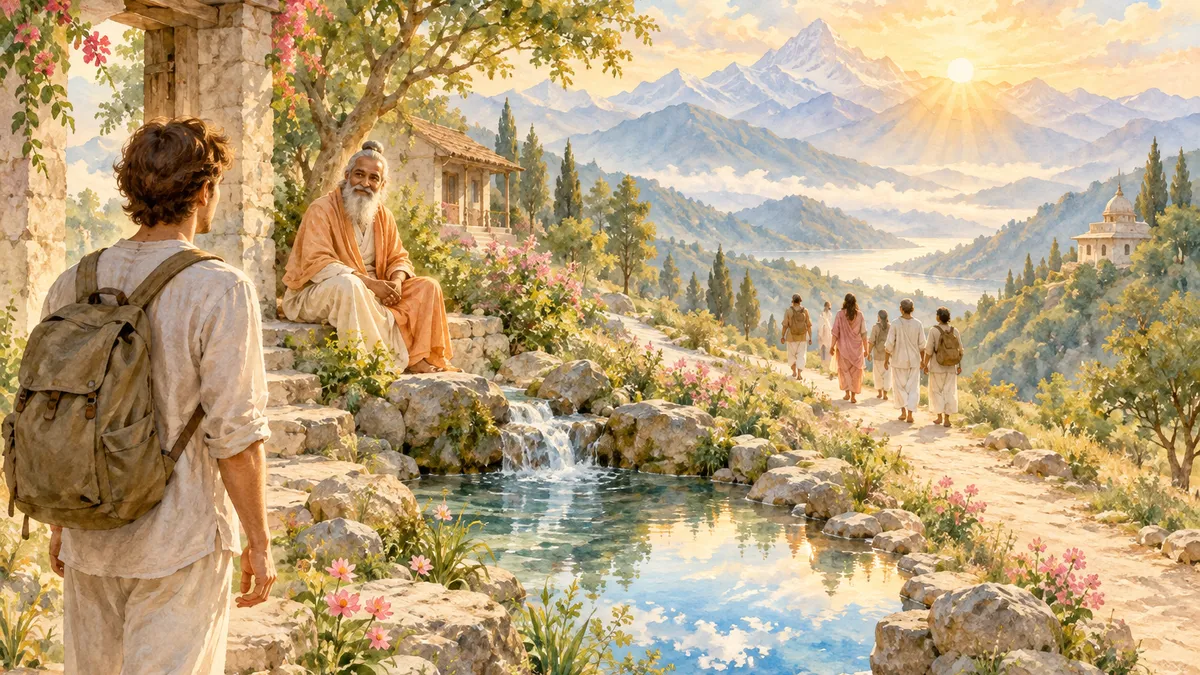
Some even say, “Taking Refuge immediately removes thirty percent of prarabdha karma, while receiving a spiritual name removes fifty percent.” I have heard this, although I do not know how any of it can be calculated, since every person is unique. Ultimately, it depends not on the formal act, but on what takes place in your heart and soul. The most important Refuge, like a spiritual name, is received in the heart. Therefore, when we repeat the Refuge mantra, we are, as it were, reaffirming our choice; we confirm that we are tired of taking refuge in illusions and our own limitations, and that we want to take refuge in something real—the spiritual path that leads to awakening. This is the meaning of this formula.
