

Commentary on the text “Yoga Vasistha,” chapter 6.11
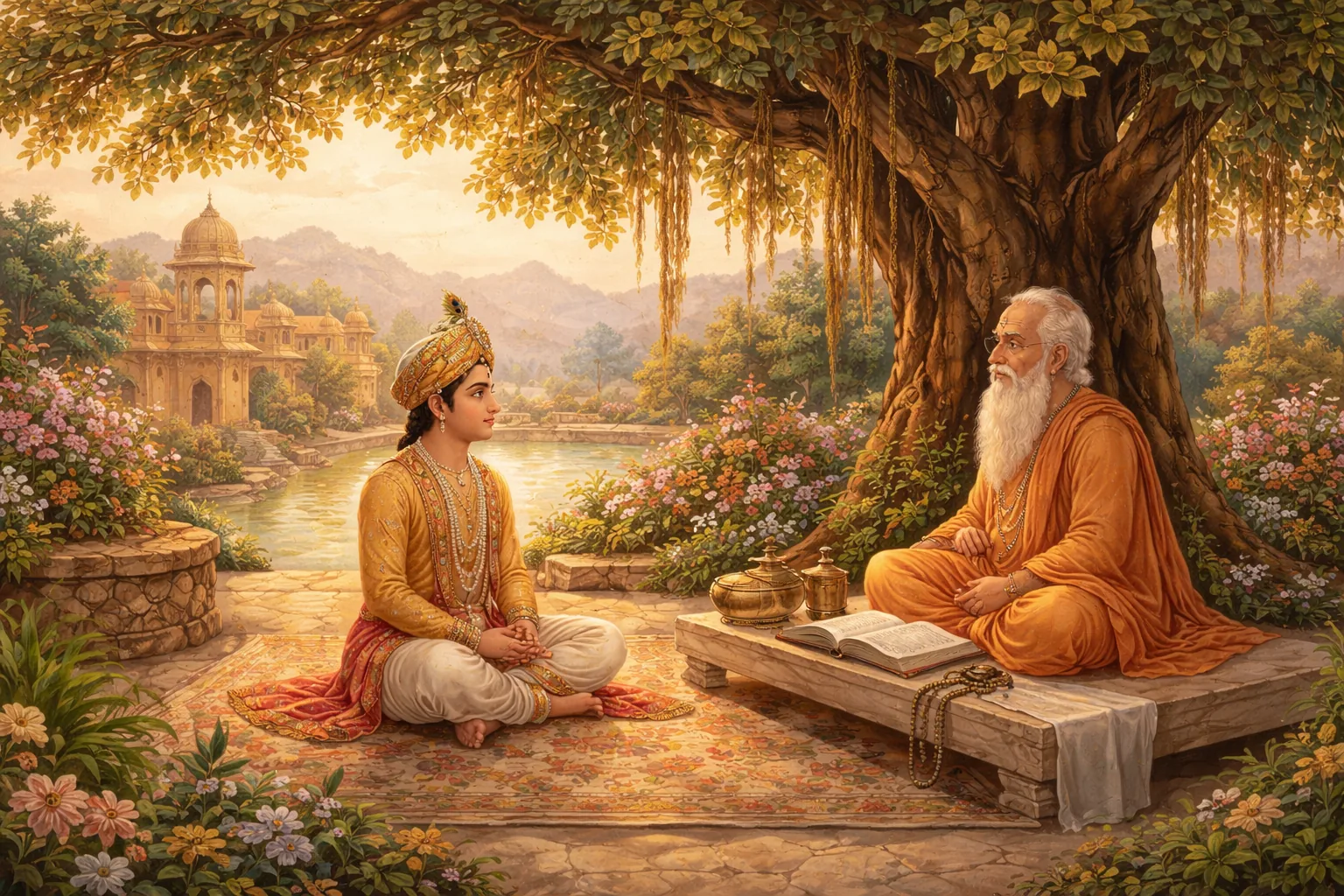
The story of Sikhidhvaja and Chudala. In the text “Yoga Vasistha” there is a chapter called “The Story of Sikhidhvaja and Chudala.” It tells of a king who ruled the kingdom of Malva in ancient times. This king was very noble and possessed all the marks of royal greatness. He lost his father early, but from a young age he was able to establish his independence and rule the kingdom with the help of ministers.
When he grew up, he was introduced to a princess from the kingdom of Saurashtra. This princess was named Chudala. When they married, they loved each other very much. They had common interests, they enjoyed themselves together in the gardens, and it is said that each blossomed in the heart of the other, as if Vishnu himself with his consort Lakshmi had descended to Earth. Thus many years passed, and there was not a single unpleasant moment in their life.
But one day they began to reflect: “Is there anything permanent in our world? Since the world is impermanent, everything changes, and we are mortal.” They came to the conclusion that only self-realization and practice make it possible to overcome suffering, and therefore they began to devote themselves more and more to spiritual practice. They received instructions from sages and then studied the sacred texts together.
The Enlightenment of Queen Chudala
The queen very often reflected on the nature of consciousness:
“I say ‘I,’ but what is this ‘I’? From where did ignorance arise, how does delusion arise, why do I perceive myself as the body, but do not perceive myself as the Absolute?”
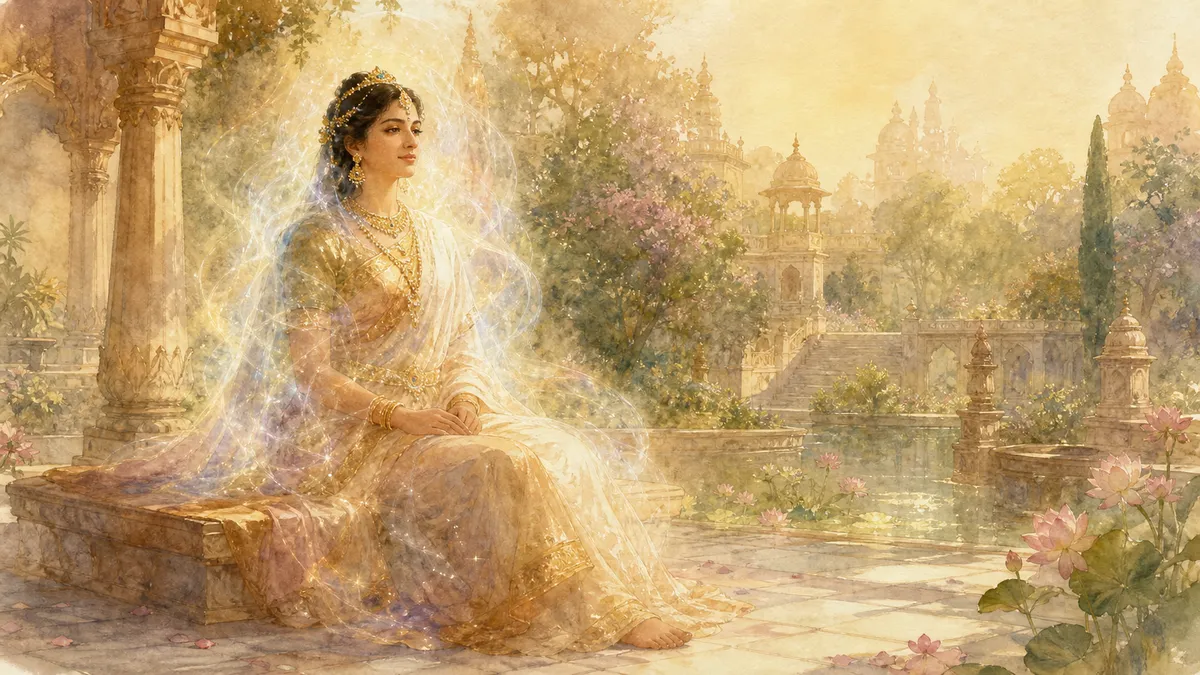
She practiced meditation on disidentification from the body and the search for the Absolute. Practicing such jnana yoga very diligently, one day she came to understand herself as pure, supreme Consciousness, which seems to pour itself into the individual personality. She realized that subject and object are unreal things and eventually attained enlightenment. This experience was so powerful that she felt immense joy, and one day she exclaimed:
“At last, I have attained that which is worth attaining. Now it is impossible to lose it. The mind, the senses—all these are only reflections of Consciousness. They are unreal, and all depend on Consciousness. Only this supreme Consciousness exists. This Consciousness is called by different names: Brahman, the supreme Self. In it there is no division into subject, object, and their relationships.”
Abiding in a great feeling of joy and bliss, she sang a song:
“I am pure Consciousness, all-pervading and devoid of the sense of ego. For this Consciousness there is neither birth nor death. It cannot be destroyed, because it is like space. Nor can it be cut or burned, since it is the pure light of awareness, without any defects.”
She sang:
“I am free from all delusions, I abide in unshakable peace. All demons, gods, and various beings are, in essence, not created, since they are not different from Consciousness. All external forms are illusory, just as clay soldiers are primarily clay and not soldiers. I remain in nirvana, without the slightest agitation of thought, having realized that all that exists is my pure consciousness. There is neither ‘this,’ nor ‘me,’ nor ‘another.’
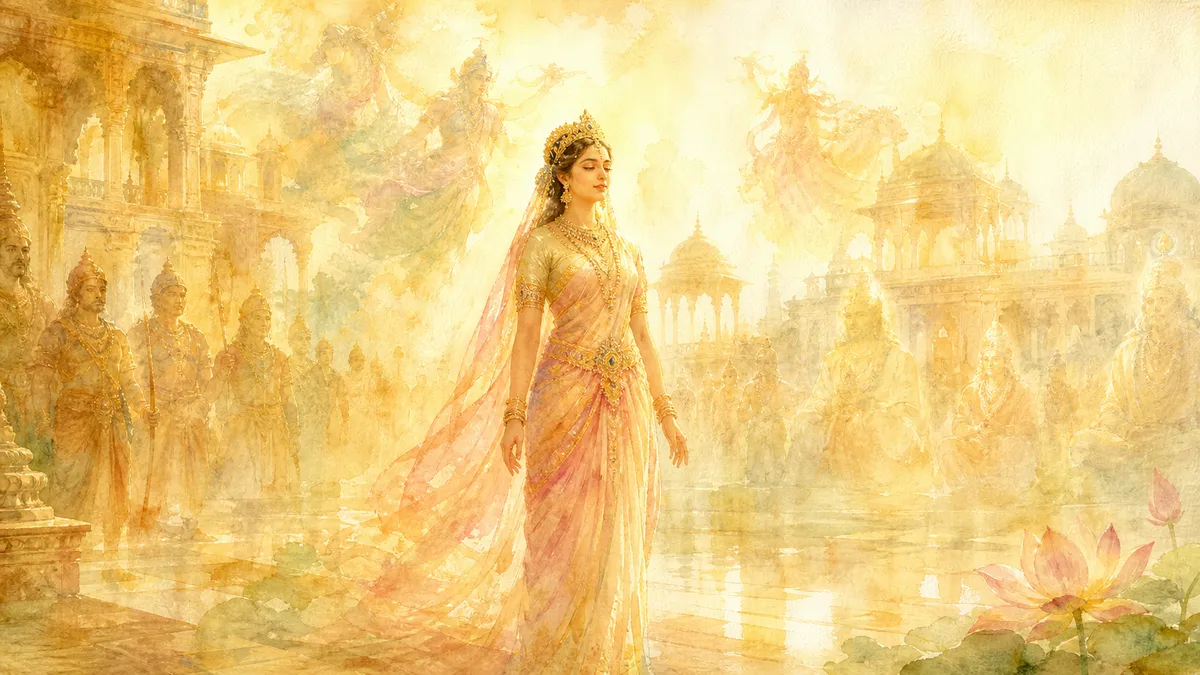
Having realized this, Chudala became established in enlightenment. Day by day the queen became ever more immersed in herself, enjoying more and more the bliss of this state. All worldly attachments and desires disappeared from her. She did not renounce anything, but neither did she strive for anything outwardly, having opened this space. She was completely free and natural in her behavior, spontaneous in her actions. All her doubts ceased, for she had crossed the ocean of existence and become established in the incomparable state, which grew more and more.
Seeing how she shone, how peaceful she was, her husband Sikhidhvaja asked:
“You shine so unusually. It seems you have gained new youth. You have no desires, you are full of bliss. Tell me, what has happened to you? You must have attained something that is very difficult to attain?”
Chudala replied:
“Although I have attained emptiness, I have left it and assumed a certain form. I abide in truth, not in the deception of external illusions, and therefore I shine. I enjoy pleasures, but at the same time I do not enjoy them. I yield neither to joy nor to indignation, and therefore I shine. Even when I am in a beautiful garden, I remain established in my awareness, not in the enjoyment of pleasures. I possess the entire universe, and therefore I shine. I am THAT, but in the true sense I actually do not exist, and therefore I am and am not at the same time. I am everything, but I am also nothing, and therefore I shine. I am content with what happens without effort, and therefore I shine. And everything I see with these eyes, feel with these senses, in fact, I do not see; I experience it only as unity.”
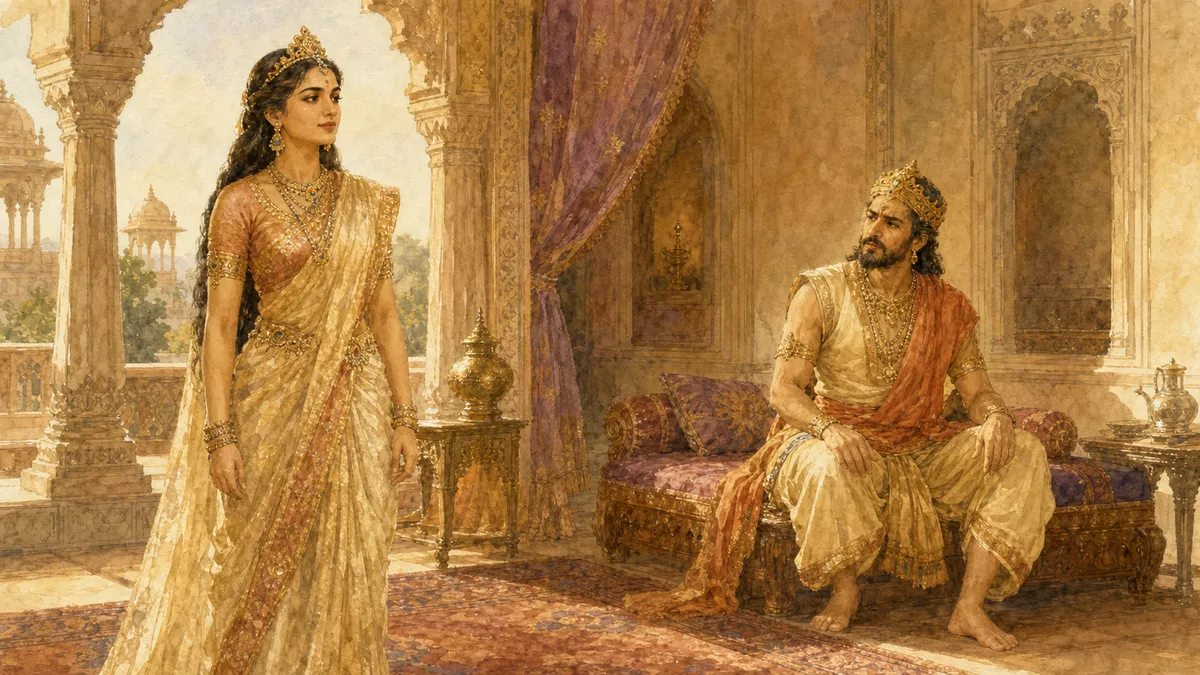
King Sikhidhvaja was unable to understand the queen’s words; he laughed at them and said:
“You are just like a child—babbling without understanding what you yourself are saying. Having abandoned something for the sake of nothing, you are both that and nothing... What even is this? This is some kind of nonsense, not a teaching.”
And he reacted very distrustfully to Chudala’s words:
“You say, ‘I am not the body, and at the same time I am not something else either,’ ‘I am everything and I am nothing,’ ‘I do not see what I see,’ and ‘I see something else.’ Why, this is sheer nonsense! Don’t trouble yourself with it; continue enjoying royal life and everything that has been given to you, and I will help you in that.”
Such was Sikhidhvaja’s reaction to her words.
Having said this, the king went about his affairs, while Chudala thought:
“It is a pity that he cannot understand my state of consciousness.”
Attainment of Siddhi and the King’s Departure to the Forest
After some time, she attained the siddhis of movement through space by performing the practice of controlling the pranas (the vital wind), that is, the ability to rise and hover in space. Engaging in control of the wind, pranayamas, and work with the chakras, she managed to achieve very high control of the wind, and therefore she secretly and invisibly continued her sadhana, hidden from the king. And although the king also continued his practice, he had absolutely no understanding of his wife’s level.
For example, if a yogin can raise the kundalini energy and, through practices, hold it above the crown of the head at a distance of twenty fingers, he can experience various states, transfer his subtle body into another’s body, bring it into samadhi, and hover in space. All this is the practice of shakti-yantra, connected with controlling the winds and channels. When a yogin perfects his practice, he can successfully control his energy if he has no obstacles. Usually everyone speaks of raising the energy to the crown of the head, but above the crown there is yet another center—the center of the astral body—and supernatural powers are mainly connected with the entry of prana precisely into this center above the crown.
Chudala also attained the ability to make her body tiny or enormous by controlling the wind with the help of the anahata chakra.
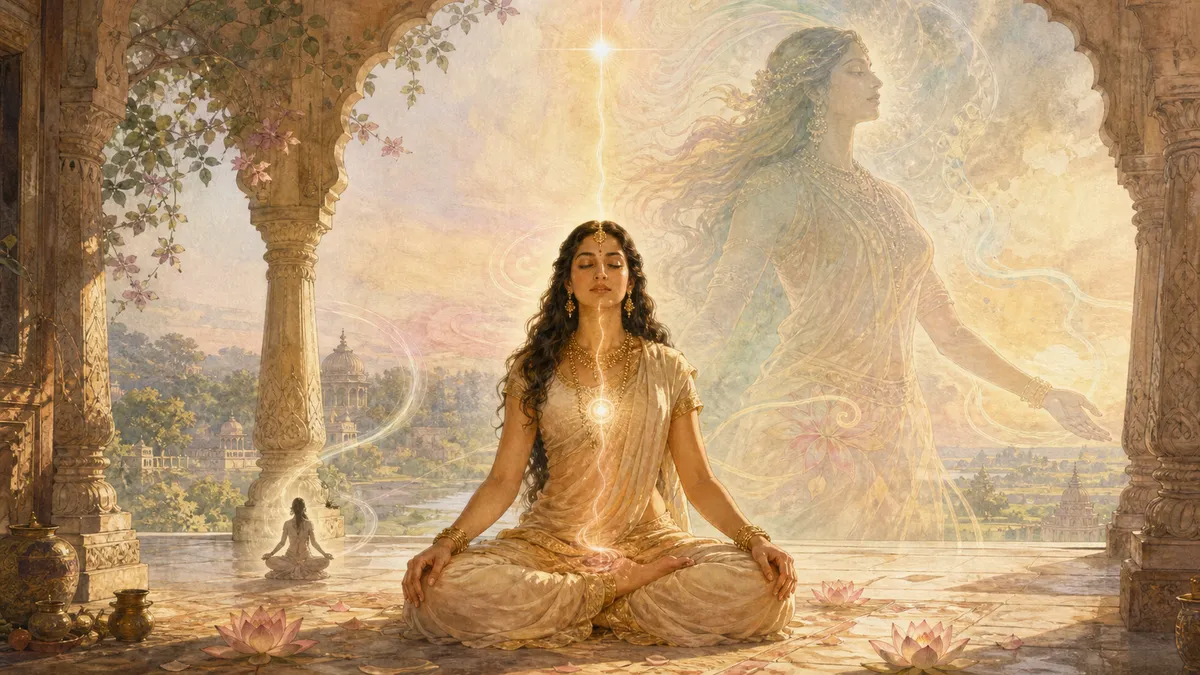
When a person attains control of the wind, he can dissolve his body into atoms, down to the state of a subtle wind, and then reassemble it anew. It is as if he burns it by means of the subtle fire arising in the anahata chakra, and then, whenever he wishes, he again unites consciousness with earth and water, acquiring a physical form.
And Queen Chudala managed to attain all this while continuing her practice. At times she entered samadhi so that her body was like a log, her breathing stopped, and she herself abided in a very deep dimension of nirvana. At times she traveled through the sky, across the oceans, wandered the earth, while not leaving her husband’s castle. She could also easily transfer consciousness into any object: a tree, a stone, a mountain, grass. Sometimes she visited heavenly palaces, communicating with gods or enlightened sages.
And although she tried in some way to help her husband attain enlightenment, all of this was useless. He still laughed at her foolishness, and Chudala decided not to display her abilities before him, considering it useless, until consciousness had matured, to “cast pearls before swine.”
The Principle of Samaya
Usually, in tantric practice, we speak of the principle of samaya. It is not that we arrogantly think that it is useless to “cast pearls” before you here. The principle of samaya means that we must, of course, respect all living beings, regardless of their spiritual level. However, the principle of samaya means that we speak about the subtle aspects of the teaching only if a person has a prepared consciousness, if he is positive, open, and treats it as sacred, with full respect. In order to enter into the transmission of the teaching, the disciple, of course, gives rise within himself to such a state of samaya connection, because if the state of samaya connection has not arisen, then the teaching “falls” on unprepared soil.
The samaya connection implies that we have sincerity, positivity, trust, openness, pure vision, and great respect for the teaching we follow, for our companions with whom we practice (samaya brothers and sisters), for the spiritual teacher, and for the lineage of transmission. That is, we treat what we follow very seriously and respectfully, since nothing less than our life, our destiny for many years and even lifetimes to come, depends on the connections we build. The samaya connection is something one does not joke about; that is, it is treated very deeply, very seriously. In ancient times, before transmitting any profound teaching, saints always tested the disciple’s ability to observe the samaya connection. If the samaya connection cannot come into being, then, of course, the transmission of the teaching cannot take place either.
So, King Sikhidvaya was absorbed in illusions, but in the end he fell into a deep depression that nothing could dispel. He began to seek solitude and performed his duties formally. He began to undertake various ascetic practices, punishing himself and his body; he gave away much of his property as donations, but this did not make things any easier for him.
After long reflection, he said to Chudala:
“For a long time I have enjoyed ruling and the pleasures of royal life, but I want to become an ascetic and go into the forest.”
Chudala said:
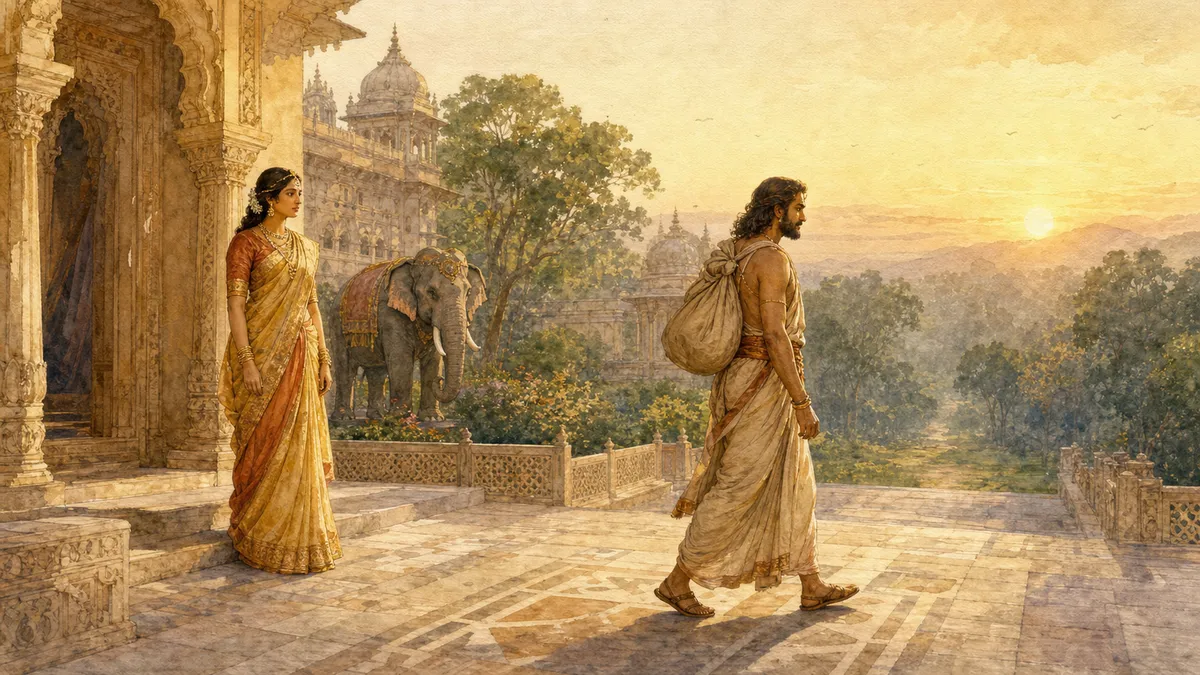
“Life in the forest is suitable for a person in old age, not for a man of your age. At your age, another life is most appropriate. When we grow old, we will both abandon this life and go into the forest!”
She still hoped that she would manage to enlighten her husband’s mind.
But Sikhidvaya insisted and said:
“Please do not put obstacles in my way. You are still a child and should not tell me what to do. So stay here and rule the kingdom, while I follow the path of enlightenment.”
Chudala thought and said:
“You want to leave your elephant at home and go looking for it in the forest... But if that is what you want, then go.”
The Ascetic Life of Sikhidvaya
The king left his castle under the pretext of inspecting the city, and he went very far from the city into the forest, to Mount Mandara. There he built himself a hut, gathered everything he considered necessary for an ascetic life: a bamboo staff, a plate for food, a vessel for water, a tray for flowers (for rituals), prayer beads, some clothing, and a tiger skin on which he could sit and meditate.
Usually tantric yogis used a deer skin, a tiger skin, or kusha grass, which possesses magical power in practice.
Sikhidvaya spent all his time reciting mantras and making ritual offerings; he also fasted and lived very ascetically in his little hut. In this way he lived for a very long time, without even remembering his kingdom, in the hope of attaining enlightenment.
Chudala announced to the courtiers that the king had gone on a “long business trip” to another state, and she ruled the state herself. But one day, eighteen years later, she decided to see how the king was doing. Chudala saw that her husband’s consciousness had already matured enough for her to transmit the Dharma to him.
Meeting the Young Ascetic
At night she left her palace and flew, using her magical powers, to the place where her husband dwelled. She reached Mount Mandara and saw that her husband had changed greatly: he was thin, blackened by ascetic practice, exhausted, quiet, lonely, and in despair, because his practice had borne no fruit.
Then Chudala thought:
“Yes, here they are—the fruits of foolishness! Only fools reach the state in which the king now finds himself. Through his own delusions he has driven himself into such a situation. Perhaps I will now help him attain enlightenment?”
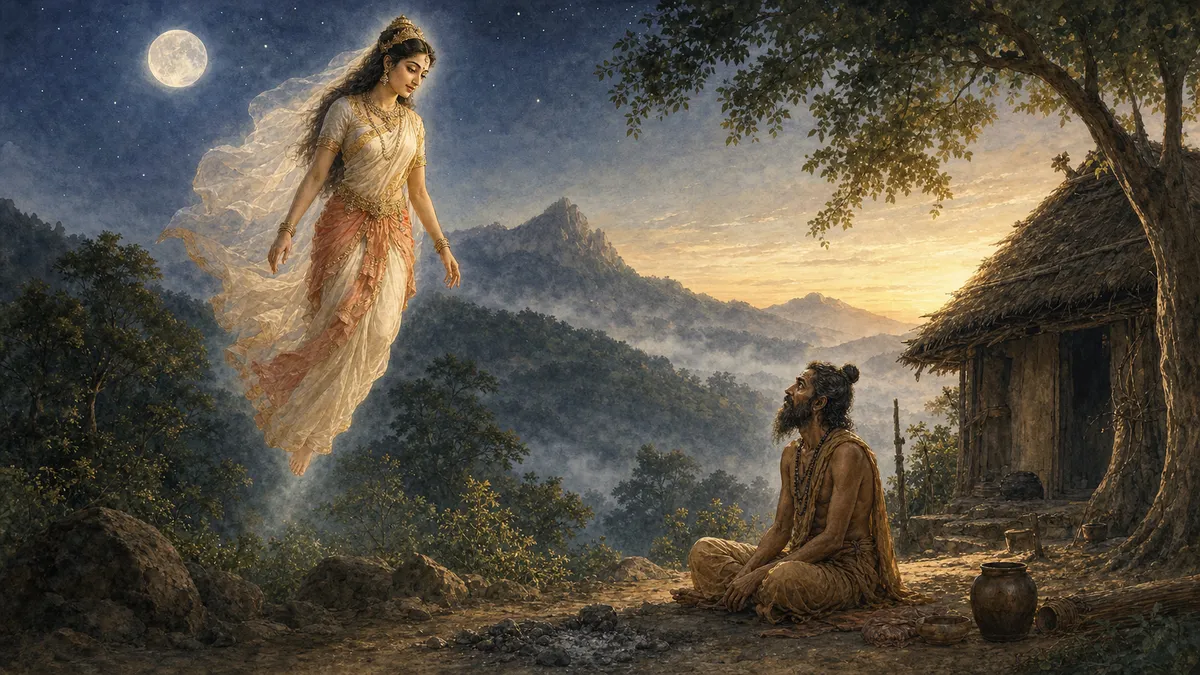
She thought that if she came to him in her own form, he would not accept her. Then she created another illusory body and appeared before him in the form of a young ascetic, descending directly in front of her husband. Sikidvaya took him for a celestial angel and greeted him very warmly.
Chudala, in the form of the young ascetic, said:
“I am the son of the sage Narada. The sage Narada once saw one of the naked celestial nymphs and manifested a subtle desire. From the power of his mind and the energy of that nymph, I was born.”
Sikidvaya believed this and asked this ascetic for instruction. He said:
“Son of the gods, you already know all that exists. I am King Sikidvaya; I have left my kingdom. I fear this unceasing cycle of life and death, where everyone constantly experiences the alternation of pain and pleasure, life and death. Although I have tormented my body, wandered everywhere, and engaged in practice, I still have not attained enlightenment, nor found happiness and samadhi. My mind is still restless; though I do not seek gain and am attached to nothing, inwardly I am also not fulfilled, since I have not yet attained enlightenment. I have very intensely practiced all kinds of yogas without interruption for many years, but I experience and receive only sorrow.”
Instructions on Knowledge and Practice
Chudala, in the form of the young ascetic, said to him:
“I have received instruction from many sages. And those sages with whom I associated transmitted knowledge to me. I asked them: ‘Which is higher—the practice of techniques or knowledge of one’s own nature?’ They answered: ‘Undoubtedly, knowing one’s own nature is higher, for only through this can one know That which alone exists. On the other hand, the various practices that are described are useful; nevertheless, they will not replace the knowledge of the true nature. If there is no knowledge, then of course it is useful to perform practices. It is just as when there are no good clothes, one must put on whatever clothes come to hand.’
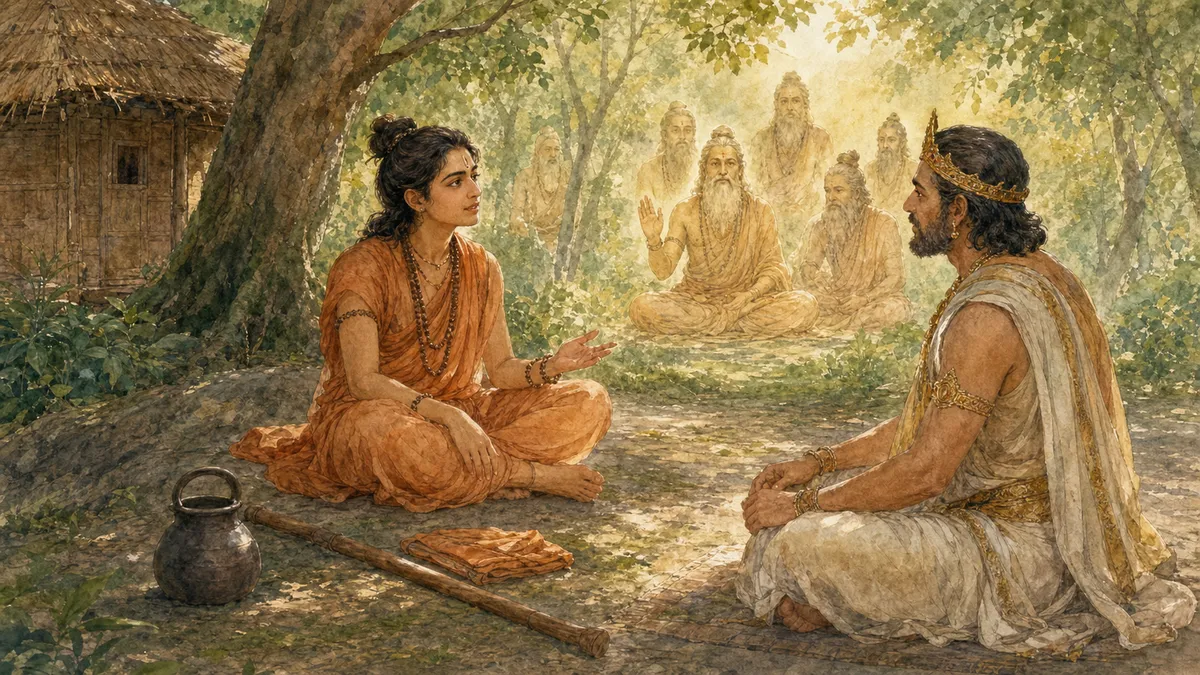
And then Chudala continued to give such instructions:
“Neither limitations, nor the ego, nor anything else is real. Fools are simply caught by the results of their actions because of the tendencies present in their minds. When tendencies are abandoned, action becomes non-action, regardless of whether it is good or bad. Even the gods (Brahma and others) declare that knowledge alone is supreme. Why, then, do you remain a fool? Why do you think that ‘this is that’ and ‘this is this,’ and continue floundering in the sea of foolishness? Why do you not inquire, ‘Who am I?’, ‘How did this world appear?’, ‘How does it disappear?’ Why not attain enlightenment by understanding the principle of the mechanisms of bondage and liberation? Why do you waste your life on useless tormenting of the body and all these ritual practices, when they bring you no benefit? Only in the company of sages, by serving them and questioning them, can you know the nature of your ‘I’.
The shastras say that the most important principle for attaining enlightenment is the company of sages or realized people. What does the company of sages mean? From our point of view, it means attaining a state of transmission, attaining proper association. While remaining within our own limitations, it is very difficult to go beyond those limitations; but if we come into contact with a consciousness that surpasses us, then we begin to see the limitations in which we abide.
And Sikidvaya said:
“Yes, sage, you have awakened me! I want to abandon my foolishness and accept you as my teacher. Please reveal to me what you know.”
The young ascetic said:
“If you are able to listen to and follow my words, then I will reveal the teaching to you, because if the interlocutor is not going to listen, respect, and absorb the teaching, it is all useless.”
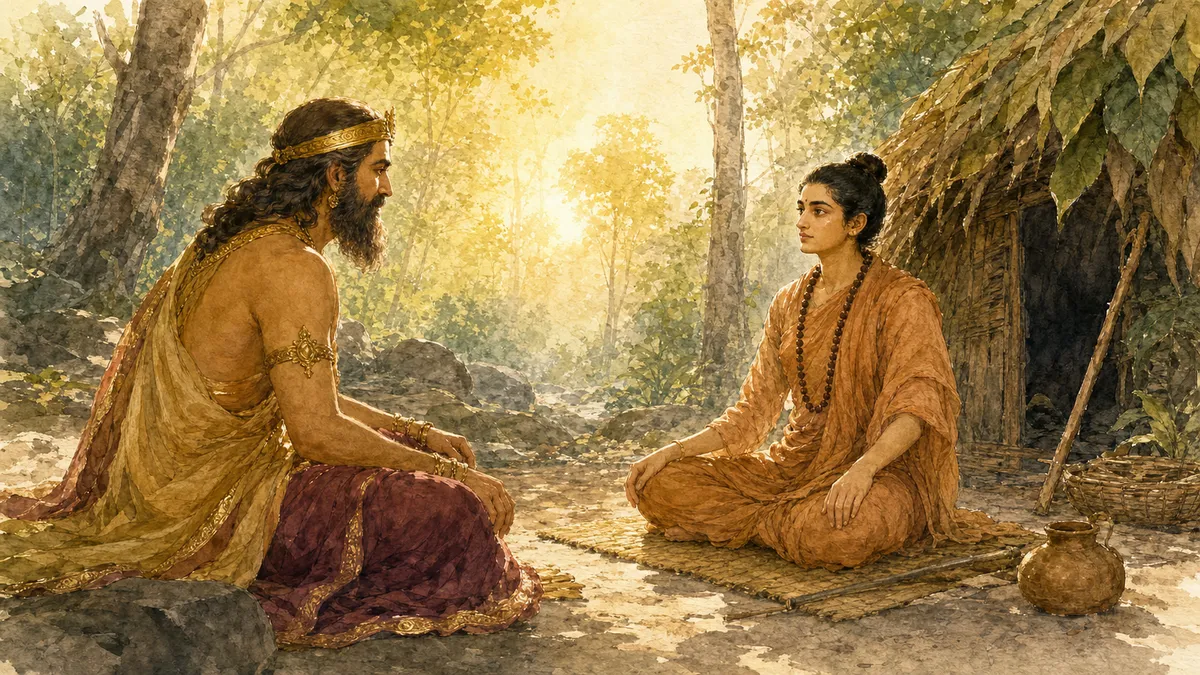
This is the principle of samaya.
One day, a disciple came to a certain teacher and said, “Please show me the path, give me instruction.” The teacher asked, “Will you follow my instructions?” The disciple said, “Yes, I will.” Then the teacher said, “Well then, let us see whether you are capable of following them. Here is a cave for you; settle in it and practice concentration for three years, and then we will talk about instructions.”
The teaching methods of antiquity were different; sometimes disciples overcame a great many different difficulties in order to receive the teaching. The teaching was not so easy to obtain. Today we can find some text on the internet and read it, but in the past all this was not so. And such a situation was quite common. This approach justified itself, because in the process of such preliminary preparation the disciple developed the necessary qualities within himself, preparing himself for an even higher level.
So, Chudala, seeing Sikidhvaja’s desire to receive the teaching, began to give him instructions.
She said:
“You have turned away from everything and come to this remote forest. However, there remains one thing that you still have not abandoned: your sense of ego. When the heart leaves the mind and the movements of thought in peace, it comes to an understanding of the Absolute. But you are still pursued by thoughts of renunciation, and renunciation itself feeds your ego; therefore you have no peace, and true renunciation does not arise in you. Such anxieties and movements of thought fill your mind, and therefore you do not find happiness. If thoughts are still in motion and you are identified with them, how can it be said that you have renounced anything? In a mind agitated by thoughts, all three worlds immediately arise. And as long as there is such movement of thoughts and identification with them, there is no rejection, no renunciation. As soon as thoughts arise in your heart, renunciation leaves your heart.”
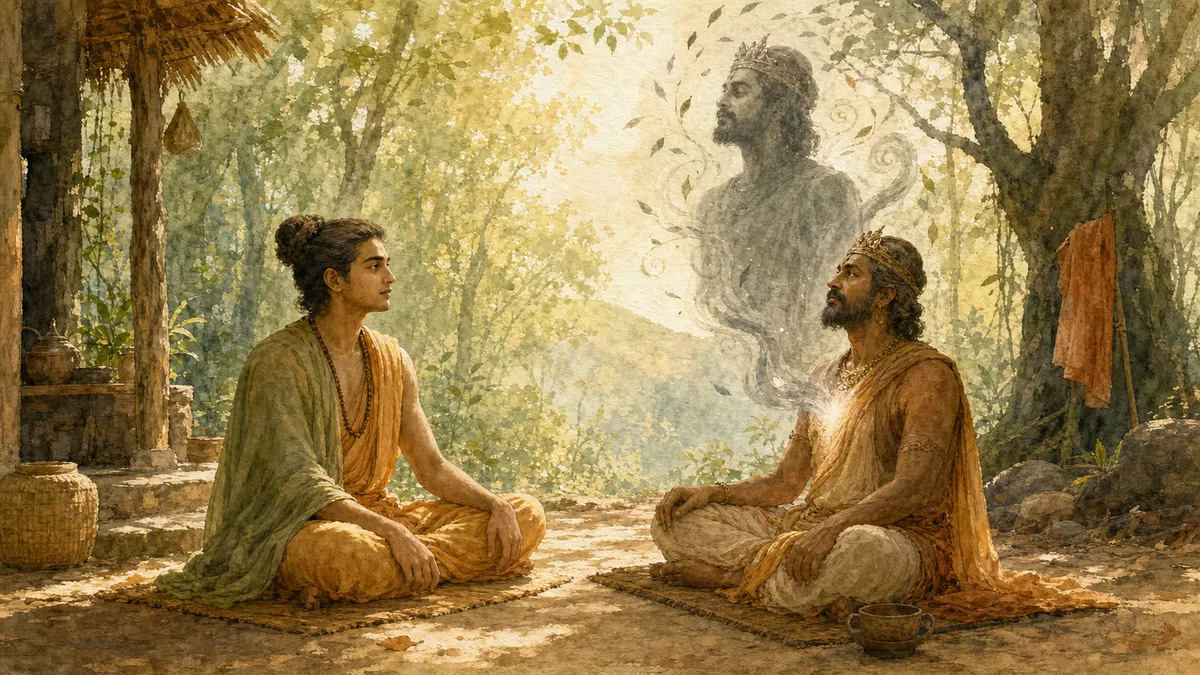
Then the young ascetic said:
“You need to renounce everything completely. Why did you not listen to the words of your wife Chudala, who knows the truth? Why have you not truly renounced everything?”
Sikidhvaja began to object:
“No, I have renounced; I left the kingdom, the palace, the entire country, and my wife. Why do you think I have not left everything?”
The ascetic began to speak:
“Wealth, wife, palace, kingdom, land, the insignia of royal power, all your relatives—all this is not yours, O king. Renouncing them is not, in truth, renunciation!”
The king was under the illusion of possession. He believed that something belonged to him. But if we understand our position in this world more deeply, we will see that in fact not so very much belongs to us. To seriously declare that I have renounced something is like saying, “I have decided to renounce the American National Bank.” In order to truly renounce something, one must possess it. But in reality we do not even possess our own body; rather, we have it on lease, because possession implies complete control over it. And who can control their body? When it wants to eat, it is forced to eat. When it wants to sleep, it is forced to sleep. When it is ill, it is ill, and when it dies, that is difficult to stop, almost impossible. Therefore, our ownership of anything in this world is a very conditional concept.
And Chudala pointed this out to Sikidhvaja. She said:
“But there is still something that seems to be yours and that you have not renounced.”
Sikidhvaja said:
“All right, let the kingdom and the rest not be mine; then I renounce this forest and everything that is in it.”
Thus Sikidhvaja mentally renounced the forest, to which he had a subtle attachment.
Then the ascetic said that the forest was not his either, and therefore there was no point in renouncing it.
Sikidhvaja said:
“This hut is now mine; I leave it too.”
To which Chudala said:
“This is not yours either. There still remains something that you have not renounced, which constitutes the very essence of the principle of renunciation. Having renounced this, you will attain freedom.”
Sikidhvaja said:
“All right, if this is not mine either, I renounce my staff, my skins, my prayer beads—in general, everything there is.”
Having said this, he jumped up from his place, gathered everything he had, and lit a huge bonfire. He threw his prayer beads into it, burned the tiger skin on which he practiced meditation, and burned his water pot (he had few possessions: a water pot, a staff, and a tiger skin).
He said:
“Now I am free from delusions! I renounce the repetition of mantras and rituals. I renounce everything that must be renounced, once and for all, because otherwise the mind will become attached again someday.”
He burned everything, and then set fire to his own hut, which he had built. He gathered the remnants of everything that remained and burned them too. He even burned his own clothes. And it is said that even the forest animals nearby, frightened, ran away.
Then Sikhidhvaja said:
“Yes, now I have been awakened by you, O son of the gods. I have renounced all attachments and concepts that supported my ego. Now I have firmly understood true knowledge. I have renounced everything and am now free from all bonds. I am in complete peace with myself. I am the victor! My clothing is the air, and my dwelling is space. I myself am like emptiness. Is there anything higher than this?”
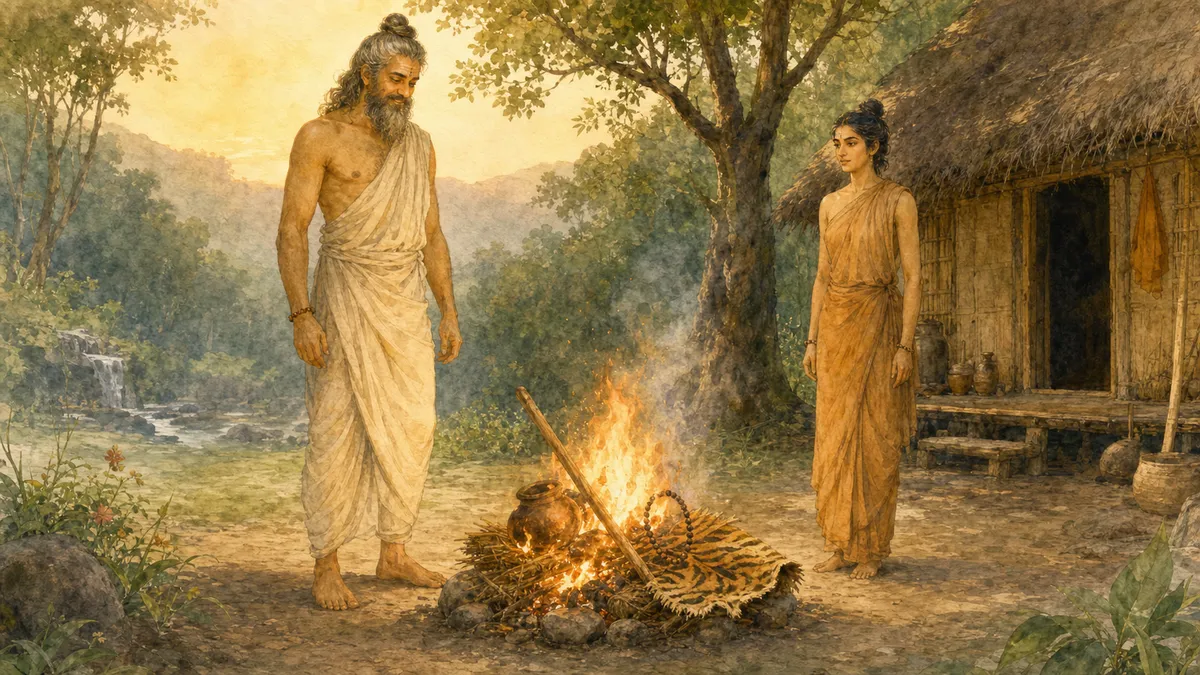
But the ascetic, that is, his wife Chudala in the form of an ascetic, said:
“In truth, O king, you have not yet renounced everything. Stop pretending to be a fool and acting as if you are enjoying the supreme bliss of renunciation! As before, you still have something left; you have not yet renounced it. And this something is the most important thing. When you cast it off without a trace, then you will attain awakening.”
After thinking, Sikhidhvaja said:
“Only my body remains. It is a refuge for worldly desires, for the venomous snakes of the sense organs. It consists of blood and flesh. If necessary, I will renounce it too; I will even destroy it in order to attain complete renunciation.”
And he prepared to jump into the fire.
Then the ascetic said:
“O king, why do you want to destroy this innocent body? It is inert and possesses no intelligence; it has nothing to do with who you are. This body is inert and dull; it takes no part in your bondage, it is not responsible for sensations of pain and pleasure. On the contrary, you want to throw away something that is very useful and can help you in spiritual practice. You still do not know what must be renounced.”
Sikhidhvaja, in complete confusion, pleaded:
“Then tell me, what must I renounce?”
The Teaching on the Mind as the Root of All Attachments
And the ascetic said:
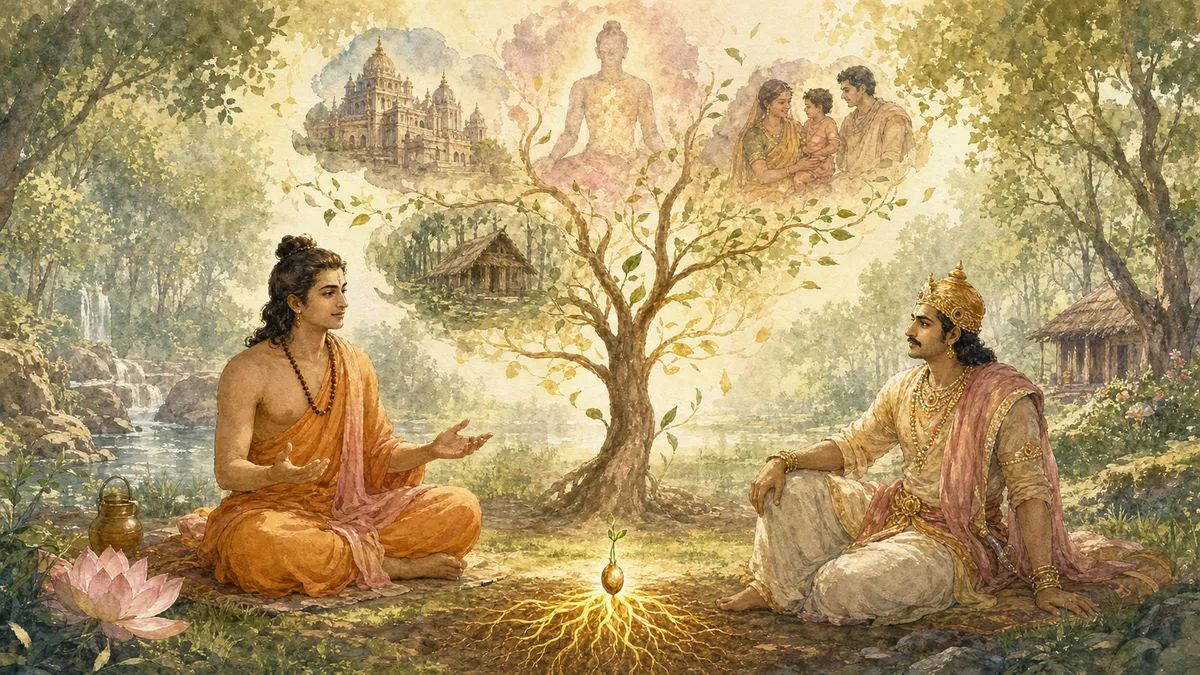
“It is your mind, which is in ignorance. The mind is ignorance, it is the world, it is you yourself as a human being. It is the seed from which the body, the kingdom, the wife, and so on sprout. And only when this seed has been renounced will there be complete renunciation! All this—good, bad, kingdom, forest—these are limitations that cause suffering to one who is under the influence of the mind, but they can give immense enjoyment to one who lives in the state of no-mind. Just as a tree sways under gusts of wind, so the body sways back and forth, experiencing pleasures or sufferings. Abandoning this is total renunciation of everything. As soon as you renounce this, the authentic truth is revealed. All concepts of unity and diversity end here; only peace remains.”
Further, this ascetic says:
“Even after renouncing the kingdom, your ego exists. And although you have burned all your possessions in this fire, you have not changed in any way. Only when you renounce the ego will you understand your true nature, and then there will be neither suffering, nor old age, nor death for you, but only true bliss. Everything else, understand this, brings only terrible suffering in this world. You will never find happiness by becoming attached to such things. Accept this truth and do as you wish. The highest truth of the knowledge of one’s own nature lies in complete renunciation, just as jewels are kept in the complete emptiness inside a pot. Therefore, through complete renunciation of everything, the Buddha attained a state beyond doubts and problems. So you too, O king, having renounced everything, remain in the form and in the state in which you are. Renounce even the concept ‘I have renounced everything’ and remain in your original state.”
And then Sikhidhvaja said:
“I do not understand this. Please tell me about the true nature of the Mind and how to renounce it so that it does not arise again and again.”
And the young ascetic began to explain to him:
“There are vasanas. Vasanas are memory, impressions of the past; they form the basis of the mind—our memory.”
For example, if we compare the memory of one person with that of another, we will see that each identifies himself on the basis of his memory. All of us, in a certain sense, are slaves of our past. Our future arises from our memory, from our vasanas and samskaras. In fact, our past is what karma is.
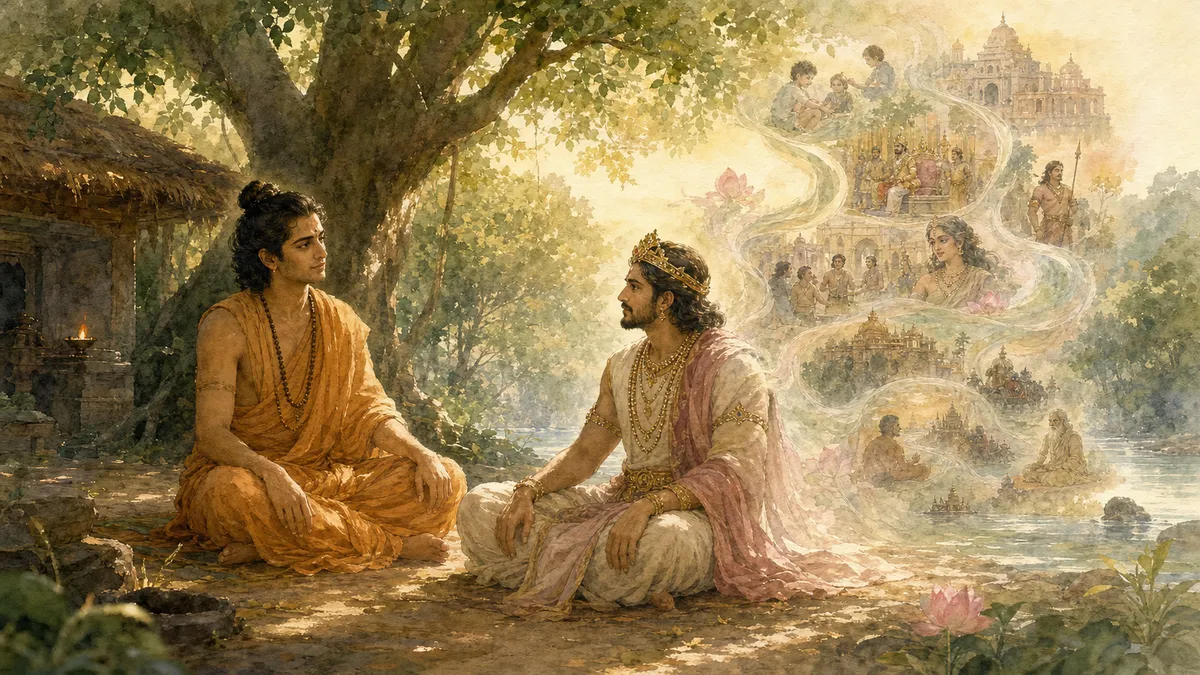
Why do we feel ourselves to be people, a man or a woman? Because we have memory, corresponding samskaras. It does not occur to us to consider ourselves a god, a deity, a demon, a spirit, or an asura. We have the idea “I am a human being.” This idea is created through the work of samskaras and vasanas, that is, the impressions existing in our memory. They are precisely what constitute our “I.” Even when we contemplate, it is very difficult to touch the level of subconscious memory. In order truly to detach from the ego, one must contemplate in such a way that contemplation penetrates to the level of the subconscious and self-liberates the memory of the past.
Then the ascetic says:
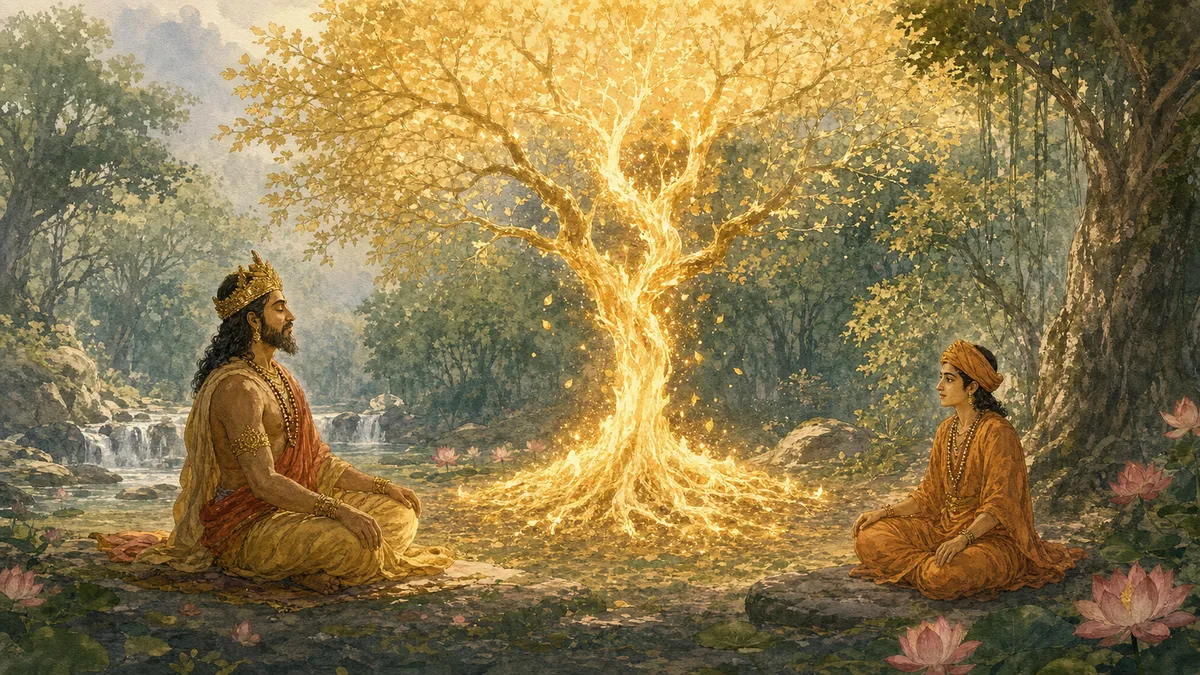
“What you consider to be yourself arises simply because of a misunderstanding of your own nature. The idea of ‘I’ is like a seed from which a great tree grows, and this tree is entirely an illusion; it is illusory. The trunk of this tree is the body. The movement of energy within it leads to its growth as a result of conceptualization, the movement of thoughts, and identification with them. Its fruits are good and bad, pleasure and pain, and ultimately, they are new rebirth and death.”
The ascetic gave him these instructions:
“This is a terrible tree. Cut off its branches and uproot it. Its branches are in fact made up of concepts and perceptions. You can uproot this tree completely even without cutting off the branches. Your main efforts should be directed toward depriving the tree of its roots. How can this tree be uprooted? Constantly reflect on your own true nature. ‘Who am I?’ Such reflection is the fire in which the tree itself, the seed, and the roots of the tree known as the ‘mind’ are completely burned up.”
As a result of the ascetic’s instructions, by reflecting on the nature of consciousness, Sikidhvaja managed to completely purify the flow of his consciousness and enter deep samadhi. In the end, he attained complete awakening.
Tests of Awakened Consciousness
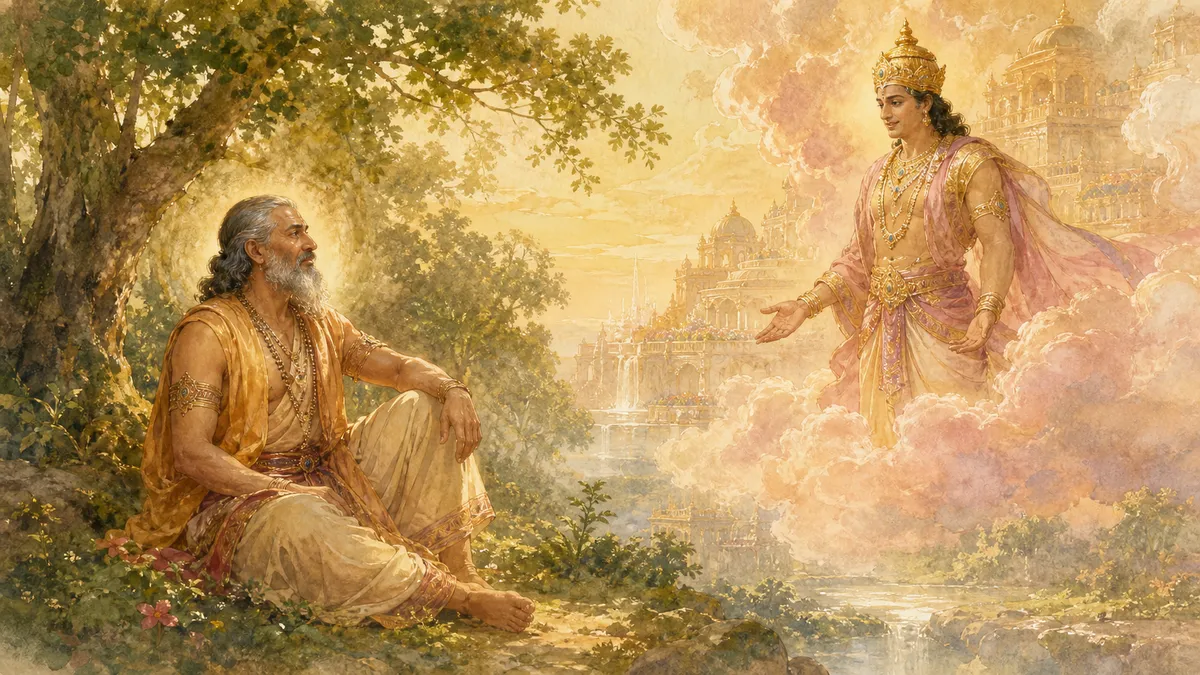
Then, seeing the king’s progress, his wife in the form of the young ascetic decided to test how unattached he was in his awakening, how free his mind was from samskaras. One day she appeared in the form of Indra, the king of the gods. When Indra appeared before Sikidhvaja, he bowed to him with great respect.
Indra said:
“Your spiritual accomplishments are noticeable even to the celestials, and all the celestials dream that you will visit their abode. Therefore, please hurry to the heavenly abode to visit us. You can remain with us and enjoy immeasurable divine powers.”
Indra invited Sikidhvaja to Heaven in every possible way, wishing to attract him with heavenly delights.
But Sikidhvaja replied something like the following:
“My mind is free from all desires. I am where I am. My heaven is with me right now, so I am not ‘burning’ with a great desire to visit heavenly abodes. I act according to what comes and goes. I have no inner desires or impulses.”
Chudala saw that his mind had truly been freed from attachments and passions. Then she decided to test him in an even more sophisticated way.
One day the ascetic came with great agitation on his face, and Sikidhvaja began to ask:
“Why are you so agitated?”
Then the ascetic (Chudala) said:
“You know, just now, while traveling between worlds, I accidentally met the rishi Durvasa. He was so beautifully adorned, lightning emanated from him. He seemed to me like a dressed-up woman hurrying to meet her lover. I decided to joke with him and said this. When Durvasa heard it, he became terribly angry with me, since he is a rishi known for his wrath, and cursed me. He said that since I had joked with him in that way, I myself would become a woman every night. I am terribly saddened by this.”
Sikhidhvaja said:
“You know that curses operate only on the relative level, while the essence of the nature of Mind cannot be touched by a curse; all the more so, you yourself are a sage, so why should you fear a curse?”
But in the middle of the night the ascetic (Chudala) began to lament:
“Look, female breasts are growing on me, ornaments are appearing by themselves, my bones are expanding like a woman’s. Horror, I am becoming a woman!”
And since he could freely change his form from male to female, he began to assume a female form at night.
Then Sikhidhvaja said to him:
“Accept it; nothing can be done, the curse is working. But your mind is not touched by anything, so abide in it and regard this as the fruit of your karma.”
After some time Chudala decided to test him further; she said:
“Look, sages are attached to nothing. Are you attached to sensual pleasures, or are you not attached to them? Or are you attached to asceticism? Now, since I am a woman, why should you not live with me as with a woman at night, while during the day we will be friends like men?”
Sikhidhvaja thought and said:
“My view is neither acceptance nor rejection. Moreover, you resemble my wife, but there is neither attachment nor aversion in me. If you wish it so, why not?”
Then they performed a wedding rite, made an offering to the gods, and exchanged garlands. After that, at night Sikhidhvaja and Chudala lived as husband and wife, and in the morning she turned into an ascetic. Thus they lived for some time: during the day they were friends, and at night they were husband and wife.
But Chudala decided to continue carrying out her plan in the form of tests. She thought:
“Now let us see how free you are from attachment to me as your wife.”
One day, by her magical power, she created a handsome young man.
When Sikhidhvaja was wandering through the forest, she divided herself into two parts so that this young man was reclining with her on the marital bed. Sikhidhvaja came and saw that his wife was amusing herself with a young man.
He thought:
“Well, so be it. Such is nature; nothing can be done. But my mind is beyond all attachments.”
Chudala began to justify herself, saying:
“You know what women’s nature is like; it is inconstant. All the more so, my female part appeared as a result of the curse; I can do nothing with myself. I have a very strong desire, and therefore in this form I cannot control it.”
Sikhidhvaja said:
“Please, do not let yourselves be distracted; there is no problem. I understand that it is simply the curse at work. Let us not consider ourselves husband and wife, but simply be friends. You may continue to lead whatever way of life you like.”
And in his soul, not even anything changed.
After all the tests, the ascetic assumed his original form. That is, he appeared in the form of his wife Chudala. Sikhidhvaja was greatly astonished.
His wife said:
“You know, I was all of this. I created the illusion of this forest, then I turned into an ascetic, then into a woman, and then I also created the young man. All of this was my teaching for you.”
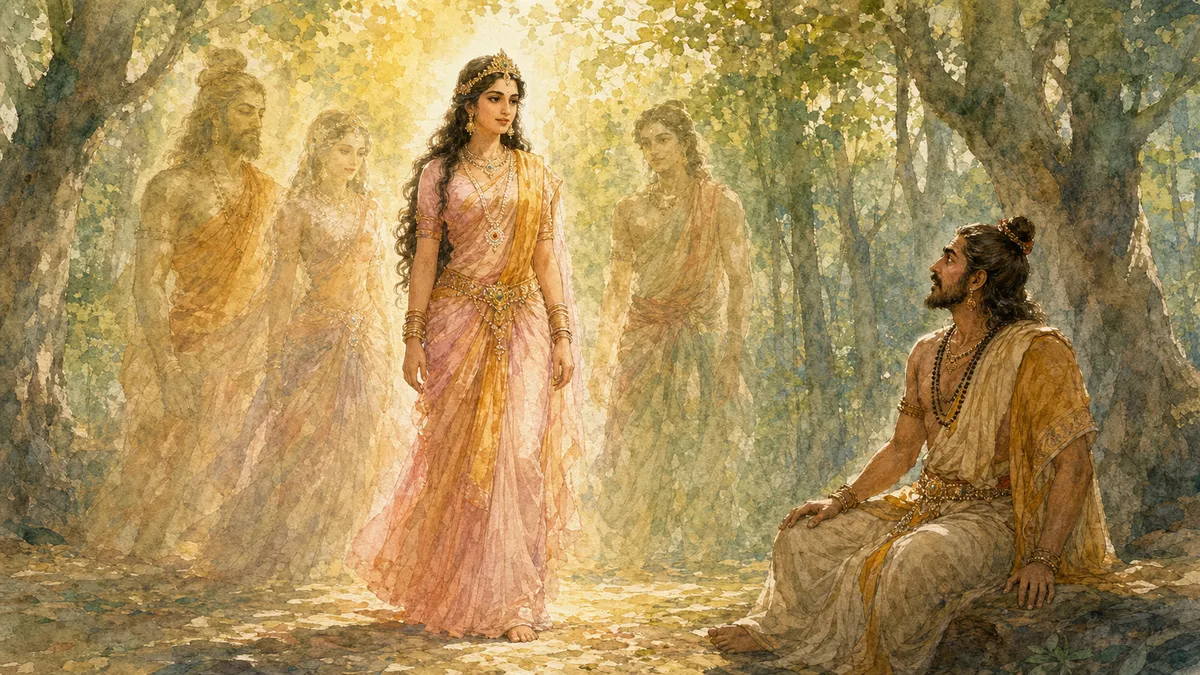
Sikhidhvaja became greatly bewildered when he saw that his wife, together with him, had been helping him move toward enlightenment and had made an enormous self-sacrifice for his sake. He felt immense, boundless gratitude to her, acknowledging her as his spiritual teacher.
In the end, King Sikhidhvaja, having attained complete awakening and siddhis, was placed on the throne by his wife Chudala when she performed a magical ritual and elevated him to emperor. Then, by her magical power, the queen materialized an army, great riches, and so on, and with all this retinue and ceremony they entered the king’s palace.
With Chudala’s help, Sikhidhvaja, having acquired the siddhis of long life, ruled for ten thousand years, after which he attained nirvana, in which there is no more rebirth.
The story of Sikhidhvaja and Chudala is the story of a living being’s battle for liberation, which gives us an understanding of what we should renounce. Until such renunciation takes place, we will remain within the limitations that will continue to rule over us. Such renunciation is possible only when we possess the subtlest understanding, which is called “viveka-vidya” (discriminating wisdom). In order to renounce something, we must have an understanding of what is to be renounced.
Obstacles in Spiritual Practice
Practitioners are often hindered by many things in spiritual practice. What exactly? Being absorbed in matters outside the teaching and service, inertia, passivity (simply put, laziness), fantasies and illusions, skepticism, doubts, when we think: “Perhaps it is so, and perhaps it is not so at all. Perhaps it is altogether impossible to attain enlightenment?” Closedness also interferes, as does a lack of understanding of the intuitive side of the teaching, an overestimation of one’s level (self-importance), when we think: “Yes, undoubtedly, I am a practitioner of the highest category—divya. What others spend time on, I have certainly already passed through.” But it may turn out that this is not at all the case, and therefore it is very important to determine precisely one’s own level. Sometimes non-observance of the principles of the teaching interferes, when we want to leap quickly over the stages of the teaching.
For example, the logic of the prajna-yantra teaching develops in such a way that we need to train in concentration, although concentration itself is not the teaching of Laya Yoga; it is a preparatory stage. Nevertheless, without it, success cannot be achieved. Therefore, I always recommend to students that they practice concentration on a point, on the flame of a candle (for at least half a year or a year).
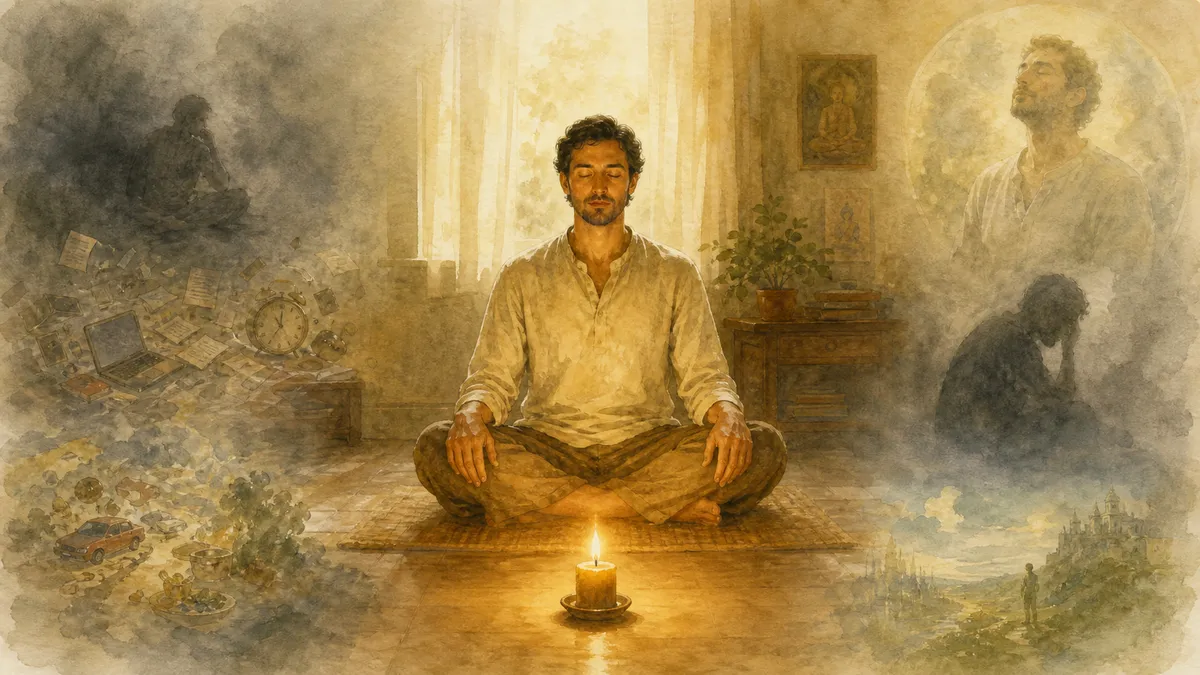
When we attain some success in concentration, we can go further in order to gradually master contemplation. And after you have acquired the ability to practice concentration on some object for an hour or an hour and a half, and we have the experience of the first dhyana, then it can be said that you have fulfilled the instructions. This is precisely why basic practices exist. Of course, basic practices are not an end in themselves; nevertheless, they are important. However, many think: “I am above all this. I would immediately abide in the nondual natural state.”
The Sequence of Practice Development
After we master concentration, we move on to the practice of contemplating the breath, and while performing anapanasati, we concentrate on the breath as the principle of movement until the mind becomes one-pointed.
Finally, after this we are already ready to move on to mahashanti (meditation of peace) and to atma-vichara meditation. This is how the logic of practice develops.
After success has been achieved in mahashanti—that is, dhyana has been experienced in the meditation of great peace and we can stop thoughts—it is recommended to perform khechari mudra or shambhavi mudra. If you have sufficient abilities, you may proceed directly to shambhavi mudra, but if they are insufficient, then usually khechari mudra is performed first, that is, concentration on a specific point in space. Only after this can one truly benefit from shambhavi mudra.
Finally, when we have become rooted and strengthened in the practice of shambhavi mudra, we can truly contemplate in movement, while working with sankalpa in parallel. After we have acquired the ability to contemplate with an open mind in movement, we can unite contemplative presence with the energy of the elements in the chakras and work with the chakras and the elements within our body. This is no longer only awareness, but awareness united with energy.
Finally, when we have succeeded in uniting contemplative presence and the elements in the chakras, we can unite with the external elements—with external earth and water, wind, space, and so on—with the external elements.
Union with Universal Forces
What happens next? Contemplation is a kind of thread onto which various practices are strung, and this thread develops and grows more and more. After this, we can unite our contemplative presence with various universal forces: with the power of creation, preservation, destruction, concealment, and enlightenment.
There are various forces in the universe—the energy of time, space, and many different energies. They are not known to us and have not yet been understood. At this stage, we learn to unite contemplative presence with these energies, thereby giving it development.
Often, at first, we can attract such forces by engaging in service. If students feel that their practice is not progressing, I often recommend that they engage more intensively in service in order to attract enlightening forces into their lives. For if such forces are not part of your environment, then even if you intensively perform certain techniques, they may not work, because you still remain within your limitations. But at this stage we unite with universal forces exclusively through the nature of consciousness, through presence.
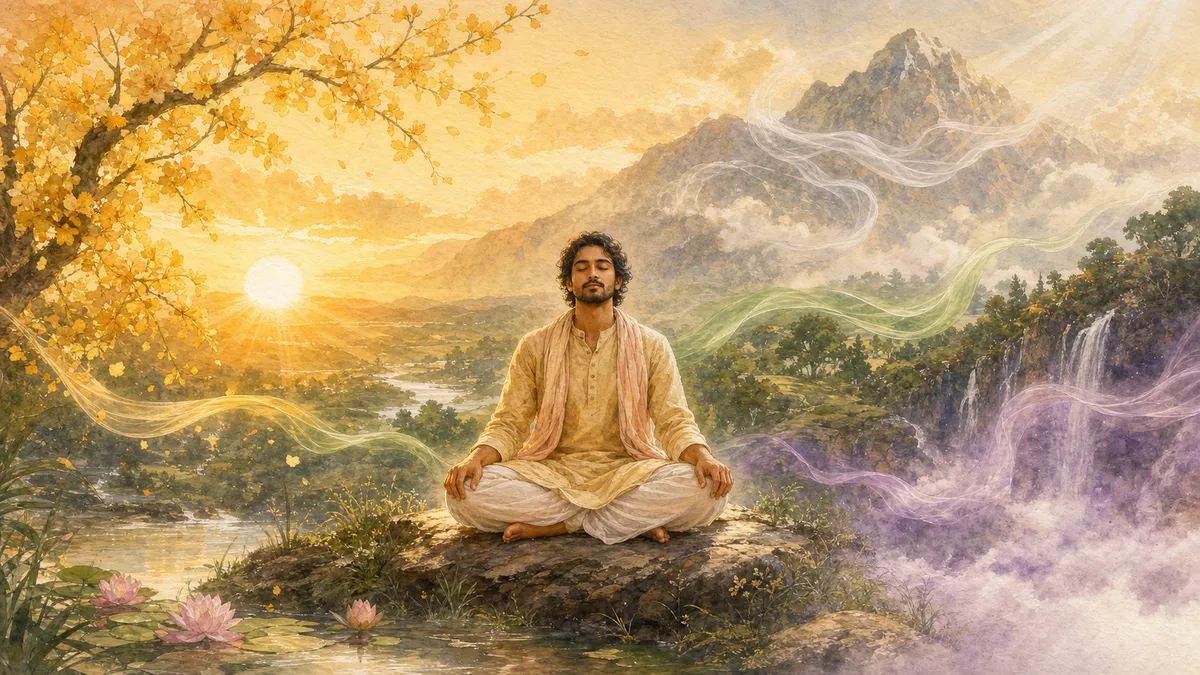
Suppose that, by uniting consciousness with creative forces, you can manifest a tremendous power of intention; by uniting consciousness with the enlightening forces of Anugraha-shakti, you can manifest changes in this world or in this karmic vision.
Finally, the union of presence with the higher levels of universal energies, such as time and space, takes place. The tempering and training of the single “taste” in the natural state occurs, its testing, the testing of pairs of opposites and various desires, visits to places of power, and the practice of crazy wisdom. This is something that is not relevant now, but lies ahead for students as practitioners if you reach a certain stage.
After consciousness has gone through all this and has developed to such an extent that it possesses a single “taste,” the time of creativity comes, the time to express oneself and manifest for the benefit of others, to create mandalas. This is the beginning of practice in the style of a deity, when practice ceases to be practice and becomes the play of divine energies. This is precisely how the principle of contemplation develops on the path of Laya Yoga.
The Right Priorities in Practice
Many practitioners initially strive for some kind of radical spiritual experiences. But if you practice diligently and methodically, spiritual experiences will come in due time.
First of all, one should not strive for spiritual experiences, because spiritual experiences are not an end in themselves. And even meditation itself is not an end in itself; the goal is the transformation of karmic vision. Therefore, I often recommend that students strive not so much for the experience of spiritual states as to develop awareness, the ability to remain in moment-to-moment awareness, which is in itself the main spiritual experience.
And the second important thing is to purify consciousness and prana. What does this mean? For example, to develop pure vision, to cultivate the qualities of sattva, to displace tamas and rajas, to free the mind from bondage to worldly stereotypes, to free oneself from egoism and kleshas (anger, pride, attachment, lust, and envy), to purify one’s external way of life—that is, to become a practitioner in external life.
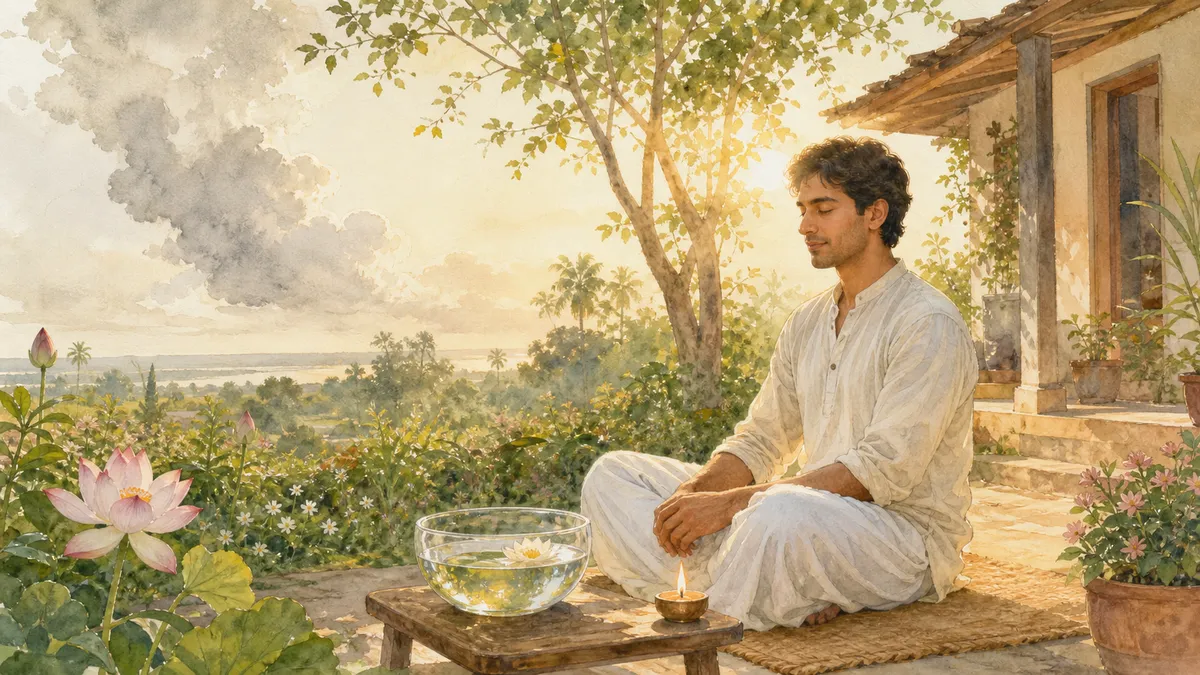
There is a great danger of becoming an indifferent practitioner of the Dharma: listening to many teachings, but without applying them in your life, feeling that the teaching is somewhere over there, while you are somewhere here, and that your life in no way reflects spiritual practice. Purifying one’s external life, environment, and lifestyle is also very important, since spiritual practice cannot be merely done; it can only truly be lived.
Finally, it is necessary to purify the meaning-forming vector. Each of us has our own particular meaning-forming vector. Simply put, this is the meaning of life; it is that for which we live and begin spiritual practice. At first, this meaning-forming vector also arises from dualistic, egoistic motivations. But as practice progresses, it is purified, when our motivation shifts from obtaining sensory pleasures, worldly success, or even enlightenment to the principle of serving the universal forces of enlightenment, which we do not distinguish from our own consciousness. It is precisely when such purification takes place that we become free from that which limits us.
