

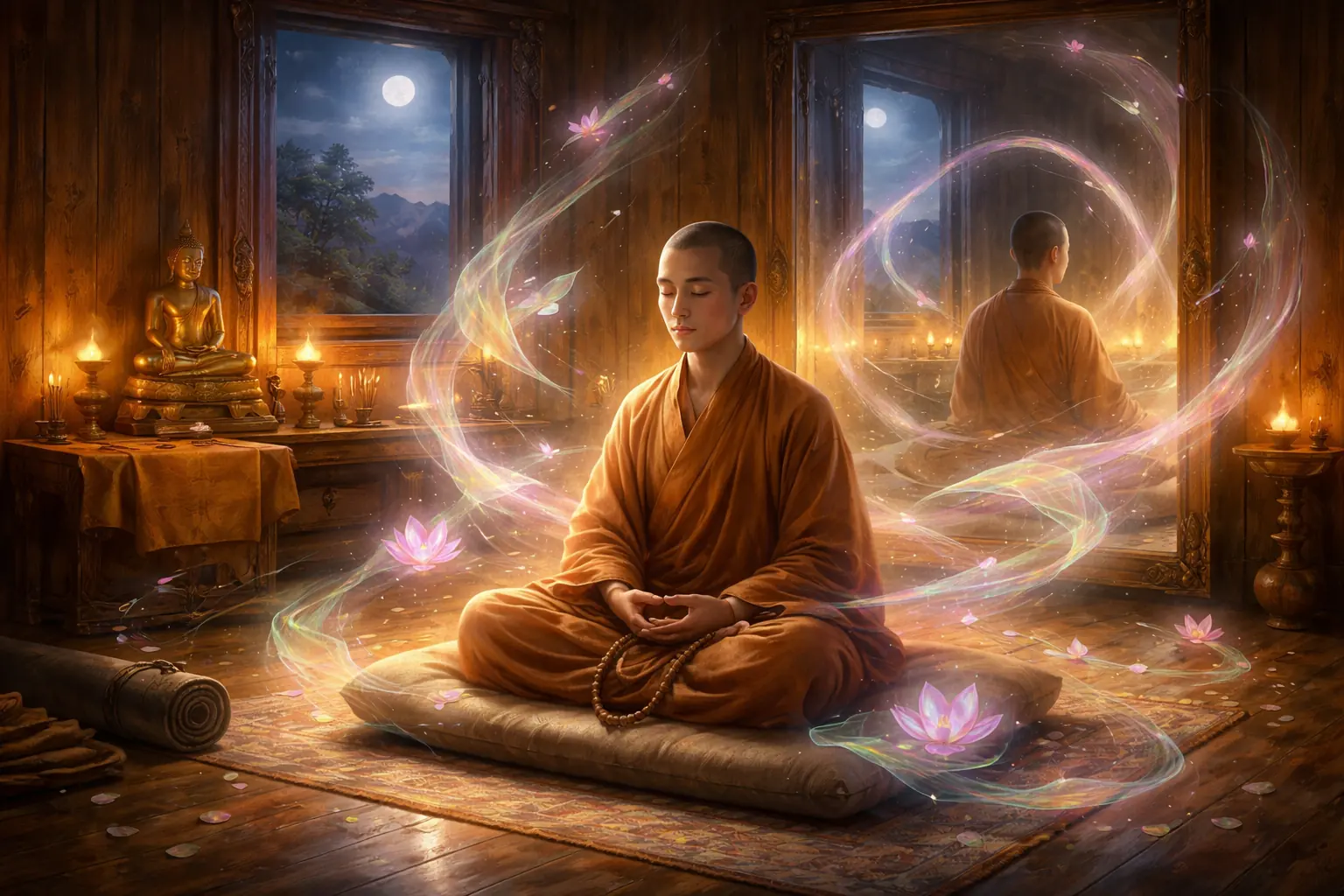
Dreams are called hidden tendencies, and therefore consider everything visible, everything that manifests during the day, to be like a dream and an illusion.
When you practice sankalpa (for example, “this is a dream”), contemplative walking, or atma-vichara, some part of your consciousness perceives the world as an illusion, while another part concentrates on the feeling of “I.” This is the basic sankalpa that you need to become accustomed to before you train yourself to enter contemplation. You should constantly remind yourself: “Do not sleep, do not become upset, do not get angry, do not become attached, do not become irritated, because all of this is a dream.” To manifest these feelings in a dream means to be asleep. But if you know that this is a dream, you are relaxed and play in this dream while continuing to awaken purposefully. And gradually, our perception of the dream shifts us toward the dreamer. In other words, the aim of your training is for your perception to be transferred more and more to the subtle levels of awareness.
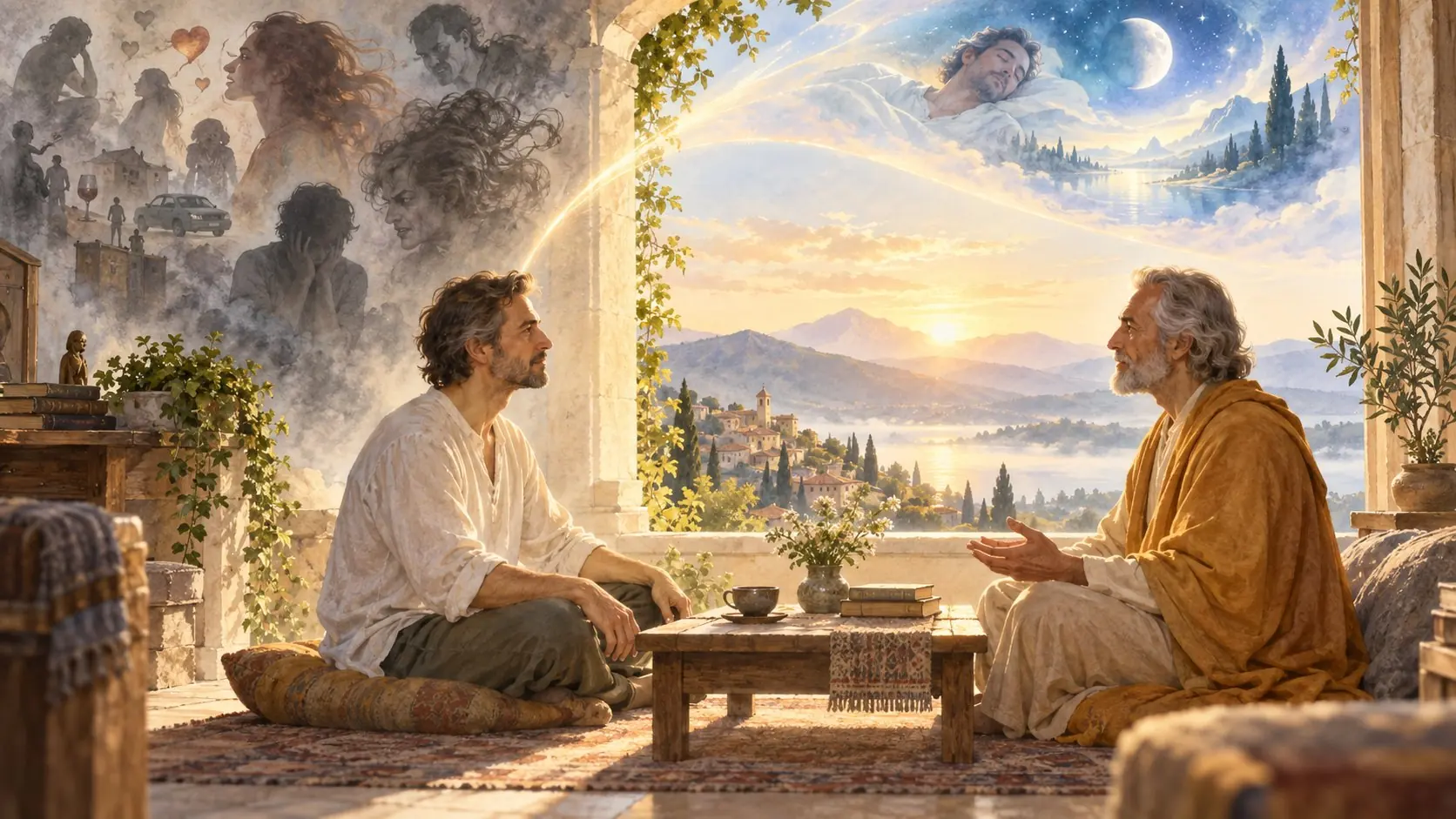
Laypeople ask questions such as: “How can I practice if I have this kind of job and these kinds of responsibilities?” And I think: “My God! I don’t know, because I am a monk. Children, alimony... I have never had any of this in my life, I have not worked a single day, so I cannot advise you. I have no such experience. I can only advise you to become a monk, because all these problems are fundamentally impossible to solve.” This is all similar to questions like: “In my dream, I have children, a wife, a job, and so on. How can I awaken? What advice can you give me?”
The Evolution of Practice and Students’ Questions
Monks or novices ask questions related to desires, energy, various impure states of mind, or methods of practice. But as their consciousness becomes subtler, experienced monks ask purely technical questions, and our conversation with them resembles a conversation between professionals. In other words, these are questions concerning the subtleties of contemplation, clarifying presence, while questions about relationships, desires, rules of conduct, inner instability, spiritual seduction, deviations, and so on have already fallen away as completely resolved; all of that is already behind them, it is all kindergarten. A conversation between two professionals revolves around refining, deepening, and clarifying the natural state; its further expansion and opening; unification in various situations; developing flexibility; learning to master the pranas and presence through effortless presence; aspects of cutting through hope and fear or Clear Light; and deepening these states in dreams. And all methods are subordinate precisely to this.
Finally, when this stage has also been clarified, what remains are questions of uniting with coarse energies, purifying the last dualistic states, clarifying them in dreams, practicing pure vision, the four visions in jyoti yoga, subtle divine energies, and manifesting oneself in the external world as a deity, that is, in a new status.
Practical Instructions on Dream Yoga
“It is especially important to practice the instructions concerning appearances manifesting during the daytime. At this time, vividly imagine that your surroundings, your home, your companions, all actions and conversations are a dream. And even say aloud: ‘This is a dream.’ Constantly imagine that this is only a dream.
Then, in the evening, as you go to sleep, arouse compassion, thinking: ‘For the benefit of all living beings in the universe, I will practice samadhi, which is like an illusion, and attain the perfect state. For this purpose, I will train in dreaming.’ Then lie down on your right side with your head facing north. Your right hand should be pressed against your cheek, while your left hand rests on your thigh.”
For matajis, everything is the opposite, because their channels are arranged in reverse. That is, we must lie on the pingala channel so that, by compressing it, we block the vasanas that move through the pingala channel. In tantra, matajis have equal rights with prabhus, so there is no discrimination whatsoever.
Divine Pride
“Clearly imagine that your body is the body of your deity.”
We must arouse divine pride and gradually become accustomed to the fact that our body is the body of a deity, not a human body. It is not necessary to visualize ourselves in the form of a deity in any special way, because this is not part of our tradition. We simply need to evoke a feeling of divine purity and bhava in relation to our own body.
“If your visualization is not clear, generate pride by thinking: ‘I am the deity.’”
Generating divine pride is a higher and subtler method than visualization. This method is characteristic of the higher tantras.
We place particular emphasis on generating divine pride, that is, a different perception of oneself. It is as if you previously felt like a small and shrunken person, but now you are creative, infinite, wise, pure, and perfect consciousness without limitations. And you must constantly affirm yourself in this new status. This is what divine pride means. For the arising and cultivation of divine pride, we have the specific sankalpa “Aham Brahmasmi.” But even without a special sankalpa, divine pride should be generated constantly.
At first, this is a feeling of elevation in the soul that grows over time. If you do it with effort, you may feel as though you are bursting, as though your pride is literally pouring out of you. But this is not yet true divine pride; that is, it is a feeling generated through effort. True divine pride is a very subtle and elevated consciousness beyond effort, unrelated to the ego, unrelated to ahamkara and individuality. In other words, we are proud not of ourselves, but of the Absolute; otherwise, with such pride one can fall into a good maya.
This means that we recognize that, as the illusory body of the Absolute, we possess purity and perfection.
The Technique of Falling Asleep and Becoming Aware of Dreams
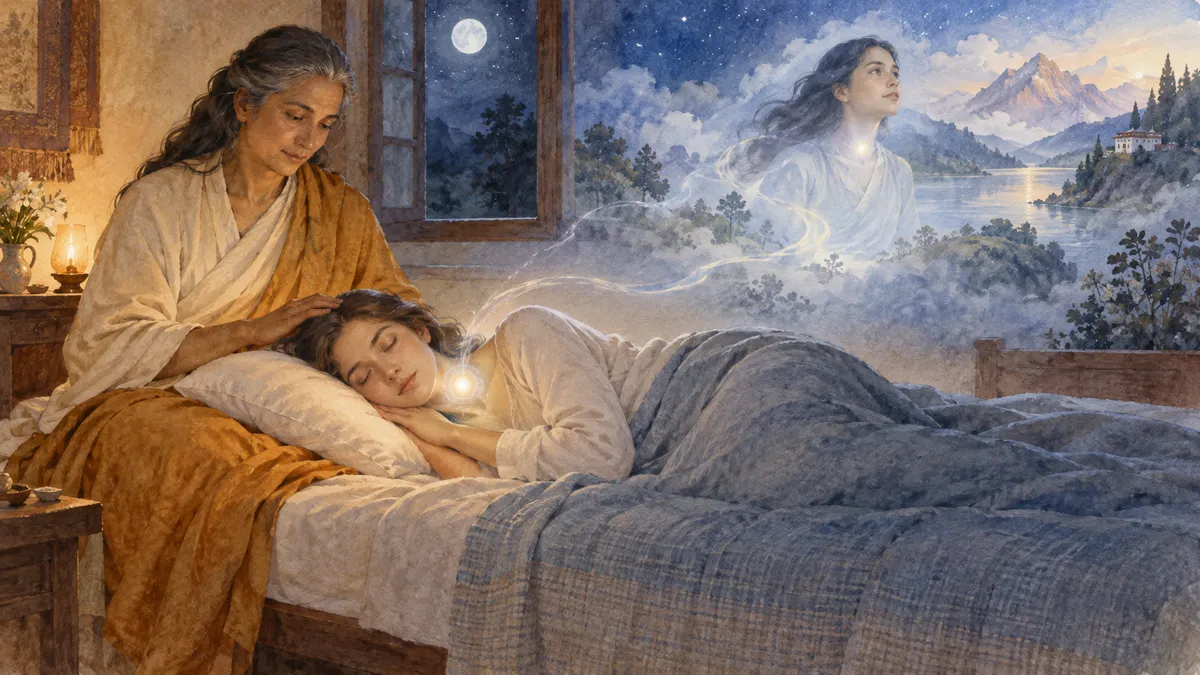
“Imagine that your head is resting on a pillow on the lap of your root Guru, and clearly focus your attention on the deity in your throat. It is the size of a thumb joint, smiling, with a radiant face, visible but without an inherent nature. Mentally say the prayer: ‘Bless me so that I may recognize the dream state. Bless me so that I may recognize the dream state as such.’ Lie down in the sleeping lion posture and generate a strong desire to recognize the dream state as such. At this time, fall asleep without being distracted by any other thoughts. Even if you do not recognize this state on your first attempt, repeat it many times, and do so sincerely, with a strong desire.”
The main thing is to fall asleep with a one-pointed mind: either focused on becoming aware of oneself in dreams with imagery, or on becoming aware of oneself in dreamless sleep. The advanced practitioner directs the mind only toward presence, without engaging in visualization, and practices the yoga of light. A practitioner who has not mastered presence engages in visualization in the chakras and directs the mind toward awareness during dreamless sleep.
“Upon waking in the morning, think insistently and clearly: ‘When I wake up, none of the dreams from the past night remains; likewise, none of the daytime appearances from the past day will appear in dreams tonight. There is no difference whatsoever between dreams during sleep and waking life. They are all illusions, dreams.’ This is the first part.
If, even after repeating this practice many times, you still have not recognized the dream state, then, using other practices, imagine yourself as your sole deity.”
Repeating the practice many times means repeating it at least three hundred times.
“Once again, clearly and distinctly visualize the deity the size of a thumb joint in your throat. Direct consciousness without applying effort, and fall asleep.”
Practices vary depending on the school, but in principle their essence is the same. We begin with the vishuddha chakra in dream yoga. The vishuddha chakra is responsible for the subconscious and for dream yoga in dreams with imagery. If you fall asleep having fixed your mind and concentrated on the vishuddha chakra, your dreams will become lucid. In one night, you can freely have five lucid dreams. If, as a result of sustained concentration, you develop a feeling of pressure in your throat, you will not even notice how you fall asleep. You will see everything as though you were lying there with your eyes open, and hear everything as though someone were speaking behind the wall, and you will think as you normally do. Then you will suddenly discover that you have awakened; that is, you will realize that you were asleep and fully aware.
Results of the Practice and Obstacles
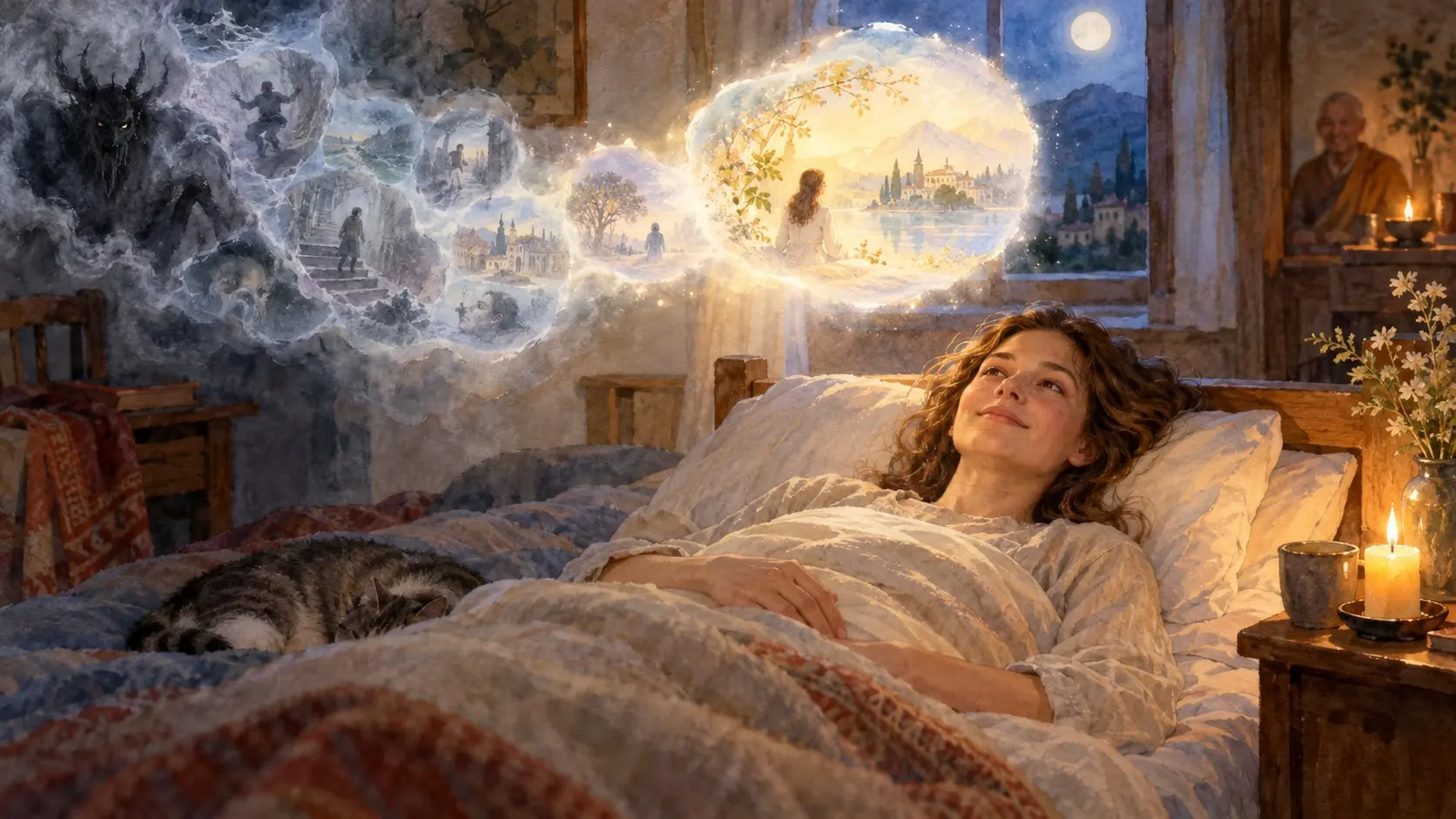
“Direct consciousness without applying effort. And fall asleep in anticipation of recognizing the dream state as such. This is the second part. Meditate, alternating meditation objects, and practice while clearly feeling that daytime appearances are dreams. Even the weakest practitioners recognize the dream state within a month. At first, there will be more dreams, then they will become clearer, and afterward you will become aware of them. Upon seeing something frightening, you will easily recognize: ‘This is a dream.’”
Even a weak practitioner will realize the dream state within a month if, while on retreat, they devote several hours to practice or train very well in it while awake. As you fall asleep, you should direct your mind toward dreams. I heard that a layperson once approached Namkhai Norbu and complained that he could not recognize dreams. Namkhai Norbu then laughed. The layperson asked, “Why are you laughing?” Pointing to his student, Namkhai Norbu replied, “Ask this student here.” And the student said, “I have been a student for fifteen years already, and I still have not managed to recognize dreams.”
“It is difficult to recognize it spontaneously, but if recognition occurs, it will be stable. If you are unable to recognize it by any means, perhaps this is due to a violation of samaya. Therefore, return to the practice, take Refuge, arouse compassion through repentance, recite the mantra, make offerings, avoid impurities, and meditate as before. Through such actions, you will recognize the dream state in just two or three months and will be able to recognize it regularly.”
Technological Possibilities
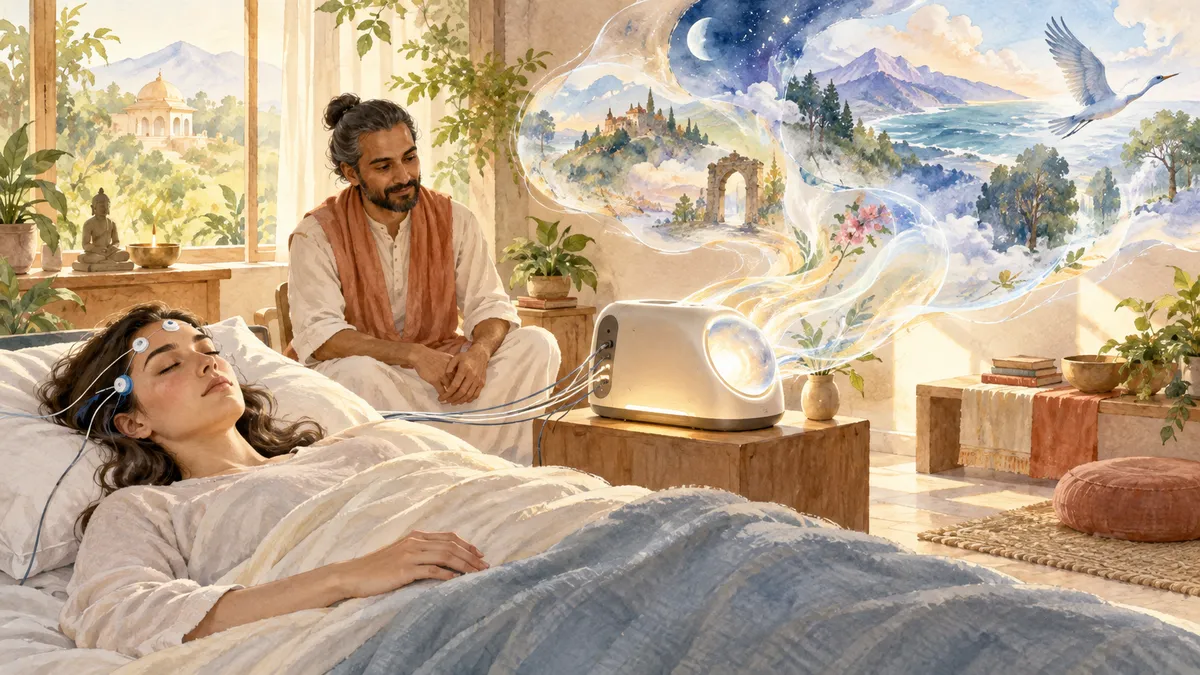
A machine has recently been invented in Japan that allows you to order dreams to your liking by entering data. This is the latest technological development. Some say that dreams of the kind requested are indeed induced, but then they get out of control. Of course, you can generate something in your subconscious, but only you yourself can fully control it.
I think that we will create one like this in the ashram, so that it could be used to generate dreams and train in successfully controlling them.
There are also other devices that we have tested a little. They cannot give you the yoga of dreams, but they can wake you at a time you specify, when you are in the rapid eye movement phase of sleep, which is registered by sensitive sensors.
Nightmares as a Catalyst and the Purification of Obstacles
“A nightmare can act as a catalyst, helping you recognize the dream state as such. If you have a nightmare, it is easy to realize that it is a dream. Whereas in an ordinary dream, realizing this is much more difficult. But if, through long and serious practice, you recognize the dream state as such, this achievement will be much more stable. Restoring a broken vow through repentance usually involves a purification ritual. Such purification can also be carried out by reciting a mantra or making an offering. In addition, you need to be mindful in order to avoid further unwholesome actions.”
If impurity arises in your consciousness, your relationships, or the principles you follow, this too can hinder dream practice.
“In other words, if you still see that your practice is unsuccessful, this may be caused by violations. Therefore, in order to purify it, do any practices, and then return to this practice. Having recognized the dream, you will practice creating an emanation and transforming into the creation of a dream. This is the next stage of the practice.”
