The Yoga of Contemplation and the Path to the Natural State of Mind
01.08.2026
0 мин. чтения
0
Share
copy
search
add
share
Commentary on the text “Laya Amrita Upadesha Chintamani”
We continue discussing the section of the teachings related to the yoga of contemplation.
To study Laya Yoga in our tradition means to study five sections, or five yantras of Laya Yoga: the section on contemplation and the section on energy, which form the foundation of the teachings, as well as the sections on dream yoga, sound yoga, and light yoga, which belong to higher levels. It can be said that the yoga of contemplation and the yoga of controlling inner energy are the foundation, while the three higher yogas are the roof and interior finishing of the edifice of enlightenment that we are building on the path of Anuttara Tantra.
The yoga of contemplation is primarily aimed at clarifying our mind, our face before birth, and at discovering our primordial consciousness. Until this primordial consciousness is understood or discovered, spiritual practice will lack a clear direction. Even if a person recites mantras, performs tantric rituals, engages in worship, or practices pranayama, their practice will always remain marked by duality and conditioning. Therefore, when it comes to training, the teacher first and foremost recommends that the student clarify the essence of the nature of Mind, Mind as such.
I will read the shlokas from the root text “Laya Amrita Upadesha Chintamani” (“The Liberating Nectar of Precious Instructions”) and comment on it.
The yogi said: “Those who skillfully interpret the Primordial Reality but are conditioned by the mind remain closed to luminous prajna because of their attachment to scriptures and dogmas.”
Even if we study texts, discuss them, or arrive at some logical, conceptual understanding, that is not enough.
The Brahmin Saraha said that one can discover the true value of texts or scriptures only after realizing one’s own mind. Until then, they remain the experiences of other people recounting their realization. Therefore, even when we study texts, our main task is to clarify our own nature of Mind.
When reading texts or hearing the teachings of saints, there is a great risk of becoming attached to a literal understanding of them and imposing some conceptual vision upon reality. This is the greatest mistake a seeker can make when studying various teachings.
When studying texts, we do not focus on metaphysics or philosophy. We are not particularly interested in these aspects. With the help of the texts and the teachings themselves, we try to clarify the nature of Mind. And all the texts of our tradition are primarily aimed at clarifying the nature of Mind. When the nature of Mind becomes clear, one’s worldview, views of the world, relationship with the Absolute, and understanding of oneself immediately become clear as well.
All the texts describe the stages of penetrating deep into our consciousness and how we can live from this depth amid the circumstances of everyday life.
“Having conquered the demon of passion and abandoned worldly concerns, the true yogi releases his mind into emptiness, peace, and non-action. Equanimous, he is like the clear sky.”
When a yogi develops the necessary qualities, their desires come under control. Most of their external problems disappear: preoccupation with social contacts, sensual attachments, and the need to control various desires, such as sexual desire—all of this ceases to be important and remains under control. Fuss and distraction by various activities—all of this becomes pacified and fully controllable, so the yogi can devote most of their time to spiritual practice. For example, monks in a monastery practice according to the following schedule:
every month, they undertake five-day or seven-day retreats
every year—three-month retreats
every three or five years—year-long retreats
Thus, they spend about a third of their lives—or even half of their lives—in practice. A retreat is solitary or group seclusion, to use Christian terminology, during which one has the opportunity to practice, meditate, and train in contemplation from morning until evening while observing silence (mauna).
The Principle of Awareness and the Nature of Mind
When all gross problems have been overcome, the yogi gradually begins to uncover the principle of awareness. He sees that his consciousness is like a mirror, while all phenomena, thoughts, feelings, and the external world are like reflections in the mirror. He begins to understand that previously he did not see the surface of this mirror but tried to follow the reflections. These reflections were constantly changing and misleading him. Yet the surface of the mirror itself remained a mystery to him; he could not discern it.
When we observe the mind, engage in self-analysis, and practice contemplation, we begin to clearly discern the surface of the mirror of the mind. We see that it is the foundation, rather than the visions that arise upon it. The surface of the mirror of the mind is the subtlest layer of awareness, resembling luminous space. It is called the fundamental Ground, the Supreme Source, primordial Consciousness, original Reality, Mind as such, Tathata, the true Suchness of Being.
When we penetrate this fundamental Reality, we discover the emptiness of all that exists, including our “self.” However, this emptiness has no nihilistic connotation; it is utterly positive. When we say “emptiness,” this merely indicates that it contains nothing familiar or habitual to us. Yet it is not simply a lifeless vacuum. Some tantras and mahasiddhas describe it as infinite luminous space.
The Space Element in Laya Yoga
In the Laya Yoga tradition, the space element is very important to us. Of all five elements (earth, water, fire, wind, and space), it is the subtlest element, capable of pointing us toward the nature of Reality. The other elements possess many samsaric qualities. One might say that they contain a great deal of maya. The lower the element, the more qualities it has that influence and condition the mind. But the space element is the subtlest and possesses the fewest qualities. It is the purest tattva and the one closest to luminous clarity, to our nature of Mind. Therefore, if you wish to gain an understanding of the nature of Mind, you should meditate on space.
There is an entire section of Prajna Yantra devoted to teaching this—the section on space (akasha). For a Laya Yoga practitioner, the space element is very important for understanding the essence of the nature of Mind. Since many practitioners perform practices by integrating with the sky and outer space, practitioners of Anuttara Tantra are sometimes called sky worshippers. This name reflects the fact that, of all images of the Absolute, infinite space is dearest to us. Of all murtis (images of a deity), the one most intimate to us is the sky, the space of the infinite universe, which has no boundaries whatsoever (mahakasha, or akasha-tattva). All other images are the blossoming of this space, a pleasant complement along the path.
Overcoming Extremes in the View
If we do not distinguish between the primordial Ground, luminous space in its pure form, and the images that arise, this means that we are fundamentally confused in our outlook, in our view. For example, we may think that the Absolute has a particular form or particular qualities and attach great importance to this. Then a conflict arises with other forms, leaving us confused.
When we hold a view connected with form and are attached to that form, this is called eternalism—that is, the one-sided extreme of affirming the reality of form. Some worship a chosen deity in one form, believing that the Absolute has precisely that form, while others worship it in another. When they compare their views, contradictions arise between them. We, however, say that all forms are merely manifestations, emanations, and blossoms of the one formless Consciousness. Forms arising in space are like bubbles appearing on the surface of the ocean.
There is another extreme, or another view, that attributes significance only to the formless and takes a nihilistic attitude toward form. Followers of this view say that only formless reality matters, while form is a complete illusion and should therefore be rejected. They believe that form is an absolute delusion, that only emptiness and spaciousness matter, and therefore only this aspect of Reality should be taken into account in practice.
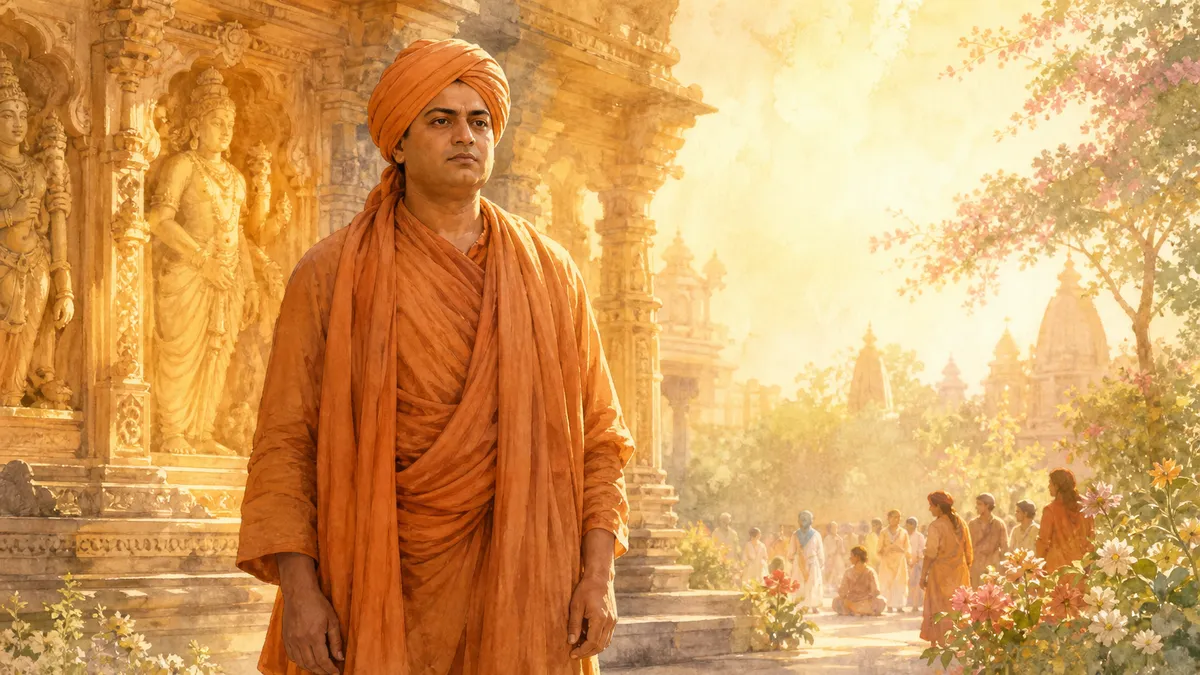
For example, in India there was a Gujarati monk named Swami Dayananda Saraswati, the founder of the Brahmo Samaj. For a time, he studied under his Guru, who practiced Advaita Vedanta, and took the teaching of the formless deeply to heart. He saw that people were heavily conditioned by the worship of form, so he began preaching that Brahman has no form, that anyone who worships form is an idolater, and that all forms must therefore be rejected. In other words, he adopted the opposite extreme position. He said something along these lines: “Brahman has no qualities, no image, no color, no smell; it is incomprehensible and indefinable. How can it be considered bound by form? How can any conceptual description be ascribed to it? All of this is delusion!” Throughout his life, he fiercely fought against forms and people’s delusions. He even traveled with his disciples, challenging Brahmins and priests from various temples to debates. He said that if he defeated them in a debate, he would order his disciples to smash all the statues and destroy all the images, since Brahman has no form. Many Brahmins were afraid of him.
He continued his triumphant travels until he met the saint Lahiri Mahasaya, who subdued his mind. He explained to Swami Dayananda Saraswati that no extreme is the truth; that form arises from the formless; that the formless is the essence of form, and therefore there is no contradiction between them; and that contradictions exist only in the dualistic mind, which does not understand this and is not ready to unite emptiness with form.
When we fall into this opposite extreme, the extreme of rejection, it is called nihilism. But we say that it is better to adhere to the middle view, without falling into any extremes whatsoever, without conditioning ourselves with any conceptual views, and simply abiding in naked awareness. Then we become established in an astonishing wholeness and harmony with Being. We understand that there is no need to reject anything or cling to anything. Everything is as it is. Behind all forms lies boundless emptiness, like luminous space. Luminous space is the source and foundation of all forms. Yet this emptiness is not merely something unmanifested. The nature of this luminous emptiness is to manifest. Its inherent quality is to radiate, emanate, and manifest constantly as energy. And that which manifests as energy is not some error or delusion. It is the play of emptiness, its manifestation, its emanation.
When we understand this, everything immediately falls into place. We no longer cling to form, understanding that forms are impermanent, that they are simply the play of primordial Space. Then, behind all forms, we perceive primordial Space. At the same time, however, we do not reject form. We understand that manifestation, emanation, and self-revelation are inherent qualities of the Absolute. And when we cling to neither one nor the other, our view becomes astonishingly holistic. This is precisely the view described by the mahasiddhas.
The Primordial Nature and Obstacles to Recognizing It
“The purity of the primordial spirit of the ‘I’ exists everywhere, but it seems as though thoughts and desires conceal it.”
The primordial space of our mind exists constantly. Right now, in the depths of our consciousness, we are eternal and boundless. Right now, we possess an incomprehensible grandeur that is naturally ours by birthright. We do not even need to earn it in any way.
Imagine a prince with royal blood flowing through his veins. He is destined to become the heir to the throne. But the prince himself does not yet know this. He considers himself a commoner. Then a royal envoy appears and tells him: “You are a prince, ready to ascend the throne right now, because this right belongs to you by birth.” And when the prince hears this, all his confusion and low self-esteem immediately disappear.
Here is another example. A peasant struggled to make a living: he chopped firewood and sold it, barely making ends meet. A holy teacher happened to pass by, and the peasant offered him lodging in his hut. But since he had only one bed, he offered it to the holy man. Because of his extreme poverty, the peasant did not even have a pillow, so he used a stone instead. When the holy man lay down to sleep, he saw with his mystical vision that it was not a stone but a huge bar of gold, merely covered with a thin layer of dirt. He laughed and said, “You sleep on a huge piece of gold, yet you live in such poverty. If you sold it, you would become the richest man in town. Then you would no longer have to work so hard and chop firewood all the time.” And that is exactly what the peasant did.
Did the peasant earn this gold? Did the holy man give him something he did not already have? No. The holy man merely pointed out what was there and had always belonged to him. The gold had always been his property; the peasant simply did not recognize it.
In the same way, our original nature is not attained but recognized as something that has always been inherent in us. What prevents us from recognizing this nature? Thoughts and desires that flow continuously from morning to evening and even at night. They follow one another so densely that they disrupt the perception of pure consciousness. This is precisely what they are called: distracting prana.
The Mechanism of Karma and Self-Liberation
On the surface, on the mirror of our mind, there are vrittis (fluctuations of the mind). Vrittis are conditioned by past impressions (samskaras) carried over from a previous life. A samskara can be imagined as a certain image or memory that suddenly flashes. It arises from the subconscious and has not yet been apprehended, but it generates certain fluctuations in the stream of the mind. These fluctuations are vrittis.
Vrittis are like waves on the surface of a sleeping lake. When such fluctuations arise, they create agitation in the mind, preventing us from recognizing our primordial nature. Agitation in the mind gives rise to vasanas—that is, impulses in the energy body that prompt us to jump up and do something. For example, an old samskara associated with anger or attachment produces a subtle sensation, and then agitation arises in the mind, giving rise within our body to a desire to do something. This is how distracting prana operates. This is the law of karma, which acts and prevents us from revealing the empty ground of our consciousness.
There was an incident at the monastery. A monk and a novice, both very young, were building a stove. While performing this service, they disagreed about exactly how it should be done and began to quarrel. When one of them climbed onto a table and tried to do something his own way, the other became angry and pushed him off the table.
In a monastery, all your subtle states are laid bare, so karma is cleansed more quickly there. And although such things happen there very rarely, they do still occur.
Since monks monitor themselves very vigilantly, they naturally performed repentance that very day, because such behavior is unacceptable in a monastery. They acknowledged that they had behaved improperly and had been unconscious. Nevertheless, I was curious as to why this had happened. When I analyzed their past karmas, it turned out that in a previous life one of the monks had been a highborn man. He was a knight, the son of a feudal prince. The second monk had also been a warrior, but of lower birth. His family had fallen into ruin, so he was forced to earn his living as an ordinary peasant. Once, the first knight, who was very proud and arrogant, was riding in his richly decorated carriage. He noticed a peasant standing by the roadside and assumed that the man was from his estate. When he saw that the peasant had not greeted him properly, he became very angry and deliberately drove the horses hard so as to splash him with mud as punishment. The knight from the ruined family, who was standing by the road, became extremely enraged and thought: “How dare this upstart, this boy, insult me, an old warrior, in such a way?” And he swore that if he ever found himself in the city again and saw the young man above him, in a carriage or on horseback, he would grab him, pull him down, and give him a good beating. Several lifetimes later, this situation manifested itself: when, in this incarnation, the first monk found himself above the other—that is, when he stood on the table—these karmas rose to the surface and manifested beyond the second monk’s control.
This is an example of how karmas operate. A person’s reactions and perceptions are programmed and conditioned by vasanas and samskaras. They are very subtle and move much faster than our surface consciousness. This is the very vicious circle of samsara that compels people to perform certain actions without even understanding why they are doing them.
What are self-liberation and contemplation? They are a special kind of training through which we learn to be aware of and recognize the primordial space, increasing the speed of our awareness in order to self-liberate the intentions, vasanas, samskaras, impulses, and vrittis arising from within. We learn to counter the inner movements of the soul with our naked awareness. And then self-liberation occurs. We do nothing, yet all these inner movements of the soul dissolve and disperse.
There are several levels of such self-liberation.
At the first stage, self-liberation is like snowflakes falling into the ocean. A snowflake falls into the ocean, but dissolves the moment it touches the water. For example, you maintain the sense of “I,” awareness, and an impulse, anger, attachment, irritation, or something else arises within you, but you look directly at this impulse with naked awareness. And as soon as you look at it, it immediately disappears.
Stages of Self-Liberation
At the second stage, self-liberation occurs even more naturally. It is like a snake uncoiling itself from the knot into which it has curled. At the first stage, a little effort is required, but at the second stage, it happens naturally. As soon as an impulse or thought arises, it is immediately liberated, because your habit of contemplation is very deep.
Finally, at the third stage, self-liberation occurs in a completely different way. The yogi’s mind is like space, so whatever arises instantly disappears within it. Whatever the yogi experiences—emotions, feelings, or thoughts—has no root, no foundation whatsoever. Having arisen, it disappears, because there is nowhere for it to take root. There is no longer an “I,” a subject, a personality that could be seized by it.
This level of self-liberation is called “a thief sneaking into an empty house.” In this case, the thieves are thoughts, feelings, and emotions. The empty house is our consciousness, which we have opened through training in contemplation.
The Nonduality of the Movements of Consciousness
“But even separating thoughts and desires from the unborn purity of the ‘I’ means falling into duality.”
At the higher stages of contemplation, all movements of consciousness, thoughts, and fluctuations are inseparable from your primordial state. They are something like an ornament, something like its play. They are harmless, so there is not even any need to control them deliberately. They are like a snake whose venomous fangs have been pulled out. They can no longer create any problems because the focus of the yogi’s consciousness has shifted to the profound ground. Now the yogi constantly abides in a space-like state.
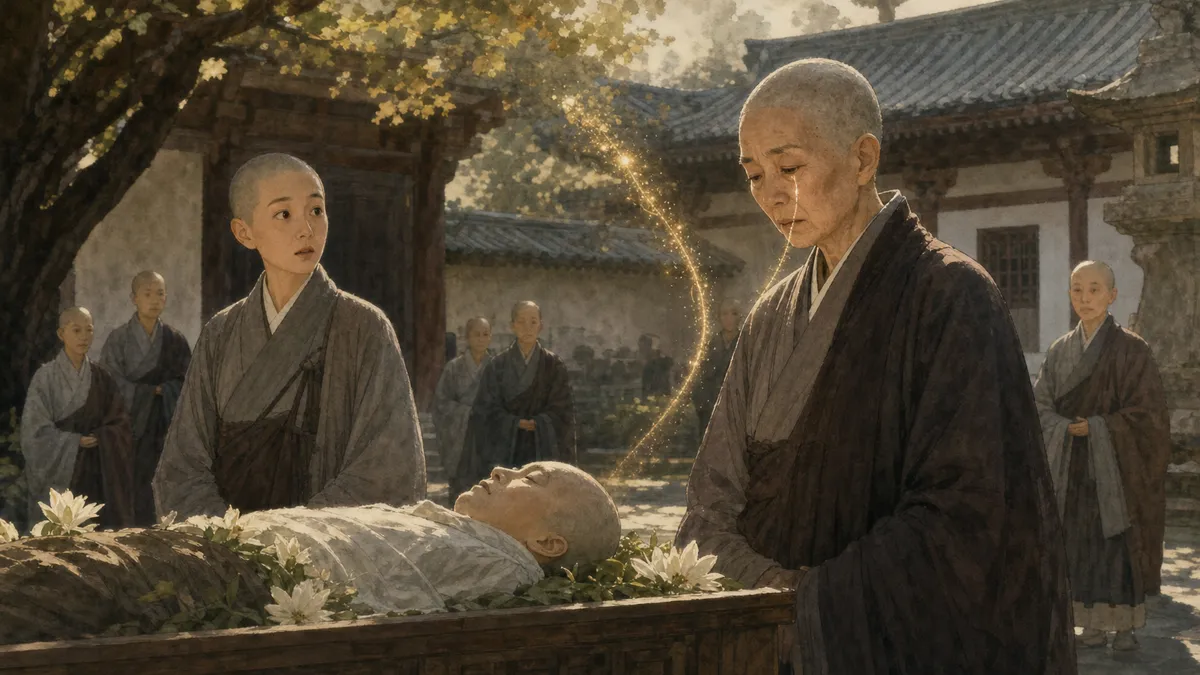
This can be illustrated by the following example. A Zen nun who was a teacher attended someone’s funeral. She was considered to have attained a high level of realization, yet she wept during the funeral. Then another nun said:
– Sister, you are regarded as a teacher who has attained an even higher level of realization than I have. I am very surprised to see you weeping. Is your mind still conditioned by illusion? Do you still have some false notions about life and death, about yourself? Or do you still have some emotional attachments? It is unbecoming for a high-level monastic to behave this way.
The nun looked at her and said:
– You do not understand at all what I am doing. My tears will ensure his rebirth in paradise. This is not at all what you think. There is not even a trace of attachment here.
In fact, this was her way of uniting her feelings with awareness and helping that person by using the karmic connection between them. This is a very subtle point: energy is not denied but used by being united with awareness. No importance is attached to feelings and thoughts; they are allowed to play freely, while the mind constantly abides in pure, empty space.
Protecting Consciousness from Bustle
“O wise one, while abiding in the peace of contemplation, guard your heart against bustle.”
At first, the yogi must protect their consciousness from all distractions and bustle. They must guard their mind against being caught up in form, name, color, taste, and smell; they must protect their consciousness as though carrying a crystal bowl filled to the brim with water. They must avoid spectacles, crowds, excessive conversation, and emotional attachments—everything that unsettles their consciousness. At least once a week, they should spend some time in solitude, observing mauna (silence). They must make every effort not to become distracted, because distraction is the scourge of one who practices awareness.
Having become distracted a thousand times, the yogi must return to contemplation a thousand times. At first, their spiritual practice is a battle: distracted—returned, distracted—returned, lost it—remembered, lost it—remembered. In this way, they fight for their awareness every second, as though fencing. The sensory objects of samsara constantly strike at them; they feel that they are letting the blows through, that samsara fences better than they do. They try to maintain awareness but feel one strike, then a second, then a third. Their consciousness is pierced, but there is no other way than to improve their fencing skill. And this takes years.
At first, it is recommended to develop this skill under favorable conditions. There are such expressions as “nurturing contemplation” and “nurturing the natural state.” Contemplation must grow. It is like a child or the sprout of a very valuable plant. For this sprout to grow and become a mighty tree, the yogi must raise it with care, nurture it attentively, protect it, and create favorable conditions for it.
Mastery of Contemplation
Gradually, as a result of such training, our mastery increases. We feel that we can now fence at the same speed as samsara, that we are struck less often, and that we no longer lose ourselves among objects. An unshakable inner center, an unshakable consciousness, appears within us, unwaveringly maintaining the state of space from morning until evening. At this stage, ordinary thoughts can no longer hook or seize us; we can self-liberate them.
How do we do this? Simply by remaining in a state of awareness. They disappear by themselves; we do not need to do anything. But when we fall asleep, we feel that we cannot release them; that is, this awareness is still lost in dreams. This means that we need to continue improving our mastery of contemplation, the art of spiritual fencing.
Masters are those who can self-liberate both sleep with dreams and dreamless sleep. In other words, they remember themselves continuously. They constantly abide in a state of profound, space-like awareness.
Why is it more difficult to liberate dreams than the ordinary world? Because dreams are subtler. Dreams move at a higher speed.
However, the highest art of the masters is the ability to liberate dreamless sleep, the pure forms of subtle maya appearing as light. There is a saying: “If you want to know whether your mind is enlightened, check whether you are aware during sleep with dreams and during dreamless sleep.” This is the criterion of spiritual realization.
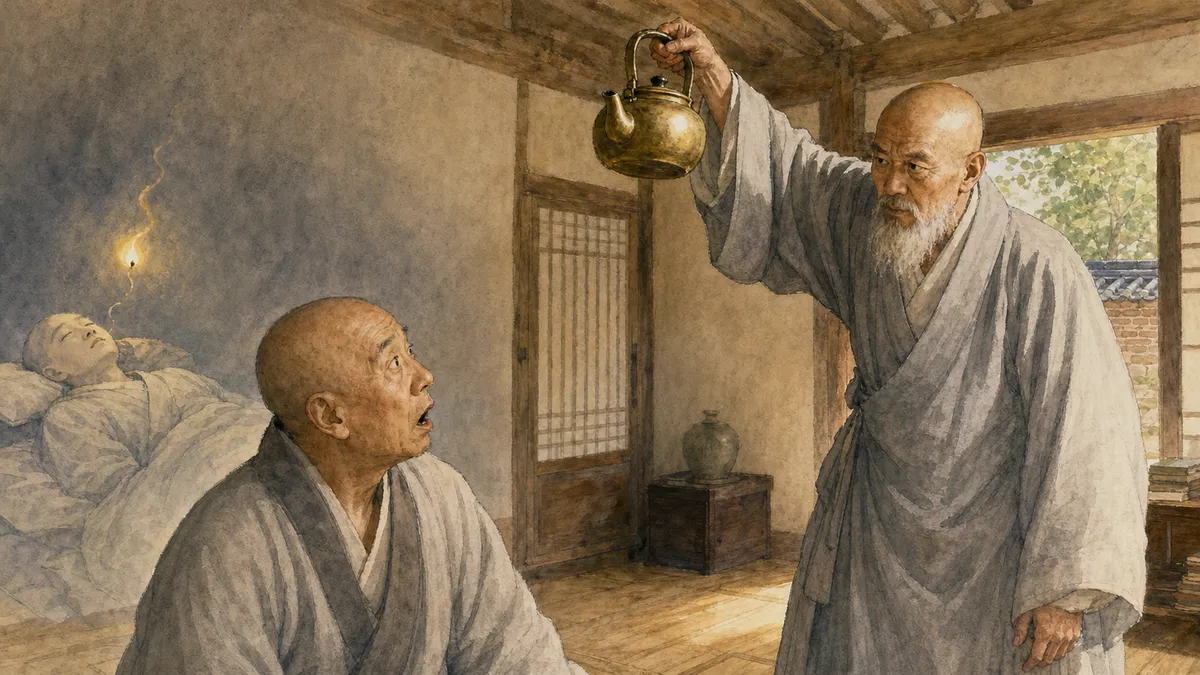
Once, an old man came to the renowned Master Seongcheol Sunim, the patriarch of the Jogye Order of Buddhism. He was a monk experienced in spiritual practice and believed that he had attained full realization, so he saw no particular need to visit Seongcheol Sunim. However, his acquaintances advised him to obtain confirmation of his level of realization from Seongcheol Sunim. After listening to the account of his experiences, Seongcheol Sunim said:
“Perhaps you have indeed found some treasure. But do you retain it in your sleep?”
The old man’s eyes widened in surprise:
“What? In my sleep? No, I do not.”
Then Seongcheol Sunim pretended to become very angry. He picked up a teapot and began striking the old man on the head with it, saying:
“And you claim that you have meditated? You do not retain it in your sleep, yet you dare say that you are realized?! Even if you were cast into the seventh hell, that punishment would still be too little for you.”
The old man bowed with great reverence, humbly accepting the blows because he had understood his mistake. Seongcheol Sunim then instructed him in proper contemplation and meditation. At that time, the old monk was already seventy years old. But he continued to practice very diligently for another two decades, and only then did he truly attain full realization.
Thus, by protecting our heart from worldly bustle, we enter more and more deeply into natural contemplation. Everything seems to begin revolving around this central point.
Abiding in the Natural State
What does it mean to be in the natural state? It is like having climbed to the summit of a mountain. The mountain summit means that you stand at the very peak, at the very center. You see all the lower paths, all the dualistic states of your mind. You see all the other mountains and understand that you do not need to go anywhere else. This is the limit, the end; this is Everest.
This does not mean that you have attained it. It means that you simply need to remain in it and not move away from it in any direction—to the right or left, into the future or the past—and that the whole of spiritual practice consists in growing into it more and more, becoming ever more deeply rooted in it. If spiritual evolution was previously somehow stretched out over time or connected with something external, now, of course, it by no means ceases; it simply unfolds in another direction. One might say that you become increasingly rooted in the present, in the natural state.
Instead of doing many things, you become increasingly rooted in non-doing, in how to do nothing. Instead of knowing many different things, you become increasingly established in not-knowing, in how to forget. To forget does not mean to lose your memory; it means to be aware yet detach yourself from and release what you know, because it is precisely the memory of themselves, their knowledge, that keeps living beings in samsara. And even when they practice, even if they meditate on Aham Brahmasmi, they remember themselves as living beings. It is precisely the memory of oneself, aham-dehasmi (“I am a human being”), that prevents one from becoming established in the understanding “I am the Absolute.” But when you practice contemplation and natural presence, you gradually displace the memory of yourself as a human being, freeing yourself from your knowledge while abiding in the natural state.
The saints say that the natural state is near, that the state of awakening is no farther away than the palm of our own hand. Yet at the same time, it is not visible, so one must practice diligently. There is a saying: “It is so simple that it is hard to believe; it is so close that it cannot be grasped.”
Contemplation of the Nature of the “I”
“O mind, always remember the Perfect!
One who always remembers the perfection of the unborn ‘I’ truly merges with Brahman, shining like the sun.”
Contemplation of the Nature of the “I” clearly reveals to you the essence of all Dharmas.
This essence is incomprehensible; one who abides in it, without scattering their thoughts and while concentrating the Spirit, attains a light body and supernatural powers (siddhis). Their negative karmas are purified by themselves through the power of mindfulness.
The six fields of the senses abide in great peace, the mind holds to the center, and the heart embraces the One.
The One Spirit permeates all that exists and returns to the primordial source.”
To engage in correct contemplation is like being at the center of the universe. It is like stepping out of the reflections and beginning to see the mirror.
The entire teaching of Laya Yoga revolves around this. It is a very subtle art. Some people, after reading a little about the teachings of Advaita and the instructions on contemplation, and gaining a little insight into consciousness, imagine a great deal, but this is not so. Contemplation is a very profound matter. Moreover, such an exalted path as nonduality and Anuttara Tantra gives rise to many deviations. Such a powerful view can very easily lead a yogi astray. These deviations were described in detail by the mahasiddhas as the six principal deviations in the natural state. On the direct path, it is possible to attain rapid realization, but there are also many dead ends and slippery steps, because at first our faculty of discernment is still weak.
Pure Vision and the Descending Power
“When, without allowing consciousness to become distracted, we abide in the essence of the incomprehensible, our Spirit begins to concentrate and negative karmas begin to be purified.”
Through the practice of the natural state, the yogi gradually transitions to a different karmic vision, the so-called pure vision. This is a real transition. The world around us begins to change. A yogi who has realized the one “taste” of the natural state lives in another dimension while still alive, although they appear to be a human being dwelling in this body.
Pure vision is the ability to see the world through the eyes of contemplation, through the eyes of unity with the Supreme Source. Through contemplation, the yogi unites with the Supreme Source. When the yogi unites with it and constantly attunes to it, the Supreme Source sends them its enlightening impulse, the descending power. This descending power is called Anugraha. At first, contemplation naturally develops through one’s own personal effort. But gradually, through contemplation, the yogi comes to the conclusion that personal effort is insufficient. No matter how mindful they may be, it is still their ego, their own “I.” And when the yogi reaches this point, they understand that the time has come to cease all effort, let go of themselves, and relax. At this stage, they open themselves to something greater, something transpersonal—something that transcends them. This is called the “descending power.”
At the stage of the descending power, the yogi can no longer make any effort. On the contrary, effort will only interfere, so they must simply relax, become like a dry leaf or a tuft of grass on the road, cease clinging, cast aside their opinions, cast aside their “I,” and relinquish all judgments and concepts. They must say, so to speak, to the Absolute: “Not I, but You. Your will be done in all things.”
If self-surrender is practiced prematurely, before understanding the principle of awareness, there is a strong likelihood of delusion, since it is unclear who is surrendering and to whom. We may construct a certain model of God, or the Absolute, in the form of an image or concepts drawn from sacred scriptures or from our own ideas, and practice self-surrender. But genuine realization cannot be attained in this way. Only after understanding the principle of awareness and the space-like nature of one’s own mind does it become truly possible to practice self-transcendence, going beyond the confines of the personality.
At the stage of the descending force, the practice is no longer carried out by the yogi. One might say that the Absolute practices within their body. It is no longer the yogi who performs the sadhana; rather, the sadhana is performed through this descending force.
Signs of Realization
“Let one who desires liberation seek a Teacher; then the essence of the primordial ‘Self’ becomes clear.
Through continuous contemplation, the great yogi reveals in their own experience signs of realization such as the ‘music of the devas,’ the ‘eyes of the gods,’ and the ‘wine of immortality.’
Proper practice inevitably leads us to begin receiving signs of realization.
The “music of the devas” refers to the sounds of anahata nada that arise as a result of the purification of the channels.
The “eyes of the gods” refers to extrasensory perception, such as the ability to perceive past lives, see at a distance, and so forth.
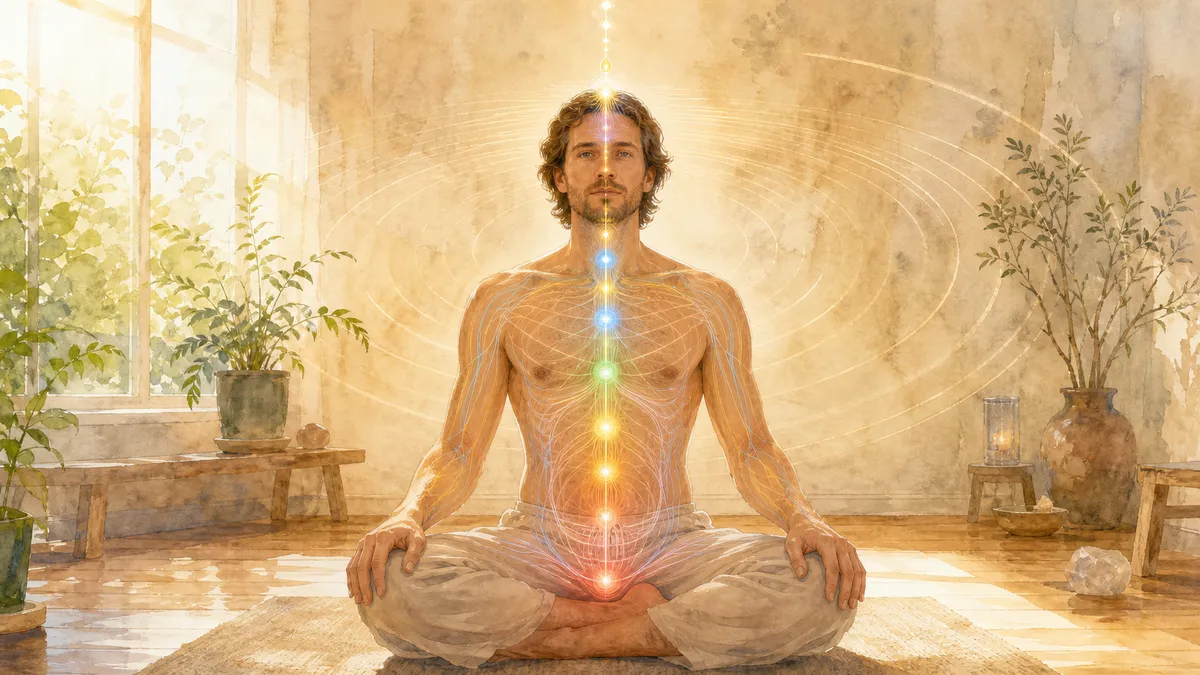
The “wine of immortality” refers to the nectar that begins to flow from the crown of the head, permeating the chakras and channels and awakening the deities within the channels. In Sanskrit, this nectar is also called amara-varuni—the nectar of immortality, or the nectar of the gods. When a yogi’s channels are pure and their energy begins to circulate through them, the wind rises, stimulating the soma chakra and the sahasrara chakra. Amara-varuni then begins to ooze from the soma chakra. It is a subtle secretory fluid that descends from the heavens and begins to drip onto the chakras, permeating the entire body. This very process is the cherished goal of yogis. When this occurs, it is said that the yogi has succeeded in awakening kundalini energy, bringing the pranas into the central channel, and beginning to unite the white and red drops. It is believed that there can be ten kinds of this nectar. The yogi gradually experiences them one after another, provided their energy is sufficiently pure.
Laya-yoga
Contemplation
Natural State
Duality
Anugraha
Nature of Uma
Self-liberation
Samskaras
Emptiness
Author Гуру
Read 15 times
Articles
Vidya AI
Search
Lectures
November 5, 2026
Mantra of the day
ОМ ЭКАЙА НАМАХ ОМ Единому – поклонение!
Auspicious Times(Rome)
Brahma Muhurta:
04:56 - 05:51
Abhijit Muhurta:
11:33 - 12:14
Sayam Sandhya:
16:40 - 17:21
Mokshada Ekadashi (6 November)
Ekadashi of liberation. Helps to achieve spiritual enlightenment.