

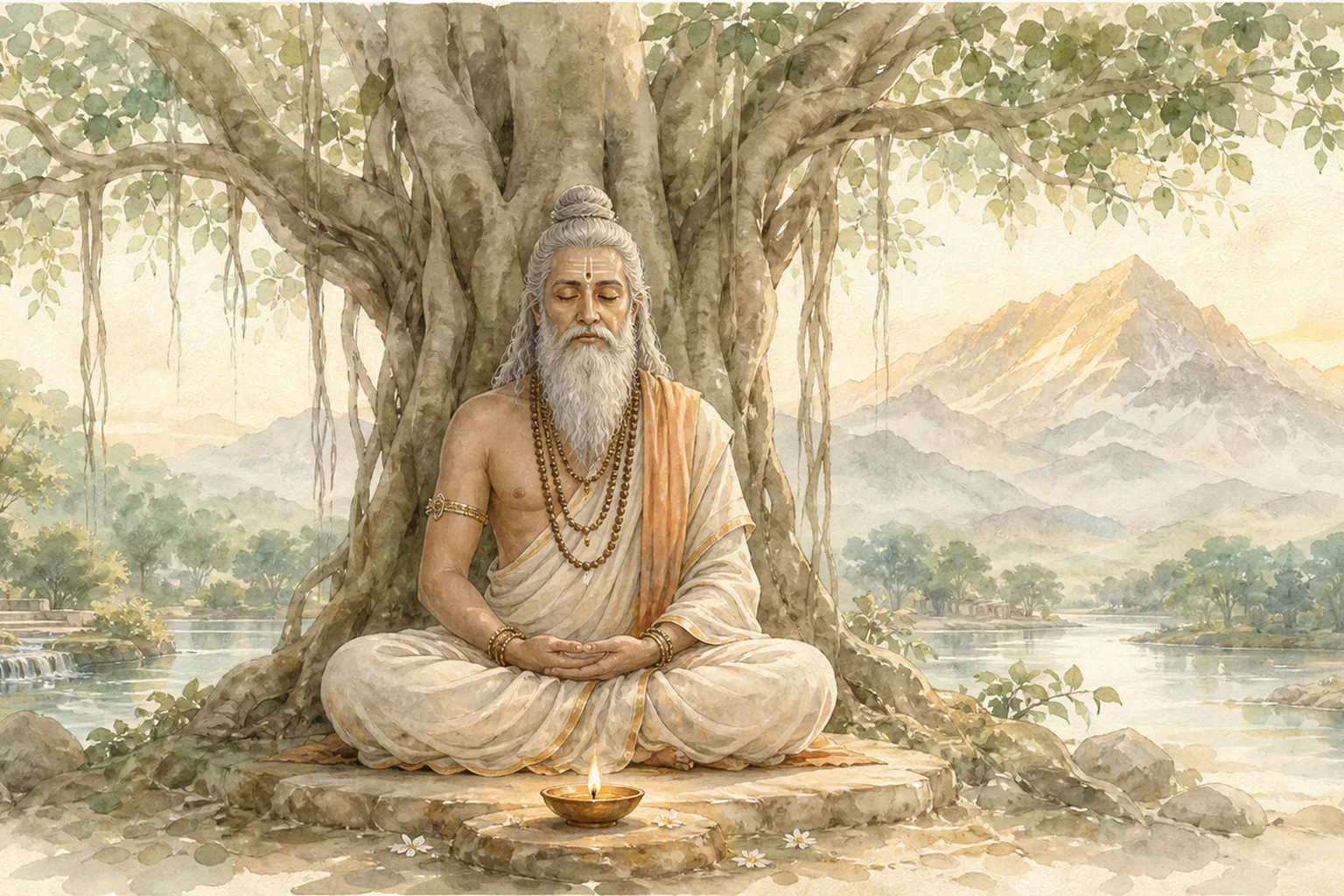
Thus, Valmiki imparts the teaching to Bharadwaja in the form of a dialogue between Rama and Vasishtha. The entire “Yoga Vasishtha” describes this dialogue. Bharadwaja once asked Valmiki:
“O Teacher, it is an immense joy to hear that Rama attained the supreme state. But is this possible for us—unintelligent, ignorant, and prone to sinful tendencies? After all, such a state is difficult even for the gods to attain.”
In other words, Bharadwaja asks whether it is truly possible for us to attain the supreme state, for Rama attained it after receiving instruction because he was an avatar.
But Valmiki replied: “I have conveyed to you in full the dialogue between Rama and Vasishtha. You must reflect upon it, for these are my instructions to you.”
The Luminosity of Consciousness
“Enlightenment is characterized by pure inner light.”
This phrase points to the luminosity of our consciousness.
The texts describe a center above the sahasrara chakra, located approximately ten centimeters above the head in the form of a radiant sphere. It is this center that is considered the essence of our soul as human beings. This center contains all luminosity, and it is believed that one who reaches it attains samadhi and various accomplishments.
When our consciousness is obscured, we do not notice its luminosity, spaciousness, purity, and perfection. All that is accessible to us is the body, emotions, and thoughts, so we judge the world from a bodily perspective. We think: “This person is so handsome! Slender, with blue eyes. And that one is simply fat.” From the bodily perspective, we move on to the mental one and think: “This person is an intellectual, an aesthete, a logician, while that one is an idiot. This person is strong-willed, while that one is a spineless weakling.” In other words, we judge from bodily and mental perspectives, and this is, of course, a delusion; that is why we lack pure vision. But if we judge from the perspective of light, we see everything differently.
Renouncing Egoism and the Principle of Service
The fundamental condition for enlightenment is the renunciation of egoism. In other words, if we desire enlightenment, we must seriously consider that an egocentric attitude is an unenlightened state. Perhaps from the ego’s point of view it is a good state, since some benefit can be derived from it, but from the perspective of enlightenment it is wrong. That is precisely why we try to dedicate merit to all living beings. What does this mean? Everything I have accumulated through spiritual practice, I send to a specific address, like an email. What is this address? It is an address that includes all living beings in the universe. If enlightenment consists in realizing the Atman, and I am the Atman, then by definition, as a particle of it, I must be present in all living beings. I must not distinguish between this body and others; that is, I must regard all bodies as my own, and therefore I can offer and dedicate all my merit to them.

The meaning of dedicating merit lies precisely in renouncing egoism, because when we adopt an egoistic attitude, we close off the path to enlightenment for ourselves. Our mind may gain something from it, but in an essential sense we will, of course, lose. To eliminate the egoistic attitude, we must reorient the meaning of our life toward the principle of service and make this principle paramount.
At first, the principle of service is not understood; it is perceived as a set of restrictions based on dualistic notions. Of course, this is incorrect. The principle of service should be discovered as an inner principle for channeling a certain absolute will, absolute energy (shakti); that is, service means that you act not from the ego, not from the mind, not from yourself, but from the Supreme. You perceive and channel the will of the Supreme through your sahasrara and manifest it—this is the meaning of service. Since this will is difficult to discern, the disciple initially practices channeling the will of the guru, the Refuge, the Dharma, and the Sangha, regarding this as their personal sadhana.
As the mind is purified, the principle of service becomes clearer, the will of the Absolute is seen as its own essential light, and this principle becomes increasingly subtle. If this light is absent, however, practice is very difficult. The consciousness of one who seeks attainment is always limited, because such a person works for oneself and for one's own sake. But this “self” is precisely the cocoon that forever locks us in samsara. We may seem to want what is best for ourselves, but in reality, by clinging to this concept of “self,” we deprive ourselves of what is best.
The principle of service, by contrast, expands the concept of the “self” to encompass the entire universe. In other words, we do not lose ourselves as individuals: our memory, volitional functions, and mental abilities remain; it is simply that our “I” becomes boundless and multidimensional—this is the essence of the principle of service. We must recognize all living beings as our own “I,” and once we have done so, it is reasonable to care for them, since we all care for ourselves. If you expand your “I” to encompass all living beings, then accept that this is your greater body, and therefore you must care for it as well.
The Illusory Nature of the World and Karmic Vision
“This creation appears out of nothing, dissolves into nothing, and its very essence is nothing; it does not exist. Because of beginningless false self-limitations, this creation appears to exist, giving rise to countless delusions. You are deluded because you do not constantly remember the truth of infinite consciousness and instead take the poison of self-limitations and the psychological conditioning that follows from them.”
The universe has no inherent existence, no essence of its own. Energy exists, but what we take to be energy—the material world—does not exist; rather, it is a product of the minds of many living beings and of collective karmas. If one asks, “Does virtual reality exist or not?”, one can say that it does not exist as reality; it exists as a convention, as an interweaving of the clarity of many different people. In the same way, this material world exists as a convention, as an interweaving of the clarity of countless beings, as a collective karmic vision. But in their essence, all objects are empty. In this context, the term “empty” does not mean something sacred, but rather the absence of inherent existence—that is, emptiness and unreality. Wisdom—the awareness that recognizes and comprehends this emptiness—is truly what is sacred and most sublime. These concepts should not be confused.
When we say that objects are empty, we mean that this little bell does not actually exist in and of itself, that it is merely a combination of visual, tactile, and auditory perceptions. In other words, the imprints of our collective samskaras—visual, olfactory, tactile, and auditory imprints—are now being projected in such a way that we see this little bell as something real.
If we had different imprints, we would see not a little bell, but something else. In other words, our perception of the little bell is determined by our karmic vision, which is the result of a combination of both individual and collective imprints. These imprints exist in the astral body, while deeper imprints concerning nation, humanity, and human nature exist in the causal body. It is precisely because these imprints exist that we are able to see the world as it is.
If a deity were here, it would have different karmic imprints and would see bells differently—for example, as a nada yantra. If a creator deity were here, it would see the bell as the seed of the universe, creating new worlds through the sound of nada. But if a hell being with negative imprints were here, it would see the bell as something terrifying that causes pain and suffering; every sound of the bell would fill it with fear, or it would think the bell was some kind of instrument of torture, because its imprints allow it to perceive reality only in this way.
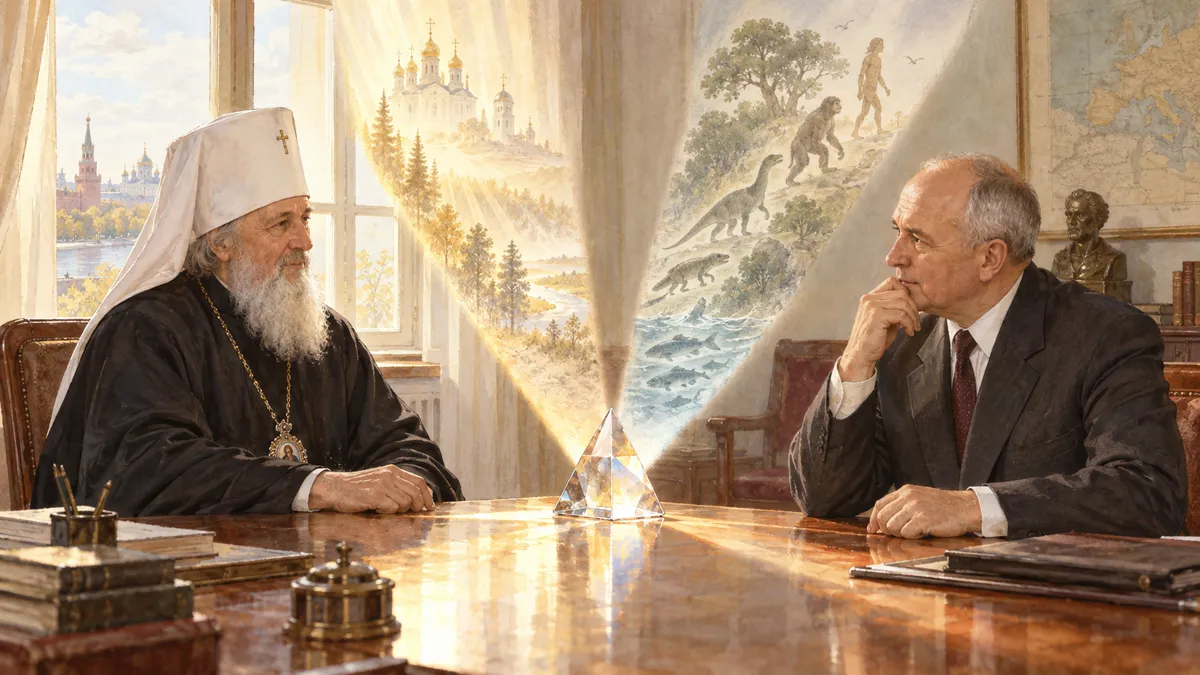
In the 1960s, when the Soviet Union still existed, an Orthodox metropolitan met with General Secretary Khrushchev. They became engaged in a theological discussion in which the Orthodox bishop argued that man originated from God. Khrushchev, adhering to dialectical materialism, or Marxism-Leninism, said that, according to Darwin’s theory, man had actually evolved from an ape through evolution, natural selection, species variation, mutations, and so on. They debated for a long time, and then the metropolitan, not wishing to defeat the head of state in the dispute, decided to compromise and said, “Let us agree on this: each of us will retain his own opinion. So as not to go against my conscience, I, as an Orthodox believer, will consider myself to have originated from God, while you, as a consistent communist, will consider yourself to have originated from an ape.” But Khrushchev, truth be told, found a reply. He said, “Very well, but if we look at the dynamics of evolution, then in my case there has clearly been tremendous progress, since I have evolved from an ape into a human being, whereas in your case there has been degradation, because God has apparently degraded to the state of a human being.” And with that, they ended their discussion. This is an example of different imprints, different karmic visions that give rise to different reality tunnels.
The Only Reality Is Infinite Consciousness
“This delusion continues until you fall at the feet of enlightened sages and receive true knowledge from them. Dear one, that which did not exist in the beginning and will not exist in the end does not exist now either. This apparent world is like a dream. The only reality in which it appears and disappears is infinite consciousness.”
For the awakened one, this world exists as a convention, but not as something self-existent. Abiding in the transcendental state of nonduality, the awakened one perceives the logic of human relationships and the human world as a game of absurdity. For example, if you were asked, “Why don’t you wear horns?”, you might think, “That is an absurd question. Why should I wear them if I do not have any?” This is indeed an absurd question that has little to do with reality, but the entire logic of this world is like that question. That is, any human interpretations, connections, moral norms, ideas, theoretical concepts, and everything else are, when compared with the awakened state, just as absurd as the question, “Why did you lose your horns?” It is impossible to lose what does not exist, and impossible to wear or not wear what is absent from the outset.
Nevertheless, saints do not deny all relative manifestations, perceiving them as a game and participating in them for the benefit of other living beings, because a stance of denial signifies the incompleteness and inflexibility of the awakened state. On the contrary, the awakened state means complete acceptance of any norms, concepts, and principles. However, this acceptance involves carrying out a particular sankalpa, an act of will; that is, it is done with a specific purpose.
The Concept of “I” and the Loss of Unity
“In the ocean of samsara, or ignorance, the concept of ‘I’ arises because of the endless potential for self-limitation. Then the movement of thought creates other concepts: ‘mine,’ ‘attractive,’ ‘repulsive,’ and so on. These concepts strike at the very foundation of one’s own awareness, and a person inevitably falls into the trap of endless anxieties and suffering.”
So why do “concepts strike at one’s own awareness”? Because these concepts plunge our soul into multiplicity, causing the unified reality of the space of awareness to be lost. This multiplicity creates thousands of confusing possibilities, and amid such confusion, the channel of communication with the divine (deva-vahini) is lost, and unity is lost. As soon as we depart from unity and the channel of communication with the divine is severed, we are like a person who has been parachuted onto some island at night, but whose radio has broken, so he no longer knows what to do next. In such confusion amid multiplicity, the sense of unity is lost, and the connection with the supreme Source is severed because of the misuse of the mind, which gravitates toward multiplicity. The task of Advaita is to transcend this multiplicity and return to the one Source.

Advaita is an uncompromising teaching that transcends the diversity of samsara. It affirms absolute unity. While there are conciliatory teachings such as Dvaita and Vishishta Advaita that preserve a certain degree of diversity (the soul and God, the jiva and the Atman, and so on), Advaita—specifically in its view, not in conduct—insists on uncompromising unity, holding that this alone is the path to transcending samsara in a single lifetime. At the same time, many interpret Advaita simplistically, claiming that if you are a follower of Advaita, you cannot exercise discriminating wisdom or perceive diversity. But that is not so. Abiding in the view of Advaita is not the same as denying diversity. On the contrary, diversity may be acknowledged, but it is acknowledged as a retinue deity, as a peripheral deity, as an adornment and a play of energies; yet it never again eclipses the awareness of unity or clouds the mind.
If you have understood this principle, then the essence of the Sahajayana teaching is also clear to you. It is this: unity in diversity. You find yourself amid the diversity of thousands of energies, concepts, and beings, yet you never lose unity. As soon as you lose unity, diversity draws you into illusion. Whether this unity is gross or subtle does not matter: you may lose it, or you may not. When you do not lose it, this is the path of liberation, of nirvana; when you become distracted and lose it, this is the path of samsara.
Brahman and the World Are One Reality
“Dive deep into the inner world, not into the sea of diversity. Who is alive, who is dead, who has come, who has gone—why do you constantly lose yourself in such false notions? When one’s own essence, consciousness, is the only reality, is there any room for the ‘other’? The theory that Brahman appears as the world just as a rope appears to be a snake was devised merely to amuse children and foolish people. The enlightened one constantly abides in the truth that Brahman does not even appear to be different from the world.”
The theory stating that people are deluded by samsara just as a person is deceived by a rope, mistaking it for a snake, is nevertheless a particular example and concept intended to explain the principle of delusion and liberation at the logical level. But in the awakened state, no distinctions are made between delusion and enlightenment, between the one who falls into delusion and the one who emerges from it, between the awakened and unawakened states, or between Brahman and certain separate beings that have supposedly fallen away from it.
The Joy of Those Who Know the Truth
Valmiki continued:
“Ignorant people who dislike solitude drown in suffering and can smile only occasionally. Those who know the truth, on the other hand, smile all the time.”
“Those who know the truth smile all the time”—this should be remembered. Why do they smile all the time? They are completely self-sufficient and joyful because they are nourished by the light of inner awareness, and the light of inner awareness (sahajya) is such a profound source of goodness that is always within you. But if you move away from this profound source of goodness, you may become despondent, cry, grow angry, or feel envious, and these are clear signs that you have lost your connection with this source.
To love solitude does not mean remaining in solitude continuously; this principle should be interpreted inwardly. It means loving to abide in a state of inner tapas (antar-tapasya), maintaining self-awareness in which there is no other, no external world. Then you possess this solitude regardless of where you are.

The Unfading Reality of Consciousness
“Truth, or one’s own consciousness, is subtle and therefore seems to be concealed by ignorance. But even if you believe in the atomic materiality of the world, consciousness does not disappear. Why, then, do you grieve? The unreal (ignorance and so on) never appears, while reality, or consciousness, never disappears.”
“Reality, or true consciousness, never disappears”—this phrase should be remembered. Sometimes, when our mind becomes absorbed in diversity, gets distracted, or is strongly captivated by thoughts or external objects, it seems to us that the reality of awareness disappears. This happens because we lack sufficient trust and experience in sustaining this reality. But in fact, it never disappears, and as soon as we turn to it through inquiry or attentive contemplation, we immediately discover that this reality has always been here.
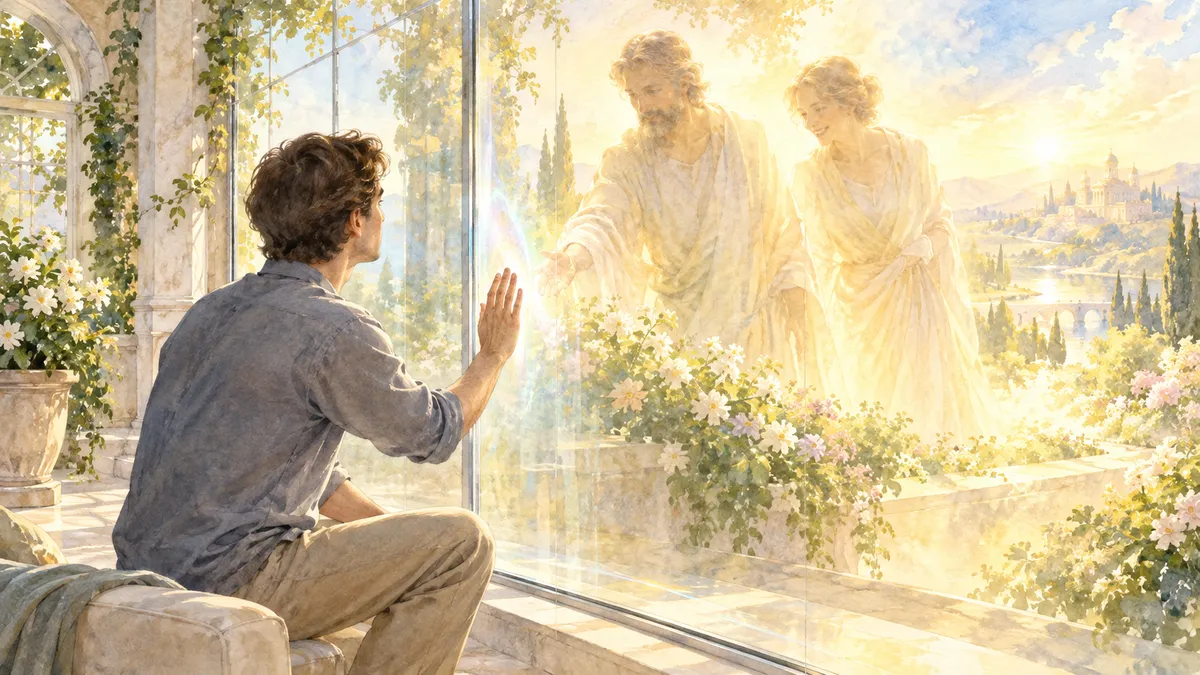
Saints and gods differ from ordinary beings precisely in that they understand this secret: the reality of true awareness never disappears. They are, as it were, on the other side of this wall. If awareness is imagined as a huge glass wall, then saints and gods are on the other side of the wall; they peer slightly into this world and do something here with their hands and feet, but the greater part of them is on the other side. People, mortals, various ignorant beings, demons, ghosts, spirits, and animals are on this side of the wall, and only occasionally do they briefly cross over to the other side (“Oh, I meditated and saw such-and-such a deity” or “When I meditated, I had such-and-such an experience”), and then return to this side of the wall again.
Crossing Beyond the Wall of Awareness
The practitioner’s task is to reach the other side of the wall and no longer fall back from beyond it. This wall is like a mirror of awareness; it is the boundary between the inner and the outer. When you enter this mirror of awareness and abide in it long enough, you move beyond this wall, to the side of the gods and saints. And if you have moved there, you feel that everything has changed, as though you have found a safe, auspicious, and quiet place that contains everything, where nothing can be lost, which depends on nothing, which cannot be burned by fire or wetted by water, and which needs neither sleep, nor rest, nor food, nor anything else. You always have it and can never lose it. And from this state, you then act outwardly.
When you act outwardly, you are like a sphere of light that animates this body. The sphere of light itself needs neither sleep, nor rest, nor food, nor sensory desires, nor this world; coming into contact with the body, it sets it in motion, prompting it to move, act, and speak, but it itself is not deluded and does not believe that it is this body.
“However, misunderstanding arises for various reasons. In order to overcome it, pray to God, who is the teacher of the entire universe. Your unwholesome karmas have not left you, but have become the strangling rope with which you are bound. Until your mind becomes no-mind, practice worship of name and form. In this way, you will become established in the contemplation of the Absolute, and then, with the inner light, you will see, if only for a second, the inner consciousness within consciousness.”
Karmic Bonds and the Search for False Freedom
Karmas bind living beings just as a rope binds a tethered dog or a cow tied to its stall. Living beings strive for freedom in various ways, but the paradox is that they believe freedom is connected with something external.
For example, why does the problem of international terrorism exist? Because there are separatist sentiments in various countries. Some people want to live as an independent nation, to have their own government and territory, and to pursue their own policies. They absorb the idea that they are fighting for freedom, and then the struggle begins and a revolution takes place. However, when they obtain the freedom they desired, it turns out to be a hollow sham, a fiction, because true freedom has never been connected with anything external; freedom is an inner factor. People need an inner revolution, because external revolutions have never brought freedom to either a nation or an individual.
Other people seek freedom in self-expression, in artistic creativity, in the opportunity to communicate with many people, or in possessing a great deal of money. All these are pseudo-freedoms, that is, fictitious kinds of freedom, deceptive freedoms. It is like a piece of candy with a beautiful wrapper, but in fact there is poison or something unpalatable inside; a person is captivated by the sight of this beautiful wrapper and tries to eat the candy, only to discover afterward that it makes them ill. All these are the various delusions of living beings regarding freedom. True freedom is connected precisely with our revealing within ourselves the space of nondual awareness and becoming established in it. Abiding in this space, we gradually free ourselves from the dictates of time, space, various universal energies, causes, and effects.

Even if a person thinks they are attaining some kind of freedom in samsara, this is, of course, a delusion. For example, if a billionaire has a stomachache, it hurts just as much as a poor person’s; if the billionaire sleeps badly, their sleep is just as poor as that of an impoverished person—that is, all their billions cannot bring them freedom from this problem. But if you control the pranas and the mind, you possess far greater freedom, and the more you purify yourself, the more independent your freedom becomes, no longer tied to the body, space, or time. Those who abide in ignorance do not understand this and try to seek freedom in external things, but this is a false path, a delusion. If people knew this secret, half the world would be monks and the other half would be practicing laypeople; everyone would go on retreats and practice, accumulating merit. But this does not happen solely because people do not know this secret.
Once, about twenty years ago, I had a strong desire to shout this secret directly into everyone’s ear, send letters to everyone, and so on. I wanted to grab each person by the lapels and shake them: “Don’t you know where your freedom lies? Awaken!” In youth, everyone has this kind of maximalism. Nevertheless, it is truly very sad to see living beings suffer because they do not understand this secret. They are like a fly that bumps against a windowpane ten times, a hundred times, a thousand times, all to no avail, while you stand aside and see that it only needs to turn around a little and it will be able to fly out through the open window, that in fact there is no problem at all. But the fly keeps beating against the glass, and it will continue to do so until it collapses exhausted and dies. This is the fundamental principle of ignorance, the delusion that holds everyone captive except those who practice, except the gods and saints.
The Principle of Service and Surrendering Actions to Brahman
“The Supreme is attained only through one’s own efforts and right actions, by which divine favor is earned. Past habits and tendencies are very strong, so one cannot rely solely on one’s own efforts. Even the gods cannot overcome the inevitable (fate). Everyone is subject to this universal order, which lies beyond thought and expression. But a spiritual hero must be certain that liberation will come, even if only after several rebirths.”
It goes on to say:
“Through wrong actions, a person becomes increasingly bound to this samsara, while through right actions, a person is liberated! Right actions in the present weaken the effects of past wrong actions. If you surrender all your actions to Brahman, this wheel of samsara will never sweep you up again.”
To surrender all your actions to Brahman means to deeply understand the principle of service. When the principle of service is not understood, selfish preferences and one’s own selfish will are important; but the principle of service means that what matters is not your will or your preferences, but the will of Brahman. It is like a certain universal force that you channel through yourself, and the more you allow it to flow through you, the more freedom it gives you. And ultimately you discover that your personal will and the will of Brahman merge and become one.
The Cosmic Dance of Time and the Role of Samskaras
“Look: ignorant people in this world play various roles, obeying the conductor’s baton of time! Time creates, preserves, and destroys. Why are you troubled by the loss of wealth and so on, and why do you yourself begin to move to the music? Remain still and watch this cosmic dance! Those who worship the gods, saints, and guru, and who adhere to the principles of the scriptures, earn the favor of the Supreme God.”
Fate and karma impose various roles on people. When a person is born, imprints are already present in the stream of their mind, in the subtle bodies. What are imprints? Suppose you have studied English; then you will have the corresponding imprints. But if another person beside you has not studied English, they will not be able to translate anything because the corresponding imprints were not created in the stream of their mind.
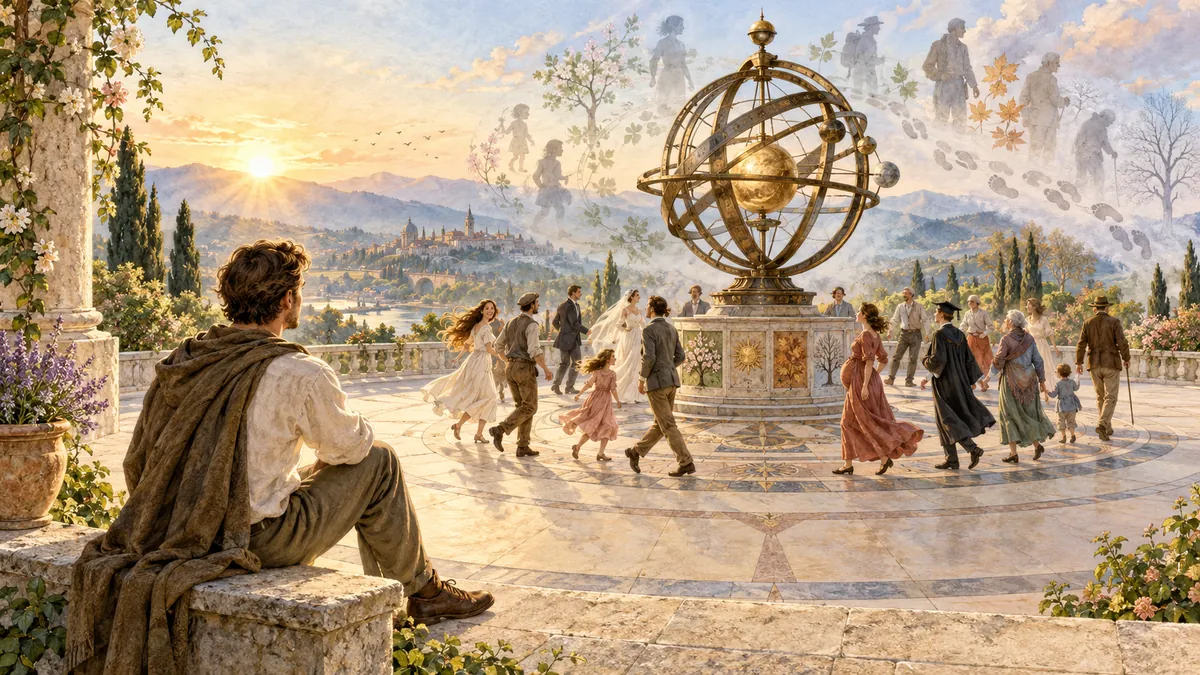
Obeying their imprints (samskaras), living beings assume various roles. And when they assume these roles, they naturally identify with them. In the process of such identification, the sense of “I am the doer,” “I am the body” increasingly crystallizes, strengthens, accumulates, and becomes something one begins to believe in, while the natural essence of the mind, on the contrary, becomes increasingly obscured and turns into something one grows distant from, ceases to understand, and ceases to believe in. A practitioner must be a spiritual hero to withstand the pressure of samskaras and time. They must constantly break through them in order to return again and again to the experience of unity.
