

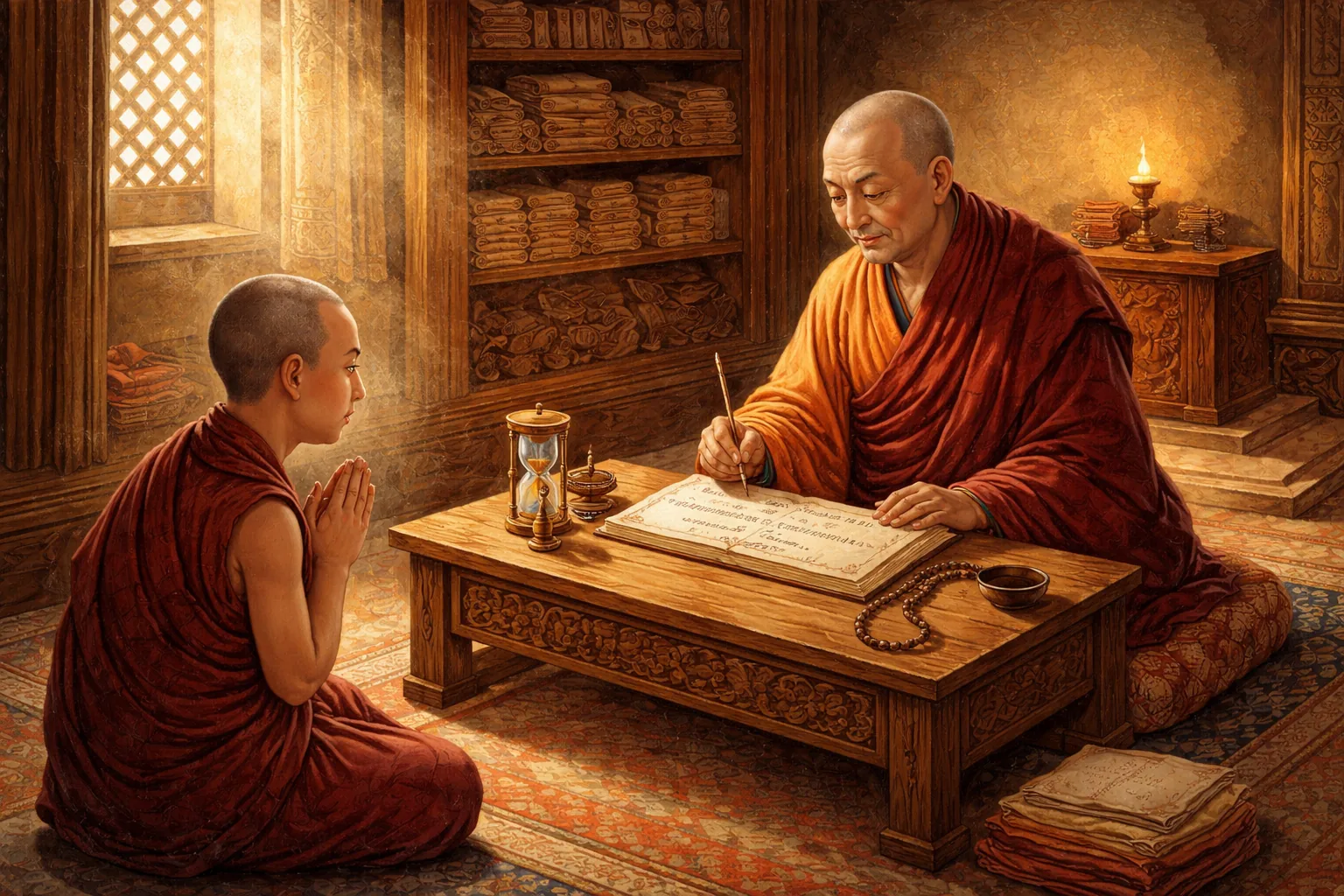
Commentary on the text “Advice from a Spiritual Friend”
Instructions on conduct by the Indian master Dipankara Shrijnana (Atisha), known as “Advice from a Spiritual Friend.”
First, homage is paid here to the masters and deities. The text begins with these lines:
“Away with all doubts. Make every effort for successful practice.”
Whatever the subject of our practice may be, the object of meditation, the sadhana, we must study it thoroughly in advance. We must understand what we want to achieve through it, and then eliminate doubts regarding this practice.
If we are told: “Concentrate on the feeling of ‘I.’ Meditate on emptiness,” but we have not clarified for ourselves what this is, and years go by while we remain in uncertainty, then this, of course, cannot be called spiritual training. Therefore, we must clearly clarify for ourselves all the subtleties of the teaching so that nothing is missed. Perhaps we think one thing about a certain practice, while the opinion of accomplished beings, siddhas, or the teacher regarding this same practice is entirely different. We should never have such a gap in understanding. We must clearly and deeply penetrate all the subtleties of the methods in order to benefit from them.
In other words, for the first twelve years, absorb everything like a sponge, penetrating everything down to the smallest details. Copy the masters in everything, immersing yourself in all the subtleties. Try to understand the workings of their consciousness, their view of the world, their everyday behavior, relationships, and style of communication. Even simply adopting all of this will greatly help you on your path.
Do not think like this: “Dharma is one thing. But there is something in my soul, and I will keep it as something precious.” Dharma is everything. It must touch our soul, our mind, and go even deeper. It must change our relationships with the world and with people, change our views of ourselves. In fact, it must change absolutely everything.
Therefore, in everything we do, we will try to adopt this deeper view. This does not mean blind imitation. We do this consciously and try to apply it to our own clarity, since, while orienting ourselves toward others, we must awaken our own awareness. The master’s goal is not to make the student an external copy of himself, but to awaken awareness in him so that he becomes completely self-sufficient. Therefore, we must eliminate all possible doubts.

At first we have many doubts because we are not yet firmly established enough in the teaching, we have a weak intellectual foundation, a weak sense of understanding of the actions of energies, and we may not understand the essence of the process of contemplation. It is as if we are walking in the dark, by touch. Nevertheless, as the teaching becomes clearer over the years, all doubts disappear, especially if they are supported by personal experience. The sooner we eliminate such doubts, the better it is for us as practitioners.
Next, the yogin Atisha says:
“Away with drowsiness, dullness, and laziness. Constantly fill yourself with enthusiasm.”
This means that we stop our vagueness, our agitation. We notice them, we know how to stop them, and we struggle to win in every meditation session. For us, each session is like entering the ring, where it is decided who will defeat whom: either your mind will defeat you, or you will defeat your mind. You will either overcome vagueness and agitation, or you will again follow your thoughts and fall into vagueness. At first, we are like an inexperienced fighter who is beaten by anyone who feels like it. But when, finally, our clarity and energy level are stable, we constantly win victories.
There is a humorous story. “I joined a kickboxing club and went there for three months.” — “Why don’t you go now?” — “They said they no longer needed a punching bag.”
At first, we constantly suffer such failures in meditation; that is, we lose either to agitated thoughts or to vagueness (tamas). But over the years, clarity is flawlessly cultivated, the spirit grows stronger, and therefore we win more and more often. This continues until we begin to win victories in every session, every second. An experienced master-practitioner is one who, in any situation, with any pranas, under any astrological configuration, and with any karmas, wins in meditation. His clarity flawlessly controls thoughts and penetrates emptiness. Therefore Atisha says: “Constantly fill yourself with enthusiasm.”

The text also says that we must show zeal and diligence so that our meditation progresses.
“Je Tsongkhapa said: ‘Wear the protective armor of inspiration and diligence, and let this armor of yours grow thicker like the waxing moon.’
Chandrakirti said: ‘All profound and superficial goals follow inspiration and diligence; with the help of these qualities, anything can be achieved.’
With awareness, vigilance, and attentiveness, always stand guard over all the doors of the senses.”
Awareness is your subtle observer, your subtle clarity manifesting at the present moment. And vigilance is control over whether it manifests or not. We should regard vigilance and attentiveness as guards at the gates of our body, speech, and mind.
Principles of Energy and Control of Radiation
There are two principles of energy: the first is when we radiate energy, and the second is when we absorb it. The principle of radiation is also called spanda, or atma-shakti. When we speak, think, or perform actions, we are thereby radiating; that is, energy goes out from us. When we look, listen, attune ourselves, this is the principle of absorption, when energy, on the contrary, enters into us. This is the creation and destruction of the universe in miniature. When we think or say something, it is similar to Brahma creating the universe.
During these two radiations of energy, we must be vigilant, that is, we must make sure that the thoughts that come from us are always pure, self-liberated, and that their basis is always manifested. We must not allow ourselves to think this way and that: “This one is simply a fool. And that one understands nothing at all,” while in our soul we are cursing everyone, yet outwardly we perform “namaste.” Otherwise, this is ordinary spiritual hypocrisy. In fact, we should perform “namaste” in the soul, even if we do not do it outwardly. In other words, we must be very vigilant regarding impure thoughts. It can be said that the initial stage of spiritual training has been successfully completed when not a single impure thought slips out of you at all. And if one does slip out, you immediately swat it down.

As practice progresses, not only do impure thoughts stop slipping out of you, but you discover their single basis. That is, you discover that thoughts themselves are inseparable from the empty basis. And then thoughts begin to emerge, but they are primordially playful, self-liberated; there is no real force behind them. They emerge like a dance, like music, like blooming. They emerge and disappear. They cease to be something that deceives you and leads you into illusion. This is like ripples that appear on water and then spread out, leaving nothing behind. If thoughts do not self-liberate, they form entire patterns, carry their own bhava, and envelop us, and we dwell as if in a cocoon in a feeling of being captured by thoughts.
But one who has mastered the secret of self-liberation does not allow thoughts to envelop him. They instantly disperse at the moment they arise. Of course, there can be no question of manifesting impure actions of body or speech. These are coarser manifestations. Everything concerning our speech and the actions of our body must come out pure.
Pure Vision and Perception
When we see something outwardly that prompts us to manifest an impure state, we should think as follows: “It must be that my vision is impure, my mind is impure. It cannot be that the Three Jewels manifest impurely. In the absolute sense, the whole world is perfection and purity, and only my vision does not yet allow me to see this.” When we try to see in this way, we control our own radiation, our own manifestation. Our vigilance stands guard. Also, when we integrate with external energy rather than radiate it, we should likewise try to regard everything we perceive as pure, discovering its empty basis. Even if it does not seem that way to us, nevertheless we must strive to see it as empty, as pure.
Everything depends on the degree of our awareness. The mind’s capacity for awareness can be compared to an iron hook. When the mind inclines toward impure vision or impure manifestations, awareness catches it and returns it to the right path.
Everything we perceive is projections of our consciousness. If we change ourselves, perception also changes. Our friends appear as peaceful gods, our enemies and demons as wrathful gods, the world as a mandala, sounds as perfect purity, and we ourselves as deities at the center of the mandala, as the absolute Brahman, as the Buddha. Everything depends on the extent to which we can acquire such pure perception.

For example, you see that a car is moving. Of course, in your karmic vision it is a car. But in reality, if you look at it from the world of the asuras, this car will appear to you differently—as something resembling a UFO, a very mystical vehicle. And if you acquire the vision of the world of the gods, then instead of a car you will see a chariot, a divine vimana—a flying craft of the world of the gods. Everything arises due to interdependent conditions.
Daily Checking of the State of Mind
Next Atisha says:
“Three times a day, invariably check the state of your thoughts.”
At least three times a day, mentally, in the soul, one should take Refuge; three times a day check one’s level of awareness; three times a day confirm the samayas; three times a day remember the four awarenesses. This does not mean that you sit down and begin going through in your mind: “So, suffering, the law of karma...” I would say that this is a subtler thing; that is, you simply maintain a very vigilant state. Without this, there is no monk as such. A monk differs from a layperson precisely by his vigilance, when he will not take even a step without self-control, without self-discipline. And this is the path to true holiness.

Earlier, when there were few monks who had several years of monastic experience, and the sangha consisted mainly of monks whose experience ranged from six months to a year and a half, those were quite some lilas. I constantly had to self-liberate and practice pure vision, cutting off my hopes. Such energies were roaming here! I was even amazed that one could seriously be like that: an ego like an elephant’s, sexual relationships and attachments almost reaching the level of family ties, a real struggle for power, when they were ready to climb to the top almost at any cost, the desire to dominate others, greed, the need to possess things, and so on. I thought: “How can all this be in the sangha? After all, they came to practice.” It seemed that all human shortcomings were protruding one after another. As for impure vision, slander, and criticism, there is no need even to speak of them, because they were simply the norm of life. But I knew that time was needed for these people to purify themselves and create the foundation for a truly holy sangha. And that is exactly what happened.
Over time, everything changes. We can already observe our kleshas, our shortcomings. There is already a master within us who controls this, so everything impure is noticed by us. It is like some uncouth person, a rustic, being invited into the high society of aristocrats. He sits down at the table, and everyone laughs at him because he makes mistakes literally at every step: now he takes the wrong spoon, now he drinks the water meant for washing hands. The aristocrats either openly laugh at him or pretend that everything is fine while choking with laughter. But over time he acquires the necessary refinement and upbringing, the necessary clarity appears in him, and therefore he can already observe all the manners accepted in that society. On a subtler level, something similar happens with the training of a monk. Even if at first he makes many mistakes, over time such attentiveness and refinement appear in him.
Acknowledging Mistakes and Attitude Toward the Shortcomings of Others
Next Atisha says:
“Acknowledge your mistakes.”
Many people think that acknowledging one’s mistake is a sign of weakness, and therefore they are ready to dig in and cling to it. In reality, to acknowledge a mistake means to distance oneself from it, to take a higher position of awareness, to observe it as something external, and thereby gain strength. That is, if a person thinks that he will lower his self-esteem, his image, by acknowledging a mistake, then that person is not yet at a very high level of development. But if a person possesses great spiritual maturity and strength, then, on the contrary, he raises his self-esteem by acknowledging a mistake. That is, he considers himself so developed that he has the right to make mistakes and acknowledge them. He can afford such a luxury, and it does not harm him in any way.

If, however, we hide our shortcomings and retouch them, then we merely strengthen our sense of guilt, unsettledness, and dissatisfaction. We look at the world with some kind of distorted gaze, or the gaze of a blind person, that is, with a gaze that does not allow us to see truly. But when we acknowledge our mistakes, we reduce the force of their impact. They cease to be something self-sufficient, because we separate ourselves from them, distance ourselves from them; that is, they no longer influence us.
“Do not look for mistakes in other people.”
There is also no need to incessantly search for mistakes in others. When we see mistakes in others, we should think as follows: “Perhaps the element being criticized exists within me myself, since I see it. Since everything is the work of consciousness, it is possible that my subconscious manifests this world in such a way that I encounter this. And until I change myself, I will continue to encounter this.” This is indeed so. If our concentration is strong, then it can condense the world around us in such a way that outwardly we will constantly encounter situations that correspond to what exists in our soul.
Concealing Virtues and Rejecting Honors
“Hide your good qualities, but glorify the good qualities of other people.”
There is a saying: “Your achievements and illuminations should be like an oil lamp burning inside a vase. It illuminates the surrounding space, but is not visible to others.” This means that you try to safeguard your inner virtues and not spill them out. You do not try to dominate others by using your spiritual experiences; you do not try to occupy some position, because all these ego games weaken spiritual practice. It is especially important not to boast of supernatural powers, not to demonstrate them as a means of self-expression, that is, without need. For example, we have monks who possess certain supernatural powers, but I recommend that they treat this with restraint.
“If you see your own shortcomings and never see shortcomings in other people, then you are a sage, even if you have no other positive qualities.”
Therefore, not looking for shortcomings in others is already a very high practice in itself. Identifying flaws in other people is a futile attempt to hide one’s own flaws.
“Reject praise and honors. Never desire fame.”
Praise and honors belong to one of the maras—the mara-son of a celestial being. In other words, this is a factor of the heavens of passion, a factor of the desire to manifest as something higher, but egoistic. Those who avoid the trap of attachments, the mara of kleshas, the mara of skandhas, can easily get caught on the hook of this mara—the mara-son of a celestial being. They practice asceticism and can control desires, but when the question arises of their power, superiority, fame, or influence over others, they suddenly lose their heads. You must understand that all this is yet another game of maya, and never fall for such tricks.
If we do not strive for gain, respect, fame, and respectability while mastering the teaching, then our self-sufficiency grows. In our soul we must be like a solitary rock that grows by itself, receiving neither honors nor praise from anyone, since all this is simply yet another dream of maya.
Why does a person desire power, praise, and honors? Because when he receives them, his ego for a certain moment begins to feel like a deity, like Brahman. These energies open up in him, his opinion of himself changes; that is, roughly speaking, they give him poa, and dependence arises, while without them they do not give him poa. Then he becomes a kind of addict of this power, and therefore subconsciously constantly strives for power, fame, or honors. This is a disease of many outstanding people and show-business stars. They feel that worldly fame is burdensome, but at the same time it is like a drug for them; that is, they also cannot do without it. The audience screams when they come out on stage, and because of this they feel like gods. For them, this is a moment when their consciousness experiences almost samadhi. And when this is absent, they feel the same as other people: ordinary, average, boring. They once again feel their own insignificance.
Nevertheless, the practitioner must feel like God regardless of whether he is exalted or, on the contrary, criticized, whether he is applauded or, on the contrary, is alone among trees and grasses. His view does not depend on whether he possesses power or, on the contrary, serves someone, because the true “I” does not depend on any of this. And only then will we truly be able to use power correctly, know the value of honors, and so on.
When a saint receives power, when honors and praise are bestowed upon him, he knows that all this is intended not for him, but for God, that he has absolutely nothing to do with it; it is simply that his body has somehow found itself here. He feels that this does not pertain to him, that it is the triumph of the Absolute. It is the Absolute that is being praised, the Absolute that receives honors, the Absolute that manifests its authority and strength in the form of might. And what does this have to do with his ego, with him? Nothing. He feels that all this is addressed to someone higher, while he is merely like a translator into the language of the human world, or a transmitter, or a postman.
He understands that it is foolish in general to take any praise or honors as being addressed to his ego, because he sees from what vast ocean his ego draws its energy. It is simply amusing to him to attribute any achievements to himself; it seems utterly absurd. Therefore, a saint never falls into such things. And at the same time, he does not miss the opportunity to praise and honor the Absolute, to manifest His glory.
Being Content with Little and Being Self-Sufficient
“Be content with little. Be self-sufficient. Respond to good with good.”
You are fortunate people because you are monks. This means that you do not dissipate your spirit, your karma, training yourselves for years to live with little. You can have peace of mind regardless of how you practice the Dharma.
To be content with little means to have a self-sufficient mind, when you are not attached to anything. Whatever you may have, you do not cling to it.
Nagarjuna wrote: “If you are content with little, consider yourself the richest person, even if you have been robbed of everything. But if you are not self-sufficient, then you are the servant of your wealth, no matter how large a sum of money you possess.”
From the point of view of the development of the sangha and the Dharma, we should always have a tendency toward prosperity; however, this is a matter of the collective energy of the sangha. From the point of view of the absolute “I,” we should always have a tendency toward non-attachment.
Contemplation of Love and Compassion
“Contemplate love and compassion. Maintain the stability of the awakened mind.”
It is said that Nagarjuna always noted that the contemplation of pure love and the outpouring of love toward other beings are better than providing them with material goods, since in that case they receive more lasting happiness.
To contemplate love and compassion means to take the position of a deity, to assume the position of the god of the holy heavens of Brahma, who has compassion for all living beings because they are part of him.
There is a story that one of Buddha Shakyamuni’s disciples, Shariputra, lacked compassion, although he was already close to attaining enlightenment. One day, Mara approached him in the guise of a man and demanded that Shariputra cut off his own arm and give it to him. Shariputra cut off his right arm and gave it to him with his left hand. However, from the point of view of Vedic etiquette, the left hand is considered impure, so one must not offer gifts, food, and so on with it. Therefore, this Mara in the guise of a man refused to accept the severed arm, saying: “You must hand me your severed arm with your right hand.” Shariputra was bewildered and thought: “If there are such malicious beings in the world, how can I possibly develop compassion?” He completely lost heart and decided not to listen to any more fools.
It is said that if people such as Shariputra found themselves in such situations, then we too must be very vigilant when our compassion is being tested. It is easy to feel love and compassion for those who feel the same way toward us, especially if we ourselves are in a benevolent state. However, it is difficult to feel compassion for someone who is disposed toward us differently.

But a saint naturally feels compassion and love for all living beings, even if they are hostile toward him. That is, he sees their malice and understands that they behave this way because they are not satisfied, because they have no contact with the Supreme Source. If they had this contact and were satisfied, they would be in immense joy and ecstasy. He thinks: “They are unlucky. They are in such a bad state. They feel this way because they have not discovered that Great Unborn, which for me is something natural.”
Therefore, he looks at them rather as a doctor looks at a patient. He does not look at them from the standpoint of some personal relationships. In principle, he does not establish direct relationships with them, but simply sees them as those who are ill, and therefore compassion naturally manifests in him. He thinks: “If they possessed an enlightened mind, would they really be so malicious or impure?”
“Avoid the ten harmful actions. Always strengthen your faith. Conquer anger and arrogance. Humble your mind.”
