

Commentary on the Text “Tripura Rahasya. Chapter 21”
Spiritual Evolution and Jnana Yoga
Shravana (the study of sacred texts) is what constitutes the entire life of a sadhu, because sacred texts originate from divine beings. Sacred texts are infinity itself speaking to us humans in a finite language. Studying texts, interpreting them, and translating the sacred text into the realm of inner experience are among the most important activities of a sadhu, one who follows the path of liberation.
It is not enough to study the texts—you must also understand them, because infinite truths set forth in a finite language are like a file compressed to an incredible size; it still needs to be unpacked and decoded. It is a hieroglyph; Chinese writing consists of hieroglyphs—you read them and cannot understand anything. Yet each hieroglyph contains a vast amount of information.
We begin with mental, intellectual understanding, but that is only the beginning. Through words and Dattatreya’s teachings, we must reach his state, his worldview, his samadhi, and attune ourselves to that realm beyond words; only then can we truly discover the source of any sacred text.
The Incomprehensible Qualities of a Jnani
“The qualities of a jnani are difficult to understand because they are incomprehensible and inexpressible. For example, a pandit and his learning cannot be described precisely; one can describe only his appearance, gait, and clothing, for his feelings, depth of knowledge, and so on are known only to him.”
There is a difficulty in perceiving religious truths. Religion appears as a powerful tradition with its own canons; however, when religion is translated into the realm of inner experience, we see that the canons fixed in words do not work, that inner experience speaks another language, and that external canons and traditions should serve only as hints toward the experience of inner reality.
Often, when a person takes the canon of religious truths too literally, a great divide arises between inner reality and religious truths. A major dilemma emerges: whether to act according to external religious canons or rely on inner experience, which lies beyond all canons and cannot be fitted into any canon. This happens because the person has understood religious truths too literally.
I heard how a Christian priest, on his deathbed, suddenly began saying, “Everything is not like that, everything is not as I was taught”—that is, he had certain ideas about spiritual life, but when the mind was swept away, he was unable to connect those ideas with any kind of experience. Another man, a professor who studied Oriental studies in China and explored various Taoist teachings, knew a great deal about texts, philosophy, Chinese culture, and biographies. He came to a Taoist master. The Taoist began explaining the work with prana and other matters to him. Suddenly, he realized that all his professorial knowledge was completely useless here. He considered himself a very knowledgeable person and had devoted his entire life to Taoist texts, yet some illiterate old Taoist quickly taught him, because external knowledge is never equivalent to inner experience.

The Spiritual Path as Creativity and Mastery
Here, the spiritual path, the mystical path, can be compared more closely to creativity. Creative people act by relying on what is within. It is impossible to create according to templates or canons—any creativity based on templates or canons immediately becomes lifeless. The spiritual path can be compared to martial arts or any kind of sport—much depends on your abilities and your inner mastery.
One thing is that certain truths exist, but another is how you personally understood them and how you personally apply them in life. Even if you have taken excellent notes on a swimming textbook and mastered knowledge of various swimming methods, it does not follow that you are an excellent swimmer. A person who has never read anything about swimming at all may swim wonderfully, better than you.
If you have studied a boxer’s or karate practitioner’s textbook thoroughly, that does not mean it will help you in life if you are unable to use it, because the most important thing here is inner experience. In martial arts, no one can say, “I act according to the canon; my martial arts are correct, and yours are wrong.” As soon as he makes such a claim, what will happen? The person he criticizes will come out and say, “Let us now see whose canonical martial arts are better”—that is, the one who demonstrates greater skill is the one who is right. The same applies to magic. No one can say, “Your magic is correct, and yours is wrong”—everything depends on what your will is like and how you apply it.
No one can say, “My method is canonical, the most powerful, the best,” because someone will immediately put it to the test. Truth, dharma, is always tested by life. No matter how a person follows something, the question of their own realization remains—how capable they are of realizing it within themselves.
If you have calmed the mind, then you have calmed the mind. If you have discovered the nature of mind, then you have discovered the nature of mind. If you can observe thoughts, then you can observe them—whether according to the canon or not. And if you cannot observe them, then whether according to the canon or not, you cannot observe them.
If you can remain in a state of awareness, then you can remain in a state of awareness. There is no such thing as incorrect awareness—awareness either exists or it does not. Conversely, if a person considers themselves right about something and others wrong, but is not aware, this will not help them in any way. Therefore, the question of whether a religion is true or untrue, whether methods are true or untrue, is always a personal question, a question of personal realization. It is not a question of the absoluteness of methods or the absoluteness of teachings—all of this is a certain aid to consciousness.
A religious person is greatly tempted to affirm their own exceptional nature by considering others to be wrong. Yet the sign, the boundary between right and wrong, lies between awareness and unconsciousness, between your personal application and your religious practice.

In other words, if your mind is calmed, if you abide in sattva, in a state of awareness, then of course your practice is the most correct, the most righteous, the most canonical. Therefore, Dattatreya says that the qualities of a jnani cannot be seen; they cannot be determined immediately, just as the qualities of a brilliant mathematician cannot be seen at once—they can manifest only under certain circumstances.
True and False Signs of a Sage
“Just as the taste of a specific dish cannot be accurately conveyed in words to someone who has never tasted it before, a pandit can be understood only by another pandit through the way they express themselves. Only a bird can follow another bird in flight. Of course, there are certain traits that are obvious, while others are subtle and incomprehensible. The obvious traits are speech, language, bodily postures in meditation, signs of worship, detachment, and so on; yet these can be imitated by those who are not sages.
That which is attainable for others with the help of and in combination with detachment, meditation, prayer, and so forth is natural for a sage whose mind is pure and guileless. One who cannot be affected by honors and insults, losses and gains, is a sage of the highest category. The best among sages is capable of answering, without any hesitation, questions concerning realization and the most exalted truths in full. He seems to become spontaneously animated when discussing matters related to jnana (realization), and he never grows tired of explaining them.”
The Limitations of the Mind in Spiritual Life
God-realization cannot be experienced at the level of the mind, because the mind itself is a form of ignorance. We are accustomed to testing the mind, using it, and trusting it in life, but as soon as we turn the mind away from material life toward spiritual life, it begins to let us down. It is as if you could walk well on land in shoes, but as soon as you decided to walk on water in those shoes, they would be of no help—to walk on water, you need some other kind of footwear: a boat.
In the same way, the mind works excellently in material life; thanks to the mind, much can be achieved and organized in material life. But it becomes useless in matters of spiritual life, in matters of penetrating into the Divine. As soon as a person begins to bring the mind into spiritual life, into the Divine, great confusion begins to arise within them—there may be incredible confusion. This is why conflict arises between different religions. Different schools are hostile to one another because everyone is attached to their own form of mind; no one can accept another form of mind, another mental perception of divine truth.
A jnani is one who transcends the mind and establishes themselves beyond the mind. At that point beyond the mind, all contradictions suddenly resolve themselves. And whenever a person remains in contradictions—in life, in the study of dharma, in relationships, in opposition—this is an immediate sign that they are in a mental position, because the position of no-mind is free of contradictions; it carries no contradictions and easily resolves any contradiction, because it is itself the source of harmony, where contradictions cannot exist.
Overcoming the Illusion of Diversity
Non-mind is a state close to nonduality. The mind is always duality. As soon as we begin to perceive something from the position of the mind, contradictions arise. Once, two professors attending the same conference stayed at the same hotel: one was an Orthodox Jew, and the other was an Orthodox Catholic. Like a Jew and a Catholic, they felt that they could not find common ground at all. Then they said: “We are wise people, after all. Let us forget that we are a Jew and a Catholic and simply communicate as two wise people.” As soon as they changed their position, they easily found common ground.
A person who remains in a mental state, who is fixated on the mental state, is initially in a state of separation — separation from the universe, separation from God, from other living beings, and from the Universe. Because of this separation, hundreds of minor conflicts are constantly born. There is a barrier, and they cannot understand another person; they can understand only their own mind — there is no longer room for someone else’s mind, because there is not enough space to let another mind in, while they still have to interact with other minds, and constant misunderstanding arises.
They also cannot understand another philosophical system or another religious, cultural, and value system, because there are mental constructs to which they adhere, but they are mental, and there is no room for anything else. Trying to let them in would mean destroying their own system, which leads to denial and, worse still, aggression. But when we remain beyond the mind, we discover that we have risen above all mental constructs, and we can beautifully unite everything; we can see everything as a whole without betraying our path in the slightest; we can be in harmony with everything, and we can be in harmony with the Universe.
When this is attained, it means that maya-mala (the illusion of diversity) has been overcome. The mind creates such an illusion of diversity, and then contradictions arise between methods, contradictions between traditions, schools, and religions, contradictions between nations and cultures, and these contradictions appear irreconcilable. This is the cause of the wars waged since the beginning of human history — these apparent contradictions of the mind, contradictions between deities, between peaceful, neutral, and wrathful ones.
Once, perhaps about 15 years ago, when I was giving a lecture, wrathful deities were displayed. Someone saw the wrathful deities and said: “These are not divine beings; they are demonic. I will not worship such beings.” But if we go beyond the level of the mind, we will see that all deities — whether peaceful, wrathful, or neutral — are different forms of energy existing in the Universe. Or there are contradictions between Brahma, Vishnu, and Shiva — all these contradictions are mental.

The only way to overcome these contradictions is to enter into a nondual view. Then what was divided is seen as whole, and what was in conflict is seen as existing in harmony and play. Removing these contradictions between oneself and others, between oneself and the Universe, between the soul and God, between different cultural systems, religious systems, and others, between these methods and others — this is the natural growth of the soul. As soon as you see that these contradictions have begun to disappear, it means that you are growing; and if they intensify, then, on the contrary, something has gone wrong.
Attaining a Single “Taste”
Attaining wholeness and reducing contradictions is a sign that you are approaching a single “taste,” that you are approaching the nature of the mind and the knowledge of the Divine — that is, there are no contradictions for God. There is even a story that Vishnu supports the gods, but he is opposed to the destruction of the asura gods, because in a certain sense he is also of the asuras, since the asuras are also needed for the Universe, for the balance of forces in the Universe. For if there were no asuras, they would not challenge the gods; the gods would relax and remain idle, the power of blessings would dry up, people would stop performing rituals and making offerings, and the ethics, culture, and morality of people would also weaken, resulting in an imbalance in the Universe.
This is Vishnu’s vision: the asuras are also needed; they also perform their functions. It would cost him nothing to take the Sudarshana Chakra and incinerate all the lower worlds, but for some reason he does not do this. In other words, the lower worlds will exist until the end of the Universe — they too are part of the universe. In Vishnu’s vision, there are no contradictions between the asuras and the gods; they are playing their roles — this is a very broad vision because it lies beyond the mind.
When the contradiction between different aspects of the teaching, between the words of Gurus and monks, between different sayings of sacred texts, between different deities, schools, and traditions, and between different approaches disappears for you, the ability to see everything as an integrated whole is such an obvious good sign that you are approaching an integrated vision of the world, a single “taste,” because a single “taste” means unity: seeing everything as whole and one, seeing similarity, seeing one thing everywhere, moving more and more from diversity, from maya-mala, the defilement of diversity, toward oneness.

There are irreconcilable contradictions between certain religions, but if you go beyond the mind, these contradictions and illusions are laughable, because all religions arose from the same source. It is like the index finger contradicting the ring finger, while they all come from the same hand. At one time, the schools of Tibetan Buddhism were hostile toward one another: Kagyu, Nyingma, and Sakya, because there was a great deal of politics and little sadhana, many ambitions, pride, and personal interests, but little of the view of nonduality, the spirit of love and compassion, this single “taste”—this sometimes happens among practitioners. Some say that these contradictions between the Tibetan schools ultimately led to China conquering Tibet and its annexation.
The vision of a jnani is the vision of all contradictions, the vision of the single “taste” and the play of the Absolute in all circumstances.
Qualities of a True Sadhu
“His nature is the absence of effort. Contentment and purity abide in him. Even the most critical situations do not disturb the peace of his mind. These are the qualities by which one must assess and examine oneself; it is useless to use them to examine others, for these qualities may be genuine or counterfeit. At first, the seeker must examine himself and always investigate and prove to himself his true level; then he will be able to judge others. Can constant self-examination fail to improve an individual? Let him not waste time passing judgment on others; let him judge himself.”
Thus, the sign of a truly good sadhu is that he does not spend time passing judgment on others; he condemns no one. If he examines anyone, it is himself; he does not look for faults in others. As soon as you see a yogi looking for faults in others, it means that this yogi does not yet possess wisdom. A true yogi examines only himself, and he does not examine himself through mental reflection; he does so by maintaining avadhana, vigilance, and awareness.
Different Levels of Jnanis
“Thus he becomes perfect. What are here called the characteristics of a jnani are intended for work on oneself, not for examining others, because these characteristics admit of many modifications according to circumstances. For example, a jnani who has realized the Supreme Being with the least effort may continue to follow his former way of life, although his mind is already inaccessible and his views cannot be shaken.
He resembles a worldly person in all practical matters. How, then, can he be assessed by others? Yet, be that as it may, one jnani recognizes another immediately, just as an expert can assess precious stones at first glance. Jnanis of a lower order behave like ignorant people when it comes to caring for their bodies.
They have not attained sahaja-samadhi, which is uninterrupted even when immersed in activity and so on. They are in a state of Perfection only when they are composed and calm. When they are not engaged in investigating the Supreme Being, they have the same bodily sense and enjoy pleasure and experience pain to the same degree as any animal. Although they do not investigate the Supreme Being at all times, they nevertheless have periods of a perfect state due to their previous practice and experience.

In any case, they are liberated, because their animal sense is merely a deviation during the intermediate episodes of imperfection, and it does not always leave any trace upon them. Their deviation is like the ash skeleton of a piece of burned cloth, which is useless even though it retains its former shape. Again, the intervals of realization exert a lasting influence on their lives, so the surrounding world no longer continues to captivate them as before. The dye applied to the edges of a piece of cloth is absorbed and gradually changes the color of the entire piece of cloth.
Thus, a jnani of the lowest category is perfect only when meditating according to schedule, and even then only if the meditation is successful. If meditation fails, then he is not perfect even during the scheduled time. He may be perfect when reading texts, contemplating advaita, experiencing flashes of realization, and holding to the view. But when he begins to act and forgets, his perfection departs; nevertheless, he can rely on faith, and even the faith of an imperfect jnani can help him progress and keep him in a state of wisdom and holiness, because faith is a jnani in potential.
Jnana is realized faith. But a jnani of the middle category is never deluded; he constantly remains in such a perhaps weakly flowing sahaja-samadhi, never loses the nature of the Mind, never slips into mental concepts, and always holds on to the feet of God.
Jnani of the Middle Category
Jnani of the middle category are never deluded by their bodies. Delusion is the false identification of the “I” with the body.
Another sign of a jnani of the middle category is that he never gets tired. Physically, he may become tired, but not psychologically or mentally, because his mind can never be confused. Whatever tasks he solves, whatever he discusses, whatever he talks about, he never gets tired; his mind is clear and capable, and he is always joyful and detached. He cannot say, “Oh, I am confused.” He is always ready to speak about absolute truth, always ready to abide in absolute truth, whatever he may be doing; that is, he possesses enormous capacity for activity, but has no sense of being the doer. It is impossible to confuse him with concepts, events, or affairs, because he always remains beyond the mind, and abiding beyond the mind grants tremendous power of inspiration.

Delusion is the false identification of the “I” with the body; this never happens to more advanced jnanis, namely, representatives of the middle category. Identifying the Supreme Essence with the body is attachment to the body. Representatives of the middle category of jnanis are never attached to the body. Their minds are practically dead due to their prolonged practice and extended asceticism.
A jnani of the middle category is one who has expanded consciousness, one who is everywhere simultaneously, in ten thousand worlds at once: physically in one place, but in consciousness in Kathmandu, on Kailash, in America, Europe, Russia, on Mars, on the Moon, at the center of the galaxy, and beyond. This is the real experience of an infinite, expanded ocean of pure Consciousness, in which there are no shores. You are sitting here, but you are an ocean without shores; knowing this ocean always inspires.
A jnani of the middle category no longer leaves this state. He is very close to God, and neither the body nor thoughts delude him; no situations—everyday, business-related, comfortable, or uncomfortable—can make him leave this infinite, expanded, freely flowing presence of the Divine, because he abides in it, and the whole world appears to him as a game, as a playground.
He is not guided by logic, the mind, or doctrines, although he may observe them; that is not the main thing. He may take from them whatever helps the Dharma, but he is guided by ordinary ethics and culture for the sake of others, knowing that this will help. He himself is free in all directions; he has no racial, cultural, national, or any other identities—his identity is Divinity. But he may play any identity if it helps the Dharma.
They are not engaged in activity because they are completely absorbed in themselves. Just as a person moves or speaks in sleep without being aware of his actions, so this category of yogis performs the necessary minimum of activity to maintain their bodies, without noticing it. Having transcended this world, such a yogi behaves like a drunk person. But he is aware of his actions. His body continues to live because of his vasana tendencies and destiny.
For example, King Janaka was compelled to be a king because of his prarabdha karma; such was his destiny and karma, while he himself remained in a state of nonduality. Prince Rama was compelled to be a prince and to withdraw into the forest for twelve years, but he never lost his realization under any circumstances. It may seem that such a person performs an action, but as one mahasiddha put it, his actions are merely a game; they are like an echo in the mountains, like a response. One should not deliberately seek human logic in them, nor rational motives conditioned by human motivation—they are abiding in God and a spontaneous response.

To remain an infinite ocean without shores, to live in unity with Brahman. What makes this life possible? The fact that all interpretations, all assessments of the mind have been liberated; there is no longer any perception of reality through the prism of the mind, there is no longer the sleep of reason—there is wakefulness. Wakefulness is faith, love, inspiration, joy, play, ecstasy, contemplation, purity, refinement, beauty, harmony; it is the endless dance of existence in the Universe, which has no end, a dance without dancers, an empty dance, a dance with no purpose, because the Divine has no ego and no purpose.
A Jnani of the Highest Category
Jnani of the highest category do not identify the Supreme Essence with the body, remaining completely unattached to their bodies. Their activity is like the work of a charioteer controlling a chariot, who never identifies himself with the chariot. In the same way, a jnani is neither the body nor the doer; he is pure mind. Although inwardly he is completely unattached to activity, to an observer he appears active and engaged in action.
A jnani is not identified with the body because, being boundless consciousness, he has many bodies; he can feel himself in many bodies, he can flow like sap through a tree, swim like a fish in water, fly like a kite, be in the body of any person as part of their consciousness, or create another body. There are no limitations for freely spreading, flowing consciousness. There are no limitations because the mind no longer creates them. When there are no limitations of the mind, boundless devotion, love, self-surrender, and harmony take their place, and the whole world around also becomes a mandala of pure vision.

He fulfills his part in the activity, acting like an actor in a production; and he plays with the world as a parent plays with a child.
A jnani does not build serious relationships with the world; he plays with it. As long as we have ego and attachment, we build serious relationships with the world; we want something from the world, and sometimes the world wants something from us. But in any case, these relationships are serious and causal; there is no room for play in them. There is either obligation or coercion, or the taking of something from this world for the sake of enjoyment.
Such relationships are called the relationship between two spouses. But a jnani relates to the world in the form of play, because the entire world is a playground for Infinite Consciousness to play. There is nothing left for him to do in the world; there is nothing he must do or must not do. He lives in unity with God and with the entire creation, with the whole Universe, but since there is energy, a moving force, this energy easily, freely, and spontaneously dances in this world, benefiting others, because he is a messenger of the boundless God, of the boundless Absolute. His energy dances, bringing benefits to others of its own accord, even without motivation; its essence is benevolence.
The Self-Sufficiency of a Jnani
A jnani demands nothing and asks nothing of others; he needs nothing. A jnani does not lose his nerve—he has no nerves. He does not live in expectations and hopes; he lives in total, supreme, boundless bliss, in brahma-ananda, the bliss of the present, and he is grateful to God every second. He is completely self-sufficient; he asks nothing superfluous of the Universe. He knows that if he asks for a lot, the Universe will also begin to ask a lot of him, and perhaps he has nothing to give. That is why I often teach my students: do not ask for anything unnecessary; if you ask for too much, the Universe will begin to ask a lot of you. Be content with what you have.

For the sake of Dharma, sometimes one needs a lot of something, but not for oneself. The less you have, the richer you are—is this a paradox? Yes, but that is how it is, because your potential to do without anything increases, whereas the more you have, the poorer you are. People on Wall Street in New York would go crazy over this philosophy, but that is how it is—the words of the saints. The more you have, the smaller your potential for non-possession, and the less freedom you have. In other words, if you need a lot from the Universe, it means that you are too lacking in self-sufficiency; there is nothing inside you, and you cannot provide for yourself.
How can this be explained? If you take a lot of things with you to Kailash because you need this and that, it means that you are weak in yourself, that you need a great deal: oxygen, a backpack, and so on; your body is weak, which means that your own energetic potential is insufficient.
Conversely, if you go to Kailash in just a T-shirt and do not need anything else, then it turns out that you are a very strong person, very well adapted, with tremendous energy. In other words, having a great many demands and possessions—what is it? A sign of your weakness. In the same way, in the material world, having great attachments, possessing a great deal, having numerous demands and requests is a sign of a weak inner potential, a sign that you have nothing of your own within and need to borrow everything. There is little energy, the intellect is weak, the will is weak, sensitivity is weak, and so on. Conversely, when you have all of this in abundance, you can do without everything, drawing only from within and using external material energy solely for the benefit of others and Dharma.
A jnani of such a high category is self-sufficient because he draws such joy from within—the joy of Divine blessing. He can also work with material energies, but not for himself: for Dharma, for others, for God, even on a large scale, yet he is never attached to them—this is his seva. But people are attached, do not understand this, and may even sometimes envy him.
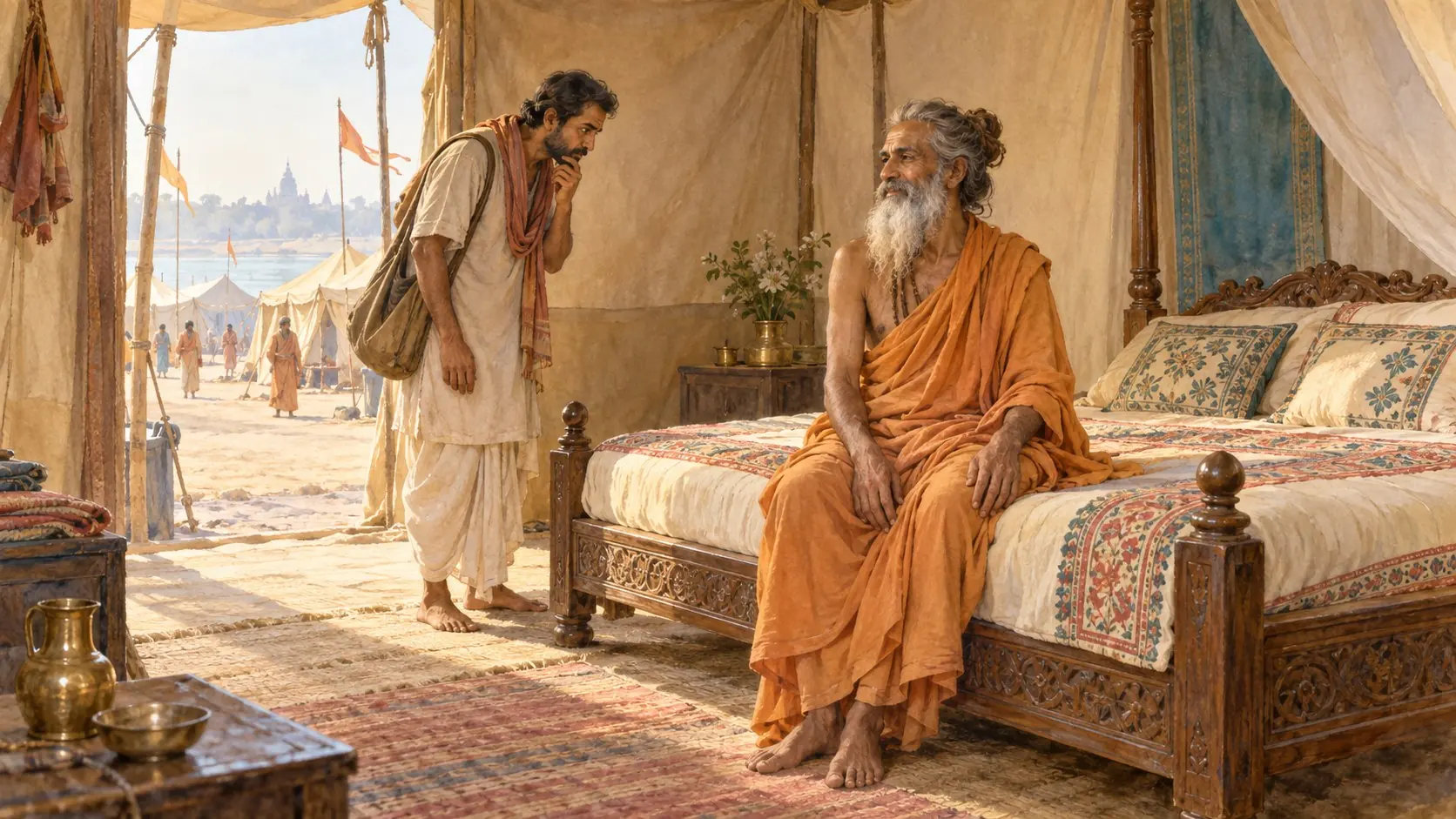
At the Kumbh Mela, Pilot Babaji told his disciples in the camp to put such a beautiful bed in the room where I was staying. They put the bed there, and I moved in. One man, an Indian, arrived, came in, began asking questions, looked at the bed, and said: “But what about renunciation? Surely you have a sense of attachment—you have such a beautiful bed.” I said: “The bed is in your mind. Whichever room I was assigned, whichever one they gave me, that is the one I moved into; I did not even think about beds. But it seems that your dreams of similar beautiful beds do not let you rest—you saw that mine had materialized.” There can be a great deal of such misunderstanding because the way a jnani thinks and the worldview of an ajnani are very different worlds, utterly different.
Of these two highest categories of jnanis, a representative of one category remains unshakable through constant practice and the disciplining of the mind, while a representative of the other does so through the power of his discernment and inquiry. The difference lies in the merits of their intellect.
