

Commentary on the text “Tirumantiram,” “The Song of the Rishi Tirumular,” Tantra One.
“Tirumantiram” is a very extensive text devoted mainly to kundalini yoga, samadhi, and siddhis. According to the teaching, we must approach the practice of the teaching already prepared, possessing a certain foundation of qualities. Usually, such qualities are spoken of as discriminating wisdom (viveka), detachment (vairagya), the sixfold qualities of sattva (shatsampat), and an ardent aspiration for liberation from the cycle of birth and death (mumuksha).
The sixfold qualities of sattva are shama, dama, uparati, titiksha, shraddha, samadhana, that is, patience, serenity, will, faith, and stability in contemplation or attentiveness. These are quite serious qualities, and in the first years we are engaged precisely in simply developing these qualities within ourselves.
The Qualities of a Vira Yogi and Preparation for Practice
In worldly life today there are many popular courses in personal growth, psychological and extreme trainings. If you are inhibited, constrained in terms of self-expression, that is, you cannot sing in front of an audience, dance, or you find it difficult to communicate, you are offered courses in artistry in order to feel yourself in a new environment. If your will is weak, if you as a person have not yet self-realized, you are offered various extreme trainings. If you lack impeccability and have weak self-discipline, if you have always lived sluggishly and lazily, you are offered corresponding courses where you can feel the living breath of impeccability.
All this is quite popular now. For example, one person conducts extreme trainings in which the following program is offered: first the participants walk on coals, then on broken glass, then they pierce the palm with a needle, testing themselves. Then they visit an Indian bathhouse, where in the darkness they are packed tightly into a small room. It is very hot there, about one hundred degrees, and they confess, and then each one reads prayers to the Spirit. This is a serious ordeal, that is, almost a matter of survival. Some of them even skydive. And in this way they remove limitations from their personality.

Last year Satya Tejasi asked me for permission to skydive. I gave it to her, she jumped, and then shared her impressions. She wanted to stop the mind and integrate the jump with presence. And she succeeded, that is, she had the experience that the conceptual mind came to an abrupt stop. She said that she had been prepared for the jump, but when she approached the exit, she was simply in shock and no longer wanted to jump, but they simply pushed her out, that is, she had no choice. She said that everyone, in such shock, stopped before the abyss, and they were simply pushed out. That is how they all jumped.
It is considered that if you have any limitations in terms of will, flexibility, letting yourself go, self-expression, or the qualities of impeccability, then such practices are favorable. You will not attain enlightenment through this, of course, if you are not a practitioner of contemplation, but you will make yourself a little better. However, it is assumed that you did all this before entering the path of anuttara tantra, that you have already gone through all of it.
I told Vasudeva about piercing with needles; he took one and pierced his hand without any emotion. But this does not mean that I am urging you to do it now. It is assumed that for you all this is like cracking nuts: walking a twelve-meter path on broken glass, skydiving, communicating flexibly, going through some extreme things. Why? Because a practitioner of anuttara tantra has a mind, qualities, and determination that are an order of magnitude higher than those of ordinary enthusiasts. That is, his inner qualities of clarity, flexibility, and concentration allow him to perform miracles. Only if we possess very great inner personal potential does the practice become highly effective and liberating for us.
Everything I have listed are the usual qualities of a vira yogi. That is, for a vira yogi, this is not difficult to do. When you begin the teaching, you may notice how many limitations there are, how many qualities of a vira yogi we lack. The teaching makes enormous demands, and if we want to practice, we must acquire these qualities: steadfastness, flexibility, patience, endurance, non-identification. We have no other way out except to acquire and develop these qualities along the path, in passing, that is, in the conditions in which you live, perceiving everything through the qualities of your practice.
These qualities are very important, because if we do not develop them within ourselves, the practice of the teaching will not bear fruit. It is like the seeds of even the finest tree, cast onto unprepared soil, failing to sprout. A true practitioner, however, has already cultivated all these qualities within himself and has largely overcome all his limitations; he possesses great spiritual concentration, purposefulness, and willpower. He is capable of creative self-expression in many things; moreover, he is also capable of not expressing himself when it is not necessary. He possesses great flexibility and, for the sake of his goal, is ready to make tremendous efforts. If needed, he applies asceticism, and if needed, immense concentration. These are the high demands the teaching places upon us.
I thought that in the future we would accept novices by saying to them: “You must go through this, this, and this. Go through it first, and then come to us.”
136: The Jiva Abides in Shiva
The scorching rays evaporate the water,
And salt gathers into crystals.
Just as salt is contained in water,
So the Jiva abides in Shiva.
There are three roots:
- seed (bindu), the liquid substances of the body
- prana or breath
- mind, consciousness (chitta)
Spiritual practice from the point of view of kundalini yoga or laya yoga is nothing other than alchemy, when we transmute the seed into prana, and prana into consciousness. Whether you practice kundalini yoga by working with prana and the body, or begin with contemplation, first rooting yourself in contemplation and then integrating the elements—everything in any case comes down to such spiritual alchemy, when the substances must be purified by rising and transforming into prana.

Prana must merge with consciousness. And the process of laya means “dissolution” not only of consciousness in the Absolute, but also of energy, of prana. As long as there is a physical body, it is of flesh and blood, not of rainbow; it abides in the impure dimension of samsara, therefore there is always something that needs to be purified, a field for purification.
One teacher put it this way: “If it seems to you that you have become a buddha, that you have no need to practice, then pinch yourself, and then you will feel that you still have a body of flesh and blood, that there is still something to purify, that there is a field for further work.”
The Great Transition
The teaching of laya yoga speaks of dissolution down to the elements of the physical body. Such dissolution is this very spiritual sublimation, alchemy, when we begin with consciousness, but gradually this consciousness takes hold of prana, mixes with prana. And when consciousness takes hold of prana, it gradually changes the structure of the human body as well. Therefore, if we speak of awakening from the point of view of the body rather than contemplation, then the attainment in laya yoga is the “great transition.”
The “great transition” means that the yogin, together with the body, passes into another dimension of Being. It is like a caterpillar becoming a chrysalis, and the chrysalis becoming a butterfly. In the same way, the yogin passes from an impure samsaric body into a pure one, then into a divine or illusory body, and finally he completely passes into the rainbow body. When such dissolution is accomplished, it is called the “great transition.” When he passes from the impure samsaric body into a pure, divine, or rainbow body of light (maya-deha), the outer world also changes. Instead of being something impure and conditioning, it becomes a mandala, that is, a pure dimension.
In essence, all our practice is such an advance along the path of the “great transition.” We are all moving toward one goal, called the “great transition” into the pure dimension of Being. Of course, this transition takes place in the pranas, consciousness, and karmic vision; it is not a tourist journey with backpacks.
137-138: The Atom and Infinity
In the boundless Universe, a tiny atom floats,
Merging with it, knowing no separate being.
So the sheath of the Spirit, rushing through forms,
Having seen His Holy Feet, will find its Ancient Home.The Holy Feet are Shiva, know this,
The Holy Feet, if one reflects, are Shiva’s world,
The Holy Feet are blissful Freedom,
The final refuge for enlightened souls.
For us, to discover the holy feet means to become rooted in presence and awareness. Even if we perform some external worship or read sacred texts, this is still an external path, when we are not yet familiar with our own nature. But in the teaching of Laya Yoga, we say that any practice is nothing other than becoming rooted in our own primordial state.
The Method of Examining Intervals of Time
Now we will continue to examine the ancient methods for discovering the natural state. About two weeks ago I spoke about the method in which we examine intervals of time in order to open presence. We can discuss this in more detail.
What is this method? When we examine the world, the fact of time is usually not taken into account by us; we ignore it and do not even think about it. Along with space, time is a factor that forms this world. It can be said that it is the force of metamorphosis of all objects in the universe, and in different dimensions time flows differently.
For example, a certain king decided to arrange his daughter’s wedding. He invited sages, saints, siddhas, and brahmins to the ceremony. By means of a certain ritual, he managed to go to the heavens of Brahma and address Brahma, the creator God, or some illusory body of his: “Great god, creator of the universe, please, I ask you to visit my daughter’s wedding. There will be many sages, saints, and siddhas there, and you will adorn our gathering. For us this would be a great blessing.” Then Brahma laughed and said: “King, you yourself do not know what you are asking. While you and I have been talking here, ten thousand years have passed on Earth. There is no longer any wedding, nor daughter, nor your tribe, nor civilization. Everything has already changed.” That is, time in different worlds truly flows differently, since it is a factor of karmic vision.
In this practice for discovering the natural state, we try to perceive any image or any sensation that arises as consisting of discrete moments. For example, if we imagine a motion picture on film, it consists of separate film frames, but thanks to movement they are perceived as something continuous. In the same way, if we examine in succession all the temporal metamorphoses of each object, then the illusion of a self-sufficient material world existing in time will disappear. And if we are able to find ourselves in such a vision, where the continuity of objects comes to an end, then the sense of materiality will also disappear and our primordial nature will shine forth.
For example, now you can try to observe a situation or an object as consisting of discrete intervals, attentively observing one interval, as well as how one interval differs from another. When you do this, the illusion of the material world gradually begins to disappear, and you begin to perceive the state beyond thoughts. You see that the true state of the material universe ceases to be something physical, something material. You see that it is a certain factor that is constantly changing. If you train in this way, then a fleeting samadhi, rasa, a powerful state of non-duality arises, allowing you to enter presence.
139-140: The Role of the Guru and Control of the Senses
To see only the Holy Form of the Guru,
Only to chant the Holy Name of the Guru,
And to hear His Holy instructions,
To reverently contemplate His Holy life –
Thus your soul will attain enlightenment.Your five senses will then submit to control,
Then the five senses will return to their proper place,
The five senses will then only change their direction,
When you thirst only for the Lord’s Grace.
Tirumular here describes Guru Yoga in the form of the traditional practice of veneration. In Anuttara Tantra, Guru Yoga is especially important, since through it blessings come and various experiences arise, especially in Jyoti Yoga. For example, if you practice Jyoti Yoga without Guru Yoga, it is unlikely that visions can arise for you, since visions are always connected with the transmission of a specific siddha. Nevertheless, in Anuttara Tantra, for us Guru Yoga is, above all, the opening of one’s own state, since our task is to discover the natural state within oneself.
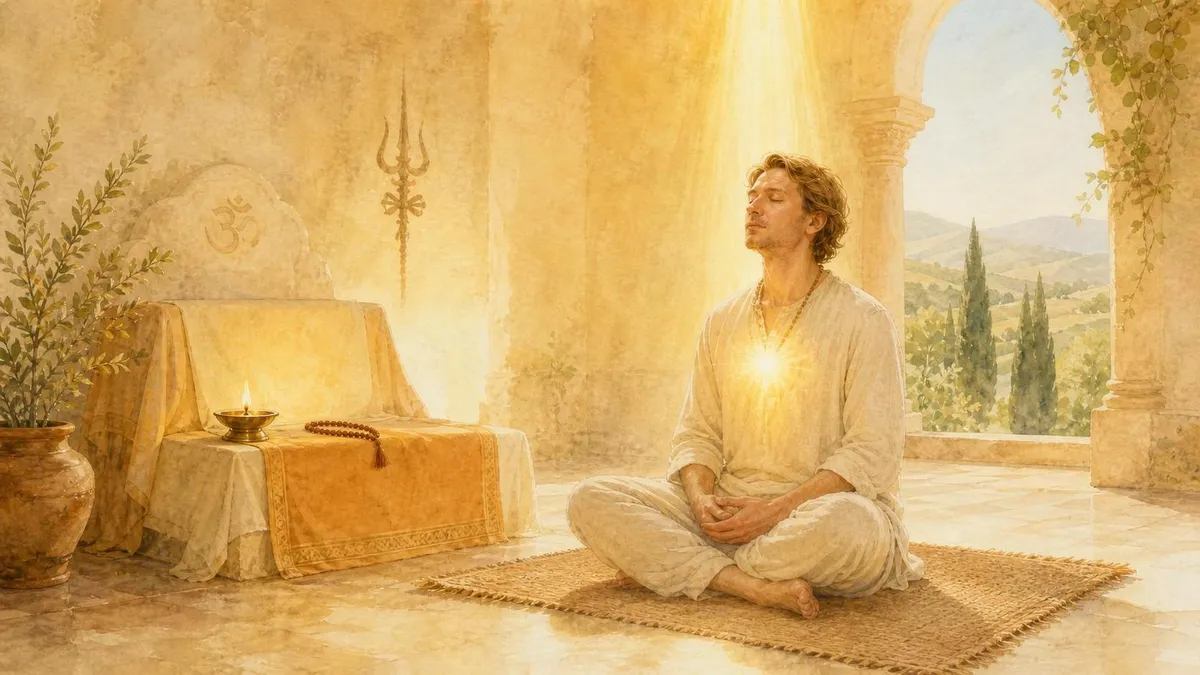
When you establish a connection with the guru and enter the teaching, it is very important from the very beginning to understand the principle of self-recognition. It is not that you, as a person, establish a relationship with the teacher like an apprentice with a master or a student with a professor. Of course, in a relative sense, it can develop that way as well. Rather, you recognize the Guru as a certain mystical energy that is subtler than you and awakens your consciousness, and you recognize yourself as part of this energy. You recognize yourself, the world, and the guru as a single playful enlightened energy, which at times conceals itself and at times manifests, now in one body, now in another, and manifests its lilas. Ultimately, everything ends in completely pure vision.
141-142: Fill Your Thoughts with Nandi
They behold only one thing — the Holy Feet of Nandi,
All they think of is the Holy Form of Nandi,
And they sing only the Holy Name of Nandi,
All their thoughts are the golden words of Nandi.Who is able to keep the holy Name of Nandi in the mind —
Yes, Nandi, the God of wisdom — becomes holy.
Now he has set out on his final journey.
Behind are the mourners, the drums in front.
This chapter is called “Fill Your Thoughts with Nandi.” What is being spoken of here? Tirumular says that a saint is one who beholds the holy feet of Nandi. What does it mean to “behold the holy feet of Nandi”? It is not about a particular saint or deity, nor about his feet, as it may seem from the point of view of a bhakti interpretation, when worship of a form is performed. In the language of sandhya-bhashya, “to behold the holy feet of Nandi” means, while coming into contact with material nature, to see through to its primordial empty essence.
In other words, when you see a lay brahmachari woman, you may think: “This is a lay brahmachari woman, her name is such-and-such, she is from Kharkov.” But if you see only this, then it can be said that from the point of view of Laya Yoga you see nothing. If you have enough clarity and look differently, then you do not make evaluations and judgments, but contemplate. Perhaps, in pure vision, you can see a deity, determine which family it belongs to, and what lilas it manifests. But if you are in an even deeper presence, then you do not think anything at all; you are at a subtle level of awareness that makes no evaluations whatsoever, and you see through to the emptiness of consciousness, the spirit that manifests through the body.
In the same way, if you look at a dog, then for you it is not a dog. In pure vision, it may appear as a wrathful dakini who has emitted a ray of her illusory body, and in an even deeper vision, it is the Absolute, which in this way manifests its lilas. Therefore, you can make prostrations even before a dog, seeing its subtle form.
Once, when we were in Crimea at a dacha near Kamenka, we were doing a short retreat. I told one laywoman to make prostrations before a goat, a sheep, or a bull, since her mind was too dualistic.
Thus, if you contemplate correctly, you see the form of the Absolute manifesting through any manifestation. This is the state of a saint.

Further, Tirumular says: “All they think of is the holy form of Nandi.”
Whether you think about service, meditation, or anything else, this thinking must never distract you from the main practice. A true yogi can always self-liberate thoughts and not be distracted from true presence. In fact, thoughts are not important at all; blocking them is not important, but thinking itself is also not important. If you are in the depth of presence, then whatever you think about, you are thinking about the supreme Source. Moreover, this thinking is not intellectual; it is thinking beyond thoughts, contemplative thinking. I use it as the directedness of consciousness, as bhava, as expansiveness, or as clarity.
Continuous Contemplation in Everyday Life
In essence, a yogi, a monk, a good practitioner is one who continuously thinks of the Absolute, without being distracted for even a second. Whether he is working in the field, eating prasada, or communicating with friends — all this is unimportant, while his inner practice continues and is nurtured from second to second, from minute to minute. And it is very important to understand: “What am I thinking about?”
Until you have unfolded contemplation, it is important for you what you think about on the relative level; that is, it is important for you to direct your mind into a positive channel, only toward the Dharma. It is important to avoid, for example, worldly thoughts, worldly conversations, and always, in one way or another, lead thoughts toward the Dharma.
But when you have uncovered the secret of self-liberation and contemplation, thoughts lose a certain power and appeal for you. You understand that, on the surface level, thoughts can play as they please, but this changes nothing, because you are in another dimension, on another plane. You continuously abide at the level of bhava and inner doing, direct the mind toward the Supreme Source, while all thoughts are like a snake whose teeth have been pulled out, that is, they will cause you no harm and will not lead to distractions. Your consciousness is constantly directed toward the Absolute. Thus, everything a saint thinks about is always the Supreme Source in any form.

For example, someone may ask: “How can one think of the Supreme Source when engaged in service or having a conversation?” That is, when he sits in meditation, he manages to direct the mind to aham-vritti, to emptiness, or to meditate on “Aham Brahmasmi,” but as soon as all this ends, the directedness also ends.
However, for a true practitioner everything looks completely different. He thinks: “How can one not think of Him? How can one not be in this? How can one agree to be distracted and lose this? How can one not see this when it is right here?” Forms, conversations, and thoughts do not obscure this, because thanks to the subtlety and art of his contemplation he has already learned to be constantly in this. He has already become so firmly established in this that external manifestations do not throw him off.
Thoughts as Nandi’s Golden Words
Further, Tirumular says:
“All their thoughts are Nandi’s golden words.”
Usually our negative thoughts are an expression of karma and kleshas, while positive thoughts are an expression of our spiritual search. It is believed that negative thoughts should be suppressed and cut off, while positive ones should be nurtured. Therefore, it is beneficial to sing bhajans, recite mantras and prayers, study sutras and texts, and in meditation it is beneficial to observe thoughts.
Nevertheless, in the natural state, when you discover it and become rooted in it, any of your thoughts are Nandi’s golden words, that is, golden words, the song of the Absolute, because they are no longer separate from the space of primordial contemplation.
Peace, Movement, and True Presence
There is a practice in which we meditate in the meditation of peace (mahashanti), when we strive to stop thoughts. There is a practice in contemplation. What does practice in peace mean? If a thought is likened to a fish, then the fish jumps out of the water, that is, out of the primordial space of presence; if we have peace in meditation, then we notice this fish. Peace is usually described in this way: “If you are in peace, then even if a thought appears, like a fish jumping out of the water, you notice it.”
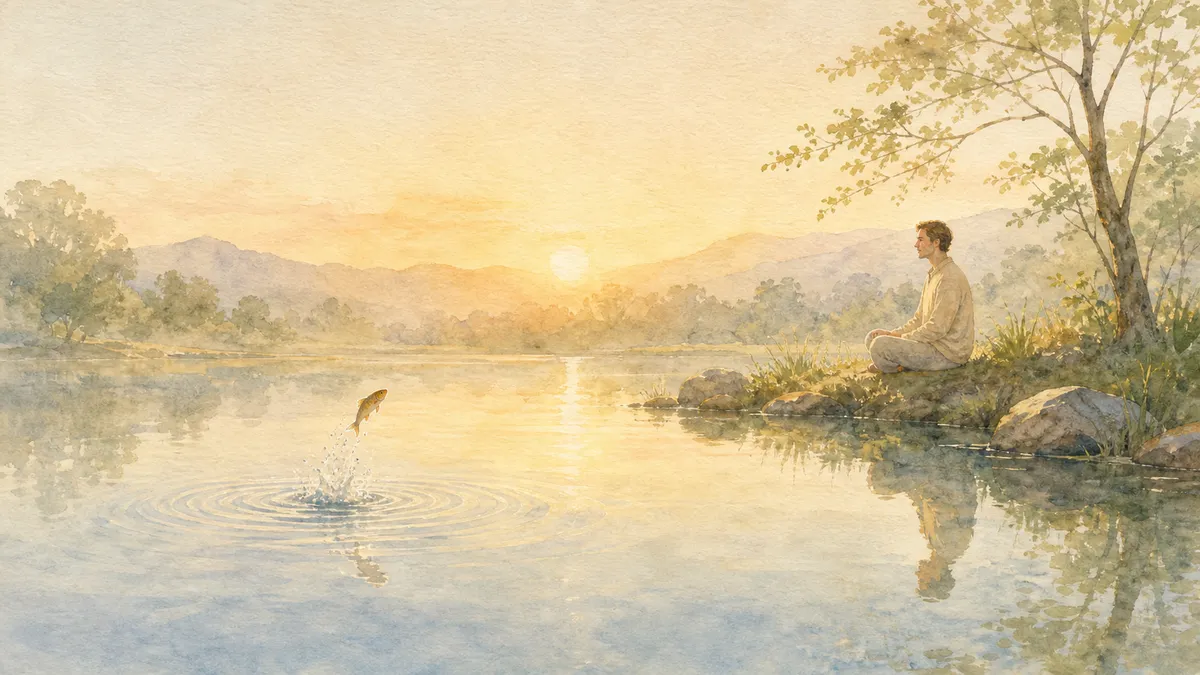
And what is the state of true contemplation? It is not simply peace, that is, the smooth surface of the water, and it is not simply that you notice the fish. Contemplation means being present in the fish, when presence and thought are inseparable. If you deeply understand this principle, then you clarify something very important for yourself.
True presence comes only when we unite several states simultaneously. Which states?
- Emptiness, that is, pure, undifferentiated, nondual awareness at the moment of samadhi
- A state of peace in which there is nevertheless movement, that is, when peace in meditation is present, but movement is also present, and this movement is recognized while peace is maintained
- Finally, only the state of movement, when there is only movement, with which we unite
True presence unites the first, the second, and the third. When such a union occurs, it is called samarasa, a single “taste.”
Therefore it is said that if you want to check whether this is presence or merely a meditative experience, make this analysis: is there any difference for your presence or not? If it is presence, it will be something like this: you meditate in retreat, you are in presence in contemplation while standing, while walking, in movement; you perform service quite actively, and there is no difference at all. That is, nothing changes; only the form of manifestation changes. There is only a certain layer of intuitive supramental awareness that is the background of all these manifestations, but in fact nothing changes for you.
If, however, during retreat you have flashes, light, ecstasy, deities, and while walking in contemplation there is some clarity, but during service, movement, speech, and eating all of this disappears completely, is lost, and other bhavas arise, then your previous experiences do not relate to presence, but to an experience. But if you clearly understand the single thread that permeates all these experiences, this is definitely the correct state of presence. Although before it is experienced, a sufficient amount of time must pass.
Chanting the holy name as a way of life
Next, Tirumular says:
“And they chant only the holy name of Nandi.”
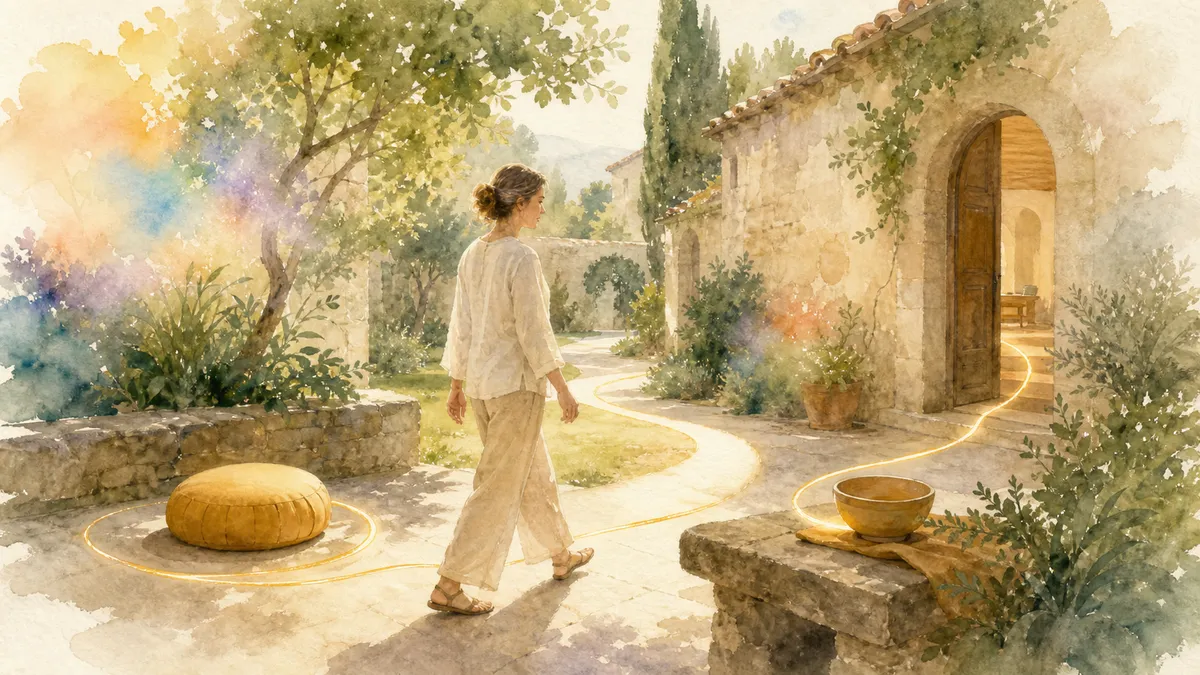
What does it mean to “chant the holy name of Nandi”? It means to manifest this deep ocean of awareness in one’s body, speech, and mind, to make everything an offering to it. Since we are human beings, besides awareness we also have a body. We are not gods in a formless world who can be like space. We have the dimension of prana, and as long as it exists, we move and do something.
How do the manifestations of a yogi-master differ from those of an ordinary person? An ordinary person manifests with the body karmically. But a yogi who is inseparable from the Source is, one might say, the chanting of the holy name of Nandi. For us, chanting the holy name of Nandi is, of course, not the kind of chanting that is proposed in “Krishna Consciousness.” We may not even chant anything at all; nevertheless, all our actions, our prana, are one great ritual offering.
Whether you are hammering nails, digging in the garden, preparing prasad, or simply taking a walk — all these are manifestations inseparable from the body, and the body is immersed in unified contemplation. That is, any action is integrated into movement, into contemplation. Every action, every sound, and every thought is an offering, and there is nothing outside of this. There exists an unbroken unity.
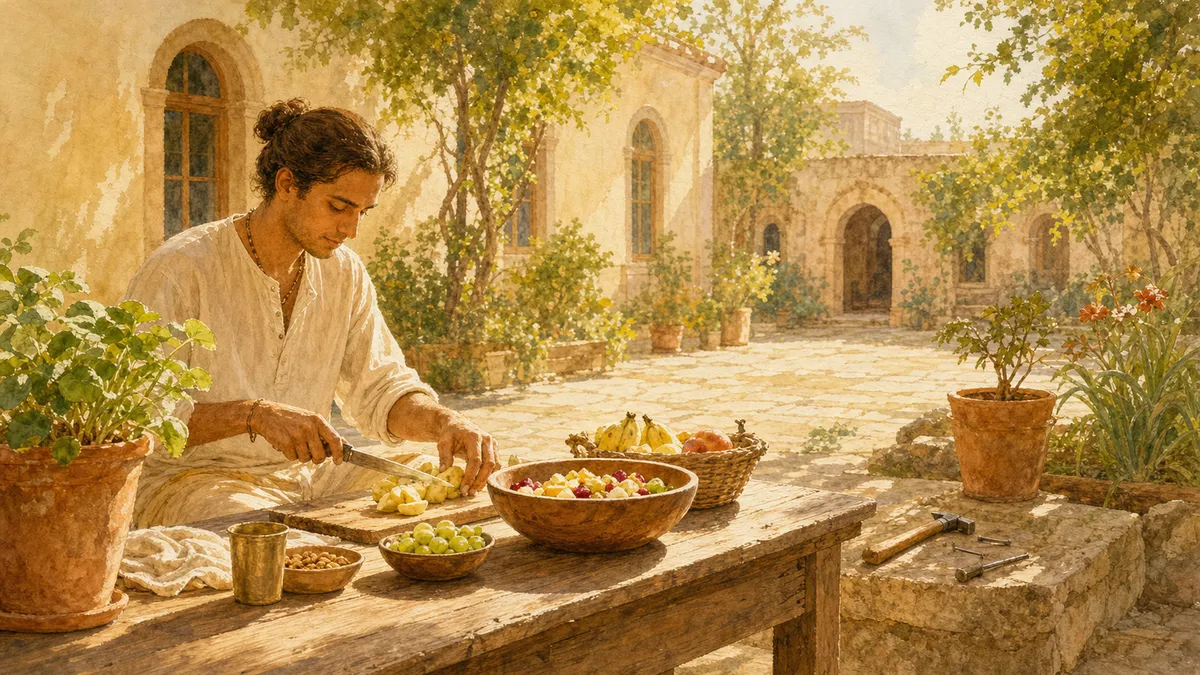
A true yogi has nothing personal, because his personality is directed toward unity with the Supreme. He no longer knows whether he is doing it, or whether the Supreme is doing it through him. It is so fused together that it can no longer be torn apart or separated. And then he feels that the universal shakti is simply playing in his body, his mind is immersed in the Supreme Source, and he himself is an illusory body. That is, he himself is the creator god, he himself is the Absolute, and this body is one of his manifestations, which manifests lilas in the mandala.
Of course, I cannot convey exactly in words what Tirumular meant behind each sentence; nevertheless, uniting in Guru Yoga through my own samadhi, having my own clarity, the instructions of the sutras, tantras, and the guru’s teaching, I can truly say that this is exactly how it was. And you become convinced of this yourself if you are a genuine practitioner. Every day you discover the dimension of the teaching through your own life and understanding.
