Commentary on the text “Chaturashiti-siddha-pravritti”
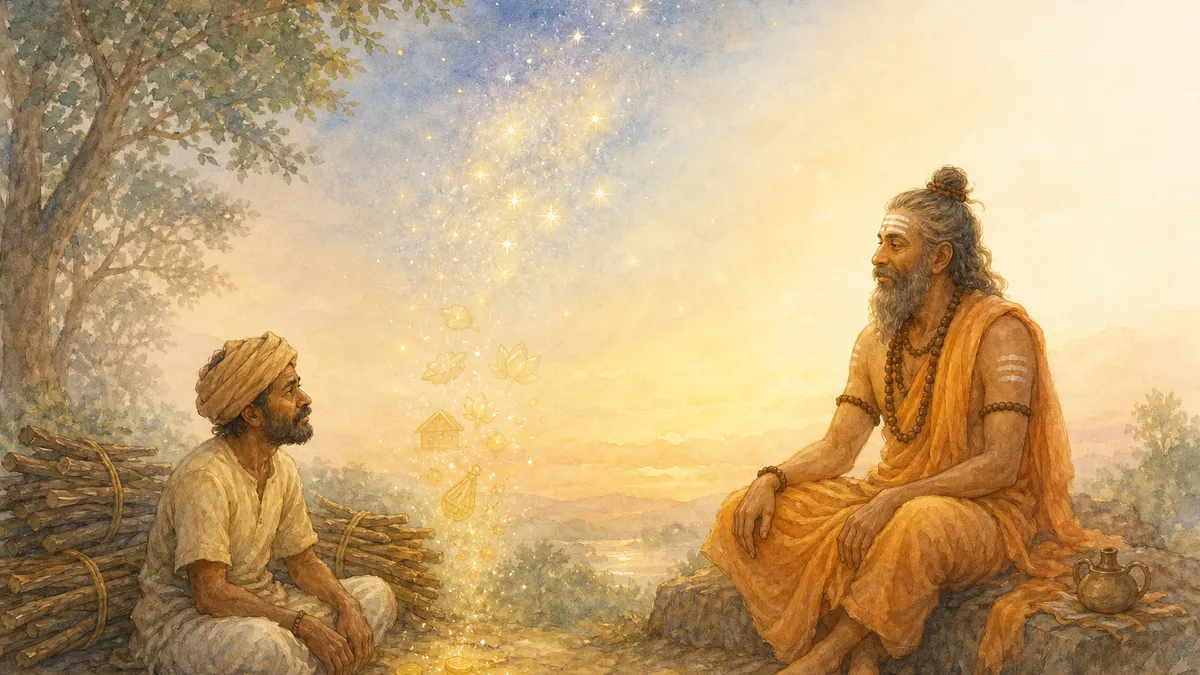
In Dhanarupa there lived a seller of firewood—Achinta, which means “one who has left thoughts behind.” He was poor. Day and night he thought about how to become rich. Nothing except fortune and money interested him. But all this was only dreams, and, not knowing what to do next, he went to a quiet place to reflect. The yogin Kambala, passing by, asked him:
“You are sitting silently alone in this wilderness. What are you thinking about?”
“I am in despair, yogin; my heart longs for fortune and money. I cannot think of anything else.”
“If I teach you how to find all this, will you practice?”
“Yes, if I learn how.”
And Achinta asked for instructions. The yogin initiated him into the sadhana and gave instructions on the profound completion stage, saying these words:
“Desire alone will not bring wealth. Do not dream in vain; it is like wishing for a child from a barren woman. You have been given a body like the sky; imagine that your mind shines like a scattering of stars, and you will become like the god of abundance. This will become more and more real, and what you wanted will appear.”
Achinta, meditating, mixed his thoughts of wealth with the stars and dissolved them into the empty nature of the sky. Thus he became free from all concepts.
Then the teacher came again and said:
“You say that there are no thoughts, and you are indeed becoming free of them. But if your nature is like the sky, from where will you look at it? And how, being beyond color and form, will you find things to desire?”
Having understood what was said, Achinta attained the siddhi of the natural state. He became a renowned teacher and gave instructions on the true nature of things, working for the benefit of living beings for three hundred years. Surrounded by countless disciples, he departed in his body into the Clear Light.
The Direct Method
The siddhas often communicated with ordinary people who, by virtue of karma, were somehow connected with them. The direct method of the mahasiddhas is to bypass philosophy and concepts, to give an introduction to reality as it is and instructions in sadhana; therefore there is the expression “the shunyata of the mahasiddhas.” The shunyata of the mahasiddhas means that, bypassing the verbal designation of reality and the philosophy of the teaching, we try to enter immediately into the state of seeing the emptiness of all things. From the point of view of the teachings of Vedanta and Tantra, a yogin’s knowledge is assessed according to how well he knows the texts, the teachings on tantric rituals, or how much he has succeeded in the various subtleties of yoga. From the point of view of the shunyata of the mahasiddhas, the level of a yogin is assessed according to how aware he is. In other words, he may not know much from the shastras, scriptures, or religious practices, but everything is determined by the degree of his awareness and his ability to maintain it.
The Qualities of a Practitioner
The yogin Kambala gives the instruction: “Desire alone will not bring wealth.”
Before we fully devote ourselves to sadhana, we must experience a very deep disillusionment with all illusions. I am not speaking about the worldly; this concerns all illusions in general. And the worldly is only a part of illusions. We must experience weariness with our own desires, with our restless mind, with our unfulfilled hopes, which bring nothing but emptiness and new bondage. We must experience a very deep disillusionment. It is believed that if a person becomes a monk, then this stage has already been passed for him. This is what worldly people think. However, in reality this is not so. On the superficial level it is so, but deep inside such disillusionment does not yet exist; there is always ignorance. A deep disillusionment with the mind’s tendency to enjoy external pleasures, to find joy in intoxicating itself with illusion, to be unconscious, must come as an inner understanding. It comes completely at the moment when we discover the natural state and make the decision never to leave it.
“Do not dream in vain” – this speaks of cutting off conceptual thinking, which prevents us from seeing reality as it is. Instead of abiding in the state of true suchness, our mind moves. There is nothing bad in movement itself – such is its nature. There is a still mind and a moving mind. However, when it moves, these fluctuations enchant us; we leave the state of the mirror and become enchanted by reflections, by movements of energy. Mind and objects are merely movements of energy, but we take them at face value. Then we do not recognize the primordial all-pervading awareness, the luminous clarity that lies behind all objects, and simply cling to the external object, and we become stuck in a dualistic state of perception.
When our mind is stuck in a dualistic state of perception, various dreams arise in us, but all these dreams are empty, void; that is, from the very beginning they have no essence, just like dreams in sleep. If we have not yet freed ourselves from these dreams and seriously believe that there is something real, then we have missed the view, missed our profound philosophy. We have missed something most essential if we blindly trust our dreams, since all this is our own mind projecting various fluctuations outward. When we build different reveries, we lose our self-born Wisdom by identifying with projections. To self-liberate means to cut off all illusions immediately at the moment of their arising. A true practitioner does not allow illusion to take root. He understands that the mind is always moving because such is its nature, and therefore it is useless to control or restrain it by an effort of will. We cannot be in a state of non-thinking or non-perception. Nevertheless, a true practitioner always knows that one must not be affected by thinking and perception; he cuts off such susceptibility while abiding in moment-to-moment contemplation. Whenever our mind has become absorbed in something in illusion, having lost awareness, we should remember and draw it back – such is the method of self-liberation.
The Body of Wisdom and Luminous Clarity
“A body like the sky.” Here the reference is not to the physical body, but to the essential body or body of wisdom – jnana-deha. Having come here, we naturally think that we possess a physical body and nothing more. However, our body of wisdom has not come anywhere and will not go anywhere after the lecture; it is like the sky. And although we do not recognize it as long as there is no samadhi, it is always with us, just as the heart always beats deep within our chest, regardless of whether we know it or not. The body of wisdom (jnana-deha), like the space of the sky, always exists regardless of our abilities.
Then the yogin Kambala gives this instruction: “Imagine that your mind shines like a scattering of stars.”
The five-part formula is as follows: first, reduce everything to the “I,” to the mind. Then, by investigating the mind, discover its emptiness. Then, by investigating emptiness, discover the luminous clarity of this emptiness. This body, like the sky, like space, that is, our primordial self-born Wisdom, possesses the nature of light or radiance.
The essence of Laya Yoga lies in maintaining a state similar to space. However, it is very difficult for us to immediately perceive what it means to become established in a state similar to space. Therefore, when we practice the “Four Infinite States of Brahma,” we first generate divine pride and then expand this state to metagalactic dimensions, until everything dissolves into such a space-like state.
When we discover this luminous clarity of the space of our mind, we become like a god of abundance. This means that the wondrous nature of the “I” begins to manifest by itself, and we discover that everything proceeds from this wondrous nature of the “I.”
The Body as a Microcosm
The “Shiva Samhita” says: “In this body there is Mount Meru, gods and deities with their palaces, there are four continents, the sun and the moon. And all of them are occupied with their own affairs, each according to their karmas.”
This should be understood deeply. The body is a microcosm. In every point of the body there are energies, subtle channels. In pure vision, these subtle channels are countless worlds with deities and beings inhabiting them. When the power of our awareness becomes deep, all these energies begin to unfold, and we see that the body itself is a manifestation of the energy of this space. This energy possesses a countless wealth of manifestations, an innumerable number of forms, of manifestations.
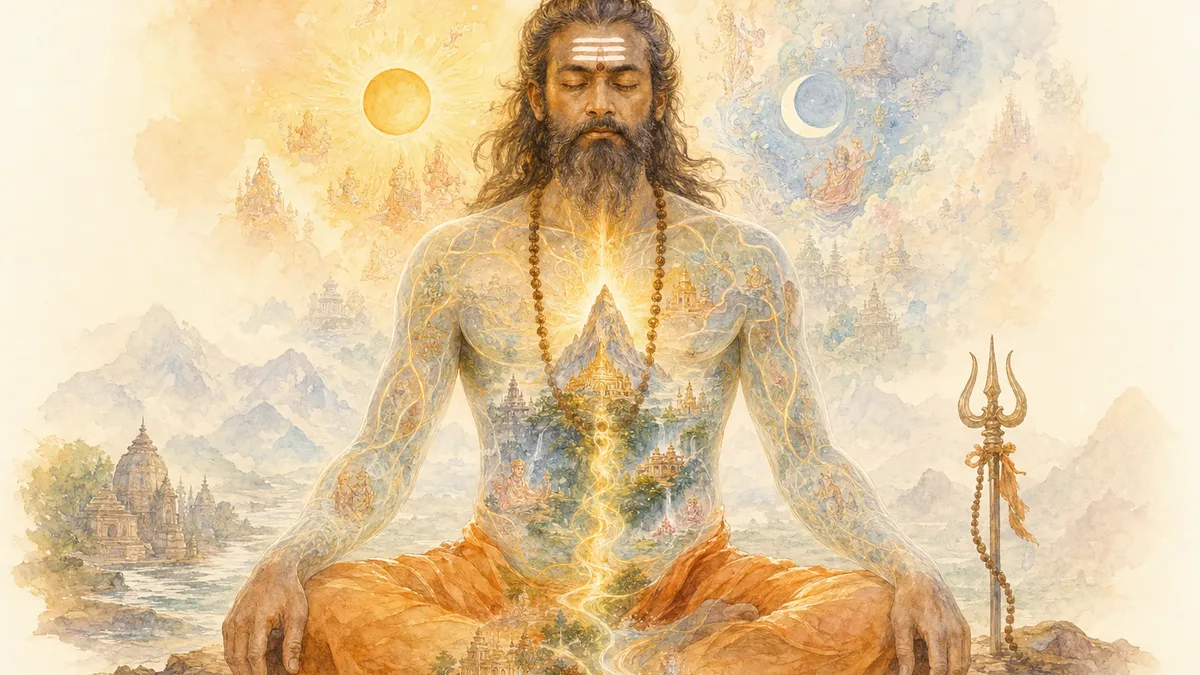
In the tantric practices of kriya and charya tantra there is a sadhana called “nyasa,” in which the yogin touches different parts of the body while reciting a mantra, and in each part he visualizes a particular deity. In this way, the body is, as it were, sealed or illuminated. The deity symbolizes pure vision, a state of energy brought to the level of pure contemplation. When our energy is purified and contemplation blossoms, we truly begin to feel such deities in the body and mind.
In laya yoga, apart from certain initiations, we do not use techniques like nyasa. Visualization and mantras are not the style of the nondual teachings of tantra. Rather, this is the style of the lower tantras. However, when our energy and contemplation blossom, these deities spontaneously manifest themselves from our body and mind. In fact, everything that emanates from the yogin’s body becomes deities. For example, the yogin hears nada sounds, which turn into wondrous melodies. In the channels he continuously hears these melodies arising in the right ear, in the crown of the head, in the spine, in the throat. Through visual perception during meditation, he constantly perceives various divine forms. Through the sense of smell, he perceives subtle fragrances when the earth element is purified. When contemplation gains strength and the energy is purified, everything begins to blossom in the body and mind of the yogin; the world seems to be transformed and becomes another, pure dimension.
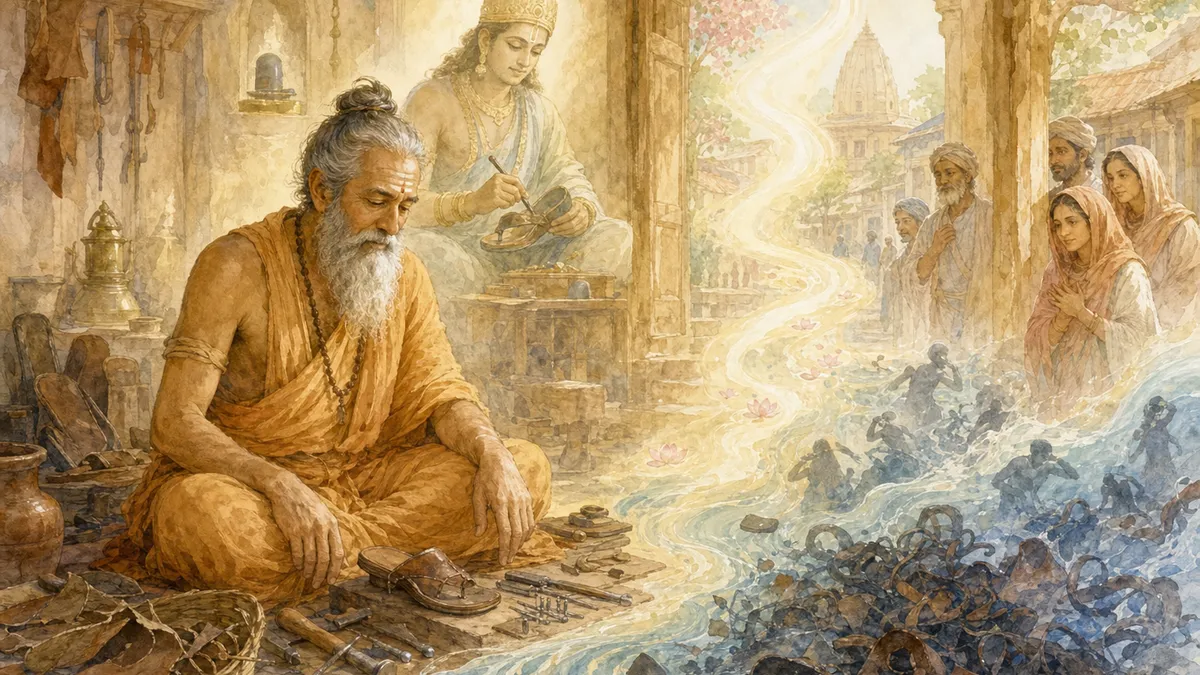
In the city of Vishnunagara, where there were eighteen castes, Chamaripa belonged to the caste of shoemakers. He repaired old shoes and made new ones, and this took up all his time. One day a yogin happened to be nearby on the street. Chamaripa immediately abandoned his work and prostrated before him.
“I cannot live in samsara and want to practice the dharma. But I have had no teacher; I have not yet entered the gates of the teaching. I implore you to teach me the dharma for the benefit of this life and the next.”
“If you can practice, I will teach you.”
The cobbler asked whether the Teacher would agree to take food in the house of a poor man of low caste.
“I will return by evening, and we shall do so,” the yogin replied.
Chamaripa told his wife and household about the guest. When the yogin returned, Chamaripa prepared a proper place for him, washed his feet, and offered him refreshments. His wife and daughter attended to him and anointed him with oil. Having finished the meal, the yogin gave initiation to Chamaripa and his wife and pronounced the following instructions:
“Let speculative distortions and biased opinions be like scraps of leather, stitched with the awl of the Guru’s instructions upon the last of friendliness and compassion. Stitched with the threads of non-attachment to affairs and objects, a shoe will appear—the wondrous shoe of the dharma body, delightful and incomprehensible to those who have not departed from false views. Guiding the thread of not-grasping at things, abandon thoughts of the pleasant and the unpleasant. Turn all judgments and opinions into your material (into leather). Meditate, stitching your experience with the teacher’s instructions, transforming it into a wondrous product of the dharma body.”
“What will I feel when doing this?” asked the cobbler.
“At first, revulsion toward samsara will increase,” replied the yogin. “Then all the elements of experience will reveal the nature of dharma.”
Having said this, he left.
The cobbler left his old home and meditated in a secluded place. All the signs occurred just as the teacher had predicted. Through the analogy with his craft, Chamaripa mastered the truths about the six root distortions and the ignorance underlying them. Continuing to work with the Guru’s instructions, he came to pure understanding. In twelve years of practice, he managed to drain an entire ocean of errors and delusions. When Chamaripa cleared away the heaps of ignorance, he attained siddhi. All this time he meditated, not distinguishing work from practice and not noticing whether it was day or night. Vishvakarman took care of the rest, so that in Vishnunagara no one knew what the cobbler was doing. But one day, at an unusual hour, someone entered the workshop and saw Chamaripa in meditation and Vishvakarman repairing shoes. One after another, the townspeople came to look at Chamaripa, until they had all gathered together and asked for teachings. First of all, Chamaripa explained how one should rely on the Teacher. He gave many teachings to living beings in Vishnunagara and became a renowned yogin. Having done much for the benefit of living beings, he departed in his body into the Clear Light.