Qualities of a Student and Three Views of Reality in Advaita
11.08.2026
0 мин. чтения
0
Share
copy
search
add
share
Commentary on the text “The Liberating Nectar of Precious Instructions”
When you listen to the teaching, it should be perceived precisely on an intuitive level rather than a conceptual one, because if you perceive it on a conceptual level, the spirit of the teaching will most likely pass you by. But when you abide in presence, in vigilant awareness, and grasp not only the words but also what lies behind them, an inner clarity is revealed within you that flawlessly shows the essence and spirit of the teaching. Therefore, the only correct way to perceive the teaching is to try to listen while abiding in intuitive awareness, in contemplative presence.
The text “The Radiance of the Precious Mysteries of Laya Yoga” (“Laya Amrita Upadesha Chintamani”).
The yogi said: “People with narrow views cling to thoughts, believing them to be the Truth. When they hear Teachings that transcend the mind, they tremble like leaves in the rainy season.
The Qualities of a Disciple and the Depth of Perception of the Teaching
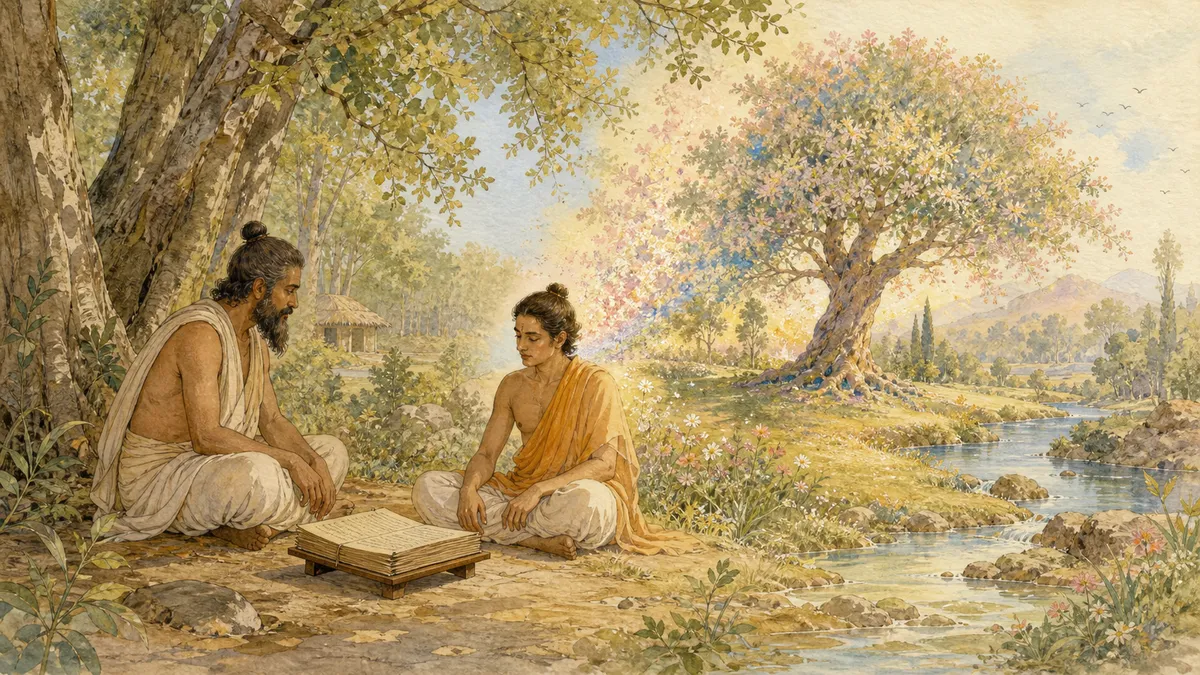
When we decide to uncover primordial awareness, we must first understand the qualities of a disciple who is ready to study the teaching. Anuttara Tantra says that liberation can be attained in a single lifetime; that is, in one lifetime it is possible to realize complete awakening, up to and including the accomplishment of the “great transition” (kaya-vyuha), the rainbow body of light. However, it would be naive to assume that this is something simple.
The teaching requires of us depth of perception, an intelligence surpassing the human level, and intuitive clarity that allows us to operate with such categories as self-liberation, play, paradox, eternity, infinity, and abiding beyond concepts. If we are at the level where we cling to thoughts, then we are limited, we hold narrow views, and we cannot operate with such categories, because the categories of eternity, infinity, play, paradox, and self-liberation, which are necessary for attaining immortality and awakening, can only be engaged with at the level of non-conceptual awareness.
To be able to operate with such categories, we need to study; that is, we must undergo proper training, since without training this is impossible.
The Principle of Training and Refuge
What does the principle of training mean?
It means that we enter a profound and authoritative lineage of transmission originating from the holy mahasiddhas. For example, our lineage includes the holy avadhuta Dattatreya, the siddhas Matsyendranatha and Gorakshanatha, and many other saints who demonstrated through their own experience the possibility of attaining full realization. We must also establish contact with a teacher who is a holder or representative of the lineage. Naturally, we must rely on certain sacred texts of the tradition. And when we have such a connection with the teaching, it is said that we acquire Refuge. Refuge means that we determine what to direct our consciousness toward, where to find Refuge, and through what we are to grow.
Our attitude toward the teaching must be very profound and serious, because the teaching touches upon very deep aspects of our “Self,” on which our life or death and our future destiny depend. The only appropriate way to relate to the teaching is to establish a worthy relationship with it. Such a worthy relationship is called a sacred connection, or the principle of samaya. If we establish a sacred connection and have the principle of samaya with the teaching and the teacher, then we can derive genuine benefit from the teaching. If we do not have such a sacred connection, our practice will be fruitless. In other words, we may spend a great deal of time without ever obtaining the expected results.
Seven Qualities of a Disciple
What are the qualities of a disciple who is suited to spiritual practice?
For example, somewhere in worldly life you may hear an announcement approximately as follows: “A research institute is seeking a specialist for the position of head of department. Requirements: higher education, an academic degree, length of service, professional experience, certain qualities, proficiency in certain skills, and so forth.” In the same way, when you enter the teaching, it is said that certain requirements are imposed upon the disciple. And if the disciple wishes to advance through the teaching but lacks the necessary qualities, then they must strive to develop them within themselves.
The First Quality Is Viveka (Discernment)
The first essential quality is viveka (discernment, discriminating wisdom). In other words, you must possess enough wisdom to understand what is valuable in this world and what is not. For example, for a yogi following the path of liberation, spiritual practice, striving for liberation, accumulating merit, his connection with a spiritual teacher, and the mystical experience bestowed by samadhi are valuable. That is, he values what liberates him from the cycle of birth and death. Power, money, relationships, attachments, and career—everything we call worldly—are of no value to him.
In other words, what leads to liberation is valuable to us, while the plans of this life are not important to us at all, although we do not reject them, since we live in this world. And if you possess such discernment, you clearly distinguish between samsara and nirvana. But if you have not acquired viveka (discriminating wisdom) from the outset, then even if you receive transmissions and numerous teachings, you have not laid the foundation, and therefore your practice will not go well from the very beginning. In other words, on a deep level, we must decide: “What do I want from the spiritual life?” For example, we may decide: “I want to follow the path of liberation of the holy siddhas, to become a saint who has attained enlightenment.”
To test whether this quality (viveka) was present, the saints of antiquity subjected their disciples to trials for many years. For example, Tilopa tested Naropa for twelve years. Many teachers of antiquity even refused to discuss the teaching with disciples who had not acquired discernment, giving them an opportunity to develop such a vision on their own.
The Second Quality—Mumuksha (Striving for Liberation)
The second essential quality is mumuksha (striving for liberation). For the teaching to benefit us, we must determine the meaning of life and decide where we are directing the vector of our consciousness. We must clearly decide for ourselves whether we aspire to fame, wealth, success in this world, finding a sexual partner, a good family life, or a leadership position, or whether we aspire solely to liberation, with everything else merely serving that goal. Mumuksha is the striving for liberation. When you have decided to follow the path of liberation, you are prepared to pay the full price for it; if necessary, you are ready to travel even to the ends of the earth to receive the teaching; if necessary, you are ready to engage in diligent practice for years—this is the striving for liberation.
The Third Quality—Vairagya (Dispassion)
The third quality is vairagya (dispassion). Dispassion means the ability to view with equanimity all events that occur in this world or happen directly to you; to remain detached, inwardly perceiving joy and sorrow, good and evil, happiness and unhappiness as changes akin to the alternation of day and night or the changing of the seasons.
The Fourth Quality—Faith
The fourth essential quality is faith. Faith means that you possess openness and trust in what you practice, and then the principle of samaya arises; that is, a sacred bond is established. One cannot enter the teaching without faith, trust, and openness. Even if you try to enter the teaching without faith, at best you will derive no benefit, and at worst you may even develop serious psychological problems or encounter obstacles.
Faith does not arise by itself; it is born from fellowship with holy people—this is called sadhu-sangha. Faith arises from a thorough study of the sacred texts of the tradition and an understanding of their depth. Faith arises from one’s own intensive practice, when personal mystical experience emerges, and therefore you become convinced that what the sacred books and teachers speak about in lectures is indeed genuinely possible.
About twenty years ago, I read various texts such as the Hatha Yoga Pradipika, the Shiva Samhita, the Gheranda Samhita, and the Shat-chakra-nirupana, and they seemed to me like ancient manuscripts of some kind. But when I began to apply what they spoke about—to work with the channels, winds, and pranas—personally experienced the awakening of kundalini on a physiological level, learned to separate the subtle body, stop my breathing, and discovered the realm of the subtle world, I realized that the texts truly worked. In other words, their transmissions can genuinely change one’s life and reveal an entirely new vision of the world. In this way, trust in them arises, because you understand that the saints and mahasiddhas discovered a very profound dimension of the universe.
The Fifth Quality — Diligence
The fifth important quality is diligence. It is not enough to have faith, discernment, dispassion, and the aspiration for liberation; it is important for all of this to begin working in practice—that is, it must be put into application, and this requires diligence. In other words, we should not merely have some declarative mindset such as, “I believe, I aspire to liberation.” That will not help. We must be diligent, meaning that we must be capable of putting everything that is taught into practice.
There is a concept known as “bee disease.” The “bee” is the first of the nine stages of tantric conduct. Avadhuta Dattatreya described the bee stage as the first step in spiritual growth. Just as a bee flies from flower to flower, gathering nectar everywhere, a spiritual seeker likewise moves among various organizations and teachers and reads books, gathering the nectar of different teachings—that is, saturating themselves with spiritual information. This stage is very important, but one must not stop there.
Having observed many lay disciples and those who attend lectures for years and even decades, I see that the bee stage has dragged on for them. In other words, the bee stage is beneficial for the first five years, but after that one must move on. And if seventeen years have passed and you still have not begun to practice but only continue to study, this cannot be called spiritual practice. In other words, it is like someone coming to a restaurant and spending several hours studying the menu, deciding which dish to eat. But the purpose of a restaurant visitor is not to study the menu for hours, but to eat and become satiated. In the same way, after studying various spiritual systems, we must decide which system we are going to practice and begin making real progress within it.
To demonstrate diligence means being capable of fulfilling all the requirements established by the system of training. For example, there is a twelve-year rule of training, a retreat system, and the principle of accumulating merit—all of this entails the need to perform various techniques, practices, and so forth. This is the principle of diligence.
Diligence means being persistent in training. If you have practiced sports, you understand what this means. Everything depends on you: if you are diligent in your training and prepared to train intensively in accordance with the prescriptions of the tradition and the instructions of the master, you will undoubtedly make progress.
The Sixth Quality — Attentiveness
The sixth quality is attentiveness. This is a fundamental principle necessary for us in practice. Attentiveness is the capacity for contemplation and for maintaining awareness. Such an ability does not arise overnight; we must earn it. For example, today there will be a transmission of the walking technique with the sankalpas “Dream” and “Atma-vichara.” One could say that this is a key that makes it possible to develop such attentiveness, but this key must be put to use. That is, you should devote at least a few days of your life to the technique of walking in contemplation, so that you can maintain the sense of “I” and the sankalpa “Dream” from morning until evening without being distracted by anything, and return to contemplation whenever distraction arises. You will see that within a single day, through the practice of attentiveness, you have opened up a new realm of awareness. You will have something to compare it with. And then you will bring this attentiveness into your life even when you are not practicing in retreat mode but living your everyday life.
The Seventh Quality — The Ability to Cooperate with a Spiritual Teacher
The seventh quality is the ability to cooperate with a spiritual teacher. For the teaching to truly benefit us, we must have a connection with a spiritual teacher and continually maintain it. It is not enough simply to study the teaching from books or, having received certain techniques, to work with them. There is something in the teaching that can be neither heard nor seen. And this something can be transmitted on a nonverbal level through such a connection. It is similar to how a person who plays the violin can absorb certain subtleties of playing only by coming into contact with a master, communicating with them directly, and observing their art in its subtle, invisible aspects.
If you have no connection with a master, it is unlikely that you would ever think of going into a dark retreat for six months. You may practice yoga and read books, but it would never even occur to you to spend six months in darkness. But if you have contact with a master and the teaching itself, then after a few years, if your level of practice has developed sufficiently, the teacher will say to you: “You know, it is time for you to take up such-and-such a practice. Pay attention to this.” This will open up an entirely new field of vision that you could not even have imagined. And there are a great many such fields within the teaching. Or the Master may say: “You know, your contemplation is good. Go to that mountain; there is a powerful place there. You will meet a dakini there, and if you endure, you will receive from her the transmission of the teaching.” It would never even occur to us that there is some mountain where a dakini dwells, from whom one can receive the teaching of the single “taste.” This is the subtle connection with the master that arises from relationship and cooperation. If it is absent, we are simply unable to enter this dimension.
The Path of Laya and Nonconceptual Perception
To cut through the conceptual view, study all available teachings, then cast them off like an old skin and follow equanimity beyond limitations and schools in order to enter the path of laya.
When speaking of the qualities of a disciple, it is also important that they be able to accept two opposing points of view simultaneously. If we abide at the intuitive level of awareness, this is possible. One should study as many sacred texts and different books as possible, and then move to a nonconceptual level beyond words, where “A” can equal “B” while still remaining “A.” That is, one should reach the level of paradox, where one can hold two or three opposing points of view simultaneously without experiencing confusion. And when we abide in intuitive consciousness, this is indeed possible; but in ordinary conceptual consciousness conditioned by manas (the conceptual mind), it is, of course, impossible.
When you have acquired the ability to hold one or two opposing points of view without becoming attached to either of them, this is a sure sign that you have begun to open up the space of contemplation and nonconceptual awareness. It means that you are no longer bound by words or by a literal, doctrinal understanding of the teaching.
The Advaita View
When we embark on the path of the teaching, we necessarily adopt a certain kind of view or worldview. In the Laya Yoga tradition, this is called drishti. This term is also translated as “view,” meaning a particular vision of the world, oneself, and the universe. We usually say that we adopt the Advaita view.
The Advaita view is paradoxical. Even when we study it at the conceptual level, this does not mean that we have understood it. The Advaita view says that everything is Brahman, everything is transcendent reality. For example, from the standpoint of the Advaita view, I did not come to the lecture, nor did you; this is not a lecture, but the play of Brahman. And from this standpoint, I am no different from you. In a certain sense, I am you, and you are me. There is no separation whatsoever; that is, we are one single, whole entity that amuses itself and plays. Its games (lilas) are endless. A seminar, instruction, teacher and disciple—all of this is play (lila). There are other kinds of games as well: among worldly people, in the world of the gods, and so on. But all of them are the games or amusements of one single transcendent entity.
In the course of these games, the Boundless, the Absolute, constricts itself in order to begin such a lila. For example, the Absolute in your body has constricted its consciousness and taken away the memory of itself as the Absolute, leaving only partial recollections. Why did it do this? So that your mind and body could acquire their own free will, through which you would realize yourself as the Absolute, and then the Absolute itself in your body would attain a new dimension of awareness.
From the perspective of Advaita, everything is one. External differences and the entire external world are an illusion. There is an expression, “Brahman sat jagat mithya,” which translates as, “The Absolute is real, while everything we see is unreal—an illusion, a dream.”
There is an expression, “Sarvam Eva Brahman,” which means that everything we see, everything that manifests, is the Supreme Source.
The third expression, “Aham Brahmasmi,” means, “I am God, I am the Supreme.”
When we contemplate these statements, they give us a completely different vision of the world. In the absolute sense, there is neither me nor you; there is only the Absolute playing different roles. In some bodies, He remembers Himself completely, while in others He plays as though He has forgotten Himself. And when He plays games in which He seems to have forgotten Himself, this is called the impure dimension—samsara.
The Nature of Forgetfulness and Awakening
Thus, we are all gods, or the one Supreme Source, God, who has forgotten Himself. In other words, when we abide in the impure dimension of samsara, we are gods who have forgotten themselves; we are captives of the mind’s dreams. We have fallen captive to our own mind, having forgotten our absolute nature, and now we are trying to remember this absolute nature in order to free ourselves from the captivity of the mind’s fantasies and dreams.
From the perspective of Advaita, we are neither father nor mother, neither man nor woman, neither human nor anyone else. We are the Supreme, who deliberately led Himself into delusion, who deliberately created the mind’s fantasies and dreams in order to play. He deliberately allowed free will to go astray, observing how this game would unfold and how He could disentangle Himself from it.
But this, of course, does not make things any easier for our relative “I.” We may think, “The Absolute is playing, but we ourselves are the ones who have actually gone astray.” After all, we do not feel like the Absolute, but like a limited personality, a being with two arms and two legs, subject to limitations. We do not feel like gods, nor like one who plays with space and time, nor like one who is immortal. Of course, we feel human. This is precisely the paradox. The Absolute wanted to experience Himself as a human being, so He allowed Himself to become completely lost. He gave His parts free will so that these parts could consciously disentangle themselves. And now, using only our own free will, based on the ego, the mind, and our experience, we must disentangle ourselves from this illusion, from the captivity of the mind’s dreams, and become the Absolute once again.
This seminar is precisely such a game of the Absolute, making use of your own free will.
The Three Foundations of the Teaching
So, we continue discussing the vision of Advaita.
The teaching has three fundamental categories: vision (jnana, drishti), meditation (dhyana), and conduct (kriya). Vision determines our worldview, that is, how we view the world as a whole (we have just discussed this). Meditation means what we practice in everyday life, the state of consciousness we adopt. Finally, conduct is how we put the Teaching into practice, how we bring awareness into everyday life.
The Three Schools of Vision
There are three main schools that define vision in the tradition of Indian schools. They are called srishti-drishti-vada, drishti-srishti-vada, and ajata-vada. (It is not necessary to memorize the Sanskrit terms; what matters is grasping their essence.)
Srishti-Drishti-Vada: Gradual Creation
The first view (or the first vision) states that the universe was created gradually; that is, from absolute emptiness, through a subtle creative tattva, the three gunas began to unfold, and the element of space appeared. Through tamas (inertia), rajas (movement), and sattva (radiance), a vibration arose in the primordial vacuum. This vacuum began to become aware of itself, reflected itself in itself, and gave rise to the primary limitation—the element of space. Subtle vibrations and vortices began within the element of space, and movement commenced. Thus arose the element of air—wind. Wind can be described as subtle prana, energy.
When the wind began to move, the friction of subtle subatomic particles caused heat reactions, which separated into a denser, independent region, and thus the element of fire emerged. When the element of fire began to condense and become denser, its more inert parts separated out; they could no longer be as dynamic but became fluid—one might say that this was liquid plasma. Thus the element of water emerged from subatomic particles that were no longer capable of intense transitions and subtransformations. Finally, when the element of water condensed and solidified, the element of earth emerged, possessing the qualities of inertia and incapable of intense transformations. This is how the five primordial elements came into being.
The five primordial elements, combining in their various aspects (sattva, rajas, and tamas), began to form different combinations. The sattvic part of the five primordial elements formed the mind, our sense of “I,” memory, and subtle intuitive consciousness. The most radiant, luminous part of the primordial elements formed chitta, manas, buddhi, and ahamkara—that is, the subtle components of our psyche. The rajasic part of the five primordial elements combined to form the five primary and five subsidiary vital forces. Prana, apana, samana, udana, and vyana are the primary pranas with which we work in Kundalini Yoga. There are also subsidiary ones: naga, kurma, krikara, devadatta, and dhananjaya (these are also studied in Kundalini Yoga). Finally, the tamasic part of the five primordial elements formed our physical body: the earth element formed flesh; the water element, blood; the wind element, prana; the fire element, digestive fire; and the space element, the cavities within the body, as well as the five karma-indriyas and the five jnana-indriyas—that is, the five sense organs and the five organs of action. This is how the creation of the universe is described from the standpoint of srishti-drishti-vada, which holds that the universe developed gradually and according to natural laws, and that it lives and functions cyclically.
The Big Bang theories found in quantum physics take roughly the same position. Moreover, all the latest achievements of quantum physics are not really discoveries in the strict sense, but rather restatements of ancient Tantric and Vedic theories.
When I read about Hugh Everett’s discoveries and the paradoxical theories of physicists, I simply see that what is regarded as the latest discoveries in quantum physics was already stated long ago in the Vedas, Upanishads, and Tantras. The rishis of antiquity knew far more than today’s scientists; they could fold time and space.
Drishti-srishti-vada: instantaneous creation by consciousness
Another type of vision is called drishti-srishti-vada. This is a completely paradoxical theory which states that the world, space, and time exist differently. From the standpoint of drishti-srishti-vada, there is no gradual creation of the universe through the Big Bang, nor is there any specific beginning or end of the universe. The universe is created every second, every instant, by each act of our consciousness.
In other words, the universe exists for as long as our consciousness exists. For example, why does this hall exist? It does not exist in and of itself, but only because we possess karmic vision. One might say that this hall exists within our vision. When we disperse and no one remains here, there will be no hall. This seems paradoxical, but it truly will not exist. You may say, “No, why not? It will still be here. If an outsider comes here and looks, they will see that this hall has not disappeared anywhere; it will still be in its place.” I will say, “For the existence of this hall to be confirmed, someone must come here. And when they do, they will create this hall through the power of their karmic vision, because this hall exists in their channels.”
And if no one comes and confirms the existence of the hall, then this hall will not exist, because it exists specifically in our channels, in our karma as human beings. As soon as there are no human beings, there is no trace of this hall, because this hall is a kind of collective visualization that we sustain.
If hungry spirits from the preta realm came to look at this hall, they would see it quite differently, since their karmic vision is different. This hall would appear to them as something small, cramped, dilapidated, and so on. In other words, they would not see the hall that humans see, because through their consciousness they would create a different universe; and since their consciousness is limited and constricted, they would create a universe corresponding to such a consciousness. If gods came to look at this hall, they would not see it as we humans do. They would see this hall as an immense, majestic, and beautiful palace; through the power of their karmic vision, they would create precisely such a hall. If asuras came to look at this hall, they would see it as a hall for some intensive practice such as wrestling or martial arts; that is, it would be a dynamic hall full of energy, but it would not be a human hall.
The Multiplicity of Variable Universes
It is said that the universe is created anew every second by our consciousness. For example, there are many variable universes different from our own. All these universes exist simultaneously. There is a universe where Christ was not crucified, meaning that he preached successfully throughout his life. There is a universe where the Tatar-Mongol invasion never occurred. There is a universe where Russia is the birthplace of Anuttara Tantra and Laya Yoga, and where this is the dominant state religion. In other words, there are infinitely many variable universes, and these universes exist simultaneously. Some universes exist only as acts of consciousness, in potential, while others exist as fully manifested, unfolded physical energies.
There is a universe where you are already a Buddha, a saint. There is a universe where you are an ordinary layperson who never even thinks about spiritual life and is absorbed in worldly concerns. There is a universe where you are a monk who has attained a certain level of liberation. There is also a universe where you live not in the human realm, but in the realm of the gods or the realm of the asuras. There is a universe where you lead a similar way of life, but something in your destiny is different. These universes exist simultaneously, right now, as possibilities or latent traces. And spiritual practice consists not in creating something, but in choosing a particular version of the universe and manifesting it.
Every act of our consciousness is a kind of choice. Each of our subtle thoughts and subtle movements is a kind of movement of karmic vision. And we, as a sphere of consciousness, move through different universes within the infinite Sphere, which has neither center nor boundaries.
Each of our movements opens up new possibilities, new variable universes. For example, you performed a thousand prostrations and thereby brought closer the possibility of manifesting a universe in which you are a saint. If you broke a commandment, acted in anger, or did something contrary to spiritual life that you would later be ashamed of, you began opening up another version of an alternative universe, one in which events unfold badly and where there is no Dharma. When you perform the ritual of offering an incense stick, another universe connected with the siddhas begins to open up; it begins to manifest and become actualized.
For example, today we sang a bhajan to Dattatreya, and in this way began to enter, to some extent, a universe where Dattatreya exists and where he bestows transmissions in the form of blessings. If you sat in the lotus posture, you began to actualize the universe in which you are already a saint or a Buddha; it began to draw a little closer. If, on the contrary, you did something reprehensible or mundane, you began opening up a universe in which liberation never exists, where even the word “Dharma” does not exist. This seems paradoxical, but it is indeed so. For example, I have learned from personal experience that there are worlds where communism triumphed in Russia, worlds where Russia is the birthplace of tantric teachings, and worlds where China, rather than the United States, is the dominant state. There are infinitely many such worlds, and every act of our consciousness opens the door to some universe. If such acts of consciousness are accompanied by a strong intention (sankalpa), a particular universe begins to materialize.
Dattatreya’s Teaching on the Creation of the World by Consciousness
This teaching was explained by the avadhuta Dattatreya in the foundational text “Tripura Rahasya,” which in terms of significance I would compare to the “Bhagavad Gita” or the “Bible.”
In his instructions, the avadhuta Dattatreya says the following to Parashurama:
The world becomes what you envision in your thoughts. The universe is a product of the mind, a product of consciousness. There is no universe independent of you, and if your vision is strong, then after some time you will begin to see it manifest.
In other words, any thought of yours, even the most absurd and incredible, can manifest. Every act of your consciousness is a potential opportunity to create a new universe in which that tendency is realized. Thus, everything depends on how powerful your consciousness is and how strong an intention you generate.
To actualize a particular course of events, we must possess a very strong intention. Someone may say, “I want to attain liberation and become the best practitioner, but for some reason I do not see my intention materializing or manifesting.” In fact, the reason is that your intention is weak: it is overpowered by the collective intention of human society and the collective intention of the gods who create the universe.
For example, Avadhuta Dattatreya says, “Your will is displaced by the will of Brahma.”
This universe is governed by creator gods, by deities. The universe is also created by the collective karmic vision of the human world. If our will is weak, we cannot realize our intention. In other words, we can influence our universe only if our will and intention possess sufficient power.
What, then, is liberation from this perspective?
To attain liberation means influencing our own universe in such a way that it appears before us in pure vision as a mandala, at the center of which we ourselves reside. It means influencing our own inner and outer universe so profoundly that we can realize ourselves as the creator of this universe—that is, become the deity at the center of the mandala. To attain this, we should train in contemplation, in the natural state, because we can enter this center of the universe only when we have awakened intuitive awareness and learned not to fall out of it. Then it begins to be cultivated.
The Paradoxical Nature of Causes and Effects
From the perspective of the drishti-srishti-vada theory, cause and effect do not exist either. In the relative dimension, cause and effect certainly exist, and the law of karma exists. That is, if you do something, you will inevitably experience a result. For example, if you kill animals, the result in your next life will be illness or a short lifespan. If you make offerings to saints and monks, print sacred images, create statues, or build temples, the result in your next life will be that you constantly receive the blessings of saints, gods, and monks, or that you yourself enter this stream. If you think about becoming wealthy and make plans to achieve it, the result of such thoughts in your next life will be wealth—that is, you will be born, for example, into the family of a prosperous millionaire. This is how the law of cause and effect operates on the relative level.
The drishti-srishti-vada theory is a higher view which states that there are no direct causes and direct effects as such, and that everything is much more complex: a cause does not directly produce an effect, but is merely an act of changing consciousness that opens up another possible universe in which what we regard as the effect already exists.
For example, a person works hard, earns money, and eventually becomes wealthy. He thinks, “I became wealthy because I worked hard.” But in fact, this is not so. He becomes wealthy not because he worked hard, but because he created a specific intention, while the work was merely a means of fixing that intention. It was this intention (sankalpa) that changed his consciousness, and consciousness then opened up that region of the possible universe in which he had always already been wealthy. In other words, there is a universe in which the person has always been wealthy, but previously he simply could not enter that universe through his consciousness. Intensive work served as a means of focusing the intention that opened up this version of the universe, which the person then entered. If this person possessed the capacity for understanding, he could enter this version of the universe immediately, simply by changing his consciousness.
The Divine Perception of Time and Space
As you can see, the theory of drishti-srishti-vada is very radical. It changes all our conceptions of the world. It is a paradoxical vision that lies beyond conventional theories of time and space. This vision is inherent in saints and mahasiddhas, that is, in those who no longer abide in the ordinary mind but have realized the natural state. Such saints operate with the categories of eternity and infinity; they are beyond space, time, play, and paradox. For example, they see time as a single thread. The past and the future coexist on this thread; that is, they are simply certain samskaras that one can enter. Just as one can rewind or fast-forward a videotape, one can likewise rewind past and future samskaras and re-enter any situation.
From the standpoint of drishti-srishti-vada, the past can also have multiple variants and be ambiguous. There is a past in which, for example, China never invaded Tibet and Tibetan Buddhism was never displaced. Or there is a past in which the October Revolution and communism in Russia never occurred. Moreover, we can actualize this past by generating specific collective intentions. That is, if all people attain intuitive consciousness, enter the old samskaras, and generate the proper sankalpa, they can change the past. And when the past changes, the history in which we live will suddenly change as well.
For example, if everyone wishes to enter the old samskaras and generates the sankalpa that Russia is the homeland of Advaita, then after some time this will manifest. Moreover, everyone will instantly develop a memory that Russia has always been the homeland of Advaita, since the memory of the old will also manifest in accordance with the memory of the past of this new variant universe. This is the paradoxical vision of the theory of drishti-srishti-vada. It requires intuitive awareness and an intellect that is not human, but divine. This is approximately how the gods think.
The Theory of Ajata-vada
But the theory of drishti-srishti-vada is not yet the highest theory; it is an intermediate one. In fact, there is an even higher theory—ajata-vada. The theory of ajata-vada is a complete paradox. It says that the creation of the universe never occurred and that the universe itself does not exist either. There are no living beings, no bondage, no liberation, no life, and no death. This is a transcendent view, a paradox that is difficult even for gods and saints to comprehend. Yet complete enlightenment can be experienced only when we attain the highest understanding of the theory of ajata-vada.
To attain enlightenment means to fully realize the understanding of ajata-vada. In other words, your worldview develops from the ordinary view of the gradual creation of the universe to the theory of its instantaneous creation, when you understand that the universe is malleable, created by consciousness and by nothing else. Then you move on to a transcendent vision, which says that there has never been any universe, any you, any bondage, or any liberation, but that there abided something absolute and paradoxical whose name is the Absolute.
The Two Aspects of the Absolute
We can also discuss the fact that the Absolute has two aspects. For example, in traditional Hinduism these are called Shiva and Shakti. In our tradition, they are called awareness (prajnana) and energy (shakti). Awareness is the principle of emptiness. Energy is the principle of creation, the principle of manifestation, which is realized through vibrations (spanda). In other words, the supreme Source possesses two qualities. One quality is the unmanifest (emptiness, nirguna, nirakara, niranjana); it is utterly pure and stainless, without gunas or qualities. The second quality is the capacity for expression and manifestation. That is, the Absolute possesses the inherent quality of manifesting, radiating, and creating. This is the principle of energy (shakti), and such creation occurs by means of spanda (vibration). As vibration spreads, it creates in accordance with universal rhythms. The law of universal rhythms is called rita, or the law of cosmic harmony.
When we practice, it is very important for us to recognize this aspect: the Absolute, the supreme Mind, can manifest, possessing a tendency toward radiation and manifestation. But if we focus only on the unmanifest, empty aspect of the Absolute, we ignore half of existence.
There are even teachings by Saraha on this subject, in which he says:
Ordinary beings whose minds are captivated by the five senses and cling to material objects are like cows. And those who are captivated by the unmanifest are even worse.
In other words, when we practice, we should not go to extremes. We should cling neither to objects nor to the unmanifest. We should regard this world as neither reality nor illusion. We should fall into the error of neither eternalism nor nihilism. We take the middle path and say that this world is both illusion and reality: the universe is illusory, yet at the same time it is real as energy, as the play of the Absolute.
The Five Powers and the Three Potencies of the Absolute
The teaching states that the Absolute creates the universe through its five powers: the power of creation (srishti), the power of preservation (sthiti), the power of destruction (samhara), the power of concealment (tirodhana), and the power of divine illumination (Anugraha).
It is also said that the Absolute has three creative potencies, described as three primordial powers: jnana-shakti, iccha-shakti, and kriya-shakti.
Jnana-shakti is the Absolute’s energy of awareness through which it knows itself. On the subjective level, jnana-shakti means that we meditate and begin to realize that the essence of our “I” is emptiness.
When you hear the words “Absolute” and “creation of the universe,” do not think that I am talking about some global matters taking place a million light-years away from us. This is not a teaching of physics at all. I am speaking about our own Absolute, about the microcosm, because every person is a microcosm. In other words, this is about you, about the powers within you. We are not talking about some God in heaven who creates something independently of us; rather, we are speaking precisely about aspects of our consciousness, because the human body is a brahmanda—a cosmic egg in which both gods and heavens exist. It is our own consciousness, and nothing else, that is the Absolute.
Thus, there are three principal powers: the power of knowledge (jnana-shakti), the power of will (iccha-shakti), and the power of action (kriya-shakti). When we know and become aware of something, the power of knowledge is at work. When we form an intention (sankalpa) and try to manifest our will, iccha-shakti (the Absolute’s power of will) is at work. When we do something, kriya-shakti is at work. For example, through iccha-shakti, the Absolute forms the intention to create different worlds, and through kriya-shakti, it creates them.
These three primordial powers correspond to the three gunas, the three fundamental energies: tamas, rajas, and sattva. And the Absolute’s energy of action (kriya-shakti) is, in turn, divided into the power of creation (srishti-shakti), the power of destruction (samhara-shakti), the power of preservation or maintenance (sthiti-shakti), the power of veiling (tirodhana-shakti), and the power of illumination and manifestation of the Divine (Anugraha-shakti).
The Power of Illumination and Spiritual Service
The power of illumination, the power of manifestation of the Divine (Anugraha), is very important to us. It is precisely this power that we rely on in our spiritual practice, while the other powers are not as important to us. The power of destruction is hostile; the power of veiling is sometimes hostile and sometimes not.
In Mahayana Buddhism, the equivalent of Anugraha is, in my view, bodhicitta—the creative power of enlightenment. And when we meditate on the descending impulse, when we engage in service, it can be said that we invoke this universal power of illumination and revelation of the Divine.
What does it mean to “engage in service”? It means consciously invoking this universal power of illumination. For example, when teachings are transmitted and the Dharma is disseminated, this universal power of revelation of the Divine is invoked and manifested. The descending power is likened to the grace of the Absolute—to that which descends and manifests. Thanks to it, texts, traditions, teachers, retreats, monks, and monasteries appear, deities give instructions, and so on.
The more we open ourselves to this power, the more we help others attain enlightenment, the more this power gives us energy and unfolds within us—this is the meaning of spiritual service, of helping others. Therefore, when you voluntarily undertake to help others and cooperate with the teaching, the teacher, and the community, you connect to this energy, to this power of enlightenment.
What is necessary to invoke this power?
In traditional texts, this power is depicted as a capricious goddess. This reflects the fact that attracting her is not easy. She can only be attracted when we think originally, hold non-egocentric attitudes, have global plans and intentions, rise to a transpersonal level, serve not ourselves, but seek to go beyond ourselves.
The Unity of View, Meditation, and Conduct
So, we have discussed certain elements of the view.
The next stage is meditation. In other words, to realize everything we have just discussed, we must meditate; we must uncover a new level of consciousness within ourselves by performing the appropriate practices.
Finally, the third aspect of the teaching is conduct. Conduct means how you will bring your new level of awareness, your new vision of yourself and the world, and the new experience gained through meditation into your everyday life.
Yogis live in such a way that their view, meditation, and conduct are in harmony and completely merged. When the view penetrates consciousness through meditation, and meditation penetrates conduct, somarasya arises—the state of a single “taste.” This means that everything now becomes one and undivided for us, and that there is no difference between our worldview, our state of awareness, and our actions. To attain the single “taste” (somarasya) is to attain liberation. And this is our goal.
Advaita
Drishti-srishti-vada
Ajata-vada
Lila
Anugraha
Samaya
Viveka
Absolute
Mumuksha
Vairagya
Author Гуру
Read 13 times
Articles
Vidya AI
Search
Lectures
November 5, 2026
Mantra of the day
ОМ ЭКАЙА НАМАХ ОМ Единому – поклонение!
Auspicious Times(Rome)
Brahma Muhurta:
04:56 - 05:51
Abhijit Muhurta:
11:33 - 12:14
Sayam Sandhya:
16:40 - 17:21
Mokshada Ekadashi (6 November)
Ekadashi of liberation. Helps to achieve spiritual enlightenment.