


Commentary on the text “On What Comes First”
The instructions of Saint Padmasambhava, which are called “On What Comes First.”
“Master Padma said: ‘First of all, have confidence in the cause and effect of your actions. Remember death.’
The Law of Karma as the Basis of Spiritual Life
“Have confidence in cause and effect” means remember the law of karma. If you remember the law of karma, then you know that you are under its control. There is no such thing as this life; rather, there is endless karma, and you either free yourself from karma or become entangled in it ever more deeply. One who is wise lives in such a way as to free himself every second. One who lacks wisdom, through inexperience, becomes more and more entangled in karma.
To remember the law of karma means to radically reassess your life. From the point of view of the law of karma, many things in the human world are meaningless. They are not only unnecessary but even harmful. But if there is no remembrance of the law of karma, a person is incapable of assessing his actions as wrong or meaningless. On the contrary, there are many things that are very important from the point of view of the law of karma. For example, painting an image of a saint or serving saints are very important actions from the point of view of the law of karma. But engaging in some personal activity, accumulating benefits, establishing ordinary relationships—these are meaningless actions. That is, from the point of view of the law of karma, we are always going either upward or downward. To take the law of karma into account means to perform only those actions that constantly lead upward.
As long as we are not free from the law of karma, we should make our life a continuous accumulation of merit, an attraction of the forces of enlightenment and harmony. Serving these forces is a natural process in which the yogin constantly interacts with them. Since five types of energies unfold in the universe, we establish relationships with these energies and become their conscious or unconscious conductors. Each of us, whether he knows it or not, is such a conductor. And a true yogin consciously becomes a conductor of certain energies.
For example, for saints the principle of helping humanity, the principle of serving the energies of enlightenment, is very important. For them this is as normal and natural as it is normal for the gods to serve the forces of creation, balance, and enlightenment. This is the meaning of their life. They cannot even imagine not interacting with these energies. It can be said that, with an invisible hand, they guide the progress of humanity.

Serving the Forces of Enlightenment
But if we look at our life, we will see that our main value, even when we have become spiritual practitioners, is, as a rule, to help ourselves, to liberate ourselves. This is, of course, good, but it is not enough, because it is like trying to pull oneself out of a swamp by one’s hair. Such a goal is centered on the ego, on the false “I.” Of course, we must help ourselves, because we will not be able to help others if we have not helped ourselves. However, helping ourselves must not become a fetish that serves the prosperity of our egoism, because one day we will inevitably run up against this fetish as if against a wall. We will see that we are not progressing precisely because we have strong clinging to ourselves, that we do not attain enlightenment precisely because we are too concentrated on ourselves and cannot open the mind to something higher. If a student is still immature, he will never understand this.
I try not to call on anyone to serve the forces of enlightenment and to join our ranks. It is not so simple. To realize the importance of such service, a living soul must do colossal inner work and reassess its values. People do not understand whom and what they should serve. Many reason approximately as follows: “I understand that it is useful to do pranayama, because as a result the body will become younger. I understand that it is important to strive for personal enlightenment. This is logical, because there is impermanence, there is ignorance. But what is the meaning of serving for the sake of others? Why on earth should I think about all of humanity? I take care of myself, so I have no time to serve others.”
But in fact, when your soul matures, this becomes a natural process for you, because you understand that it is impossible to help only yourself, since we do not live in an enclosed space. “Others” and “I” are fictions. In reality, there is a single energy — karmic vision. In reality, there are no others separate from you. These others are you yourself; they are your own illusory bodies. Having realized this, we reassess everything, and then our help to others is seen not in a banal, not in a human way, but more globally. We simply see that there is an energy with which we constantly interact, and therefore it is very natural to be its conduit and spread it around as much as possible. This is the only normal way of existence. You no longer have concepts of yourself, of others, of service; you simply do it without even thinking, just as a holy siddha blesses simply by virtue of his nature, because inwardly he is absolutely attuned to this.
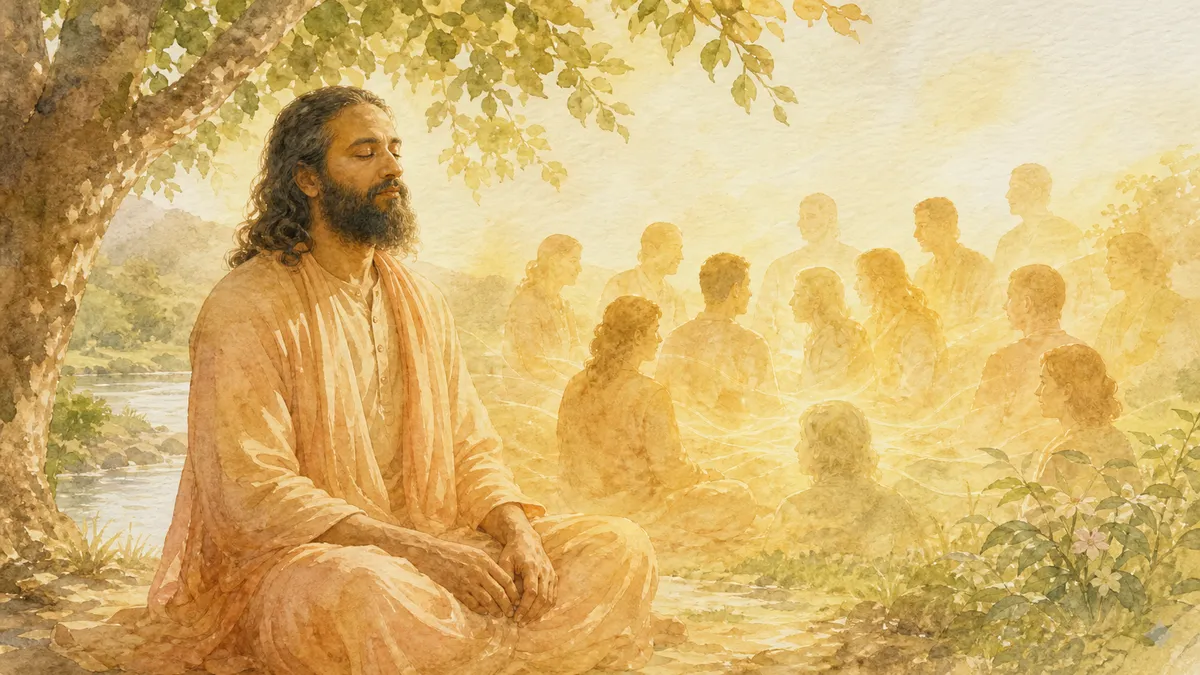
To free oneself from the law of karma, one must truly restructure one’s value system and understand this principle. One should reason as follows: “Service to these exalted goals and forces is immensely important, even if I myself do not attain certain heights in the process. It is precisely such service that is worth dedicating one’s entire life to, because this is exactly how the siddhas, buddhas, saints, and gods acted.” When we discover that our goals begin to change, then we truly become liberated from the law of karma.
The Infinity of Existence and Future Lives
“This life lasts only a very short time, so do not chase after its benefits. Remember that a long future lies ahead. Strive for the good of the future.”
Existence is infinite. Life is not exhausted by a span of eighty years. Future lives will inevitably come, and in them there will be nothing that does not correspond to the present life. Whoever is occupied with worldly, samsaric things will be occupied with the same in the next life. Whoever strives for enlightenment, not losing their awareness even for a moment, will continue to be occupied with the same. Whoever is absorbed in the eight worldly dharmas will continue to be absorbed in them. Whoever is engaged in serving the saints will perfect themselves in this even further. Whoever has realized presence and self-liberation will grow in this. Whoever has become rooted in divine pride, manifesting the qualities of blossoming and blessing, will manifest even greater majesty and glory as a deity. These are future lives, which are an absolute reality.
The Danger of Falls on the Spiritual Path
“For the good of your future life, now be prepared and confident that you will not slip onto the path of falling.”

A true monk always examines his life very carefully so as not to slip onto the path of falling. In spiritual life there is not only progress and ascent; unfortunately, there are also falls. Sometimes, after having the status of monk and senior monk, one may receive the status of novice, brahmachari, or layperson. This also happens, because spiritual life is unpredictable and resembles a winding path. Obstacles and worldly desires arise, old samskaras of the false ego surface, unreadiness for new experiences appears, as do being captivated by clarity, an imbalance of pranas, and a lack of understanding of the Dharma. There are very many things a neophyte does not even suspect. And instead of flying toward nirvana like an arrow, he begins to spin in place, moving to the right or to the left.

I read the revelations of a certain Christian monk. He wrote: “One day I looked at my brother monks and saw that all of them were deluded. I wept very bitterly because of this.”
It is not for nothing that the siddhas say: “The spiritual path is like the edge of a razor.” To pass along it, one must slip past and guard oneself against all temptations. A true monk knows this perfectly well, and therefore carefully watches over himself every day, not only at the stage of novitiate, but even after ten or more years of monastic life. The more experienced a master he becomes, the more deeply he watches over himself.
Many people think that masters are relaxed because they have already realized themselves and can behave however they please. But this is not so. The deeper the master, the more he keeps watch over himself. Even if he does not demonstrate this outwardly, he will not make a single superfluous movement; he will not even move a finger for no reason. He keeps watch over himself not through some external constraints, but by virtue of inner clarity, analysis of prana, taking into account the situation, signs, relative circumstances, and, most importantly, presence. And the more a yogin reveals the primordial state, the greater the reality he encounters, the more his reverence increases, which is also called “fear of God.” That is, inwardly he is not in a relaxed state, even if it seems so from the outside. In the same way, as a practitioner raises his level of awareness, he must keep watch over himself more and more. His stricter and more critical attitude toward himself should increase over time, not decrease. A true yogin always sets his standard a little higher, and therefore always sees how much work he needs to do. By following this principle, you will be protected from all falls.
On the one hand, one must not become shriveled up, fall into a feeling of sinfulness and self-abasement, thinking: “Nothing is working out for me!” This contradicts the supreme vehicle of the principle of the natural state and divine pride. You are already so abased by your position in samsara that there is nowhere lower to go, so this will not help. Therefore, our main task is to nurture the natural state and take root in divine pride, always identifying ourselves with the deity, and not to engage in self-abasement. On the other hand, a yogin must definitely always possess vigilance, alertness, and self-demandingness. And then there will be no falls. It is necessary to constantly notice your reactions, attachments, identifications, and distractions. You must constantly pull yourself up, track your hidden subconscious desires and clinging, the egoism, pride, and conceit that manifest, and inwardly reproach yourself for this. And if you know how to liberate yourself, then instead of reproach you need to practice self-liberation.
Overcoming Self-Satisfaction and Continuous Practice
“Do not be self-satisfied in anything. If you preserve pride, considering yourself learned, great, and noble, you will acquire no good qualities.”
On the one hand, we must take root in divine pride; on the other, we must never allow ourselves to become mired in self-satisfaction. If you understand that divine pride refers not to the ego (ahamkara), which must completely capitulate, but to the essential “I,” you will not make this mistake.
“Therefore cast aside vanity and be diligent in the practice of the Dharma, not deviating for a single moment.”
“Not deviating for a single moment.” Since you are practitioners of the highest teaching, you should know that your Dharma is not conditioned by place, time, or circumstances. You can practice it very flexibly in any conditions and at any time, because it is internal. It needs neither a special position, nor japa, nor rituals, nor anything else. Awareness, contemplation — this is inner work that can be applied at any moment and in any situation. That is why it says here: “not for a moment.”
Working with Emotions and Misdeeds
“Apply the antidote to actions. If even the most insignificant disturbing emotion or unwholesome action arises in your being, think of it as an inexpressible suffering the size of Mount Sumeru.”
Until you have learned to unite with and self-liberate emotions, you must treat arising anger, irritation, attachment, lust, and so on with great care and strictness, because to follow the lead of any emotion means to create the basis for future suffering. This must be taken very seriously. When you become rooted in presence, all emotions will be something unreal for you, having the same “taste.” When angry, you will laugh. It will simply be the play of presence. But until there is such a play of presence, careful self-control is needed.
“Nothing is achieved by actions performed with doubt, so do not have the slightest doubt. Until you abandon attachment to the ego, misdeeds, however insignificant they may be, will bring consequences. Therefore it is so important to avoid misdeeds.”
Misdeeds mean negative karmic actions: evil thoughts, slander, killing, theft — everything that contradicts yogic principles. Until we have learned to act from the natural state and the ego has been absorbed into it, all misdeeds will be accompanied by evaluative activity, bhava, and any misdeed will always be followed by a subconscious emotional evaluation, whether you want it or not. And this emotional evaluation will leave an imprint (a karmic trace). This means that you will inevitably have to reap the fruits of your karma.

When we are already rooted in contemplation, our actions cease to create karmic traces, because we can self-liberate everything and no longer get involved in emotionally colored evaluations. Nevertheless, it is said: “Even if your mind is boundless like the sky and you have attained the state of a buddha, be meticulous in your conduct. Do not commit misdeeds even the size of a mustard seed.”
Vows and samaya
“Teacher Padma said: “Having taken the vows of the higher or lower vehicles, do not abandon them even to save your life. If you break them, the most important thing is to repent immediately and take the vows again.”
What are vows? They are a certain vision, not an empty formality. Here, vows refer to tantric samayas, the commitment of the single samaya of contemplation, and monastic vows. To take vows means to enter a particular dimension of consciousness. Having undertaken any obligations, a yogin must observe them carefully; and if they are broken through inattention, he must purify, restore, and reaffirm them, without waiting for others to point this out.
Usually, lay disciples are required to observe the basic yogic vows: not to eat meat, to observe brahmacharya, not to kill, not to lie, and so on. The principle of tantric samaya means that you enter a single field of consciousness in which the spiritual teacher, the siddhas, and the teaching abide. If you leave this field of consciousness, your entire spiritual practice collapses. One could say that samaya is an attunement to a certain vision that leads us along the path of spiritual life. It is very important to maintain this attunement continuously, that is, always to observe samaya and the purity of the transmission. Samaya means that you establish elevated, sacred relationships with the teacher, the teaching, one another, and the sangha, and treat them as the treasure of your heart, nurturing, developing, and deepening them; and if they are broken, you purify them. This does not mean that, having received initiation from a teacher into some teaching, one can later think: “Perhaps this teacher is in fact some kind of impostor. Perhaps this teaching is some kind of nonsense. But I suppose I will practice it anyway.” Such an approach cannot be called the practice of samaya. It is a practice that will bear no fruit; it will bring only obstacles. When we enter into samaya, this is the realm of the holy, the sacred; therefore the teaching must be treated not as things are treated in the world of people, but with respect and even reverence. Samaya leads us into the world of the gods, and elevated beings and energies must be dealt with very carefully. If we allow inattention and handle our samaya carelessly, serious obstacles arise in spiritual life, which can lead to illness, the absence of spiritual experiences, and even bad rebirths in future lives. I know this from my own experience. When disciples violated samaya, I always sensed it in advance. For example, I would have bad dreams, and there would arise a feeling as if a sack of cement had been poured over my astral body, so I had to perform special practices to disperse these impure bhavas. Why does this happen? Because if a person’s samaya is broken, negativity manifests in his subtle body; and you, as the initiating teacher, are connected with the disciple, so this negativity, of course, enters your subtle body. That is why it is said that one should not initiate unworthy disciples, because this will create obstacles both for the disciple himself and will bring suffering to, or create obstacles for, the spiritual teacher. Some even say that the health and lifespan of a spiritual teacher depend on how well the disciples observe the principle of samaya. This especially concerns not anuttara tantra, but the lower tantras, where initiations with deities and transmissions into the practices of specific deities are given. This is indeed so. If any subconscious aparadhas (violations) arise, it is necessary to take care to purify them in time.

The following example shows how seriously this is regarded in the tantras. Naropa showed Marpa the deities and asked: “To whom will you bow first—the guru or the deities?” Marpa made a mistake by bowing first to the deities rather than to the guru. Naropa said: “Because you have made a mistake, your life will not last long.”
Differences in approaches to samaya in different tantras
In kriya tantra and charya tantra, the principle of the purity of samaya is given very great importance, since any deviations can seriously affect the practitioner’s spiritual life. In anuttara tantra, we attach great importance to the unified samaya of contemplation, while the samayas spoken of in the context of the fourteen root downfalls are secondary for us. We have more freedom, we have more confidence, because we know that even if, through inexperience, secondary samayas are violated, our unified samaya of contemplation is the guarantee of fundamental purity, and therefore it will purify them.
Although this, of course, does not mean that secondary samayas need not be purified if they become defiled. Moreover, the unified samaya becomes fully purifying only at the stage of the unified “taste”; nevertheless, we must believe in its purifying power from the very beginning. The unified samaya is the universal principle of the natural state, which solves all problems in one stroke.
In Christianity there is an expression: “Love is above fasting.” In this case, love embodies the unified samaya, while fasting embodies the vinaya precepts or tantric samayas. And although the vinaya precepts and tantric samayas are important, the unified samaya is much more important.
I read that one Christian saint, during a fast, was invited by a layman to his home. When the table was set, the saint refused to eat, saying: “How can one partake of prasad during a fast?” The hosts were deeply upset. Seeing that he had brought them sorrow, the saint remembered that “love is above fasting,” and therefore said: “Well then, set the table, we will eat.” He was not a novice, but an elder, a saint who had realized love and could self-liberate relative conventions. This is an example of how the unified samaya is above secondary principles.

Nevertheless, this is not a reason to violate them at every step, thinking: “Love is above all restrictions; the unified samaya will write everything off.” If you seriously think this way, it is a path to downfall. Here everything must be very subtle.
I heard that students who adhered to the principle of the unified samaya came to the retreats of one holy teacher, a Tibetan lama. At every retreat, the lay practitioners would hold a drinking party. The teacher said to them: “Perhaps you have already become mahasiddhas? If that is so, then, of course, you may rely on the unified samaya. But if you have not yet become mahasiddhas, then it is better to guard yourselves carefully, even if you are not monks but laypeople.”
Why did this happen? Because the prevailing opinion was that if you adhere to the unified samaya of contemplation, then you can do anything you want, “dance in space.” But if you are monks, you should know: let inner awareness dance, while outwardly you must guard yourself. Therefore we say that the view should dance, while conduct should be monastic and restrained, and then you will not make a mistake.
Purifying violations of samaya
“Some people, having broken their vows, fall into despondency and do nothing except commit further violations. But just as a person who has fallen into mud becomes clean by washing and sprinkling himself with fragrant water, purify your obscurations, downfalls, and transgressions so that broken vows never accumulate.”
If something is violated, this is no reason to fall into despondency. One simply needs to analyze the cause, change the functioning of consciousness, perform repentance and purification, restore the samaya vows, and continue the practice.
“Do not associate with or befriend a person who has neglected morality or violated his samayas even for a moment.”
This is an important principle. If you associate with a person who shared samaya with you and then violated it, you yourself may become defiled. You will have unpleasant visions in which you enter a dark basement; your spiritual experiences will deteriorate. Therefore it is said: “Do not accept even a crumb as an offering from a person who has violated samaya.” This does not mean that we should be angry at violators of samaya and show them our disdain. If this happens, one should say: “You know how the principle of samaya works. Therefore, first restore and purify your samaya, and then we will build a relationship with you.”

“If you, dressed in white clothes, fall into a greasy swamp, the black mud will inevitably stain the whiteness. In exactly the same way, even if your samayas are pure, you will inevitably be stained by others’ violated samayas. But if your samayas are not pure, then black will not stain black; therefore be extremely cautious. It is important not to associate with depraved people and with those who have lost their vows. In any case, one should take care that there is no cause for shame.”
Questions and Answers
Question: “You said that obscuration occurs due to subconscious evaluation. What do you mean by subconscious evaluation? Is it some kind of bhavana that manifests subconsciously?”
The discriminating consciousness that operates with the notions of bad-good, pure-impure, good-evil, right-wrong, truth-falsehood, and so on, is not in the surface consciousness but in the subconscious. Evaluative and rational activity is carried out precisely from this level.
For example, you perform some action and think something like this: “In the Absolute everything is pure and sacred, so it is not a big deal if I do something foul. It is still an illusion; it is still a play.” It is as if you have self-liberated this action at the level of surface consciousness, but the subconscious works faster, so at the level of the subconscious the evaluation has nevertheless taken place; the action has nevertheless caused an impure bhava, which has settled in the subconscious as an imprint. This means that the subtle karmic result that arose as a consequence of this action will ripen.

But if you have entered the subconscious by the power of contemplation and even the slightest fluctuations, the movements of the mind, are already absent, evaluative and rational activity does not occur, and everything is perceived in pure vision, then there will be no consequences from such karmic activity. The question is how subtly you are aware and whether or not obscuration will arise in your soul.
For example, it is said that once someone saw Ramakrishna eating excrement. The disciples said: “How can you eat that?!” Ramakrishna replied: “Excrement and the most delicious food are one and the same in non-duality. You do not understand this because your mind is too dualistic.” The disciples thought: “Our teacher must be very holy if excrement is as pure to him as the most delicious food.” Then someone sarcastically remarked: “Eating one’s own excrement is not such a great achievement; anyone can do that. But someone else’s...” Ramakrishna said nothing in response; he simply went to the sewage drain, took excrement from there, offered it as prasada, and ate it. After that, no one could say anything more to him.
Why was this possible for Ramakrishna? Because he did not think about excrement; he thought about God. An ordinary person, seeing excrement, thinks about excrement, but Ramakrishna, seeing excrement, thought about God and saw God. And when God eats God, nothing exists except the divine. In Ramakrishna, the evaluative and rational activity that would say that this is something impure did not switch on. For him it was the energy of God, and therefore there could be nothing impure in it. But if even for a moment the thought had been allowed that this was something impure and disgusting, even if afterward, by force of will, one tried to convince oneself that in God everything is one and pure, this impurity would still have penetrated the consciousness. This is precisely the difference between the single “taste” and obscuration. Of course, excrement is an extreme example; we, of course, do not engage in such things. This is more related to the sadhanas of the mad avadhutas of the Kaula tradition.
Question: “Does this mean that one must uncover the deeper layers of the subconscious? That is, self-liberation is not possible in surface consciousness using simpler practices?”
It is possible to self-liberate in surface consciousness as well, but that is not enough.
“But the subconscious shoots through and evaluates very subtly. You can only contemplate it. How can this subtle shot of the subconscious be liberated?”
If your contemplation is deeper, at the level of superconsciousness, then you can notice these evaluations and self-liberate them. Everything depends on where your point of awareness is located.
“So if the subconscious has not been uncovered, then your self-liberation is merely a superficial game?”
It is a practice, but it is kriya-jnana, that is, the self-liberation of the path, not the self-liberation of the fruit.
“So it does not work one hundred percent?”
It works at your level. You must know your own bar and not jump over it. That is, you can self-liberate theories, thoughts, ordinary fixed ideas, or certain generally accepted attitudes inherent in ordinary people. Compared with such a level, you have already advanced quite far. But there are some deeper things you still cannot self-liberate, so for now you do not need to touch them, but act in relation to them according to the principles of vinaya.
It is one thing to self-liberate some superficial things, and another thing to self-liberate energy (shakti), that which has been absorbed very deeply into us. After all, divisive consciousness has been absorbed into us very deeply at the subconscious level, for example: identification with gender, sex, pain, the instinct of self-preservation, the division into pure and impure, attachment to the body, generally accepted ideas of good and evil. Everyone has their own boundary where they can self-liberate and where they cannot.
A holy siddha is one who expands the boundaries of his self-liberation and can combine things that seem incompatible, absolutely paradoxical, and even absurd. Nevertheless, for him it is one. He can go beyond the boundary where the mind of an ordinary person already refuses to function.
For example, in my youth I was always attracted to theater, painting, cinema, and so on. I felt that for me this was the only way to perceive reality, that no other values were profound for me.

A saint who self-liberates the incompatible constantly lives in the paradoxical, the absurd, and the incomprehensible. This is true emptiness beyond the limits of the ordinary, the human. Only there does he comprehend the reality of samarasa, the single “taste.” Nevertheless, abiding in samarasa, in the transcendental, the mad, the absurd, and the incomprehensible, he acts in the relative dimension in such a way as to benefit others. He takes into account the limitations of others and even pretends that he shares them too.
Question: “Guruji, you say that at the level of energy one cannot self-liberate, while at the surface level of consciousness one can self-liberate. But if through some action, pure or impure, you fall into the subconscious and still try to self-liberate through surface consciousness. If you do this often, will it not turn out in the end that you will be able to self-liberate at the subconscious level as well?”
Everything depends on the individual. If you are a vira yogin, after roughly twelve years of training this may serve as a means of attaining samarasa. That is, first a foundation of the natural state must be created. In this way Tilopa taught Naropa, placing him in paradoxical situations so that Naropa would realize the single “taste,” discard notions of right and wrong, the instinct of self-preservation, and so on. But Naropa, before he was capable of practicing, was by that time already a teacher, a pandit at Nalanda University.
This is called the practice of the single “taste.” And such a practice exists in the monastic training program. However, it is unsuitable for novice postulants or monks, and may be appropriate only for vira yogins who have sufficient spiritual experience. This is already the next stage of training at the level of siddhi.
Question: “If through some action you enter the subconscious and at that moment, through surface consciousness, decide to self-liberate, is it not already all happening in the subconscious? After all, the seed has still arisen, fallen into the subconscious, and is already sprouting there.”
This is a very slippery point. The fact is that the subtle body can become polluted even if the yogin verbally self-liberates. Verbal self-liberation is not enough; self-liberation at the level of pure vision is needed. Therefore, it is important not to overestimate one’s capabilities.

Question: “And if there is something disgusting in taste, but outwardly one at least tries not to grimace, imagining that it is mahaprasad, will something inside respond and self-liberate through the outward?”
If you integrate certain incompatible things with your practice and at the same time try to truly self-liberate, awareness can indeed grow. That is so. However, the self-liberation of incompatible dualistic things should be done only under the guidance of a spiritual teacher. There are tantras and upadeshas for such practice. To begin with, try doing the following: when you are served tasteless prasad, observe whether you can eat it with the same joy as something delicious.
