Karma, Posthumous Retribution, and the Power of Pure Vision
12.08.2026
0 мин. чтения
0
Share
copy
search
add
share
Commentary on the text “The Tale of Choijid Dakini”
The remaining part that I intended to comment on is the story of the fates of living beings upon rebirth. A fat, unattractive nun was also questioned, and she said:
“I sowed my own field and wore my own clothes. When I had enough food and clothing, I decided that I would not strive for holiness. It is a lie when they say that giving alms will bring benefits in the future. It is a lie when they say that, in their past rebirths, rich people not only worked diligently sowing their fields, but also had faith. Having decided that one should give alms to no one, I did not give any. I neither paid homage nor made offerings to the Teachers and those who recited the mantra. I did not listen to the Teaching. I lived on my own land and ate my own food. I never felt remorse at the thought that I was impious. I do not even know whether I followed the Teaching in my past rebirths. And now I have no debts that I might promise to repay to the Teaching merely because I had never felt remorse before. I have not a single sin to confess. I did not know that a time would come when my sins and virtues would be reckoned with such precision. Had I known, I would have become renowned for good deeds. Everything I did was wrong! But now, if I am returned to the world of the living, I will do good with zeal and diligence.”
When she had told her story, they looked into the mirror and the book and announced:
“When you were preparing to cut your hair and put on the yellow deel, you were not particularly devout. Since you did not listen to the religious teaching, you did not know what would benefit you after death and what would harm you. Enjoying your food and possessions, you flaunted them before others and turned away from those who followed the Teaching. Constantly dwelling among laypeople, you indulged your lust with them. You received what had been cooked for the clergy, yet you yourself offered neither a cup of tea nor even a little flour. While others listened to sermons from clergymen who had arrived from the ten directions, paid them homage, and offered them food and gifts, you, woman, cursed and disgraced them, saying: ‘They make offerings not because they are devout, but in order to gain the support and favor of the Teachers.’ Whenever you learned of even minor transgressions committed by others, you distorted and exaggerated them, deceived other people, mocked them, and put them to shame. If you saw two people in love, you did everything possible to sow discord between them and separate them. You slandered and drove the souls of all lovers to despair. By fanning the flames of fury and anger and inciting others to malice, you accumulated sins as unbearable as seething boiling water. Moreover, when the almsgivers Nasundzula Ekhe and Buyanu Jargalan received the ulanu belik gorelo (vow and guidance), while making an offering to the Teacher, you reviled all three—the almsgivers and the Teacher—and thereby troubled the Teacher’s soul. Because of this, some people ceased to honor the Teacher and laid the foundation for their own suffering and ill fortune. Troubling the Teacher’s soul is a greater sin than killing a thousand living beings. This Teacher is a yoga-chara who has comprehended the true nature of the soul. This Teacher can help everyone who has been spiritually connected with him. But you, fat red-faced woman, look at your deeds. Whoever came to you seeking alms, not only did you give them nothing, but you also called them names, saying: ‘You look like devils.’ Look how many times you called people dogs, men yaks, and women cows. And although you later performed a few good deeds, they will now bring neither benefit nor harm.”
When all this had been announced, Namon Khan said:
“Yes, among those who, like you, have obtained a human body in the human world, some come having contemplated the Buddha, some having attained human bliss, while others, for the sake of food and clothing, have committed such deeds that they will never be freed from the sufferings of the three kinds of ill fate.”
The Preciousness of Human Birth and the Karmic Balance
Human birth is called precious precisely because it opens up the possibility of following the path of Liberation. Besides this, one can, of course, perform various actions of body, speech, and mind for the sake of food, clothing, satisfying ambitions, the ego, or personal interests. The task is to live this life in such a way that, when the debit-credit balance is calculated, the account shows a positive balance; this is the minimum. A positive balance of sins and merits is the key to being born human again or even attaining a higher birth. If the balance is negative, the vector of consciousness shifts into lower karmic dimensions.
To ensure such a positive balance of the “white and black pebbles” of fate, it is necessary to avoid impure actions at the level of behavior, impure thoughts at the level of thought, and impure speech at the level of speech.
The Consequences of Impure Speech and Thoughts
It is believed that those who do not refrain from impure speech will experience the following torments in hell in their next life: their tongue will become enormous, it will be rolled out like a pancake and turned into a red-hot sheet of iron, and then struck with hammers. In their next life, they will have foul-smelling breath, bad and painful teeth, inarticulate speech, and serious problems with rhetoric. Everything they say will irritate or anger others, even if they say something good. Others will feel as though they are being insulted. These are the consequences of harmful speech.
It often happens that we say perfectly normal things, but others perceive something entirely different, and a conflict arises out of nothing; this is no coincidence. The point is that the deep karmas of our subtle body affect and distort the karmic vision of those around us in such a way that others resonate with these karmas and pay no attention to our actual words. Even if our speech is good, others still perceive it as malicious and may become angry with us. This is a consequence of the past karma of slander.
If we indulged in slanderous thoughts, then despite our good intentions in this life, others will constantly feel that something is wrong with our intentions. We will be surprised: we sincerely wish them well, we are pure, yet for no reason others suspect us, slander us, and think badly of us—this is karma returning to us. In other words, although our subtle samskaras of prarabdha karma may self-liberate and be transformed by the power of our practice, they nevertheless affect the subtle bodies of others on a subtle level.
If, in a past life, we practiced black magic—for example, separating wives from their husbands, casting love spells, making someone ill by placing a curse on them—then in this life, even if we strive to cultivate wholesome thoughts and the Four Immeasurables and have completely changed our outlook, bad karma will rain down on us from seemingly nowhere. Other people will involuntarily strike us with their thoughts, or this bad karma from the astral world will simply come in the form of astral attacks, and we will not know where they come from. We will experience various sufferings of the subtle body, illnesses, and obstacles even though we ourselves commit no sinful actions, control our thoughts, and cultivate pure vision; nevertheless, all this will still occur. For example, we may suffer from headaches or encounter obstacles in meditation. This is a consequence of black magic practiced in past lives. And if that magic was especially harmful, such a person experiences serious problems with the subtle body.
Sama-Yoga and Sahaja-Spanda
To maintain a positive karmic balance, it is necessary to live in such deep contemplation that there is sama-yoga (equilibrium), and the power of contemplation is such that everything it touches turns into a devata (deity) and is purified. Only sama-yoga can dissolve the power of past sinful deeds and transform everything into pure vision.
Sama-yoga means that we are so deeply immersed in presence that this presence already possesses sahaja-spanda. Sahaja-spanda means that our presence has blossomed. We are not merely trying to remain aware; this awareness already possesses its own creative vibration, and this vibration can transform the world around us.
For example, if I am trying to be mindful and there is some irritating sound, my awareness may be sufficient for me simply not to become irritated and to remain attentive. But if my awareness is very deep, a vibration radiates from the space of that awareness, and this vibration merges with the sound; then my karmic vision changes in such a way that the sound ceases to be irritating and becomes something divine and beautiful. This means that sahaja-spanda has transformed an impure sound in my perception: it no longer irritates me and has become something beautiful.
I actually had a similar experience. Once, when I was seventeen, I was peeling potatoes together with thirty other people in uniform—such were the times; we had to serve the Motherland. It was four in the morning, and there was an entire mountain of potatoes. The potato-peeling machine had broken down, so we had to peel them by hand. Imagine several tons for fifteen hundred people, and there are only thirty of you, like thirty heroes at Stalingrad, and no one else is going to peel them for you; do whatever you like, but several tons still have to be peeled. So everyone was already peeling at the limit of their endurance, hardly even seeing the potatoes anymore. Some machine was operating nearby, making a tremendous noise, and it was extremely irritating. On top of everything else—being covered in dirt and potatoes, surrounded by those people from six in the evening until four in the morning—it is not a particularly joyful occupation when you are seventeen.
At some point, all those disruptive pranas enabled me to enter contemplation so deeply—there was nowhere else to turn; if you did not contemplate, you could not do anything at all—and suddenly I stopped hearing the irritating sound, and beautiful melodies that I liked very much began to emerge from it. They entered the subtle body at the level of the heart and ears, and immediately that sound turned into something miraculous. This is an example of how sahaja-spanda can transform sound into pure vision. Pure melodies began to emerge from the grinding, rattling, and humming, like symphonic music: Schubert’s waltzes, Chopin, Bach, Mozart. I wanted to go over and see whether there was a radio or something else there; it seemed incredible. Nevertheless, this music continued for several hours, so it was easy to finish peeling those potatoes. This is an example of how sahaja-spanda can change your perception when the power of presence is strong enough.
The Judgment of Yama and Retribution
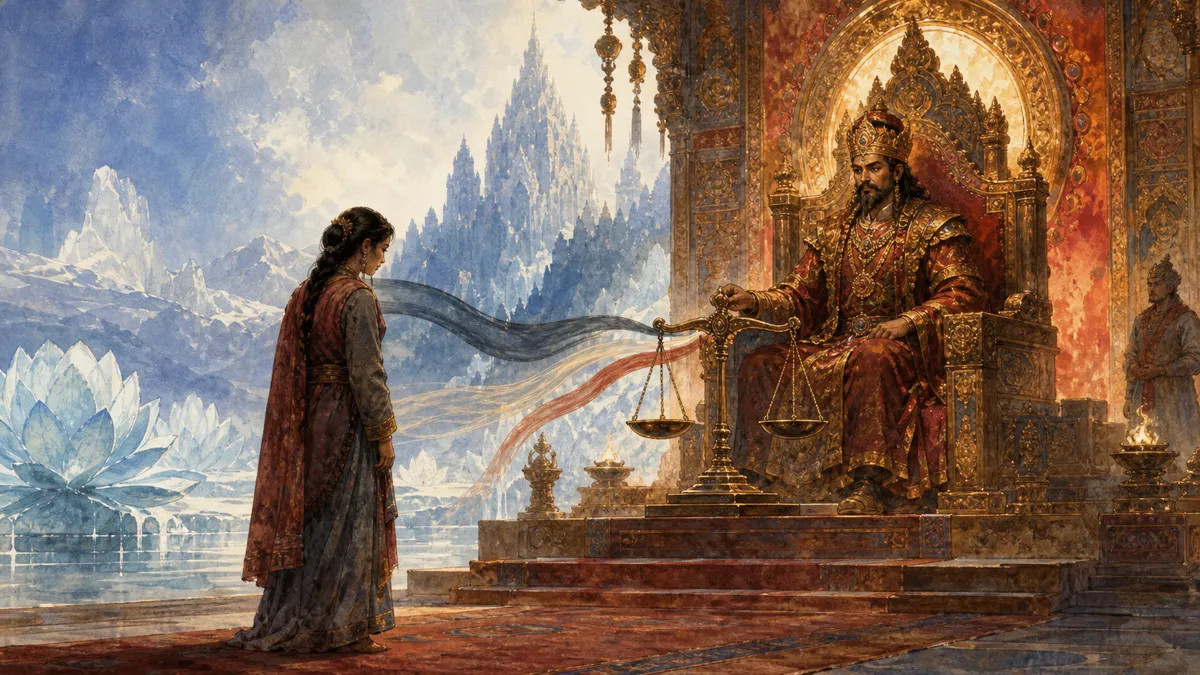
“People like you, after becoming nuns, disturb the soul of the Teacher in relation to those above you; and in relation to those below you, by driving the souls of neighbors, lovers, and children to despair, malice, and irritation, you yourselves are guilty of their sins. Since her sins have ripened in her own body, speech, and mind, send her to suffer, beginning with the Hell of Loud Wailing and the cold Hell that splits apart like a lotus. Plow her tongue, which has fallen out of her throat, and drive a thousand iron nails into it. Keep this woman, who has earned an evil fate, in those hells until her term expires. Since calling men and women yaks, cows, dogs, and the like is a sin of speech, you will be reborn countless times as a yak, a cow, a dog, and a devil. Not even an hour of bliss will come to you.”
As soon as he gave this order and the servants hooked her by the heart and led her away, the woman said:
“If there is anyone here who is going to the human world, let them convey that people should not commit such evil deeds, which cannot be atoned for, even if their sins have accumulated accidentally or through ignorance. Let them say that those who possess property should not think ill of other people or, when refusing them alms, flaunt their wealth. In short, let them not harm their posthumous retribution. If they know this, they will not act recklessly.”
Having said this, she departed.
The key phrase here is: “Let them not harm their posthumous retribution.” By committing wrong, impure, and thoughtless acts in this life, living beings themselves ruin their future destiny. If they knew this, they would refrain from doing so. This happens because of ignorance, but such ignorance does not absolve them of responsibility. Many people would reconsider doing what they do, or would at least think very seriously about it.
If you perform bodily karma, then this karma will manifest at the level of the body, on the external plane. But if your thoughts are pure at the moment you do something wrong, then the experience will be hellish at the level of energy, of the subtle body, but at the level of the soul you will not be disturbed or suffer; your state will remain calm and clear.
Once, about twenty years ago, during Kundalini Yoga practice at a retreat, I had an experience of the hell realms, in which my subtle body experienced various worlds. Suddenly, in one of these worlds, I saw my subtle body chained to a white couch, unable to move, while malevolent beings stood around me with syringes and connected me to a machine that pumped out my blood; in other words, I was simply being used as a donor. The whole situation was horrifying, as is usually the case in a hell realm. Then I thought, “If I am aware, then in pure vision there is no problem; this too is a mandala with which one can integrate.” As soon as I thought this, the Four Immeasurable States arose, and suddenly I saw that the beings of hell, with their syringes and scalpels, loved me and were sincerely, openly, and benevolently pumping out my blood. They were filled with such tenderness and compassion that a wave of this tenderness and compassion swept over me as well, and I was ready to give all my blood voluntarily. There was no suffering; my soul was filled with joy.
This means that there was karma to experience the hell dimensions at the level of the subtle body, but at the level of thought there was no such karma; instead, there was the karma of pure vision, and therefore there was no suffering. Thus, if you have done something on the gross level but have purified your mind through the practice of pure vision, then even if you enter a hell dimension, you will not suffer psychologically, even if you have to encounter such energies in the subtle body. This is often what saints do: they descend into the hell realms without experiencing hellish torment on the psychological level; they simply walk through hell and, by the power of their consciousness, lead conditioned beings out of those worlds by performing a transference of consciousness for them.
The Precision of Karmic Retribution
A man was also questioned, and he said:
“Since it was customary to hunt wild animals in the places where I lived, I too was guilty of killing wild goats. Although my wife and I had no intention of refusing alms, our family was large, so we could not give much. I killed eight or nine animals at home. When it was my turn to guard the mountain gorge, I robbed two pilgrims, a man and a woman. Such are my sins. Having arrived here and seen how precisely your assistants count sins and virtues, I became distressed. But now I can find no way to become more virtuous.”
The precise tallying of sins and virtues is a feature of the intermediate state. This precision is roughly comparable to how all the websites you visit are logged on a computer, or how a record of all your mobile phone calls can be printed out; there is great clarity and precision. In the intermediate state, during Yama’s judgment, this precision is even greater: every moment of your life can be recorded as if one enormous film were unrolled and examined frame by frame, in detail, second by second.
There may be a vision like this: “You are standing before a large screen, as in a cinema, with several beings standing nearby. The images on the screen move, and when necessary they are stopped and discussed, as though your life were being wound forward or backward, and you are shown: ‘These mistakes were made here, and those mistakes there.’ Then the film of your life is wound further and shown to you. When you see particular actions, an evaluation arises within you; your mind will not remain neutral, and a judgment will inevitably arise: whether the actions were bad, good, or neutral, you will inevitably react. Sinful actions will inevitably give rise to obscured states, while positive actions will give rise to elevated states. As all this is shown to you, the state of your soul will change. Perhaps you will see certain actions from the very moment of your birth and experience joyful moments or, on the contrary, pangs of conscience. As all this is shown, a certain vibration will unfold within your soul. The resulting, cumulative vibration of all these bhavas arising from such a review will determine your next rebirth.
As you have seen, for ordinary laypeople who did not practice the Dharma or perform sadhana, the entire reckoning takes place on the external level: how much one donated, what one said, what one did—that is, an action for which retribution immediately follows, whether merit or punishment, with an unambiguous identification with the action.
The Karma of Practitioners and Its Distinctive Features
With practitioners, everything is much more complicated. As I have said, the karma of consciousness is higher than the karma of the body. The higher your level, the less directly cause is linked to effect. There is considerable leeway and variation; the same action does not necessarily lead to the same consequences.
For example, an action is negative, but the motivation is positive. Will there be merit or not? They may balance each other out. Or an action may be neutral but performed in a deep state of awareness that imbues it with profound bhava. In that case, the action itself is unimportant, while the bhava is very important, so the balance is highly positive.
You may be asked clarifying questions about certain points, such as: “What is this? Please explain your actions; the motivation is unclear.” If your motivation was pure at the moment of the action, or you performed samskara-shuddhi, or through the practice of the natural state deeply self-liberated your actions, generated pure vision, and are able to convey that pure vision convincingly, then it will count as a pure action. Such are the subtleties.
It is similar to the process of emigrating to a country such as Canada, the United States, or Israel: an immigration officer speaks with you, examines your documents, biography, and other information, and then asks leading questions in order to grant you a visa or residence permit. If you answer well, you will receive a favorable placement; if not, you may be denied a visa and told: “Look for worlds or countries where you do not need to apply for a visa.” Everything depends on how you present yourself there. If you substantiate your case in a deep state of presence and convey pure bhava, you will be treated with respect, and this will be positive.
Yama’s Judgment: A Detailed Inquiry
As soon as he had reported this, the servants looked into the mirror and the book of destinies and said: “Yes, if you had no other sins besides these, your suffering would not last long. When innocent wild animals were grazing, you had some of them hunted down by dogs, some strangled in snares, and some shot with a bow. Look in the book: you yourself killed ninety wild male goats, sixty-seven female goats, five bears, and seventeen monkeys. Look, in your own home you slaughtered eleven goats, nine sheep, two yaks—an adult and a calf—and seventeen pigs. When your turn came and you guarded the mountain gorge for twelve years, you demanded payment from every pilgrim, both men and women. You extorted money from some and simply robbed others. How many years did you engage in robbery? Before your time, nothing but the toll was taken from people. Although, as the ringleader of these outrages, you did not appropriate a larger share for yourself, you will bear the greater part of the sin. When your lawful turn came to perform the annual sacrifice, you had sufficient provisions and your paternal inheritance for this purpose. Yet, under a corrupting influence, you stopped giving alms; see for yourself. Of all the other sins you committed, the sin of refusing alms is the greatest. You drove a man and a woman to despair by depriving them of sustenance. Before your time, no one was refused alms. For having stopped the distribution of alms, you will suffer for a thousand years in the realm of the pretas. For sinning through robbery, you will suffer greatly in the eighteen dreadful hells. For taking the lives of animals, you will go to the hell where beings repeatedly die and come back to life, and to the hell of black lines. When you are freed from there, you will assume the forms of the wild and domestic animals you killed, repay them for their lives, and be pardoned.”
As soon as the servants reported this, a white man arrived and said, “He has done nothing to deserve such torment. In his countless previous rebirths, he performed many good deeds, yet he was unable to lay out the white stones of the virtues he had accomplished.” A black man also appeared and declared, “There is no other place for him but the dreadful hell. Here is the heap of sins he accumulated in his previous life alone,” and he poured out a pile of black stones as large as a mountain.
When the servants swarmed upon the man like flies on meat and led him away, he said, “If there is anyone here who is returning to the human world, let them warn people not to commit grievous sins as I did, or the hour of deliverance from suffering will never come for them.” Having said this, he departed.
Differences in Posthumous Experience
Every living being whose mind has not been liberated undergoes such an experience to one degree or another. Visions of Yama’s judgment do not arise for those who attain Liberation, because their minds are free from any fixation on name and form. Those whose minds are holy and pure are instantly reborn in the Worlds of the Gods or in the Worlds of the Pure Lands. But those whose minds remain uncertain always undergo such a subtle reckoning.
Pure vision
Karma
Rebirth
Intermediate State
Sahaja-spanda
Sin
Samyoga
Judgment of Yama
Author Гуру
Read 13 times
Articles
Vidya AI
Search
Lectures
November 2, 2026
Mantra of the day
ОМ САХАДЖАЙА НАМАХ ОМ Естественному – поклонение!
Auspicious Times(Rome)
Brahma Muhurta:
04:53 - 05:48
Abhijit Muhurta:
11:33 - 12:14
Sayam Sandhya:
16:44 - 17:25
Mokshada Ekadashi (6 November)
Ekadashi of liberation. Helps to achieve spiritual enlightenment.