

Commentary on the text “Tripura Rahasya,” Chapter 14
Why the universe is merely simple imagination; how to acquire that strong will which can create it; how to attain the supreme truth.
The Nature of Memory and Samskaras
“The memory of individuals, composed of tendencies acquired as a result of participation in various actions in previous births, is now sustained by the intellect and abides in the form of prakriti (nature).”

The memory of individuals is samskaras. Samskaras exist as mental traces or imprints in our subtle bodies. They determine karmic vision, destiny, and our behavior.
Before entering the monastery, novices prepare astrological charts and a chiromantic forecast. To some extent, your samskaras can be read on the hand, and also by drawing up a proper horoscope within a good astrological tradition. To some extent, your destiny is cast into a certain form and already exists.
People who do not engage in spiritual practice carry out this predetermined program. Only practitioners can activate the higher levels of karma (buddhi-karma, bhagavata-karma) and properly use manasa-karma in order to transcend the lower karmas (prarabdha-karma and dharma-karma).
Types of Karma
Prarabdha is the destiny given to you at birth, determined by your mental imprints
Dharma-karma is the insurmountable, nodal moments of your destiny
Manasa-karma is the karma of resonance, when you resonate with something while being subjected to the informational influences of your environment; it is the ability to absorb information from the environment. For example, a monastery is a classic example of manasa-karma—a favorable environment, serving as a secondary cause, forms new karma
Buddhi-karma is your intuitive consciousness, your willpower, subtle awareness, which you develop as a result of working with sankalpa and contemplation
Bhagavata-karma is Anugraha, grace
The lower types of karma can be transcended only by developing consciousness at the very highest levels. Therefore it is said that the destiny of practitioners is to some extent unpredictable. That is, it is predictable at the level of the five elements, but beyond them it is not predictable, because a practitioner is like a good programmer who can enter the program and change the parameters of his destiny.
The Threefold Nature of Prakriti
“This prakriti is threefold, because the fruits of actions are of three kinds. It manifests as the three states of life—waking, dream sleep, and deep dreamless sleep. Then it takes the name chitta (the substance of the mind). This memory is called prakriti in deep dreamless sleep, and chitta in the other two states. It always contains within itself the inanimate aspect of the tendencies of the mind and the animate aspect of the intellect.”

Our memory consists of manas and buddhi.
All of a person’s actions are in fact determined by his past. In childhood, you unconsciously received imprints in your consciousness that you do not even remember now, but these imprints still govern you.
Sometimes one can observe how a grown woman plays the role of a little offended girl. She replays the same program that happened to her at the age of three, when she was not given a chocolate bar. Now the chocolate bar may have grown to other proportions, nevertheless she still plays this little offended girl. Or an adult replays an imprint received in childhood from parents, when he experienced certain fears or, conversely, fought for a favorite toy. Only now the toy has increased to the size of something large. All of these are samskaras residing in memory, which govern people’s consciousness.
The Unfolding of Samskaras in Meditation
If you diligently practice Mahashanti, the samskaras of your subconscious unfold and surface one after another. It may look like this. You meditate and recall many subtle nuances that you had long since forgotten, and suddenly you see how badly you acted, or how touching your relationship with someone was. You have not yet mastered the secret of self-liberation, and all of this surfaces in the soul during retreat and can confuse you very much. For example, I observed how one person even cried during a retreat when he remembered how disharmoniously he had treated his father.
At first, memories of events lived through long ago may flood in. Then the memories shift toward childhood impressions, and forgotten pictures of childhood arise before you. If you meditate well, you can return to the moment of birth, even experience the first emotional experiences connected with being born into the world. You can even have experiences connected with conception. For example, many patients of psychotherapists, immersed in a hypnotic trance, in regressive hypnosis recount how they stood beside a couple having sex and observed it from the side, preparing to enter the mother’s womb. These are memories connected with birth itself.
Finally, if you go even further, you can see your own death in a previous birth and learn why in this life you have certain experiences related to it. For example, if a person drowned in a past life, in this life he will have an aversion to water, a disharmony of the water element. If in a past life he was killed in a war with representatives of some race or nation, he will have a subconscious aggression toward that nation or race, which he will not even be aware of.
This is how hidden tendencies manifest.
In my presence, one person often cursed Soviet power, the communist government. I saw that when he began talking on this topic, he would get so carried away that he even lost control of himself. In essence, he had already become a practitioner, Soviet power no longer existed at all, yet his fists would clench when he began to reason about these topics. I became curious as to why this was happening. It turned out that in a past life he had been a White Guard officer and had been obsessed with dreams of a strong empire, an Orthodox state headed by a tsar-monarch, but all his dreams were completely destroyed during the years of the civil war.
The Mechanistic Nature of Human Actions
Our memories consist of many samskaras that we, as a rule, are not aware of. People act by taking their state of consciousness, their train of thought, and their mental attitudes as something self-evident, without seeing that they have been formed. They are like a program that has already been set, and therefore their actions are completely mechanistic, since they are simply executing these programs. Of course, practitioners try, as far as possible, to free themselves from this mechanistic execution of the program. Even when these programs arise from within them, they try not to follow them.
In the same way, with diligent practice of Mahashanti, you may experience past lives that will reveal something to you about aspects of your personality. You can roughly learn what the cause of your present merits is or, conversely, of your obstacles. These causes lie in the distant past, where you experienced different events, had relationships, views, and values. A practitioner who meditates diligently remembers many of his past lives.
For example, while analyzing my own samskaras, I learned that in one of my past lives I practiced Tibetan Buddhism, was at the same time a worldly ruler in the region of Buryatia, and held a spiritual rank. In another life I was a spiritual teacher. In yet another life I was an official in Egypt, close to one of the empresses, who promised me a career in exchange for good relations with her. Ironically, in this life she became a nun. In another life, in the town of Chihuahua in northern Mexico, I was a military leader of the Maya tribe, involved in delivering a narcotic herb for the performance of magical rites. And one of the novices, who is now a laywoman, was the son of my enemy, the prince of the ruler whom I opposed. In one of my lives I was a high-ranking monk of a Catholic order, who was also interested in political intrigues. All this multitude of lives eventually led to awakened consciousness; their samskaras also determine present actions. In one of my most recent lives I was a representative of the siddhas Matsyendranath and Gorakhnath, flew on a vimana (celestial chariot) together with another monk, and was someone like an observer from the world of the gods. This was a higher world than the world of humans.
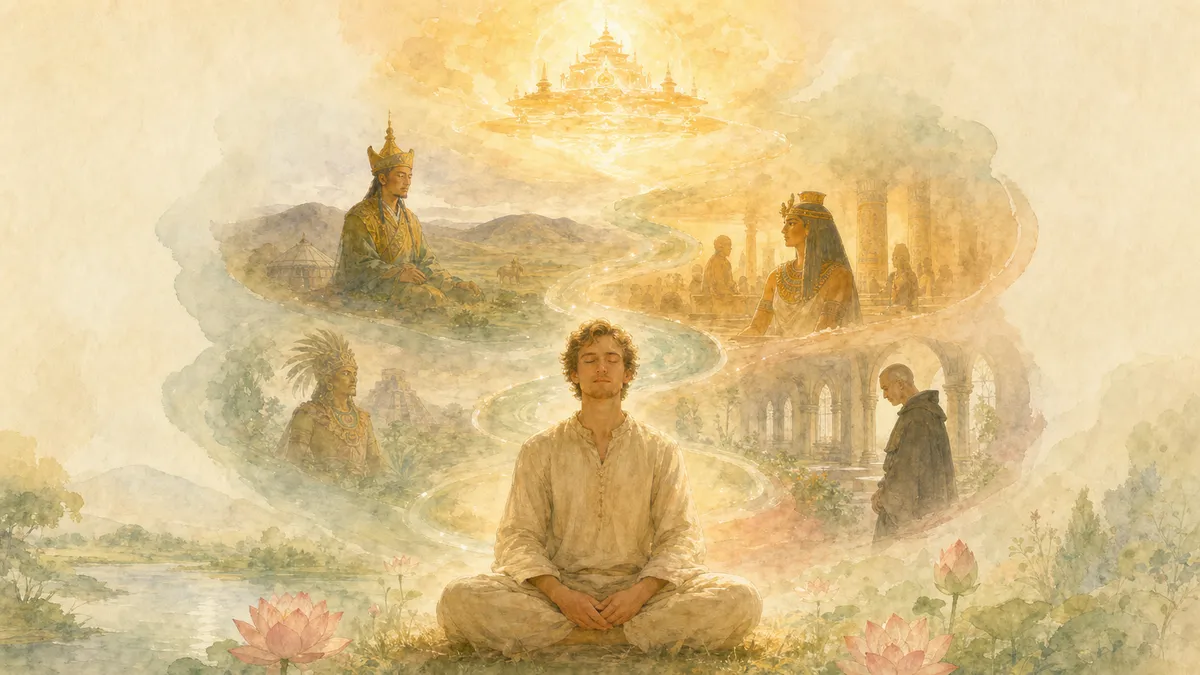
In the same way, if you meditate well, you will inevitably encounter the samskaras of your past incarnations.
When you reveal the single essence of the mind, behind all these samskaras you see the observer. When this observer becomes strong, these samskaras self-liberate and cease to determine your actions — this is called the cessation of the wheel of samsara. But until you discover this essence of the mind, the samskaras will, of course, determine your future actions and birth.
The Unmanifest State of Tendencies
“When the tendencies still remain in temporary inactivity without being exhausted, then their entire aggregate is called avyakta (unmanifest). Differences arise only in chitta, and in deep sleep there are no differences among individuals, so this is prakriti, which is known as chitta when differences are manifested.”
Differences in karmas exist as long as there is consciousness that has images.
In dreamless sleep, the differences between people and karmas are erased, because dreamless sleep is a unified consciousness.
And when we speak of meditation on the Supreme Source, we are speaking precisely of this state. One could say that to be in sahaja samadhi is to be in dreamless sleep while awake, or at least to orient oneself toward such a presence.
The Threefold Nature of Chitta
“Therefore the mind (chitta) is purusha (the individual) when the turn of the animate aspect comes, and the very same mind is avyakta (the unmanifest) when prakriti (nature), the inanimate aspect, asserts its rights.
This chitta is threefold, according to its functions, namely: ego, intellect, and mind.”
Chitta, consciousness, is threefold: ego (ahamkara), intellect (buddhi, intuitive consciousness), and mind (manas). These three facets of one’s own consciousness should be remembered.
Manas is operational thinking, which works in a binary mode: yes-no, right-wrong. It is the consciousness that gives you commands: take prasada, bad-good, and so on.
Buddhi is that which illuminates manas. It is intuitive consciousness, bearing light, depth, refinement, mystery, and play. It is your subtle intuitive clarity, which nourishes manas and, in general, chooses goals. Values are always connected with buddhi: the meaning of life, one’s attitude toward practice — all this is decided in intuitive consciousness.
Ego (ahamkara) is individualized consciousness, your idea of yourself: I am I, and not someone else; I exist; I am such-and-such. It is a complex of absorbed ideas and identifications about oneself.
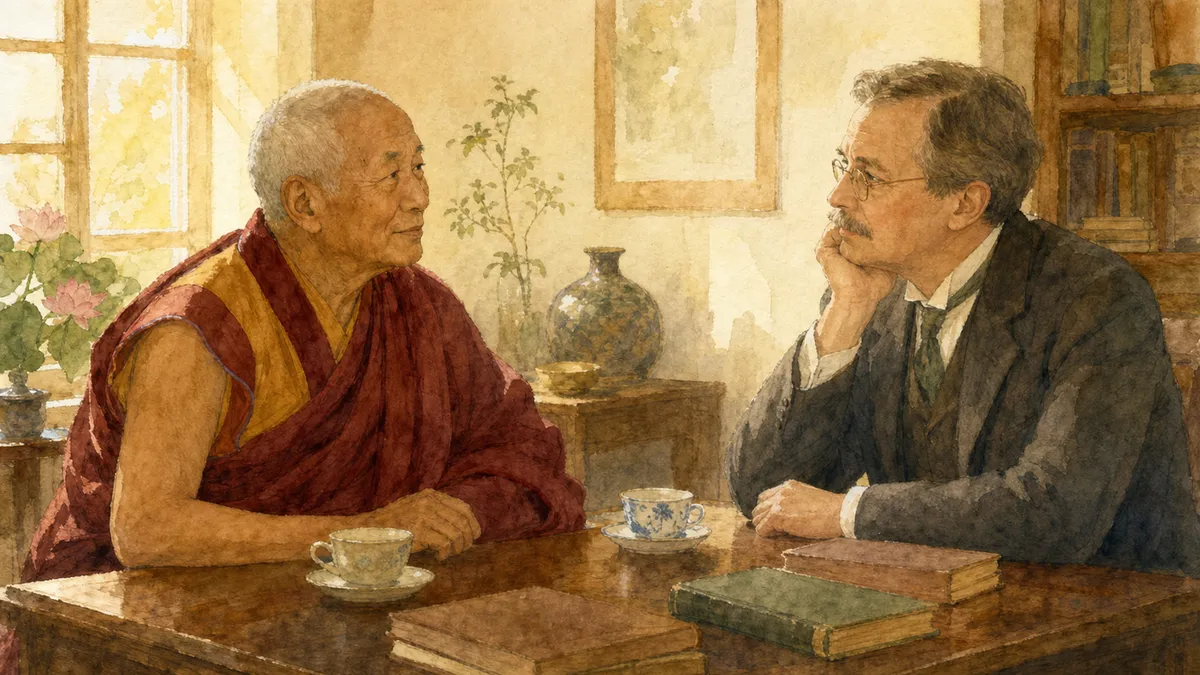
A professor of Western philosophy once asked a Tibetan lama:
— Could you convey the essence of the teaching in a few words?
The lama said:
— That is impossible in a few words.
But the professor insisted very strongly, and then the lama said to him:
— Very well. The essence is that you do not exist, that you are not you.
The professor could not understand this.
The Nature of False Identification
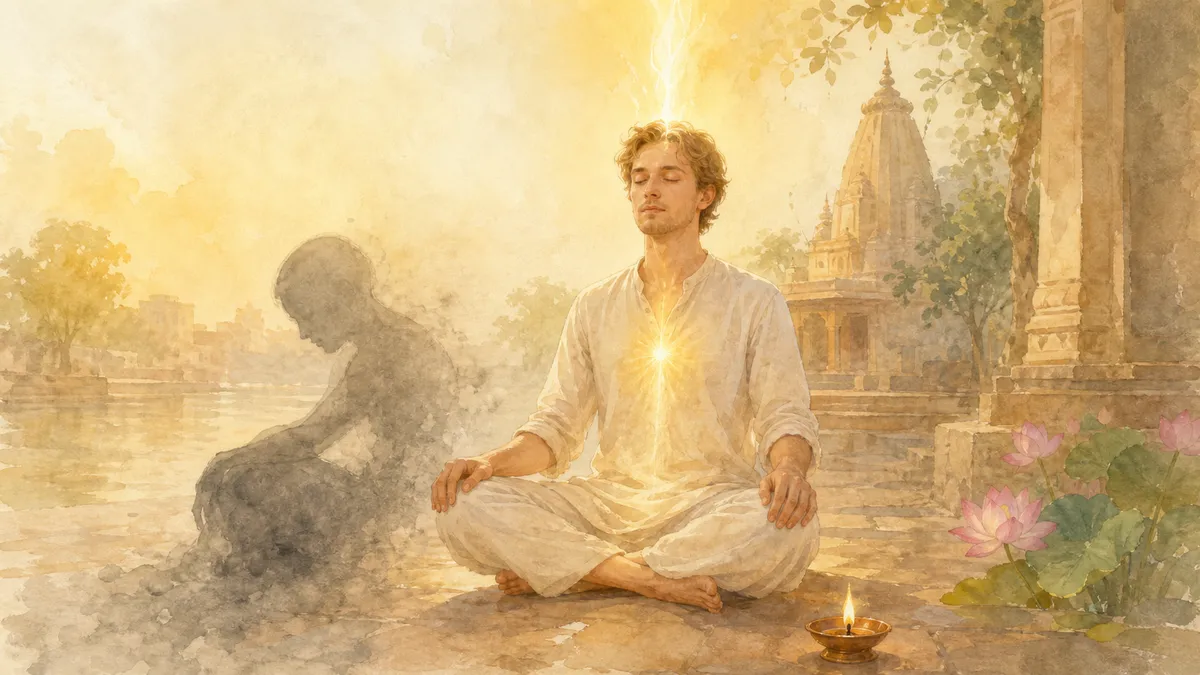
Ahamkara creates the idea of a personality, of individualized consciousness. But the paradox is that there is actually no personality — it is only a conglomerate of absorbed ideas with which identification has occurred. It is like having a set of clothes that makes up your costume, and you have begun to identify with this costume.
When various situations occur, your ahamkara manifests, experiencing envy, jealousy, resentment, anger, dissatisfaction, and irritation. It manifests in this way because there is identification with what you are not; but saints, unlike ordinary people, believe that disidentifying from what you are not is a matter of honor. They greatly welcome it when they are helped to do this. But sometimes, looking at practitioners, one can see that not everyone welcomes it. However, for spiritual growth this is actually very useful. If you do not carry out such disidentification, you will not progress spiritually. In other words, to carry out disidentification is to give yourself a great gift.
In ancient times, siddhas helped disciples accomplish disidentification through very radical methods. For example, one Sufi consciously trained himself in humility. Once, while he was sleeping on the ground, some hooligan came up and relieved himself on him. The saint got up as if nothing had happened and said: “You see, ego! You deserve nothing more.” This is an example of the greatest humility and complete disidentification. If you put yourself in his place, you could trace your own turbulent reactions to this situation, because false self-identification keeps us firmly in the cage of egoism. Until we free ourselves from it, we will not be able to realize our own buddhi.
Many times we must say to our ego: “You see, ego! You deserve nothing more.”
Such an approach does not contradict divine pride. Our divine pride remains; it simply operates on a subtler level — the level of buddhi and the Atman.
“When chitta is under the influence of the three qualities, it manifests in the greatest variety as follows: under the influence of the quality of sattva (radiance), it becomes the five senses: hearing, sight, touch, taste, and smell; of rajas (activity) — the five organs: speech, hands, feet, the organs of excretion and reproduction; of tamas (darkness) — the five elements: earth, air, fire, water, and ether.
The Supreme Mind plays with the universe in a similar way, all the while remaining the untouched witness of its own creation.”
