

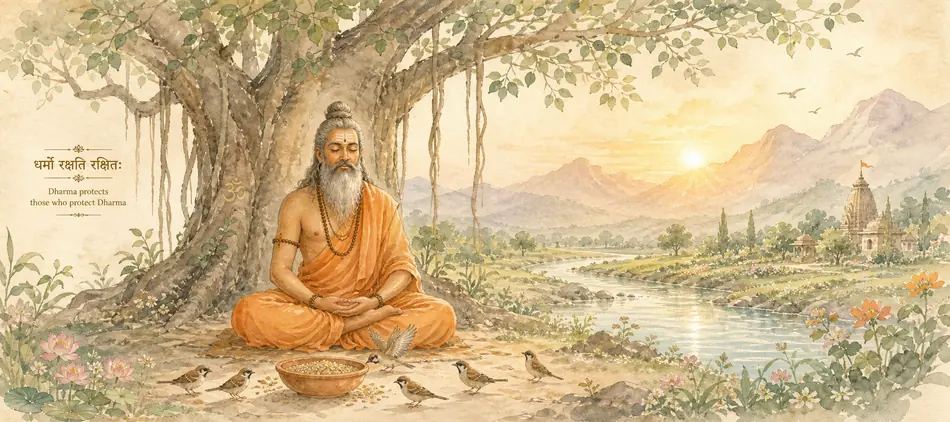
“For example, if in a previous life a person was accustomed to killing, they will be inclined to kill in this life as well. If they were accustomed to taking what belongs to others, they will be inclined to steal. This is why some people, from their earliest childhood, kill worms and flies that catch their eye. Such a propensity for killing corresponds to the actions they committed when they were killers in the past.”
Those who engage in hunting and fishing will experience karma in the bardo in which they themselves will be hunted, have molten lead poured down their throats, or be cut into pieces. Such is the consequence of accumulated killing karma. In other words, they created certain causes that opened them to the lower worlds.
In the subtle world there are various spirits, some of which are called punishing spirits. Punishing spirits are those who possess powerful kleshas, are connected with the lower worlds, and take pleasure in tormenting living beings. For them, there is no greater joy than carrying out punishment. How is punishment carried out? In a person’s subtle body, in the subconscious, in the astral world, their impure karmas and bhavas are visible as imprints, and the spirits see them perfectly, which gives them the right to carry out the punishment. Then, with all their fury, they attack that soul and carry out such punishment until the person’s subtle body is freed from certain kleshas and changes.
The Influence of Past Actions on the Present Life
“As a result of the influence of past actions, all people are born different. Some are inclined to kill, others to steal, while still others have no inclination whatsoever toward such actions because they enjoy performing good deeds. All such inclinations are remnants of past karmas or, in other words, consequences corresponding to actions committed in the past. Therefore, it is said: to know what you did in a past life, look at what you are like now; to know where you will be born in the future, look at what you are doing now.”

The inner state of awareness, which also manifests as prana, behavior, and actions, indicates the place of one’s next birth. Many factors are required for a karmic imprint to ripen; that is, a particular karmic action does not necessarily lead unequivocally to certain results. From a higher perspective, a karmic action opens you to a certain energy, and that energy affects you in accordance with your stream of subtle karmas and in accordance with prarabdha, dharma-karma, manasa-karma, buddhi-karma, and bhagavata-karma.
Factors in the Ripening of Karmic Results
Many factors are required for a karmic result to ripen. The first is motivation. In other words, a great deal depends on motivation. If an action is performed with pure motivation, this means that the karmic result is weakened. Conversely, if an action is performed with a corresponding motivation, this means that the karmic result will manifest in full. The subsequent assessment of the action performed is also very important. If, after performing an action, a feeling of satisfaction and a desire to repeat it arise, the consequence grows to its full strength and produces seeds. If there is repentance, reconsideration, self-liberation, and an assessment of the action as something that must not be done again, then such an action is purified and disappears completely or partially, depending on the depth of repentance or reassessment—that is, on whether one has managed to penetrate to the level of samskaras from which the actions arose.
Repentance is not always effective. If you repent superficially, merely as a formality, you will not be able to fully mitigate the consequences. Self-liberation is not always effective if you are not a master of self-liberation, if your actions are no longer a dance or a lila. Why? Because subtle samskaras, such as anger, attachment, and others, lie deep within the subconscious. To self-liberate them, you must penetrate to the same level of the samskaras while practicing repentance and reassessment. If the samskaras operate from the level of dream sleep, then you must penetrate to the level of dream sleep within your subconscious in order to accomplish self-liberation and completely erase the karmic result. This is why the following instruction is often given: “Even if my mind is as boundless as the sky, my conduct is as careful and meticulous as finely ground flour.” This means that regardless of what we may think about our self-liberation and presence, and no matter how immense our divine pride may be, we must very carefully observe the principles of conduct, the samayas of relationships, and various yogic principles in everyday life.
In the Buddha’s community, there was a monk who constantly insulted arhats with such words as sheep’s head, pig’s snout, bull’s head, and so on. As a result, he was reborn as an eighteen-headed aquatic monster, a genetic mutant, because these subtle karmas encountered holy consciousness, and the most powerful imprints instantly arose at the level of the samskaras of the subconscious. At rebirth, the subtle creative drop was cast precisely into such a mutant form.
Karmic Tendencies and Their Manifestations
“The behavior of every being corresponds to their previous actions. This is also true of animals. Falcons and wolves love to kill, while mice love to steal.”
If someone teaches in this life, this clearly indicates that they possess the corresponding samskaras; in other words, it is not without cause. Their subtle body has accumulated the karma of teaching. If they teach well, this means that they have been doing so for more than one lifetime, because no one can teach without possessing samskaras and without having previously created merit in the form of causes and effects. If someone creates masterpieces in this life and the chakras in their hands are open, this clearly means that they have created a sufficient number of causes to invoke Vishvakarman into their body. If someone leads others in this life, it means that they have come from the heaven of the thirty-three gods, from Indra’s heavenly realm, and the deity’s bhava enables them to remain clear and guide others. This means that they have the karma of a deva: to assume responsibility, to stand at the head of the mandala, to possess clarity, and to be wiser than others in order to guide them. If someone oversees rules and principles, safeguards the foundations, and maintains balance in the sangha or elsewhere, this means that they already possessed the corresponding karma. For example, they may have been an assistant to Yamaraja or Dharmaraja and supervised the operation of the law of cause and effect, or they may have been a kinnara and monitored the balance of the universe, ensuring that living beings did not violate laws that could lead to global cosmic or ecological catastrophes; in other words, they had the dharma of possessing clarity in maintaining equilibrium.

If someone behaves badly, offensively, and tactlessly, this means that causes were created in their past. That is, they were a reckless person, a bandit, a brahmarakshasa, or an asura who could never understand other people and did not even consider trying to understand them, who always regarded their own qualities as more important than those of others and was accustomed to acting defiantly. These are clearly samskaras that have not been self-liberated and that point to past lives. If they cannot be self-liberated in this life either, this will continue in subsequent incarnations.
Contemplation and Pacification of the Kleshas
Your practice of contemplation truly becomes effective when you free yourself from samskaras. In other words, if you can pacify the kleshas, this is an indication of the effectiveness of your practice. It is said: “If contemplation does not lead to the pacification of the kleshas, then such contemplation is worthless.” The pacification of the kleshas is an indication that your contemplation is correct. It is not the case that the kleshas remain while you think, “I am in presence; it is all right, my kleshas have become wisdom.” When kleshas become wisdom, they cease to be kleshas and are completely sublimated into pure vision. True contemplation means that regardless of whether you apply the transformation methods of tantra or the method of “leaving everything as it is” and self-liberation, the kleshas must nevertheless inevitably undergo transformation. They must inevitably be pacified and brought into the mandala of contemplation. If a person succumbs to irritability, anger, improper speech, despondency, melancholy, or other negative states, this indicates that their practice is not truly working. They have specific gaps and major spiritual difficulties precisely in contemplation. They have missed or failed to clarify some very important point, their meditation has not been reunited with life, or they have not even attained the first level of contemplation. When samskaras or kleshas put them in some kind of deadlock or difficult situation, the agitated pranas and the samskaras that initiate these agitated pranas completely disrupt their presence, and all their sankalpas are lost. If this happens, the yogi must study the texts again and again, listen to lectures, ask the teacher to clarify the principle of contemplation and the principle of self-liberation, communicate with monks who have mastered them, and work on this again and again until they finally succeed in bringing the kleshas under control.
Why is this important? Because it is equivalent to experiencing a shock in the bardo or hurtling into a womb in one of the lower realms. It is said that when a person travels through the bardo, at some point they stumble; just as a bird gets caught in a snare, so a sentient being in the bardo sooner or later makes a mistake. Why are inexperienced practitioners reborn in the bardo? Because they live in the bardo as spirits for a long time, and then make a mistake and end up in some astral situation from which they cannot escape; their mind falls asleep and becomes clouded. When their mind becomes clouded, they make an unconscious choice, such as entering a crevice or a hollow to hide from an imagined danger, or boiling over with anger. This mistake results in their finding themselves in the womb of a dog or bear, in hell, and so on. This mistake consisted of a temporary clouding of consciousness. An experienced practitioner, however, by maintaining presence, will not allow consciousness to become clouded.

Experiences Corresponding to the Cause
“Experiences corresponding to the cause.
Because you killed in the past, your life will be short and you will suffer from many illnesses. Some infants die soon after birth—this is the consequence of their past sins.”
This also depends on the gravity of the action. If it is the killing of a small insect, a mosquito, which does not make a strong impression on the mind and is not comparable to anything on a human scale, then this is not powerful karma. If it is the killing of something larger, then, of course, it worsens a person’s karma. Conversely, it is believed that if you want to increase your lifespan or be healed, various tantric and Ayurvedic texts recommend giving food to animals, rescuing animals, birds, and fish destined for slaughter, and setting them free. In fact, a practitioner’s entire life should be an accumulation of merit, not only through positive thinking but also through positive action.
For example, when you perform service in a monastery, it is very important to be aware of this principle. You should think: “I am not working; I am making an offering and accumulating merit before the saints, before the siddhas, before the Dharma.” The more such merit you accumulate in the relative world, the faster your spiritual growth proceeds, because you connect with higher subtle energies. Merit accumulated in relation to saints is especially auspicious, provided, of course, that proper samaya is maintained. Do not think that everything is determined solely by consciousness and that the entire world is an illusion. In the absolute sense, this is true, but we depend on external things and the external world far more than we realize.

Types of Karmic Actions
Question: Guruji, I read in a book that actions are of three kinds: actions that bring good karma, actions that bring bad karma, and actions that bring the unshakable. Could you please explain what this means?
We have just discussed bad karma, so everything is clear here. An action that brings good karma is one that evokes a positive feeling in people and leads them into a meditative state, for example: making a statue of Gorakshanath, painting an image, composing a bhajan, making an offering to saints and siddhas, connecting oneself with the world of the siddhas, spreading the Dharma, awakening and purifying the minds of others, simply helping in any way possible, spreading pure vision, and serving practitioners in retreat. One who serves practitioners in retreat earns good karma, and therefore will be provided for whenever they themselves practice in retreat, as well as in future lives. Beneficial actions are all those that connect one with the higher worlds. Such actions prolong life, improve health, and ensure a favorable birth in the next life. One cannot be reborn in the world of the Brahma gods through karmic actions and merit alone, since this requires developed contemplation and dhyana. But one can be reborn in the pure lands simply through service and the accumulation of merit. And if it is not rebirth in the pure lands, it may be rebirth in a community of practitioners with divine karma, where there are no obstacles, where one easily encounters the teaching and the teacher, where conditions are favorable, and so on. In other words, beneficial actions are all those that initiate deva-bhava, an elevated feeling, in your channels. And we, as monks, must fill ourselves with actions that evoke elevated feelings in us continuously and constantly.
Question: Please tell me, does collecting donations result in the accumulation of merit?
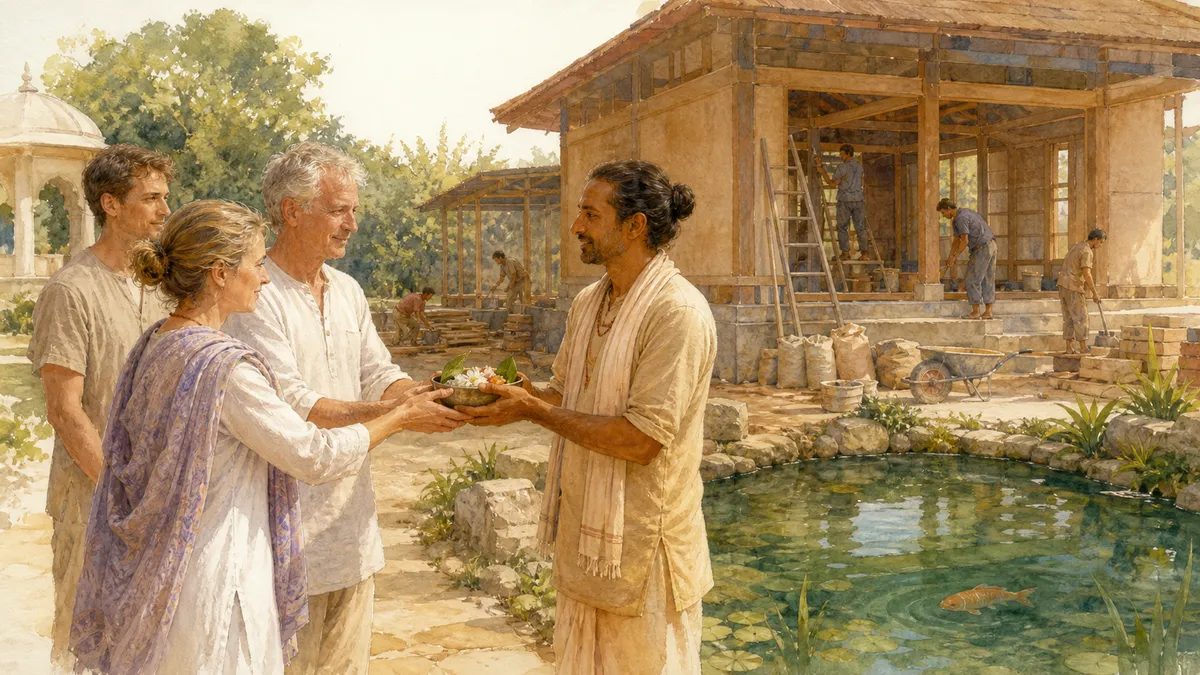
Yes, it does. But if, after collecting donations, you buy yourself a cake and eat it alone, without even offering it, and do so in an unconscious state, then this is the karma of hungry spirits. But if you bring the donations to the administrator, who distributes them, and those donations are used, for example, to commission a statue of a saint, build a temple, or construct a hall where laypeople can practice in retreat, then this is undoubtedly the accumulation of merit.
There is a story about this. A guru saw a fish lying on the ground. It was being devoured by many small fish. He concentrated, entered the samskaras of past lives, and began to weep, saying:
— Be very careful with donations, especially those given personally and connected with promises.
His disciples asked him:
— What is the matter?
He said:
— Do you know who this fish was in the past? He was a guru who performed exorcisms and practiced healing. He was very powerful and wise. He only had to look at a person for evil spirits to leave them immediately. But when he was asked to perform the transference of consciousness, he accepted donations and then simply said “phat,” because in fact he did not know the practice of transference of consciousness. And as a result, he was reborn in this form.
Illnesses as a Consequence of Karma
“There are people who suffer from numerous ailments from early childhood until old age. This is explained by the ripening of actions they committed in the past, when they took lives or tormented living beings. Such people should not think about how to recover as quickly as possible, but should repent of their past sins and vow not to repeat them in the future.”
When a person falls ill, they try to treat themselves with pills and use other methods of healing, thinking that the problem lies entirely in the organs. But in fact, a disease that manifests in the organs is merely a consequence. If you are familiar with the theory of Kundalini yoga and can feel the flow of prana in the body, you should know this. Diseases arise in the organs when there is an imbalance in a chakra, when the chakras lack the elements of earth, water, and fire. And why do the chakras lack earth, water, and fire? Because there are certain subtle-material obstacles that cause an imbalance.
According to some concepts, particularly in Taoist medicine, the human body contains three major spirits and eight lesser spirits associated with the organs. These are impure, untamed kleshas—energies that have become personified. On certain days, according to astrology, these spirits ascend to heaven and report to Chitragupta, the keeper of destinies, all the evil deeds and transgressions committed by a person so that their life may be shortened. Why do they want to do this? They want to free themselves from the body as quickly as possible and attain an independent existence. These spirits—personified impure pranas—exist in a person’s energetic, subtle body. Through practice, a yogi purifies these pranas, tames them, completely subdues them, and dissolves them. But until a person does this, they remain in the body.
Question: “Guruji, could you comment on the following situation: does karma accumulate if you accidentally step on a small living creature without seeing it—that is, if your body harms a living being, but this happens unintentionally?”
If the living creature is small, the mental imprint is insignificant, there is no malicious motivation, and there is an element of self-liberation or remorse, then the karmic effect is minimal. Nevertheless, one should always try to remain attentive.

Question: “Guruji, I have read that some saints emphasize that even the accumulation of good karma can distract one from practice. People think, ‘I will keep accumulating merit, and then I will practice.’ In other words, sometimes even the accumulation of good karma can be harmful in the sense that if you keep postponing practice, you will be born in your next life under such favorable conditions that you will have everything and will not even want to practice. You will have no problems and will enjoy excellent health. So it is not always right to place one’s hopes in the next life.”
Accumulating Merit and Contemplative Practice
In fact, this was said in a different context. It referred to laypeople engaged in the pious accumulation of merit, not to practitioners. In other words, those teachers were addressing laypeople specifically, telling them, “Be good, practice karma yoga, build, donate, love; you do not need to renounce anything or practice—just be good.” What this means is that if you simply remain good and merely accumulate good karma without practicing contemplation and awareness, then this will indeed become an obstacle to liberation. We, however, are speaking in an entirely different context: we are speaking about the unity of contemplative presence and actions connected with accumulating merit. There is therefore as great a difference between the two as there is between heaven and earth.
As an antidote to bad karma, one should strive to accumulate merit, avoid unwholesome actions, and so on. Because you took what belonged to others in the past, you will suffer from poverty. Even if you acquire a little wealth, you will either be robbed, have it stolen, or lose your property to an enemy in some other way. Therefore, those who have nothing should not make tremendous efforts to become rich, but should instead strive to acquire at least a spark of good merit.
Worldly people generally believe that one must work hard to become rich. Nevertheless, many of them fail to do so, even though they work hard.
I once said to someone, “Look! You have worked your entire life, but what do you have in the end? You have nothing. Perhaps something is wrong; perhaps you need to change your philosophy.” All his life he had thought that one had to work, while I kept telling him that he needed to change his consciousness. I said, “Look, your philosophy does not work, so try, at least as an experiment, to generate a different bhava.”
To change one’s consciousness, one must cultivate the attitude of a giver, of one who bestows gifts. This is the principle of accumulating merit. If a person accumulates merit, they automatically begin to assume the status of a giving, protecting, caring deity, and in worldly terms, the status of a deity implies wealth.

If in the past you did not practice generosity, which would have secured wealth for you in this life, then no amount of effort will help you now. Imagine how much wealth robbers and thieves obtain in a single haul. If they were always lucky, there would not be enough space on Earth to store their loot. However, those who engage in such a trade ultimately die of hunger.
In our world of karmic actions, everything you do in your youth will, for the most part, affect you later in the same life, while under special circumstances the consequences may come immediately. Thus, if, hoping to become rich, you engage in dishonest trade, steal, and so on—that is, act contrary to your own desires—you will not escape the realm of pretas for many kalpas, and even in this life you will have time to experience the consequences of your unwholesome actions. You will become increasingly poor and miserable. Even if you have some means left, you will not be able to enjoy them. The more you acquire, the more acutely you feel your poverty and need. And your greed is to blame. Your wealth becomes the cause of further unwholesome actions.
In other words, the cause here is the mind, which contracts more and more as a result of such actions. It closes in on itself and, as a result, becomes completely disconnected from the supreme Source.
Karmic Consequences of Unwholesome Actions
It is said that the consequence of the debauchery a person indulged in is that he will have an ugly, lazy, and wicked wife. We usually attribute quarrels, disputes, and mutual dislike between spouses to bad temper. Instead of hating each other, spouses need to realize that their bad karma has ripened and be tolerant.

This is not the worst thing for a monk. Perhaps it is even a blessing, because in this case one can become a monk sooner.
But in fact, this is a consequence that manifests as an experience corresponding to its cause—the debauched actions committed in the past.
What does “debauched actions” mean? It is lust in the mind and body that is not controlled, disrupts the state of awareness, clogs the nadis, causes the loss of prana, lowers apana-vayu, makes the mind contract, and renders it dull and primitive.
As a consequence of lying, manifesting as an experience corresponding to its cause, you will often suffer from the attacks and deception of others. Therefore, if you endure undeserved reproaches and accusations, you need to realize that this is the consequence of having lied in the past. Do not harbor hatred toward those who reproach you; do not quarrel with them. Rejoice and be grateful to them for helping you rid yourself of the consequences of many unwholesome actions.
An ordinary person cannot discern the subtleties of karma; the laws of cause and effect are unknown to them. They do not control events and think that they happen by themselves, but this, of course, is not so. Long before an event occurs, it has already been planned; it existed in the subtle body. The samskara was merely waiting for a favorable alignment of astrological factors, certain karmic currents, or the arrival of deities governing karma and accompanying spirits in order to unfold this situation. This situation had already been carefully prepared in the subtle body for a long time by the gods, the inner devatas. Then it unfolds, and the person thinks, “Why did this happen? How could this have happened?” But it existed as a hidden informational causal imprint and unfolded because this imprint resonated with circumstances that had become favorable for drawing out this karma and making it manifest.
The Enemy as Teacher
An enemy who repays your kindness with evil helps you in your practice. His well-deserved reproaches act like a whip, directing you toward virtue.
If you can apply pure vision when you hear something negative, you free the samskaras. If you apply self-liberating presence, the samskaras are liberated even if you simply transform them through the method of pratipaksha-bhavana, cultivating the opposite attitude and thinking: “He is helping me in my practice. In fact, he is a great friend of mine. Who else would train me in this way?” Then you have a chance to quickly cleanse your karmic imprints. But if you apply neither naked awareness nor pure vision, do not see everything as lila, and do not thank him, thinking that he is helping you in your practice, but instead seriously “buy into” the situation, then this is, of course, the worst possible option—you are completely captive to karma.

An enemy is a teacher who destroys attachment and prejudice. Understand that he is so kind to you that you owe him a debt you have yet to repay.
This means that an enemy, foe, or ill-wisher is the best guru, one who destroys your illusions through vajra—that is, wrathful—methods. How could you not be grateful to him? Perhaps you would otherwise have had to be reborn a couple more times, but he sacrifices himself and takes on your bad karma so that you may be freed from it.
Consequences of Unwholesome Actions of Speech
The consequence of slander is not only that there will be no harmony among your followers or servants, but also that they will rebel against you. For example, if you are the head of a monastery, your monks will not get along with one another; if you are an official, your assistants will not get along; if you are a householder, your servants will not get along. No matter how much you admonish them, they will neither listen nor obey.
It follows that I need to repent in such cases.
Because you uttered insulting words in the past, you will always hear hurtful speech. Moreover, your words will also be perceived as grounds for quarrelling. Insults are the gravest of the unwholesome actions committed through speech. Even the proverb says: “Words are neither arrows nor swords, yet they can wound the mind to death.” Insults instantly arouse anger in other people. But what is even worse, if you insult a holy person with even a single word, you will be unable to escape hell for many rebirths.
You must always be very sensitive to the samaya principles governing relationships, because you are all connected at the subconscious level; all of you constitute a single mandala. In the realms of the gods, the principle of samaya is paramount. Beings live there not because they are all registered as residing in the same district or hold citizenship in the same country, nor because they belong to a political party or share common interests, but because there is a shared wave of consciousness, the principle of samaya, a spiritual bond. In the realms of the gods, the principle of samaya—the principle of maintaining the purity of the spiritual bond—is very important. It is said that if someone violates the principle of samaya, the other gods also begin to suffer or fall ill. Then, using their divine vision, they determine who has defiled samaya or who is encountering obstacles, and they correct this imbalance. The senior gods, the guardians of equilibrium in the universe, determine where the principle has been violated and instantly remedy the violation. Such gods are called kinnaras or kimpurushas. You, too, must ensure that this balance is preserved within the sangha as a mandala and, of course, never commit actions that disturb it.
Learn always to speak courteously. In particular, remember that saints and bodhisattvas are not always easy to recognize. Therefore, it would be better for you to learn to regard everyone as a pure being, to speak of their virtues, and to praise their wholesome qualities. It is said that condemning or insulting a bodhisattva incurs a more severe punishment than killing all the beings of the three worlds.
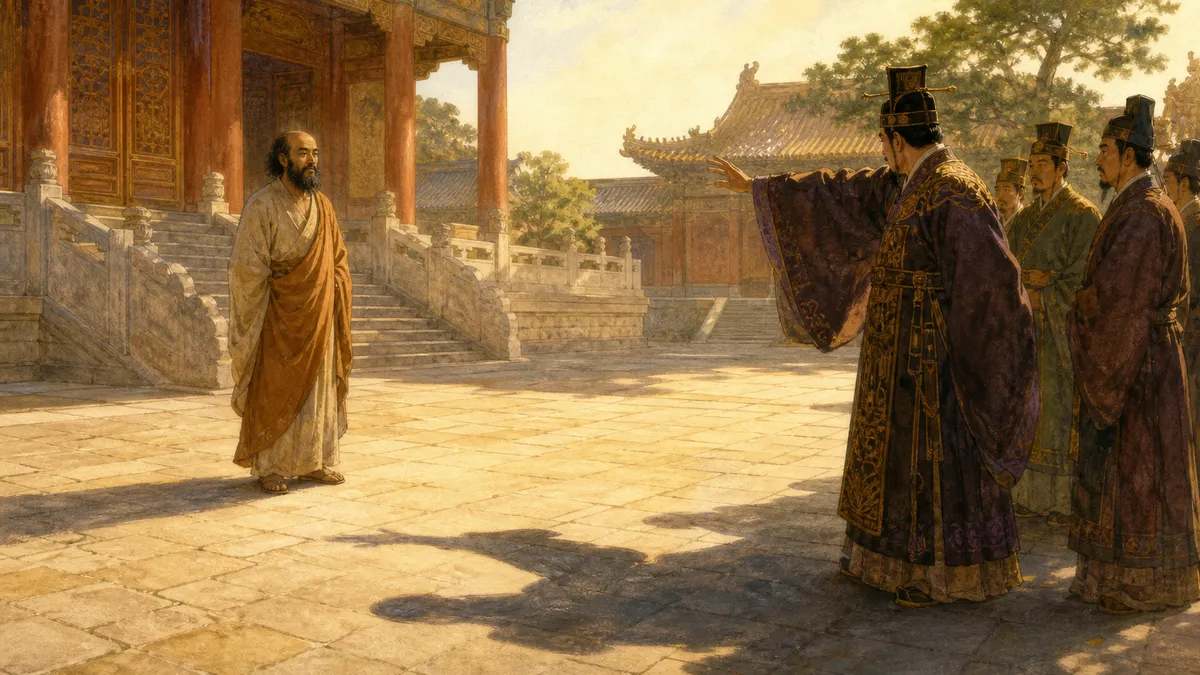
There is a story that Bodhidharma once met the Emperor of China. He was not recognized as a saint, and some officials even insulted him. When an imperial official insulted Bodhidharma, he said, “You will be punished for this insult and will die in twelve days. But I can heal you.” The official became angry and struck him. Bodhidharma said, “Then you will die in six days.” The official laughed and struck him again. Bodhidharma said, “Then you will die in three days.” The official struck him once more, and Bodhidharma said, “Then you will die today.” The official spat, said nothing, and left. That same day, he left his body. This did not happen because Bodhidharma had cursed him or practiced black magic. It happened naturally, because he was punished by his own inner deities. The official could not possess the clarity to see Bodhidharma’s spirit, his awakened consciousness, but the inner deities possess clairvoyance and therefore saw Bodhidharma’s awakened consciousness. Since the inner deities oversee the law of karma, reward or punish a person, and are not constrained by the human body because they care for the soul, his own inner deities inevitably passed such a sentence, and his karma was therefore cleansed instantly.
Karmic Consequences in External Conditions
The consequence of idle talk manifests not only in the fact that your words will carry no weight, but also in the fact that you will lose confidence and self-assurance. People will not believe you even when you are telling the truth, and you will never dare to speak before a large gathering.
Consequences ripening as external conditions. As a result of committing murder, you will be reborn in a bleak, gloomy land full of life-threatening ravines and precipices. As a result of taking what belongs to others, you will be born in lands where the fields constantly suffer from frost and hail, orchards bear no fruit, and famine prevails. As a result of sexual misconduct, you will live in repulsive places, amid excrement and manure, in filthy swamps and unhealthy regions. As a result of lying, your well-being will be unstable, your mind agitated, and your surroundings will always harbor danger. As a result of slander, you will live among impassable rocky gorges. As a result of insults, you will be reborn in a harsh region where there are only rocks, boulders, and thorny plants everywhere. As a result of idle talk, you will be reborn in a barren land where, no matter how hard you work, nothing grows, and the changing of the seasons is unpredictable and unreliable. As a result of greed, you will be reborn in a region with meager harvests and will endure many hardships because of poor environmental conditions.
Why does this happen? Because energy is emitted during actions, words, or thoughts. This energy emission is low or not self-liberated; it opens a person’s consciousness to other worlds: harsh, wrathful, and furious worlds. A karmic connection with these worlds is established through the subtle body, and then the spirits or deities ruling these worlds take note of the person. They remember him; that is, there is a mark within him that tells them, “This is one of ours. When his human karma is exhausted, we have the right to claim this person.” Such a mark is precisely a samskara. When a person enters the bardo, this mark in his subtle body is visible to the spirits or deities of that realm. They send their messengers into the bardo, saying, “This person did such-and-such during his lifetime. We have a claim on him; we must invite him to join us.” If these are the lower worlds, how is he invited there? They snag him with a hook, place a noose around his neck, and drag him away.
Naturally, when a person accumulates merit and performs good deeds, they create an astral connection with the higher worlds, and spirits and deities take notice of them. Their subtle body also bears the corresponding marks. Then they say, “During their lifetime, this person did such and such; they have the right to enter our abode.” The following scene often unfolds: when a person has both kinds of karma, with marks from different worlds, both divine spirits (devas) and spirits of the lower worlds may lay claim to them at the same time, and so a magical war breaks out between them. In the absolute sense, both the spirits of the lower worlds and the devas, angel-like beings, are manifestations of the primordial Mind, but until a person realizes this, they perceive them as external to themselves. Moreover, both kinds of manifestations possess energy (shakti), so one cannot shut them out simply by saying, “It is all an illusion.” Of course, one can say that it is all an illusion, but it is living shakti. It will not even ask whether you see it as an illusion or not; it simply acts. True self-liberation lies precisely in the ability to liberate a particular shakti, to tame it or bring it under control. And if such taming or self-liberation of shakti does not take place, then naturally it will not be an illusion; it is real. It is like a freight train: regardless of whether you consider it an illusion or not, it will keep moving and will not even pay attention to you. The same can be said of the shakti possessed by these beings.

As a result of ill will, you will be reborn in a country that is constantly exposed to danger from various disasters. As a result of false views, you will be poor and deprived of patrons and friends.
Understanding the Law of Karma and Liberation from It
If you practice awareness without understanding the principle of the law of karma, you can be called a nihilist, that is, someone who has strayed from the middle way of understanding. The law of karma is very complex. How it operates can be understood only after the elements have been completely dissolved. It is believed that a yogi, by concentrating on the manipura chakra and opening the fire element, can understand how karma works, see the consequences of the actions of body, speech, and mind, and how they take shape as images. In other words, the manipura chakra may be said to be the key to understanding the law of karma, causes, and effects.
The higher our level of awareness, the more independent we are of the law of karma. The deeper our pure vision and the more fully the single “taste” is developed, the freer we are from it. The deeper our presence and self-surrender, the more we identify ourselves with the Absolute, the less the law of karma affects us. However, the law of karma continues to influence us until we have completely dissolved the tattvas.
Levels of Liberation from Karma
How does liberation from karma take place? First, the mind, consciousness, is liberated. In other words, if you are a master of contemplation, you can be free from the law of karma at least on the level of consciousness. You no longer experience confusion, sorrow, bewilderment, despondency, or guilt. At least on the level of the mind, you can say, “This or that is all a consequence of obscured states. But in the highest state, everything is absolutely pure and perfect.” Or you can say nothing at all and simply remain beyond thought, in a paradoxical, spacious state, abiding in purity and perfection; then your mind does not contract despite the consequences of karma.
This is the initial level of self-liberation. Nevertheless, even if you can liberate the mind and your soul does not suffer, there are pranas that cannot be liberated. Such a person may enter a lower world, but they will maintain awareness. However, they will experience all the limitations of that world and will be unable to do anything about them; that is, their potential for enlightenment will be severely restricted. The most they can do is simply not suffer inwardly, but regard it all with philosophical calm and simply remain self-aware. They will understand that nothing can be done, that this is simply their karma, and they will be grateful for the events that happen to them.
A higher level of self-liberation is the ability to control prana, whereby one can subdue prana and control the elements. Then any karma that comes into contact with such a being is unable to affect them at the level of prana. At this level, a person can subdue spirits and alter dreams. If obstacles arise, they can dispel them through the power of presence. If planetary aspects align and an unfavorable astrological situation arises, bringing impure samskaras that lead to illness and suffering, by entering samadhi and abiding in presence, they can displace them. This means that, at the level of prana, they can self-liberate samskaras through the power of consciousness.
Finally, the highest level of freedom from karma consists in the liberation of the material elements—that is, in the ability to truly transform the five elements and fully control them, up to and including the transition into the rainbow body. This is the highest level of self-liberation, when karma cannot touch the yogi even in the slightest degree, when nothing exists any longer except pure vision.
The Path to Divine Karma
How should one live in order to minimize karmic consequences? It is necessary to practice awareness and pure vision in order to accumulate merit and minimize obstacles during one’s lifetime. In other words, one must become a deity, become divine in the relative dimension of energy. If you become deities at the level of pranas or bhava, your life is prolonged, your body is always healthy, you never encounter obstacles, you have favorable conditions for practice, residual karmas do not affect you, and you are fortunate in sadhana.

To acquire the karma of a deity means becoming an exceptionally fortunate practitioner, known as divya (divine). Such practitioners attain liberation in this very lifetime. If, however, a yogi does not possess the qualities of divya but has, for example, the qualities of pashu, they encounter a great many difficulties in practice. Even with transmissions and good conditions for practice, they are forced to struggle fiercely against their karma, which repeatedly manifests as worldly desires, impure dreams, illnesses, and unstable situations. If this occurs, there is no other way but to work on strengthening pure vision and deva-bhavana—that is, transforming oneself into a deity.
