

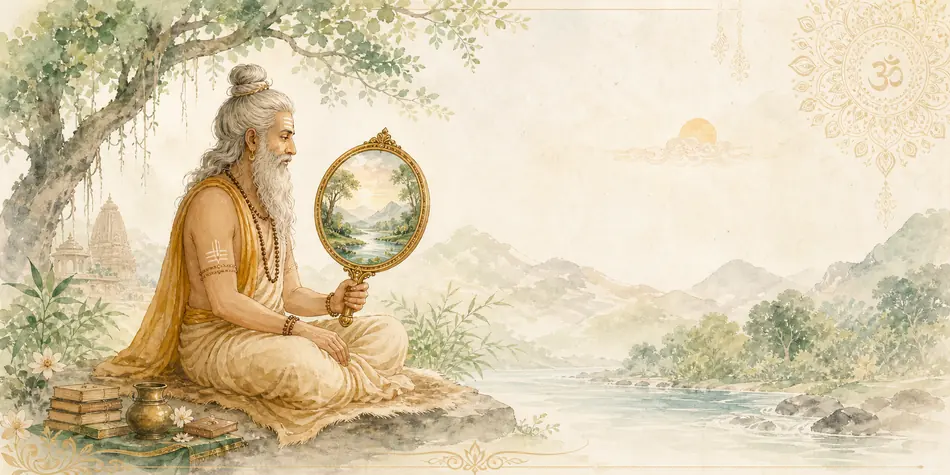
Commentary on the text “Tripura Rahasya,” Chapter 18, “On the Unity and Indivisibility of the Supreme Essence.”
“For the Supreme Essence is always self-luminous and nondual, and it displays the diversity of phenomena just as various reflections are seen in a mirror.”
In the teaching tradition, primordial awareness is often compared to a mirror. The metaphor of the “mirror” is also frequently used in Tibetan Anuttara Tantra. It points to the fundamental ground that serves as the basis for all manifestations. All manifestations are like reflections. The mirror itself is not tainted by the reflections. For example, if we place one object, two objects, a thousand, or a million objects in front of a mirror, we cannot say that the mirror somehow identifies with these objects or becomes soiled. Essentially, no matter how many objects are reflected in the mirror, they do not affect it. This metaphor illustrates the principle of the stainlessness of primordial awareness.
When we come into contact with various objects, we perceive not reality but merely reflections. To perceive reflections means to remain in duality and in the perception of a multiplicity of objects. When we perceive reality, we see the mirror as the true ground, and we see everything that manifests as the play of these very reflections.
A Radical Change in Our View of the World
The aim of our spiritual practice is to radically change our habitual view of the world. What we think about the world is, in fact, merely our habitual view. But the habitual view of the world we have adopted is not exactly wrong; it is simply one among many different views. It is flawed, it causes suffering, and it makes us limited and mortal; therefore, in the course of spiritual practice, we must change ourselves in such a way as to change our view of the world.
From the standpoint of the ordinary view of the world, a dog is a dog, a person is a person, and a monk is a monk; they all live with their own small meanings and goals. But from the standpoint of Advaita, everything is seen completely differently. A holy sage looks with equal eyes upon a dog, a dog-eater, a humble Brahmin sage, and a monk. He sees them through the eyes of unity. For him, they do not seem to exist, or they exist only conventionally, because the jnani sees them in unity; he sees them as Brahman. Neither the dog, nor the Brahmin, nor the monk does anything in and of themselves. Moreover, from the standpoint of Advaita, they do not exist at all; there is only the one Absolute, which plays through its energies, manifesting as a dog, a Brahmin, a monk, a layperson, and so on. This is the most radical view of the world imaginable. But the saints affirm that it is precisely this view of the world that frees us from suffering, illusion, and ignorance.

View as the Foundation of the Spiritual Path
To change one’s view of the world is, essentially, to acquire the View. We have already said that there is such an aspect of the path as the View. In the tradition of Laya Yoga and Anuttara Tantra, it is generally said: “What matters is not so much meditation as becoming accustomed to the View.” That is, we must become accustomed to a different view of the world and become fully established in it so that we are no longer misled. Another term for this view of the world, the View, is karmic vision, loka-drishti—that is, a perspective associated with a loka, with a particular level of the world.
The Karmic Vision of Different Worlds
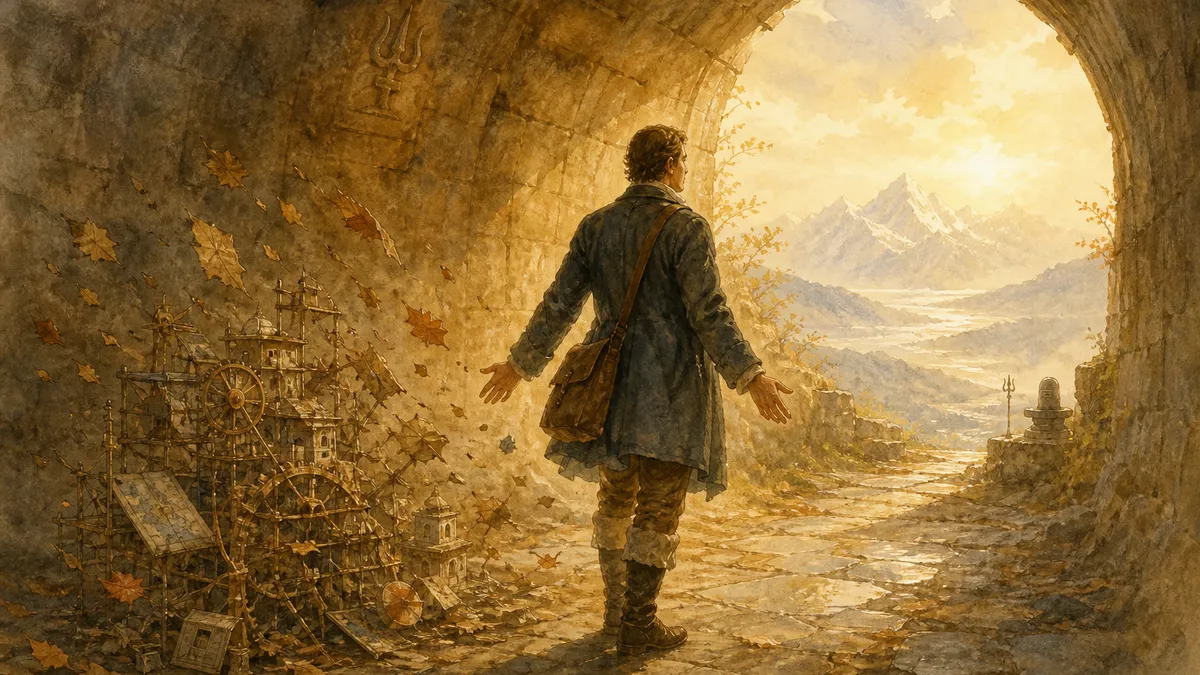
All living beings have a particular view of the world, a particular karmic vision. For example, hungry ghosts abide in a narrow worldview. Their view of the world is such that even if you wanted to offer them a glass of water, they would be unable to drink it because their consciousness would corrupt the water, and upon drinking it, they would feel terrible pain and burning. In their karmic vision, in their view of the world, water turns into some kind of burning acid or something unpleasant. They themselves created this view of the world through their past actions. One could say that they have driven themselves into such a tunnel of reality. And it will take an enormous amount of time to cleanse their consciousness of this habitual view of the world.
What about the asuras? In the world of the asuras, whatever you say will be regarded with great suspicion: either as a challenge to fight or as an act of hostility. And no matter how much you try to convince them of your pure intentions and sincerity, they will treat you with skepticism, try to anticipate your intrigues, and at the same time devise plots to neutralize them. This is the asuras’ worldview, and nothing can be done about it. They have placed themselves in a tunnel of reality where the world consists of rivalry, hostility, suspicion, sophisticated stratagems, great clarity, and so on.

Likewise, the world of the gods has its own particular vision. When the gods interact with living beings, they perceive them in an exalted way, even though they see their limitations.
Tunnels of Reality and Liberation
Living beings place themselves in a particular tunnel of reality through their previous actions. This is karmic vision, loka-drishti. There are as many such tunnels of reality as there are units in infinity, and our tunnel of reality—the human one or that of practitioners—is one among an infinite multitude. People who more or less share the same karmic vision and a common tunnel of reality come together. They form a single race, civilization, ethnic group, or an entire world—a loka. The fundamental basis that gives rise to lokas is precisely the existence of a particular karmic vision. In other words, it is not matter but consciousness that determines being. It is consciousness—karmic vision—that determines the structure of the elements, matter, and so on.
When we speak of liberation, it means that we must free ourselves from our habitual worldview, habitual outlook, and habitual karmic vision, because if we continue to cling to it, it will continue, since it is infinite, just like any other karmic vision. That is, this universe of attachment will never end, because this energy is infinite, as it emanates from the Absolute. There is an infinite energy of ignorance, stupidity, and tamas; there is an infinite energy of struggle, games, sexual desires, and refined pleasures; there is an infinite energy of clarity—all these are lokas that are not limited by anything. But when we, living beings, jivas, enter these energies, we manifest within them in a limited way, that is, as finite beings subject to the law of reincarnation. This is precisely why it is said that such tunnels of reality are unsuitable for us. In other words, the six worlds of samsara are an abode of sorrow and suffering, a realm of delusion, the terrifying wheel of the cycle of birth and death. These are not so much worlds through which the soul travels; rather, they are different tunnels of reality or levels of karmic vision, and all of them are unsatisfactory. We usually begin spiritual practice precisely by contemplating the unsatisfactory nature of all these tunnels of reality into which our consciousness is placed. As a result of such contemplation, a strong desire arises to free ourselves from the cycle of birth and death, escape samsara, and attain liberation.
The Illusory Nature of Birth and Death
Why do birth and death exist at all? Why must we be born, die, and be reborn? Who established it this way? Could all of this not have been avoided? In reality, birth and death are not immutable. They exist only in our karmic vision, in our worldview, in our tunnel of reality. In the world of the gods, birth and death do not exist. The gods are immortal; they are not born as humans are. In the world of saints, gods, and rishis, such concepts do not exist at all. They have different concepts of space and time, and there is no law of cause and effect. In higher dimensions, worlds consist of play, love, harmony, immortality, creative energies, and awareness. Compared with these worlds, our world is a prison, something like an abandoned barracks for criminals serving their sentences; moreover, they do not fully understand how they should work with their consciousness, how to behave, or what they need to do to escape from it.

Those who regard it as a field for entertainment and pleasure are gravely mistaken, and life will inevitably prove this to them. Sooner or later, they will realize that they live in a world they do not control at all; on the contrary, this world controls them. They will certainly understand this, but it will be far too late. Whatever plans a person may devise, whatever dreams they may hope to fulfill, a moment will come when they will be unable to control even their own body, and will no longer be able to engage in their usual activities or move about. Others will gain power over them (relatives or people in white coats, for example), while they themselves will be unable to control either their life or their body, let alone experience any pleasure.
The Need to Control Universal Energies
Only a shortsighted person strives to obtain pleasure in this world. A farsighted person understands the unsatisfying nature of reality; they understand that they live in a world of uncontrollable energies, that their individual personality does not count for anything here and may be swept away by these universal forces at any moment. Realizing all this, they make every possible effort to change their karmic vision, to shift themselves (their consciousness) into a tunnel of reality in which they begin to control these universal forces, so that they no longer cause them any problems.
The simplest example is Alexander the Great, who conquered half the world, but was he able to control his death or his rebirth? All his achievements were useless in this respect. The world knows great rulers and founders of entire civilizations, but even their immense power did not enable them to control their bodies, their lives, or their deaths. They all had grandiose plans, yet they did not consider how it would all end. They lacked the clarity to assess the situation correctly; their assessment of the world was mistaken. For example, if Hitler had known in advance how his invasion of the Soviet Union and the Second World War as a whole would end, would he have embarked on the whole Third Reich venture?
It can be said that most undertakings in the material world end in failure because, sooner or later, the living beings engaged in carrying them out encounter a situation in which they cannot control the energies that dominate this world. In particular, one of the strongest energies is the energy of the destruction of the physical body, disease, suffering, old age, and death. When we reflect on this, we understand that it is impossible to find happiness within this karmic vision. We have driven ourselves into a tunnel of reality in which, no matter how hard we try, we cannot attain complete satisfaction because we cannot control the energies of this world. It is precisely then that we come to understand the need to free ourselves from such a vision. We conclude that we must change our habitual view of the world, because until we do so, we are doomed to suffer, no matter what we do or what we think about it.
Overcoming the Illusions of Conditioning
People often have certain fantasies or illusions: “My purpose is such and such,” or “Everyone must build a house, plant a tree, and raise a son.” All these are illusions within our habitual view of the world. That is, all of us, all living beings, are completely conditioned and bound by this view of the world. Whatever we may think, whatever we may imagine, whatever we may absorb through our upbringing or under the influence of society, all of it is useless in the face of our global limitations, because minor changes do not work in this case. This is precisely why the saints of antiquity set us a very radical example, urging us to abandon our habitual view of the world and attain complete liberation from the six realms of samsara. By complete liberation, they mean the formation of a new view of the world that is far broader and deeper. It is a state in which the subject is united with the object; it is the world of nonduality. Only then will you be able to control universal energies through the power of consciousness without any problems or suffering.
The Illusory Nature of Creation
“Therefore, dismiss creation as a mere thought or series of thoughts, and realize the nondual, residual, and pure mind as the supreme Essence.”
The theory of the creation of the Earth and the universe, our perception of the Earth, stars, and planets, the laws of physics, cause-and-effect relationships, ethics, aesthetics, kinship and marital relations, science, culture, art, philosophy, and our way of life—all these are parts of our karmic vision, our reality tunnel. They seem real only as long as we remain within this karmic vision. But as soon as the karmic vision changes, they can all be regarded as illusions. And when the saints say that the world is an illusion, this is exactly what they mean: the world is real for you only to the extent that your karmic vision is real, to the extent that you are immersed in a particular reality tunnel, in a familiar worldview. But as soon as you step outside it, this world dissolves without a trace.
Subconscious Belief in Familiar Reality
In other words, on a subconscious level, we believe very strongly in this world; we constantly renew and reinforce this belief, which is formed roughly by the time we reach sexual maturity. One might say that we are constantly reciting a kind of “creed”: “I believe that I am a human being of such-and-such a sex. I believe that the Earth is round, that there is a Sun, day and night. I believe that I am mortal.” And so on. This vision of ourselves is the object of our unceasing belief, upon which we “meditate” twenty-four hours a day. This belief has taken very deep root at the subconscious level, which is precisely why the spiritual path is so difficult. Even when we try to attain true “I Am” awareness, our subconscious belief in the familiar worldview constantly makes us forget it. And this will continue until we finally displace the old belief in the samsaric reality tunnel entirely, replacing it with a new level of awareness.
Pure Vision as a Way of Life
To enter the state of Advaita means to begin believing in a different worldview, to change one’s belief completely. We do not mean religious faith in the form of dogmas or a system of theology. We mean belief in a particular worldview to which we are accustomed and which we trust. Usually, when pure vision is mentioned, everyone smiles: “Oh, how wonderful! What an interesting technique.” But the saints speak of pure vision not as some special technique applied only during practice itself; they speak of pure vision as a way of seeing the world. In other words, their pure vision truly manifests in the course of their lives—they actually live that way!
Methods for Changing One’s Worldview
What, then, is the key to changing our familiar worldview? We should not mistakenly think that we can easily change our worldview simply by practicing a little atma-vichara. This is impossible because we share our familiar reality tunnel with billions of other living beings. It is “encoded” in our genetic memory and in the collective unconscious, so it will not simply let us go.
At first, such a worldview is transmitted through the profound study of sacred texts, which must continue until they become our way of thinking. Studying sacred texts does not mean memorizing them like a schoolchild, but rather attuning ourselves to their spirit. At least, this is the only thing we can do at the initial stage. Then immersion in the new worldview occurs through communication with a spiritual teacher, and only afterward through meditation and the development of awareness, because meditation and the development of awareness are the most difficult. This is precisely why the sacred texts insist on intellectual training, Guru Yoga, and transmission. If we have not absorbed a higher karmic vision through texts and communication, it is very difficult for us to absorb it through awareness; the process of awareness is very subtle, and so it is easy to make numerous mistakes, as the overwhelming majority of practitioners do.
Guru Yoga as the Synchronization of Vision
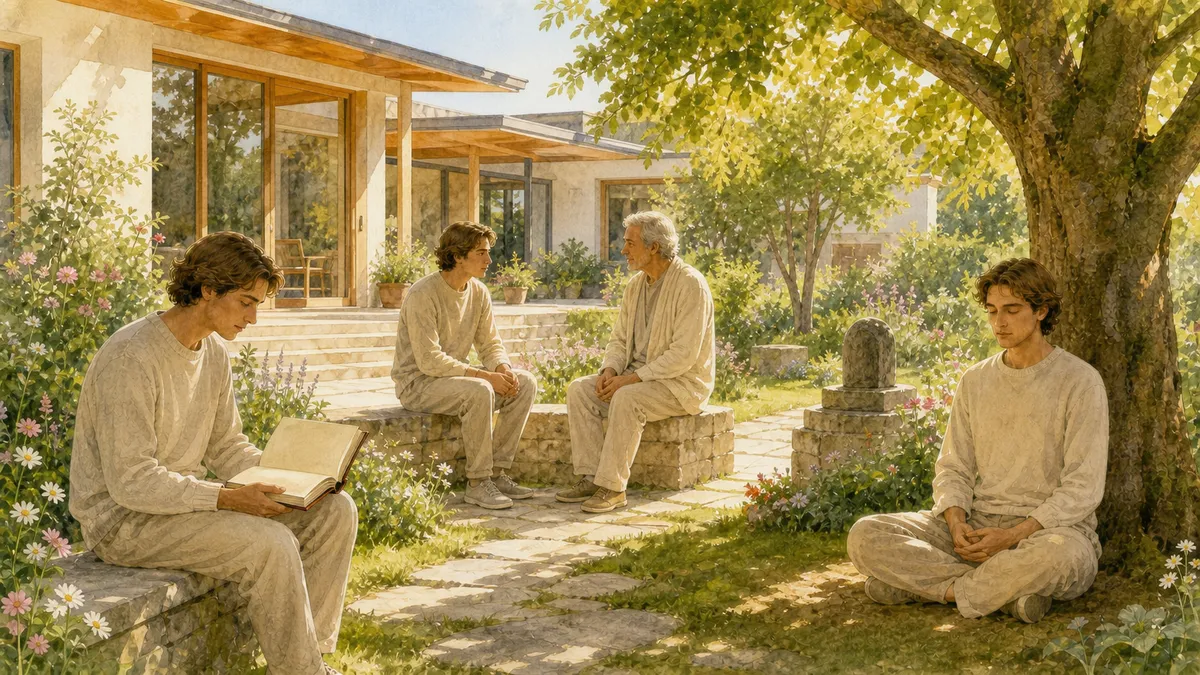
Guru yoga is the process of synchronizing the worldview of the disciple with that of the spiritual teacher, deity, or saint with whom the disciple unites. In the course of this synchronization, the disciple discovers that they are gradually moving into another reality tunnel, where they begin to perceive reality differently. In other words, from a siddha’s point of view, certain events are seen one way, while from an ordinary person’s point of view, they are seen differently.
The True Goal of Spiritual Practice
“If the body and creation are transcended and the supreme Self is realized even once, the result is wisdom that will destroy ignorance and end the cycle of birth and death.”
Many people believe that the goal of spiritual practice should be certain visions or energetic experiences. In fact, of course, this is not so. Neither visions nor energetic experiences, nor even the cessation of breathing and immersion in samadhi, are the goals of spiritual practice. These are merely intermediate stages and steps indicating that you are moving in the right direction. You can become a Buddha without experiencing a single vision or stopping your breath even for a second, because these are bodily processes associated with the pranas. For example, arhats without signs of siddhis were described in the Buddha’s community. That is, they possessed neither the six divine powers nor clairvoyance, yet they were fully awakened; the completeness of their enlightenment was beyond doubt and was attested and confirmed by the Buddha himself.
The Five-Part Formula for Changing Karmic Vision
The goal of spiritual practice is precisely to change one’s habitual picture of the world, enter a different karmic vision and a different view, and fully identify with this new view. Naturally, a different view and a different picture of the world entail a great many experiences, but they do not necessarily manifest as visions or energetic experiences of some kind. For us, the primary means of changing karmic vision is the principle of maintaining awareness—contemplation.
It usually begins with the disciple logically clarifying for themselves the five-part formula that shows exactly how to change karmic vision. It is said that first you must learn to reduce everything to the mind; that is, you must understand that everything depends on you and that everything that happens is connected specifically with you, with your “I am” awareness. When a person suffers, becomes irritated, and regards external objects as the cause of their difficulties, this means that they simply do not understand the first link in this five-part formula. When a person understands the principle of “reducing everything to the mind,” they know that in reality no problems exist; there is only the absence of the witness (sakshi), the observer. “Reducing everything to the mind” is the practice of atma-vichara, or the practice of naked awareness. If you have understood and realized the principle of “reducing everything to the mind,” you are now the unaffected witness, the observer who is beyond judgments and concepts.
For example, some disharmonious situation arises. But if you reduce everything to the mind, this means that you observe the situation instead of forming judgments and becoming entangled in it. While remaining in a state of observation, you see that there is a distance between you and the situation, that the situation exists as if on its own, while you exist on your own. If you have discovered consciousness that exists on its own, how can the situation cause your suffering or difficulties? Most practitioners who cannot understand this principle are at the very initial level of spiritual practice and experience many difficulties.
The second part of the five-part formula states that the mind must be reduced to emptiness. This means the following: when we discover the independent consciousness of the witness, which exists on its own, we must analyze it deeply and determine that the witness as such is absent, while there is an emptiness resembling space; it has always existed, but previously we did not recognize it because we were inattentive to it. The very fact of a person’s attentiveness to this empty ground begins to actualize it, turning all problems into illusions, while inattention to it pushes it into the background, and then material problems reappear, changing from illusory into real ones. This is the essence of the two paths: nirvana and samsara.
Why do hungry ghosts, humans, animals, or asuras suffer? Because they fail to properly recognize the witnessing “I am” awareness and its emptiness. They fail to draw inspiration and strength from this awareness, even though it is a tremendous source of creative inspiration and even of power and energy (shakti). It is this awareness, and nothing else, that is the inexhaustible source of the gods’ power (aishvarya-shakti) and the mighty shakti capable of controlling even the elements. For example, if a person recognizes the emptiness of this awareness, they attain great clarity, their creative powers unfold, extraordinary abilities manifest, and they successfully express themselves in any situation. Regardless of the material circumstances, they are able to bring them under control and turn them to their advantage. But if a person does not recognize this awareness and its emptiness, they are, of course, cut off from the Supreme Source; therefore, they lack inspiring power and can make decisions only at the level of manas (the conceptual mind).
Liberation from Sankalpas
“Moksha (liberation) should not be sought in the heavens, on earth, or in the lower realms. It is synonymous with Self-realization. Liberation is simply the manifestation (realization) of the pure natural state of one’s higher Self as a result of becoming free from sankalpas (thoughts or imagination).”
Ordinarily, we all very strongly share the view of reality customary in the human world, without even realizing it. We have identified with these ideas for a very long time, and so they have become deeply rooted in us. Nevertheless, all these habitual notions are in fact nothing more than an illusion.
When the emperor came out with his retinue to meet Bodhidharma, Bodhidharma placed a shoe on his head, wishing to show that his worldview, his karmic vision, differed radically from the emperor’s, and therefore he saw no reason for contact. When the emperor asked what rewards he would receive for having erected many stupas and statues and made many offerings, Bodhidharma replied, “The seventh hell.” The emperor did not like this at all. Of course, according to our habitual worldview, the emperor should receive great merit for making offerings, creating statues and stupas, and performing other virtuous deeds. From Bodhidharma’s perspective, however, all this was entirely unimportant and insignificant. In this way, he wanted to tell the emperor that these merits would not save him anyway, because without a fundamental change in his worldview, all of it was useless. He said, “Much more is required for liberation—you must change everything! Your illusions will not help you in any way.” Bodhidharma’s thinking was several orders of magnitude higher than that of Emperor Wu.
Ordinarily, we must cultivate virtues, accumulate merit, and create positive karma, and this is absolutely necessary in order to accumulate sattva, radiance. Yet this in itself is not liberation. Having accumulated enough sattva, one can be reborn in the pure lands; however, the liberation we are speaking of entails a change in karmic vision, and karmic vision can be changed only through the development of the principle of awareness.
It says here, “As a result of liberation from sankalpas.” Liberation can be attained as the manifestation of the pure natural state when we free ourselves from sankalpas. Sankalpas are the dualistic states that fill us. The pure natural state is always obscured by them. It cannot manifest as long as we are filled with sankalpas with which we identify. In other words, the heaps of our dualistic notions must dissolve, and only then can the primordial natural state manifest.
Often, a person does not even notice these dualistic notions. It takes a great deal of time or tremendous clarity for one to become aware of them within oneself. Dissolving them is an even more difficult task. It requires constant, unceasing vigilance in maintaining presence. For example, imagine that right now the roof disappears and ten tons of icy water pour down on you. Your mind will immediately react: “What is this? Why?” It begins to judge, protest, and generate various thoughts about it. In this case, the icy water is a secondary cause that triggers your hidden sankalpas. Only if no judgments arise within you at the moment of such a perception and your awareness is not obscured can it be said that you have no sankalpas. The same is true of all other situations.

Dissolving Dualistic Notions
A person as such is filled with inner sankalpas and dualistic notions, but these sankalpas can manifest only when a certain situation arises; in other cases, they remain unmanifest and hidden. Saints usually say that attaining the single “taste,” when all dualistic notions in the stream of our mind dissolve, is liberation itself. Notions of good and evil, pure and impure, right and wrong, truth and falsehood, sacred and mundane, past and future, finite and infinite—all of these are dualistic notions generated by our habitual worldview. To realize nonduality means to synthesize and unite all these dualistic notions into one and become free from them. But how can such fundamental dualistic notions as, for example, the past and the future be dissolved? Only if we immerse ourselves in the unified Sphere that is always in the present. Then we understand that time as such does not exist; there are only fluctuations of the mind and consciousness moving in different directions, which means that they all constitute a single mass in which there is no division into past and future. It is precisely at this stage that the yogi attains prakamya-siddhi (independence from the flow of time).
The movement toward holiness is a movement toward ever-greater integration with the view of the saints, the gods, and Advaita. When a yogi’s karmic vision begins to grow sufficiently profound, the gods and saints begin to notice him and visit him in dreams or meditations—this is one of the signs of progress, indicating that his consciousness is being elevated.
