

Commentary on Sri Ramana Maharshi’s text “Collected Works.”
You may regard this satsang as a continuation of the commentary on the chapter “On Self-Inquiry” from the text by Sri Ramana Maharshi.
“In order to follow the highest teaching, we must possess qualities suitable for those fortunate disciples who are capable of benefiting from the teaching. These qualities are: great faith, great determination, and great understanding.”
Possessing these qualities, we can truly benefit from the Teaching.
Great faith means that in this life we have made the great decision to follow the path of the saints to the very end. That is, we have decided to follow the path of the saints rather than that of ordinary people, rather than that of laypeople, and to follow it to the very end—not one-third of the way, not halfway.
The very act of making such a decision is great determination. This means that we challenge ourselves. And when we realize this challenge, for example, by taking monastic vows, we may be surprised or even frightened. On the other hand, when we realize that there is no other way out, since Reality itself has issued an even more radical challenge to us by placing us in samsara, giving us a body, and causing us to be born here without our knowledge, then making such a decision is an adequate response to the challenge posed to us. We have been challenged in the form of birth and death, which means that once we are born, we will inevitably die; therefore, making such a decision is adequate—there is nothing particularly heroic about it.
Finally, great understanding means that we clarify the very heart of the dharma. This is the meaning of following the practice of the Teaching. Great understanding means that we try to develop the level of understanding spoken of by the Guru and the sutras. Once I asked a nun who was outside the ashram several questions, knowing her condition. In response, she sent me a blank sheet of paper. I thought, “If she is satisfied with such understanding, then there is no problem.” However, I would not do that. Concepts are not the teaching, but they can be used to reveal the teaching.
The Nature of Reality and Karmic Vision
“When you perform the practice, as a result of the practice you will see that everything is created by your thought. And when you finally realize this, you can trace its Source. All things are created by your thought and mind. If you trace the Source of your thought and mind, you will discover that it disappears. It disappears and returns to its natural state.”

The holy siddhas assert that reality is continuously projected by us from within outward. That everything visible is nothing more than a magic trick, a magical show, a great hologram, a skillfully created virtual reality. That all external objects possess as little inherent self-existence as reflections in a mirror: no matter how much we search, not one of them is self-existent, possesses its own nature, has independent existence, or possesses self-existence. They all possess the nature of emptiness and arise from a single source—Consciousness. Although they continuously manifest in miraculous, magical, and infinitely diverse ways, nevertheless there is not the slightest trace of an inherent essence in them. This continuous reality is constantly produced by our own consciousness. However, when it is projected by our own consciousness, due to a lack of discernment we cannot distinguish the projection of this Reality from consciousness itself. Then we fall under the spell of our own projections. When we fall under the spell of our own projections, it resembles a person who has gone to a movie theater and forgotten that he is in a movie. He experiences everything together with the protagonist: he cries when the protagonist cries, is terrified by the dangers threatening the protagonist, and becomes attached to the same people to whom the protagonist is attached.
What does it mean that all external things lack self-existence? It means that neither the gods, nor the heavens with their gods and palaces, nor the hells with the beings suffering there exist outside karmic vision. They do not possess their own nature, but are merely the perceptions of sentient beings. All six realms of samsara are like this.
This does not mean that such perception cannot have an effect. The suffering of hell beings is as real as the pleasures of the gods. Nevertheless, these realms are created by karmic vision, and karmic vision is the result of the perceptions of gods or hell beings.
What does karmic vision mean? It is a way of seeing the world that depends on secondary causes or past impressions, on previously accumulated karmic traces. These traces are called “samskaras.” In other words, beings perceive this world in accordance with the causes that were created in the stream of their consciousness. Therefore, hell beings, looking at a river, see a river of fire, gods see nectar, asuras see weapons, humans see a river, and animals see a habitat. It is the same substance, yet each sees it differently. Why do hell beings see a river as a river of fire, while gods see it as nectar? Because they have different perceptions conditioned by past samskaras or accumulated causes. In other words, they project different states from within themselves. These projections are, as it were, superimposed on the original Reality and seem to obscure it. They cannot obscure it completely. Moreover, in the absolute sense, they do not obscure it at all, but it appears as though they do. Then a living being becomes captivated by this magical show and begins to believe in this virtual reality projected from within itself. All this happens because of ignorance, because of a lack of discernment. A lack of discernment is a weakness of consciousness, a lack of depth in consciousness.
Spiritual Practice as the Removal of the False View
Spiritual practice is the removal of the false view. And what is called liberation and enlightenment is the removal of false perception of oneself and the Universe. The meaning of jnana yoga lies precisely in removing misunderstanding of oneself and the world, in removing the false view. As soon as the false view is removed, we acquire the true view, and then no attachments or illusions are possible. Therefore, jnanis do not share the views of ordinary people.
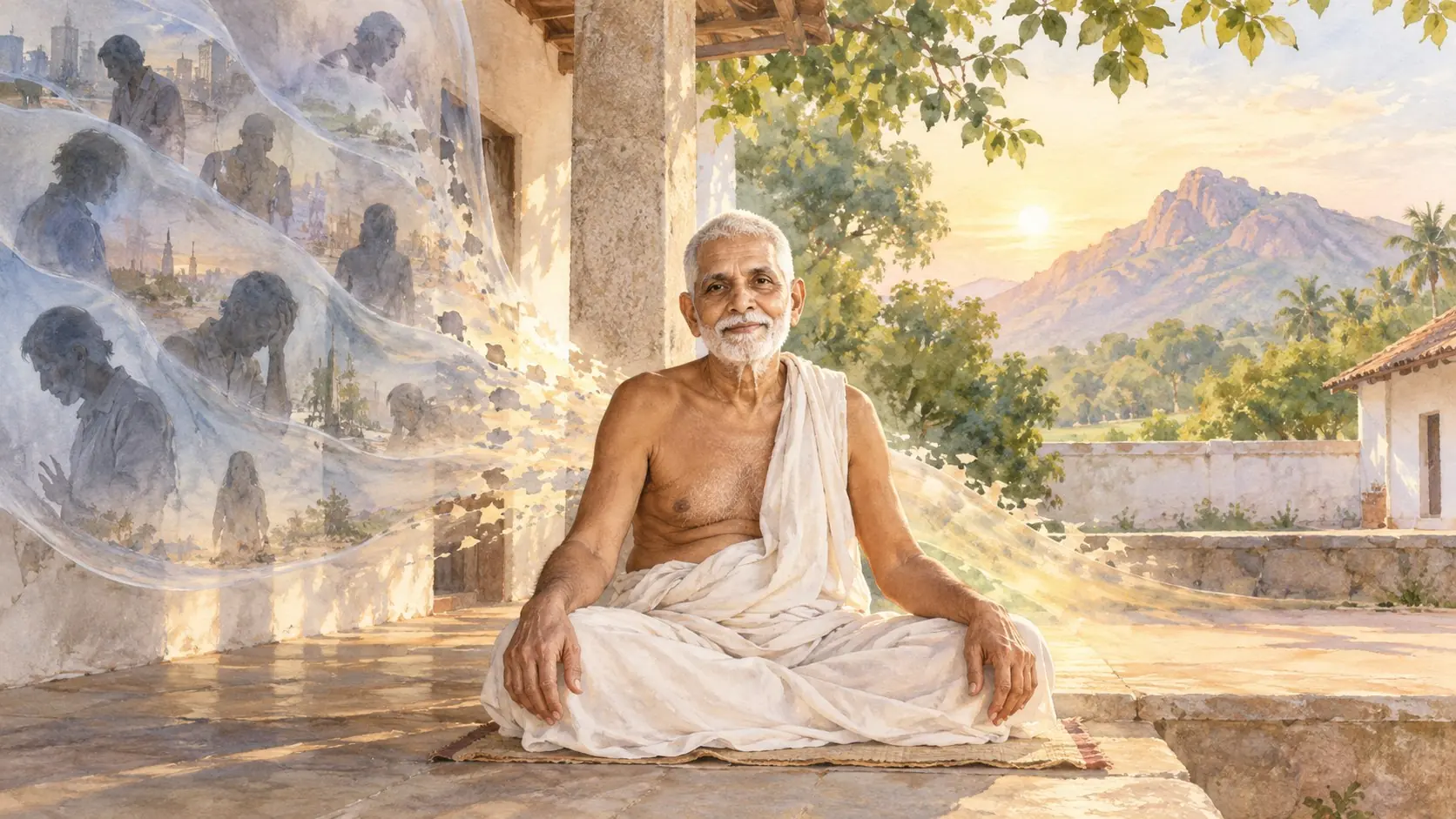
Once, a disciple came to Bhagavan Sri Ramana Maharshi and said:
— Bhagavan, feeling great compassion, you, like a caring mother, look after us day and night so that we may move toward enlightenment. You feel great compassion for us.
Ramana smiled and replied:
— A true jnani never feels this.
This should be understood correctly. It does not mean that he does not feel compassion; however, his compassion is not like the compassion of ordinary people. If it were like the compassion of ordinary people, he would not be able to help.
Ramana then explained:
— While feeling compassion, a jnani does not see other people, he does not see suffering, he does not see suffering beings, and he does not see himself helping other beings. Nothing of this sort takes place in his consciousness. From the outside, it may seem to someone that he is helping, that his body is doing something. Nevertheless, in his true state, nothing of the kind is happening, because if something were happening, he would not be a jnani.
This is so because one who is established in the state of the Source knows the magical show as a magical show; he never becomes attached to it and attaches no importance to it. When false views have been removed, this is possible in principle.
What gives rise to suffering, attachments, and so on? The cause is false views, ignorance. What gives rise to anger, fear, and insecurity? The cause is ignorance. We do not know who we really are, and therefore confusion overwhelms us. It is like a person looking into a mirror and trying to grasp the objects reflected in it. But no matter how many attempts he makes, they will all be unsuccessful, since none of these objects has ever existed. When we experience attachments, we are like such a foolish person. When we become angry and project something, we are like a person threatening his reflection in the mirror or making demands of it. Understanding the principle of the mirror and reflections, we understand the utter foolishness of this and smile. We have gained knowledge, so now reflections and projections will never mislead us again. We no longer dwell in reflections; we are no longer part of the projection, but abide in the state of the mirror, and therefore the magical show ceases to influence us.

The Source of All Manifestations
“All things are created by your thought and mind. If you trace the source of your thought and mind, you will discover that it disappears. It disappears and returns to its natural state; this is the limit. And every single thing is dependent on the mind. All worldly life, all beings in the six realms—everything is in the same position.”
The aim of the practice is to put an end to all illusions in worldly life and to realize that all of this is created by our mind. That is why it is said that the world is like the ordinary mind. Projections in themselves are neither bad nor good. From the perspective of understanding, they are energy that is miraculously and continuously emanated from the source of our “I.” “Projected by the mind” does not mean that we ourselves project them; it means that they are projected by the essence of our mind, which is Brahman itself. But when we become attached to projections, they condition our consciousness, and therefore we fall into slavish dependence on them.
There is a story about a man who successfully sold hay and bought a sack of grain. He hung this sack of grain from a ceiling beam. Then, pleased, he lay down on his bed and began thinking about how he would sow the grain and how a harvest would grow. He imagined that, after gathering the harvest, he would sell it successfully, and thus be able to buy even more grain. When he sowed the grain again and sold the harvest, he would buy himself a horse, and would even have money left over to build a house. Then he dreamed that, with such property, the best girl in the village would certainly want to marry him and that he would have a son. He even began dreaming about what he would name his son. He looked at the moon and thought, “I will name him ‘famous as the moon.’” But while he was dreaming in this way, he did not notice a mouse making its way along the ceiling beam and gnawing through the rope with which the sack was tied directly above his head. The sack then fell on his head and killed him.
When we daydream and create projections, we fall into slavish dependence on them. In the end, we discover that we are left with nothing, having taken projections for something that truly exists. A true practitioner of presence never allows himself to become dependent on projections.
The practice of self-liberation is called “The Wish-Fulfilling Jewel.” One saint said that there is no higher method than this practice. Once we have discovered the way of contemplation and the way of presence, there is no longer any strict need to perform practices belonging to the lower paths. Of course, we can perform them, and until contemplation has become firmly established, it is indeed very important for us to do so. However, when our contemplation has developed, the true practice becomes continuous remembrance, or the continuous maintenance of contemplation without distraction. When our discernment has become sufficiently clear and we can clearly see where the projections are and where our pure consciousness is, we move on to the third essential principle—nididhyasana, uninterrupted contemplation.
Something similar exists among Christian mystics at the highest stages of realization. At the highest levels of holiness, Christian ascetics write about how to keep the mind continuously in God, how to place it in God. However, this is not widely discussed, and most likely Christian ascetics reached such a state through intuitive insights, their own mystical experiences, or the instructions of their teachers. This is absent from the teachings described more widely, since Christian doctrine is based on duality and concepts.
Nididhyasana is the third essential principle of laya yoga; in a certain sense, it is the culmination of the practice. When we have decided to remain in the pure state of mind, we make an effort not to lose it. It is a state of contemplation in which everything that arises in the mind immediately achieves self-liberation. Having received direct introduction and eliminated all doubts, we can remain in such a state of self-liberation. However, we must genuinely make certain that this true state is not some mental surrogate for self-liberation.
When I asked several questions of the nun who had sent me a blank sheet of paper, she was unable to answer a single question satisfactorily. I said, “Mataji, you may send me stacks of A4 sheets, 150 sheets per stack, but I will never tell you that you are in the correct state of contemplation until you provide satisfactory answers to the questions.” This should be understood.
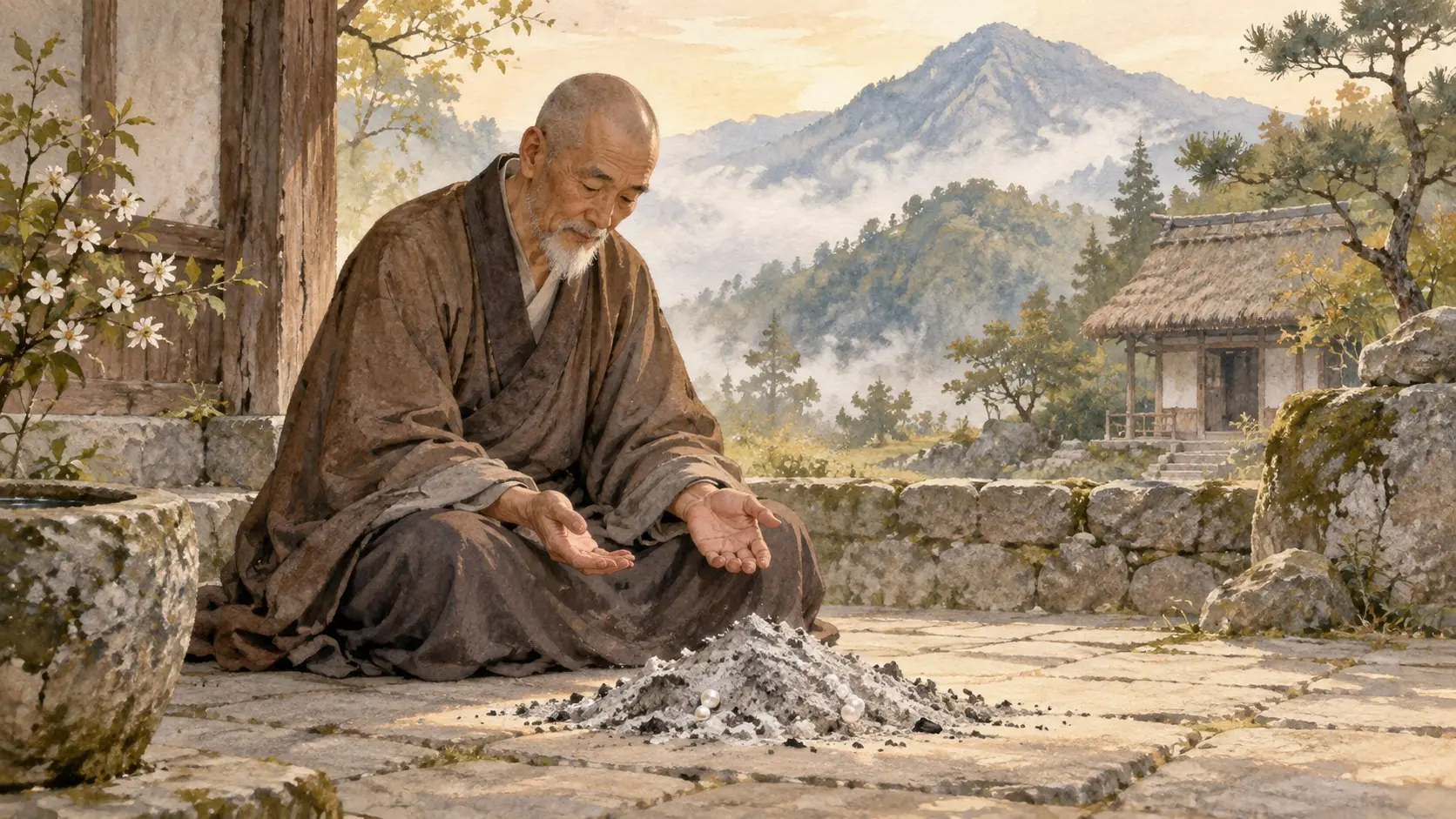
There is a story in Zen. A monk was meditating on a mountain. One day, a master came to his hut to test the level of his understanding and asked him a question that the monk was unable to answer satisfactorily. However, later, when this monk was cremated after leaving his body, ringsel (relics, pellets) remained after him during the cremation. It is generally believed that when the body of a saint who performed certain tantric practices is cremated, such pellets may remain. They are called sharira, ringsel, or tigle. These pellets are formed from ashes. They are essential substances or drops of nectar melted as a result of the elements melting in the chakras. They may be white, red, blue, yellow, or even black. It is believed that the holier a person was, if they practiced certain tantric methods, the more of these sharira may remain. If a person practiced sutra methods or realized only the immortality of consciousness, they do not remain. Sometimes part of the body is left uncremated, for example, the tongue or heart, because they have become filled with spiritual energy. After this monk’s body was cremated, many sharira remained. When the master who had tested the monk was told that he had apparently assessed the monk’s level incorrectly, and that this monk had most likely been a saint, the master grinned and said: “Even if two cartloads of sharira had remained from him, he still did not answer my question.”
The following example is given: in order to learn how to swim, we must train with an experienced swimmer who will first teach us simply to stay afloat. Remaining in correct contemplation is like knowing how to stay afloat. Only after that can we begin mastering various swimming techniques. Once we have learned to swim, only one problem remains—to be able to cover the distance within a certain period of time. This is precisely what begins at the stage of nididhyasana—uninterrupted contemplation of the mind. In other words, if we have cut off all doubts and established ourselves in the correct state of contemplation, we now need to maintain it continuously, without distraction, throughout our entire life, until full realization, while applying various subtle methods to accelerate the process, so that our lifetime will be sufficient for realization. For example, when we maintain the principle of a certain contemplation, we encounter karma, secondary causes, and obstacles. We see that there are many such causes and that we need to dissolve them all. In order to dissolve them, we require skillful subtle methods to dissolve not only consciousness but also all the energies of the body.
Attaining the Immortal State
“The practice is aimed at attaining liberation, transcending birth and death, and conquering the immortal state.”
What does the immortal state mean? It means realizing one of the immortal bodies beyond birth and death. At first, the immortal body of wisdom (jnana-deha) is realized. Jnana-deha can be attained even through the simple practice of sutra. When you attain such samadhi that your meditation continues uninterruptedly, penetrating both dream sleep and dreamless sleep, such an immortal body is realized. The sutra path ends when continuous consciousness has been realized in dreamless sleep and when the state in dreamless sleep has become equal to remaining in the ordinary state. It is then considered that immortal consciousness has been conquered.
However, on the tantric path, not one but two or three immortal bodies are realized. The saints say that realizing the activity of immortal consciousness means realizing pranava-deha, that is, the second immortal body, consisting of energy. For this, it is necessary to generate a deeper state of meditation so that the energies circulating in the body are melted. The body consisting of energy dwells in the world of form (Rupa-loka). It can be seen only by a highly advanced meditating practitioner.
Direct Transmission and Its Features
What does direct transmission or direct introduction mean? It resembles the way a coach throws a student into the water in the hope that the student will either learn to swim or drown by adopting an incorrect view. “Drowning” means that, upon encountering a profound teaching of awareness, there is a high probability of misinterpreting it—for example, calming down while mistaking some illusory state for the correct one, or making some kind of deviation. That is why such great emphasis is placed on direct transmission and confirmation, so that this deviation does not occur.
In the lower tantric teachings, deviation is impossible, because if you are given a mantra, visualization, or method of concentration, you clearly know that you must do only this way and no other. If you are shown the Traiya Bandha Mudra, Maha Mudra, Kriya Yoga, or Kundalini Yoga, you are told: “Do it only this way, and not otherwise, and there will be such-and-such results, and no others.” You either attain them or you do not. There is no room for ambiguity here. But with the higher teaching, things are different. Here there is great freedom. It is as if an advance is given to the student. At the same time, however, the freedom to misunderstand also increases.
Concentration and Correct Contemplation
To realize an understanding of the natural state, we perform basic practices, such as concentration; however, concentration in itself does not bring liberation if the principle of correct contemplation has not been realized. It is believed that if death overtakes a practitioner while they are abiding on one of the levels of meditative concentration, they will be reborn on the mental plane corresponding to the dhyana they attained. For example, if meditation was performed with an object, rebirth will take place in the world of forms (Rupa-loka). If meditation was practiced without an object, rebirth will occur on the higher mental planes of cosmic consciousness—in the formless world (Arupa-loka).
When we follow the teaching of nonduality and have somewhat dissolved our dualistic notions, this does not yet mean that we merge into Brahman as oil merges with oil. These are merely concepts, and even if we have reached some nondual, nonconceptual level, this is only the most superficial understanding. When we touch the subconscious or the subtle layers of the causal body (karana-sharira), we discover that dualistic notions remain there in the form of subtle states. This means that our nondual awareness must penetrate much deeper.
Therefore, it is usually said that one should not rely on inner experiences while practicing. In essence, the criterion of correct practice is the absence of attachment to anything. When you have no attachment to external or any internal states, even the most subtle ones, this is the correct principle of spiritual growth.
Criteria for a Yogi’s Progress
What are the criteria for a yogi’s progress? They are not limited to mystical experiences and various states of clarity:
First, it is an increase in mindfulness and the ability to self-liberate in the smallest things.
Second, it is a deepening of devotion and self-surrender, along with a decrease in selfishness and clinging to the ego.
Third, it is the pure perception of one’s brothers and sisters in the Dharma and of the world as such.
These criteria of spiritual growth unmistakably indicate that our practice is deepening and developing, and that compulsive clinging to oneself and to the ego is diminishing.
Types of Liberation
“If a student has attained the first dhyana in their meditation practice, they may be reborn among the deities of Brahma’s abode, residing on the lower mental planes of Rupa-loka. For example, those who worship the deities Vishnu, Shiva, and Krishna and attain stable concentration while worshipping the deities may be reborn in the worlds of the deities and attain one of the levels of liberation (mukti).”

It is believed that there are five main types of liberation:
Sayujya-mukti — this is the state of dissolution, Vedantic liberation, when a living being merges its mind with Brahman.
Sarupya-mukti — this is the state in which a living being, through the practice of worship, acquires the same form as the deity. This type of liberation is primarily characteristic of tantric methods of transformation or worship. If a yogi worships a deity, their subtle body acquires the same form. Even their physical body may resemble the form of that deity if they diligently perform worship or tantric visualization practices.
Salokya-mukti — this is liberation in which a living being enters the same plane of existence as the deity with whom they practice.
Samipya-mukti is liberation in which a living being becomes a companion of a deity, being reborn in the world of form surrounded by deities. For example, devotees of Krishna, the Vaishnavas, imagine themselves as gopis and Krishna as their beloved. If their devotion develops, their subtle body is molded into the form of the deity during their lifetime, becoming imbued with that form, like molten metal being cast into a mold. At the moment of death, when the physical оболочка is removed, just as a metal casting is taken out of a mold, their subtle body, newly cast in the form of the deity through their devotion, takes on the form of that deity.
These are different types of lower levels of liberation. In some teachings, they are usually called liberation in the sense that release from the world of samsara takes place. However, this cannot be called true liberation. It is merely rebirth on higher planes of existence and the attainment of a divine form. In higher teachings, such liberation is not recognized as genuine, since the accumulation of merit among the gods eventually declines, and their stay in the world of the gods comes to an end, no matter how long and wonderful it may be.
The Worlds of Brahma-loka and Their Nature
These subtle mental planes belonging to the world of Brahma-loka are situated far above the highest astral layers of the world of passion (the world of desires), where the deities residing there are still subject to sensual desires. The deities of the worlds of Brahma are no longer subject to sensual desires and passions. They experience something akin to subtle intellectual pleasures, various enjoyments associated with states of clarity. They are also endowed with extremely subtle mental bodies surrounded by an enormous luminous aura. These bodies are purer and more refined than the bodies of the deities (devas) dwelling in the world of passion (Kama-loka).
Nevertheless, the realm of Brahma-loka also reflects a conditioned state of being and therefore still belongs to the worlds of samsara. Although existence in Brahma-loka lasts for a very long time (millions of human years), it is not considered true liberation.
The gods in the worlds of form possess a subtle body, also called the body of glory. However, one should understand the difference between attaining the world of Brahma-loka through the practice of merit, worship, tantric visualization, or dhyana, and attaining the pranava-deha, which is achieved as a result of liberation and contemplation. Just as enlightened beings (saints) and ordinary worldly people in the human world have identical physical bodies, so in the worlds of the gods everyone possesses identical luminous bodies (bodies of glory), but some gods may be worldly, while others possess nondual awareness. When we speak of the realization of the pranava-deha (the divine body), we are referring to those gods who, unlike worldly gods, have attained the state of liberation. This is another level of practice, and such liberation cannot be attained through the ordinary state of dhyana.
The Formless World (Arupa-loka)
“Having attained perfection in the practice of the higher dhyanas, called ‘absorption,’ a practitioner may be reborn in the four spheres of cosmic consciousness belonging to the realm of the formless world (Arupa-loka), which lies beyond Brahma-loka. These four levels of cosmic consciousness of the formless world are as follows: infinite space (Akasha Ananta), infinite consciousness, the state of absolute nothingness or nonbeing, and the state in which there is neither cognition nor noncognition (or neither perception nor nonperception).”

They are called formless because the consciousness of these beings is not localized in space. They are endowed with extremely subtle mental bodies that extend infinitely through space and have no inherent form. However, they possess a subtle form of ignorance that separates them from nonduality. Although they are endowed with such an exceedingly subtle body, their ignorance has not ceased.
In many religions, attaining such a formless world and a formless state is considered liberation. However, in the absolute sense, this cannot be called true liberation. These are merely mystical experiences, states of consciousness that are impermanent by nature and have the property of coming to an end. Therefore, rebirth among the long-lived gods is not considered to be what yogis seek, because it does not provide complete liberation from the cycle of samsara.
Just as an arrow shot upward will eventually fall, so the samadhi of the world of the gods will eventually come to an end. The pleasures of the gods and their absorption in their own states surpass any description. For the human world, this is extremely exalted. Just as in the human world two people who love each other are absorbed in their love and notice nothing around them, so the gods of the world of form or the formless world are so absorbed in their state that they do not wish to notice anything. However, they do not understand that this state will eventually end, that it will be exhausted just like any temporary state, and that they will have to be reborn again.
Limitations of Concentration Practice
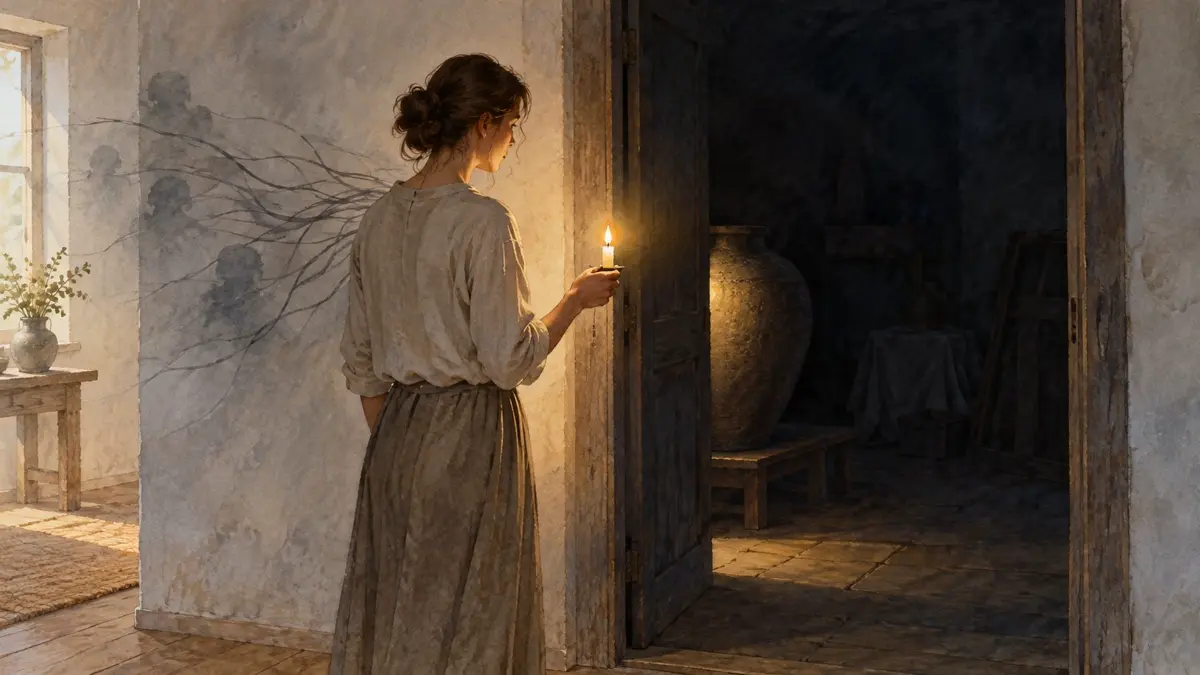
If one becomes captivated by the experiences produced by concentration practice, this is merely a by-product of spiritual evolution. The following example is given: even if a person enters a dark room and tries to examine some object by candlelight, they will not be able to see it completely until they take it out of the dark room. In the same way, the experience of the dhyanas does not bring liberation until we master true contemplation, until we open the room and take the object outside.
The experience of the dhyanas also does not liberate because dhyana as such does not eliminate karmic traces; it merely blocks them for a while. As long as dhyana lasts, karmic imprints have no effect, but when dhyana ceases to operate, the karmic traces resume their activity. And such a practitioner does not know what to do with these karmic traces; they cannot bring them under control.
Even if hidden subconscious impulses, such as anger, lust, attachment, and so on, are blocked for a while by dhyana, a one-pointed state, this still does not mean anything. For example, one nun experienced states close to the third dhyana. However, when she left that dhyana, she was overcome by ordinary human states of attachment and the like. In other words, such dhyana has little value; one could say that it has no value at all, since karmic imprints are not eliminated. However, she tended to regard her experiences as something very valuable not only for herself but also for others. But the Guru thought that, from the standpoint of liberation, these experiences had no value whatsoever.
True Contemplation and Self-Liberation
When we acquire the capacity for contemplation and true self-liberation, this surpasses the path of dhyana, because all our karmic traces (samskaras) are liberated at the very moment of such contemplation, without even the slightest following after them.
It is said that one who abides in correct contemplation is like a mighty lion, the king of beasts, fearlessly making its way through the jungle to its resting place. Or there is the following example: when an elephant goes to drink, all the small animals and insects scatter in terror; nothing is capable of resisting it. Or when a powerful torrent descends from the mountains, it washes away stones, plants, and everything else. Such an elephant or powerful torrent is the state of the presence of awareness.
When the true state of the presence of awareness has arisen, our subconscious impulses, thoughts, and attachments are destroyed simply by maintaining the presence of awareness. Even at the initial stages, nothing is capable of shaking such a yogin. To be sure, there is a great difference between the first level of the self-liberation of thoughts and the final one, because at the first level self-liberation occurs through effort, while at the highest level thoughts are destroyed at the moment they arise. Nevertheless, these two states have something in common: whatever thoughts and passions arise, they dissolve in either a higher or a lower way. Nothing remains as such. Nothing remains unrecognized.
It is precisely this knowledge, or primordial awareness (jnana), that is the basis of liberation. Only this knowledge is jnana. Other experiences of clarity, dhyana, and states of mental emptiness are not true jnana and therefore are not considered liberating.
When we have attained such understanding, we truly realize jnana and abide in the state of nididhyasana — uninterrupted concentration of the mind. We must clearly understand the difference between dhyana and contemplation so as not to confuse subtle states with the correct state of presence.
Self-Liberation and the Stream of Subconscious Thinking
“Without having confidence in liberating dualistic thoughts at the very moment they arise, and without making this self-liberation the basis of our practice, we will again and again find ourselves captive to the various manifestations of the projections of our consciousness. And our life unfolds in reflections generated by the dream of samsara. Then we simply accumulate karmic causes, and wandering in samsara does not cease, because we are completely overwhelmed by the stream of subconscious thought, which is imperceptible, like water flowing among dense riverside sedge.”
You have probably noticed that when you meditate, even if your thoughts have stopped, there is still a certain subtle stream of subconscious impressions that continues to move, and it is much more difficult to stop. This subtle stream belongs to the subtle layer of awareness; it influences rebirth in the bardo.
It is believed that liberating the vrittis is not difficult; for this, one simply needs to practice mahashanti meditation, stopping thoughts. In order to liberate the samskaras, a deep level of contemplation is required, one that continues not only while awake but also in sleep. And in order to liberate the bijas, that is, what constitutes the source of the samskaras, an even deeper level of contemplation is required, one that continues during dreamless sleep.
Therefore, when we practice the path of uninterrupted contemplation (nididhyasana), we first liberate the vrittis, that is, habitual thinking. Every second, we do not allow thoughts to take root and liberate them, looking directly into them and allowing them to dissolve in empty presence. When we are able to maintain meditation in dreams, we liberate the samskaras associated with the subtle body. Finally, when we maintain meditation during dreamless sleep, we liberate the bijas (that is, that which generates the samskaras)—subtle seeds, the sources of karmic perception, which reside in the causal body (karana-sharira).
The Natural Freedom of Thoughts and the Cessation of Karma
“If all our thoughts, both gross and the most subtle, attain their natural freedom, like clouds disappearing without a trace in the summer sky, the process of accumulating karma will be stopped.”

Often, when we read the texts of Shankara and Ramana on Advaita Vedanta, it is difficult for us to understand what “I am Brahman” means. We think: “Very well! I am Brahman—that is a very attractive theory, but what should I do with it? After all, I definitely feel that I am also a human being with a whole host of different karmas. I remember that I am Brahman only during a lecture, when I am reading, and also on retreat. The rest of the time, I remember perfectly well that I am a human being. In dreams, I have a human body, not the body of a deity. So it turns out that there is a huge difference between what I think about myself and what I am.”
And when we feel that in our practice there is an enormous gap between the view, perspective, philosophy, and our own state, this means that we simply have not yet learned to contemplate correctly. Correct contemplation and the liberation of thoughts (shravana, manana, and nididhyasana) eliminate this gap.
When we truly open the nondual state for the first time, we experience a profound state of awareness. Then we clarify it and begin to believe in it. Having clarified it and come to believe in it, we work with it so that it will never again be interrupted. We give it depth and, by maintaining this depth, connect it with all karmas, allowing them to dissolve in this depth of awareness. Then we see that what Shankara or Dattatreya writes about suddenly becomes our own state as well. Then we feel how profound the teaching we follow is, and how deeply we are beginning to understand it. Then we are filled with the greatest joy at having become such fortunate practitioners. Before we experience this, such joy does not yet fill us, because we do not understand our own happiness.
The River of the Lower World and the Liberation of Thoughts
“When thoughts arise, one should not allow them to become the river of the lower world that gives rise to delusions.”

When do thoughts become a river of the lower world? When these thoughts are not liberated but acknowledged and, taking root, give rise to various incorrect states (bhavas). In other words, when our false ego feeds on thoughts. If we encounter jealousy, that jealousy continues and generates karmic imprints (samskaras and vasanas). Or if it is anger, it does not dissolve but manifests within us for a long time. Experiencing anger, we perform certain actions or generate thoughts. Then this is simply the accumulation of new karma, a river of the lower world that will inevitably sweep us away someday.
Or when we have attachment, we think: “So what? Everyone has attachments.” And we do nothing about it, displaying a tendency toward compromise. We think: “Yes, that’s just how I am!” Then this attachment simply continues within us; we carry it, afraid to look it in the face. This, too, becomes a river of the lower world, drawing us toward new rebirths.
“Otherwise, we will be caught in the net of memories born of our own mind.”
Usually, the term “being caught in the net of memories” refers to rebirth. Our past impressions catch us in a subsequent birth if we have not liberated them during our lifetime. When we sleep, we experience our past impressions. And if our mind responds to them, we forget about the practice or forget that we are asleep. Then we become entangled in these impressions and experience everything they offer us.
Once, in a dream, I was walking through an area resembling a shop and looking at beautiful fabrics. Practicing contemplation, I saw various things and objects. Then I thought of a disciple whom I had known for a long time and called out to him. Thanks to my concentration, his subtle body responded quickly, because he had been practicing Guru Yoga for a long time and had devotion to the Guru. He appeared beside me and began helping me choose fabrics with great interest. Seeing that he was unaware that he was asleep, I began explaining to him that his body was currently lying on the bed. As soon as I told him this, he experienced something like a shock and woke up. As soon as he woke up, he disappeared. Then we met a second time, and he was already in a lucid state.
When you are not caught by your subconscious impressions and are able to maintain the practice in dreams, your subconscious impressions can no longer influence you, because you recognize them as an illusion and are never captivated by them. This means that in the intermediate state, in the bardo, you attain liberation effortlessly, even if you did not attain it during your lifetime.
The State of Natural Remembrance and Nididhyasana
“Instead, we should constantly remain in a state of natural, effortless remembrance. This is what allows us to recognize the nature of thoughts at the very moment they arise. When you practice in this way, this will be the state of nididhyasana.”
When you are listening now, one could say that this relates to shravana (transmission) and manana (clarification). And when, after the lecture has ended, during the bhajan mandala, and after leaving the altar hall, you continue to remain in contemplation, this will be the stage of nididhyasana.
