

Commentary on Longchen Rabjam’s text “The Precious Treasury of the Dharmadhatu”
“By virtue of the equal nature of all phenomena, there is nothing that does not abide within the sphere of its equality. The state of the awakened Mind, in whose single equality everything is equal, wholly embraces all with its openness, like the unborn sky.”
The Equal Nature of Phenomena
The first phrase is “by virtue of the equal nature of all phenomena.” The diversity of countless phenomena in the Universe appears to us as not equal because of the mind’s tendency to accept and reject. To experience the state of nonduality means to align one’s vision in such a way that there is neither acceptance nor rejection of anything whatsoever. Then everything seen and heard appears as a single mass of Consciousness. This mass of Consciousness is absolutely pure, perfect, inconceivable, and boundless. In it there is no division into subject and object.
We can come into contact with this mass of Consciousness when we stop accepting and rejecting, and instead establish ourselves in nondual contemplation. It is our outer part, connected with the ordinary mind, that accepts and rejects. The equal part is our deep inner part.
Thus, the entire Universe in which we now live is simply the consequence of our accepting some things and rejecting others. When a yogin enters this sphere of great equality completely, in his karmic vision the Universe disappears even literally, physically. For the yogin, subjectively, the universe of material objects disappears, while for others this is seen as the great transition into the rainbow body. From the point of view of conditioned people, it seems that the Universe remains and the yogin disappears. From the yogin’s point of view, everything is the other way around: he remains, while the Universe disappears.
The Nature of Karmic Vision
The point is that the Universe in which we live is created by our minds; it is a collective visualization, a magical show, a virtual reality that we sustain by the power of our consciousness. Therefore, to live in any world means to sustain a certain type of karmic vision. For example, when it is said that we live in the world of humans, Jambudvipa, the Saha-loka, this means that we share common collective samskaras. We share the collective karma of all humanity and live amid common samskaras, the karma of the country, and so on. When our consciousness changes, we go beyond this.
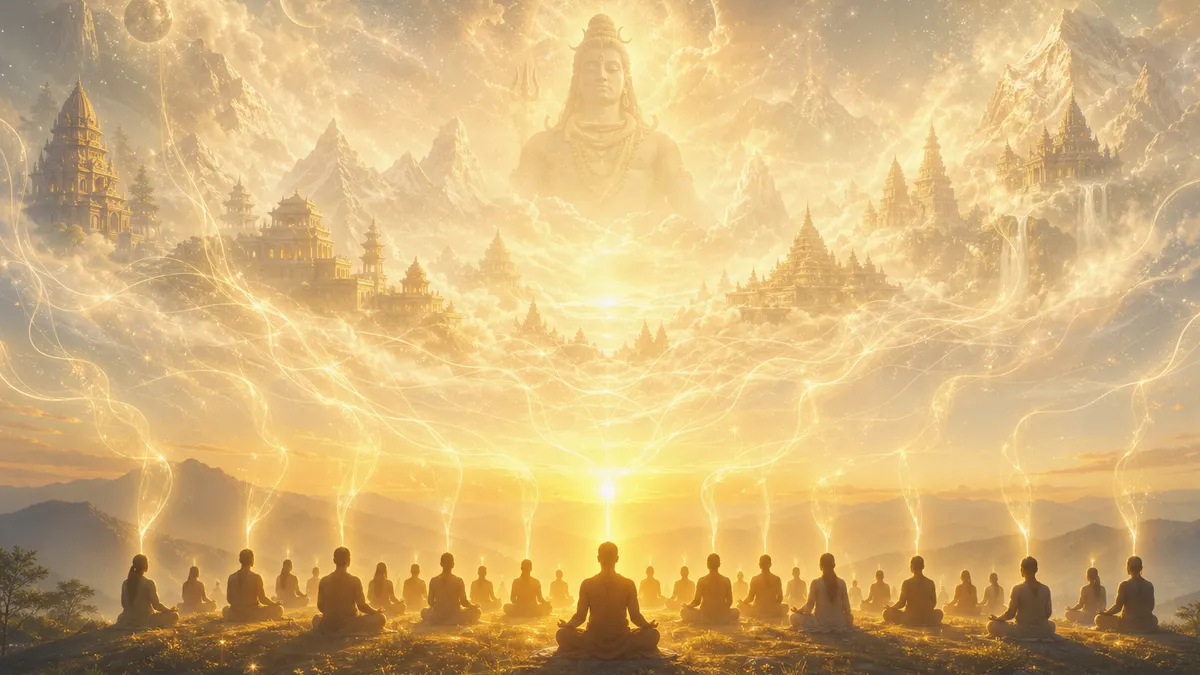
However, in the primordial Reality of our great “I,” there exists only the equal state, which is called the single “taste.” All phenomena acquire one and the same quality; that is, whatever the yogin hears, sees, or touches, he hears, sees, and touches only the Atman. It is all one and the same natural state, which manifests in manifold ways. This is the state of nonduality, which is completely boundless.
The Story of Marpa and the Single “Taste”
When Marpa was returning from India to Tibet, he was crossing by boat together with his companion Nyo, who at that time was already a well-known scholar. Nyo envied Marpa; he thought that if Marpa read all the texts and became more learned than he was, his own fame would diminish. Then, having paid the ferryman-boatman good money, he persuaded him to supposedly, through carelessness, throw overboard Marpa’s bag with the very precious texts (sutras and tantras) that Marpa was bringing after visiting several dozen teachers in India. The boatman did this.
But Marpa understood what was happening and said: “Nyo, do you think my knowledge is contained in these papers? All my knowledge is the blessings of Guru Naropa in my consciousness. I have attained realization, and my mind is equal, therefore I am not angry with you; however, by such deeds you are accumulating negative karma. You have just drowned your own fame and your own career.”
Despite the fact that all the scriptures were drowned, Marpa was not distressed in any way, because for him the state of equality had been realized. Bad and good experiences were perceived by him in the same way; everything was seen as transcendental: if there are texts, good; if there are no texts, also good.
When we cultivate such equality, we will see that for our mind there are no obstacles. In fact, there never were any obstacles for it, but our very fixation, grasping, acceptance of one thing and rejection of another created barriers. We could long ago have had a wide-open mind and been one with infinity, but there were barriers in our consciousness that did not allow the mind to be wide open. However, the single “taste” of equality means that all barriers disappear, that everything is absolute, positive, transcendental.
Uniting Inner and Outer Space
Enlightenment, entering the natural state, is nothing other than the union of inner and outer space. With the help of the eyes, we blend this inner and outer space; therefore, we contemplate with open eyes, unlike other types of seated meditation. Outer space is the entire visible world: mountains, trees, the sky, stars, metagalaxies. Union with outer space gives us the opportunity to understand the boundlessness of the nature of the Mind. The nature of the Mind includes the entire infinite cosmos, all spaces. In contemplation, we unite with all of this.
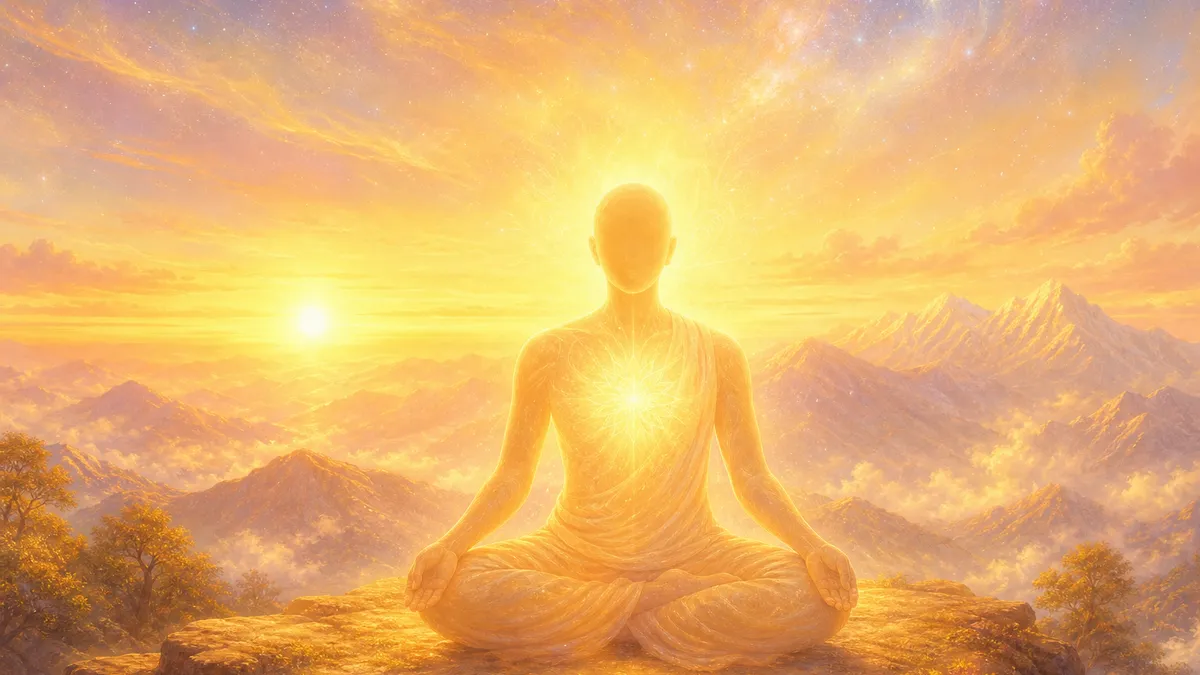
When a yogin contemplates outer space, a moment comes when all the diversity of objects appears to him as a single incomprehensible mass of Consciousness. And when contact with this external incomprehensible mass occurs, the yogin seems to receive an enlightening impulse, a push. This enlightening force is Anugraha. Having received the enlightening impulse, his consciousness opens even more strongly in response, and the remnants of the “I” are eliminated. Then the state within and the state without become equal, and so there is no longer either outer or inner. The cage is broken; the bird soars freely in freedom.
