

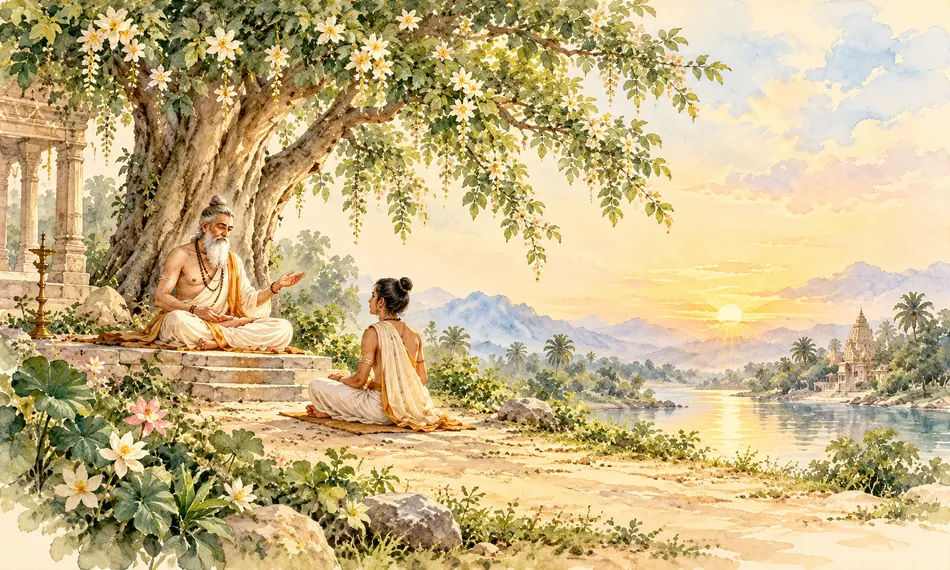
Satsang is a concept from the Vedic tradition, from Vedic culture. I have not heard of it existing in other religions, although perhaps it does. Satsang is a time to meet with the Master and a time to encounter the divine, one’s true Self in the presence of the Master. Usually, several disciples sit at a satsang, and the Master gives teachings, remains silent, or meditates; the disciple either listens or meditates. But the most important thing is that during satsang, the goal is set: to touch the divine, to establish a connection with the Divine Source.
Satsang is a widespread tradition in the Vedic culture of Sanatana Dharma. Sanatana Dharma is commonly called Hinduism. But we call it Sanatana Dharma because that is correct. Sanatana Dharma translates from Sanskrit as the eternal divine law of the universe. It is indeed not so much a religion of a particular prophet that arose at some point and was given by some saint; rather, it is a divine law that has always existed and continues to exist, regardless of whether we know about it or not, which is of no significance. It never came into being. Sanatana Dharma has no specific date of origin; it was not created by any prophets. It has existed from the very beginning. And, generally speaking, all religions can in a sense likewise be regarded as part of Sanatana Dharma, because all the many religions are, in one way or another, also part of this eternal natural divine law.
The Meaning of Human Life and the Four Goals of Existence
So, what does Sanatana Dharma say? Sanatana Dharma, through the words of the Vedic texts, the Upanishads, the Vedas, the Itihasas, the Puranas, and the divine sages, says that the meaning of human life lies in realizing divine wisdom. Such wisdom gives us the strength to be free, to free ourselves from our limitations. And the fact that we are limited is probably something no one would deny, because all human life is a life of limitations. But there is a possibility of freeing ourselves from such limitations. Yet in order to free ourselves from them, we must have a certain strength and spiritual wisdom. This strength and wisdom is called jnana-shakti—the power of knowledge, the power of divine wisdom. Accordingly, the meaning of all Sanatana Dharma, of the spiritual path of Sanatana Dharma, is the realization and attainment of divine wisdom.
The Vedic tradition generally describes four principal meanings of existence for society and for every individual:
dharma (the development of righteousness within oneself)
artha (prosperity in every sense)
kama (the fullness of life, attaining bliss, joy, and pleasure from life, fulfilling desires)
moksha (attaining Liberation, merging with God, the Absolute)
The first three are considered lower goals, while the true, authentic goal of life in Vedic culture and of the entire Vedic society, Sanatana Dharma, is moksha—merging with the Absolute, liberation from the injustice of the laws of samsara, liberation from the limitations of the cycle of birth and death. Accordingly, when we embark on the path of Sanatana Dharma as spiritual seekers, we have this highest goal in mind—moksha, the attainment of Liberation.

The Five Divine Powers of the Enlightened One
Liberation means realizing divine wisdom. Realizing divine wisdom endows us with certain powers:
svatantrya-shakti — the power of divine freedom;
iccha-shakti — the power of divine will;
aishvarya-shakti — the power of divine manifestation and omnipotence, such as mastery over one’s body, energy, mind, destiny, and karma;
kriya-shakti — the power of action. The fivefold kriya-shakti means the ability to create, sustain, and destroy various energies, and to conceal and reveal the divine.

When we follow the path of Dharma, the path of moksha, these inner powers gradually awaken within us. The most important of these powers are jnana-shakti (the power of divine wisdom), iccha-shakti (the power of divine will), and kriya-shakti (the power of divine action). They are personified by three goddesses: Saraswati, Lakshmi, and Parvati. These three goddesses are not merely somewhere outside us; they are subtle divine energies hidden within us. When we reveal them within ourselves, they help us on the path to liberation; they free us from that ignorance, from that samsara of the material world into which we have fallen and in which we have become entangled.
The Three “V’s”: Vichara, Viveka, Vairagya
What is the path to comprehending divine wisdom? This path has been described by many saints, and it can be described in three words. We need to develop three “V’s” within ourselves: vichara, viveka, and vairagya.
Vichara — the power of penetrating wisdom
Vichara means the power of the penetrating wisdom of consciousness, the power of self-inquiry. For example, if through the power of meditation we are able to penetrate the dream state, and through the power of contemplation we are able to penetrate dreamless sleep and discover our Self as free from the physical body, free from the astral body, free from names and forms, as pure space of consciousness in which there is no duality, no subject and object, then this can be called vichara. There are two types of vichara: external (bahir-vichara) and internal (antar-vichara).
Bahir-vichara consists in consciousness being applied to external objects. For example, bahir-vichara is characteristic of scientists and scientific research; that is, all modern science is bahir-vichara. Bahir-vichara is the power of consciousness applied to external objects. For example, I want to know what a rose is. To do this, I study its molecular structure and the process of the rose’s evolution, describe which class it belongs to, what chemical processes take place within it, and so on. In other words, this is the mind directed outward. Bahir-vichara provides an understanding of the processes of this world, but it does not provide an understanding of one’s own life; unfortunately, it does not help in any other way. At most, it helps us arrange our lives better and develop comfortable devices.

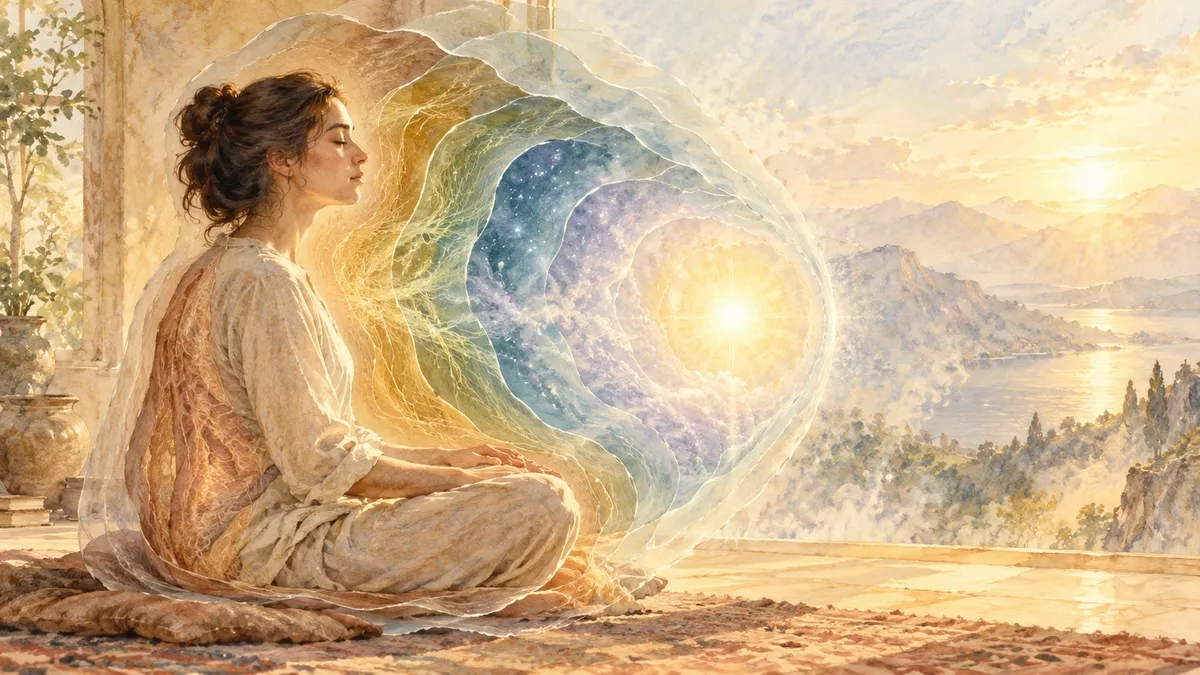
Atma-vichara, or antar-vichara, is inner research; that is, research that we turn inward. And when we turn our knowing activity inward, we can investigate our physical body, then discover the energy body within it; then we can discover the subconscious mind (the subtle astral body); finally, we can discover that we ourselves, as consciousness, are not the astral, energy, or physical body. We can discover within ourselves the body of emptiness, the body of space — the causal body. We can even go beyond the causal body and discover our divine Self. Vichara means continual investigation until we separate ourselves from the five sheaths and discover the pure nondual space of consciousness beyond subject and object.
Viveka — discriminating wisdom
When we have this understanding and are able to separate ourselves from the five sheaths, this is called viveka. Viveka means “discriminating wisdom.” Pancha kosha viveka means that the power of our clarity and the refinement of our consciousness are sufficient to understand: “I am not the physical body, I am not the energy body, I am not the astral body, I am not the mental body, I am not the causal body. I am Atman! I am divine consciousness beyond duality, beyond subject and object. My true consciousness is not in the waking state, in ordinary awareness. It is not in the dream state. It is not even in dreamless sleep. My true consciousness lies beyond these three states. My true consciousness is pure, omniscient, all-pervading, omnipresent; it is never stained by anything, has no name, form, qualities, or definitions, and exists beyond time, beyond the past, present, and future.” This true consciousness is the goal we must attain in order to free ourselves from ignorance.

Vairagya — Detachment from Samsara
Thus, when we acquire these two “V”s: vichara (inquiry) and viveka (discrimination), we follow the classical practice of Advaita Vedanta described in the text “Vidyaranya Panchadasi,” in the texts of Sri Adi Shankaracharya “Viveka Chudamani,” “Atma Bodha,” and “Tattva Bodha,” and in the text “Yoga Vasistha.” Then vairagya arises. Vairagya means detachment and dispassion toward samsara. Then samsara, that is, the external material world of illusions, is no longer capable of capturing our soul or plunging our consciousness into the cycle of births and deaths. Vairagya means that we gradually detach and distance ourselves from this world, which is a material trap for the soul. Then Liberation arises.

The Four “S”s: Seva, Sadhana, Svadhyaya, Samadhi
Thus, vichara, viveka, and vairagya are three qualities that every yogi and every sadhu should cultivate on the path of the Vedic tradition. But by what means, by what method, is this achieved? It is achieved through seva, through service, through sadhana (spiritual practice), svadhyaya (the study of sacred scriptures and reflection upon them), and samadhi. Samadhi is entering a transcendent state, when our breathing may stop and when we can meditate beyond the body.
Seva — The Spirit of Service
Seva means the spirit of service that we must cultivate within ourselves. Unfortunately, consumer culture directs people toward individualism, egoism, and the satisfaction of their own needs. But Vedic culture approaches life and the meaning of life in an entirely different way. Vedic culture says that the main purpose of life is service to God, carrying out the divine will, and serving the divine. It is very important to cultivate this spirit of service because, if God is our highest Self—that is, if God is our true identity—then whom else should this body and this mind serve? Cultivating such a spirit of service gradually purifies our karma, makes us independent of the ego and karma, and creates a strong connection with the Supreme Source.
Sadhana — Spiritual Practice
When we have established ourselves in this spirit of service, we are ready to undertake sadhana (spiritual practice). Spiritual practice on the path of Advaita, on the path of yoga, is not practice for the sake of the ego or for acquiring supernatural powers. From the perspective of the saints of Sanatana Dharma, spiritual practice on the path of yoga is intended to enable us to serve the divine even better and to serve others. This is the only right motivation that quickly leads to Liberation. That is, we strive to attain samadhi and meditate in order to help others more effectively. When we perform sadhana with precisely this motivation, practice tapasya (ascetic practice), and support it with the study of sacred texts (svadhyaya), sooner or later a conscious state—samadhi—arises.
Samadhi — The Transcendent State
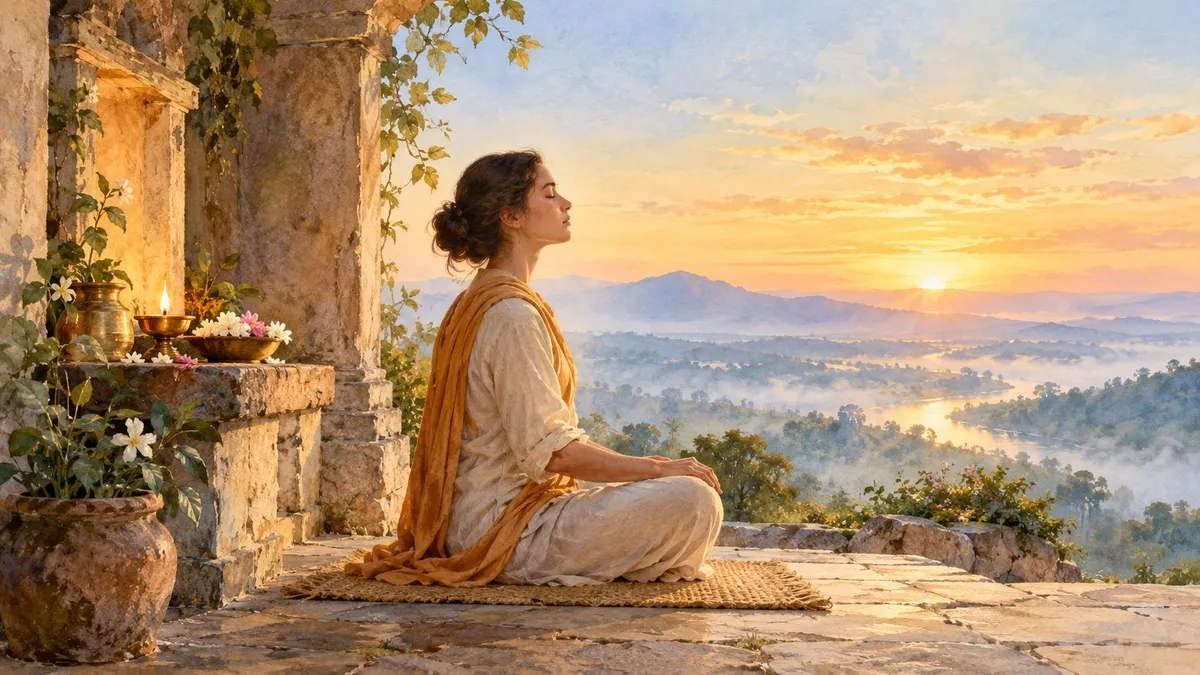
Samadhi is the culmination of spiritual life. Everything comes through samadhi. If we look at divine beings—Bhagavan Dattatreya, the goddess Lakshmi, and others—they are all in samadhi; they are not in an ordinary, obscured state, in a state of concepts, logic, or ego. They do not exist in such states at all; their ordinary state is samadhi, that is, the transcendent state.
Samadhi differs from the ordinary state of mind. How does it differ? If the ordinary state is built on logic, a sense of ego, and predominantly on the perception of external phenomena, then samadhi lies beyond concepts; samadhi is based on the perception of divine light and divine wisdom beyond the ego. If the state of an ordinary person is built on the ego, then samadhi, on the contrary, is built on the dissolution or rejection of the ego. During samadhi, the conceptual mind does not function; it is paralyzed. During samadhi, a person perceives divine truth directly, bypassing philosophies, doctrines, concepts, religions, notions, and definitions.

The true essence of any religion, any philosophy, any teaching culminates in samadhi. If you delve into Buddhism, Christianity, Judaism, Islam, or shamanic religions, you will see that they all culminate in the state of samadhi, when there is no subject, no object, no names, forms, or definitions, when the empty and non-dual essence of consciousness is experienced. However, the paths to this may be different.
There can be different types of samadhi:
Savikalpa samadhi — when our “I” is still preserved to some extent, when there are certain dualistic concepts in our mind
Nirvikalpa samadhi — when dualistic concepts are no longer preserved in our mind, the ego is absent, and we penetrate into very deep layers of consciousness, into non-duality
Natural samadhi (sahaja) — when the state of non-duality is maintained in everyday life, even when a person talks, eats, drinks, moves, walks, stands, sleeps, or lies down
Svarupa samadhi — when the elements of the body are remolded by the power of the inner light, the body dissolves into its nature, and the divine essence manifests, that is, samadhi of the manifestation of one’s true nature
Thus, practice, spiritual sadhana, must necessarily lead to at least some type of samadhi. If you have attained a certain level of samadhi, it means that you are doing everything correctly. However, it is not all that simple. When you begin your spiritual life, you discover numerous obstacles to samadhi, because samadhi must be preceded by stable meditation. For example, in order to sit in meditation for five or even ten hours, in order to remain in meditation throughout the day in everyday life, your mind must be trained.
When we have not disciplined our mind, it is incapable of remaining in meditation because it lacks concentration. This means that we need to work on concentration. But when we discover that we lack concentration, we also discover that our energy channels are blocked; we lack the energy for our mind to remain attentive and concentrated for a long time. When we understand that our energy channels are blocked, we realize that we also need pranayama and asanas. And if we eat meat and waste sexual energy, then we also lack the principles of yama and niyama. And we understand that we wanted samadhi, but we are still lacking so much, so we are pushed back to the first stage — the stage of yama and niyama. Unfortunately, there are many conditions that must be fulfilled to attain samadhi. In order to discipline and purify ourselves, we must make certain efforts, and such efforts are called tapasya.
Tapasya means that day after day we follow some kind of spiritual discipline. We withdraw into retreat (in a monastery, in the forest, or in the mountains), observe mauna (silence), take on certain retreat commitments, and write ourselves a schedule that includes sixteen or eighteen hours of practice, depending on how much patience we have. And we perform tapasya; we carry out spiritual practice again and again.
Service can also be tapasya, when, having set aside our egoism, we serve divine forces and divine beings. This type of tapasya is most preferable for a person who has never meditated seriously. In other words, a person can also purify themselves well through selfless seva, when, having set aside their ego, they do something for others: serve a sadhu and transmit divine energies.
Many people do not understand the principle of tapasya. They know that if one withdraws into the mountains, practices asanas and pranayama, meditates, recites mantras, and observes mauna (remains silent), this is serious, genuine practice. But I can say that you can achieve the same result through service, through seva, if you perform it with the right attitude and toward the right recipients. Why? Because seva is capable of directly introducing you to qualities close to sahaja samadhi.
After all, when you perform seva, you are not pursuing personal goals. When you perform seva, you do not cling to the result; you try to cast aside the ego and eliminate the sense of doership and of being the doer. If you serve sacred objects, divine beings, or sadhus, then gradually, very gently, seva will lead you to certain states beyond notions and concepts, and you too will be able to experience non-conceptual rasas, that is, the tastes of nondual states. I have female disciples who attained experiences of Enlightenment precisely through seva, when they focused entirely and completely on a particular service. Of course, they also practiced tapasya in solitude, but the experiences came to them precisely through self-surrender and seva. By combining seva, sadhana, and the study of sacred texts (svadhyaya), one can attain samadhi.
Svadhyaya — the Study of Sacred Texts
The study of sacred texts should begin with a blessing, with a transmission. That is, we can simply take a book and start reading it, but when you receive the appropriate initiation, for example, shastra-kripa-samskara diksha, you receive from the Master a blessing to study it, as well as specific instructions on how to study it properly so that the text gives you the power of awakening. This is because, in the Vedic tradition, a text is considered vidya. Vidya is the body of the deity. In other words, a particular deity stands behind the books and the text. By studying the text, one can establish contact with this deity.
When you study a text according to a specific discipline—for example, observe mauna (silence) for a certain period, recite a mantra before each chapter, face east, and wear no iron objects (there are various commitments and conditions that should be accepted)—all of this strengthens your practice. As a result, you can truly receive the blessing of the sacred text and a mystical experience.

The Three Obstacles of the Mind: Mala-Vikshepa-Avarana
Thus, when seva (service), sadhana (spiritual practice), and svadhyaya (the study of scriptures) are combined, we move toward the state of samadhi. Samadhi is the ultimate goal; it is entry into superconsciousness. Samadhi gives us access to divine wisdom. On the path to samadhi, we eliminate various obstacles arising from the mind. What are these obstacles? They are mala (impurity of the mind), vikshepa (fluctuations of the mind), and avarana (certain obscurations).
In other words, our mind can be likened to a lake. There is a certain impurity (mala) on this lake, which can be compared to silt. The fluctuations of the mind (vikshepa) can be compared to ripples on the surface, to the waves on the lake. Avarana can be compared to an oil film. We eliminate all three types of impurity through sadhana, svadhyaya, and seva.
Types of Impurities of the Mind
To speak in more detail, what are these three types of impurity? Mala has several varieties. Anava-mala is the impurity of the mind associated with the feeling “I am small,” “I am an individual.” Maya-mala is associated with the perception of multiplicity (this is a flower, this is a book, this is a man, this is a woman, and so on); that is, we become lost in multiplicity, our mind becomes mired in multiplicity, and we do not see the one consciousness, the nondual Absolute that stands behind all differences. Karma-mala is a type of impurity in which we believe, “I am doing,” “I am the doer,” “the fruits and results belong to me,” “I am the taster,” “I am the enjoyer,” “I am the ultimate beneficiary of all impressions.” These three malas—anava-mala (the feeling “I am a small individual,” “I am limited”), maya-mala (the feeling “the world is diverse,” “the world is not one”), and karma-mala (the feeling “I am the doer,” “I act,” “the fruits and results belong to me”)—form an impurity of the mind (mala) that prevents us from attaining samadhi.
Vikshepa is another obstacle. Vikshepa is the wavering of the mind. For example, you sit down to meditate, and five minutes later you want to jump up because you remembered something, so you even forget the subject of meditation. Or you begin Atma-vichara, but you imagine some spirit, start thinking about it, and therefore lose the subject of meditation. Or you begin Mahashanti, but energy awakens in the muladhara chakra, so you look at the muladhara chakra; then energy circulates through the channels in the body, so you decide to focus on the channels; then a thought about a deity arises, so you begin visualizing the deity; then you become completely distracted. An hour passes—and in the end there is neither Atma-vichara nor meditation, because the mind constantly jumps from one subject of meditation to another. All of this is vikshepa. Vikshepa must be overcome by practicing concentration, hardening the mind, and learning to be stable. For example, we began contemplating while moving and decided to be attentive to the breath or to the feeling of I (any sankalpa can attract attention), but our stream of thoughts is so powerful that after five minutes we abandon it. I tell my students: “If you have taken up contemplation, the practice of Atma-vichara, practice it for at least a year from morning until evening, standing, sitting, lying down, while walking, eating, working, and talking. Practice self-remembering, Atma-vichara, for at least one year, and this will give you profound experiences.”
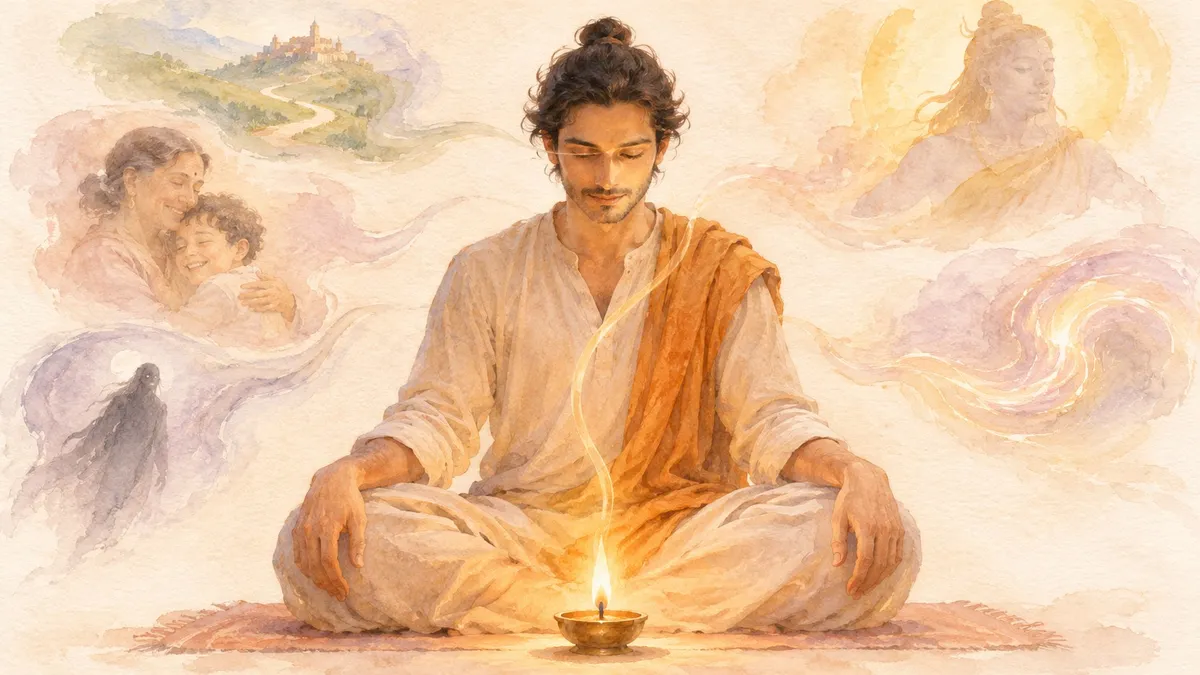
Avarana is the third obstacle. Avarana is our desires, our kleshas, our egoism. When our desires uncontrollably interfere with us and overwhelm us, all our attempts to meditate and engage in sadhana encounter resistance from our desires. We literally have to fight our desires, the tendencies of the mind, and overcome them. Desires exist because there are impressions (samskaras) from past lives, impulses that make us move in a certain direction (vasanas). In other words, our soul is not a blank slate. Our soul is a particular stream of consciousness that is constantly moving in a certain direction. Perhaps we are not even aware of this; it seems to us that there is nothing of the sort, but every person is a particular stream whose vector is determined even before birth. For example, someone is drawn to becoming a politician; consciousness irresistibly moves and moves them toward politics. Someone is drawn to becoming an artist or a musician; their consciousness moves in a particular stream. Someone is irresistibly drawn to business, and even if business causes them problems, they continue moving along this stream. In other words, every soul is endowed with such streams, which shape karma. And all this is called prarabdha karma—the karma of past lives. We are all moving along particular streams. This is avarana, that is, a certain obscuration of the mind that constantly obstructs meditation. And even if a person meditates occasionally, inner urges, samskaras, and inner tendencies still compel them to abandon meditation and continue producing their karma. For example, I have read that there were practitioners in the Buddhist tradition who completed a three-year retreat in solitude, then emerged and became successful businessmen. In other words, they did not become great hermits or great masters; karma still moved them in a certain direction.
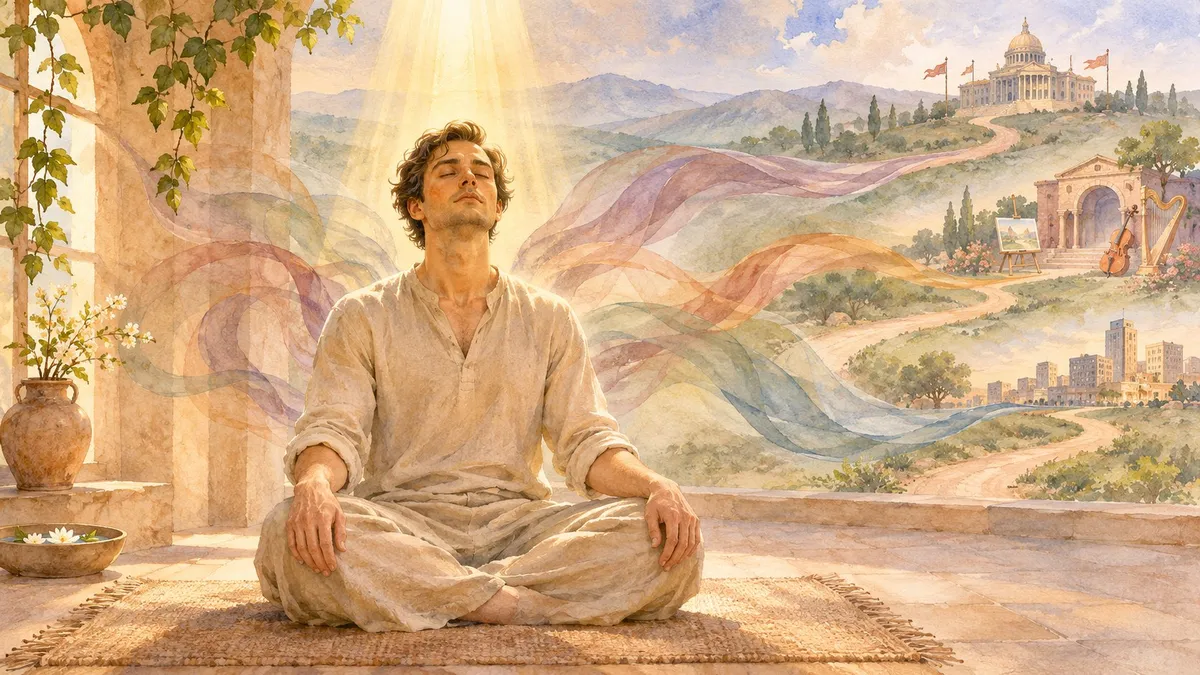
Thus, if we overcome these three obstacles—mala, vikshepa, and avarana—our mind becomes empty, pure, nondual, and we are ready to attain samadhi.
The Necessity of Divine Support
On the spiritual path, personal efforts are not enough. No matter how intellectual we may be, no matter how strong our will and abilities may be, and regardless of our personal qualities and spiritual path, this is an entry into the divine dimension. Enlightenment is not the enlightenment of the ego. Enlightenment is always an entry into the sacred, into the divine dimension.
On the path to enlightenment, it is impossible to bypass God; that is, one cannot attain enlightenment for oneself while leaving God somewhere aside. Because Enlightenment is precisely union with God, with the Absolute. It is impossible simply to meditate for a while, then stand up and say: “I am enlightened, and I do not care about God; I am God unto myself. I am enlightened!” This is impossible, because Enlightenment means that you and God are one; you have merged with God, you have known God, you have encountered God, you have seen God, and you yourself have become God. In the process of such an encounter, the ego disappears.
When we understand this, we realize that we need a blessing; we always need the support of higher divine forces. Without this support, no matter how hard we try, we cannot achieve much, because the spiritual path itself is the discovery within ourselves of divine contours of consciousness, divine structures; it is the discovery of the inner deity within ourselves. And divine support is indispensable for this. Therefore, shraddha (faith) is also important for Enlightenment.
Shraddha, sharanam, and shila
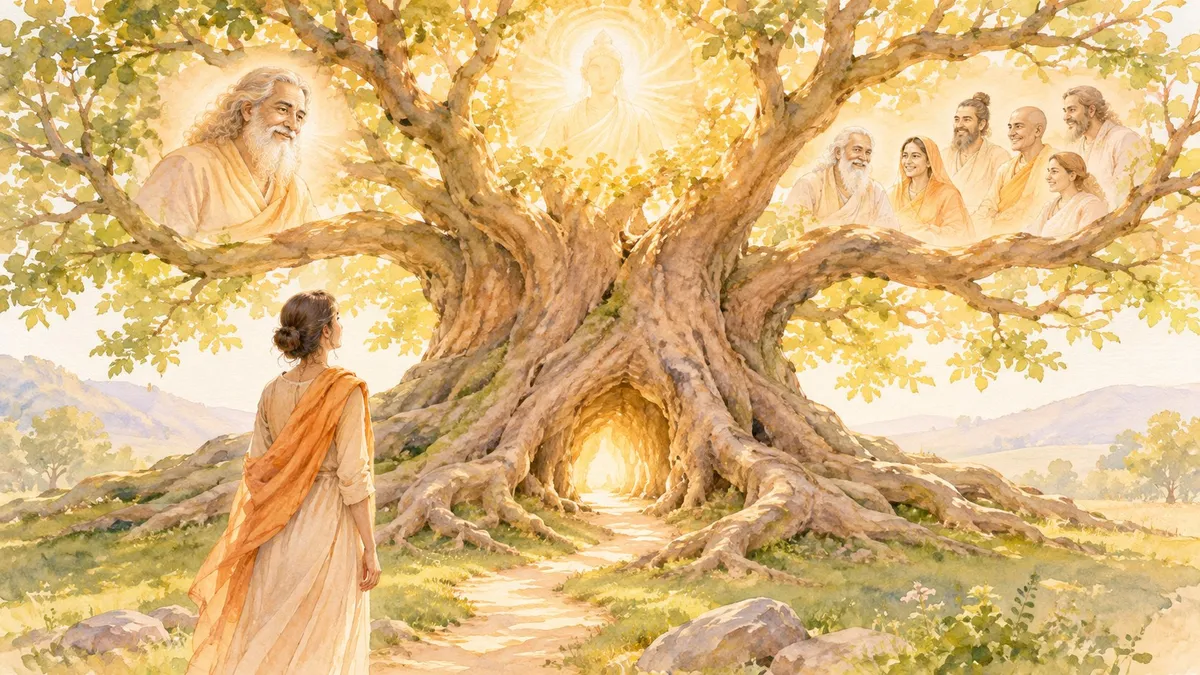
You can begin with faith in your chosen deity, faith in the Guru, or faith in yourself—in anyone at all. Start with something, at least, but acquire strong faith. Later, you will understand that faith is energy. If you believe in something, you will understand the very principle and be able to believe in something else. But it is impossible to live without faith. On the spiritual path, faith is the fundamental condition. You can have faith even in your parents as your gurus. You can believe in anything, but you must have faith. Later, this faith will become purified and crystallized, and will connect you with divine beings. At this stage, the root Guru, the chosen deity, and the saints of your Refuge are very important; that is, a particular spiritual family is important, because through such faith you enter a specific assembly of deities and holy beings. It is an entire vast spiritual family. And all of this we call the Tree of Refuge.
When your faith leads you to the high culture of saints, divine beings, rishis, and siddhas, we call all of this sharanam. Sharanam means refuge. In other words, refuge means that we establish a connection with an entire family of divine beings. If this connection is strong, it constantly protects and blesses us whenever necessary. What does sharanam mean? When we take refuge in a deity, in a family of divine beings, we constantly place our trust in this refuge, make offerings to it, worship it, invoke it, praise it, and serve it; it is a mystical channel of connection with divine energies (deva-vahini). If you have this mystical channel of connection with divine forces, you can move along the path of Enlightenment very successfully; you will have no obstacles, and you will be protected from the influence of evil planets (grahas) and harmful spirits. Even if they appear, you will still be protected from them.
Thus, we need shraddha (faith), sharanam (refuge), and shila (personal inner determination). If you say, “In this life, I must come to know the divine will; I will strive to follow the path of Liberation; I will strive to attain samadhi,” then this intention, this sankalpa, should be constantly nurtured, cultivated, and developed so that it remains and deepens. You should form the right motivation: “I will do this not for myself, not to satisfy any of my selfish ambitions; I will always do it for the benefit of all living beings. I aspire to attain samadhi so that I can help all living beings move toward enlightenment as quickly as possible and carry out the divine will.” Then this will be the right shila—inner self-discipline, inner determination with the right motivation. Shraddha (faith), sharanam (refuge), and shila (determination) are three important components of the spiritual path.
The Three Main Rules of the Spiritual Path
These are the fundamental principles: vichara, viveka, vairagya, seva, sadhana, svadhyaya, shraddha, sharanam, and shila. If you understand all these principles, you are fully equipped on the path of the Vedic tradition. And then the Master tells you the secret of the three main rules.

There are three main rules, the understanding of which will open up to you the wisdom of all the sacred texts of the Vedic tradition of Sanatana Dharma, of all saints, all spiritual practices, all tantras, sutras, upadeshas, Puranas, and Vedas. What are these three main rules? Shravana, manana, nididhyasana.
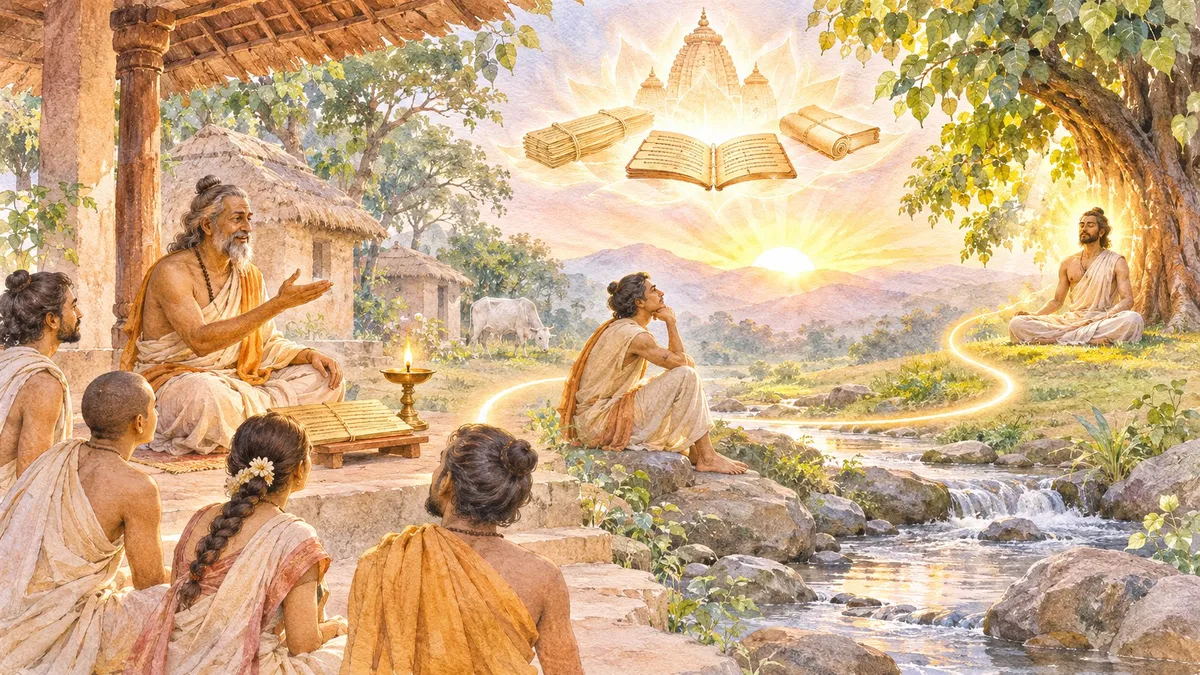
Walking the spiritual path means practicing shravana, manana, and nididhyasana. I will not speak about them, in order to awaken in you a certain impulse, a curiosity to learn about them yourselves. I give many lectures on the subject of shravana, manana, and nididhyasana, so if you wish, you will certainly be able to study these three principal rules on your own. Here are three magic words for you: shravana, manana, nididhyasana. If you have a sincere interest, you will certainly decipher them and understand that your entire destiny on the spiritual path depends on realizing these three words, that all of life is shravana, manana, nididhyasana. And what I teach my students is shravana, manana, nididhyasana. What the great saint Ramana Maharshi taught, what Dattatreya, Vasistha, and others taught, is shravana, manana, nididhyasana.
When we uncover the essence of these three principles, the entire Vedic Dharma opens before us as clearly as the palm of our hand. Even if we do not know Sanskrit, even if we are not very successful at performing yoga asanas, even if we have not read the Upanishadic texts or the texts of Shankara extensively, that is not a problem. But if we have received an explanation of these three principles from our Guru, from our Master, and follow them throughout our lives, then we know the entire essence of Vedic Dharma.
That is the conversation we have had.
Om. Namaste.
May the blessings of Dattatreya, all the saints, and the divine sages be with you. May your spiritual path always be auspicious.
