Brahma's Cosmic Plan and the Nature of True Tapasya
31.07.2026
0 мин. чтения
0
Share
copy
search
add
share
Commentary on the Text “Skanda Purana. Chapter 22. Section 1, Part 2”
Text of the Skanda Purana: The Gods in Brahma’s Abode
“Narada said:
Thus humiliated, the gods, who had assumed the form of monkeys, accompanied by the great Indra, arrived at the abode of the Self-Born Brahma.
Thereupon, the astonished Brahma said to the chief Suras: “Remain here in your own forms; here you have nothing to fear from Taraka.”
Then the gods, whose lotus faces had grown dim, resumed their own forms and bowed to him like sons before their father. They all extolled him thus:
“Salutations to You, the Source of the universe, the Creator, Protector, and Destroyer of the universe. Salutations to You! Such are Your three aspects.
In the beginning, You create the waters and place the seed within them. It becomes the golden embryo Hiranyagarbha, in which moving and unmoving beings abide.
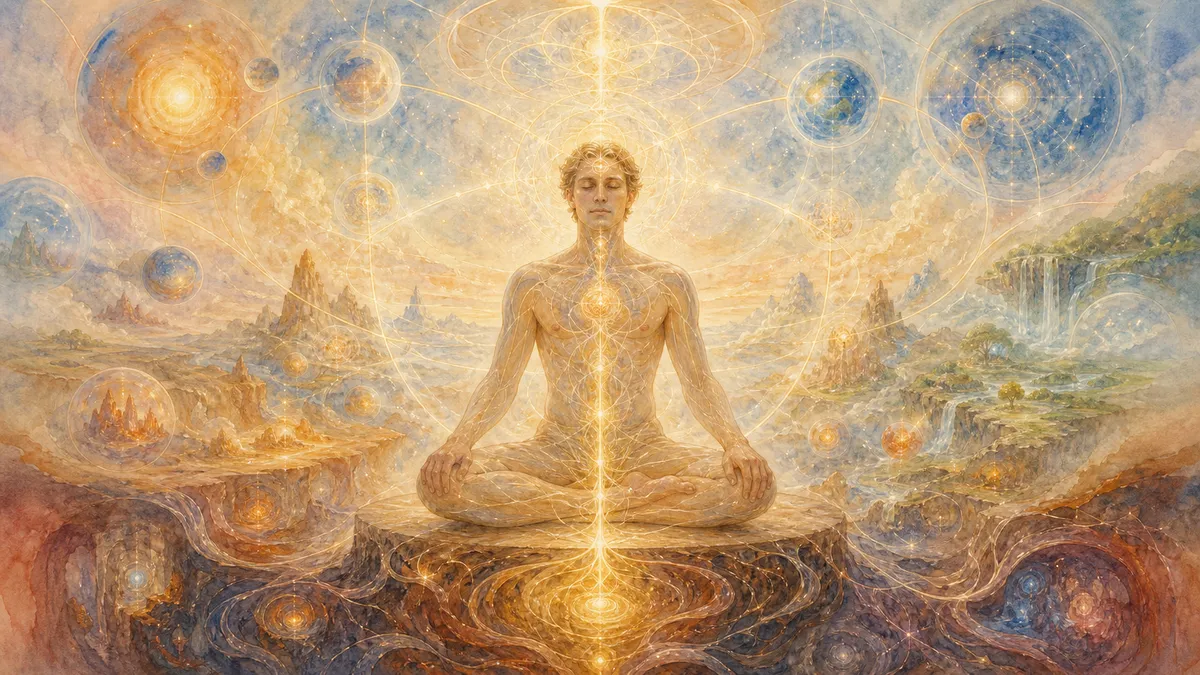
The Vedas describe You as one with the universal form. Your single form includes Patala, which constitutes the soles; the hell Rasatala constitutes the feet. Mahatala constitutes the ankles, Talatala the calves, Sutala the knees, Vitala and Atala the thighs, the surface of the earth the groin, the firmament the abdomen, the realm of the luminaries the chest, and the heavenly world is called the arms.
Mahar-loka is the neck, Jana-loka is celebrated as the face, Tapa-loka is the forehead, and Satya-loka abides as the head.””
The Body as a Microcosm: The Teaching of Shakti Yantra
Our body is a projection of the greater universe as a microcosm. Everything that exists in the channels of our body also exists in the universe. Everything that exists in the universe—energies and worlds—also has its projection in our body. By understanding this secret, one can listen to one’s body and recognize changes occurring in the universe. The bhavas that arise in the channels are identical to the bhavas that arise in the lokas of the greater universe and to the bhavas of the beings inhabiting them.
When your prana is here, you are in Tapa-loka; when your prana is here, you are in Satya-loka; here, you are in Jana-loka; here, you are in Mahar-loka. When your prana is here, you are in Patala-loka. Then your inner nagas, your inner powerful demons, are very strong. By moving prana through the channels and changing the bhava, you connect with different regions of the universe. This is an axiom of the Shakti Yantra teaching—the connection between the channels and the external universe.
Continuation of the Skanda Purana Text: The Praise of Brahma and the Gods’ Complaint
“The sun and the moon are the eyes, the cardinal directions are the ears, and the Ashvins are the nostrils. The followers of the Vedas say that You are the Atman abiding in the Brahmarandhra.
Those who remember this universal form and worship it become free from the bondage of birth and attain You, the Supreme Abode.
They pray thus: “You are the gross form abiding among living beings; You are the subtle form contemplated in the mind; therefore, the Vedas declare that You are omnipresent. O Lotus-Born One, we undoubtedly offer our salutations to You.”
Thus extolled, Virinchi became exceedingly pleased, for he knew everything.”
The gods praised Brahma, and Brahma began to console them. All of this was, in fact, part of Brahma’s own design, his script. Therefore, Brahma knew this script from the very beginning, but the gods did not, because the vision of gods such as Indra and those subordinate to him is weaker than Brahma’s vision. They cannot see far across the kalpas as Brahma can.
“To reassure them, he said: “All of you are suffering and distressed; your lotus faces have grown dim, your weapons have been taken from you. Your jewels and ornaments have been lost.
O Gods, the grief and terror you are experiencing affect me as well, for you are the arms of my Viraj form. Everything worthy and exalted, everything endowed with inherent power, everything pious and mighty, is contained within my body. In it, you abide as my arms. And these arms of mine have been destroyed.””
Brahma perceives the gods as his arms, as karma-indriyas—that is, as that through which his activity, his kriya-shakti, operates. He does not perceive the gods as separate from himself. To him, they are like parts of his body. He perceives human beings in the same way. But the gods have a false sense of separateness—to a small degree. In human beings, it is present to a very strong degree, and therefore the sense of individual identity and identification with the body arises.
“The gods said:
“We have been grievously insulted and wronged by the son of Vajranga, O Lord, whom You endowed with boons. You should know this.
The ocean shore, near the mouth of the Mahi River, the holy place of Sharvika, was seized by force by him, O Lord, and turned into a wasteland.
All the siddhis of all the gods have been taken away by him. Now he alone rules over the universe in the form of the great spirit.
The Moon, the Sun, the planets, the stars, and the others who belonged to the side of the gods have been stripped of their positions by him, while those who belonged to the side of the Daityas have been appointed in their place.
He captured us and mocked us cruelly. On Vishnu's advice, we somehow escaped from this difficult situation.
We seek refuge in You; we are oppressed and suffer from hunger and thirst. Since You are regarded as the protector of Dharma, You must protect us.”»
The Nature of the Asuras and the Story of Taraka
Taraka was a great asura, a Daitya. Daityas, asuras, and danavas are one race. This race is characterized by extremely strong egoism, a degeneration of consciousness toward individualism, and the attribution of divinity to the qualities of the ego. That is, they too evolve, but not in the same way as humans and gods; they evolve through the ego. They have no concept of self-surrender or unity with the entire universe, but they do possess a very strong crystallization of merits and qualities in the hypertrophied form of individuality, and they can attain tremendous power.
Taraka means “one who ferries others to the opposite shore.” Ironically, he bears such a spiritual name. Taraka was a Daitya. He could not be killed by the gods because of a blessing he had received from Brahma. Whenever the gods hurled their weapons at him—lassos, nooses, chakras, and threshing weapons—whenever the spirits under their command cast darts at him, and Indra hurled his thunderbolt at him, all of these returned to the gods. He would simply paralyze them, draw the siddhis out of them, or send their weapons back to them. The gods were constantly beaten and humiliated by Taraka.
Continuation of the Skanda Purana: Brahma’s Reply and the Plan for Skanda’s Birth
“After the Suras had spoken thus of the Daitya’s outrages, the Self-born Lord pondered and gave the Suras a truthful reply: ‘The Daitya Taraka cannot be killed by anyone, whether Sura or Asura. The lord who will kill him has not yet been born. Through his austerities, he has become so powerful that he is capable of burning the three worlds. I warned him, and he chose the blessing he desired. This Daitya chose a blessing according to which his death would come at the hands of a seven-day-old infant. This seven-day-old infant, who will be born to Shankara, will become the slayer of the hero Taraka. The auspicious goddess named Sati, who destroyed herself as a result of the shock caused by Daksha’s disrespect, will be born as the daughter of Himachala.
Efforts must be made to unite this goddess with Shankara. I will undoubtedly do what must be done in this regard.’
After the Lotus-born Lord himself had spoken thus, the gods bowed to him and departed for Mount Meru in the form of monkeys.
When the gods had left, Lord Brahma, the grandsire of the worlds, remembered Nisha, who had previously been born from his body. The goddess of night appeared and stood before him. Looking at her, the Lord said to her in a secluded place:
‘O Night, a great task concerning the gods has arisen before us. You will have to accomplish it, O noble woman. Listen carefully to the essence of the task.
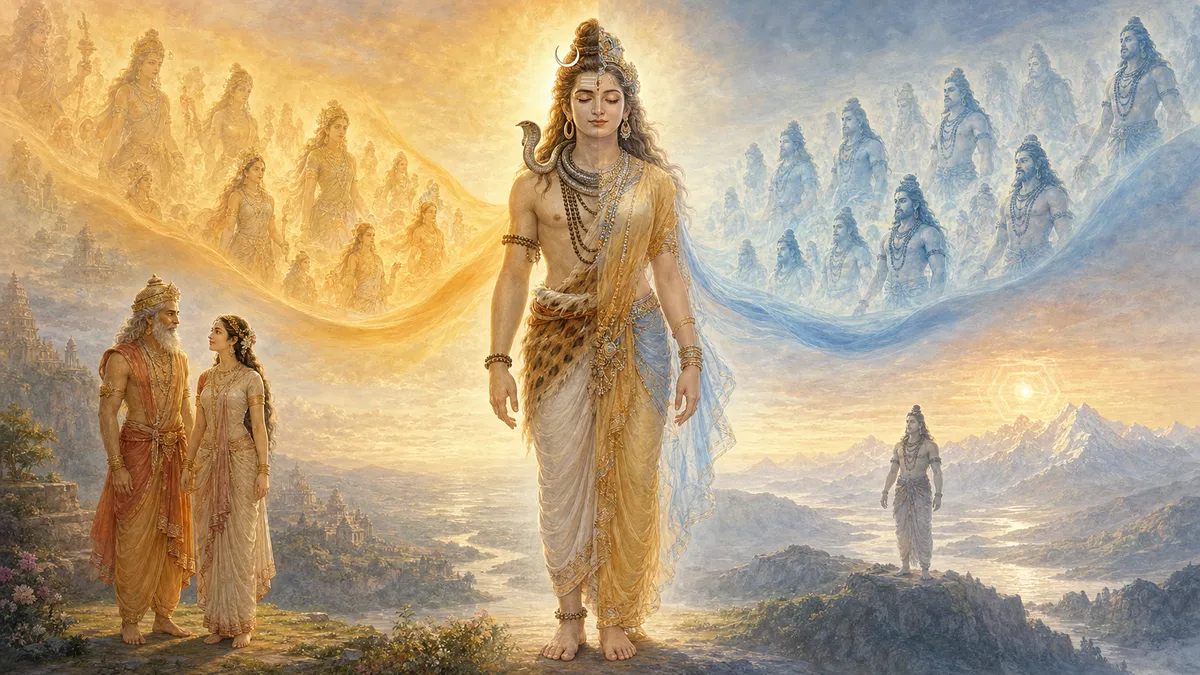
There is a lord of the Daityas named Taraka. He has defeated the Suras and become invincible. In order to destroy him, Lord Shiva will beget a son who will kill this Daitya Taraka. In the beginning, when I was born, I saw Lord Ardhanarishvara before me. He stood in one place while simultaneously abiding throughout the entire universe. Looking at him, I said, “I worship the Lord with devotion.” Thereupon, the feminine separated from the masculine. It is said that all women in the three worlds were born from the feminine part. The eleven Rudras and men were born from the masculine part. Looking at the feminine part, I said to my son Daksha:
“Accept this daughter. The universe is mine, as it is yours. She will be the daughter who saves you from the terrible hell called Put.”
Thus addressed, Daksha accepted her as his daughter. Naming her Sati, he gave her in marriage to Rudra. For a certain reason, her father offended her. He was a person of sinful deeds, a disgrace to the family, a person given to self-destructive acts, an evil soul.’»
Brahma’s Multi-Stage Plan: The Lila of the Gods
This recounts Sati’s previous story. Brahma’s plan was that Sati should be reborn as Parvati, the daughter of the king of the mountains. Then, at Indra’s prompting, Kama, the god of love, was to arouse love in Shiva and bring him out of tapas, samadhi, and asceticism. Why? So that he would look upon Parvati and wish to marry her. It was an elaborate, multi-step scheme, a lila, intended ultimately to reunite Parvati with Shiva, so that he would beget a child, Skanda, and Skanda would slay Taraka.
Why did Brahma not kill Taraka himself or ask Shiva to do it? Because if the great gods had done so, they would have shaken the foundations of creation and interfered with its course. The universe and its scenario were Brahma’s sankalpa. And according to Brahma’s sankalpa, it had to happen in precisely this way and no other. Had the gods intervened, it would have violated this scenario and shaken the entire universe and the foundations of creation. This must not be done. The matter had to be resolved through the power and hands of the younger gods. And it was for this purpose that an elaborate, multi-step scheme was undertaken.
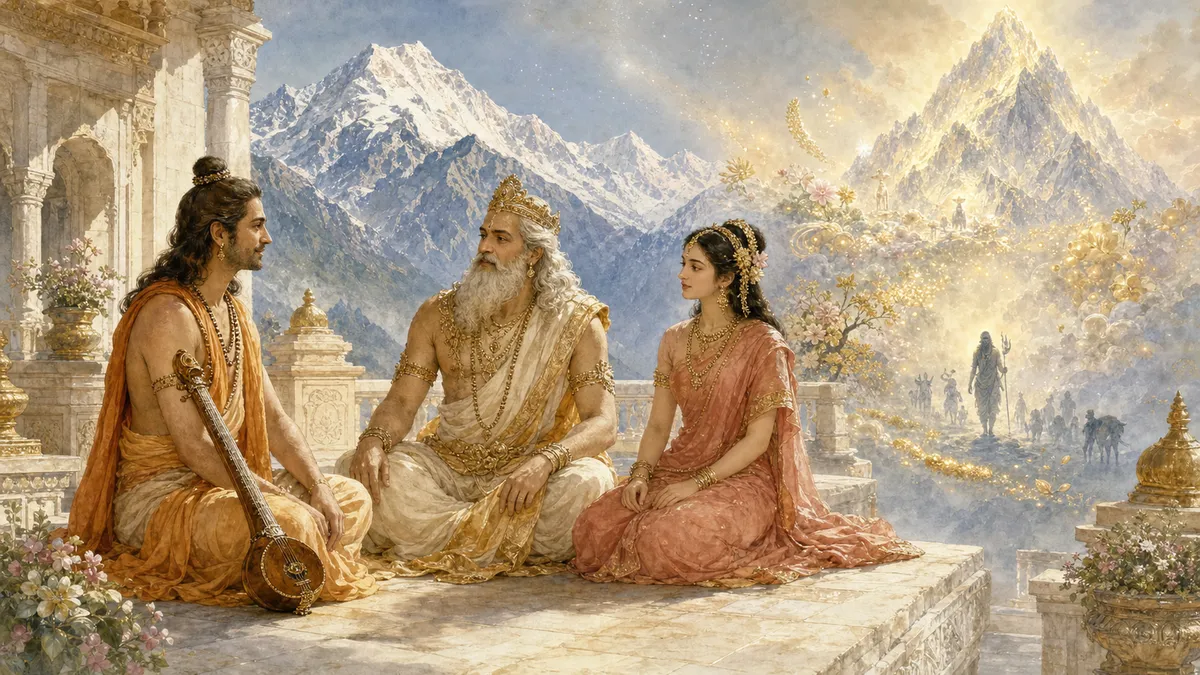
It begins when Narada seemingly happens to visit Himavan, the king of the mountains. The king of the mountains proudly shows him his daughter Parvati and asks him to bless her. But Narada becomes perplexed and says, “I do not even know how to bless her.” The king of the mountains was greatly disconcerted and thought, “Can it be that she has no merit, so Narada cannot bless her?” He said, “Bless her with a good husband and with happiness.” But Narada said, “I do not even know how to bless her, because her husband will be a very strange person. He is surrounded by odious, negative beings; he is poor, smeared with ashes, has no possessions, and no lineage.” Himavan was deeply distressed because he thought she was destined for an unhappy marriage. Narada liked to joke, intrigue, and play games, so he said, “Do not worry. This is a great blessing. Her husband will be the very source of all worlds and all wealth”—and thus reassured Himavan, the king of the mountains.
Continuation of the Skanda Purana Text: Sati’s Rebirth
“Those who do not worship Rudra are a stain upon their family. They are pishachas. They become evil spirits and brahmarakshasas.
Because of the insult inflicted upon her by Daksha, the Goddess abandoned her body. The sacrifice was destroyed by Bhava. This should be known to you. Now she will be born as the daughter of Himalaya and will take Maheshvara as her husband.”
Traditions About Brahma and the Mountains: Stories from the Puranas
Everything we see around us here is imbued with these stories. We must remember them. Why, for example, are there many temples of Vishnu and Shiva, but no temples of Brahma? It is said that once, when Shiva appeared as a lingam, Brahma and Vishnu began arguing over which of them was greater and more important. Shiva manifested as a pillar of light; Brahma, in the form of a swan, flew upward, while Vishnu, in the form of a boar, decided to descend and seek the lower end of the lingam. This is a well-known story. Vishnu returned in the form of a boar and said that he had not found the end of the lingam. Brahma, in the form of a swan, had not found the end of the lingam either, but wishing to salvage his pride, he claimed that he had seen it. Shiva then cursed him and said that no one would worship him in this kalpa. That is why there are many temples of Vishnu and many of Shiva, but not a single one of Brahma. There is only one somewhere.
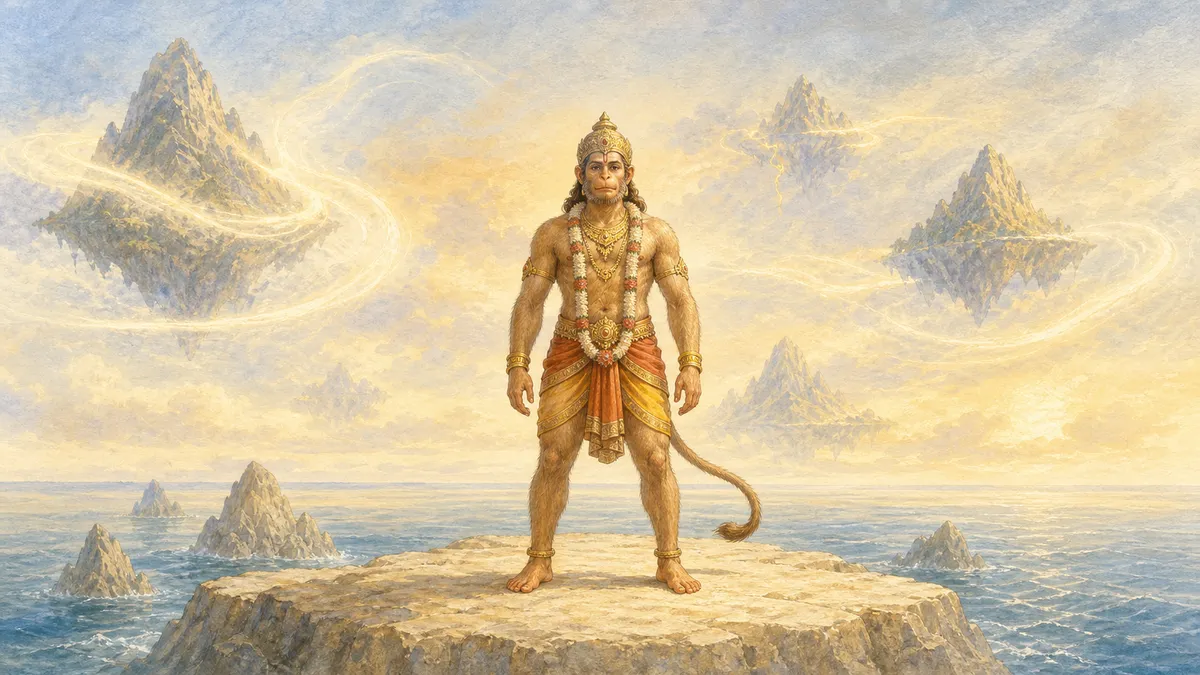
It is also said that long ago, during the Satya Yuga, mountains could fly. This means that the devas of the mountains could move about and travel. Then the gods and some rishis began to worry that if the mountains flew around too much, they might fall on them and cause trouble. At Brahma’s command, Indra then began clipping their wings—that is, depriving them of the siddhi of movement. All the mountains had their wings clipped, and all lost the ability to fly. Only one mountain, named Mainaka—whose spirit or deity was a friend of the god of wind—was swiftly taken to the bottom of the ocean and hidden there. It alone did not lose the ability to fly. And when Hanuman flew to confront Ravana, it was Mainaka that provided him with an auspicious place to land—out of their old friendship and at the request of the god Vayu. Thus, during the Satya Yuga, the spirits of the mountains were more powerful than they are now and were omnipresent devas. Indra later limited their powers.
Questions and Answers
Question: We have 1,008 temples—the sankalpa has been manifested and established; it is already being embodied. There is a stipulation that each of the 1,008 temples should stand for the 800 years during which Laya Yoga will flourish on Earth at the very least. In other words, construction technologies in precisely this form need to be considered right now.
Guru: It will continue to flourish beyond that. Strategic thinking—I agree. There is indeed such a sankalpa concerning 1,008 temples, so that our pilgrimage sites in Russia will be no worse than those in Nepal. You can see how powerful the culture is. Whether people practice or not, their own shakti sustains them all.
Question: Each temple is like a spaceship. This means that the very best materials, the most durable ones, and the most advanced technologies must be used.
Guru: Each temple can be likened to a yantra—a mystical structure that connects with other worlds, a portal for communicating with divine forces.
Question: If we build temples this way, this approach will carry over to everything else—to everything we do. Arya Loka will be built using precisely this approach. In other words, the 1,008 temples are Arya Loka’s flagship, its vanguard, the locomotive that will bring Arya Loka to the manifested level. And the strategic course is for the 1,008 temples to appear, after which everything else around them will begin moving and manifesting by itself.
Guru: Of course. Such a strategic course exists. There is both a strategy and a set of tactics for the development of Divya Loka—up to 2020 and up to 2045. Tactics up to 2020, strategy up to 2045. It simply has to be implemented constantly—through tapasya. It exists and will be announced. Everything is attainable through tapasya. Divya Loka appeared through tapasya, and everything else appeared through tapasya as well. Tapasya means not only external austerity, but also concentration of the mind, focus, willpower, purposefulness, service, and self-sacrifice to the divine forces. The stronger the tapasya, the greater the blessing. If Taraka received such a blessing from Brahma that he could twist all the gods around his finger, then I think we will receive the blessing to build 1,008 temples. Through asuric austerity, Taraka even managed to drive the gods from all the planets.
Sattvic and Asuric Tapasya
What is wrong with rajasic, asuric tapasya? In tapasya performed in the gunas of rajas and tamas, the blessing remains effective only as long as the tapasya is being performed. As soon as it ends, the blessing is immediately lost. It works only within the scope of the sankalpas. Even if a deity is compelled to grant such a blessing, it will find a way to take it back and circumvent it. Taraka received the blessing that he could only be killed by a six-day-old child—so a six-day-old child, Skanda, was born and killed him. The asuras do not understand this and seek temporary, limited tapasya in order to obtain certain siddhis. But the gods do not seek some temporary, limited siddhi—they strive to become one with the Absolute, to surrender themselves, and dedicate all their tapasya solely to this. Ultimately, truth is always on their side. They follow the path of evolution correctly. By receiving limited blessings, the asuras may seem to overpower others, but the balance and harmony of the universe is restored nonetheless and casts them down.
Our tapasya is sattvic tapasya, associated with service, self-surrender, and the natural state. Otherwise, if asuric tapasya were beneficial, we would all line up in a row and quickly accomplish something. But it is not beneficial.
Question: Could you shed some light on the events of the past two days? Very dense energies and a very powerful bhava can be felt here. But one realizes that much remains unseen—it is hidden due to weak integration with the whole. What is happening here on the inner level?
The Subtle Plane: Spirits of the Locality and Karmic Scenarios
There is a difference on the subtle plane. The spirits of the locality, the devatas, are different. They observe you and your subtle bodies, make contact through dreams, and read the memories in your subtle bodies, studying what kind of people you are. All of this belongs to the realm of the subtle body. Above the subtle body, everything is one and nothing happens. There is witnessing awareness—and that is all.
Remain above the subtle body, and wherever you are, you will be regarded as one of their own; you will be welcomed and respected everywhere. There are different energies—this has always been the case and always will be. Sometimes I check into a hotel, and the local spirits begin to protest. But when you adopt a viewpoint above the subtle body, everything changes.
Sometimes you come to a temple, to a sacred place, and deities await you there with blessings—some peaceful, others of a different kind. In accordance with your memory and karmas, they bless you, and various scenarios of destiny begin to unfold. For those with sinful samskaras, negative scenarios unfold; for those with good merit, both monks and laypeople, positive scenarios are blessed and set in motion. This is the meaning of receiving blessings. If a sinful person comes here, their karma will begin to be cleansed. When sadhus come, everything is fine with them.
Karma-bhava: karmic results always return. What happens is strictly what is contained in our mind and memory.
Encountering Lower Entities in a Dream
Question: I had a bad dream today. For half the night, some obviously lower entities—vampires or perhaps not vampires—were trying to take over my consciousness. But I did not give in, although it was difficult. In the end, I asked them their names, and by the end of the night I woke up in a normal state.
They do not like revealing their names. To learn a spirit’s name is to gain power over it: you can summon it at any moment.
Question: I asked him. I began looking for the Guru—I am aware of what I am doing, yet everything seems to go wrong as if on purpose. I seem to be doing everything correctly, but it turns out wrong. Still, I did resist. I felt that I was overcoming them. When their leader—they began passing him off as the Guru—started teaching me something, I asked, “What is your name?” They gave their names, but I could see that it was not the Guru. And then they seemed to fall away.
Such beings will always read from your memory who you are in order to establish contact. Remain above the subtle body, and all of this will disperse, be released, and dissolve. To remain above the subtle body, you simply need to be attentive and abide in a state of faith and awareness.