

Commentary on the text “Subala Upanishad”
The “Subala Upanishad” is a dialogue between the sage Subala (the author of this Upanishad) and the creator god Brahma, during which Brahma revealed the mystery of the creation of the universe and jnana yoga. The “Subala Upanishad” is highly important for understanding certain practices of anava yoga described in it, as well as certain practices of shakti yantra.
The Emergence of the Primary Elements
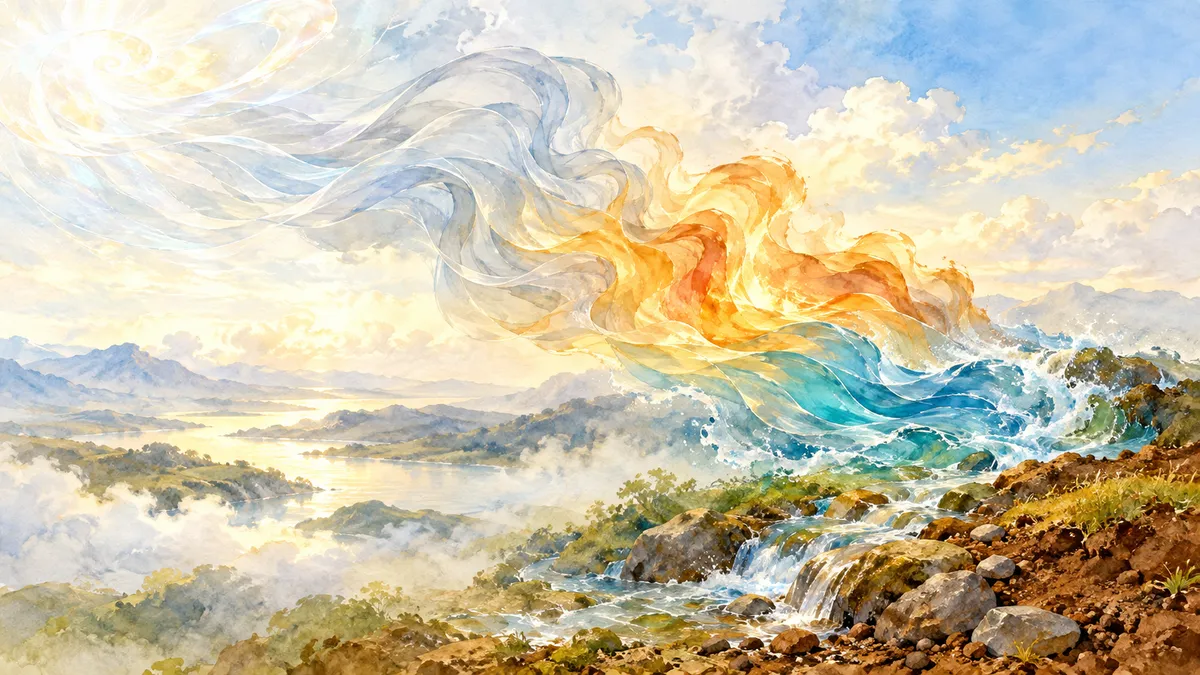
“What was there then?” To Subala, that Brahma said: “There was neither being nor non-being then, nor was there both being and non-being simultaneously. From this darkness appeared, from darkness—the primary element, from the primary element—space.”
At first, primordial chaos emerged from non-being. From primordial chaos appeared the primary element—mahatattva, that is, the primary element at the stage when there was no differentiation into water, earth, fire, wind, space, and so on. Mahatattva (the primary element) is the foundation for the emergence of the other elements. When differentiation takes place within the element of mahatattva, distinction into earth, water, fire, air, space, and other things begins, and the tattvas start to group together.
“From space—wind, from wind—fire, from fire—water, from water—earth.”
When we speak of wind, fire, and earth, we mean a state of vibration of matter that becomes increasingly denser as differentiation proceeds.
The Cosmic Egg and the Divine Human
“Then the egg appeared. After being incubated for a year, it split in two: into earth below and space above.”
The cosmic golden egg—the brahmanda—is the primordial Sphere in which, under certain incredible qualitative conditions, the five elements existed in a compressed form. It was said to be “incubated,” meaning that under incredible temperature conditions of dimensionality, shifted physical constants, folded time, and in the absence of external and internal space, the five tattvas existed in such a partially unfolded state; they were, as it were, incubating until it was fully formed and the elements separated.
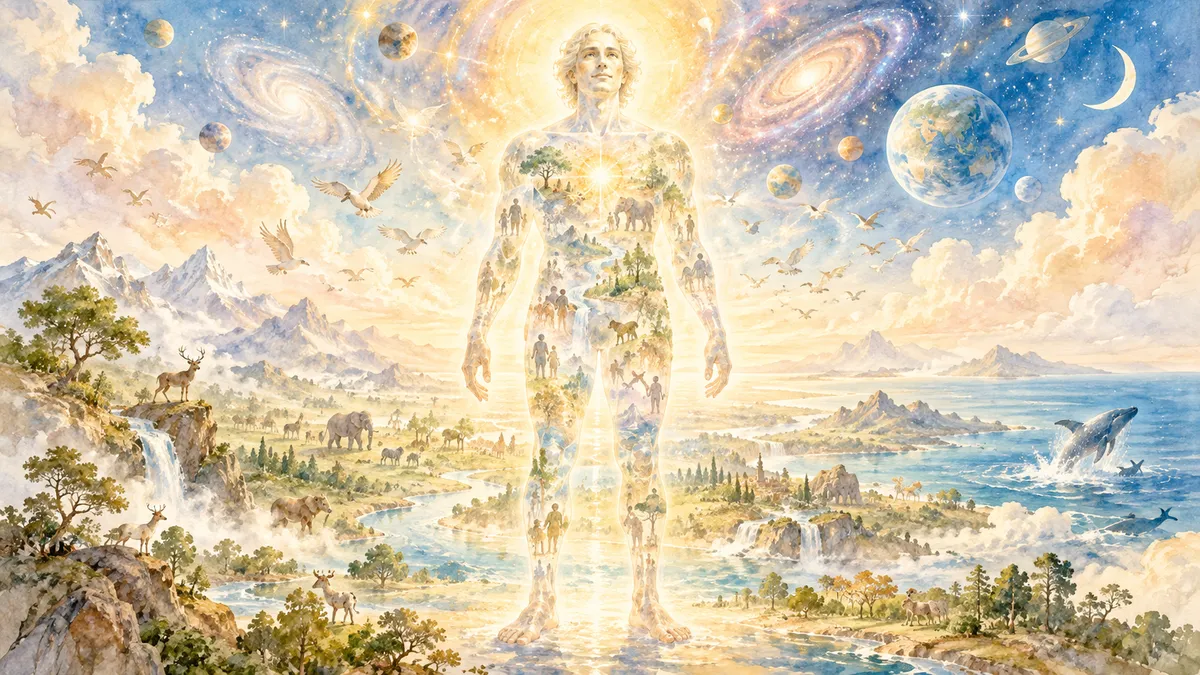
“In the middle, the divine human arose. A human with a thousand heads, a thousand eyes, a thousand feet, and a thousand arms.”
Adipurusha is the primordial soul. Some call it Prajapati. In other words, this divine human is the same as the biblical first human. The thousand feet, heads, and eyes signify consciousness possessing colossal divine potential. One could say that this is the deity of the human race, if we speak of it as Prajapati. But if we speak of it as Adipurusha, then it is the deity of all beings in the universe.
The Creation of Death and the Deities
“First of all beings, he brought forth death—Khandaparashu, the three-syllabled, three-headed, three-legged one. His name is Brahman. He entered Brahman, and Brahman produced seven sons from his mind.”
When it says “brought forth death,” this means that a foundation was created—the primordial undifferentiated consciousness beyond the three gunas, while the state of death is the dissolution of the three gunas and entry into clear light. It is precisely this state that is being referred to here.
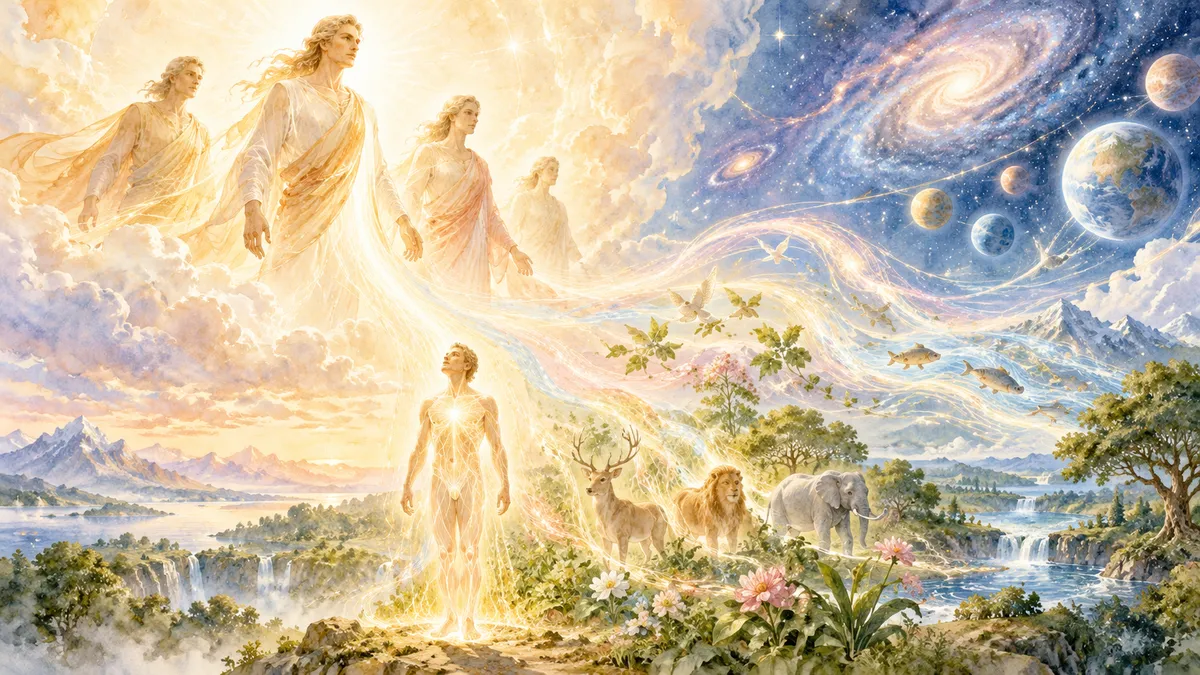
“They, in turn, produced from their minds the virajas, endowed with truth, and they are indeed the Prajapatis.”
In turn, deities emerged from the undifferentiated state of clear light. Through the power of their minds, they created deities-creators subordinate to them, belonging to the class of Prajapatis—progenitors or producers of generative power.
Of course, human beings did not originate from apes, but from the deities. Being the precursors of all manifestations in the universe, the deities created everything in this world. These are creative, highly intelligent energies, and particles of these energies are present in each of us, in our consciousness and body.
The Creation of Worlds and Beings
“The mouth of that divine being became the Brahmin, his arms the Kshatriya, his thighs the Vaishya, and from his feet the Shudra was born; the Moon was born from his mind, the Sun from his eye, the wind and breath from his ear, and all this is born from his heart.”
This divine being is not some enormous giant whose body gives rise to the sun and the moon. It can be said to be an exceedingly subtle, undifferentiated consciousness in which different elements and tattvas form the lokas and their corresponding inhabitants.
The gross elements become gross energies in our world and in other worlds, forming the lower realms. The subtle elements, in which sattva-guna predominates, form the higher Worlds of the Gods. The intermediate elements (rajas-guna) form worlds filled with rajas.
“From his lower breath arose the Nishadas, Yakshas, Rakshasas, and Gandharvas; from his bones—the mountains; from his hair—the herbs and trees; from his forehead Rudra, born of anger, emerged. The breath of this great being is the Rigveda, Yajurveda, Samaveda, Atharvaveda, phonetics, ritual science, grammar, etymology, prosody, astronomy, discourse, Mimamsa, Dharmashastras, interpretations, supplementary interpretations, and all beings.”
It is said here that the breath of this being is various teachings, sciences, dharmas, and so forth. How are we to understand this? In reality, Dharma and the sacred texts are all the movement of prana, the subtle wind that, in turn, emanates from an even more exceedingly subtle state of the primordial being, Adipurusha.
The Movement of Subtle Prana in the World
If we look from a more global perspective at a monastery and the activities of monks and saints, we will feel what this activity is. For example, saints and gurus perceive subtle vibrations coming from superconsciousness, from the Atman, from the collective subconscious. Their consciousness then translates this into the language of revelations, the language of symbols, lucid dreams, and prophetic dreams. Next, what they perceive is translated into an acceptable form and becomes texts, sutras, lectures, instructions, transmissions, visions of gods, deities, dakinis, and so forth. Then this materializes and is transmitted to connected disciples, and the subtle prana they perceive becomes statues, monasteries, retreat halls, rules, instruction books, technical practices, seminars, and lectures. It takes on this material form (a transformation of shakti). Then, descending still further, it becomes understanding, clarity, self-discipline, love, harmony, and awareness in people’s souls. Finally, descending even lower, it becomes various kinds of energy. The lower the beings are, the less of this light reaches them, because as it descends, this subtle prana coming from Adipurusha, along with the subtle clear light, becomes increasingly distorted and clouded.
All living beings perceive the movement of this subtle prana. When you meditate in the same way, you perceive this movement of subtle prana coming from the great being—from your own “I.” Sometimes it becomes poetry for you, sometimes lectures, sometimes inspiration and clarity, sometimes simply samadhi and good meditation, sometimes understanding, and sometimes just a conversation. As living beings, we are a kind of receiving antenna in physical bodies, picking up this prana.
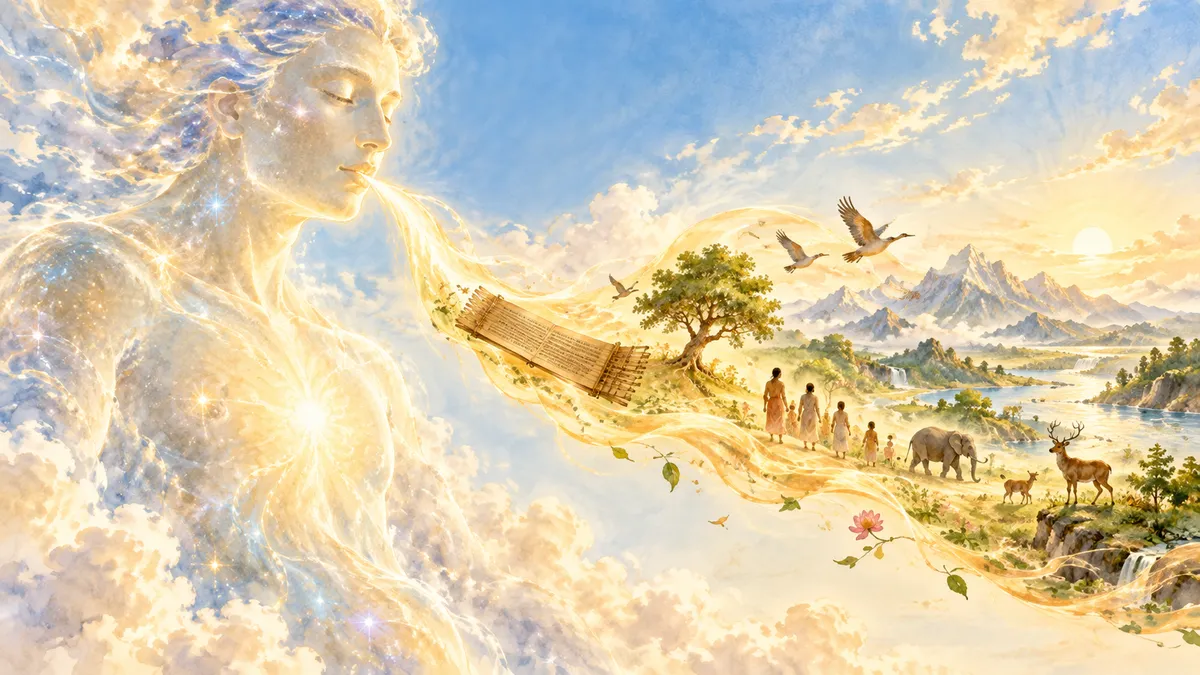
Prana has five streams, five types of energy that you know: creation, preservation, destruction, concealment, and manifestation of the divine. The way one stream or another of prana is distinguished depends on the karmic tendencies and abilities of a living being to distinguish it; that is, this stream is one, undifferentiated, and whole. But differentiation occurs as a result of the individual characteristics of living beings.
The Polar Principles of Creation
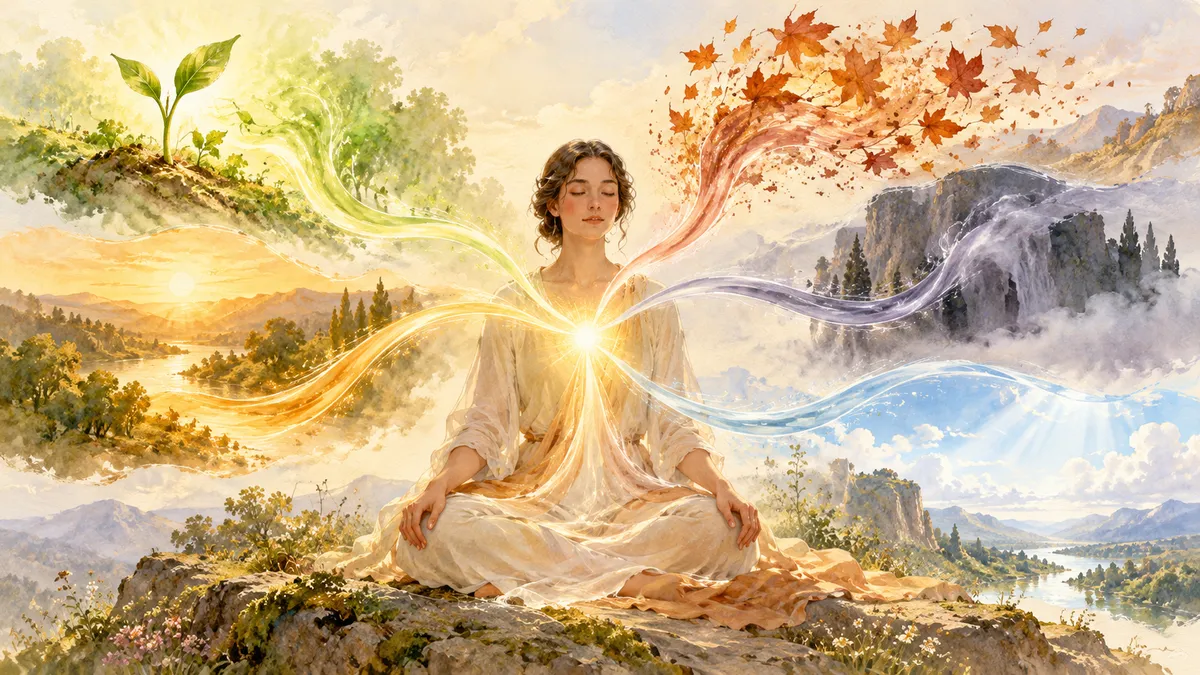
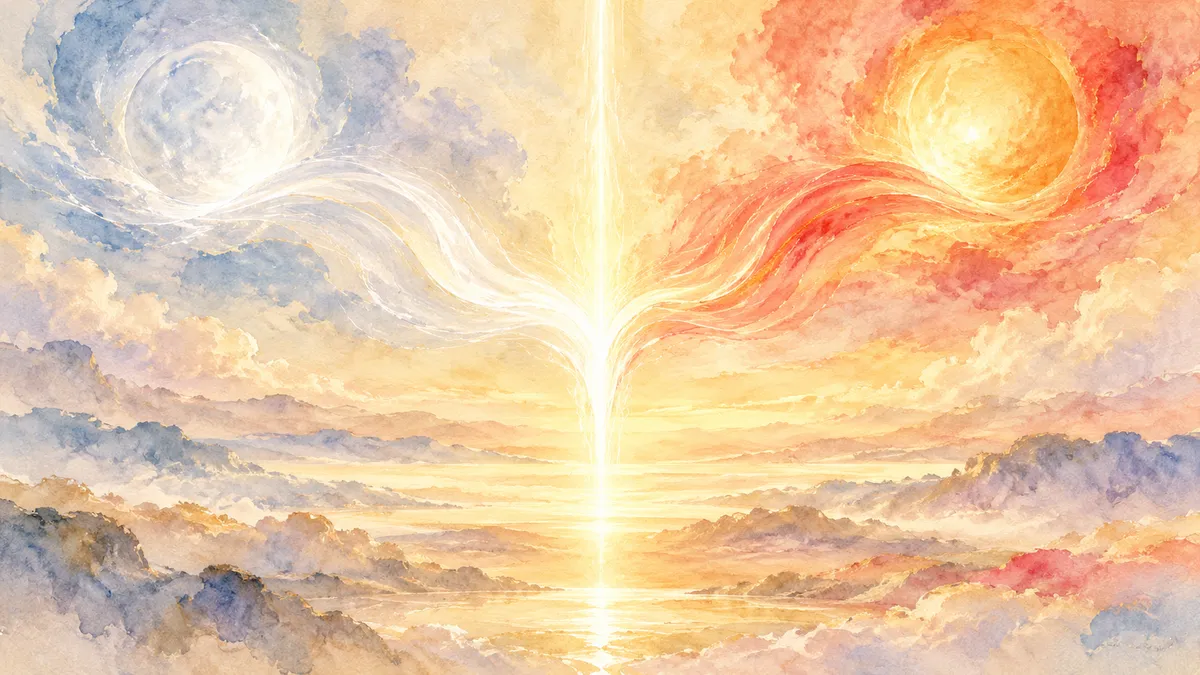
“The golden radiance in which this Atman and all the worlds abide divided into two halves—the female and the male. Having become a god, he created gods; having become a sage, he created sages. In the same way, he also created Yakshas, Rakshasas, Gandharvas, the inhabitants of villages and forests. He also created animals: one a cow, the other a bull; one a mare, the other a stallion; one a female donkey, the other a male donkey; one the ‘supporter of all’ (the Earth), the other the ‘supporter of all’ (Vishnu).”
Manifestations—the masculine and feminine polar principles, lunar and solar—are originally manifestations of the two principles, Shiva and Shakti, or primordial Emptiness and primordial Energy. These two principles unite at the level of the original, primordial, unmanifest consciousness. In our body, they exist as two bindus (red and white), and at the moment prana enters the sushumna, they unite.
Pralaya—The Destruction of the Universe
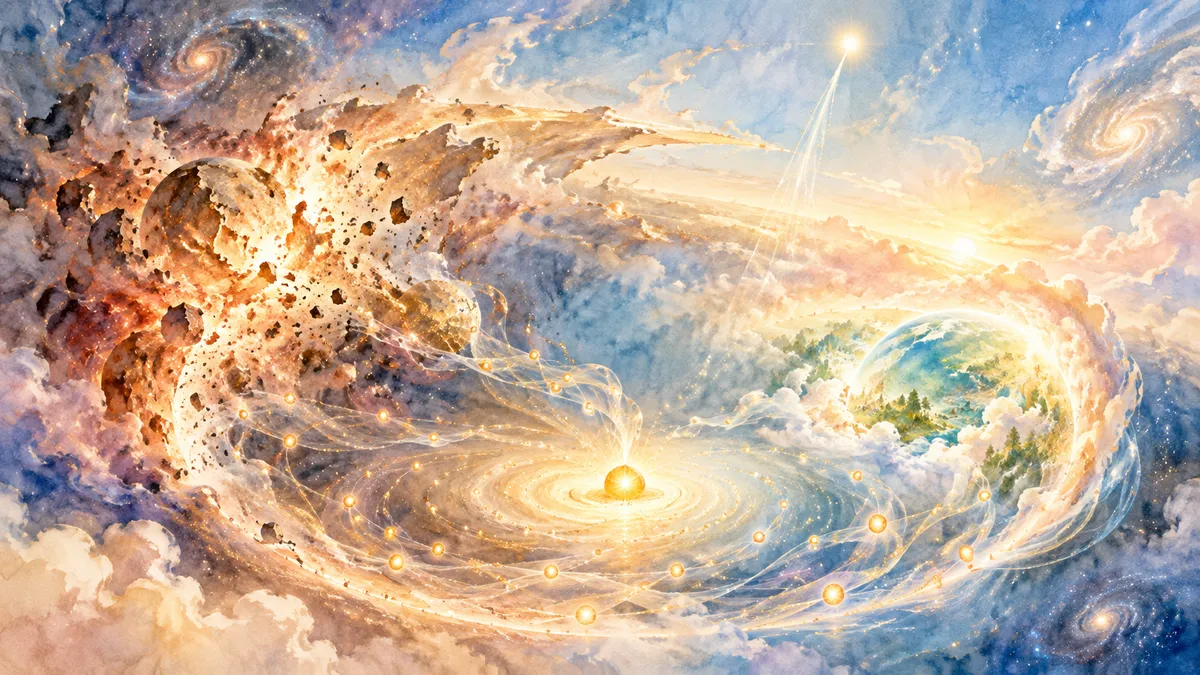
“At the end of time, he becomes Vaishvanara and burns all that exists: earth dissolves into water, and water into fire.”
It is said that each loka (universe) exists for as long as it is allotted, according to the universal cosmic law called rita. Our universe and the other lokas are structured according to this law. The universe exists for four yugas, and then, at the end of the kalpa, an imbalance of the primordial elements arises, and all creation is destroyed.
When the universe is destroyed, this is called pralaya. During a minor pralaya, the worlds are destroyed up to the heavens of samsara. During the great pralaya (mahapralaya), all worlds up to the unmanifest are destroyed. It is said that ten celestial years before the onset of the minor pralaya, the gods, with their divine vision, see everything becoming tinged with red and the balance of forces in the universe changing. Because of this, the gods suffer and grieve; they are immortal, but the power of pralaya is such that it dissolves the consciousness even of samsaric gods. Yogis and siddhas who have realized unity with Brahman, however, are not destroyed even during pralaya, which is why their immortality is absolute and genuine.
After each destruction of the universe, when the cosmic fire burns up the elements, a new unfolding—manvantara—takes place. The sleeping collective karmas, dormant in the unmanifest, begin to unfold again. Souls that have not attained liberation by this time are seized by the unfolding of the samskaras and are reborn once again, becoming embodied beings: they acquire flesh, blood, and consciousness. Liberated souls are no longer subject to the movement of these samskaras.
The Dissolution of the Elements
“Water into fire, fire into wind, wind into space, space into the senses, the senses into the tanmatras, the tanmatras into the primordial element, the primordial element into the great one, the great one into the unmanifest, the unmanifest into the imperishable, the imperishable into darkness, death. And darkness merges with the Supreme God, beyond whom there is neither existence nor non-existence, nor existence and non-existence simultaneously.”
Here, the process of the dissolution of the elements during the destruction of the universe at pralaya is described. At the same time, this process is identical to the process of the dissolution of the elements in the physical human body at the moment of death.
The elements sequentially dissolve into one another, passing into a subtler state. Wind dissolves into space, space dissolves into the senses, and the senses dissolve into the subtle elements—the tanmatras—on which they are based. All our senses are based on subtler states called tanmatras; you should know this from the teaching of the Shakti Yantra. That is, each sense has its own tanmatra, a certain subtle element on which it is based. For example, the tanmatra of sight is the element of fire.
Thus, the tanmatras, in turn, dissolve into the primordial element. The primordial element is mahatattva, the single element in which all other elements are contained in an undifferentiated state. Some consider the primordial element to be simply the principle of consciousness. The primordial element dissolves into great consciousness—mahatattva, while mahatattva (the great element) dissolves into the unmanifest, undifferentiated state (nirguna). The undifferentiated state dissolves into the imperishable, the eternal. And the imperishable itself dissolves into primordial chaos. Primordial chaos merges with the Supreme God, beyond whom there is neither existence nor non-existence. This is the teaching of nirvana, the teaching of all the Vedas.
The Practice of Contemplation and Dissolution
It can be said that when we practice contemplation, we follow approximately the same principles, trying to establish ourselves at least in the space. From space, we try to move to the subtle level of the tanmatras, that is, to the state in which sight, taste, smell, and touch merge into one.
One of the students from Odesa wrote that during the retreat he had an interesting experience: in meditation, he began to experience a state in which sight, hearing, smell, and touch were perceived as a whole, as something unified. This is precisely that stage.
Then we try to enter from the level of the tanmatras into the primordial element, into the mahatattva, that is, into the single principle of consciousness. You often hear instructions that being in presence means being in a state of space, but in fact presence is not limited to space alone. Space is, one might say, the minimum support from which we proceed even deeper, namely, to the extremely subtle state of consciousness. Finally, when we enter the primordial element of consciousness through presence, the unmanifest opens up, and following the unmanifest comes the imperishable, that is, that which never changes. When we can abide in the imperishable, we go beyond death. When, having gone beyond death, we merge our consciousness with that which is even deeper, this is what is called “merging with the Supreme God, beyond whom there is neither being nor non-being.”
The Practice of Finding the Face Before Birth
“Truly, all this was non-being in the beginning, and reflecting on that which is unborn, unarisen from anything else, unsupported by anything else, soundless, intangible, formless, tasteless, odorless, unchanging, without mass, ungrowing, not great, unarisen—this is its Atman; the wise person does not grieve.”
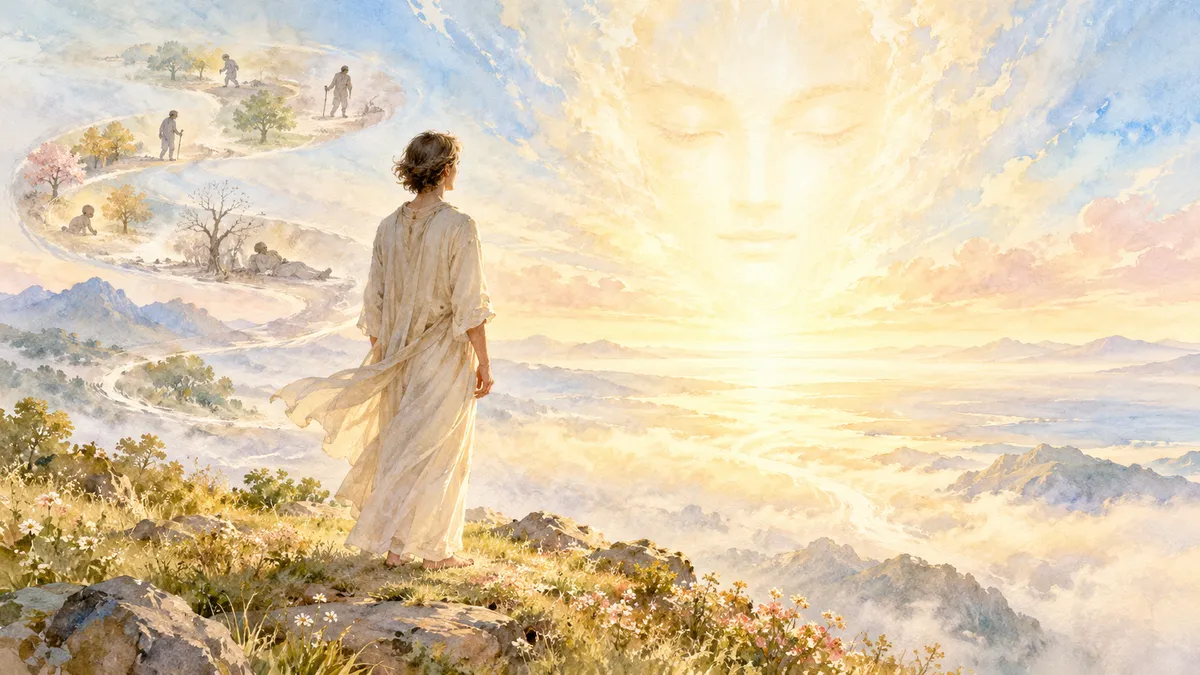
There is a practice in which we reflect on the Source of everything, that is, on what preceded birth. There is a common expression: “Find your face before birth.” This is one of the practices from the section on anava yoga.
If we reflect on what existed before our birth or before the birth of all living beings, what was neither being nor non-being, in which there were no sense organs or anything else, and if we establish ourselves in such a vision, then it can be said that we free ourselves from the bonds of karma.
To find your face before birth is precisely to “free oneself from the cycle of birth and death.” This face before birth has always existed. It does not so much need to be created as found within oneself, revealed, and, as it were, remembered anew, uniting one’s consciousness with it.
The Sixfold Practice of Liberation
“It is without life, without a mouth, without ears, without sound, without mind, without glory, without eyes, without a name and without lineage, without a head, without arms and without legs, unattached to anything, neither red nor measurable, neither short nor long, neither massive nor atomic, neither small nor limited, undefinable, neither elongated nor meaningful, unmanifested, not hidden, without an inner or outer aspect.
It consumes nothing, nor is it itself consumed by anyone. It should be attained through truth, gifts, austerity, fasting, restraint, and indifference to everything—through this sixfold practice. Let one follow these three: restraint, gifts, and compassion. Then its pranas will not depart and will dissolve here. Having become Brahman, one will dissolve in Brahman itself. Who knows this?”
