Where Your Mind Is Directed: The Law of Karma and Liberation
04.06.2026
0 мин. чтения
0
Share
copy
search
add
share
Commentary on the text “Gorokkho-bijoy” (“The Victory of Gorokkho”)
“With each day, youth passes away.
The unfortunate husband, understanding nothing, tames a tigress in his home.
When day comes, the tigress enchants the world.
Night will come and suck all the juices from the body.
The tigress stole a pot of milk and is boiling it,
while the cat sits nearby and waits!
The very best milk has been poured onto the ground; the pitcher remains in the sky!
A stream flows down the mountain slope; in it, the dariputi swims against the current.
Tormented by hunger, the frog croaks; she has hoisted eight sacks onto her back!
The blind brother sings a song, the crippled brother listens,
the fingerless brother plays the drum!
What fish is it, Teacher, that goes against the current in the ocean, running merrily and frolicking?
Be careful on both the last and the tenth days of the lunar month.
From the breath of the tigress, life gradually departs.
And you will live the twelve months of the year in a single day!
Only when you behold the face of the Teacher will you comprehend the truth!
By performing the secret rites, you will know the wind on the left.
Having restrained consciousness, you will preserve life.
Never spend your own moon,
for a lifespan of twelve years can be lived in a single day.
Listen, listen to the instructions on happiness!”
“Tell me, wherein lies the life of all beings?
Through which channel does prana come, and through which does it depart?
In what union does the Atman manifest?
Under what sign do the water and the pitcher prosper?
On what does the wind feed while abiding in the sky?
At what moment does consciousness disappear into the Atman?
What person awakens the mind in sleep?
Where does consciousness dwell, and where the wind? Where do the five essences, the tattvas, abide?
What sounds, outside and within, resound without ceasing?
Where do they arise, where are they found?”
Having said this, Gorokkho bowed and folded his hands in prayer. Lost in thought, Min exclaimed: “O God, God!”
Laughing, Min said: “Oh, what great words! Tattva and linga are invisible, so why do you ask such things?”
Growing angry, King Min uttered these words: “Why are you yourself a disciple, yet you instruct me so?”
Laughing, Gorokkho replied: “You are great, but you have become ignorant of yoga. First, Teacher, let us speak of the body. Whence was the body obtained? From what does it arise?
Secondly, Teacher, let us speak of what is most necessary for this body. What person prays, and what prayer do we call unutterable?
Thirdly, after reflecting, tell me about the five-sounded music played by the watchman.
Fourthly, let us speak of where Srihat is located. Reveal all the truths, great man!
Fifthly, let us speak of where the ceaseless roar can be heard. Repeat all the truths that I revealed to you.
Sixth, tell me of the Most High: in what temple does He dwell, and what is His form?
Seventh, let us speak of the essence of samsara. For what person are you the Teacher, and whose disciple are you yourself?
Eighth, you will tell me one more thing: by what power are water, earth, and sky held together?
Ninth, name the signs of the wind. What does the wind partake of, though it itself is the universal food?
Tenth, tell me: since death passes no one by, when the lamp goes out, where does the light go? When parting from the body, where does prana go? Reveal, O lord Min, the lofty meaning of this!
Eleventh, tell me about the word: when the word sounds, where does the sound go?
Twelfth, tell of the miracle. Upon the destruction of what body is there no pain?
Thirteenth, tell of the highest deed, which is called sleep, and who awakens one from sleep?
Fourteenth, tell of the place of the mother and father. In which world did you dwell before? Whence were you born, where did you abide in peace? And what seven bodies created you?
Fifteenth, tell of the cause of creation, tell of Adya, of the objects of creation.
Sixteenth I shall ask, and you answer, lord: what is called the Thousand-Petaled Lotus, and what is it like?
Seventeenth I shall ask, listen attentively, tell of the cause of the union of great beings.
Listen to my eighteenth question, Teacher! Explain to me, what kind of person are you?
Nineteenth, also tell, righteous one, in what temple is that which is called consciousness found?
Twentieth, tell where consciousness is located? Where does it reside, and by what is it constantly nourished?
Twenty-first, tell, Teacher, of the light of Consciousness. Whence come the fragrances of sandalwood and incense?
Twenty-second, tell, lord of the Mins, when sleep comes, where does consciousness go?
Twenty-third, tell, when you were in your mother’s womb, what gods were present in your body?
Twenty-fourth, I shall speak words that are shameful for the uninitiated to hear: when are mother and wife, brother and son, one and the same?
Twenty-fifth, tell one more truth, O ascetic! On the new moon, with whom does the moon unite?
Twenty-sixth, be sure to tell of the severing of Rahu’s head. The question is, when does this happen, and when does it not?
Twenty-seventh, tell, so as to enlighten me, where is consciousness born, where does it move?
Twenty-eighth, tell of yet another truth: who constantly does good, who commits sin?
Twenty-ninth, tell of one more thing, O greatly wise one! Whence is the body born, where is its place?
Thirtieth I shall ask, so listen to the question: what is called consciousness, what is called wind?
Thirty-first, tell of what I shall ask you: who wants to eat, and who to unite? When does Anadi overcome time and death? What cosmic body manifests the signs of this?”
“From Chhaya the body appears, from the body—consciousness.
When Chhaya became the body, Shiva became Shakti.
Second, know that the unutterable mantra is the essence of the four Vedas.
A being who constantly repeats it knows no death.
Third, listen about the five bodies and the sense organs,
from which the chambers are built, three angulas in length.
When Hara and Gauri dwell in those chambers,
there the five-toned instrument invariably sounds, the bell rings.
The siddhi pacifies consciousness, immersed in contemplation.
Set Khemai as the guard, and you will know yourself,
you will hold the sun and the moon in the house, you will hear how the five-toned music plays.
Fourth, listen about the purpose of Srihat.
Listen attentively! It protects the heavenly city.
Fifth, I shall tell of that which rises from below upward in the vessel,
rises, having left its home.
Sixth, listen about the Most High!
He exists in form and without form—that is His essence!
He fills the world with Himself, abiding in His own body.
It is impossible to behold Him, though He is near.
Seventh, listen, I shall tell of the purpose of the Teacher!
Know then, only the Guru is truth in the untrue samsara.
The Most High is the manifestation and action of the three gunas:
know that the Teacher is like Him.
The Guru is tempered like gold in the fire of knowledge.
A fool will stray from the path, but the Teacher will guide him onto the righteous path.
As though he rubs stone against stone and strikes forth the sparkling fire of wisdom.
He is like Niranjana, who dwells in the body.
Go and honor the feet of the Teacher!
Eighth, I shall tell of water and the firmament.
Life is preserved, filled, the body by the calmed wind.
Ninth, I shall tell, listen, of the purpose of the wind:
filling the body with fragrance, the wind preserves life within it.
Tenth, I shall tell how the triple hearth burns.
Listen, lord, Teacher Mochondor!
There is no wind in the body; for the body—death.
Fire flows to fire, water to water, earth remains in earth—know this, it is the truth!
Having become ash, dust, your body will disappear.
Consciousness is a wondrous chariot, and the wind is its charioteer.
Seated upon it, the gray goose races swiftly.
The wind, like the sun, guides the chariot.
Having taken flight, the best of geese flies away to the city of Brahma.
Eleventh, listen to the judgment concerning the word:
sound flies in order to unite with the heavens.
Twelfth, Teacher, I shall tell of Niranjana in the body.
Consciousness, the mind, is distinct from him—this is the cause!
Thirteenth, O Teacher, I shall tell of the cause of sound.
I shall tell of a little more; listen, Teacher, attentively!
When you eat, the brahma wind blows; in the heart the upper wind blows,
suddenly, like a sigh, the wind of kama blows.
Currents move in the body, as leaves tremble on the sacred fig tree.
The eyelids close quickly. Having lost strength, in the end you will fall to the ground. Shakti and Shiva depart to the Supreme.
Become your own guardian, in order to preserve yourself.
Naga and the other five winds are chief in the body. Know, then, that the wind is enclosed in the pitcher.”
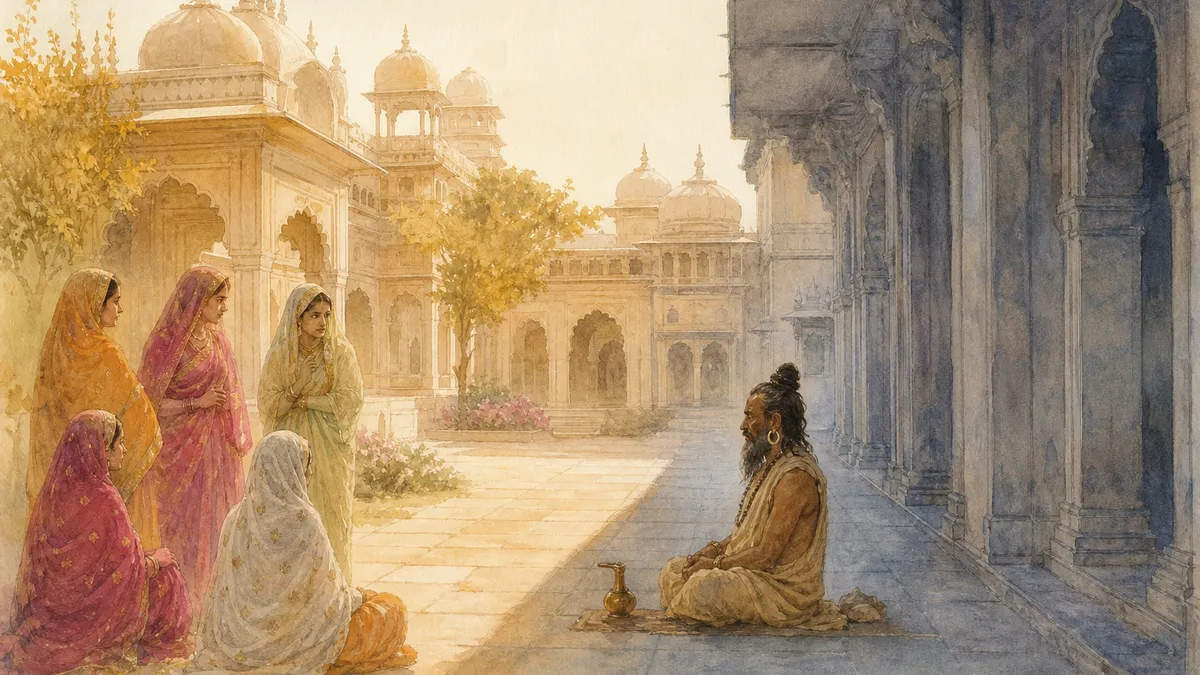
The Kodoli women said: “All this is wondrous; we feel it with our hearts—truly, Gorokho is a saint!”
The Kodoli women said: “He is a rakshasa! He came, taking on the form of a yogi through sorcery. He even managed to raise a dead man after seven days! By deceit he wants to lead our lord away.”
And the Kodoli women surrounded Min on all sides. Sixteen hundred Kodoli women held Minonath back.
And Gorokho decided: “I shall bring forth the shunya mantra; I shall deprive them of reason! I shall drive them all away, and then I shall take possession of their lord.”
And the yogi-nath flared up like fire! Gorokhonath said, calling the Moon and the Sun as witnesses: “With the mouth you eat, with the mouth you purify yourselves, and with the mouth you unite with the Supreme. May Gorokho’s curse turn you into bats! From now on, live in the trees, feed on roots and fruits. I have finished with you by this curse.”
Having said this, the yogi-nath snapped his fingers. Having turned into bats, all the Kodoli women flew away. All the Kodoli women flew away, leaving Minonath behind. All the Kodoli women flew away, and the city became empty.
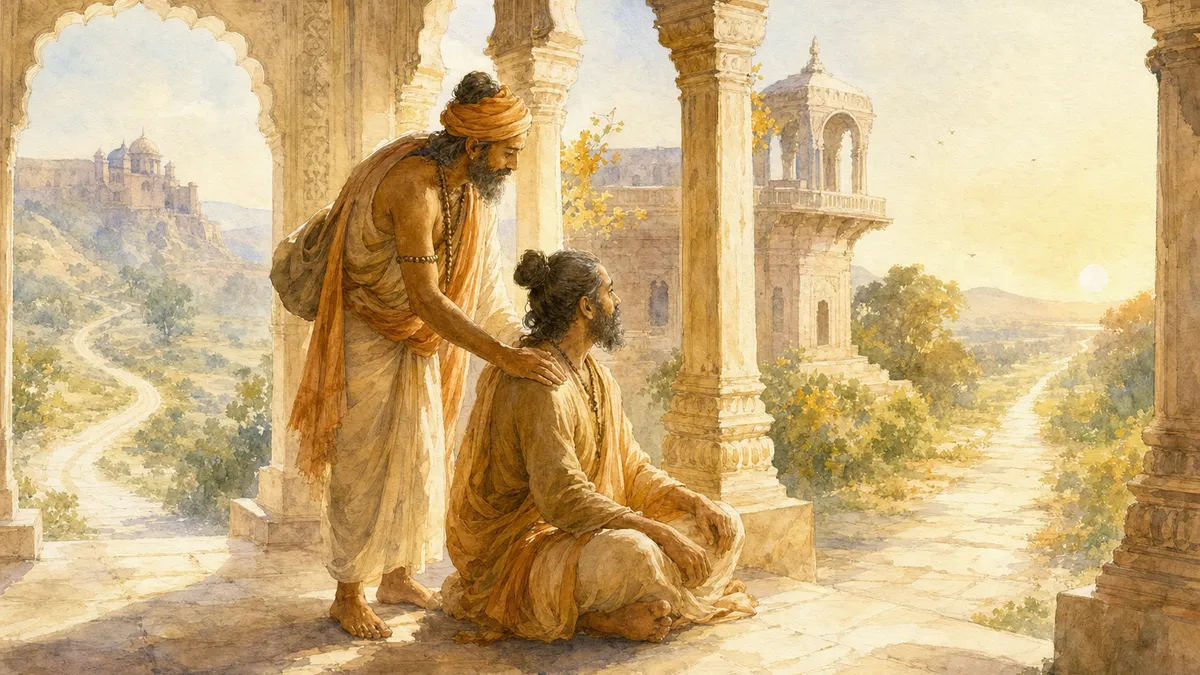
And then Min spoke, as befits a Teacher. Delusion vanished, Min came to his senses, Minonath awoke from sleep! Min obtained divine knowledge and assumed a yogic posture. Then Gorokhonath also decided to assume a yogic posture. They seated Bindunath in a yogic posture. Thus, having assumed yogic postures, they set off on their way!
And the three of them reached Bhujiyanagor. Minonath performed the ritual of the body while sitting in a yogic posture. From below, the Teacher directed the pranas upward. Such is divine knowledge!
Min remembered the ancient instructions; he remembered all the bija mantras. When you turn your mind to the ancient commandments, you will gradually merge with Brahman. Minonath strengthened his body by practicing yoga.
“Listen, listen, good people, to the tale of Gorokho’s victories!
Reflect, look back, and look ahead!
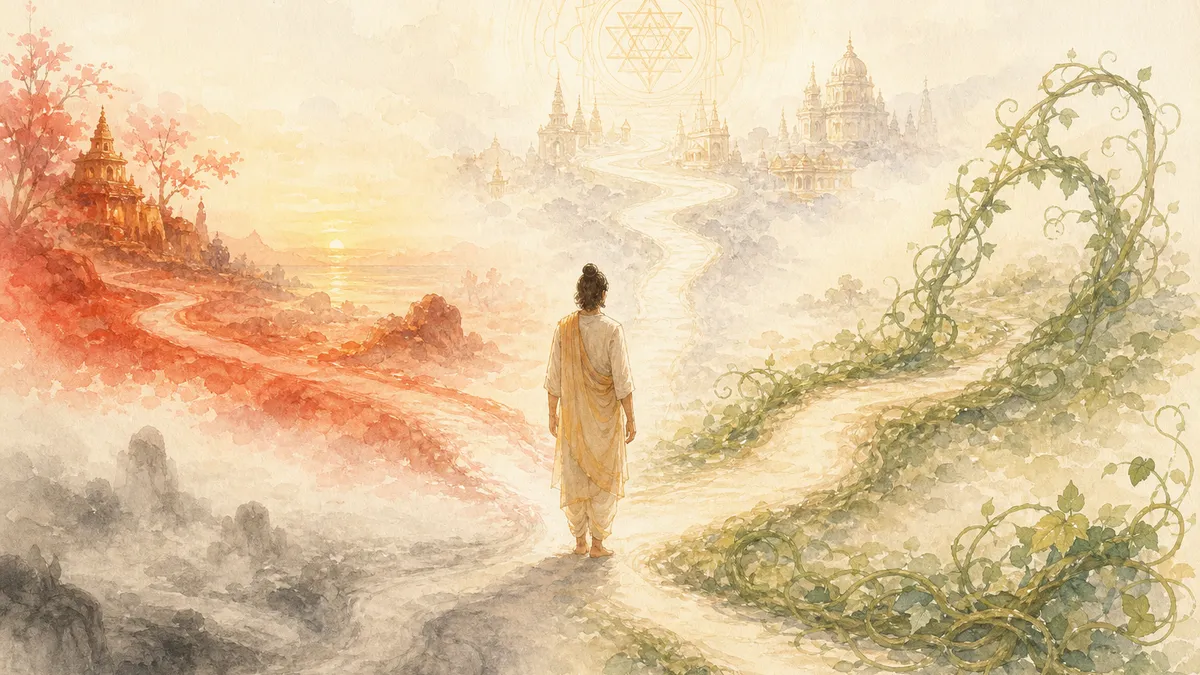
In whichever direction you turn your mind, there you will find yourself!
A thousand times I bow at the feet of the Teacher!
Know that the tale of Min’s admonishment has come to an end!”
Controlling the Direction of the Mind
We will not comment now on Gorokhonath’s symbolic language, because there are so many questions here that roughly two volumes of commentaries would be needed for the questions he posed, since the highest truths of kundalini and raja yoga are being expounded here. In time, when you have studied the Teaching sufficiently, you will gradually be able to answer them yourselves. Gorokhonath awakened Minonath. It is said: “Reflect, look back, and look ahead. In whichever direction you turn your mind, there you will find yourself.”
Who is a yogin, and how should a monk conduct himself? He must continuously control the direction in which his mind is turned. Perhaps we do not fully understand, and at the beginning of spiritual practice many different things manifest in us; for example, faith or confidence in our choice may be absent. When there is confidence in one’s choice, then determination or perseverance may be absent, and a tendency toward compromise manifests. When there is determination or perseverance, then proper understanding is lacking. I say to such disciples: “Always reflect and look around in order to determine in which direction your mind is turned.”
There are disciples who, while thinking, postpone their realization. Everything is being decided now. Since you have entered the path of Dharma and have come such a long way, do not let the instructions be wasted. Do not let the Teaching fail to be realized in you. Use this precious chance! Perhaps you do not yet fully understand what fortune has befallen you—to follow a lofty teaching. Nevertheless, it is so. However, when one follows a lofty teaching, the demand is also high. A lofty teaching differs from lower ones in that it liberates in a single lifetime. Not like a sutra over several lifetimes, but in one. It is usually considered that lofty teachings are intended for people of high capacity. This means that even if we do not possess such abilities, we must strive to develop them. No one can do this except ourselves.
When we do not understand the importance of our practice, the importance of the present moment, we allow ourselves to be inattentive. When we realize the law of karma and reincarnation, we by no means reconcile ourselves to our inattentiveness. Our next birth depends on the direction in which our mind is looking now.
Examples of Karmic Connections from Past Lives
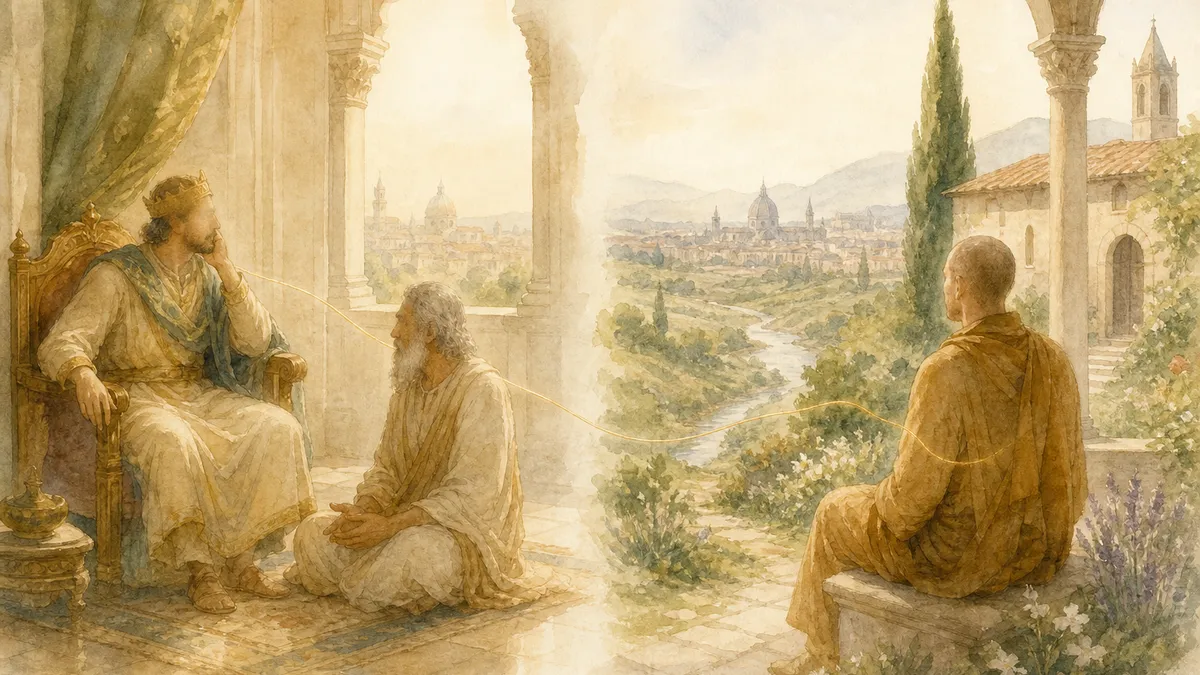
I had a disciple who was a monk. I also knew him in a past life. At that time he was a king, and I was a yogi. I would come and ask him for donations, in accordance with the Dharma of that time, and sometimes I would preach to him. No matter how much I preached to him, his soul looked toward the world. One day, becoming angry, I said to him: “My foot will never set here again. I do not want to speak with you; it is useless. You are a complete idiot! Everything I say goes in one ear and out the other.” Having become angry in this way, I left him. Thanks to the karma that had been created, he came in this life as well. Nevertheless, in this life too he was unable to hear what I was telling him.
We have a novice who in a past life was a prince during the time of the Aztec civilization in South America. At that time I was on the side of those who fought against her; nevertheless, the karmic connection was favorable. Just as in this life, in that life she had affairs, duties, concerns, and relatives. But does she remember this now? That monk in his past life also had a kingdom, wives, concerns, and everything else. Does he remember this now?
One of the nuns had been an Egyptian queen in one of her lives, and I was connected with her, since she patronized me in political power. She was attached to herself, to her status as queen. Does this matter now? Do the relationships that existed matter? They do. In what sense? Only in the sense of the Dharma; in any other sense, they have no significance whatsoever.
A monk and a nun from our sangha were starship testers in the world of the asuras in a past life. They were male friends, and during an accident they died on the same day. In this life one received the body of a woman, and the other received the body of a man. Thanks to the old karmic connection, their attachment continued in this life as well. Do they remember this?
In a past life I was a spiritual Teacher. For several lives I was a practitioner. In other lives I was a priest, a military commander, a priest of the rites, a diviner, and a prophet. In the same way, each of you has a train of past lives behind you. Nevertheless, I can say that now this life is the most important; it is the culmination. From this life you can make a start and break out of the circle of birth and death. If such a start is not made, there will be new births, new bodies, and new ignorance. Therefore, this life is the most important. Everything depends on the direction in which you turn your mind. Where you direct your consciousness, what you fix it on—there your next birth will be. This is a fact; this is the inexorable law of karma.
The Law of Karma and the Directions of Rebirth
One who is subject to passions will fall into the world of passion and will continue to satisfy them. One who is subject to attachments will fall into the world of attachments, where they will again be among affection and aversion. One who is subject to tamas and ignorance will fall into the world of tamas, as if into darkness, into an unclear, dull state. Perhaps into the body of an animal. One who is captivated by levels of clarity, by subtle states, will fall into the world of subtle states, become a deva, and will contemplate yantras and beautiful palaces, exquisite landscapes, hear beautiful melodies; however, they will remain in a state of non-liberation.
One who is captivated by the tendency of the asuras will fall into the world of the asuras, will be born in a world of swift, fierce, dynamic, active energies, when their force is such that there is not even time to think about the Dharma. Those among you who realize the awareness of presence will fall into worlds of awareness and presence, where you will have clarity and a body like that of the gods. One who realizes the state of formless dhyanas will fall into the world of formless dhyanas; he will not be liberated, but will live for a very long time as infinite consciousness, having no body. He will no longer receive a body in samsara or in the world of forms; he will have a body like the space of consciousness. Nevertheless, after some time he will descend again when his samadhi is exhausted.
One who attains the samadhi of the 1st, 2nd, 3rd, and 4th dhyanas and becomes established in this samadhi will be reborn as a god in the world of form, enjoying beautiful images in heavenly abodes. Nevertheless, he will be intoxicated by his state of dhyana. When it is exhausted, he, like an arrow shot into the sky, will descend and again receive a body in the world of humans or in other worlds.
One who transcends the dhyanas and reveals the beautiful state of nondual presence will become free from all worlds and will not be seized by any of them; he will become Brahman itself. He may receive the body of a god, but it will not be an ordinary body; he will be fully awakened. Whatever world he may find himself in, his consciousness will be the consciousness of awakening, and his body will be the body of a deity. This is the law of karma. We can receive only what we absorb into our consciousness.
The Method of Teaching: Casting Off Illusions and Attachments
How do I teach my students? Cast off all illusions, renounce all attachments. If there is even a millimeter of attachment in you, you will have to receive a new body in the next life and once again wash away new karmas. Cast off your own inner illusions; do not trust the false self. Whatever thoughts, emotions, or feelings arise within you, observe them, do not consider them to be yourself; none of this is important.
Concentrate fully on the teaching; apply all your strength to derive benefit from the teaching. The teaching of the siddhas is the essence, the nectar, the quintessence; it is the highest thing that exists on earth. And if there is something else, it will prove to be approximately on the same level, since the siddhas are alike, international, and their teachings are generally similar. The immortal Taoists, the immortal Naths, or the mahasiddhas teach approximately one and the same thing.
Concentrate on the teaching in order to fully understand its essence, its quintessence, and apply it to yourself, so that you can apply all the additional aspects of the teaching and benefit from it. Practice continuous contemplation; perform your prayer practice, your monastic practice. Every day in the monastery, live as though it were your first and last day. Leave aside all worldly and even spiritual plans for the future. Take nothing into account: neither worldly life, nor old connections, nor your own perception, but only the saints. Generate such uncompromising impeccability in practice, contemplation, meditation, and service. Do not let your consciousness change; do not build relationships with one another like worldly people.
The Life of a True Yogin
When you act in this way, you become true yogins, people of dharma. Do not befriend someone who is not a yogin, who is not a person of dharma. Do not condemn them, but keep your distance from them, although I think there are no such people here. For a person of dharma, there is only dharma. For a person who wishes to know God, there is only God.
One should be open and friendly; nevertheless, in matters of principle, one should always adhere only to the truth. Openness does not mean letting maya into yourself. Friendliness does not mean being friends with ignorance and worldly desires.
Service as a Path of Realization
When you train diligently in your practices every day, they produce an effect. When you engage in service, you have an auspicious method of realization—an entirely easy one, not a difficult one, easier than techniques and kundalini yoga. When engaging in service, engage in service, not work; constantly maintain an elevated state of self-offering. It all comes down to whether you maintain such a state or not. If you do work but do not have this state, then you are simply losing energy. But if you engage in service with self-offering, it becomes the most excellent formless practice.
When the doer departs, when the discriminating “I” that is attached to the result, builds hopes and plans, and has fears and attachments departs, then the wondrous diamond of non-duality will manifest and be laid bare. Without effort, without techniques, without concentration, it will suddenly manifest by itself if you engage in service in the right way.